How Does GDPR Affect Email Marketing in 2026? (Practical Compliance Guide)
Finding someone's work email used to be the hard part. Now the hard part's proving you had the right to email them - and proving you stopped when they said "no."
GDPR didn't kill email marketing. It killed lazy email marketing.
Direct answer: how does GDPR affect email marketing? It forces you to (1) have a lawful basis and transparency for processing personal data (collecting, storing, enriching, tracking), (2) honor rights like objection and deletion, and (3) prove it with records. In the UK/EU, the permission to send marketing emails is usually governed by PECR/ePrivacy rules, while GDPR governs the surrounding data handling and accountability. For the outbound-specific playbook, see GDPR for Sales and Marketing.
One more reason to take this seriously: GDPR fines can reach EUR20M or 4% of global annual turnover (whichever's higher), with a lower band of EUR10M or 2% for certain infringements. PECR/ePrivacy enforcement can also bite - often for the exact "we just sent a few campaigns" behavior teams treat as harmless.
What you need (quick version)
Here's the practical checklist I'd want on my desk before anyone hits "Send" again:
- Know which law governs which action (sending vs storing vs tracking).
- Stop using "legitimate interest" as a shortcut - ePrivacy/PECR governs the send in most cases.
- Implement a consent log + suppression across systems (ESP, CRM, enrichment, spreadsheets, everything). If you need a clean SOP, use an email verification list workflow to enforce quality gates before sending.
- Put unsubscribe in every marketing message, and make it one-click/simple.
- Don't hide who you are: clear sender identity + valid contact address for opt-outs.
- Segment individuals vs corporate addresses (UK) and treat sole traders like individuals.
- Lock down your stack: DPAs, access controls, audit logs, breach workflow.
- Keep retention sane: if you can't justify keeping a lead, don't keep it.
Do this first before you debate edge cases.
- Build a single suppression source of truth and sync it everywhere daily.
- Add a consent/permission field model (what you have, where it came from, when, and what wording).
- Run a list hygiene pass: remove role accounts, verify deliverability, and stop emailing addresses that never should've been collected. If you’re seeing rejects, troubleshoot errors like 550 Recipient Rejected.
GDPR vs ePrivacy/PECR: how GDPR affects email marketing sends
Most compliance confusion comes from treating GDPR like it's the only rulebook. It isn't.
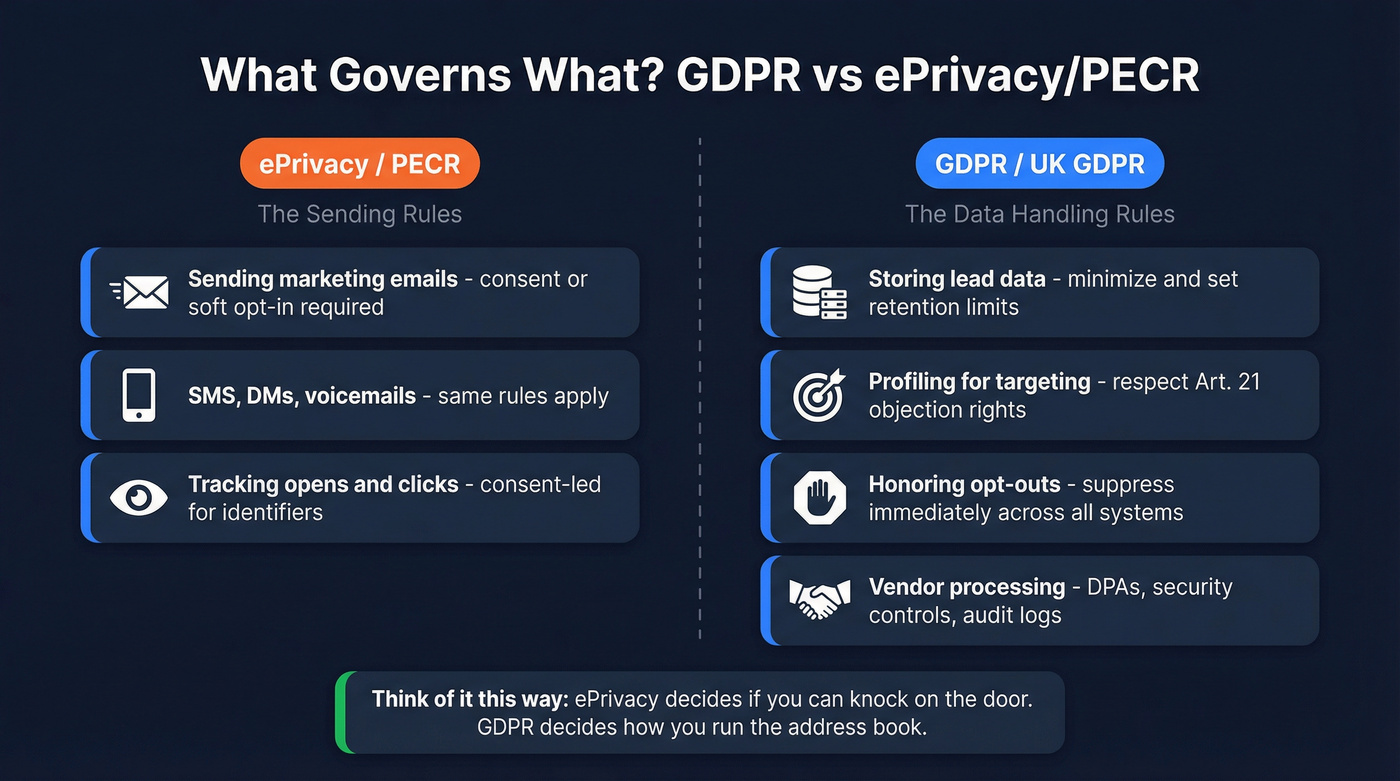
UK: PECR decides if you can send; GDPR decides how you handle the data
In the UK, PECR (Privacy and Electronic Communications Regulations) is the "sending rules" law for electronic marketing. UK GDPR still matters a lot - but mainly for the surrounding processing: collection, storage, enrichment, security, retention, and rights handling.
So in the UK, don't overthink it: start with PECR for permission to send, then use GDPR to make sure everything around that send is lawful and auditable.
EU: where ePrivacy covers the send, GDPR Article 6 isn't the test for that act
In the EU, the "sending rules" come from the ePrivacy Directive as implemented in each country. And when ePrivacy specifically governs direct marketing emails, the common logic (tied to GDPR Article 95 and the lex specialis approach) is simple: you don't justify the sending itself under GDPR Article 6 - you follow the ePrivacy rule for that act, and GDPR governs the rest.
This is exactly the point that came through in Inteligo Media: as summarized by Reed Smith, when the Article 13(2) soft opt-in conditions apply, GDPR Article 6 conditions aren't the legal test for the sending itself.
What governs what?
| Activity | Governing framework | What to do |
|---|---|---|
| Sending marketing email | PECR/ePrivacy | Consent or soft opt-in (where available) |
| Storing lead data | GDPR | Minimize + retention rules |
| Tracking opens/clicks | ePrivacy + GDPR | Treat pixel/identifier-based tracking as consent-led; document it |
| Profiling for targeting | GDPR | Respect Art. 21 objection; add safeguards |
| Honoring objections | GDPR | Suppress immediately |
| Vendor processing | GDPR | DPA + security controls |
For a clean regulator-friendly split, I think of it like this: PECR/ePrivacy decides if you can knock on the door. GDPR decides how you run the address book - and what you do when someone tells you to stop.
The ICO's PECR breakdown on electronic mail marketing is the clearest starting point if you're operating in the UK.
Do you need consent? A decision tree for real-world scenarios
Let's make this concrete. In the UK, PECR Regulation 22 says you mustn't send electronic mail marketing to individuals unless they've specifically consented or you meet the soft opt-in conditions.

Also: "electronic mail" is broader than most teams' mental model. Per the ICO, it includes emails, SMS, picture/video messages, voicemails, and direct messages via social media (as long as it's stored electronically). If your "email marketing" program quietly includes SMS nudges or DMs, you're still in the same compliance universe.
Here's a text decision tree you can actually use:
START
↓
Are you sending "electronic mail" marketing? (email/SMS/DM/etc.)
↓ yes
Is the recipient an individual (or sole trader/partnership)?
↓ yes
Do you have explicit, specific consent for marketing?
→ yes: OK to send (keep proof + easy opt-out)
→ no:
Did you get their details during a sale or negotiations to buy?
AND is your message about your own similar products/services?
AND did you offer opt-out at collection + in every message?
→ yes: soft opt-in applies (still keep proof)
→ no: don't send
↓
If recipient is a corporate body (UK):
You can generally email under PECR, BUT:
- don't conceal identity
- include a valid address + opt-out
- honor objections immediately
- UK GDPR still applies if it's personal data (e.g., a named employee)
END
Mini-scenarios (how this plays out in real life):
- Newsletter signup form: consent's the cleanest path. Store the exact wording and timestamp.
- Checkout/customer purchase: soft opt-in can apply for "similar products," but don't stretch "similar" until it snaps.
- Webinar registration: often isn't a "sale." Treat it like consent-driven marketing unless you've got a real soft opt-in basis.
- Outbound cold email to a named person: in many cases you're outside soft opt-in. This is where teams get burned by assuming GDPR legitimate interest is enough. If you’re running outbound, align this with your cold email outreach tools and make sure suppression sync is enforced.
Consent vs soft opt-in (and why soft opt-in isn't a loophole)
Soft opt-in is useful. It's also the most abused concept in email marketing compliance.

Under the ICO's PECR guidance, soft opt-in only works if all of these are true:
Use this if (soft opt-in conditions):
- You got the person's contact details during a sale or negotiations to buy.
- You're marketing your own products/services.
- The marketing is for similar products/services.
- You gave a simple opt-out:
- at the time you collected the email, and
- in every message after that.
Skip this if (common wishful thinking):
- You got the email from a directory, scraped it, bought a list, or "found it online."
- The person attended a webinar, downloaded a guide, or visited your booth and you're calling it "negotiations."
- You're promoting partner offers, a marketplace, or anything that isn't clearly "your own."
- You can't prove the opt-out was offered at collection (this is where bad record-keeping quietly kills you).
Here's the thing: soft opt-in is interpreted narrowly. Yes, "sale" can be broader than a literal payment (freemium can count when there's indirect remuneration via paid tiers), but not every free thing qualifies. A free whitepaper with no real paid model behind it isn't a "sale" just because you want it to be.
Also, don't try to rebrand marketing as "informational updates." If the email has a commercial purpose, regulators treat it as direct marketing.
Practical guardrails I've seen work (and survive internal audits):
- Treat soft opt-in as customer lifecycle marketing, not lead gen.
- Put "similar products" into a product taxonomy you can defend.
- Set a timebox: if "negotiations" were 18 months ago, stop pretending.
- Include a preference center option if you're sending multiple categories.
If you want a deeper EU framing on the "sale can include freemium" angle, Bird & Bird has a solid explainer: https://www.twobirds.com/en/insights/2026/understanding-soft-opt-in-when-free-deals-count-as-a-sale-under-eprivacy-rules
Service emails vs marketing emails: the line that gets teams in trouble
This is the most common "we're trying to do the right thing" failure I see: teams label something as a service email to avoid marketing rules, then stuff it with upsell.

A clean classifier:
Usually service (transactional)
- Password reset, account security alerts
- Invoice/receipt, payment failure, renewal confirmation
- Product outage notices, critical policy changes (not promotional)
Usually marketing
- Newsletters, product announcements aimed at revenue
- "We thought you'd love this feature" when it's really an upsell
- Event invites, webinars, "book a demo" sequences
The messy middle (where you need discipline)
- Product feedback surveys: service if it's genuinely about improving what they already use; marketing if it's a disguised lead-gen form.
- Onboarding emails: service when they're necessary to use the product; marketing when they push upgrades unrelated to activation.
- "Account review" emails: service if it's required/admin; marketing if it's a sales pitch in a trench coat.
My rule: if you'd be annoyed to receive it after opting out of marketing, it's marketing. Treat it that way, include opt-out, and don't play games with labels.

GDPR compliance starts with data quality. Bad emails mean you're processing personal data you can't even reach - creating liability with zero upside. Prospeo's 5-step verification and 7-day refresh cycle mean every email in your list is accurate, deliverable, and defensible.
Stop risking fines on stale data. Start with 98% accuracy.
B2B email marketing under GDPR/PECR: what changes (and what doesn't)
B2B is where people get dangerously confident.
In the UK under PECR, you can send marketing emails to corporate bodies (companies, LLPs, and certain public bodies). That's the headline everyone repeats.
The footnote that matters: sole traders and some partnerships are treated like individuals. So the consent/soft opt-in logic snaps back into place fast, even when the email looks "business-y."
A simple way to operationalize this:
B2C vs B2B (UK PECR practical segmentation)
- Named person at a corporate domain: PECR is more permissive than B2C, but it's still personal data, so UK GDPR applies to how you store, enrich, and target them - and you must honor objections.
- Sole trader / partnership: treat like an individual -> consent or soft opt-in.
- Role accounts (info@, sales@): still marketing, still needs governance, and it's usually a deliverability dumpster fire anyway.
EU reality check: B2B rules vary by country because ePrivacy is implemented locally. If you're running pan-EU outbound, the safest default is to behave like consent/soft opt-in is required unless counsel has mapped specific countries and use cases.
Hot take (because someone needs to say it)
If your average deal is small and your list is scraped, compliance isn't your biggest problem - deliverability is. Start by fixing data quality and contact decay.
Look, I've watched teams "win" the internal legal debate and still lose the inbox for six months because their data quality was trash and their opt-outs weren't synced.
Tracking & analytics: opens, clicks, pixels, and consent (the part marketers hate)
Open tracking and click tracking are where "email marketing" quietly turns into behavior monitoring.
Here's the practical breakdown:
- UTM parameters on links (e.g.,
?utm_source=newsletter) are usually the lowest-friction measurement. They don't inherently require reading/writing identifiers on the user's device by themselves, but what happens after the click (analytics cookies, ad pixels) can. - Tracking pixels for opens often work by loading a unique image URL that can be tied to an individual recipient. In many EU/UK implementations, this is treated like identifier-based tracking and should be handled as consent-led (or disabled / aggregated), especially when combined with profiling or cross-channel attribution. If you’re evaluating tools, compare options in best email open tracker.
- Third-party tracking (ad platforms, retargeting, enrichment triggered by opens) is where you rack up risk fast. If your email activity feeds ad targeting, you're no longer "just sending emails."
My operational rule: if your email tracking identifies a person or builds a behavior profile, treat it like cookie/CMP-grade consent work, because in practice that's how regulators and privacy teams will evaluate it once you connect the dots across your ESP, your site analytics, and your ad stack.
Avoid "forward-to-a-friend" and referral traps (ICO's instigating warning)
"Forward this to a colleague" sounds harmless. The compliance trap is when you collect and send to the colleague yourself.
The ICO warns about instigating marketing: if you encourage or enable someone else to send marketing messages on your behalf, you can still be on the hook.
Two common ways teams mess this up:
- "Refer a friend" form that asks for the friend's email, then your system sends the invite. That's still your marketing email.
- "Email this deal to a friend" widget that triggers an email from your servers. Same problem.
The safer alternative is boring but effective:
- Use a shareable link (copy/paste) instead of collecting a third party's email.
- If you run referrals, let the referrer share a code and have the friend opt in themselves.
Unsubscribe, right to object (Art. 21), and suppression lists (the operational truth)
Unsubscribe is the part everyone thinks they've solved - until you look across the whole stack.
Under UK GDPR, the ICO's explicit: the right to object to direct marketing is absolute. No balancing test. No "but we really need pipeline." And it includes profiling related to direct marketing.
That means if someone says "stop emailing me," you don't just stop one campaign. You stop using their data for direct marketing, full stop.
In our experience, the fastest way to get into trouble isn't bad intent. It's bad plumbing.
The pro/con of suppression vs deletion
Suppression (recommended in practice):
- Pro: You keep minimal data so you don't re-import and re-contact them later.
- Pro: It's compatible with storage limitation because the purpose is narrow: honoring the objection.
- Con: You need discipline: minimal fields, locked access, and clear purpose limitation.
Deletion (sounds clean, often fails):
- Pro: Feels privacy-forward.
- Con: If you delete everything, you'll often re-add them from another system or vendor list and email them again - creating a worse outcome.
A quick scenario I've seen more than once: a rep exports a CSV from the CRM on Monday, someone unsubscribes on Tuesday, and then the rep uploads the Monday CSV into a sequencer on Friday. Congrats, you've just emailed an unsubscribed contact and nobody even noticed until the angry reply hits the shared inbox.
What to do when...
Someone clicks unsubscribe:
- Add to suppression immediately (email + domain if needed).
- Sync suppression to ESP, CRM, enrichment tools, and any outbound sequencer.
- Keep a record of when/how the opt-out happened.
Someone replies "stop emailing me" (or worse):
- Treat it as an objection even if they didn't use the link.
- Suppress, confirm, and don't argue.
- If they ask for deletion, delete non-essential data - but keep minimal suppression fields so you don't contact them again.
You inherit a list from a past employee/agency:
- Assume consent proof's missing until proven otherwise.
- Quarantine it, segment it, and don't blast it.
The ICO's guidance on the right to object is worth bookmarking.
What teams struggle with in practice (and how to stop bleeding time)
If you've ever felt like GDPR compliance is expensive, vague, and impossible to do perfectly, you're not alone. The same pain points come up in almost every marketing/RevOps team:
- "Is this service or marketing?" (and nobody wants to be the person who says "it's marketing")
- Cookie/CMP friction that makes attribution messy and sparks internal fights
- Legal advice costs that don't translate into a workflow your team can run
- Tool sprawl (ESP + CRM + sequencer + enrichment) that breaks suppression the moment someone exports a CSV
The fix isn't more policy docs. It's plumbing:
- Add a permission regime field (consent / soft opt-in / corporate / unknown).
- Use a single suppression source of truth with automated sync.
- Decide your tracking posture (pixel on/off; aggregated vs individual) and document it once.
- Create a service vs marketing rubric your whole team follows, so you don't relitigate it every campaign.
What records you must keep to prove compliance (copy/paste schemas)
GDPR compliance is mostly a documentation game. Not because paperwork's fun, but because when something goes wrong, "we thought it was fine" isn't a defense.
At minimum, you need three operational artifacts:
- Consent log (proof of permission)
- Suppression list (proof you stop)
- LIA / ROPA / DPIA where relevant (proof you thought it through)
Minimum viable documentation (what actually gets used)
- A ROPA entry for "Marketing communications" and "Lead enrichment."
- An LIA if you're relying on legitimate interest for surrounding processing (like storing leads, segmentation, certain analytics).
- A DPIA if you're doing higher-risk profiling or large-scale monitoring.
- A vendor register with DPAs and security notes.
The EDPB's legitimate interest framing is a simple three-part test:
- Legitimate interest (real, lawful, clearly articulated)
- Necessity (no less intrusive equally effective way)
- Balancing (rights/expectations vs your interest, plus safeguards)
If you want the EDPB's operational direction, start at the EDPB's guidance hub and work from there: https://www.edpb.europa.eu/our-work-tools/our-documents_en
Consent log schema (copy/paste)
| Field | Type | Example |
|---|---|---|
| person_id | string | crm_12345 |
| string | a@co.com | |
| consent_status | enum | opted_in |
| timestamp_utc | datetime | 2026-02-01T... |
| source | string | webinar_form |
| collection_method | enum | form/checkbox |
| ip_address | string | 203.0.113... |
| user_agent | string | Chrome... |
| consent_text | text | "Send me..." |
| privacy_notice_url | string | /privacy |
| double_opt_in | boolean | true |
| withdrawal_ts | datetime | null |
| withdrawal_method | enum | link/reply |
| notes | text | campaign=Q1 |
Those fields (timestamp, source, IP, exact wording, method, withdrawals) are the difference between "we're compliant" and "we can prove it."
Suppression list schema (copy/paste)
| Field | Type | Example |
|---|---|---|
| suppression_id | string | sup_987 |
| string | a@co.com | |
| hashed_email | string | sha256... |
| scope | enum | email/domain |
| reason | enum | unsub/obj |
| channel | enum | email/sms |
| source_system | string | ESP |
| event_ts_utc | datetime | 2026-02-10... |
| proof | string | link_click_id |
| expires | date | null |
| notes | text | "Stop..." |
Two rules I enforce with teams:
- Suppression data is minimal and locked down.
- Suppression sync is automated. Manual processes fail on Friday afternoons.
For a practical GDPR security/retention angle for email data, GDPR.eu's email guidance is a decent high-level reference: https://gdpr.eu/email-encryption/
Vendor & stack hygiene: ESP/CRM/enrichment due diligence checklist
Most teams obsess over the email copy and ignore the stack. Regulators (and deliverability) don't care about your copy if your systems leak data or keep emailing people who opted out.
Translate controller vs processor into actions:
- Know your role: you're usually the controller for marketing decisions; vendors are processors.
- Get a DPA signed with every vendor touching lead/contact data.
- Access controls: least privilege, SSO where possible, remove ex-employees fast.
- Audit logs: you need to see who exported what and when.
- Data residency/subprocessors: know where data goes and who else touches it.
- Breach workflow: have a 72-hour-ready process for assessing reportability and notifying where required.
- Suppression interoperability: can the vendor ingest suppression lists and enforce them reliably?
- Deletion/retention controls: can you actually delete or anonymize when needed?
This is also where list-building and enrichment tools quietly create risk. If your enrichment vendor can't enforce opt-outs globally, you'll re-import suppressed contacts and re-contact them. If you’re choosing vendors, start with a shortlist of lead enrichment tools and validate suppression support in procurement.
Prospeo, "The B2B data platform built for accuracy", fits well in stacks where you care about data quality and governance at the same time: 300M+ professional profiles, 143M+ verified emails, a 7-day refresh cycle, and global opt-out enforcement with DPAs available.
What regulators typically nail you for (so you can avoid it)
You don't need scary fine stories to understand enforcement. The patterns are boring - and that's why they're so common:
- No proof of consent (or consent that's bundled, vague, or pre-ticked)
- Soft opt-in stretched beyond recognition ("they downloaded a PDF, so it's a sale")
- No clear sender identity or no valid contact address
- Unsubscribe that's hidden, broken, or requires logging in
- Ignoring objections ("stop emailing me" replies not treated as opt-outs)
- Bought/scraped lists with zero provenance
- Tracking/profiling without a coherent consent story
- Suppression not synced across tools (ESP stops, sequencer keeps going)
If you fix suppression plumbing and permission records, you eliminate most of this list in one go.
What's changed for email marketing compliance in 2026 (and the 2025 change that now bites)
A lot of "GDPR email marketing" content is stuck in 2018. A few updates matter operationally right now.
Timeline (what changed and when)
19 June 2026 (UK): Data (Use and Access) Act 2026 (DUAA) impacts PECR
- A PECR infringement can occur even if the message isn't delivered. If your team thinks "it bounced, so it doesn't count," kill that belief today.
- PECR breach reporting language for telecom providers shifts toward "without undue delay" and "where feasible within 72 hours," aligning with the general breach-response mindset.
5 February 2026 (UK): Charity soft opt-in commencement
- Charities can use a soft opt-in style pathway for people who've shown interest in their work, with conditions.
- It's not retrospective, so charities often need to run two regimes in the same database: legacy consent vs the new soft opt-in category.
EU (Inteligo Media / ePrivacy clarification): freemium can count, but narrow
- Soft opt-in can apply where "sale" includes indirect remuneration (freemium tied to paid tiers).
- The exception's narrowly interpreted, and purely free models are still risky to treat as a sale.
- As summarized in Reed Smith's write-up of Inteligo Media, where the ePrivacy soft opt-in rule applies, GDPR Article 6 isn't the test for the sending itself - ePrivacy is.
What to change in your workflow (practical bullets)
- Stop treating bounces as non-events. Under DUAA's clarification, attempted marketing communications can still be infringement even if they don't reach the recipient.
- Add a "permission regime" field to contacts: consent vs soft opt-in vs corporate B2B vs unknown.
- If you're a charity, build segmentation + record-keeping now so you can operate two regimes cleanly after 5 Feb 2026.
- If you run freemium, document how the free offer is economically tied to paid services before you lean on soft opt-in logic.
Implementation checklist: how GDPR affects email marketing operations
This is the "RevOps meets compliance" list. If you do these, you'll avoid most real-world mess.
Campaign-ready compliance checklist
- Classify recipients: individual vs corporate body (UK), and flag sole traders/partnerships as individuals.
- Set your sending basis (PECR/ePrivacy):
- Consent, or
- Soft opt-in (and store proof of each condition)
- Make identity obvious: sender name, company identity, and don't conceal who you are.
- Include a valid contact address and a simple unsubscribe in every marketing message.
- Double opt-in: not required by GDPR, but it's the strongest evidence you can collect. If you're building a list from scratch, it's worth the friction.
- Consent log is mandatory in practice: store timestamp, source, IP, exact wording, method, and withdrawals.
- Suppression is a system, not a list:
- One source of truth
- Sync to ESP + CRM + outbound sequencer + enrichment tools
- Block re-imports
- Tracking posture: decide whether open tracking's on/off, whether it's individual-level or aggregated, and align it with your consent/CMP approach.
- Inherited list scenario: quarantine, demand proof, and re-permission if needed.
- "Stop emailing me" reply scenario: treat as an objection, suppress immediately, and confirm once.
- Retention: set an expiry for unengaged leads (and enforce it). For the operational side of keeping systems clean, see how to keep CRM data clean.
Re-permissioning legacy lists (the playbook that actually works)
If you've got a dusty list and no clean consent trail, don't "warm it up." Re-permission it.
- Segment first
- Customers (possible soft opt-in, depending on context)
- Leads with provable consent
- Leads with unknown provenance (the danger zone)
- Run a one-time permission pass
- Plain-language email: what they'll receive, how often, and why you're emailing
- One clear CTA: "Yes, keep me subscribed"
- If they don't opt in, stop marketing to them
- Lock the process so you don't recreate the mess
- Require consent text + timestamp fields for any new import
- Block sends to "unknown" permission regime
- Keep suppression synced so opt-outs don't boomerang back
This is one of those rare compliance moves that also improves performance: smaller list, higher engagement, fewer spam complaints.
Your suppression list is only as good as your data source. Prospeo gives you 143M+ verified emails with built-in catch-all handling, spam-trap removal, and honeypot filtering - so your compliance team sleeps at night and your bounce rate stays under 4%.
Clean data isn't optional under GDPR. Make it your default.
GDPR didn't make email marketing impossible. It made "spray and pray" indefensible.
If you do one thing this week, implement a suppression source of truth and the consent-log fields above, then make every tool in your stack obey them. That's the real answer to how does GDPR affect email marketing in 2026: less guessing, more proof.
FAQ: GDPR and email marketing
Does GDPR ban email marketing?
No. GDPR doesn't ban email marketing; it regulates how you process personal data and prove your basis for using it. In practice, the sending rules often come from PECR/ePrivacy, while GDPR governs transparency, security, retention, and rights handling.
Do I need double opt-in for GDPR?
GDPR doesn't explicitly require double opt-in, but it requires valid consent and the ability to demonstrate it. Double opt-in is strong evidence because it proves the recipient controlled the address and took a clear confirming action with a timestamp.
If someone unsubscribes, do I have to delete them?
Not automatically. You must stop using their data for direct marketing, but it's often better to keep a minimal suppression record so you don't accidentally re-add and re-contact them later. Keep suppression data limited and purpose-bound.
Can I rely on legitimate interest for cold email in the UK/EU?
For the act of sending marketing emails, PECR/ePrivacy rules often control, and legitimate interest isn't a shortcut around consent/soft opt-in requirements. Legitimate interest can still matter for surrounding processing, but treat sending permission as an ePrivacy/PECR question first.
What's a practical way to reduce bounce risk while staying compliant?
Verify emails before you send, remove risky address types, and sync suppression across every system that can send. Prospeo helps operationally by verifying emails at 98% accuracy and enforcing opt-outs globally, which reduces bounces and complaint-driven risk.