How to Improve Cold Email Conversions: The Complete 2026 Playbook
You sent 2,000 cold emails last month. You got six replies - four were "please remove me from your list." Your reply rate is sitting at 0.3%, your domain reputation is tanking, and your SDR team is starting to wonder if cold email is dead.
It's not dead. But the way most teams run cold email in 2026 might as well be.
Here's the thing most guides get wrong: they start with copywriting. The real answer to how to improve cold email conversions starts with infrastructure. Nearly 20% of cold emails get flagged as spam despite being completely legitimate - not because the copy is bad, but because the foundation underneath is broken. Bad data, no verification, sloppy authentication. Those emails never had a chance.
The average reply rate across billions of cold emails is 3.43%. The top 10% of campaigns hit 10.7%+. That's a 3x gap, and it isn't explained by better subject lines. It's explained by better data, better targeting, and better infrastructure - the boring stuff nobody wants to talk about. This playbook covers the full stack, from domain setup to follow-up cadence, backed by benchmark data from billions of cold email interactions, a 5M+ subject line dataset, and real practitioner case studies.
The contrarian thesis running through everything: fix your data before you fix your copy.
What You Need to Boost Conversions (Quick Version)
If you're short on time, here are the three things that'll move your numbers the most - in priority order:

1. Fix your data first. 22.7% of email contacts go stale every year. If you aren't verifying every address before you send, you're burning your domain reputation with every campaign. A bounce rate above 2% actively damages deliverability.
2. Target fewer, better prospects. Hyper-targeted lists outperform mass blasts by 2.76x. Segmented email lists boost ROI by 36%. Five hundred perfectly researched prospects will outperform five thousand scraped contacts every single time.
3. Then optimize copy, subject lines, and follow-ups. This is where most guides start. It should be step three, not step one.
Is it your messaging or your targeting? Here's the diagnostic: if you're getting opens but no replies, it's messaging. If you're getting bounces and spam flags, it's data quality. If you're getting replies but they're all "not interested," it's targeting. Almost always, the fix order is targeting, then data quality, then messaging.
Cold email still delivers $36 for every $1 spent - the highest ROI of any B2B channel. But only if the foundation is solid.
Cold Email Benchmarks - What "Good" Actually Looks Like in 2026
Before you optimize anything, you need to know what "good" means. Too many teams chase vanity metrics or compare themselves to marketing email benchmarks, which are completely different animals.

Here's where things actually stand based on Instantly's analysis of billions of cold email interactions and Sopro's 151 million outreach data points:
| Metric | Average | Good | Top 10% |
|---|---|---|---|
| Reply rate | 3.43% | 5.5%+ | 10.7%+ |
| Open rate | 27.7% | 45%+ | 60%+ |
| Response rate | 5.1% | 7%+ | 12%+ |
| Bounce rate | - | Under 2% | Under 1% |
| Conversion rate | - | 2%+ | 5%+ |
Sopro's 2026 data across 151 million outreach points shows a 5.1% average response rate - higher than the reply rate figure because it includes multichannel touches. An email campaign conversion rate above 2% is solid. Above 5% is exceptional for most B2B industries.
If you're below 1%, something structural is wrong - and it's probably not your copy.
Conversion rates vary wildly by industry. SaaS companies often see lower rates due to market saturation, while niche verticals can hit 5%+. Open rates tell a similar story:
| Industry | Avg Open Rate |
|---|---|
| Software/Tech | 47.1% |
| Healthcare | 32.6% |
| Financial Services | 28.1% |
| Banking | 19.7% |
| Consumer Goods | 19.3% |
If you're selling software to software companies, a 30% open rate is actually below average. If you're selling into banking, 25% is solid. Context matters.
The top 10% of campaigns don't just have better copy. They use micro-segmentation, continuous A/B testing, and smart automation. They treat cold email like a system, not a one-off blast.
The Foundation - Deliverability Infrastructure
This is the section most cold email guides skip or bury at the bottom. It should be first. No amount of clever copywriting matters if your emails land in spam.
Authentication (SPF, DKIM, DMARC)
Google, Yahoo, and Microsoft all enforce bulk sender rules now. As of 2025, Microsoft joined Google and Yahoo in requiring authentication for Outlook.com consumer mailboxes - non-compliant senders get moved to Junk, then rejected entirely.
The non-negotiables:
- SPF, DKIM, and DMARC configured on every sending domain. DMARC p=none is acceptable as a starting point, but you need it set up. (If you need the walkthrough, see SPF DKIM & DMARC.)
- Spam complaints under 0.3%. This is a hard threshold. Exceed it and you're flagged. (More detail: spam rate threshold.)
- Bounce rate under 2%. Above this, you're actively damaging your domain reputation with every send.
- One-click unsubscribe (RFC 8058) for anything that could be classified as marketing.
- From: domain alignment with either SPF or DKIM (Gmail's specific requirement).
If you aren't sure whether your authentication is set up correctly, check Google Postmaster Tools for Gmail and Microsoft SNDS for Outlook. They're free and take five minutes.
Domain Strategy and Warmup
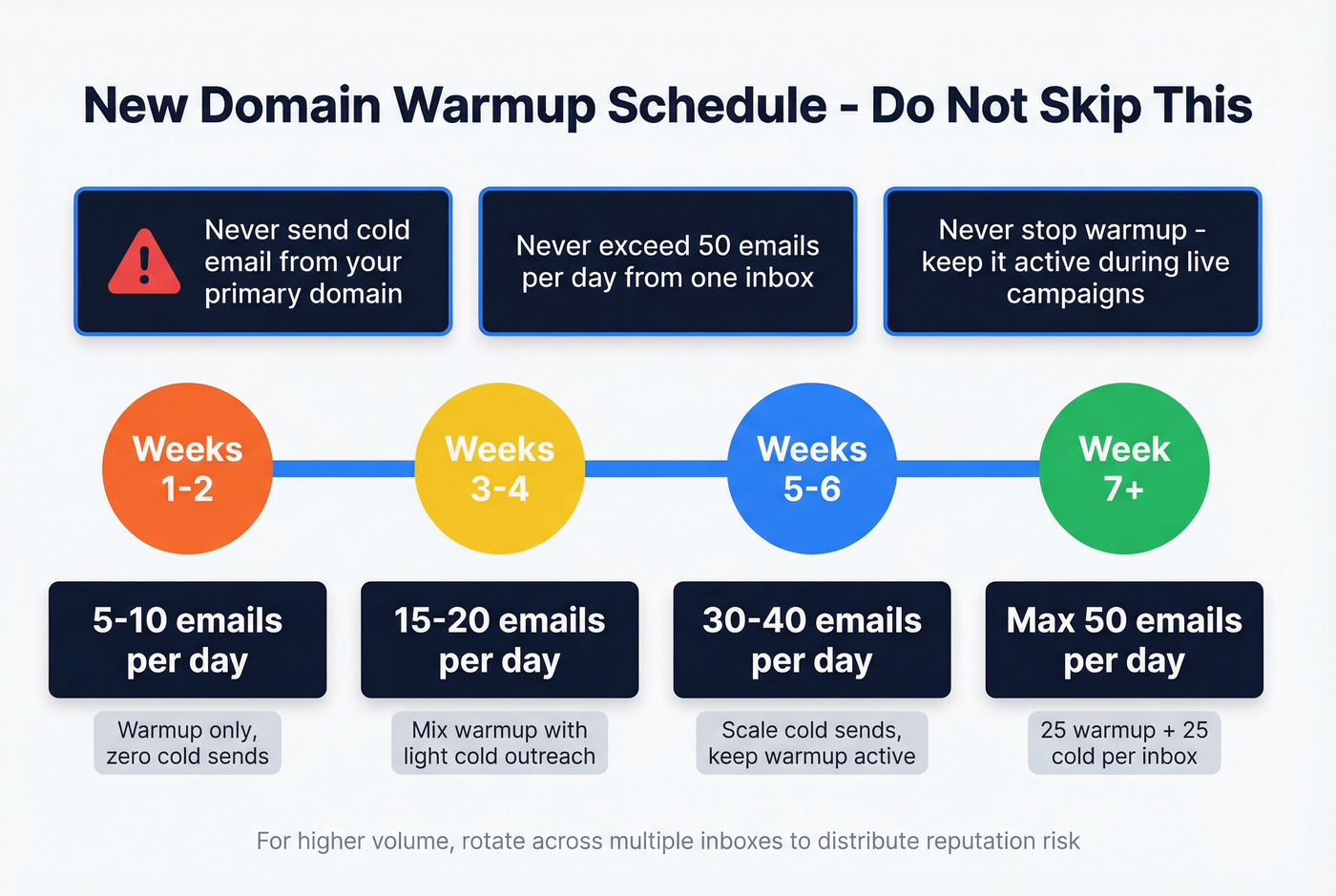
Never send cold email from your primary business domain. Full stop.
If your main domain is acme.com, buy getacme.com, tryacme.io, or acmehq.com for outbound. If a sending domain gets burned, your main domain - and all your transactional email, support email, and marketing email - stays clean. Set up a custom tracking domain (branded CNAME) to avoid shared-domain reputation risk. This takes 10 minutes and prevents your sends from being lumped in with every other customer on your sending tool's shared domain.
Warmup isn't optional. Here's a realistic schedule for a brand-new domain:
| Week | Daily Volume | Notes |
|---|---|---|
| 1-2 | 5-10/day | Warmup only, no cold |
| 3-4 | 15-20/day | Mix warmup + light cold |
| 5-6 | 30-40/day | Scale cold, keep warmup |
| 7+ | Max 50/day | 25 warmup + 25 cold |
Never exceed 50 emails per day from a single inbox. For teams sending at higher volumes, rotate across multiple inboxes - not just domains - to distribute reputation risk. And never stop warming. Keep it active even during live campaigns. (See email pacing and sending limits for a deeper breakdown.)
One thing that frustrates me about this space: warmup pool quality varies enormously between tools. A bad warmup pool with invalid addresses will actively damage your reputation instead of building it. Vet your sending tool's warmup infrastructure before you trust it with your domain.
Email Verification - The Step Most People Skip
Here's the stat that should scare you: 22.7% of email contacts become outdated every year. That means roughly a quarter of any list you bought or built six months ago is now garbage. Every bounce from those dead addresses chips away at your sender reputation. (If you want the benchmark math, see B2B contact data decay.)
The Meritt case study makes this concrete. Before implementing proper verification, their bounce rate sat at 35%. Pipeline was stagnant. After switching to verified data with Prospeo, bounce rate dropped under 4%, and pipeline tripled from $100K to $300K per week. Same team, same offer, same copy. The only variable was data quality.

One more tactic that's counterintuitive but backed by data: turn off open tracking. An analysis of 44 million emails found that disabling open tracking pixels more than doubled reply rates - 2.36% vs 1.08%. Tracking pixels trigger spam filters. If you're optimizing for replies (which you should be), kill the pixel. (Related: best email open tracker.)

This article proves it: bad data kills cold email before copy ever gets a chance. Prospeo's 5-step verification and 7-day data refresh keep bounce rates under 2% - the threshold you just read about. Meritt cut their bounce rate from 35% to under 4% and tripled pipeline.
Stop burning your domain reputation at $0.01 per verified email.
Targeting - The 2.76x Multiplier
Targeting is the single biggest lever for lifting your outbound response rates, and it's the one most teams underinvest in. They'll spend hours A/B testing subject lines while sending to a list they scraped in 20 minutes.
Precision Targeting vs. Mass Blasts
Buzzlead managed cold email for 50+ B2B companies and generated $8M+ in revenue. Their data is clear: hyper-targeted lists outperform mass blasts by 2.76x.
The ProductEVO case study makes this visceral. They had a full-time employee plus a $25,000 ZoomInfo subscription running outbound. Result: 9 qualified calls in three months. Nine. After switching to precision targeting with smaller, signal-based lists, they booked 142 qualified meetings and generated $90,000 in profit over 10 months. That's not a marginal improvement. That's a completely different business outcome from the same channel.
For building signal-based lists, Apollo (starting around $49/month) gives you a solid B2B database with company and contact filters - it's a good starting point for teams that need volume. Prospeo's 30+ search filters layer in buyer intent signals across 15,000 topics, technographics, job changes, funding events, and headcount growth, so you can build lists based on who's actually in-market rather than who matches a job title. (More on this approach: intent signals.)
500 perfectly targeted prospects outperform 5,000 loosely targeted ones every time. The math is simple: if your reply rate on a targeted list is 8% vs. 2% on a mass list, you need 4x the volume to get the same results - and that 4x volume is destroying your domain reputation in the process.
Trigger Events That Actually Work
Trigger event targeting delivers 2.3x higher reply rates compared to generic outreach. A trigger event is anything that signals a prospect is in-market or open to a conversation right now.

The most effective triggers:
- Recent funding rounds - company just raised, they're hiring and buying
- New executive hires - new VP of Sales needs to build their stack
- Tech stack changes - they just adopted a competitor or complementary tool
- Department job posts - hiring signals budget and growth
- Conference attendance - they're actively learning and networking
Trigger-event personalization in subject lines lifts open rates by 42.4%. Compare that to using {{firstName}} alone, which only adds 9.6%. The gap between "Hi Sarah" and "Congrats on the Series B, Sarah" is enormous.
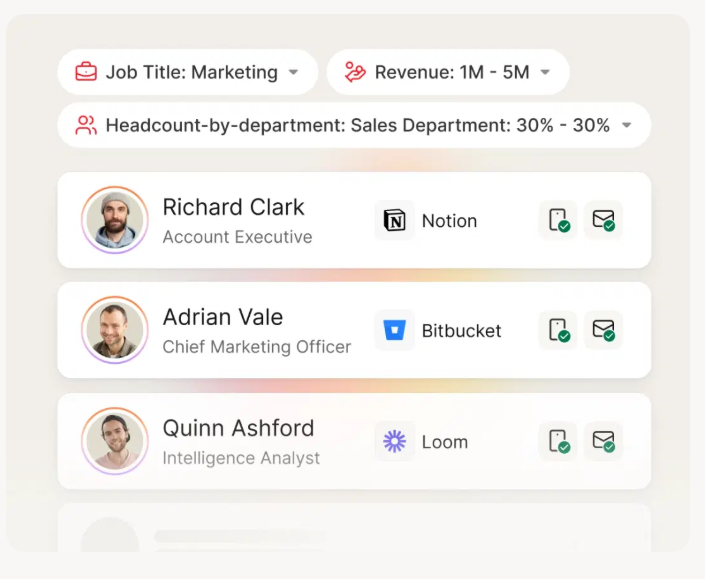
You read it above: hyper-targeted lists outperform mass blasts by 2.76x. Prospeo gives you 30+ filters - buyer intent, technographics, job changes, headcount growth - across 300M+ profiles so you send fewer, better emails that actually convert.
Build the micro-segmented lists that put you in the top 10% of campaigns.
Subject Lines That Actually Get Opened
Your subject line is the gatekeeper. 64% of people decide whether to open based on the subject line alone. Get this wrong and nothing else matters.
Five Rules from 5M+ Emails
An analysis of 5,000,000+ cold emails identified five rules that separate high-performing subject lines from average ones. Subject lines following all five rules averaged a 62.4% open rate. Breaking even one dropped performance to 43.1%.
- Under 40 characters. The 21-40 character range hits the highest open rates (49.1% average). 68% of first opens happen on mobile - long subject lines get truncated.
- Specific personalization. Company name adds +21.9%. Trigger events add +42.4%. First name alone? Only +9.6%.
- Lowercase formatting. Lowercase outperforms standard capitalization by 8.2%.
- Avoid spam triggers. Words like "free," "guarantee," "act now" - you know the list. Also avoid "newsletter" (-18.7% open rate).
- Create information asymmetry. The reader should feel like you know something relevant about their business that they'd want to hear.
Templates with Open Rates
Here are the top-performing subject lines from that 5M+ email dataset, with actual open rates:
| Subject Line | Open Rate | Category |
|---|---|---|
| Loved your talk at {{event}} | 68.9% | Event trigger |
| Congrats on the funding, {{firstName}} | 67.3% | Funding trigger |
| Welcome to {{company}}, {{firstName}} | 66.1% | Job change trigger |
| Saw {{company}}'s new launch | 64.8% | Product trigger |
| Noticed something about {{company}} | 63.2% | Curiosity |
| Re: {{company}}'s growth | 62.1% | Growth signal |
| Is {{company}} still doing X? | 56.8% | Question |
| How does {{company}} handle X? | 53.4% | Question |
Trigger-event subject lines dominate the top spots. Question-based subject lines average 51.6% - solid but not exceptional. The "Re:" prefix lifts open rates 12-15%, though it's controversial because it implies a prior conversation that didn't happen. I've seen teams use it successfully, but it can erode trust if the prospect notices. (More examples: cold email subject lines that get opened.)
Timing matters too. That "Congrats on the funding" line hits 67.3% when sent within 7 days of the announcement. After 30 days? It drops to 48.2%. Trigger-based outreach has a shelf life.
Email Copy and Personalization That Converts
You've got the open. Now you need the reply. This is where most teams fall into one of two traps: either they write generic templates and blast them, or they spend 15 minutes per email hand-crafting novels that nobody reads.
Positioning Beats Personalization
A practitioner on r/coldemail put it perfectly: "Focus on positioning more than personalization." An attractive offer with a clearly articulated pain point will outperform blanket personalization every time.
Surface-level personalization - "Hi Sarah, noticed you're the VP of Marketing at Acme Corp" - converts at 2-3x lower rates than research-driven personalization. The reader can smell a mail merge from a mile away.
Another practitioner broke down their process: they scrape the last 10 posts from a prospect's professional profile, read 40-50 pages of the company website, and write fully custom emails. No templates. They send 30-50 emails per day and get a 10% reply rate. Compare that to spray-and-pray teams sending 500+ per day at under 1%.
The math favors depth. 50 emails at 10% = 5 replies. 500 emails at 0.5% = 2.5 replies. And the 500-email approach is actively destroying your domain while producing fewer results.
Adjust Your Message by Role
The same product solves different problems depending on who you're emailing:
- C-Suite (VP+): Lead with strategic outcomes and revenue impact. They don't care about features - they care about growth, risk, and competitive advantage. Keep it to three sentences.
- Mid-Level Managers: Focus on operational pain. How does your solution save them time, reduce headcount needs, or make their team look good?
- Technical Roles: Lead with integration, workflow, and specifics. Include a concrete technical detail.
- SDR/BDR Leaders: Talk about rep productivity, ramp time, and pipeline metrics. These people live in dashboards - give them numbers.
A cold email to a CTO about data enrichment should read completely differently than one to a VP of Sales about the same product. Same value prop, different frame.
The Five Levels of Personalization
Not every email needs 15 minutes of research. Match your personalization depth to the prospect's value:
- Basic - Name and company. The bare minimum. Adds almost nothing in 2026.
- Contextual - Company events, news, funding. "Saw you just raised a Series B." Meaningful lift.
- Behavioral - Digital behavior signals, content engagement, tech adoption. "Noticed your team adopted Snowflake last quarter."
- Predictive - AI-predicted resonance based on pattern matching across multiple data sources.
- Hyper-personalization - All of the above combined with real-time data. The gold standard.
Personalized emails generate 6x higher transaction rates. The sweet spot for most teams is level 3-4: AI-powered research combined with human editing. Clay (starting around $149/month) handles enrichment and signal aggregation well - pulling from dozens of data sources to build a research dossier on each prospect. A human reviews and tweaks the output. (If you're using AI, also read AI cold email personalization mistakes.)
Modern buyers receive an average of 120 emails per day, with 30-40 of those being sales-related. Your email is competing with 39 others. "Hi {{firstName}}, I hope this email finds you well" isn't going to cut through that noise.
Two Frameworks That Work (AIDA and BAB)
AIDA (Attention, Interest, Desire, Action)
Saw {{company}} just expanded the SDR team to 12. Scaling outbound with bad data is a nightmare - we've seen teams burn 3 domains in a month.
We help sales teams verify every contact before it hits a sequence. Bounce rates drop under 2%, reply rates go up.
Worth a 5-minute call Thursday?
BAB (Before, After, Bridge)
Most SDR teams spend 30% of their time on leads that'll never convert - wrong titles, dead emails, companies that aren't buying.
Imagine if every lead in your sequence was verified, in-market, and matched your ICP.
That's what [solution] does. Can I show you in 5 minutes?
Both frameworks share the same principles: keep it under 80 words, make one point, include one CTA, and give one reason to reply. Plain text only - fancy HTML formatting screams marketing email and tanks deliverability.
CTAs, Follow-Ups, and Multichannel Tactics That Drive Replies
CTAs That Book Meetings
The CTA is where most cold emails die. Either it's too vague ("Let me know if you're interested") or too aggressive ("Book a 30-minute demo here").
The pattern that works best is the "small ask" - a specific, low-commitment request tied to a concrete benefit:
"Are you open to a five-minute chat about lowering your cloud computing costs by 30%?"
This works because it respects the prospect's time, quantifies the value, and makes saying yes feel easy.
Here's my hot take: calendar links kill conversions. Practitioners on r/coldemail consistently confirm this - offering specific times outperforms sending a Calendly link. "Would Tuesday at 2pm or Thursday at 10am work?" creates scarcity and reduces friction. A calendar link feels like homework. (More CTA patterns: sales CTA.)
For deals under $15k, you probably don't need a 30-minute demo slot anyway. A 5-minute call closes more deals at that price point than a formal demo ever will.
The Follow-Up Sequence (Where 42% of Replies Hide)
58% of replies come from the first email. That means 42% come from follow-ups. If you're only sending one email, you're leaving almost half your replies on the table.
| Day | Email Type | Purpose | Expected Response Curve |
|---|---|---|---|
| Day 1 | Initial outreach | Hook + value prop + CTA | ~58% of total replies |
| Day 3 | Value hook | New angle, add context | ~15% of total replies |
| Day 6 | Social proof | Case study or result | ~12% of total replies |
| Day 10 | Personal observation | Unique insight about them | ~10% of total replies |
| Day 15+ | Breakup email | Last touch, low pressure | ~5% of total replies |
The critical insight: step 2 emails that "feel like replies, not reminders" outperform formal follow-ups by roughly 30%. Don't restate your entire pitch. Write something like:
"Hey - forgot to mention, we just helped [similar company] cut their bounce rate from 12% to under 2%. Thought that might be relevant given your team's growth."
That reads like a human following up, not an automation sequence firing. Each subsequent message should introduce a fresh angle - a new case study, a relevant stat, or a timely trigger event the prospect would care about.
Space follow-ups 3-4 days apart. Under 4 touchpoints gives up too early. Beyond 7 diminishes returns. The sweet spot is 4-7 emails over 14-21 days. (See follow up email sequence strategy for templates and timing.)
Buzzlead's data shows 80% of positive responses come from the first two emails. Their recommendation is to run 2-3 email sequences, not 7-8. Test both - your market and offer will determine which works better.
Beyond Email - The Multichannel Multiplier
Email alone gets you a ~2% reply rate. Adding a second channel doubles response rates. That's not a marginal improvement - it's the difference between a struggling channel and a productive one.
The "Triple Tap" framework:
- Connect on a professional network with a personalized note (40-60% acceptance rate)
- Send a research-led email referencing something specific
- Follow up with a value-add - an article, a benchmark, an insight
Voice notes on professional networks get 8x higher reply rates than text messages. If you aren't using them, you're leaving the highest-engagement channel on the table. Some teams are also experimenting with short, personalized video clips (Loom or Vidyard) in the second or third touch - practitioners report 2-3x higher reply rates when a 30-second personalized video replaces a text-only follow-up.
For sending automation, Instantly (plans start around $30/month) handles email sequences, warmup, and inbox rotation well - it's the go-to for teams scaling past a handful of inboxes. (If you're evaluating platforms, start with cold email outreach tools.)
Cold calling still works too, especially for higher-value deals. Connect rates run 5-10%, but conversion to meeting is 2-4x higher than email when you actually get someone on the phone.
Skip the multichannel approach if you're sending fewer than 50 emails per week. At that volume, just nail the email fundamentals first.
A/B Testing - The Systematic Way to Raise Your Conversion Rate
Most teams A/B test randomly. They'll test a subject line one week, a CTA the next, and a send time the week after - with no system and no statistical rigor.
Here's the priority order, from highest to lowest impact:
- Subject lines - the biggest lever. Personalized subject lines increase open rates by 26%. Test two to three simultaneously.
- Email body content - positioning, length, personalization depth.
- CTAs - direct ("Are you available Thursday at 2pm?") vs. soft ("Would it make sense to explore this?").
- Sender name - first name only vs. full name vs. name + title.
- Send time - Tuesday-Wednesday see peak reply rates. Wednesday is highest.
Rules that matter:
- Minimum 100-200 prospects per variant. Anything less and your results are noise, not signal.
- Test one variable at a time. If you change the subject line AND the CTA, you don't know which moved the needle.
- Measure by reply rate, not open rate. Opens are increasingly unreliable due to tracking pixels, privacy features, and bots. Replies are the metric that matters.
- Curiosity-driven subject lines increase open rates by 15% and engagement by 7%.
Look, A/B testing isn't glamorous. But it's the difference between teams that plateau at 3% and teams that climb to 8%+. The top performers use continuous testing - it's not a one-time exercise, it's a system. Every test compounds, and over a quarter the gains add up to fundamentally better results from the same list size. (Framework: A/B testing lead generation campaigns.)
The $400 Cold Email Playbook - A Real Case Study
A practitioner on Reddit documented their entire cold email operation, from zero to $2,400 MRR. The numbers are worth studying because they show what's possible on a shoestring budget.
The funnel:
- 15,400 emails sent over 90 days
- 693 replies (4.5% reply rate)
- 277 demos booked
- 83 customers acquired
Those 83 customers translated to $2,400 in monthly recurring revenue.
The cost breakdown:
| Category | Cost | Per-Unit |
|---|---|---|
| Domains (GoDaddy) | ~$20/year each | - |
| Email hosting (Zoho) | $12/year per mailbox | - |
| Email validation | $12 for 12,000 | ~$0.001/email |
| Total setup | ~$400 | - |
| Cost per demo | - | ~$1.44 |
Compare that $1.44 per demo to the industry average of $50-$150 per qualified meeting. Or compare it to Facebook, where CPMs are up 89% since 2023.
The sending discipline was key: start at 5-10 emails per day per mailbox, scale to a max of 30 per day. Four to five follow-ups spaced 3-7 days apart. Plain text only. No images, no attachments, no fancy formatting.
Cold email's ROI of $36 per $1 spent makes it the most cost-effective B2B channel available. But that ROI only materializes if you protect your infrastructure. The $400 playbook worked because the practitioner verified every address, warmed up properly, and respected sending limits. At roughly $0.01 per verified email, list verification is essentially free compared to the cost of a burned domain.
Mistakes Killing Your Conversions (and the Compliance Checklist)
Ten Mistakes to Fix Before You Optimize Anything Else
- Bad targeting. Sending to everyone wastes time and destroys deliverability. This is mistake #1 for a reason.
- No verification. Every unverified email is a coin flip. Enough bounces and your domain is toast.
- Writing too much. Keep emails under 80-150 words. Best-performing emails stay under 80.
- Sounding robotic. "Dear Sir or Madam, I hope this email finds you well" = instant delete. Write like a human.
- No clear offer. The prospect should know in 5 seconds why you're emailing and what's in it for them.
- Weak subject lines. Short, relevant, human. "Quick question about {{company}}" beats "Innovative Solution for Your Business Needs."
- Only sending one email. 42% of replies come from follow-ups. One email is half a campaign.
- Talking about yourself too much. "We're a leading SaaS platform that..." - nobody cares yet. Lead with their problem.
- Spamming links and attachments. Images and attachments kill deliverability. Multiple links trigger spam filters. One link max, and not in the first email.
- Giving up too early. Your first campaign will probably underperform. That's normal. Iterate on data, targeting, and copy - in that order.
Compliance Quick Reference (CAN-SPAM, GDPR, CASL, Spam Act)
Rules apply based on the recipient's location, not yours. Sending from Texas to a prospect in Germany? GDPR applies.
| Region | Key Rule | Consent? | Penalty |
|---|---|---|---|
| US (CAN-SPAM) | Opt-out model | No prior consent | Up to $51,744/violation |
| EU/UK (GDPR) | Legitimate interest | B2B: no; B2C: yes | Up to 20M EUR or 4% revenue |
| Canada (CASL) | Express/implied consent | Yes (strictest) | $10M CAD/violation |
| Australia (Spam Act) | Express/inferred consent | Yes | $2.22M AUD/day |
For B2B cold email in the US, you can send without prior consent as long as you include a clear unsubscribe mechanism, your physical address, non-deceptive subject lines, and accurate sender identification.
GDPR's "legitimate interest" provision allows B2B cold email, but you must document your justification - the outreach needs to be relevant to the recipient's role and proportionate. Honor opt-outs immediately. (More detail: GDPR for sales and marketing.)
CASL is the strictest. You need express or implied consent before sending. Implied consent exists for published business addresses or existing business relationships, but the bar is higher than CAN-SPAM or GDPR.
The practical reality: inbox penalties (spam filtering, domain damage) happen long before legal penalties. If you're following deliverability best practices - verification, authentication, reasonable volume, clear unsubscribe - you're covering most of the compliance bases too.
FAQ
What is a good cold email conversion rate in 2026?
The average reply rate across billions of cold emails is 3.43%, while a conversion rate above 2% is solid for most B2B industries and above 5% is exceptional. The top 10% of campaigns hit 10.7%+ reply rates through micro-segmentation, continuous A/B testing, and verified data. If you're below 1%, focus on data quality and targeting before optimizing copy.
How many follow-up emails should I send?
Send four to seven touchpoints spaced 3-4 days apart over 14-21 days. 42% of all replies come from follow-ups rather than the initial email. Stop when you've got no new value to add - follow-ups become counterproductive when you're just resending the same pitch with a different opening line.
Does personalization actually improve cold email results?
Trigger-event personalization lifts open rates by 42.4%, while {{firstName}} alone adds only 9.6%. Surface-level personalization converts at 2-3x lower rates than research-driven personalization. The needle moves when you reference something specific - a funding round, a product launch, or a hiring signal.
How do I stop cold emails from going to spam?
Authenticate every sending domain with SPF, DKIM, and DMARC, and keep bounce rates under 2% by verifying every email before sending. Warm up new domains for 2-4 weeks, never exceed 50 emails per day per inbox, and disable open tracking pixels. We've seen teams go from 35% bounce rates to under 4% just by switching to verified data - the deliverability improvement is immediate.
How much does cold email outreach cost?
Infrastructure runs $400-$2,000 per month depending on scale, covering sending tools, domains, verification, and list building - with an all-in cost per email of roughly $0.10. ROI averages $36 per $1 spent, making it the most cost-effective B2B channel available and significantly cheaper than paid ads where B2B CPMs have surged 89% since 2023.