Your Mail Merge Open Rate Is Lying - Here's What to Trust
You sent 300 cold emails via Gmail mail merge. Your tool says 72% open rate. Now subtract bot opens, Apple Mail prefetches, and the five times you checked your own Sent folder on your phone. Real open rate? Closer to 43%. Mail merge open rates are the most misleading metric in cold outreach, and most teams are making decisions based on numbers that are at least 30% noise.
Over half of all emails sent and received daily contain some form of tracking. The problem isn't that tracking exists - it's that the data it produces has become nearly useless as a standalone metric.
Here's the thing: if your average deal size is under $25k, you don't need accurate open rates. You need accurate reply rates. Stop tuning subject lines and start tuning your offer.
The Short Version
- Your open rate is inflated by bots, self-opens, and Apple Mail Privacy Protection. Treat it as directional, not absolute.
- A "good" cold outreach open rate is 30-50% pre-MPP. Post-MPP, don't trust the number at face value.
- Reply rate is your primary metric - it's the only one that can't be faked.
- Verify your email list before sending. Bounces wreck both your metrics and your sender reputation.
How Open Tracking Actually Works
Mail merge tools embed an invisible 1x1 tracking pixel in your HTML email. When a recipient's email client loads that image, it fires a request back to the sender's server, logging a timestamp, IP address, device type, and email client. That's your "open."
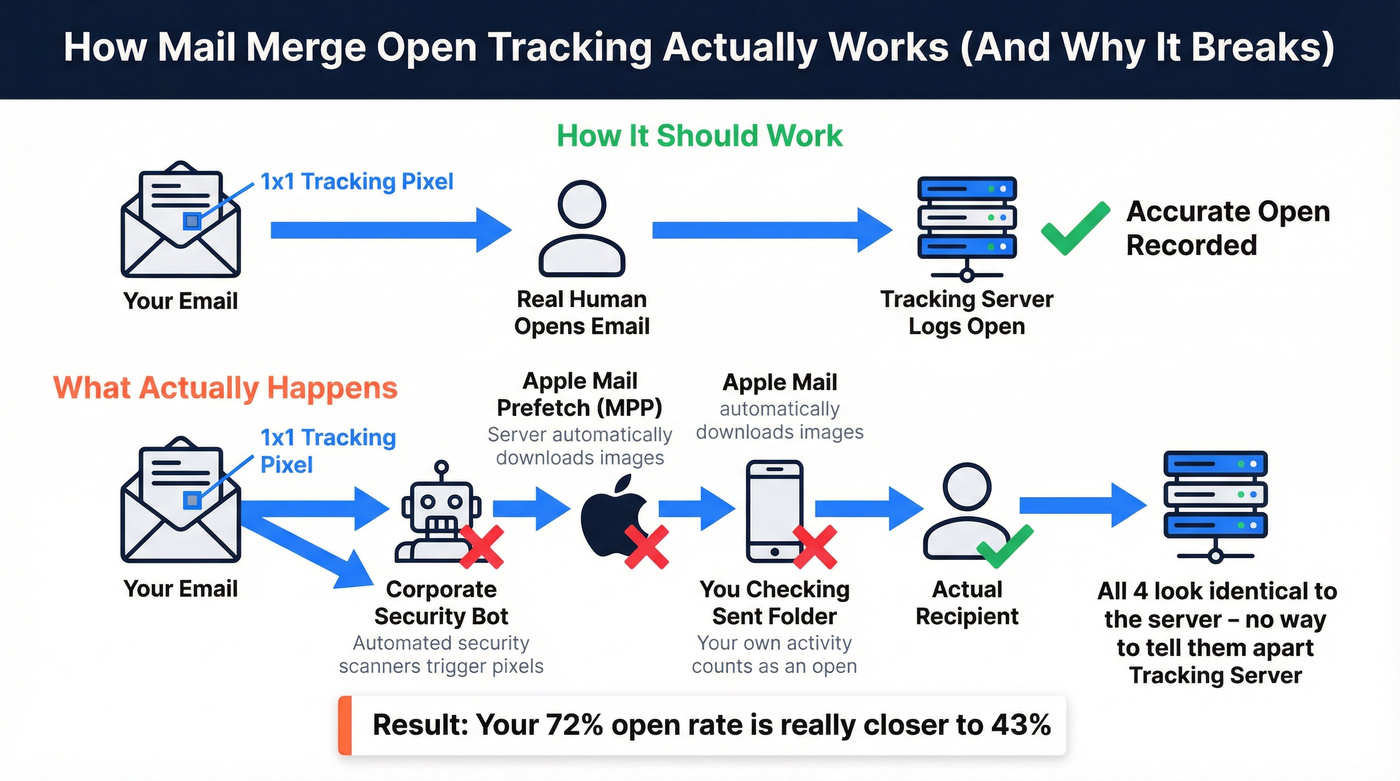
The problem is obvious: anything that loads that image counts. A bot, a security scanner, Apple's proxy server, you checking your Sent folder - they all fire the same pixel. There's no way for the server to distinguish a human reading your pitch from a corporate firewall scanning attachments.
Link tracking works differently. Clicks route through a redirect URL before forwarding to the destination, making click data inherently more reliable. If your tool supports both, weight clicks higher. For a deeper breakdown, see our guide on open rate vs click rate.
What's a Good Open Rate?
"Good" depends entirely on what you're sending and who's receiving it.
| Email Type | Typical Open Rate | Reliability |
|---|---|---|
| Cold outreach (pre-MPP) | 30-50% | Moderate |
| Newsletters/promo | 10-20% | Low post-MPP |
| Internal comms | ~64% | Higher (controlled) |
| All email average | ~18% | Low post-MPP |
Industry matters too - nonprofit and education emails tend to outperform retail and e-commerce on opens, though post-MPP that gap is increasingly hard to verify.
Small swings between campaigns are often noise. Compare trends across campaigns with similar audiences, and never treat a single campaign's open rate as ground truth. If you still want to improve subject lines, use a deliverability-first playbook like how to increase email open rates for sales.

Inflated open rates start with dirty lists. When 35% of your emails bounce, your denominator shrinks and your open rate lies even harder. Prospeo's 5-step verification catches spam traps, honeypots, and invalid addresses - customers drop bounce rates from 35%+ to under 4%. At $0.01 per email, cleaning your list costs less than one wasted follow-up.
Fix your data before you fix your subject lines.
Five Reasons Your Numbers Are Wrong
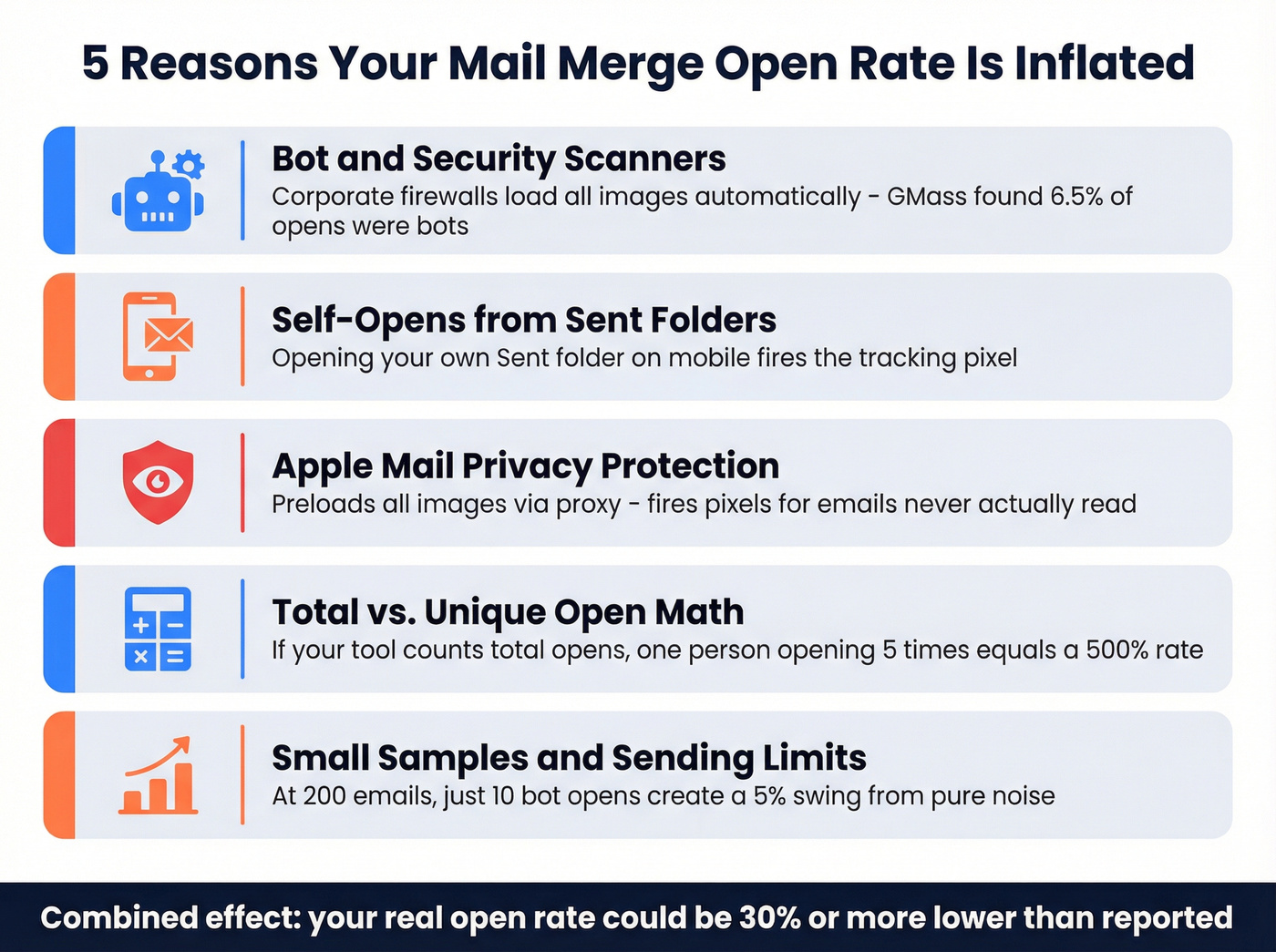
Multiple mechanisms inflate mail merge open rates, and many tools don't filter for all of them by default. We've seen teams celebrate "record-breaking" campaigns that were really just bot-heavy sends. If you're building a stack, start with the basics in our roundup of cold email marketing tools.
Bot and Security Scanner Opens
Corporate email security tools routinely scan inbound messages by loading all images and clicking all links. Data from GMass shows false opens rose from roughly 2.5% to 6.5% of opens in their dataset over time based on suspicious User Agent patterns - and 4.5 million false open records were deleted from their database. If an open registers within seconds of sending, it's almost certainly a bot.
Self-Opens from Sent Folders
This one catches people off guard. Opening a message in your Gmail Sent folder - especially on mobile - fires the tracking pixel. You just inflated your own open rate. GMass offers a hardening feature that replaces Sent messages with pixel-stripped copies, but it adds about four seconds per message and only makes sense for small campaigns.
Apple Mail Privacy Protection
Apple Mail Privacy Protection preloads all images via Apple's proxy servers, firing your tracking pixel even if the email sits unread forever. It masks IP address, timestamp, geolocation, and device type. The key nuance: MPP affects anyone using the Apple Mail app, including people reading Gmail addresses through Apple Mail.
Twilio's data from MPP's first week showed it accounted for 5% of all opens, with unique opens jumping 6.5% - nearly double the largest one-week increase in the prior six months. That was 2021. Adoption among Apple Mail users is now near-universal, and 77% of marketers surveyed by Twilio mistakenly believed MPP activates automatically. It's opt-in, but the prompt is persuasive enough that almost everyone says yes.
Total vs. Unique Open Math
Quick diagnostic: send a test email to yourself, open it five times, and check what your tool reports. If it says 5 opens instead of 1, you're looking at total opens divided by recipients - a formula that can produce rates above 100%. Always confirm your tool reports unique opens.
Small Samples and Sending Limits
Gmail caps free accounts at 500 emails/day and Workspace at 2,000/day. At 200 emails, 10 bot opens create a 5% swing from pure noise. You can't draw meaningful conclusions from that.
How to Get Tracking You Can Trust
Your SDR asks why the open rate dropped from 65% to 40% between campaigns. It didn't. The first campaign had more Apple Mail users. We've watched teams waste weeks optimizing subject lines based on data that was heavily distorted by machine opens.
Switch reporting to unique opens only. Enable bot UA filtering if your tool supports it. For campaigns under 500 messages, turn on open tracking hardening to eliminate self-opens.
Skip all of this if you want to stay sane:
- Obsessing over open rate deltas within normal measurement noise
- Comparing rates across campaigns sent to different audience segments
- Using open rate as a trigger for automated follow-ups without a confidence threshold (use follow-up email reply rate instead)
The single highest-impact thing you can do for your mail merge metrics is verify your list before sending. Bad emails bounce, bounces shrink your delivered denominator, and a smaller denominator inflates your open rate while simultaneously destroying your sender reputation. Prospeo's 5-step verification process catches invalid addresses, spam traps, and honeypots - customers report bounce rates dropping from 35%+ to under 4%, which means the open rate you do see is calculated against a clean, real denominator. If you need a workflow, start with email verification for outreach.
Mail Merge Tools: Tracking Compared
| Tool | Open Tracking | Bot Filtering | MPP Handling | Starting Price |
|---|---|---|---|---|
| GMass | Yes + hardening | Yes (UA-based) | No native fix | $29.95/mo |
| Mailmeteor | Yes (real-time) | No | No | $9.99/mo |
| YAMM | Yes | No | No | $48/yr |
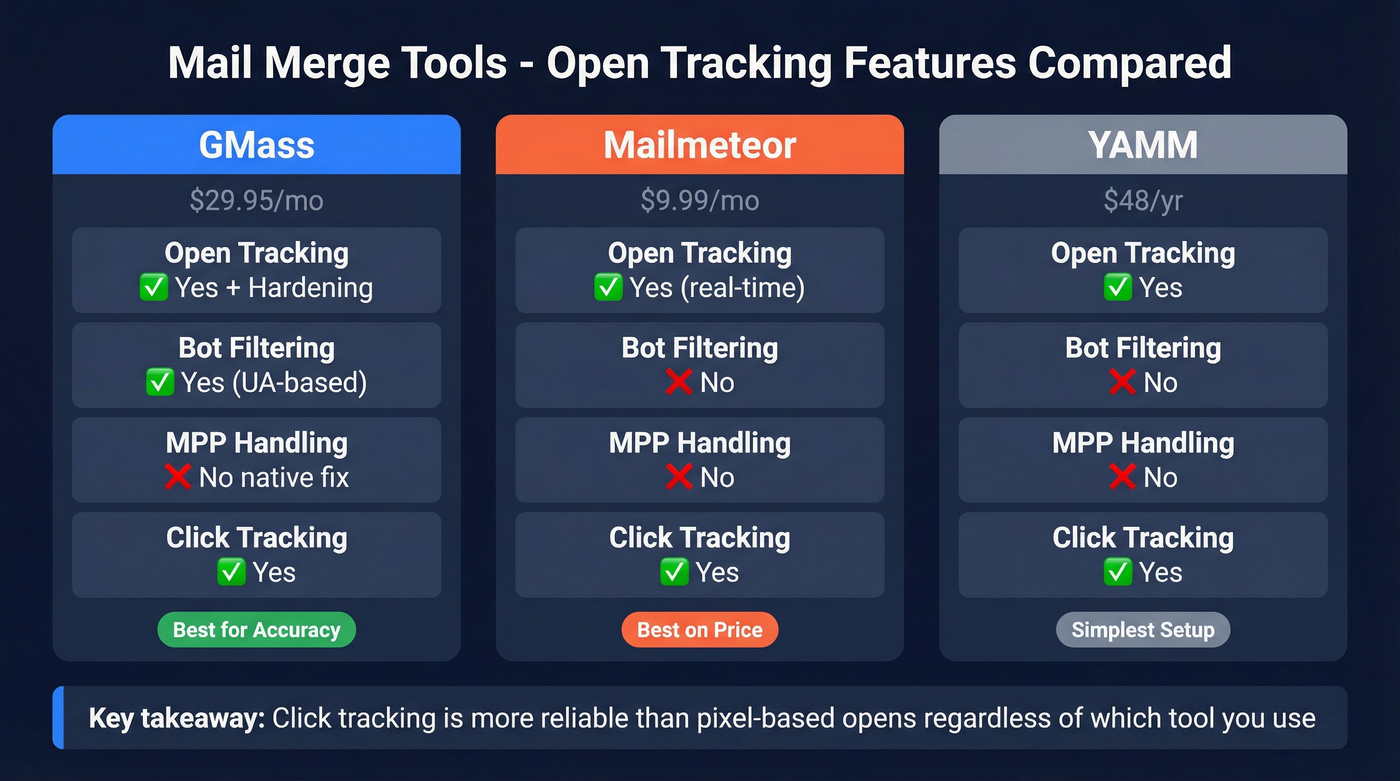
All three support click tracking, which is more reliable than pixel-based opens regardless of filtering.
GMass is the only tool here that publicly documents both UA-based bot filtering and the self-open hardening feature. If open rate accuracy matters to your workflow - for A/B testing, sequence triggers, or reporting - it's worth the premium. Mailmeteor wins on price for teams that just need basic tracking. YAMM is the simplest option for straightforward Workspace setups. If you're evaluating trackers specifically, compare options in our best email open tracker guide.
What to Track Instead of Opens
Let's be honest: open rates are theater post-MPP. The consensus across sales communities on Reddit is blunt - reply rate is the only metric that survived it. In our experience, teams that shift reporting from opens to replies make better decisions within two weeks. If you want more levers that move replies, use these cold email tactics.
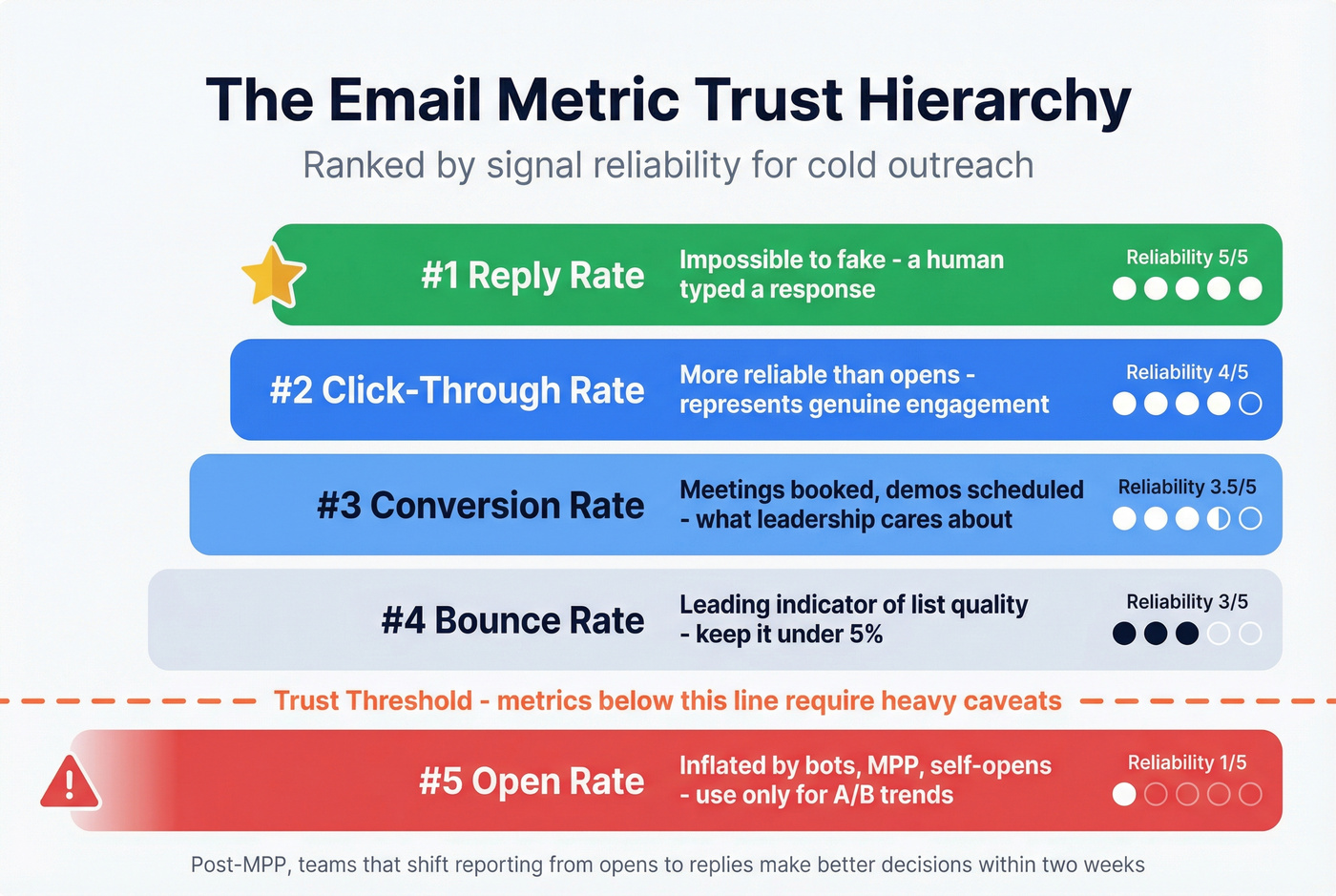
Here's the hierarchy, ranked by signal reliability:
1. Reply Rate
Impossible to fake. A human typed a response. This is your north star for cold outreach effectiveness, and everything else is a proxy for it.
2. Click-Through Rate
More reliable than opens by a wide margin. Apple's Link Tracking Protection strips UTMs in Mail and Safari, which complicates attribution, but clicks still represent genuine engagement from a real person.
3. Conversion Rate
Meetings booked, demos scheduled, deals created - the metric your leadership actually cares about. Connect it back to individual campaigns when you can.
4. Bounce Rate
Your leading indicator of list quality. If it's above 5%, clean your list before your next send. Prospeo's free tier covers 75 verifications per month, which is enough to spot-check a small campaign. If you're comparing vendors, start with our list of the best email checker tools.
5. Open Rate
Use it for A/B testing trends across large samples with similar audiences. Never use it as an absolute measurement of campaign success. For outbound, open rate sits firmly at the bottom of the reliability stack.
You just read that reply rate is the only metric that can't be faked. But replies require reaching real inboxes - which requires real email addresses. Prospeo delivers 98% email accuracy across 143M+ verified addresses, refreshed every 7 days. That means fewer bounces, a healthier sender reputation, and metrics you can actually trust.
Stop optimizing noise. Start sending to verified contacts.
FAQ
What's a realistic open rate for a Gmail mail merge?
Pre-MPP, cold outreach via Gmail mail merge typically sees 30-50% unique opens. Post-MPP, treat any rate as directional only - swings between campaigns are often noise from Apple Mail prefetches and bot scanners, not real engagement changes.
Can I trust open rates if most recipients use Apple Mail?
No. Apple Mail Privacy Protection preloads tracking pixels, recording "opens" for emails that were never read. If a significant portion of your list uses Apple devices, your rate is inflated by design. Track replies and clicks instead.
How do I reduce bounce rates before a mail merge?
Run your list through a verification tool before sending. Catching invalid addresses, spam traps, and honeypots before they hit your sending infrastructure keeps bounces below 5%, which means the metrics you do see reflect real delivered emails rather than a shrinking denominator.
Does sending to multiple recipients inflate the open rate?
Yes. Each recipient's client behavior - bots, MPP prefetches, self-opens - compounds the noise. The aggregate rate in your dashboard masks wildly different engagement across individual contacts, which is why per-recipient click and reply data gives a far more accurate picture of what's actually working.