How to Get Free Email Leads in 2026 (Without Wrecking Your Sender Reputation)
Apollo slashed its free plan from 10,000 credits to 720 - overnight, with zero warning. If you built your prospecting workflow on that free tier, you woke up to a broken pipeline and a scramble for alternatives. That's the fundamental problem with chasing a free email lead source: the tools change the rules whenever they want, and your sender reputation pays the price.
Email still returns $36-$40 for every $1 spent - the highest-ROI channel in B2B by a wide margin. And 18% of companies achieve ROIs above $70 per $1 invested. But that ROI assumes your emails actually land. Send to a list full of invalid addresses and you're not generating leads - you're burning your domain.
There are three paths to free email leads: finder tools for B2B prospecting, marketing platforms for list management, and organic strategies that cost nothing but time. The principles are the same whether you're just starting out or scaling an existing pipeline.
What You Need (Quick Version)
- Best free email marketing platform: Kit - 10,000 subscribers, unlimited emails, free forever.
- Best free strategy: Blog + lead magnet - sites with blogs generate 67% more leads than those without.
What "Free Email Lead" Actually Means (Three Paths)
People searching for this term want one of three very different things. Knowing which path you're on saves you from picking the wrong tool entirely.
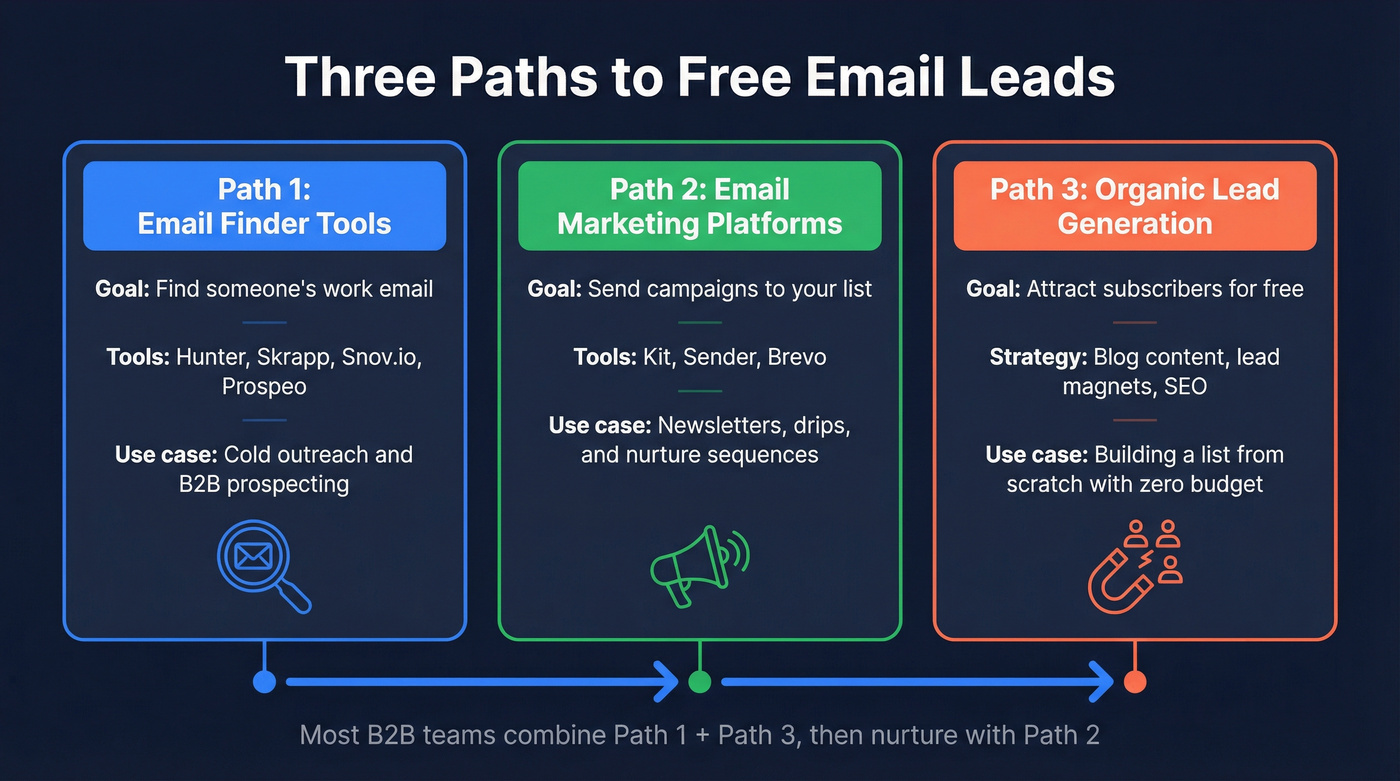
Path 1: Email finder tools (B2B prospecting). You need someone's work email address so you can send a cold outreach message. Tools like Hunter, Skrapp, and Snov.io do this.
Path 2: Email marketing platforms (list management). You already have leads - you need a free tool to send newsletters, drip campaigns, or product updates. Kit, Sender, and Brevo live here.
Path 3: Organic lead generation (no tools required). You want strategies to attract email subscribers without paying for software or ads. Content marketing, SEO, referral programs.
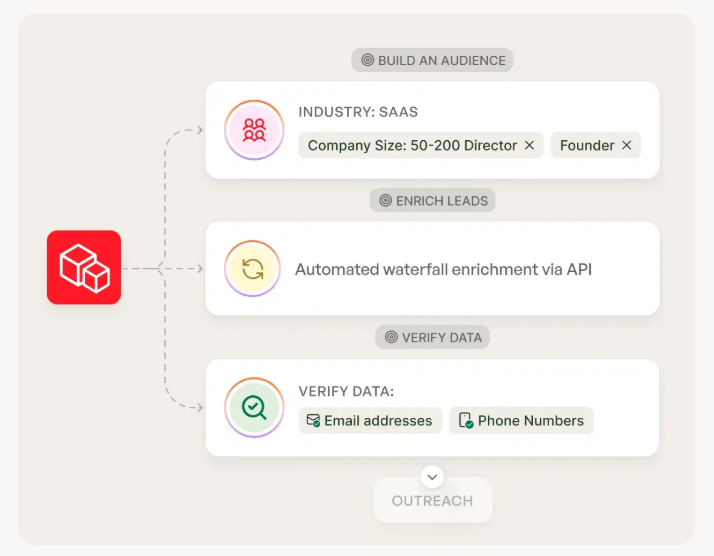
Most B2B teams need a combination of Path 1 and Path 3. You find emails with a tool, verify them, then nurture with content. The tools are the plumbing. The strategy is what makes it flow.
Which Path Is Right for You?
- You have subscribers and need to email them at scale --> Path 2. Start with Kit or Sender.
- You have neither list nor subscribers --> Path 3. Start with blog content + lead magnets, then layer in a finder tool once traffic arrives.
- You're an agency managing multiple client campaigns --> Path 1 + Path 2. Use a finder tool for prospecting and a marketing platform for nurture sequences.

You just read the independent benchmarks - most free email finders bounce 11-22% of the time. Prospeo's 5-step verification, catch-all handling, and proprietary infrastructure deliver 98% accuracy on a 7-day refresh cycle. Your free tier includes 75 verified emails. No credit card. No broken sender reputation.
Stop gambling your domain reputation on dirty free data.
The Truth About Email Accuracy (Before You Pick Any Tool)
Every email finder tool claims 95%+ accuracy. Independent testing tells a very different story.
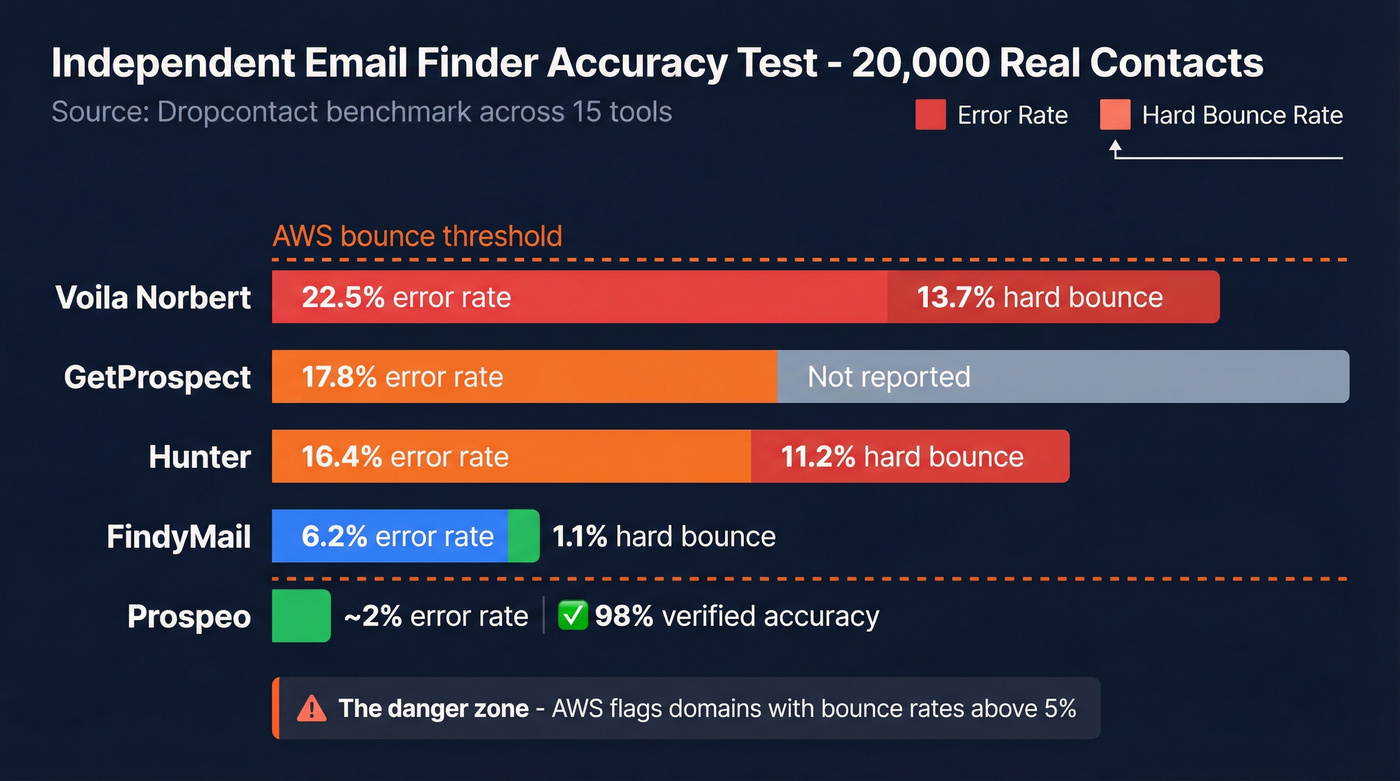
A Dropcontact benchmark tested 20,000 real contacts across 15 email finder tools - the largest study of its kind. The results are brutal:
- Hunter: 16.4% error rate, 11.2% hard bounce rate
- GetProspect: 17.8% error rate
- Voila Norbert: 22.5% error rate, 13.7% hard bounce rate
- FindyMail came in at #2 overall with a 6.2% error rate and just 1.1% hard bounce - strong, but still far from the 98%+ most tools promise on their marketing pages
The core problem: 98% of email finder solutions pull from the same underlying databases and run validation through the same third-party services - ZeroBounce, NeverBounce, Debounce, Bouncer. When everyone uses the same pipes, everyone gets the same dirty water.
Then there's the catch-all domain problem. Between 15% and 28% of B2B domains are configured as catch-all, meaning they accept any email address without bouncing. Most tools either skip these entirely (missing high-value enterprise prospects) or mark them as "valid" when they're not. Either way, you lose.

Here's the thing: if your average deal size is modest - say under $10k - you probably don't need ZoomInfo-level data. But you absolutely need ZoomInfo-level accuracy. A single bad bounce cascade can tank your domain reputation for weeks, and recovering from a blacklist costs far more than the $30/month you saved on a cheap tool. Fix your data quality first. Everything else - copy, subject lines, send times - is optimization on top of a broken foundation if your bounce rate is above 5%.
Best Free Email Finder Tools for B2B Prospecting
Here's how the major free tiers stack up in 2026, organized by what actually matters: free plan generosity, accuracy, and what you'll pay when you inevitably outgrow the free tier.
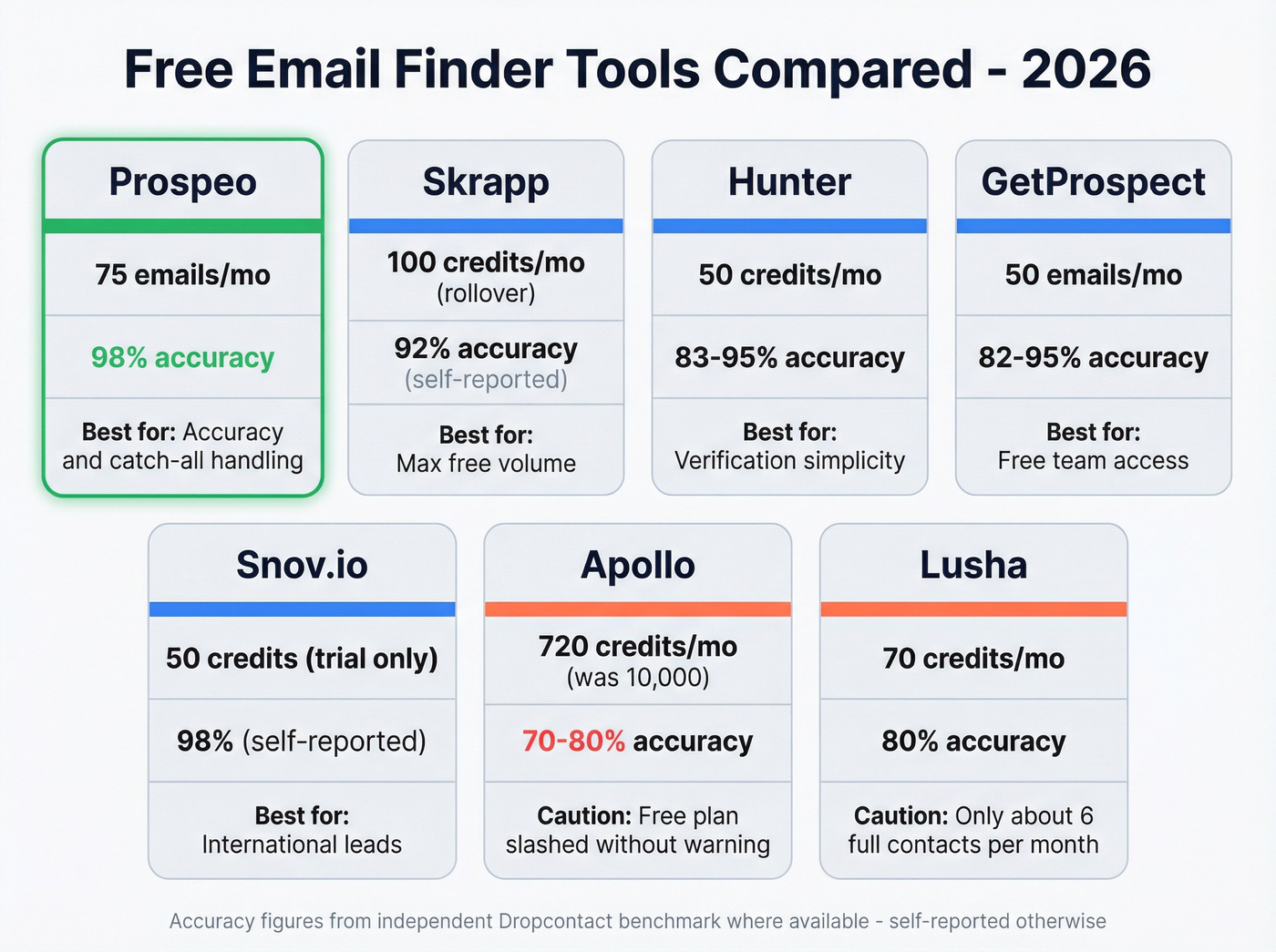
| Tool | Free Plan | Accuracy | Best For | Paid From |
|---|---|---|---|---|
| Skrapp | 100 credits/mo (rollover) | 92% (self-reported) | Generous free tier | $30/mo (annual) |
| Hunter | 50 credits/mo | 83-95% (83.6% in independent test) | Verification simplicity | EUR34/mo |
| GetProspect | 50 valid emails/mo | 82-95% (82.2% in independent test) | Free team access | $34/mo (annual) |
| Snov.io | 50 credits (trial) | 98% (self-reported) | International leads | $29.25/mo |
| Apollo | Up to 720 credits/mo | 70-80% | Large database | $59/user/mo |
| Lusha | 70 credits/mo | 80% | Quick lookups | $29.90/user/mo |
Prospeo - Best for Email Accuracy
If your bounce rate matters - and it should - start here.
Prospeo's free tier gives you 75 verified emails per month plus 100 Chrome extension credits, no credit card required. That's enough to test a real prospecting workflow, not just kick the tires. The 98% email accuracy runs on proprietary infrastructure - not the same third-party validators everyone else uses. A 5-step verification process handles catch-all domains, strips spam traps, and filters honeypots before you ever hit send. The database covers 300M+ professional profiles on a 7-day refresh cycle, so you're not emailing someone who changed jobs six weeks ago.
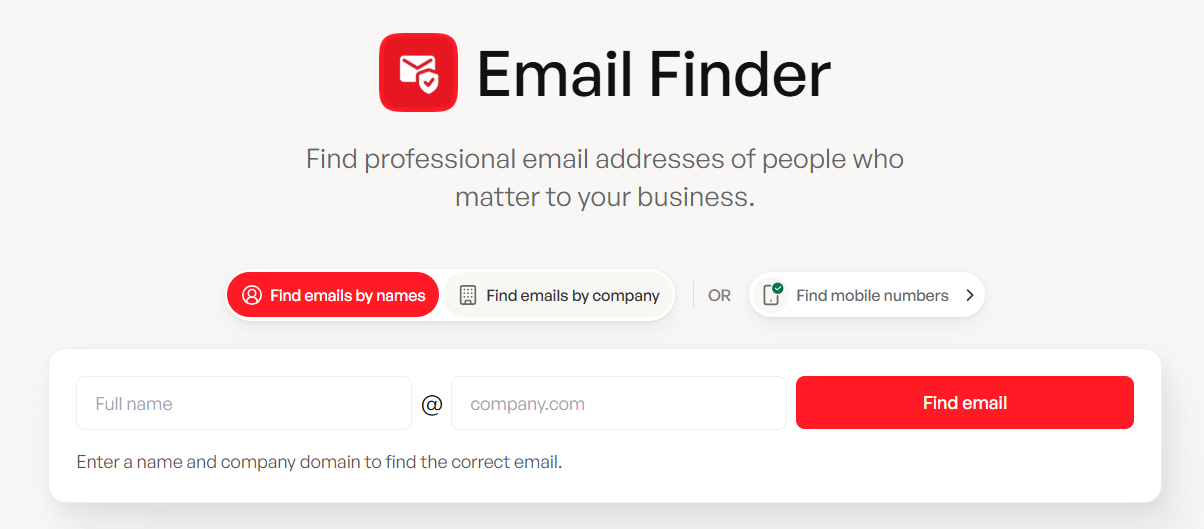
The Chrome extension works on any website, professional profiles, and CRMs - 40,000+ users run it daily. When you outgrow the free tier, paid plans start at roughly $0.01 per email - 90% cheaper than ZoomInfo on a per-lead basis.
Stack Optimize built from $0 to $1M ARR using Prospeo, maintaining 94%+ deliverability and sub-3% bounce rates across all their clients. That's the kind of production result that matters more than any benchmark.
Skrapp - Best Free Plan Generosity
Use this if: You need maximum free volume and don't mind slightly lower accuracy.
Skip this if: You're sending to enterprise domains where catch-all handling matters.
Skrapp gives you 100 credits per month - the most generous in this list - and unused credits roll over. Their fair credit policy only charges for "Valid" or "Catch-all" results, so invalid lookups don't burn your allocation. The self-reported 92% search success rate wasn't included in the Dropcontact benchmark, so take it directionally. Paid plans start at $30/mo (annual) for 1,000 credits.
Hunter - Best for Verification-First Simplicity
Hunter's 50 free credits per month won't win volume contests, but user reviews consistently say "the contact information always works." The tool works better as a verification layer than a primary email source - if you already have a name and company, Hunter confirms the email fast. Paid plans start at EUR34/mo for 24,000 credits (a 480x jump from free) with bulk verification at $1 per 1,000.
GetProspect - Best for Free Team Access
GetProspect's killer feature on the free tier isn't the 50 valid emails per month - it's unlimited teammates. Every other tool on this list restricts free plans to a single user. If you've got a small team testing cold outreach together, this is the only free option that doesn't force you into separate accounts. You're only charged for verified valid emails, and unused credits roll over. Paid plans start at $34/mo (annual).
Snov.io - Best for International Leads
Snov.io's 50 free credits are technically a trial, not a permanent free plan - but the tool earns its spot for international prospecting. With 400,000+ users across 180+ countries and localization in five languages, it handles non-English markets better than most US-centric alternatives. The all-in-one approach - email finder, cold email, automation - means you're not stitching together three tools. Paid plans start at $29.25/mo for 1,000 credits.
Apollo - Proceed with Caution
Teams that built their entire outbound workflow on Apollo's free plan learned a hard lesson when those credits vanished overnight.
Building workflows on Apollo's free tier is building on sand. The database is massive - 275M+ contacts - but accuracy runs 70-80%, which means one in four or five emails bounces. The paid Basic plan starts at $59/user/mo for just 250 email credits. Apollo's strength is breadth, not precision.
Lusha - Watch the Credit Math
Lusha's 70 free credits per month sounds decent until you do the arithmetic. One email reveal costs 1 credit. One phone number costs 10 credits. One CRM export costs 1 credit. Revealing a complete contact with email, phone, and CRM push burns 12 credits.
That's roughly 6 usable contacts per month on the free plan. Paid Pro starts at $29.90/user/mo.
Other Tools Worth Knowing
Wiza offers 25 free credits per month and claims 99% deliverability. It's built specifically for prospecting from professional profiles - worth testing if that's your primary workflow.
ContactOut gives you 5 free lookups per day (roughly 150/month), which is generous if you're doing low-volume, high-value prospecting. The data skews toward tech and enterprise contacts.
FindyMail ranked #2 in the Dropcontact benchmark with a 6.2% error rate and 1.1% hard bounce - strong independent results. No permanent free plan, but the trial is worth running if accuracy is your priority. Paid plans start around $49/mo.
Best Free Email Marketing Platforms for Managing Your List
Once you've gathered your leads, you need a platform to email them. These handle list management, campaigns, and automation - a different job than email finding. If you're trying to build an email list for free, the platforms below make it possible without spending a cent on software.
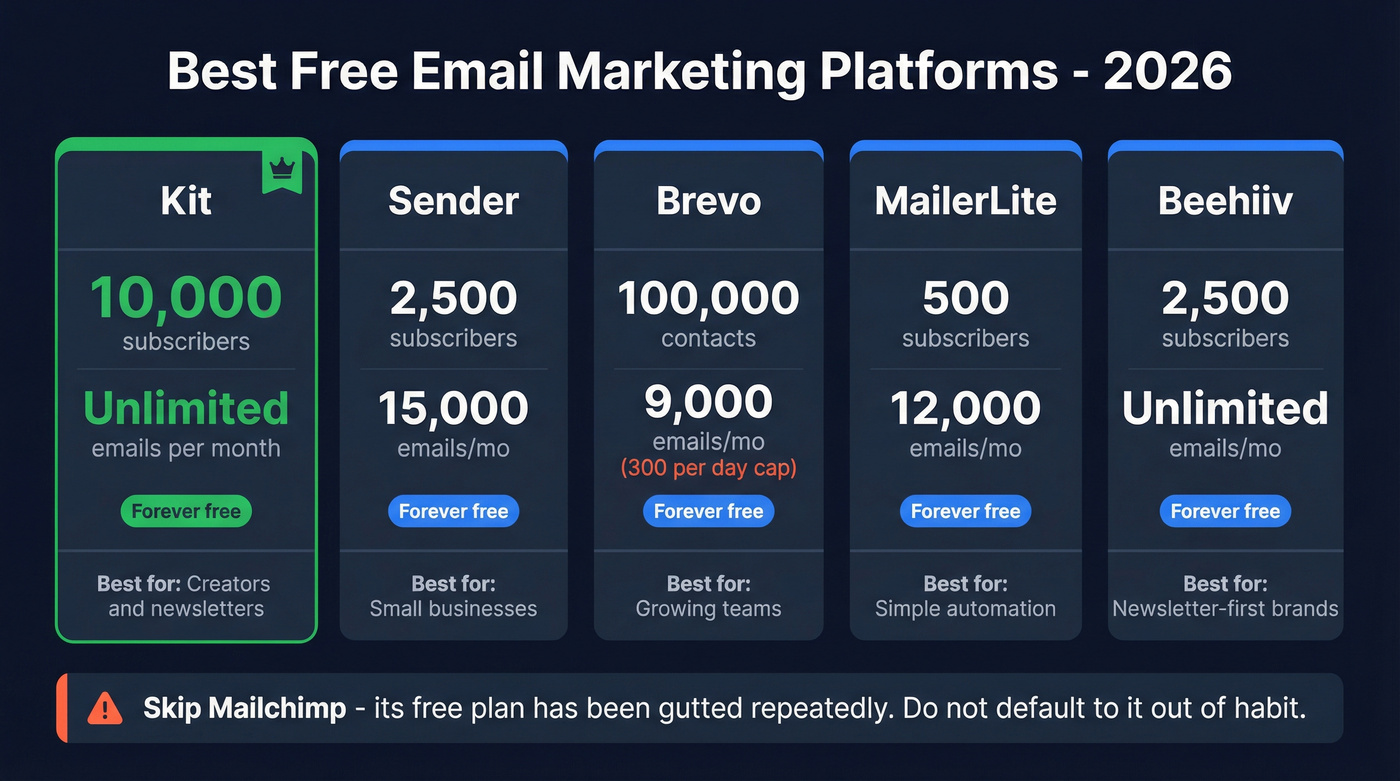
| Platform | Free Tier | Subscribers | Emails/Month | Best For |
|---|---|---|---|---|
| Kit | Forever free | 10,000 | Unlimited | Creators & newsletters |
| Sender | Forever free | 2,500 | 15,000 | Small businesses |
| Brevo | Forever free | 100,000 contacts | ~9,000 (300/day) | Growing teams |
| MailerLite | Forever free | 500 | 12,000 | Simple automation |
| Beehiiv | Forever free | 2,500 | Unlimited | Newsletter-first |
Mailchimp's free plan has been gutted repeatedly over the past few years. Don't default to it out of habit.
Kit (ConvertKit) - Best for Creators
Kit's free plan is absurdly generous: 10,000 subscribers with unlimited emails. The catch is you don't get automation sequences on the free tier - just broadcasts and basic landing pages. But for building and emailing a list, nothing else comes close at this price (free). Paid plans start at $15/mo when you need automation. If you're running a newsletter or content-led growth strategy, Kit is the obvious starting point.
Sender - Best for Small Businesses
Sender gives you 2,500 subscribers and 15,000 emails per month on the free plan, with automation included. That's a meaningful difference from Kit if you need drip sequences without paying. The drag-and-drop editor is straightforward, and deliverability is solid. Paid plans start around $15/mo. For a small business running email campaigns, Sender punches well above its weight class.
Brevo - Best for Growing Teams
Brevo's free tier allows 100,000 contacts - by far the largest contact limit on any free plan. The constraint is sending: 300 emails per day, roughly 9,000 per month. If you have a large list but send infrequently (monthly newsletters, event announcements), Brevo's free plan is perfect. Businesses that regularly clean their email lists see a 15% improvement in deliverability rates, so pair Brevo's generous contact limit with quarterly list hygiene. Paid plans start at $9/mo for higher send volumes.
MailerLite & Beehiiv - Honorable Mentions
MailerLite offers 500 subscribers and 12,000 emails/month free, with a clean editor and decent automation. Beehiiv is newsletter-focused with 2,500 subscribers and unlimited sends on the free tier - great if your lead generation strategy is content-first. Both are solid depending on your workflow. MailerLite paid starts at $10/mo; Beehiiv at $49/mo.
How to Build a Free Email List With Organic Strategies
Tools find emails. Strategies create demand. Here are seven approaches that generate leads without spending a dollar on software - backed by data on what actually moves the needle.
1. Blog content + lead magnets. Sites with a blog generate 67% more leads than those without. The formula is simple: write something useful, gate the deeper version behind an email capture form. A "2026 Cold Email Templates" PDF behind a landing page will outperform a generic "subscribe to our newsletter" box every time. One Reddit user built 500+ email subscribers in three months for a furniture store using this exact approach - free content driving opt-ins into behavior-triggered email campaigns.
2. Website conversion optimization. A 5% improvement in your website's conversion rate can double your leads without increasing traffic. Exit-intent popups, sticky bars, and inline CTAs are free to implement with tools like BDOW (formerly Sumo) or Beehiiv's embeddable forms. Most B2B sites convert at 2-3%. Getting to 4-5% is achievable with basic optimization.
3. Social selling on professional networks. 80% of B2B leads come from professional networks. Posting consistently, engaging in relevant conversations, and DMing warm prospects costs nothing but time. The key is providing value before asking for anything - share insights, comment thoughtfully, build familiarity. Then use a tool like Prospeo's Chrome extension to grab verified emails when someone engages back.
4. Referral programs. Referred customers have 30% higher lifetime value than those acquired through paid channels. A simple "refer a colleague, get [benefit]" program turns your existing customers into a lead generation engine. You don't need software for this - a Google Form and a spreadsheet work fine at small scale.
5. Email nurture sequences. Businesses using email lead nurturing generate 50% more sales-ready leads at 33% lower cost. The mistake most teams make is treating email as a one-shot channel. Sequences with 4-6 emails see up to 50% higher reply rates than single-touch campaigns. Cold email benchmarks sit at 15-25% open rates and 1-5% reply rates - a well-built nurture sequence pushes you toward the top of those ranges.
6. SEO. The top 3 Google results capture 75% of clicks. If you can rank for terms your buyers search, you get a steady stream of inbound contacts without ongoing spend. It takes time - 6 to 12 months for most competitive terms - but the compounding effect is unmatched.
This is the most sustainable way to build a free email list over the long term.
7. Content repurposing. Repurposing existing content saves 70% more time than creating from scratch. Turn a blog post into a carousel, a webinar into 10 short clips, a case study into an email sequence. Every piece of content should live in at least three formats.
Before you send a single cold email from any of these strategies, verify every address. Any verification tool beats sending blind - one bad bounce cascade can tank your domain reputation for weeks.
Mistakes That Kill Your Email Lead Generation
I've seen teams waste months blaming their copy, their subject lines, their send times - when the real problem was a 15% bounce rate from bad data. Fix the data first. Everything else gets easier after that.
Do this: Define your ICP with specific firmographic and behavioral criteria before you prospect.
Not that: Cast a wide net and hope volume compensates for poor targeting. It won't. Broad targeting drains resources and stifles sales productivity.
Do this: Build a 4-6 email nurture sequence for every lead source.
Not that: Send one email and move on when they don't reply. Very few B2B leads are ready to buy immediately. The "now or never" mindset is one of the most costly mistakes in lead gen.
Do this: Diversify across at least three channels - cold email, content, social, referrals.
Not that: Go all-in on a single channel. Over-reliance on one source is a recipe for unpredictable performance. When that channel dips (and it will), your pipeline disappears.
Do this: Verify every email before sending. Run your list through an email verifier, remove invalids, handle catch-alls carefully.
Not that: Trust the "95% accuracy" claim on your email finder's marketing page. Independent testing shows error rates of 16-22% for popular tools. Your sender reputation can't absorb that.
Do this: Track bounce rates, reply rates, and spam complaints per list source.
Not that: Ignore data quality metrics until your domain gets blacklisted. By then, recovery takes weeks. Prevention is infinitely cheaper than remediation.
Cold Email Compliance - What You Need to Know
Cold emailing is legal in most countries. But "legal" comes with conditions, and the penalties for getting it wrong are severe enough to sink a small company.
| Regulation | Region | Key Requirement | Max Penalty |
|---|---|---|---|
| CAN-SPAM | US | Opt-out, physical address, honest headers | $50,120/email |
| GDPR | EU/UK | Consent or legitimate interest | EUR20M or 4% revenue |
| CASL | Canada | Express/implied consent | $10M/violation |
| Spam Act | Australia | Explicit consent | $1.1M AUD |
The good news for B2B teams: cold email is generally more permissible than B2C under GDPR. The "legitimate interest" basis allows you to email business contacts when you have a reasonable basis for believing your product is relevant to their role. That's not a blank check - you still need to document your reasoning and honor opt-outs immediately.
The UK's post-Brexit PECR rules offer even more flexibility for B2B cold email, as long as you include a clear opt-out mechanism.
Here's what trips people up: 53% of users mark emails as spam because they can't find an unsubscribe link. Not because they hate your product - because you made it hard to say no. Every cold email needs a visible, one-click unsubscribe. Period.
Technical requirements matter too. SPF, DKIM, and DMARC authentication aren't optional anymore - major email providers reject unauthenticated messages outright. If you haven't set these up, do it before you send a single cold email. (If you need the checklist, start with SPF, DKIM, and DMARC.) European regulators have issued six-figure fines for GDPR consent record failures, and the FTC now monitors email compliance automation tools. 68% of marketers find it challenging to stay compliant due to constantly changing regulations.
The frustrating part? None of this is hard to implement. Physical address in the footer, one-click unsubscribe, honest subject lines, SPF/DKIM/DMARC records. It takes an afternoon to set up and protects you from six-figure fines. Just do it.
Stack Optimize scaled to $1M ARR with sub-3% bounce rates across every client. The difference? Proprietary email infrastructure that doesn't rely on the same third-party validators as the 15 tools that failed the Dropcontact benchmark. At $0.01/email when you outgrow free, it's 90% cheaper than ZoomInfo.
Get free email leads that actually land in inboxes.
FAQ
How do I get free email leads without buying a list?
Use a free email finder tool like Prospeo (75 verified emails/month), Hunter, or Skrapp, then supplement with organic tactics like blog content gated behind lead magnets. The most effective approach pairs a finder tool for targeted B2B prospecting with inbound content that attracts subscribers over time. Sites with blogs generate 67% more leads than those without.
Is cold emailing legal?
Yes - cold emailing is legal in most countries when you follow the relevant regulations. CAN-SPAM (US) requires opt-out mechanisms, a physical address, and honest subject lines. GDPR (EU/UK) allows B2B cold email under "legitimate interest" with proper documentation. Penalties reach $50,120 per email under CAN-SPAM and EUR20M under GDPR.
How many free emails can I find and send per month?
For email finders: Prospeo gives 75 verified emails, Skrapp gives 100 credits, Hunter gives 50 credits. For marketing platforms: Sender allows 15,000 emails/month, Brevo allows roughly 9,000/month, and Kit offers unlimited sends to 10,000 subscribers. Most teams need one finder tool plus one marketing platform.
Why is my bounce rate so high with free email tools?
Most free email finders claim 95%+ accuracy, but independent testing shows 16-22% error rates for popular tools like Hunter and GetProspect. The root cause: nearly all tools rely on the same third-party databases and validators. Choose a tool with proprietary verification and always run a separate verification pass before sending.
Can I use free tools for large-scale cold outreach?
Free tiers are designed for testing, not scaling - at 50-100 credits per month, you'll exhaust them in days. If cold outreach is a core revenue channel, budget $30-60/month for a paid plan. Email marketing returns $36-$40 per $1 spent, so even a modest paid tool pays for itself with one closed deal.