How to Generate B2B Leads That Actually Convert in 2026
Your SDR team sent 2,000 emails last month. They booked three meetings. Not because the messaging was bad or the ICP was wrong - because 700 of those emails bounced, another 400 landed in spam, and the remaining 900 hit inboxes of people who changed jobs six months ago. The machine built to generate B2B leads isn't broken. The data feeding it is.
We're skipping the generic "try content marketing!" advice here. What follows: real CPL benchmarks by industry, a modern AI-powered stack you can build for under $250/month, and the unsexy data quality fix that separates teams booking 30 meetings a month from teams booking three.
What You Need (Quick Version)
Where to spend: B2B SaaS leads cost $237 blended ($310 paid, $164 organic). Organic costs 35-50% less but takes 6-12 months to compound. Know your industry's CPL before you set a budget.
What stack to build: You don't need a $40K/year platform. Three tools, under $250/month total:
- Prospeo for verified contact data (free tier, paid from ~$39/mo) - 300M+ profiles, 143M+ verified emails, 125M+ verified mobile numbers, 98% email accuracy, 7-day data refresh
- Instantly or Smartlead for cold email sequences ($37/mo)
- Clay for workflow automation and enrichment waterfalls ($149/mo)
What to fix first: Data quality. Snyk had 50 AEs running outbound with 35-40% bounce rates. They fixed the data layer first. AE-sourced pipeline went up 180%. Everything else - messaging, channels, cadence - is a multiplier on clean data. Bad data multiplied by great strategy still equals bad results.
What B2B Leads Actually Cost
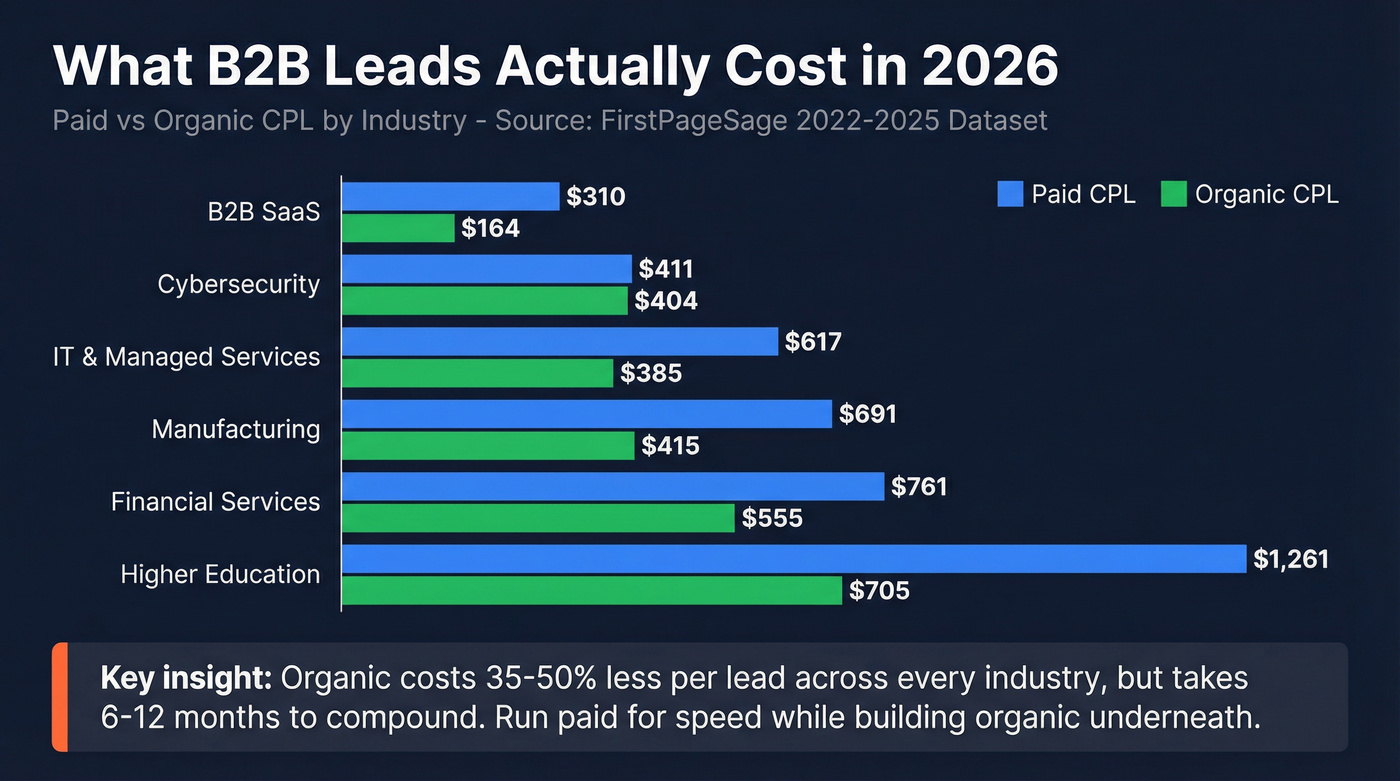
Most teams set lead gen budgets based on vibes. Here's what the numbers actually look like, pulled from FirstPageSage's multi-year dataset covering January 2022 through June 2025.
| Industry | Paid CPL | Organic CPL | Blended CPL |
|---|---|---|---|
| B2B SaaS | $310 | $164 | $237 |
| Cybersecurity | $411 | $404 | $406 |
| IT & Managed Services | $617 | $385 | $503 |
| Manufacturing | $691 | $415 | $553 |
| Financial Services | $761 | $555 | $653 |
| Higher Education | $1,261 | $705 | $982 |
The pattern holds across every industry: organic channels cost 35-50% less per lead. But organic takes time - six to twelve months before content and SEO start compounding. Paid channels buy speed. The smart play is running paid for immediate pipeline while building organic infrastructure underneath.
Here's what most teams miss: these are cost-per-lead numbers, not cost-per-opportunity. If your data quality is poor and half those leads bounce or go to the wrong person, your effective CPL doubles. A $237 blended CPL becomes $474 when your bounce rate sits at 35%. Data quality is a direct line item on your unit economics, whether your dashboard shows it or not.
Cybersecurity stands out as an anomaly - organic CPL ($404) barely undercuts paid ($411), which means content alone won't save you in that vertical. You need direct outreach with verified contacts to move the needle.
The Modern Lead Gen Stack
The 2026 lead gen stack isn't one tool. It's a workflow. Intent data feeds enrichment, enrichment feeds scoring, scoring feeds personalization, and personalization feeds sequences. Each layer compounds the one before it. Teams running this full loop report 50-70% lead quality increases, 3-5x response rate lifts, and 20-30% shorter sales cycles compared to static list-based outbound.
| Tool | Category | Starting Price | Best For |
|---|---|---|---|
| Apollo | Database + Sequences | $49/user/mo | SMB all-in-one |
| ZoomInfo | Enterprise Database | $15K+/yr | Large sales orgs |
| Clay | Workflow Automation | $149/mo | Enrichment waterfalls |
| Instantly | Cold Email Sequences | $37/mo | High-volume outbound |
| Salesloft | Sales Engagement | $125+/user/mo | Enterprise sequences |
| 6sense / Demandbase | Intent + ABM | $30-100K+/yr | Enterprise intent |
That ZoomInfo line is the anchor. At $15K+/year for a single seat, it's the incumbent - and the reason the $250/month stack below exists.
Intent and Signals
Signal-based selling has replaced spray-and-pray. The framework: identify who's researching your category, when they're actively in-market, and why that moment matters for outreach timing.
Skip this if: Your average deal size is under $5K and your sales cycle is under two weeks. Intent data pays for itself on deals with longer consideration windows. For transactional sales, spend the budget on volume instead.
Enrichment and Verification
This is the layer where most stacks quietly fail. You pull a list of 500 VP-level contacts, push them into a sequence, and 150 bounce. Your domain reputation takes a hit. Your deliverability drops for the next campaign too. It's a compounding problem that gets worse with every send.
Look for data that refreshes weekly - not every six weeks, which is the industry average - because roughly 30% of B2B data decays annually. Apollo works as a secondary enrichment source at $49/user/mo with 275M+ contacts, though its email accuracy sits around 79%. In our experience, running an enrichment waterfall through Clay that checks multiple sources and verifies the output catches the gaps any single provider misses.
Scoring and Prioritization
In one documented case, predictive scoring hit 90%+ accuracy identifying high-conversion leads - top-scoring leads converted at 3.5x the average rate, while bottom-tier leads saw an 80% conversion drop. Reps stopped wasting time on them entirely.
Even a basic scoring model combining intent signals, firmographic fit, and engagement data will outperform "work the list top to bottom" every time. You don't need a six-figure AI platform for this. A weighted spreadsheet model beats no model.
Sequences and Outreach
For cold email at scale, Instantly ($37/mo) and Smartlead are the value picks - inbox rotation, warmup, and deliverability monitoring built in. Salesloft at $125+/user/month is the enterprise play with deeper CRM integration.
Generic cold email reply rates sit at 1-3%. AI-personalized outreach with clean data pushes that to 5-10%+. The gap between those two numbers is the entire argument for investing in enrichment and personalization before you touch your copy.
The $250/Month Stack
If you're building from scratch, here's the opinionated pick:
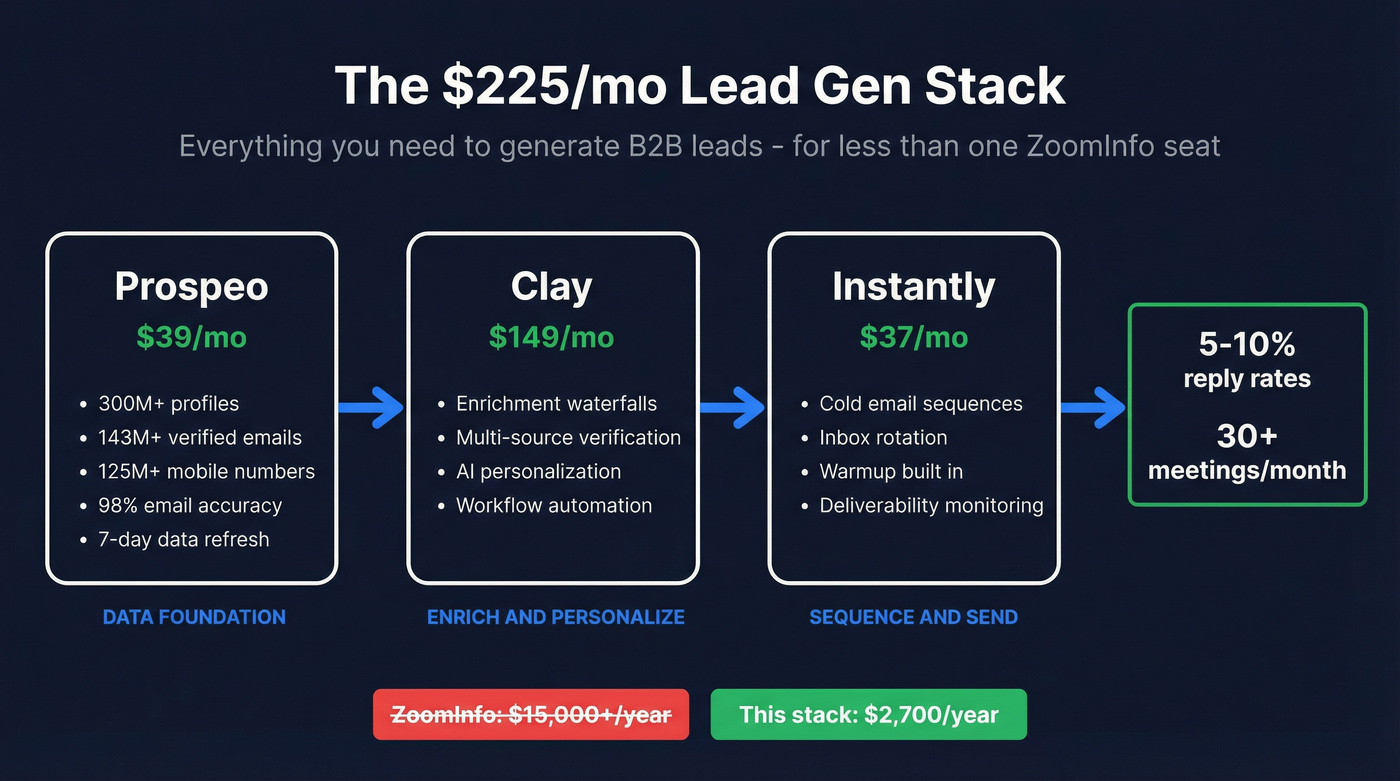
- Prospeo (~$39/mo) - verified contact data, email finder, mobile numbers, intent signals. Your data foundation.
- Instantly ($37/mo) - cold email sequences with inbox rotation and warmup built in.
- Clay ($149/mo) - workflow automation, enrichment waterfalls, AI personalization at scale.
Total: $225/month. That's less than a single ZoomInfo seat, and you get cleaner data with more workflow flexibility.
Look, ZoomInfo is still the most comprehensive all-in-one platform. But most teams don't need all-in-one. They need accurate emails, working phone numbers, and a way to sequence them. Paying $15K/year for features you'll never touch is how RevOps budgets die quietly.

That $237 blended CPL doubles to $474 when 35% of your emails bounce. Prospeo's 98% email accuracy and 7-day data refresh cut bounce rates below 4% - Snyk proved it across 50 AEs, driving 180% more pipeline.
Stop paying twice for every lead. Fix the data layer first.
Data Quality - The Multiplier
Nobody gets excited about data hygiene. It's the single highest-leverage fix for most outbound teams though, and ignoring it is quietly destroying pipeline.
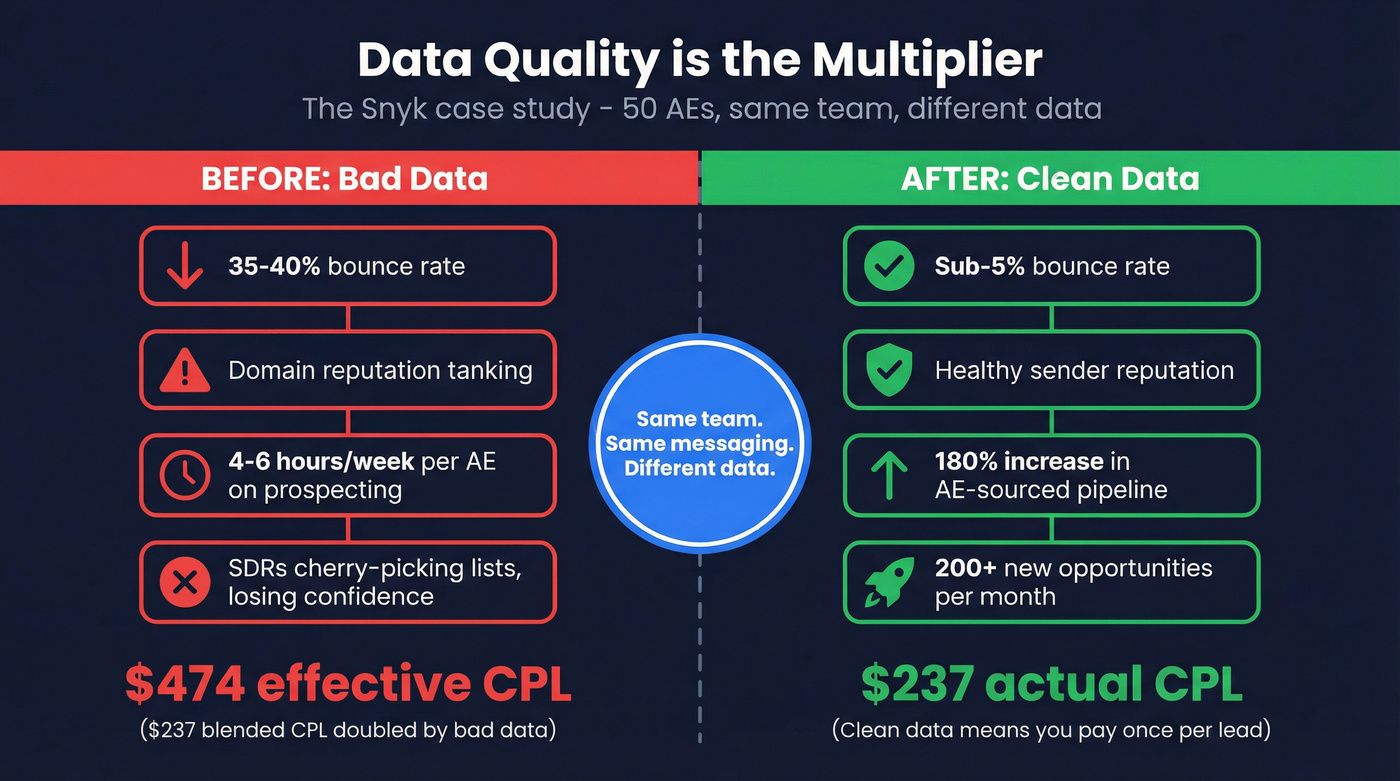
When 35% of your emails bounce, three things happen simultaneously. Your email domain reputation tanks, so more of your future sends get filtered. Your sequences waste credits and rep time on contacts that don't exist. And your SDRs lose confidence in the data, so they start cherry-picking instead of working the full list. We've watched this exact pattern play out with teams that come to us after burning through two or three other data providers.
Snyk's story illustrates this perfectly. They had 50 AEs each spending 4-6 hours per week on prospecting. Bounce rates ran 35-40% with their previous data provider. After switching to a verification process that includes catch-all domain handling, spam-trap removal, and honeypot filtering, their bounce rate dropped below 5%. AE-sourced pipeline jumped 180%, and the team started generating 200+ new opportunities per month.
The mechanics matter. A proper verification stack runs distinct checks on every email: syntax validation, domain verification, catch-all handling, and spam-trap/honeypot filtering. A weekly refresh cycle means you're not emailing someone who left the company last month. Providers refreshing every six weeks can't keep up - by the time their data updates, your bounce rate has already spiked.
If your current bounce rate is above 5%, stop optimizing your subject lines. Stop A/B testing your CTAs. Fix the data first. Everything else is a rounding error until your emails actually reach inboxes.
300M+ profiles, 143M+ verified emails, 125M+ mobile numbers - all refreshed every 7 days, not the 6-week industry average. Stack Optimize built a $1M agency on this data with sub-3% bounce rates and zero domain flags.
Clean data at $0.01/email. No contracts. No sales calls.
Five Mistakes That Kill Lead Gen
Slow Follow-Up
Contacting a lead within 60 seconds of their inquiry increases conversion odds by 391%. Most teams respond in hours. Some respond in days. By then, the prospect has already booked a demo with your competitor who had instant routing set up. If you don't have automated lead routing, that's your next infrastructure investment - before you spend another dollar on lead gen.
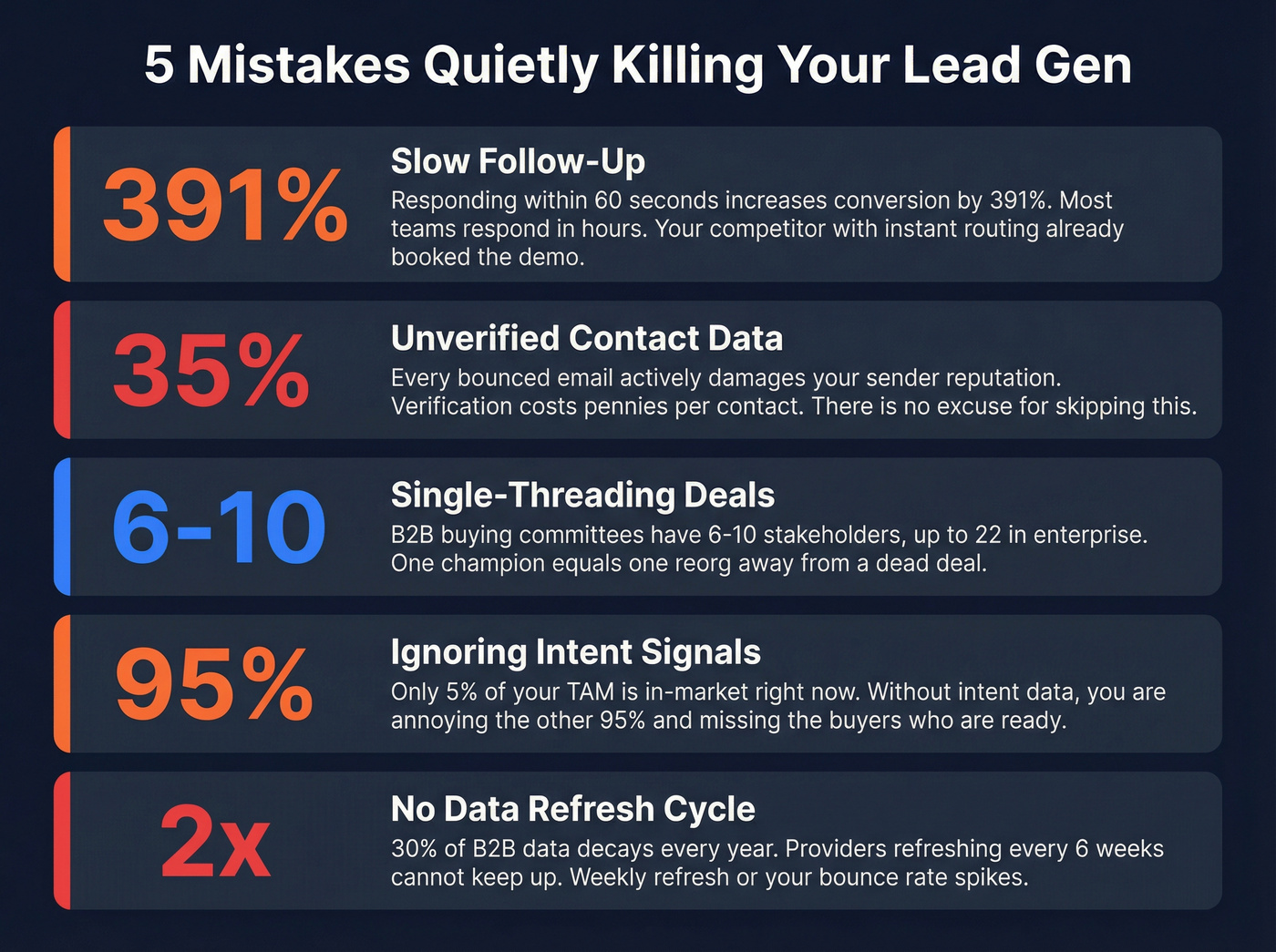
Unverified Contact Data
Every bounced email isn't just a wasted touch - it's active damage to your sender reputation. Verification costs pennies per contact, and the ROI is immediate. Run every list through a verification tool before every campaign. There's no excuse for skipping this step.
Single-Threading Deals
B2B purchase decisions involve a buying committee of 6-10 stakeholders, and complex enterprise deals can involve up to 22. If your reps are only talking to one champion, they're one reorg away from a dead deal. Multi-thread every opportunity above your average deal size - build contact maps for the full buying committee including the economic buyer, technical evaluator, end user, and legal.
Ignoring Intent Signals
Spraying cold emails at static lists is the 2020 playbook. Intent data tells you which accounts are actively researching your category right now. Teams that layer intent signals into their outreach prioritize the 5% of their TAM that's actually in-market instead of annoying the 95% that isn't. The consensus on r/sales is pretty clear: generic blast outreach is dying, and signal-based targeting is what's working for teams that track their numbers.
Measuring MQLs Instead of Pipeline
If marketing celebrates 500 MQLs while sales complains about lead quality, your measurement is broken. MQL volume is a vanity metric that incentivizes the wrong behavior - gating mediocre content behind forms to inflate numbers. The MQL-to-SQL handoff matters less than whether the opportunity actually closes. Measure cost per opportunity, pipeline velocity, and revenue influenced.
How to Get B2B Leads From Three Channels
94% of marketers diversified their channel mix last year. The question isn't whether to diversify - it's where to concentrate.
Signal-Based Outbound
Outbound isn't dead. Lazy outbound is dead.
The modern version starts with intent signals - who's researching your category, what topics they're consuming, which accounts show buying behavior - and builds personalized outreach around that context. The framework from Amplemarket's research puts it well: decide who to contact, when to act, and why that moment matters.
A cold email to a VP of Engineering that references their company's recent job postings for your tech stack gets a fundamentally different response than "Hi, I noticed you're in the software space." One nuance specific to B2B: many buyers use corporate email rarely associated with personal social accounts, so Facebook and Instagram targeting doesn't work the way it does in B2C. Your outbound needs to reach professional inboxes directly, which circles back to having verified business email data before you write a single subject line.
Content That Compounds
49% of marketers report declining traditional search traffic due to AI-generated answers, per HubSpot's 2026 State of Marketing report. That sounds alarming until you read the next stat: AI referral traffic is 58% higher intent. The visitors who do click through from AI summaries are more qualified than the old Google click-through crowd.
The play in 2026 is publishing content with a genuine point of view - 61% of marketers say brand POV matters more in an AI-plus-human world. Generic "what is lead generation" posts get summarized by AI and never clicked. Opinionated, data-rich content with original benchmarks earns the click-through and helps you attract higher-quality prospects from organic channels over time. Video compounds this further: 78% of B2B marketers already use video, and brands combining video with creator partnerships are 2.2x more likely to be trusted.
ABM for High-Value Accounts
For enterprise deals, account-based marketing remains the highest-ROI channel - but only when executed with discipline. Build a target account list of 20-50 companies, use intent platforms to identify which are actively in-market, and run coordinated outreach across the buying committee. Stop tracking MQLs for ABM. Track account-level engagement, pipeline velocity, and average contract value.
A single enterprise deal from a well-executed ABM program can return more than an entire quarter of MQL-driven inbound. We've seen teams waste ABM budgets by targeting 500+ accounts - that's not ABM, that's just marketing with extra steps. Keep the list tight, go deep, and multi-thread aggressively.
Metrics That Actually Matter
The metrics that matter in 2026 aren't the ones most dashboards show.
Buying-group coverage - what percentage of the buying committee have you engaged at each target account? If you're only reaching one contact per account, you're single-threaded and vulnerable.
Pipeline velocity - how fast do opportunities move from creation to close? This catches process bottlenecks that lead volume metrics hide entirely.
Cost per opportunity - not cost per lead. A $500 CPL that converts at 20% to opportunity is cheaper than a $100 CPL that converts at 2%.
Speed-to-lead - measure the time between a lead's first action and your team's first response. If it's over five minutes, you're leaving conversion on the table.
ACV by source - which channels produce the largest deals, not just the most leads? Events might have the highest CPL but also the highest average deal size. Cold email might generate volume but skew toward smaller contracts. Let the revenue data guide your channel mix, not the lead count.
A team generating 50 high-intent leads with full buying-committee coverage will outperform a team generating 500 unqualified MQLs every single quarter. If you want to generate B2B leads that actually move pipeline, measure what matters downstream - not what looks good on a slide.
FAQ
What is B2B lead generation?
B2B lead generation is the process of identifying and attracting potential business buyers through outbound outreach, inbound content, paid channels, or a combination - then qualifying them for your sales team. In 2026, effective programs layer intent data, verified contacts, and personalized sequences rather than relying on a single channel.
How much does a B2B lead cost?
B2B SaaS averages $237 blended ($310 paid, $164 organic). Financial services averages $653. Cybersecurity sits at $406. Organic channels cost 35-50% less but take 6-12 months to compound, so most teams run paid for immediate pipeline while building organic underneath.
What's the best tool for finding B2B leads?
For verified contact data, Prospeo offers 300M+ profiles with 98% email accuracy at ~$0.01 per email - with a free tier of 75 emails per month. For sequences, Instantly ($37/mo) or Smartlead. For workflow automation, Clay ($149/mo). Start with the Chrome extension to build verified lists in minutes rather than days.
Is cold email still effective in 2026?
Yes, but only with verified data and strong personalization. Generic cold email reply rates sit at 1-3%. AI-personalized outreach with clean data pushes that to 5-10%+ reply rates. Multichannel approaches that add social touches see even higher engagement.
How many leads should a B2B company generate per month?
There's no universal number - focus on cost per opportunity and pipeline velocity instead of raw volume. A team generating 50 high-intent leads with buying-committee coverage consistently outperforms one generating 500 unqualified MQLs. Measure downstream revenue impact, not top-of-funnel vanity metrics.