

Metadata vs 6sense: You're Probably Asking the Wrong Question
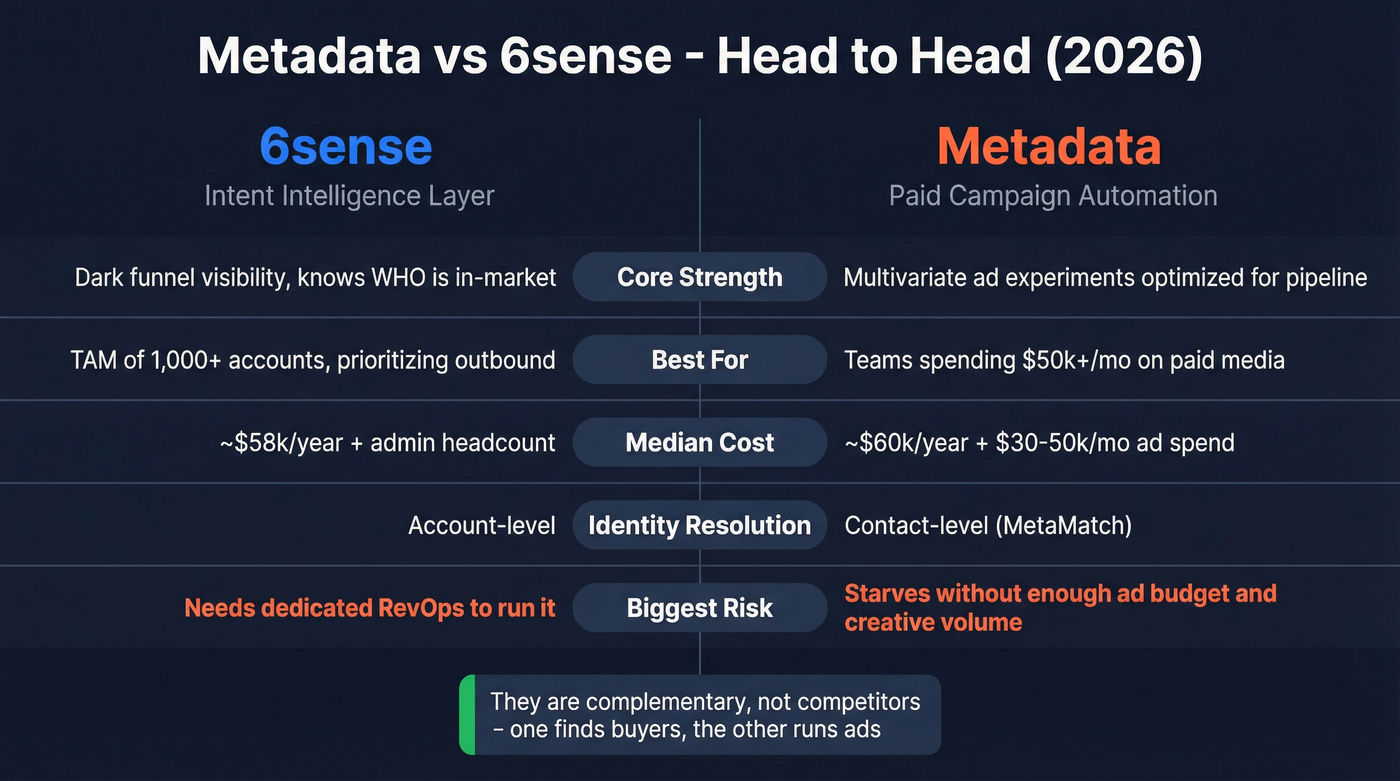
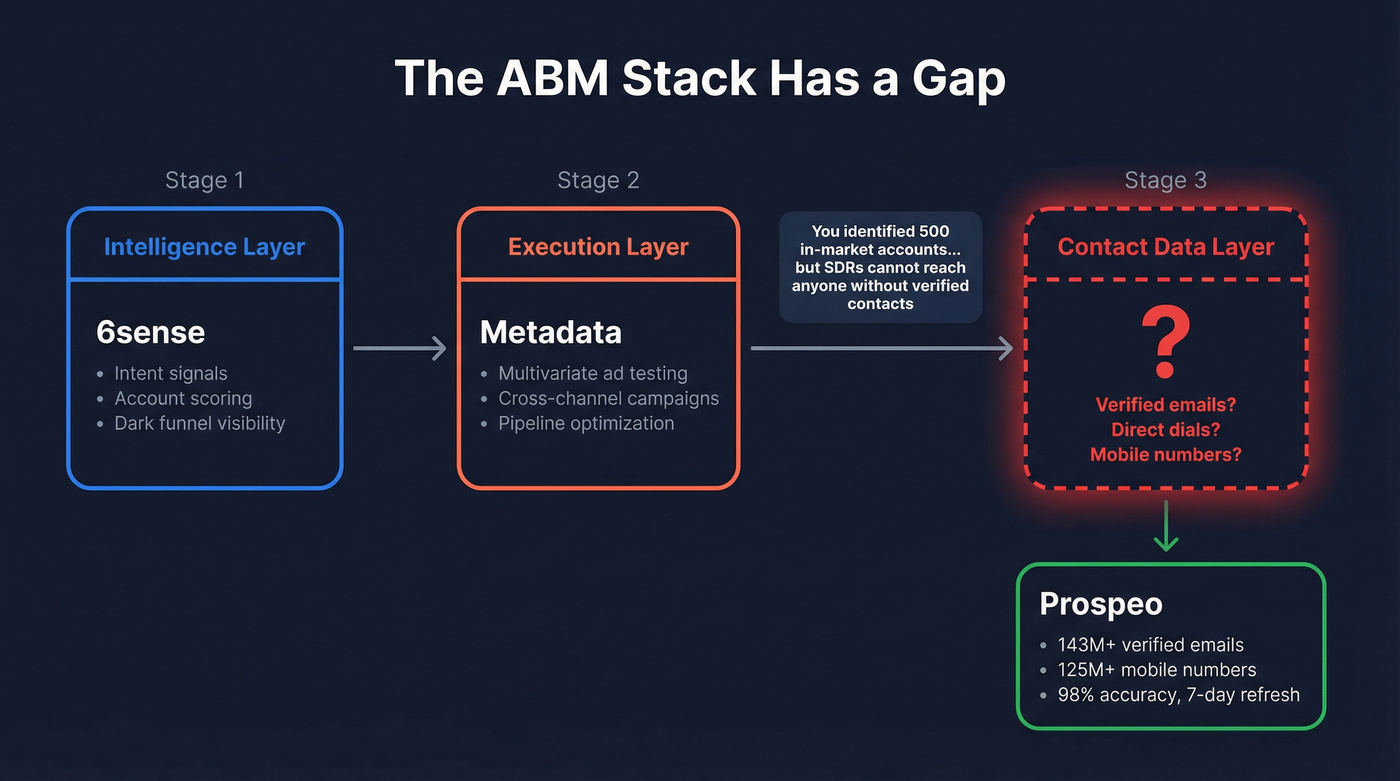
Your VP asked you to evaluate ABM platforms, and somehow Metadata and 6sense ended up on the same shortlist. Here's the thing - they don't actually compete. 6sense is an intelligence layer that tells you who's in-market. Metadata is an execution layer that runs and optimizes your paid campaigns. Comparing them is like comparing Salesforce to Google Ads.
The real question isn't which one to buy. It's whether you need either one yet, and what foundational layer you're missing regardless.
30-Second Verdict
- Pick 6sense if your TAM is 1,000+ accounts, you need intent signals to prioritize outbound, and you've got budget for a ~$58k/year median contract plus implementation and admin headcount.
- Pick Metadata if you're spending $50k+/month on paid media and need multivariate experimentation optimized toward pipeline, not MQLs.
- Skip both if you're an SMB or early-stage team. Use a lighter outbound stack and save the enterprise ABM budget for when your pipeline justifies six-figure software spend.
What Each Tool Actually Does
6sense - Intent Intelligence
Named a Leader in The Forrester Wave: Intent Data Providers for B2B, 6sense is a "dark funnel" visibility engine. It tracks buyer intent across 40+ languages, claiming 10x the coverage of other B2B intent providers, and partners with Bombora, TechTarget, TrustRadius, and G2 to aggregate signals. Predictive AI scores accounts and surfaces them to sales when they're actively researching your category.

Recent updates brought Connected TV advertising with 90%+ completion rates, proactive email validation for AI Email campaigns, and a redesigned Chrome Extension Copilot. There's also a free tier with 50 data credits per month - limited, but a real way to test before committing.
The core value is SDR prioritization. TrustRadius reviewers consistently say 6sense works best when you're selling to a defined account list and need to know when those accounts start researching again.
Metadata - Paid Campaign Automation
The Eightfold.ai case study tells you everything: $8M pipeline created, 13 closed-won deals, and 1,414 hours of manual work automated. Metadata takes your budget and runs multivariate experiments across channels like Meta, Google, Reddit, and professional social ads from a single interface, then optimizes toward pipeline and revenue via your CRM. Their patented MetaMatch identity graph matches personal identities to corporate profiles, enabling B2B-grade targeting on traditionally B2C channels.

Capterra rates it 4.4/5 based on 25 reviews. If you've got creative volume and ad budget, Metadata finds winning combinations faster than any human media buyer. But it needs fuel - more on the budget math below.
Feature-by-Feature Breakdown
| Feature | 6sense | Metadata | Winner |
|---|---|---|---|
| Intent data | Native, 40+ languages | Not native | 6sense |
| Ad execution | Display + CTV | Meta, Google, Reddit, professional social | Metadata |
| Experimentation | Limited | Multivariate at scale | Metadata |
| Revenue attribution | Account-level | Campaign-level via CRM | 6sense |
| Identity resolution | Account-level | MetaMatch (contact-level) | Metadata |
| Chrome extension | AI Copilot | No | 6sense |
| CRM integrations | Salesforce, HubSpot | Salesforce, HubSpot | Tie |
Both tools sit around ~4.4/5 on G2. The practitioner consensus across review sites is consistent: 6sense is powerful but demands dedicated admin ownership, while Metadata needs serious ad budget to justify the platform fee. They're complementary, not interchangeable.

6sense and Metadata cost $50K+ each - but neither gives your reps verified contact data. Prospeo fills that gap at $0.01/email with 98% accuracy and a 7-day refresh cycle. Teams using Prospeo book 26% more meetings than ZoomInfo and 35% more than Apollo.
Stop paying enterprise ABM prices for contacts that bounce.
Pricing - What You'll Actually Pay
| 6sense | Metadata | |
|---|---|---|
| Starting price | Free (50 credits/mo) | ~$24,000/year |
| Median contract | ~$58,000/yr | ~$60,000/yr |
| Typical range | $50k-$300k+/year | $30k-$105k/year |
| Hidden costs | RevOps/admin headcount | Ad spend minimum $30k-$50k+/mo |
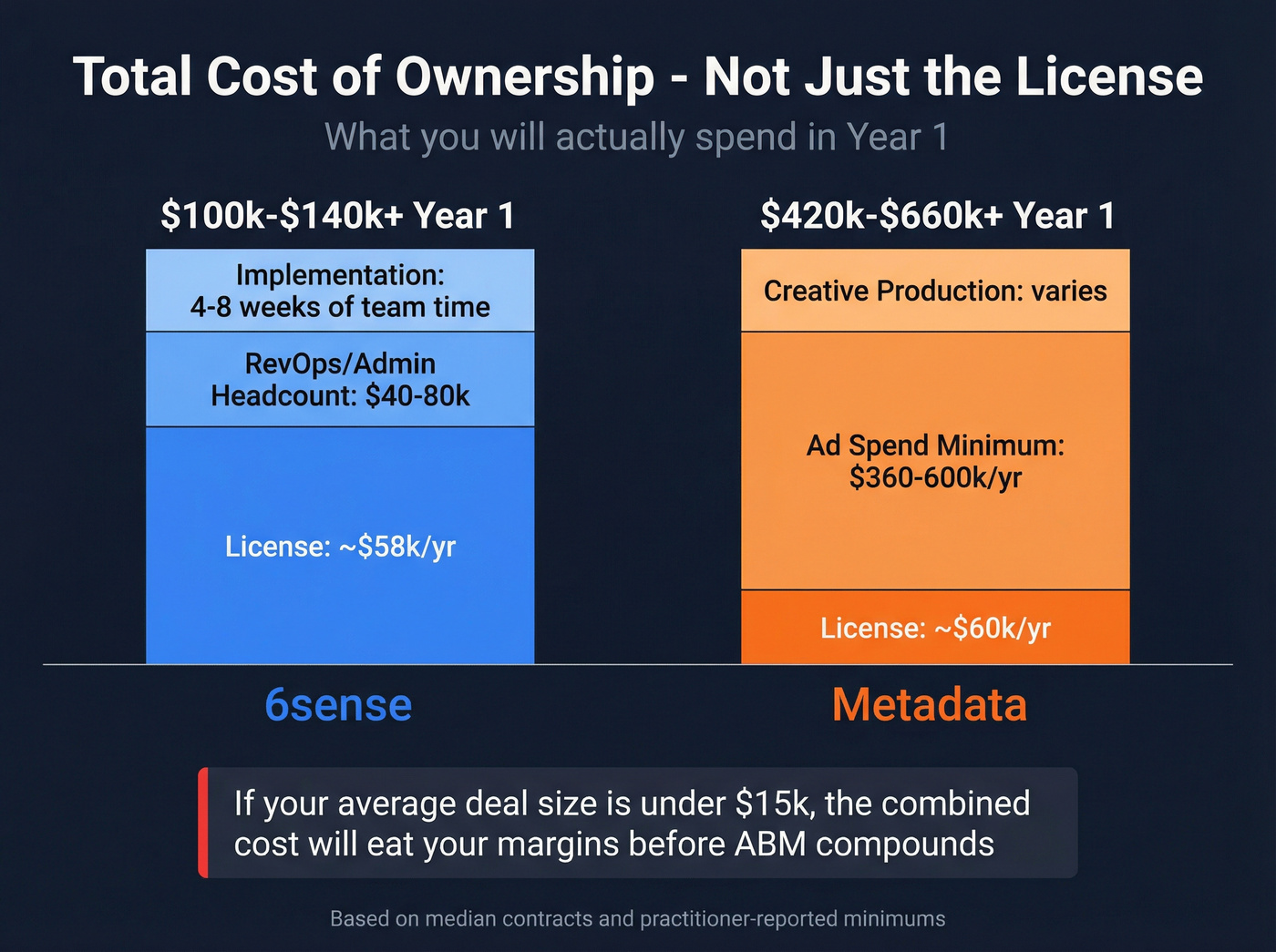
The license costs look similar on paper, but total cost of ownership diverges wildly. 6sense's hidden cost is people - it often requires dedicated RevOps or admin ownership, and credits don't roll over. Metadata's hidden cost is media spend. One TrustRadius reviewer broke down the math: 4 creatives x 2 audiences x 2 channels = 16 experiments at $40/day each, running ~$19k/month minimum just for the experiments to have statistical significance. Below $50k/month in total ad spend, the experimentation engine won't have enough data to shine.
We've seen teams sign 6sense contracts expecting plug-and-play intent data, then spend 4-8 weeks on implementation and another quarter getting reps to actually use the signals. Budget for the full picture - not just the license - or you'll regret it by Q2.
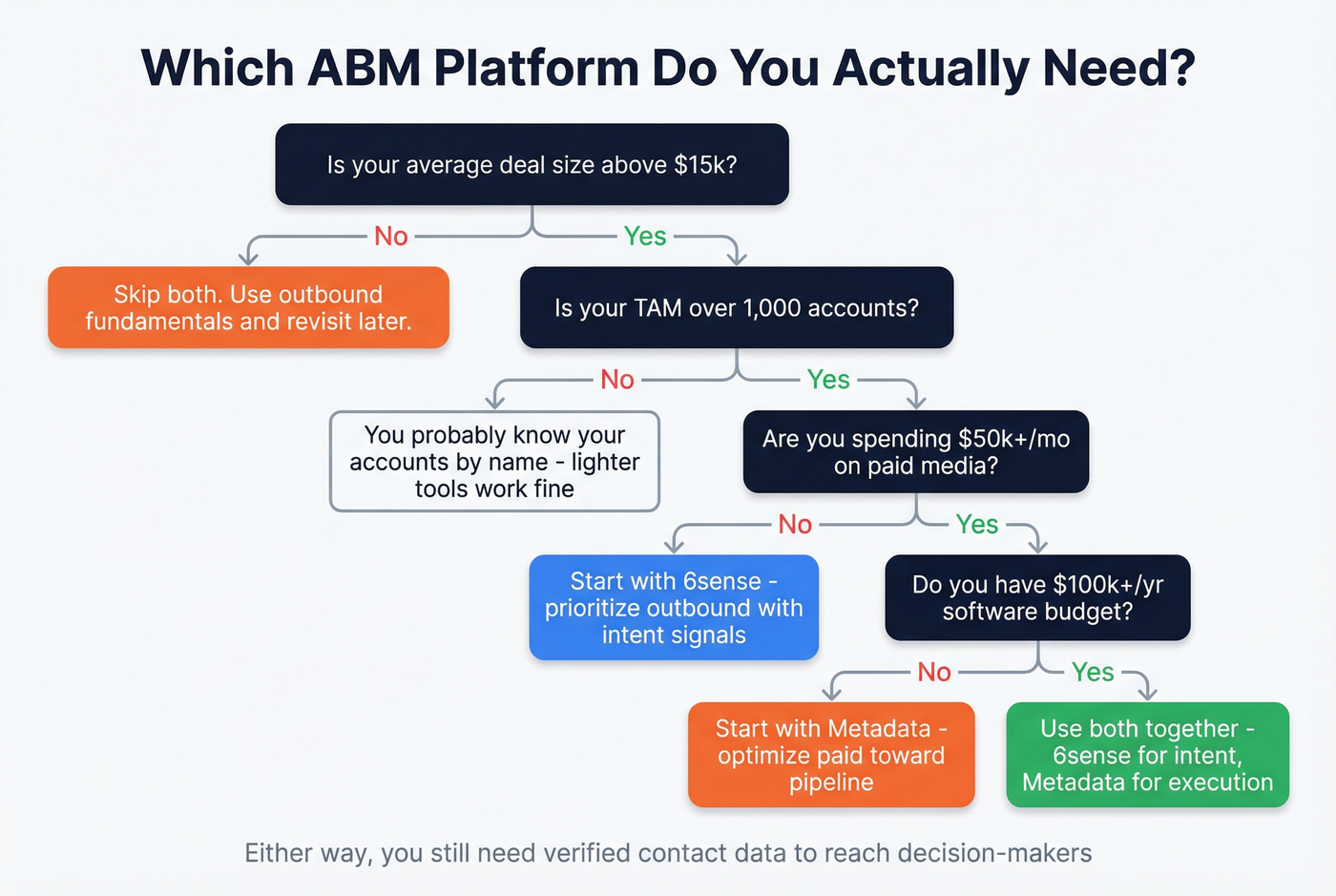
Let's be honest: if your average deal size is under $15k, you probably don't need either platform. The combined cost of software, ad spend, and admin headcount will eat your margins before ABM compounds. Start with outbound fundamentals and revisit when deal sizes justify the infrastructure.
Who Should Pick Which
Pick 6sense When...
Your TAM exceeds 1,000 accounts and you need dark-funnel visibility to prioritize outbound. Knowing which accounts are actively researching your category genuinely changes how reps allocate their time - and for large-TAM sales orgs, that's worth the investment. Skip it if your target market is small enough that you already know every account by name, or if you don't have budget for both the license and the admin to run it.
Demandbase is the closest direct 6sense competitor, combining ABM intelligence and ad execution in a single platform. Worth evaluating if you want fewer vendors.
Pick Metadata When...
You're spending $50k+/month on paid media and want to optimize toward pipeline instead of vanity metrics. In our experience, teams below $30k/month in ad spend get more value from native platform tools than from Metadata's experimentation engine. Skip it if you don't have a steady stream of creative assets to test - the multivariate engine starves without volume.
For teams not ready for enterprise ABM platforms, Apollo.io offers basic ABM targeting and outbound at a fraction of the cost.
The Data Layer Both Tools Miss
Neither platform solves contact data. That's the frustrating part. You ran Metadata for three months, generated 2,000 leads, and half the emails bounce. Or 6sense surfaced 500 in-market accounts, but your SDRs can't find working phone numbers for decision-makers.

Your ABM stack identified 500 in-market accounts. Now what? SDRs need direct dials and verified emails - not more dashboards. Prospeo has 143M+ verified emails and 125M+ mobile numbers with a 30% pickup rate, ready to plug into Salesforce, HubSpot, or your outbound sequencer.
Turn intent signals into booked meetings with data that connects.
FAQ
Can you use 6sense and Metadata together?
Yes - many enterprise teams run 6sense for intent feeding into Metadata for execution. This is the ideal setup if you've got $100k+/year in combined software budget and $50k+/month in ad spend. Smaller teams should start with one and layer the other after proving ROI.
Is 6sense worth it for small teams?
Rarely. If your TAM is under 500 accounts, you're paying ~$58k/year for intent signals you likely don't need. Start with lighter tools - Prospeo offers Bombora-powered intent data across 15,000 topics starting at ~$39/month - and revisit 6sense when pipeline volume justifies it.
Which platform has better attribution reporting?
6sense offers stronger account-level attribution tied to buying stages, while Metadata provides campaign-level attribution via CRM revenue data. For multi-touch ABM reporting, 6sense edges ahead. For paid-media ROI tracking, Metadata is more granular.