How to Find B2B Leads That Actually Convert
It's Monday standup. Your SDR team ran 200 dials last week and connected with eight people. Half the phone numbers in your CRM are dead. The "verified" email list you bought bounced 23% on its first sequence, and your domain reputation just took a hit. B2B contact data decays at 2.1% per month - roughly 22.5% annually - which means a quarter of your database is garbage before the year's out.
If you're trying to find B2B leads that actually turn into pipeline, bad data is the first wall you'll hit.
This isn't another list of 30 tools with no opinion. We've tested the major platforms, compared the numbers, and put together a step-by-step process for building targeted prospect lists with real pricing and the tools worth your time in 2026.
The Short Version
Define your ICP before you touch any tool. Use a verified database - not the biggest one, the freshest one - to build your list. Verify every email before you send, because your domain reputation depends on it.
What Are B2B Leads?
Not all leads are equal, and the type determines which tools and channels you invest in. Three categories matter:
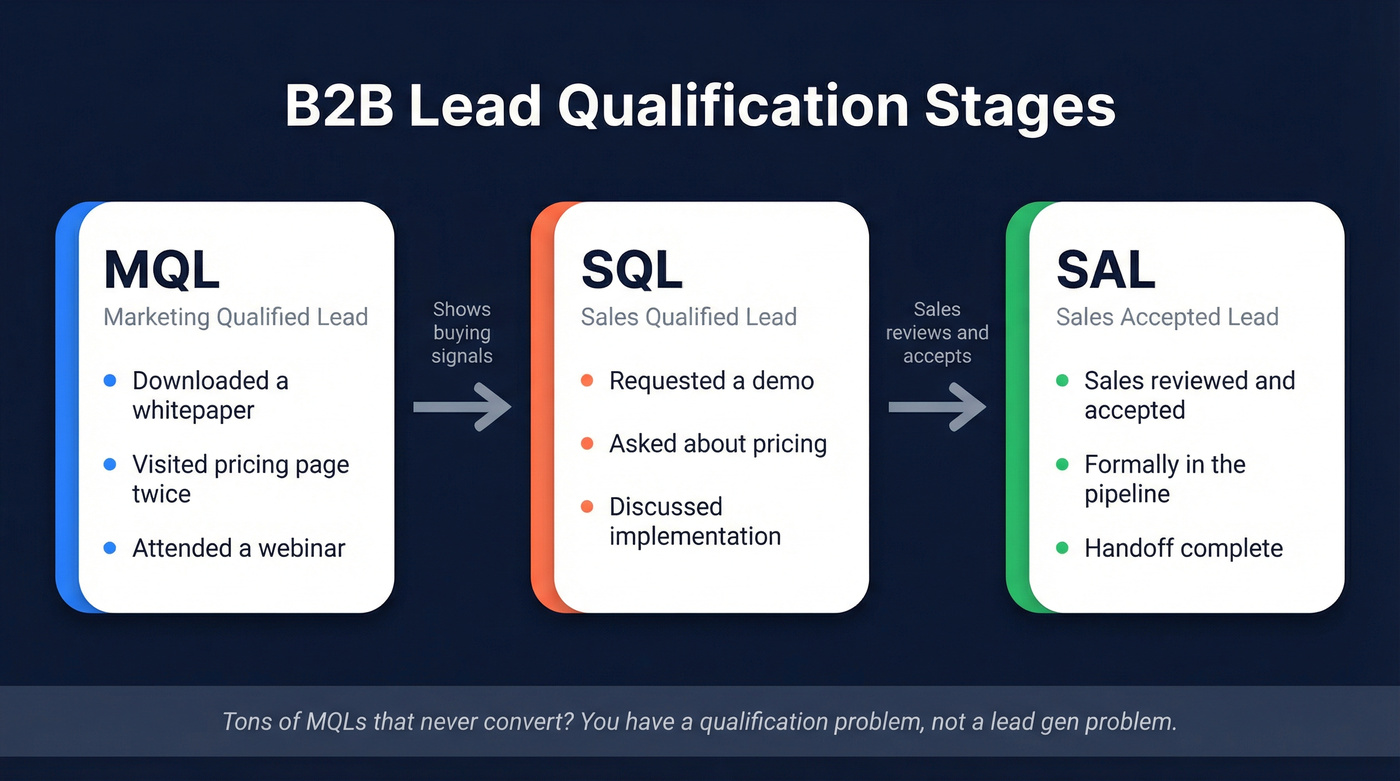
- MQL (Marketing Qualified Lead): Engaged with your content - downloaded a whitepaper, attended a webinar, visited your pricing page twice. Showing interest, not buying intent.
- SQL (Sales Qualified Lead): Showing buying signals - requested a demo, asked about pricing, discussed implementation timelines, or pulled up case studies and ROI calculators.
- SAL (Sales Accepted Lead): An MQL that sales has reviewed and formally accepted into their pipeline. This handoff prevents leads from falling through the cracks between marketing and sales.
Here's the thing: if you're generating tons of MQLs that never convert, you don't have a lead gen problem - you have a qualification problem. Fix that before buying another tool.
Why Data Quality Beats Database Size
Most major platforms advertise hundreds of millions of contacts. The question nobody asks: how many of those emails actually land in an inbox?
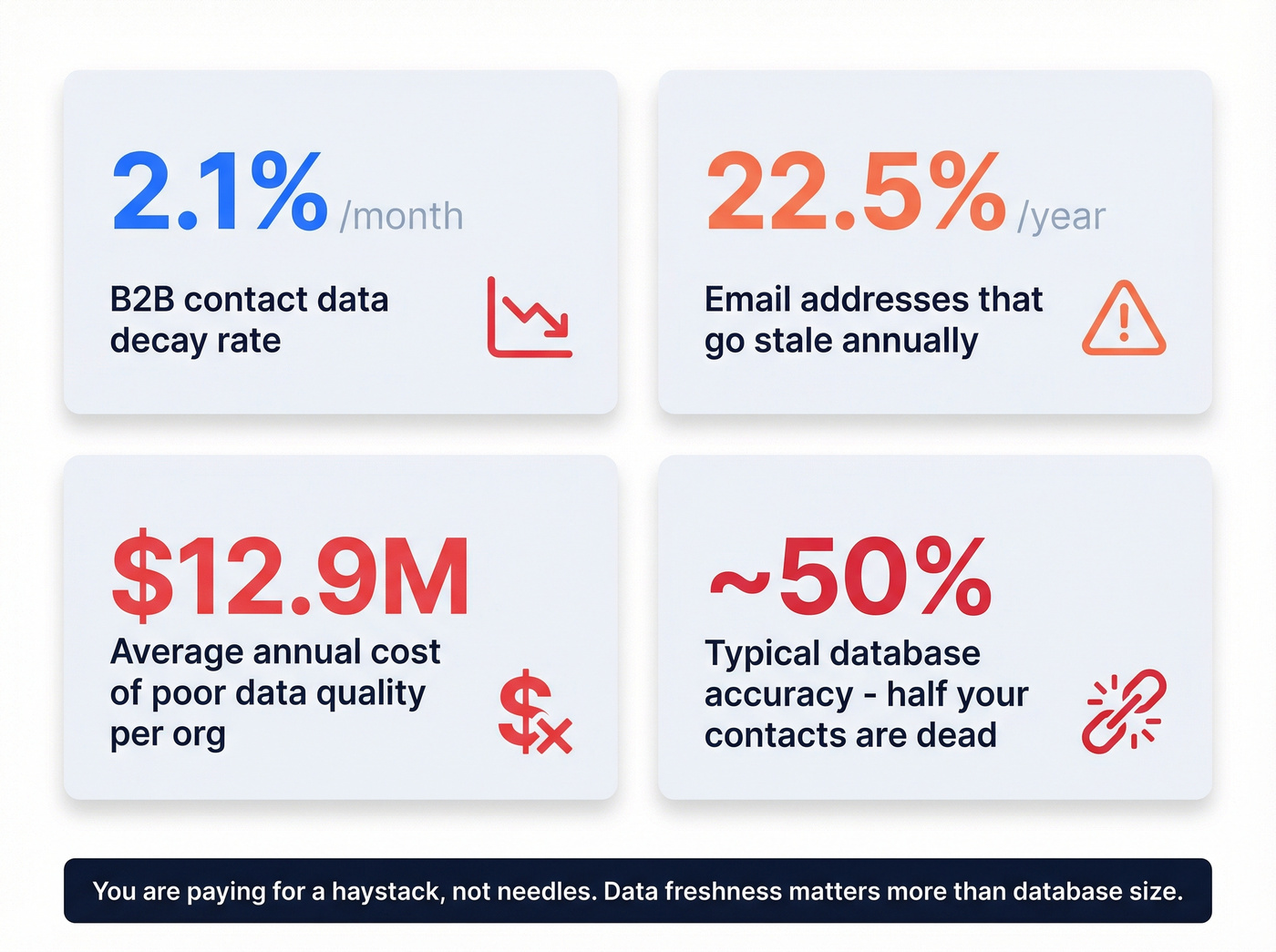
The numbers are brutal. B2B contact data decays at 2.1% per month, and 23-30% of email addresses become outdated every year. Phone numbers change at 18% annually. Sales reps lose an estimated 500 hours per year validating and correcting bad contact info. The average cost of poor data quality runs $12.9M annually per organization - and one industry analysis found that typical databases deliver only about 50% accuracy.
That last stat is worth sitting with. Half the contacts in a typical database won't connect you with anyone. You're paying for a haystack, not needles.

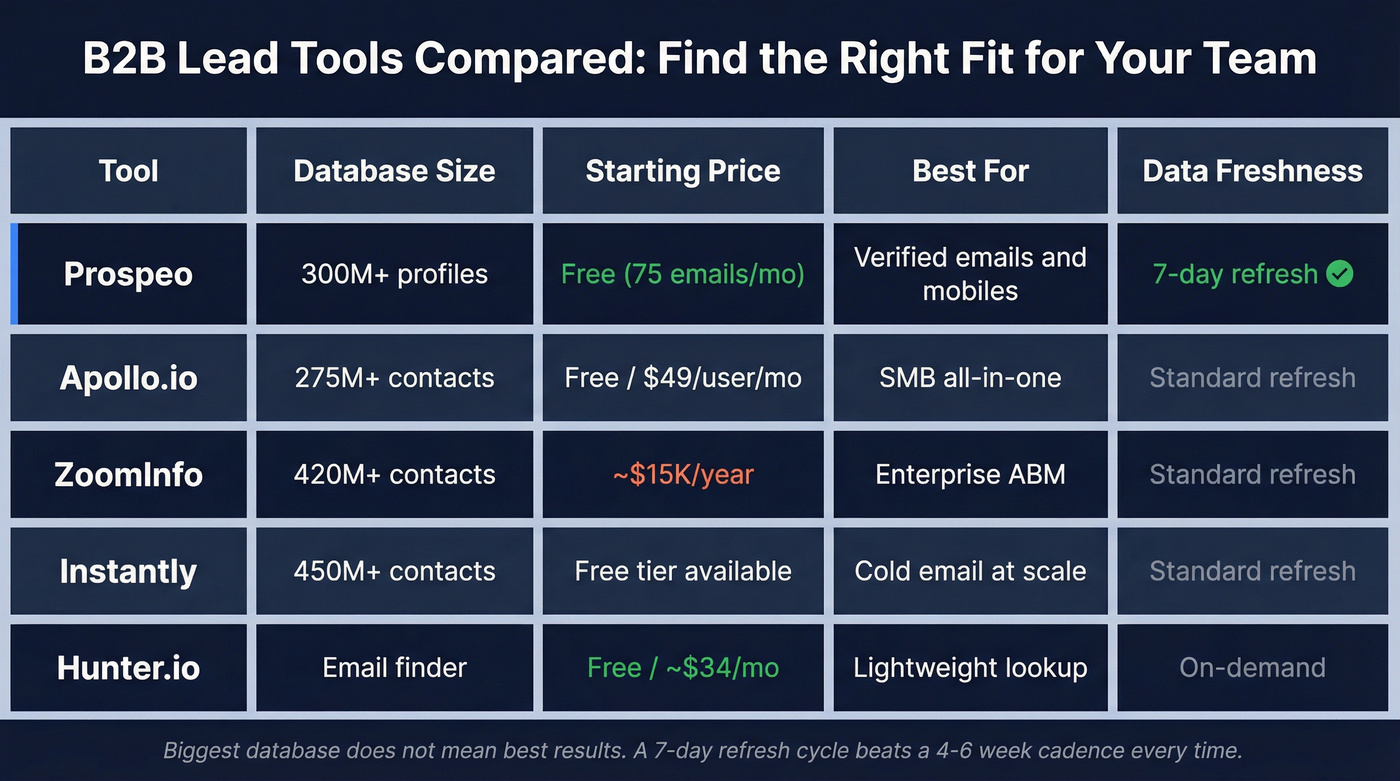
Some competitors advertise "pay only for verified leads" or tout billions of daily searches. Operational scale doesn't equal accuracy. What matters is the verification methodology behind those numbers and how often the data gets refreshed. A 7-day refresh cycle - versus the common 4-6 week cadence - is the difference between calling someone who left the company last month and reaching them at their new role.
If your average deal size is under $15K, you almost certainly don't need a six-figure data platform. A smaller, fresher database will outperform a massive stale one every time.

Your database decays 2.1% every month. Prospeo refreshes every 7 days - not 6 weeks - so every lead you pull is current. 300M+ profiles, 98% email accuracy, 30+ filters including buyer intent and technographics. Build a verified list from ICP to export in under 5 minutes.
Stop prospecting from a haystack. Start with verified needles.
How to Find B2B Leads in Five Steps
1. Define Your ICP
If you can't describe your ideal buyer in one sentence, you're not ready to prospect. Your ICP should cover:
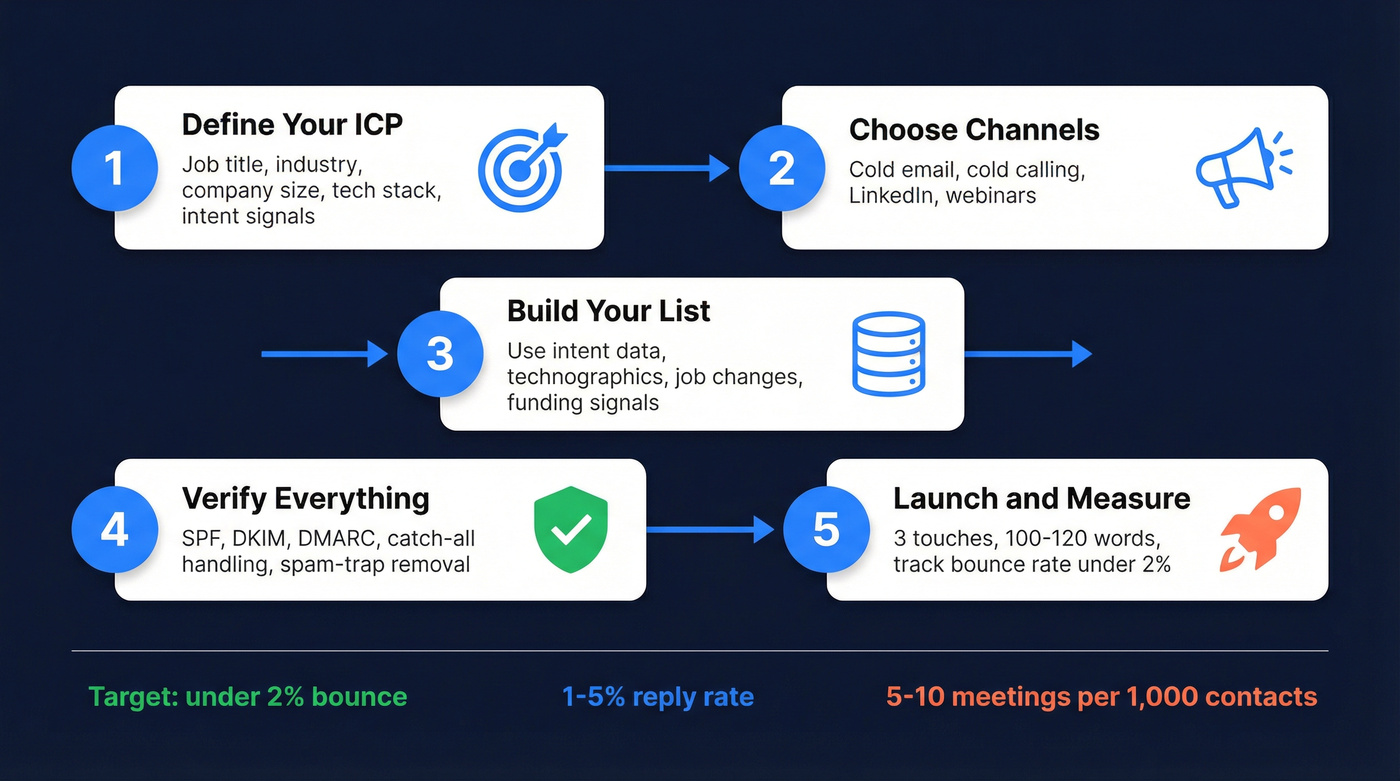
- Job title and seniority level
- Target industry
- Company size by headcount and revenue
- Tech stack they're likely running
- Intent signals suggesting they're in-market
A good ICP statement: "VP of Sales or CRO at B2B SaaS companies with 50-500 employees, using Salesforce and Outreach, who've recently hired 3+ SDRs." That specificity separates a 2% reply rate from a 0.2% reply rate. Thorough prospect research at this stage saves you from wasting credits on contacts who were never going to buy.
2. Choose Your Channels
Not every channel works for every team. Here's what the benchmarks say.
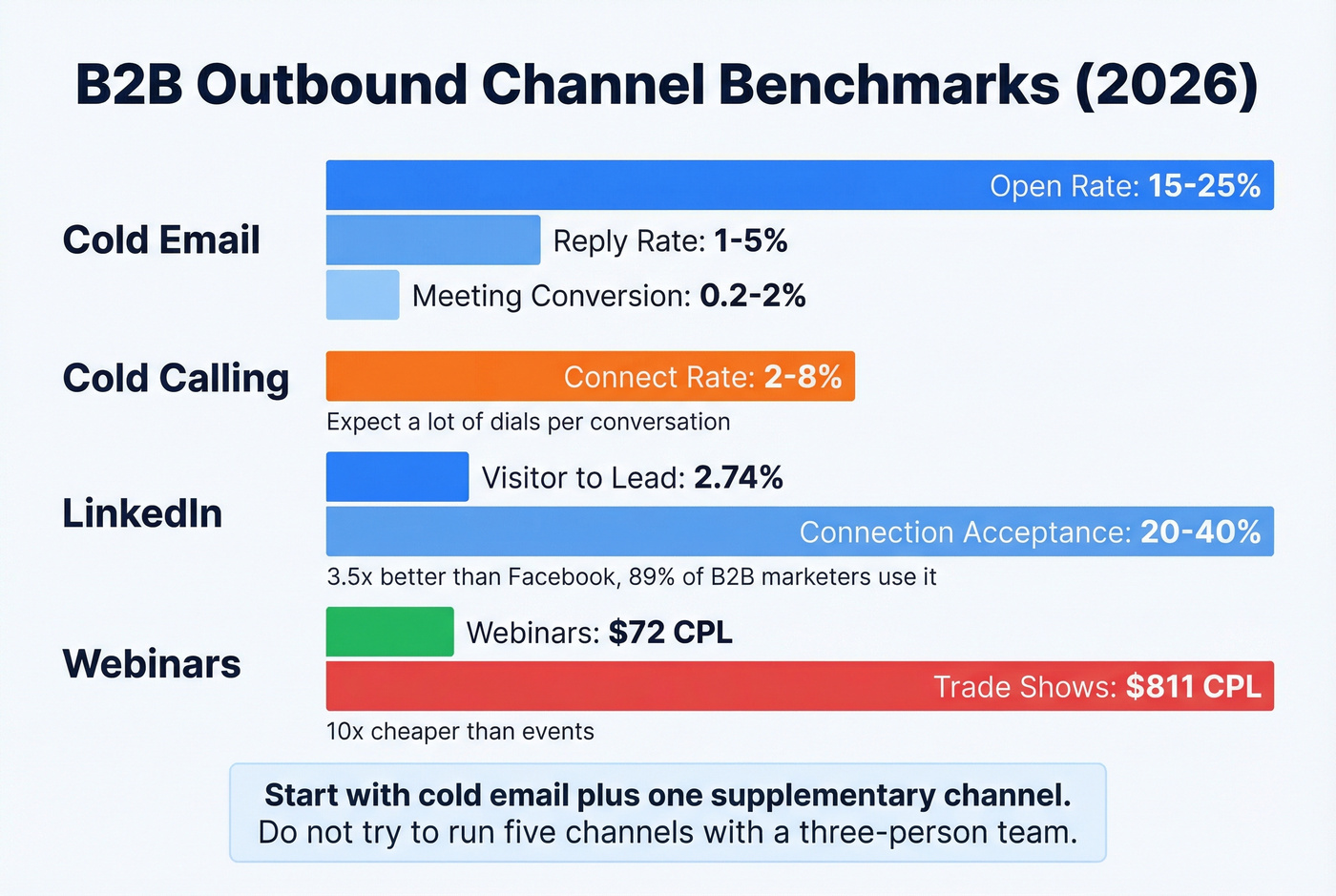
Cold email delivers 15-25% open rates and 1-5% reply rates, with 0.2-2% conversion to meetings. If you're above 3% reply, you're doing well. Cold calling connects at roughly 2-8%, so expect a lot of dials for every conversation. LinkedIn converts visitors to leads at 2.74% - roughly 3.5x better than Facebook - with connection acceptance rates around 20-40% depending on your profile and message. 89% of B2B marketers already use it for lead gen. Webinars run about $72 CPL compared to $811 for trade shows, a 10x difference that makes webinars the clear play for teams without event budgets.
Website visitor identification tools capture anonymous traffic you're already paying for - more on Leadfeeder below.
Most teams should start with cold email plus one supplementary channel. Don't try to run five channels at once with a three-person team.
3. Build Your List
This is where your tool choice matters most. You need a database that lets you search by the ICP criteria you defined above - not just name and company, but intent signals, tech stack, job changes, and company growth indicators.
Look for platforms offering buyer intent data, technographic filters, job change signals, headcount growth, and funding round tracking. The goal is to go from ICP definition to exported list in under five minutes. CRM enrichment matters too - top data enrichment tools can push 50+ data points per contact directly into Salesforce, HubSpot, or your sequencer of choice.
4. Verify Before You Send
Even the best database has some decay. Before every campaign, set up SPF, DKIM, and DMARC on your sending domain. Run every email through verification - not just a syntax check, but catch-all handling, spam-trap removal, and honeypot filtering.
If you're not verifying before every campaign, you're burning your domain. Period. A 7-day refresh cycle means most contacts are already verified when you pull them, but running a final check on any list that's been sitting for more than a week is non-negotiable.
5. Launch and Measure
Keep sequences short: 3 touches over 1-2 weeks. Copy should run 100-120 words - nobody reads a 400-word cold email. Include a one-click unsubscribe link; it improves deliverability and keeps your outbound program compliant.
A 0.2-2% conversion rate from cold email is normal. If you're sending to 1,000 verified contacts per month and booking 5-10 meetings, you're performing well. Conversion rates vary by industry - B2B SaaS sites convert at about 1.1%, manufacturing at 2.2%, and legal services at 7.4%. Track bounce rate (under 2% is excellent, over 5% is a red flag), reply rate, and meetings booked - not just opens.
Best Tools to Find B2B Leads
| Tool | Database Size | Starting Price | Best For | Key Differentiator |
|---|---|---|---|---|
| Prospeo | 300M+ profiles | Free (75 emails/mo) | Verified emails + mobiles | 7-day refresh, 98% accuracy |
| Apollo.io | 275M+ contacts | Free / $49/user/mo | SMB all-in-one | Built-in sequences + dialer |
| ZoomInfo | 420M+ contacts | ~$15K/year | Enterprise teams | Advanced intent data |
| Instantly | 450M+ contacts | Free tier available | Cold email at scale | Warmup + sender rotation |
| Leadfeeder | Website visitors | Free / $99/mo | Inbound capture | Anonymous visitor ID |
| Hunter.io | Email finder | Free / ~$34/mo | Lightweight lookup | Domain search |
| Skrapp.io | 200M+ professionals | Free (100 credits) | Profile-based prospecting | Email finder + verifier |
| Lusha | Not public | Free / ~$40-100/mo | Quick lookups | Browser extension |
| Snov.io | 500M+ leads | Free (50 credits) | Budget outbound | Lead finder + campaigns |
Prospeo
Prospeo's core advantage is simple: the data is accurate and it stays accurate. 98% email accuracy across 143M+ verified emails, 125M+ verified mobile numbers with a 30% pickup rate, and a 7-day refresh cycle that keeps decay from eating your lists. The Chrome extension with 40,000+ users lets you pull verified contact data from any website or CRM in one click, returning 40+ data points per contact.
Real results back this up. Meritt tripled their pipeline from $100K to $300K per week after switching, with bounce rates dropping from 35% to under 4%. Snyk's 50-person AE team cut bounce rates from 35-40% to under 5% and generated 200+ new opportunities per month. At roughly $0.01 per email with a free tier that includes 75 emails and 100 Chrome extension credits monthly, there's no contract and no sales call required to get started.
The article math is simple: 1,000 verified contacts, 5-10 meetings booked. But that only works if your emails actually land. Prospeo's 5-step verification with catch-all handling, spam-trap removal, and honeypot filtering keeps bounce rates under 2% - at $0.01 per email.
Protect your domain reputation and book 26% more meetings.
Apollo.io
Apollo is the strongest starting point for SMB teams that want everything in one platform. The database covers 275M+ contacts, and the built-in sequencer and dialer mean you don't need three separate tools. Pricing is transparent: free tier, then $49, $79, or $119 per user per month.
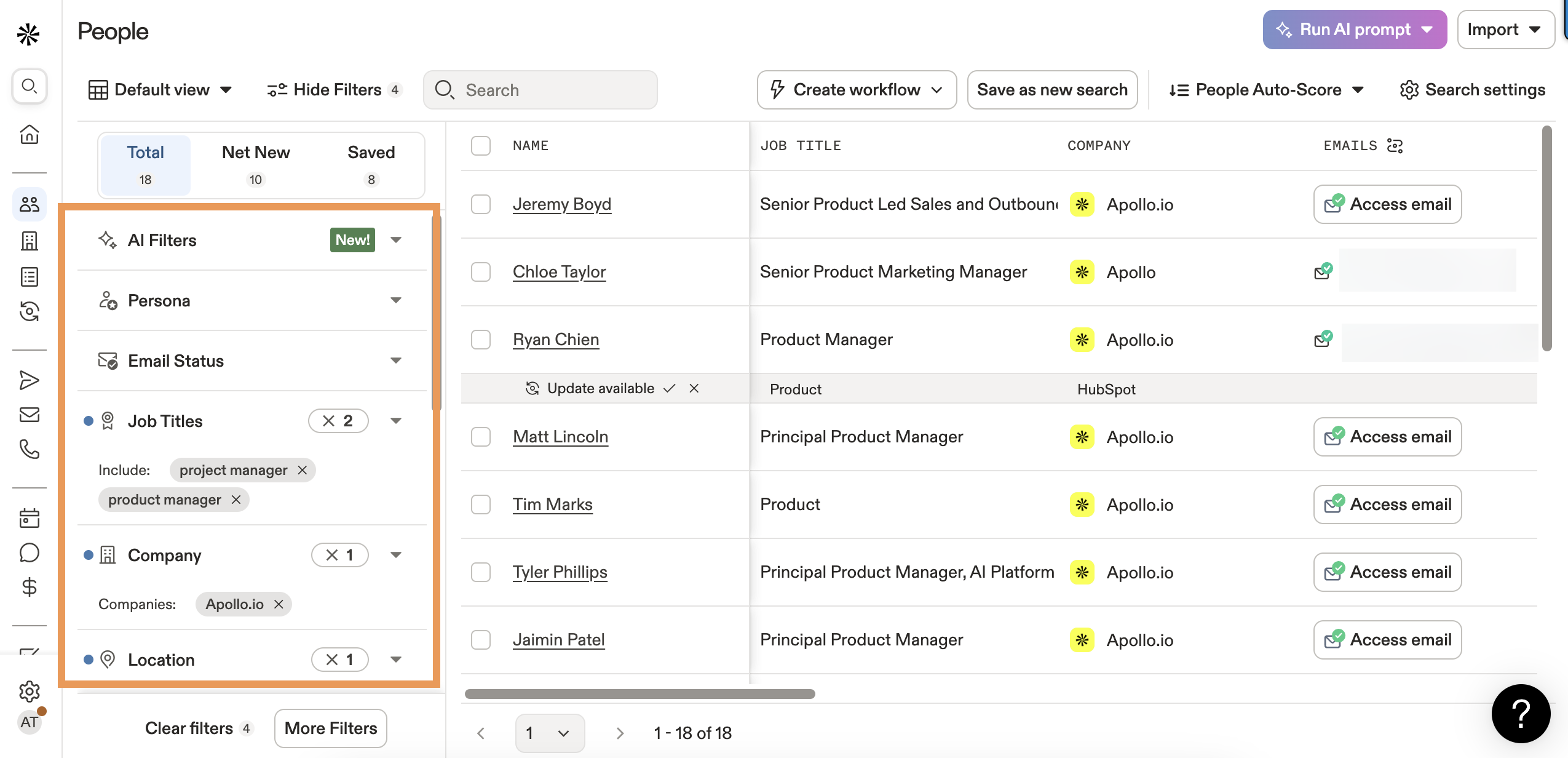
Use this if: You're a small team that wants prospecting, sequences, and a dialer in one tool without stitching together a tech stack. The free plan is genuinely useful for testing.
Skip this if: You're scaling hard and need consistently fresh data at high volume. Reviews commonly flag data freshness concerns and credit limitations when teams ramp outreach. Apollo wins on price and ease of use versus ZoomInfo but loses on intent data depth and enterprise compliance features.
ZoomInfo
ZoomInfo has one of the largest databases in the space - 420M+ contacts and 100M+ companies. The intent data is best-in-class for enterprise teams running sophisticated ABM programs with lead scoring and buying committee mapping. If you have 50+ reps and a six-figure data budget, it's the default for a reason.
But let's be honest about the cost. A 10-seat contract with intent data runs $25K-$45K per year. Enterprise deals clear $100K+. Annual minimums, often multi-year. Aggressive renewal tactics are a common complaint on r/sales and other sales communities - the consensus is that you should negotiate hard and never auto-renew. One published accuracy test put ZoomInfo email accuracy at 78%, which is solid but not exceptional.
Instantly
Instantly built its reputation on cold email infrastructure - warmup, sender rotation, and campaign management. The lead finder database covers 450M+ contacts. You can start for free, then upgrade based on sending needs; the lead finder is billed separately based on credits. Best for teams whose primary motion is high-volume cold email and who want sending infrastructure bundled with their data.
Leadfeeder (Dealfront)
Leadfeeder solves a different problem: it identifies companies already visiting your website and shows you which pages they viewed. It's a complementary inbound channel, not a replacement for outbound databases. The free plan covers basic identification, and paid plans start at $99/month with CRM integrations. Best for teams already generating website traffic who want to convert anonymous visitors into actionable leads.
Hunter.io
A lightweight email finder, not a full database. Punch in a domain, get a list of associated email addresses with verification built in. Free tier available, paid plans around $34 to $149 per month. Best for freelancers and small teams doing manual prospecting who don't need intent data or phone numbers. It does one thing and does it cleanly.
Skrapp.io
Skrapp focuses on email finding from professional profiles and company domains. It also includes an email verifier with AI-powered verification that detects personal, disposable, and gibberish emails and supports catch-all handling. Free tier includes 100 credits, and the Lead Search product provides access to a continuously refreshed database of 200M+ professionals and 20M companies. Best for teams doing profile-based prospecting who want a straightforward email finder without the complexity of a full sales intelligence platform.
Lusha & Snov.io
Lusha offers quick browser-based contact lookups with a solid extension. Free tier, then roughly $40-100 per user per month depending on credits. Credit limits frustrate power users fast. Best for occasional lookups, not bulk list building.
Snov.io is budget-friendly with built-in outreach workflows. Free trial includes 50 credits, and plans scale by credits up to 100,000, with custom plans beyond that. Best for bootstrapped teams running simple outbound who don't need phone numbers or deep intent data.
What's Changed in 2026
Mass lists and spray-and-pray email stopped working for most teams. Here's what replaced them:
First-party signals over third-party lists. Site engagement, product usage, and content interaction tied to specific accounts give you warmer prospects than any purchased database.
AI augments, doesn't replace. Predictive lead scoring and next-best-action routing still need a human reviewing before they ship. We've seen teams automate themselves into terrible personalization - don't be that team.
Expert content beats volume content. Executive POV pieces and genuine community engagement outperform a blog-post-a-day strategy.
Email is a precision channel. SPF/DKIM/DMARC is table stakes. Short sequences, concise copy, and aggressive list hygiene separate inbox from spam.
The B2B lead generation services market is projected to hit $32.85B by 2035. The money's still flowing - it's just flowing toward precision over volume. Teams that find the best prospects, not the most contacts, are the ones scaling pipeline efficiently.
Compliance Basics
The minimum before sending your first email: for B2B prospecting in the EU/UK, GDPR legitimate interest is a common lawful basis - document it and make sure the contact's role is relevant to what you're selling. Every commercial email should include a working unsubscribe, with opt-outs processed within 10 business days. Practice data minimization by only collecting what you actually need. Maintain a master suppression list across all tools and campaigns so someone who unsubscribes from one sequence doesn't get another.
Document your consent basis, data sources, and processing activities - if a regulator asks, you need to show your work. This isn't legal advice, but it's the practical floor that keeps you out of trouble.
FAQ
What's the fastest way to find B2B leads?
Use a verified database with intent filters to build a targeted list in minutes, then verify before sending. Platforms with 30+ search filters - including buyer intent, technographics, and job change signals - let you go from ICP definition to exported list in under five minutes. Speed comes from filter precision, not database size.
How much does B2B lead data cost?
Free tiers exist at Apollo, Prospeo, and Hunter. Enterprise platforms like ZoomInfo start at $15K+/year. Most SMB teams spend $50-$200/month. The real cost isn't the subscription - it's wasted time and burned domains from bad data.
How do I know if my leads are accurate?
Check your bounce rate after your first campaign. Under 2% means your data source is solid. Over 5% is a red flag - usually a freshness problem. Also watch reply rates: zero replies on 500+ sends likely means emails are landing in spam, not inboxes.
What's the difference between a lead database and an email finder?
A database lets you search by filters - title, industry, intent signals, tech stack - and build lists proactively. An email finder takes a name and company you already know and returns the email address. Databases are for scaled outbound; email finders handle one-off lookups when you've identified a prospect and just need contact details.
How many B2B leads should I generate per month?
The average B2B organization generates roughly 1,877 leads per month, but 80% never convert. A team closing $50K deals at a 5% close rate needs 20 qualified opportunities per month - not 2,000 unqualified names. Focus on quality over volume.