Podcast Email Outreach That Gets Replies (System + Templates)
You can do everything "right" and still get ghosted by podcast hosts.
I've seen it a dozen times: someone sends 30 pitches in a week, gets zero replies, then starts rewriting subject lines like that's the problem. It usually isn't.
Podcast email outreach isn't a manners contest. It's a credibility test, and most pitches fail it in the first five seconds.
Hosts ignore you for three boring reasons:
- Wrong inbox: you emailed the show's generic contact, but bookings run through a producer or network address.
- Bad data: your email bounced or hit a dead alias, so you never had a chance.
- Template smell: even if you listened, your email reads like you didn't - generic praise, vague topics, and a CTA that creates work.
The fix isn't "be nicer." It's a simple system: proof-of-listening -> tight episode angles -> one low-friction CTA -> a strict 3-email stop rule -> deliverability thresholds that tell you whether the problem is your list, your offer, or your inbox placement.
Hot take: if you're pitching podcasts to "build awareness" for a low-priced offer, you're probably wasting time. Guesting works best when you can name a specific listener you want, a specific problem you solve, and a specific next step you want them to take.
What you need (quick version)
If you only fix three things, fix these - because they map to how hosts triage email fast: effort, fit, and friction.
1) A proof-of-listening line (not "big fan" fluff)
Your first 2-3 lines should prove you listened. That single detail flips your email from "spam" to "someone did the work," which buys you another 10 seconds of attention.
Good proof lines:
- "Your question to [Guest] about 'what breaks at 10 reps' was the most useful part of the episode."
- "I liked the way you framed [topic] as a tradeoff, not a checklist - especially the part about [detail]."
2) A strict 3-email stop rule
One initial email + 1-2 follow-ups. That's it.
This protects your reputation with hosts and protects deliverability. The fastest way to get future pitches ignored is to become "that person" who won't stop.
3) Deliverability basics with real thresholds
If your email doesn't land in inbox, your copy doesn't matter. Use thresholds so you can diagnose the real problem:
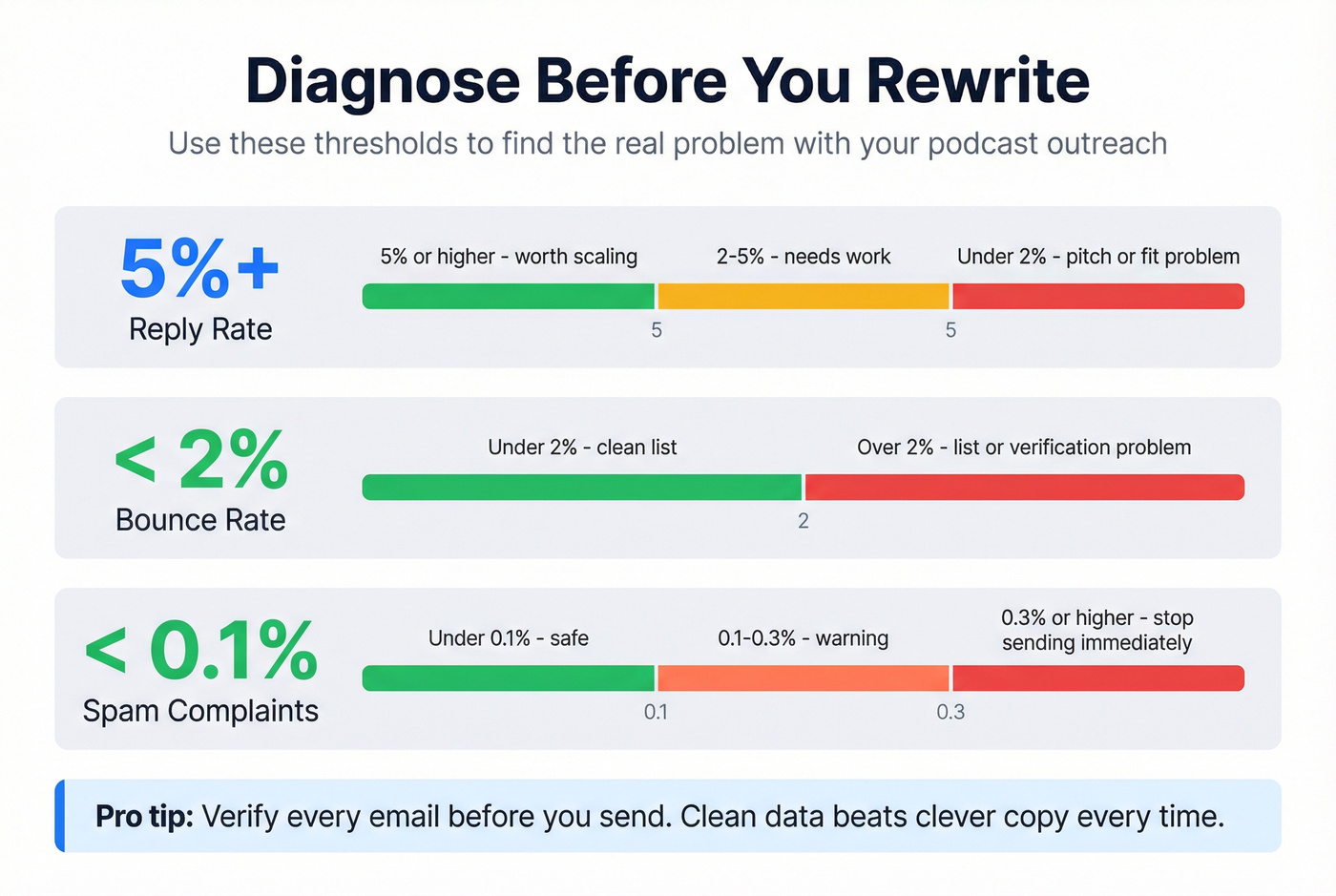
- Reply rate: 5%+ is a cold baseline worth scaling
- Bounce rate: <2%
- Spam complaints: <0.1% (and treat 0.3% - 3 complaints per 1,000 emails - as the danger zone)
Quick diagnosis (use this before you rewrite copy):
- Bounce >2% -> list/verification problem
- Spam complaints >=0.3% -> targeting/message problem; stop immediately
- Reply <2% with clean delivery -> pitch/fit problem
One operational habit fixes a lot: verify emails before you send volume so bounces stay under 2%.
We've tested a bunch of workflows over the years, and the boring truth is that clean data beats clever copy more often than anyone wants to admit.
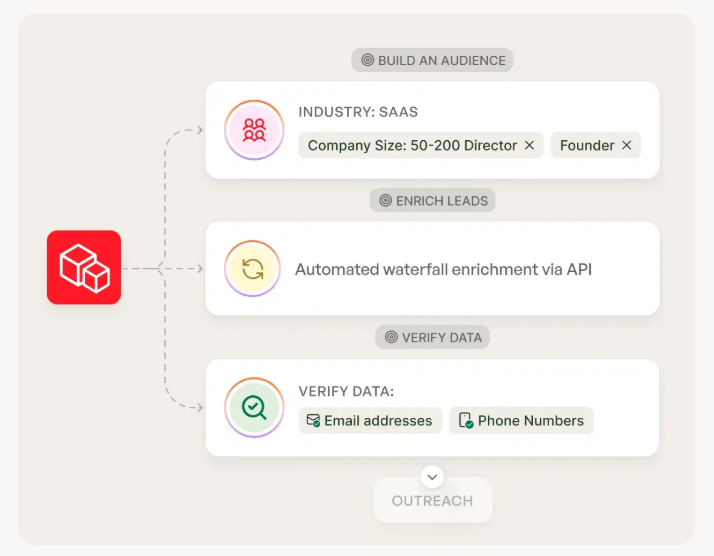
One tool that's built for that is Prospeo, "The B2B data platform built for accuracy."
What makes podcast hosts ignore you (host reality)
Hosts don't ignore you because you didn't say "hope you're well."
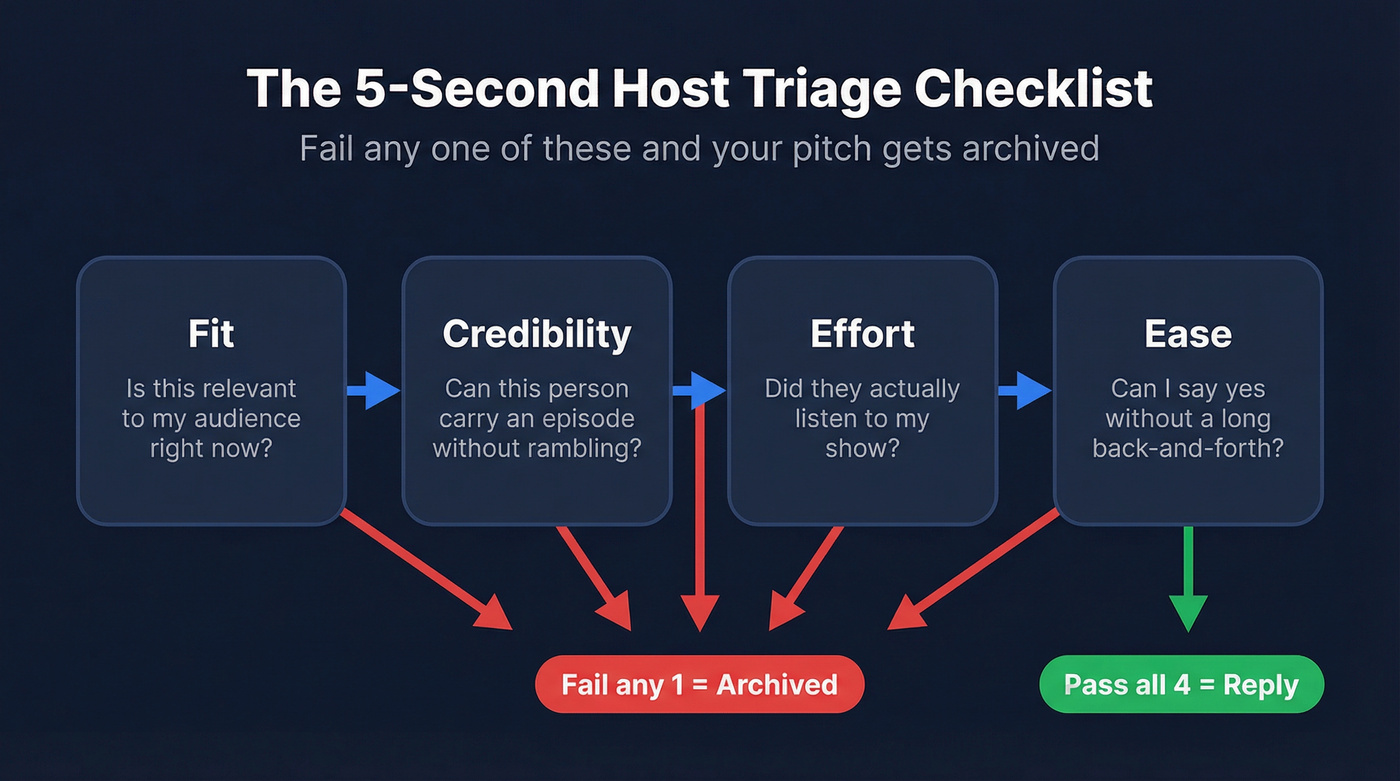
They ignore you because your pitch creates work.
Here's the host brain in fast-forward. They open your email and subconsciously run a checklist:
Host triage checklist (5 seconds):
- Fit: Is this relevant to my audience right now?
- Credibility: Can this person carry an episode without rambling?
- Effort: Did they listen, or did they spray-and-pray?
- Ease: Can I say yes without a back-and-forth thread?
If you fail any one of those, you're archived.
"Creates work" vs "removes work" (a concrete example)
Creates work: "I'd love to come on and share my story. Let me know what you think!" Now the host has to invent the angle, guess your expertise, and figure out scheduling.
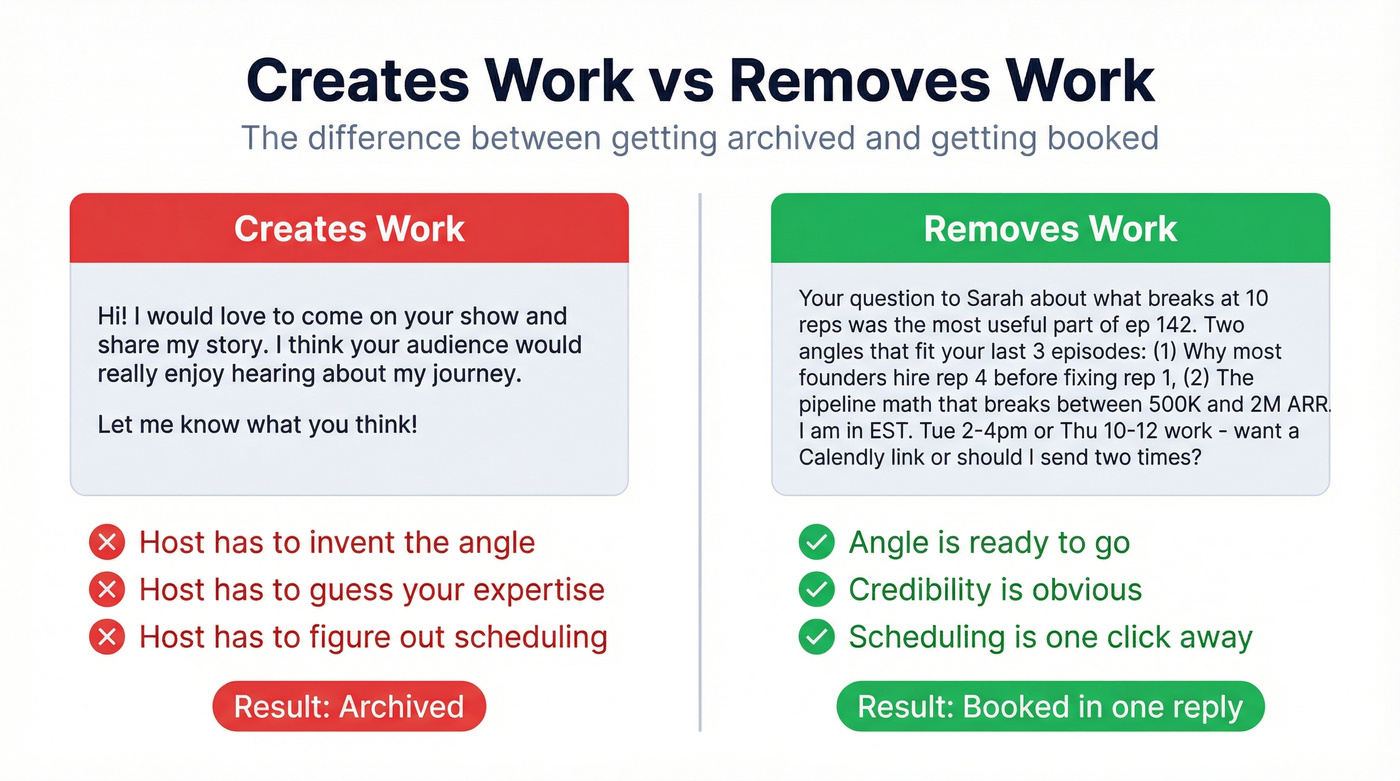
Removes work: "Two angles that fit your last 3 episodes: (1) [angle], (2) [angle]. I'm in [TZ]. Tue 2-4pm or Thu 10-12 work - want a Calendly link or should I send two times by email?" Now the host can forward it to a producer and book you in one minute.
Do this
- Prove you listened with one concrete reference. A real detail beats a paragraph of praise.
- Pitch the episode, not yourself. Give 2-3 tight topic angles that fit their audience.
- Make the next step easy. One CTA: "Want me to send 3 bullet talking points?" or "Open to a 15-min pre-chat next week?" (More on structuring that CTA in our Sales CTA guide.)
Avoid this
- Fake fandom. One host put it perfectly: "Don't tell me you're a big fan if you clearly haven't listened."
- Template smell / AI sludge. Established shows spot it instantly: generic adjectives, over-polished tone, zero specifics. (If you're using AI, avoid the common traps in AI Cold Email Personalization Mistakes.)
- Over-following-up. Daily "just bumping this" reads as automation.
Here's the thing: producers and hosts are swimming in pitches. I once helped a founder pitch a mid-sized B2B show, and the producer replied (politely, but clearly annoyed) that they had 40+ "guest requests" sitting in the inbox and only booked two a week - so anything that wasn't instantly usable got archived.
That's your competition: a steady stream of "Dear Sir/Madam" energy. Your job is to look like the one email that's already halfway to booked.
Podcast email outreach workflow (Targeting -> Tracking)
This is the workflow we'd run if we had to book podcast spots consistently without burning a domain. It's not fancy. It's repeatable.
Step 1: Target by audience alignment, not audience size
Big audiences are tempting. Misaligned audiences are useless.
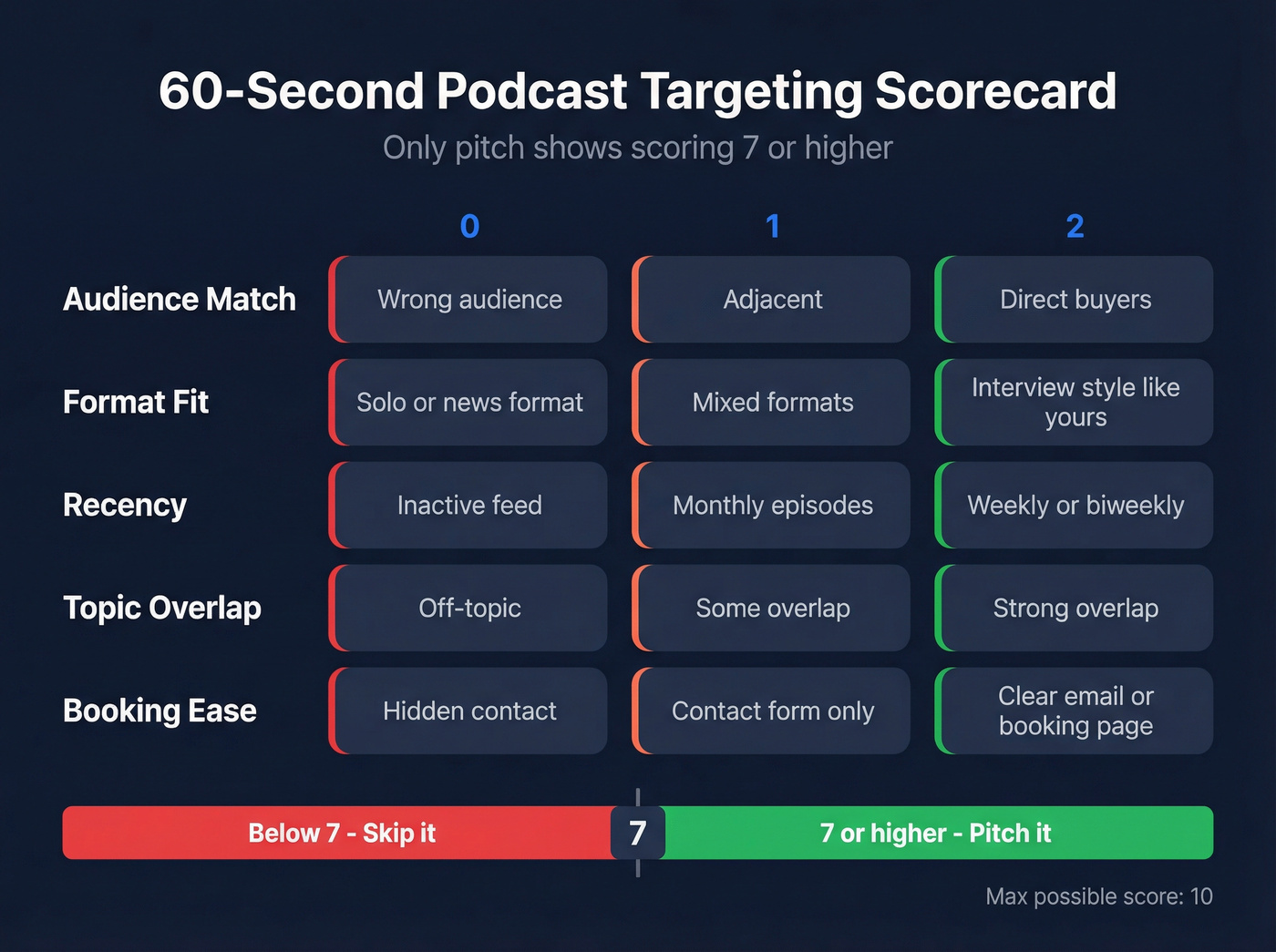
Use a 60-second score so you don't overthink it:
| Score item | 0 | 1 | 2 |
|---|---|---|---|
| Audience match | Wrong | Adjacent | Direct buyers |
| Format fit | Solo/news | Mixed | Interviews like yours |
| Recency | Inactive | Monthly | Weekly/biweekly |
| Topic overlap | Off-topic | Some | Strong |
| Booking ease | Hidden | Contact form | Clear email/booking |
Rule: Only pitch shows scoring 7+ unless you have a warm intro. (If you want a more rigorous way to define fit, start with an ideal customer lens.)
Step 2: Decide the right "yes person" (host vs producer vs network)
Pick one primary contact per show. Don't email three addresses at once.
Use this hierarchy:
- Producer email (best when the show is established): producers schedule, triage, and keep the calendar sane.
- Host email (best for smaller/indie shows): the host is the scheduler.
- Network/booking inbox (best for network shows): they route requests and enforce process.
If the show has a "Book a guest" page, follow it. Ignoring their process is the fastest way to get ignored.
Step 3: Listen to at least two recent episodes (non-negotiable)
Two episodes gives you:
- Their real tone (formal vs casual)
- What they've covered recently (so you don't pitch repeats)
- The host's favorite angles (frameworks, contrarian takes, war stories)
If you can't do two episodes, you're not ready to pitch. You're just broadcasting.
Step 4: Vet red flags before you waste time
Skip shows that create friction or risk:
- Inactive feed (no episodes in months)
- Poor audio quality (you'll sound worse by association)
- Host constantly talks over guests (you won't land your points)
- Outdated site/contact info (dead inboxes = bounces)
One more that people hate hearing: if the show is clearly a hobby and the host hasn't responded to anyone in months, move on. You're not doing "persistence." You're doing unpaid admin.
Step 5: Build a list with research inputs (not just emails)
Your list should include the proof line and the angle you'll pitch. This is where most people lose: they collect 200 emails and then write 200 generic pitches.
Minimum fields that keep you honest:
- Show name
- Host/producer/network contact name
- Contact path used (email / form / booking page)
- Proof line (one specific moment)
- Angle (the episode you're proposing)
- Last touch date + next follow-up date
- Outcome (no reply / no / yes / booked)
Step 6: What to do when there's only a contact form
Contact forms can work - if you treat them like a constrained inbox.
Do this:
- Keep it under 120-150 words
- Put your 2-3 angles as bullets
- Add time zone + two time windows
- Include one link (one-pager or speaker page)
Don't do this:
- Paste a full media kit
- Add three links and a calendar embed
- Write a novel (forms get skimmed even harder than email)
Step 7: Verify, send, and track like an operator
The first follow-up is typically where most replies come from - but only when deliverability is clean and the pitch is specific.
Track:
- Sent date
- Follow-up dates
- Reply outcome (yes/no/no response)
- Booked? (Y/N)
- Notes for future personalization
If you sequence from Smartlead/Instantly/Lemlist, keep the ground truth in a sheet so you don't double-tap the same show from multiple inboxes. (If you're building sequences across multiple senders, use team email sequences rules to avoid overlap.)

Your podcast pitch doesn't matter if it bounces. Prospeo's 5-step email verification keeps bounce rates under 2% - the threshold this article recommends. Find verified emails for hosts, producers, and network contacts at 98% accuracy for ~$0.01 each.
Clean data beats clever copy. Verify every address before you pitch.
Build a targeted list (and get the right email)
You're not building "a list of podcasts." You're building a list of specific people who can say yes.
The fast playbook when you can't find an email
Use this order. It's the shortest path to a deliverable address:
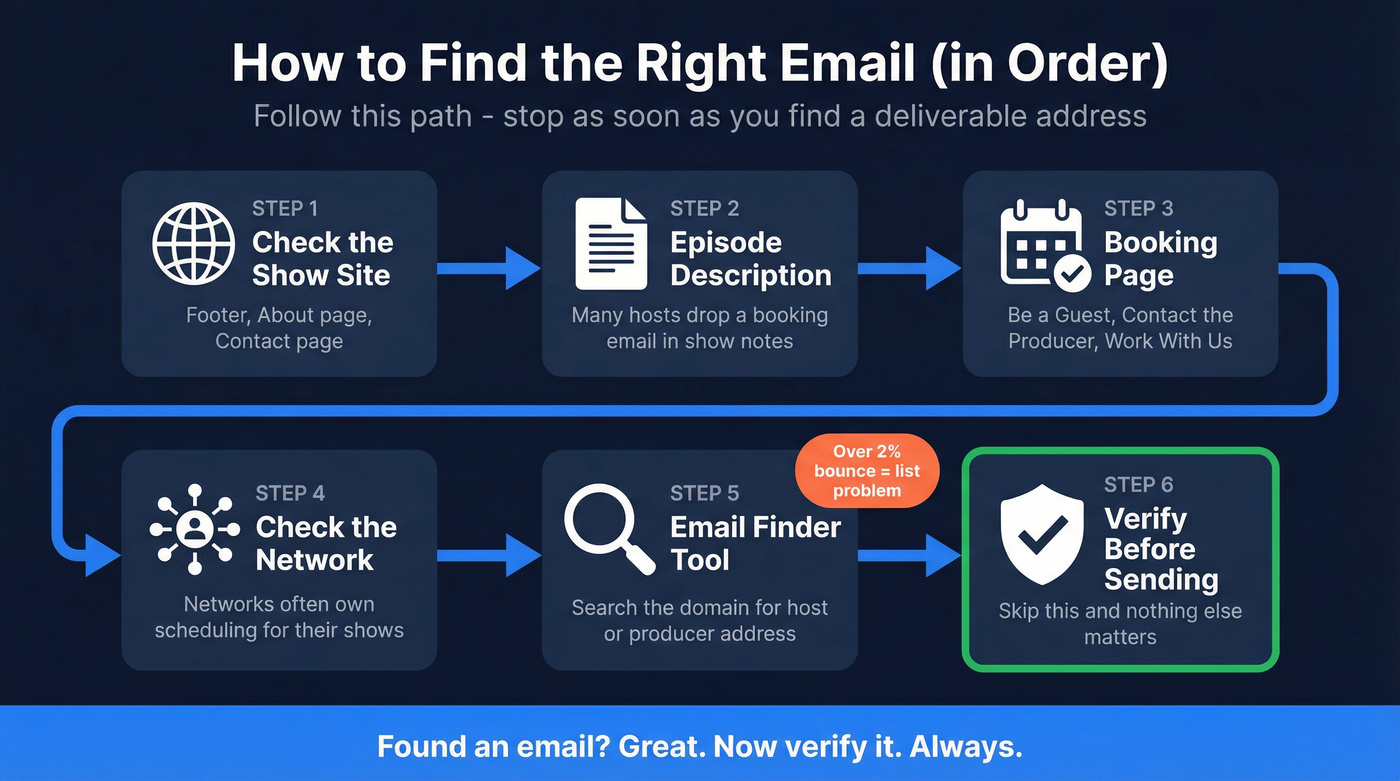
- Check the show site (footer, About, Contact)
- Check the episode description (many hosts drop a booking email there)
- Check the booking page ("Be a guest," "Contact the producer," "Work with us")
- Check the network (if the show is part of one, the network often owns scheduling)
- Use an email finder on the domain
- Verify before sending (this is where most outreach falls apart)
If you're sending any volume, verification isn't optional. Above 2% bounce = list problem. (Use a documented email verification list SOP so this doesn’t get skipped.)
Targeting checklist (fast but effective)
- Pick 1-2 audience personas you want listening. (If you need a starting point, use these buyer persona examples.)
- Pick 2-3 episode angles you can credibly deliver.
- Pull shows that match those angles.
- For each show, identify the best contact route:
- direct host/producer email
- network/producer email
- contact form
- booking page
Fields to capture (this is what keeps you from sounding generic)
| Field | Why it matters |
|---|---|
| Show name | Personalization anchor |
| Host/producer | Who can say yes |
| Angle | Your episode fit |
| Proof line | Credibility signal |
| Contact source | Where you found it |
| Outreach address | |
| Last episode date | Activity check |
If you're doing this at any scale, add:
- Status (Not contacted / Sent / FU1 / FU2 / Replied / Booked)
- Next follow-up date
- Contact path used (email/form/booking)
- Last touch date
- Notes (what they care about, what they've covered)
The pitch structure that doesn't sound spammy
Stop trying to sound excited. Sound prepared.
A clean structure works because it mirrors how hosts evaluate you: fit, credibility, effort, ease. If you want a starting point you can customize, use a cold email podcast pitch template - but treat it as scaffolding, not a script. (For a more general framework, see our cold pitch email guide.)
Subject line (boring is fine)
- "Guest idea for [Podcast Name]"
- "Potential guest: [topic]"
- "Episode idea: [specific angle]"
Why: boring subjects look human and avoid spammy patterns. (If you want more options, borrow from these cold email subject lines.)
Opening (proof-of-listening line)
1-2 sentences that prove you listened. No flattery paragraph.
Why: this is your "I'm not blasting you" receipt.
Who you are (one sentence)
"I'm [Name], [role] at [company], we help [audience] do [outcome]."
Why: hosts need to place you fast.
Why you're a fit (one sentence)
Tie your experience to their audience's current problems.
Why: this answers "why my show?" without a speech.
2-3 topic angles (bullets)
Make them specific and episode-shaped:
- "How to [do X] without [common failure]"
- "The tradeoffs between [A] and [B] when you're at [stage]"
- "A teardown of [process] with numbers from [experience]"
Why: bullets reduce reading time and reduce the host's planning work.
Proof (one line)
Pick one:
- a relevant credential
- a metric
- a recognizable customer category
- a prior talk/podcast link
Why: one proof line beats five vague credibility claims.
Scheduling friction killers (add this block)
- "I'm in [TZ]. If it's easier, I can do Tue 2-4pm or Thu 10-12."
- "Want a Calendly link, or should we schedule over email?"
Why: this removes the most common stall: "Sounds good - how do we schedule?"
One clear CTA
One ask, not three:
- "Open to a 15-min pre-chat next week?"
- "Want me to send a 5-bullet outline for the best-fitting angle?"
Why: low commitment = more yeses.
Signature (make it real)
Real name, role, company, and one simple link (site or one-pager). No attachments.
Why: attachments add friction and can trip filters.
A copy/paste AI prompt that avoids "template smell"
If you use AI, use it to generate raw material - then rewrite the final email in your voice. Real talk: if you paste the output straight into a sequencer, hosts will smell it.
Paste this prompt:
You are writing a cold podcast guest pitch email. Podcast: [Name] Host: [Host name] My bio: [2-3 sentences] My credibility: [1 metric + 1 proof link] Recent episodes (titles): [Episode 1], [Episode 2], [Episode 3], [Episode 4], [Episode 5] Write: (1) one proof-of-listening opening referencing a specific moment from one episode, (2) three episode angles as bullets tailored to the show, (3) one low-friction CTA, (4) add scheduling options with my time zone: [TZ] and two time windows. Constraints: under 140 words, no hype adjectives, no "big fan," no exclamation points.
Podcast email outreach follow-ups (timing + stop rule)
Podcast follow-ups aren't PR follow-ups. That's where people mess up.
BuzzStream analyzed 65K+ campaigns and 8M emails: follow-ups drive 85% higher reply rate than one-and-done outreach. The first follow-up is the money email because it catches the host when they're in "admin mode," clearing the inbox between recordings, sponsor reads, and whatever else is on fire that week.
But there's a cliff:
- The first follow-up does the heavy lifting.
- Reply rate drops 66% after the first follow-up.
Timeline that fits podcast norms
- Email 1 (Day 0): the pitch
- Follow-up 1 (Day 5-7): value-add follow-up
- Follow-up 2 (Day 12-14): close-the-loop + easy yes
Stop after that. The 3-email stop rule is reputation insurance. (If you want more cadence patterns, use these outreach sequences.)
What "value-add" follow-ups look like (steal these)
Pick one - don't stack them.
- New angle: "If the first angles aren't a fit, here's a tighter one based on your last two episodes: [one sentence]."
- Relevant episode reference: "Your recent episode on [topic] made me think this would land: [angle]."
- Mini-outline: "Here are 5 bullets I'd cover so you can see the flow."
- Scheduling clarity: "I'm in [TZ]. Tue 2-4pm or Thu 10-12 work. Want a Calendly link or email scheduling?"
Callout: the fastest way to get blocked Daily follow-ups read as automation. Some hosts explicitly say they'll block and mark as spam when you follow up daily, especially if you rotate addresses.
Deliverability checklist for podcast outreach (2026)
Most "0 reply" campaigns are actually "didn't hit inbox" campaigns.
Look, I hate that this is true, because everyone wants a copy fix. But if you're bouncing, landing in spam, or tripping complaints, your "perfect pitch" is just a well-written message nobody sees.
Authentication (non-negotiable)
- SPF: set
- DKIM: set
- DMARC: set
Concrete rule that matters: since Feb 2024, Google requires authentication for senders of 5,000+ emails/day to Gmail; Yahoo aligned similarly. Even if you're below that threshold, authentication is still the baseline for serious outreach. (If you need the DNS walkthrough, use SPF DKIM & DMARC.)
Warm-up ramp (don't jump to 100/day)
A safe ramp per inbox:
- Week 1-2: 5-10/day
- Week 3-4: 15-20/day
- Week 5-6: 30-40/day
- Week 7+: cap at ~50/day per inbox
Need more volume? Add inboxes. Don't brute-force one.
Content rules that actually move deliverability
- Skip open tracking pixels for cold outreach.
- Keep it mostly text (no images).
- No attachments.
- Keep links minimal (one link is plenty).
- Avoid spammy formatting (caps, hype punctuation, "FREE!!!").
Monitor reputation (don't fly blind)
Use Google Postmaster Tools to watch:
- spam complaint rate
- domain reputation
- delivery errors
Healthy metrics (what "good" looks like)
| Metric | Healthy | Risk |
|---|---|---|
| Reply rate | 5%+ | <2% |
| Bounce rate | <2% | >2% |
| Spam complaints | <0.1% | >=0.3% |
Compliance guardrails (US + UK quick notes)
Not legal advice - just the guardrails teams miss.
US: CAN-SPAM (B2B included)
CAN-SPAM applies to commercial emails, including B2B. Penalties run up to $53,088 per email.
Your outreach emails need:
- truthful headers (From/Reply-To)
- non-deceptive subject lines
- a valid physical postal address
- a clear opt-out method
- opt-out honored within 10 business days
- opt-out mechanism that works for 30 days
Also: don't sell or transfer emails of people who opted out (except to a compliance vendor). (Related: what counts for the CAN-SPAM physical postal address requirement.)
UK: PECR + UK GDPR (quick rules of thumb)
- Corporate subscribers (limited companies/LLPs/public bodies): cold outreach is generally OK with a clear opt-out and relevance to their role.
- Sole traders/partnerships: treat like consumers - consent is required before marketing emails.
- UK GDPR still applies if the email identifies a person. Legitimate interests is the usual basis, and you'll want a Legitimate Interest Assessment (LIA) plus transparency: who you are, why you're contacting them, where you got the data, and how to opt out/complain. (More detail in GDPR for Sales and Marketing.)
Swipe file: copy/paste templates (with personalization slots)
These templates are for guest booking (you pitching yourself or inviting someone), not sponsorship sales.
Template 1: Invite a guest to your show
Subject: Guest invite: [Podcast Name] - [specific topic]
Hi [First name] - quick note after listening to "[Episode title]". Your point about [specific detail] was sharp, especially when you said [short quote/paraphrase].
I host [Your podcast], a show for [audience]. I'd love to have you on to talk about:
- [Angle 1 tied to their expertise]
- [Angle 2 tied to their recent episode]
- [Angle 3: contrarian or tactical]
I'm in [TZ]. If it's easier, I can do Tue 2-4pm or Thu 10-12 - want a Calendly link or should we schedule over email?
- [Name] [Role], [Company] [Link to show or one-pager]
Proof-of-listening line examples
- "The 'what we stopped doing' segment at 18:40 was gold."
- "I stole your framing of [concept] as a spectrum, not a binary."
Template 2: Pitch yourself as a guest
Subject: Guest idea for [Podcast Name]: [clear outcome]
Hi [First name] - I listened to your episode with [Guest] and liked the part about [specific moment]. It connects to a pattern I'm seeing with [their audience].
I'm [Name], [role] at [company]. We help [audience] achieve [outcome]. Three episode angles that fit [Podcast Name]:
- [Angle 1]: [what listeners will learn]
- [Angle 2]: [tradeoff + who it's for]
- [Angle 3]: [mistake teardown + fix]
Proof: [one line credential/metric + link]. I'm in [TZ]. Tue 2-4pm or Thu 10-12 work - want a Calendly link or should we schedule over email?
Optional: if it's a fit, I'll also promote the episode to [newsletter size]/[audience].
- [Name] [Link to one-pager]
Template 3: Follow-up #1 (value-add, not "checking in")
Subject: Re: [original subject]
Hi [First name] - one tighter version in case it helps.
Based on your recent episodes on [theme], I'd tailor this as: [Reframed angle in one sentence]
3 talking points:
- [Bullet 1]
- [Bullet 2]
- [Bullet 3]
If you want, I can send a 5-bullet outline you can forward to your producer.
- [Name]
Template 4: Follow-up #2 (close the loop)
Subject: Re: [original subject]
Hi [First name] - last note from me.
If you're booking guests, reply with "A" for [Angle 1] or "B" for [Angle 2], and I'll send a 5-bullet outline. If not, no worries - I'll stop here.
- [Name]
Tools + pricing (build list, find emails, verify, track)
Your stack doesn't need to be fancy. It needs to be reliable.
Operational order: build list -> find contact path -> verify -> send -> track.
Quick comparison (pricing + when to use)
| Tool | Best for | Pricing (2026) | Key limitation | Winner / when to pick |
|---|---|---|---|---|
| Prospeo | Find + verify emails | Free; ~$39+/mo | No podcast database | Best for accuracy + verification before sending |
| Rephonic | Podcast research | $99/$149/$299 | Export limits | Best for podcast targeting depth |
| Listen Notes | List exports | $26 pass; $140/mo | Emails vary | Best budget discovery list |
| PodMatch | Matchmaking | Host $6/mo; guest ~$20-$60/mo | Less control | Best for warm intros inside a marketplace |
| Hunter | Domain finding | ~$49-$199/mo | Needs verification | Best for likely addresses on a domain |
| Google Sheets | Tracking | Free | Manual | Best simple CRM |
| Google Analytics | Link clicks | Free | Not email metrics | Best click signal |
| Postmaster Tools | Reputation | Free | Gmail-only | Best deliverability view |
Prospeo (Tier 1): clean contact data before you pitch
Prospeo is "The B2B data platform built for accuracy," and it's the tool we keep closest to the "send" button for one reason: it protects deliverability. It delivers 98% email accuracy, runs on a 7-day data refresh cycle, and includes catch-all handling, spam-trap removal, and honeypot filtering so you don't torch a domain on bad addresses.
Where it fits in podcast outreach: once you've identified the show and the right person (host, producer, or network contact), use Prospeo to find and verify the email before you run a sequence. Shows change producers, networks rotate inboxes, and "contact@" addresses quietly die all the time; fresh verification is how you keep bounces under 2% and stay out of trouble.
Pricing is straightforward: free tier includes 75 emails + 100 Chrome extension credits/month, and paid usage is about $0.01/email. Links: Email Finder and pricing. (If you want a broader comparison, see our email verifier websites roundup.)
Rephonic (Tier 1): research depth + outreach inputs
Rephonic is excellent for finding shows that match your niche and giving you context for personalization. Pricing: Light $99/mo, Standard $149/mo, Business $299/mo. Use it when you're building a real target pipeline, not when you already have a short list.
You can see more on Rephonic's podcast outreach database.
Listen Notes (Tier 1): fast list building on a budget
Listen Notes is a quick way to export a discovery list. It indexes 3.5M+ podcasts. Pricing: $26 for a 2-day Premium pass or $140/mo ongoing. Expect show metadata and websites; emails are included only when available, so you'll often pair it with a finder + verification step.
PodMatch (Tier 2): matchmaking instead of cold outreach
PodMatch is a marketplace-style approach: matches and messaging inside the platform. Pricing: host plan $6/mo; guest plans typically ~$20-$60/mo depending on tier.
The upside is momentum: you can get conversations going without hunting for emails. The downside is control - you're playing inside their matching system, not your own list.
Hunter (Tier 2): domain-based email finding
Hunter is strong when you have a podcast or network domain and want likely addresses. Pricing typically starts around ~$49/mo and scales into ~$99-$199/mo tiers. Treat it as a finder, then verify before sending. (If you want a deeper list of options, compare email lookup tools.)
Google Sheets / Analytics / Postmaster Tools (Tier 3)
- Sheets: your simple source of truth for status, last touch, and follow-up dates.
- Analytics: useful for one-pager clicks (not inbox placement).
- Postmaster Tools: the clearest view of Gmail reputation and complaint rates.
You found the perfect show, scored it 7+, and wrote a killer proof-of-listening line. Don't waste it on a dead inbox. Prospeo's 300M+ profiles and 7-day data refresh help you reach the actual booking contact - not a generic alias that nobody checks.
Reach the right person at every podcast with data refreshed weekly.
FAQ
How many podcast pitch emails should I send per day?
Start at 5-10/day per inbox for the first two weeks, then ramp gradually to ~50/day per inbox by week 7+. For most teams, 20 highly targeted pitches with real proof-of-listening will outperform 200 generic sends.
Should I use open tracking for podcast outreach?
No - skip open tracking for cold outreach because pixels can hurt deliverability and opens are noisy. Use replies as your primary success metric, and if you include a single link, track clicks as a secondary signal.
How long should I wait before following up on a podcast pitch?
Wait 5-7 days before your first follow-up, then send one final follow-up about 7 days later. Stop after 2 follow-ups (3 total emails) to protect your reputation and avoid spam complaints.
What should I include in a podcast media kit link?
Include a 1-paragraph bio, 2-3 episode angles, 3-5 credibility bullets, and 1-2 links (site + best talk/podcast). Keep it scannable: hosts usually decide in under 2 minutes, and too many links slows them down.
What's a good free tool for verifying podcast host emails?
Prospeo's free plan includes 75 email credits plus 100 Chrome extension credits per month, which is enough to verify a small, high-quality list before you send. Aim for <2% bounce rate; if you're above that, fix your data before you touch your copy.
Credibility beats politeness: prove you listened, pitch tight angles, make scheduling easy, stop after three emails, and verify addresses before you scale your podcast email outreach.