

Hyper-Personalization in Email Marketing: The 2026 Playbook With Real Numbers
Your last campaign hit a 1.69% click rate. Your welcome flow - the one nobody's touched in months - quietly pulls 5.58%. That's a 3.3x gap, measured across 183,000+ brands in Klaviyo's 2026 benchmark dataset. The difference isn't creative. It's not subject lines. It's that automated flows respond to individual behavior, and campaigns don't.
Hyper-personalization email marketing is how you close that gap everywhere - in a world where 392.5 billion emails are sent daily.
The Short Version
Shift budget from campaigns to automated behavioral flows. Flows convert at 13x the rate of campaigns - 2.11% placed order rate vs. 0.16%. That's not a marginal improvement; it's a different category of performance.
Start with three AI capabilities: behavioral triggers, dynamic content blocks, and send-time optimization. Everything else is optimization on top of optimization.
Fix your contact data first. Personalization engines are worthless if roughly 21% of opt-in emails never reach the inbox. Run your list through email verification before you invest another dollar in AI features.
What Is Hyper-Personalization?
If {first_name} in a subject line is your personalization strategy, you're a decade behind. Here's the actual spectrum:
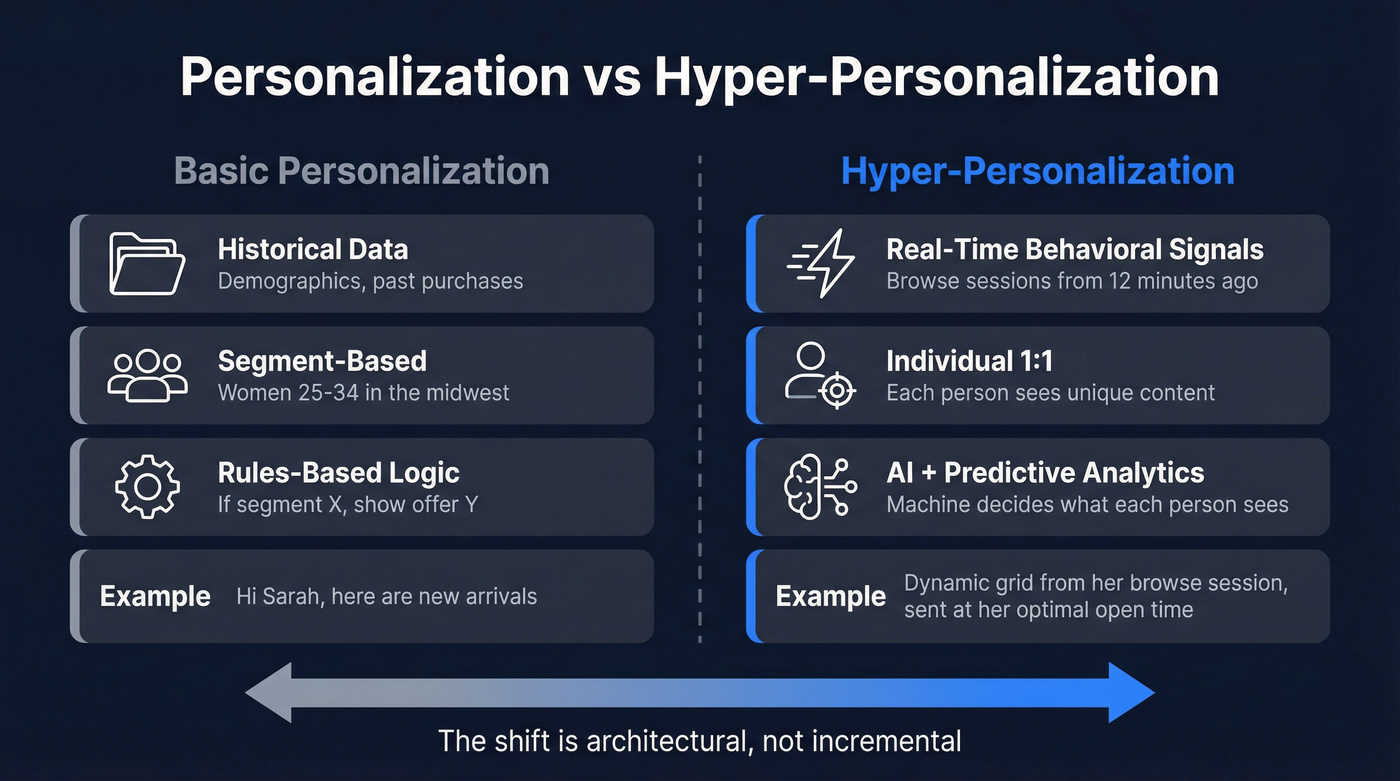
| Dimension | Personalization | Hyper-Personalization |
|---|---|---|
| Data type | Historical (demographics, past purchases) | Real-time behavioral signals |
| Scope | Segment-based ("women 25-34") | Individual-level, 1:1 |
| Engine | Rules-based logic | AI + predictive analytics |
| Example | "Hi Sarah, here are new arrivals" | Dynamic grid from her browse session 12 min ago |
The shift isn't incremental. It's architectural. You're moving from "group people into buckets" to "let the machine decide what each person sees and when they see it."
Why It Works - 2026 Benchmarks
Automated flows hit a 5.58% click rate on average. The top 10% hit 10.48%. For placed orders, flows average 2.11% while campaigns average 0.16%. That's not a rounding error - it's a fundamentally different motion. Campaigns are for announcements. Flows are for revenue.
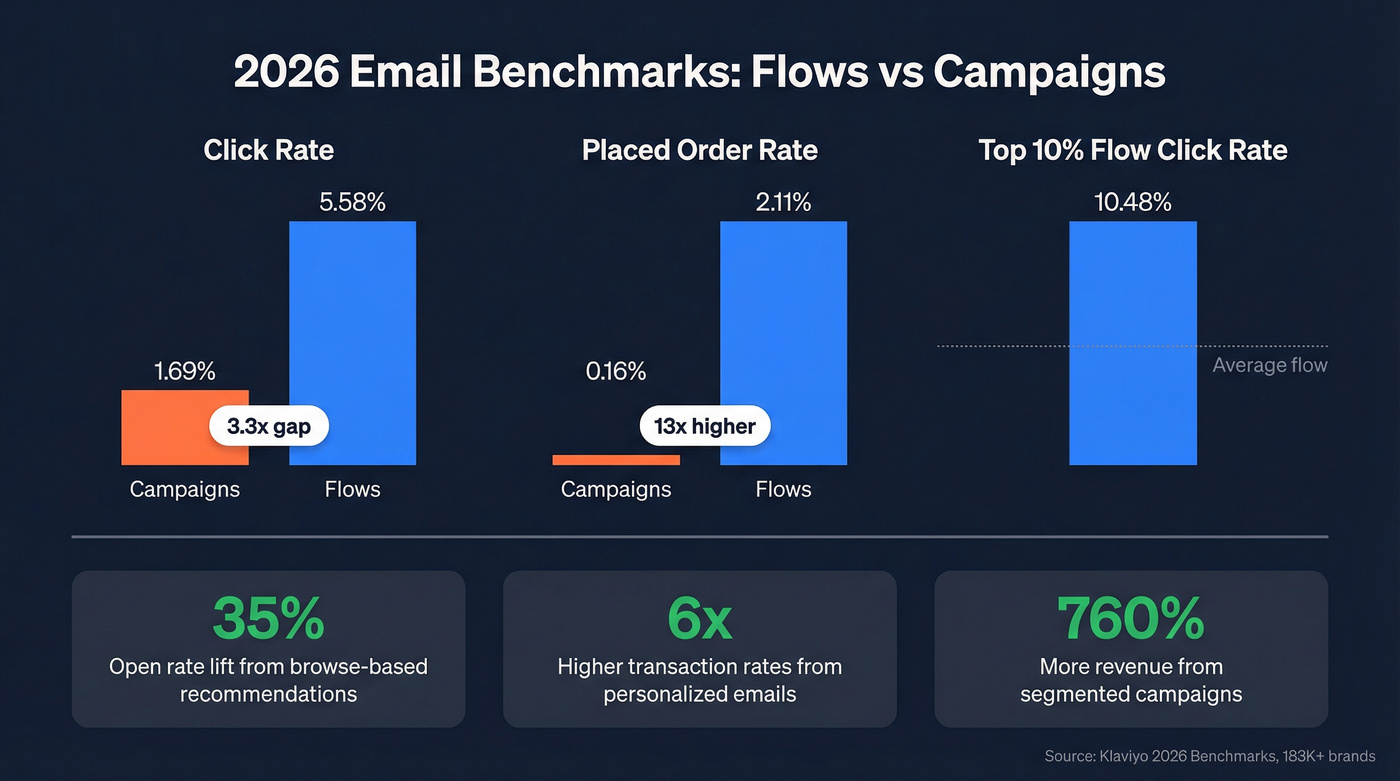
Send-time optimization alone moves the needle. Shady Rays tested it across 30+ campaigns and saw a 10%+ increase in placed order rates versus a control group, with the top 15% of campaigns using personalized send times seeing a 35% click rate increase. In one fashion ecommerce case, browse-based recommendations lifted open rates 35% and doubled CTR. The broader data backs this up: personalized emails deliver 6x higher transaction rates and segmented campaigns generate up to 760% more revenue than one-size-fits-all blasts.
In our experience, teams that nail behavioral triggers and send-time optimization before adding complexity see the fastest ROI. The fancy stuff can wait.
How AI Powers Hyper-Personalized Campaigns
You don't need every AI feature your ESP offers. You need three to start, and you can layer the rest as your data matures.
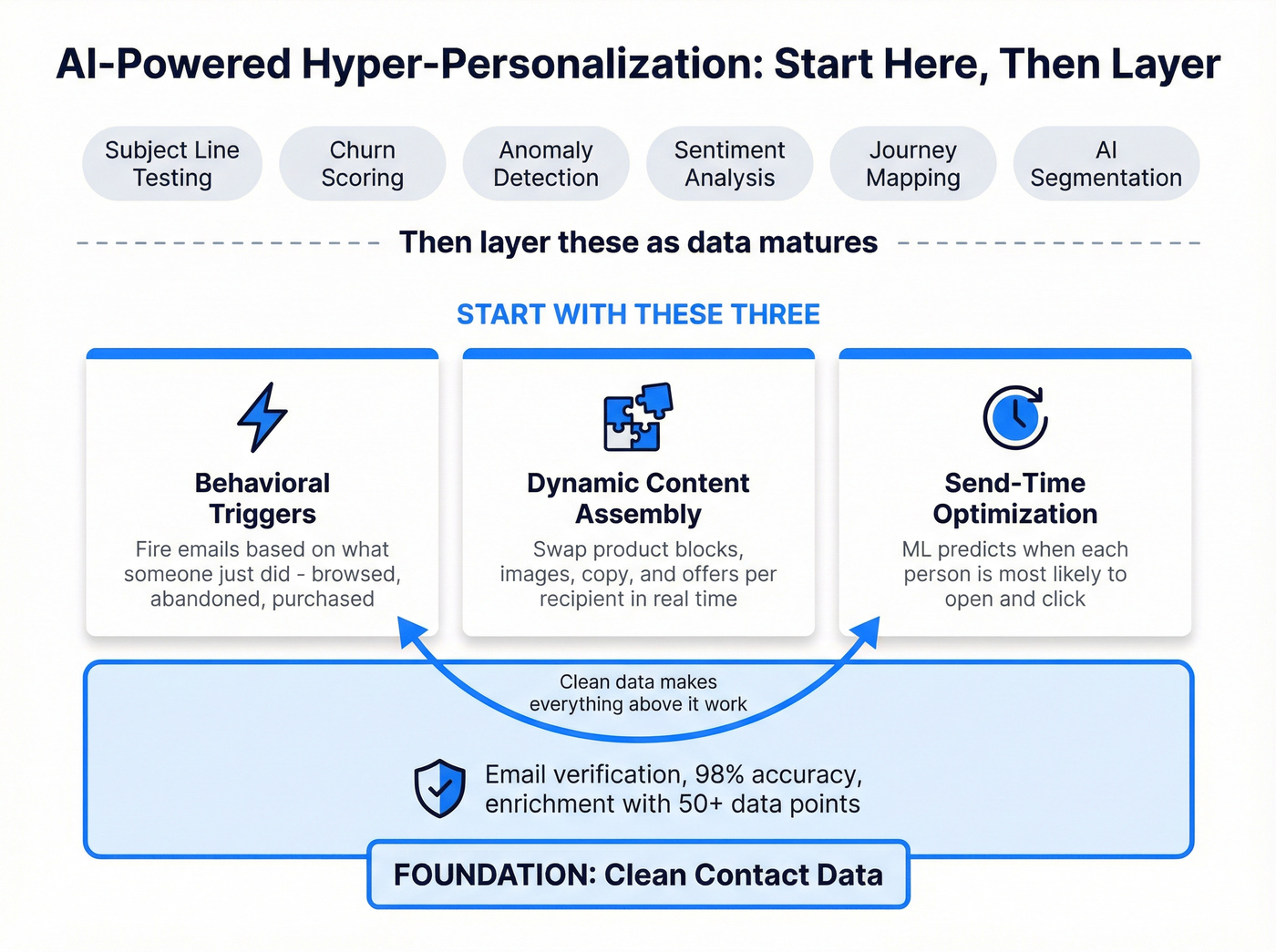
Behavioral triggers fire emails based on what someone just did - browsed, abandoned, purchased - not what segment they're in. Dynamic content assembly swaps product blocks, images, copy, and offers per recipient using real-time data. Send-time optimization uses ML models to predict when each recipient is most likely to open and click, then schedules accordingly.
Once those three are running, layer in subject line testing, churn scoring, anomaly detection, sentiment analysis, journey mapping, and AI-driven segmentation. But let's be honest: the differentiator isn't which features exist. It's whether your data is clean enough to make them work.
If you want a deeper breakdown of what actually works (and what doesn't), see our guide on AI in Email Marketing.

Your AI personalization engine is only as smart as the contact data feeding it. Prospeo delivers 98% email accuracy with a 7-day refresh cycle - 6x faster than the industry average - so your behavioral triggers fire on real people, not dead addresses.
Stop personalizing emails that never reach the inbox.
8 Hyper-Personalized Email Patterns
Each pattern ties a specific behavioral trigger to a personalization variable that changes per recipient.
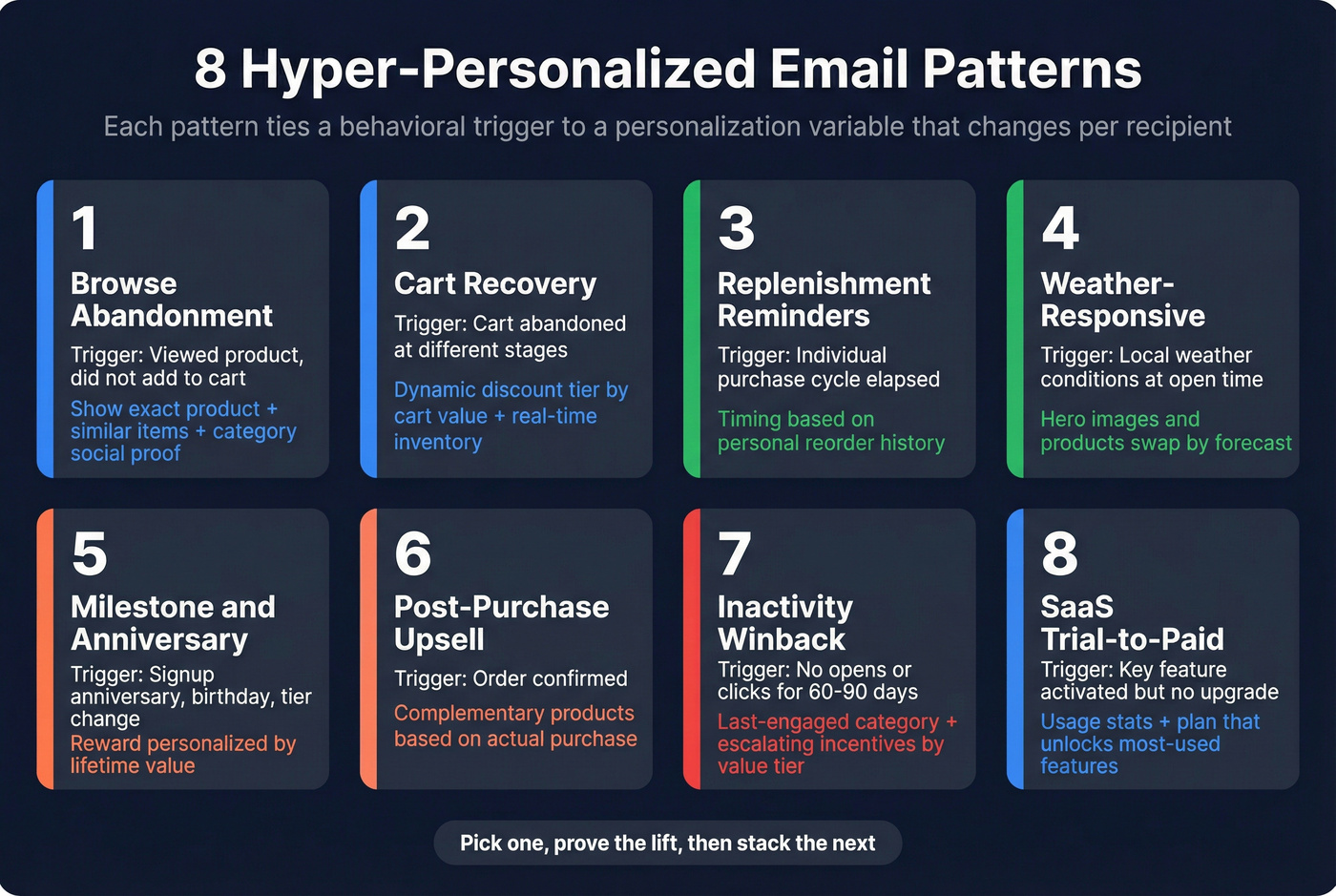
1. Browse abandonment. Trigger: viewed product but didn't add to cart. Personalize with the exact product, similar items, and category social proof. This is the lowest-effort, highest-return pattern for most ecommerce teams - we've seen brands launch it in under two hours and see measurable lift within a week.
2. Cart recovery with dynamic urgency. The person who browsed for 30 seconds gets a different email than the person who entered their shipping address. Completely different signals, completely different urgency. Personalize the discount tier by cart value and show real-time inventory counts.
3. Replenishment reminders. Trigger: purchase cycle elapsed (30 days for skincare, 90 for supplements). Adjust timing based on individual reorder history, not category averages.
4. Weather-responsive product blocks. Picture this: it's 38 degrees and raining in Chicago. Your subscriber opens an email and sees rain boots and a waterproof jacket. Their friend in Phoenix sees sunglasses and SPF. Hero images and recommendations swap based on each recipient's local forecast.
5. Milestone and anniversary emails. Trigger: signup anniversary, birthday, or loyalty tier change. Personalize the reward based on lifetime value.
6. Post-purchase upsell. Trigger: order confirmed. Serve complementary products based on what was purchased, not generic cross-sells. (If you want examples you can swipe, see these upsell patterns.)
7. Inactivity-triggered winback. Trigger: no opens or clicks for 60-90 days. Personalize with the last-engaged product category and escalate incentives by customer value tier. Skip this pattern if your list hygiene is poor - you'll just be emailing dead addresses and tanking your sender reputation.
8. SaaS trial-to-paid nudge. Trigger: trial user activated a key feature but hasn't upgraded. Personalize with usage stats and the specific plan that unlocks their most-used features.
These eight patterns form the backbone of any individualized email strategy. Pick one, prove the lift, then stack the next.
Data Quality: The Part Nobody Wants to Talk About
The consensus on r/emailmarketing is blunt: personalization fails when the data underneath it is garbage. About 21% of opt-in emails never reach the inbox. Remember that welcome flow pulling 5.58% clicks while your campaigns sit at 1.69%? That's clean behavioral data doing the work. Without it, your AI models learn from noise.
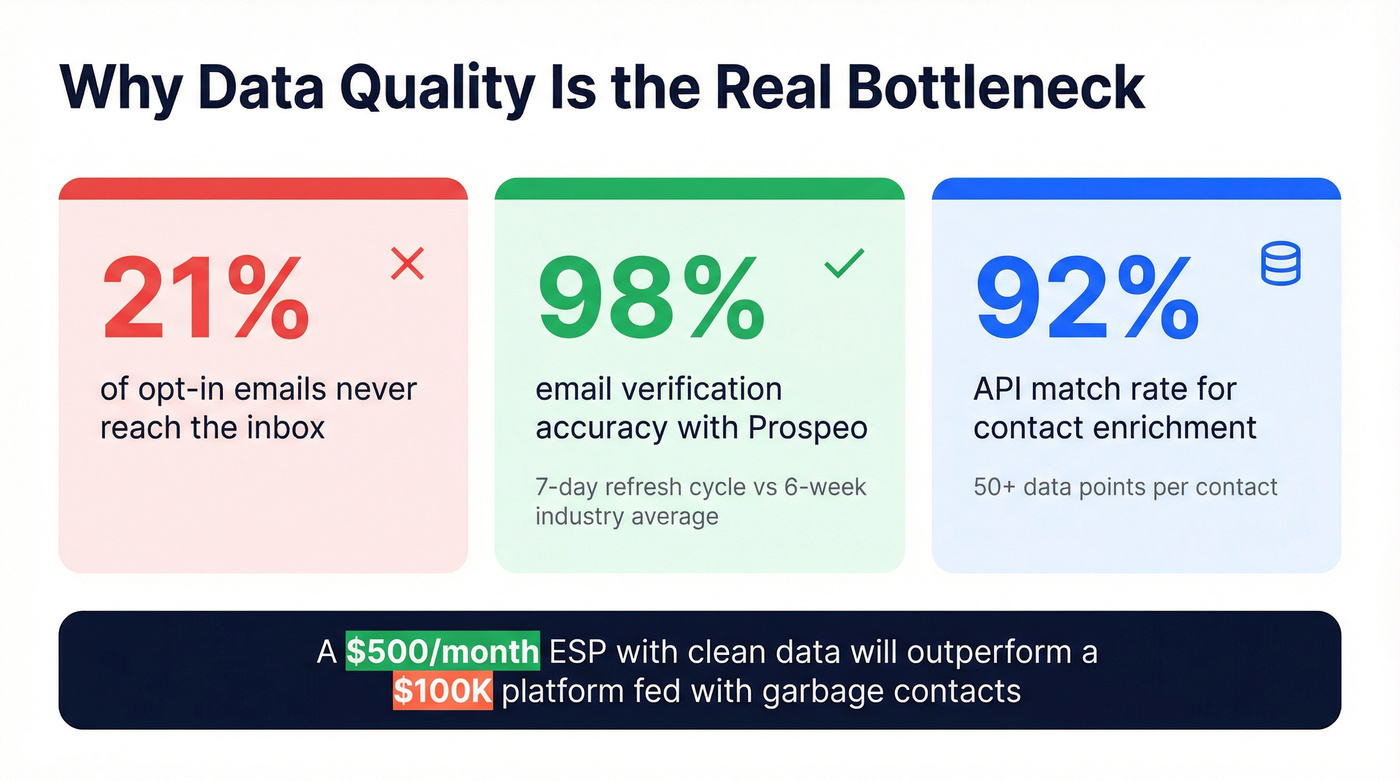
Here's the frustrating part: the bottleneck is almost never your email platform. A $500/month ESP with clean data will outperform a $100K platform fed with garbage contacts. We've seen teams spend $35K/year on enterprise personalization engines while their contact lists rot underneath.
This is where data enrichment matters. Prospeo's email verification hits 98% accuracy with a 7-day data refresh cycle - the industry average is six weeks. The enrichment layer returns 50+ data points per contact with a 92% API match rate, so your behavioral segments are built on complete profiles rather than guesswork.
If you want to systematize this across your stack, start with data quality scorecards and a simple CRM hygiene routine.
The Creepiness Threshold
77% of consumers don't fully understand how their data is collected and used. That gap between "we know a lot about you" and "you don't know we know" is where trust breaks down.
The fix isn't less personalization - it's consent-based personalization. Preference centers, quizzes, and explicit opt-ins (zero-party data) let customers tell you what they want. GDPR and CPRA aren't obstacles; they're guardrails that force you to build on trust rather than surveillance. Brands building on consent will outlast those mining inferred data from black-box models.
Tools and What They Cost
The personalization engines market hit $1.2B in 2024 and is projected to reach $31.6B by 2030. Here's how to think about the landscape:
| Category | Example Tools | Price Range | Best For |
|---|---|---|---|
| SMB ESPs | Mailchimp, Brevo, GetResponse | $20-$300/mo | Small lists, basic automation |
| Mid-market automation | Klaviyo, ActiveCampaign, HubSpot | $500-$5K/mo | Behavioral flows, dynamic content |
| Enterprise omnichannel | Braze, Iterable, SFMC, Adobe | $20K-$200K+/yr | Multi-channel orchestration |
| Data quality layer | Prospeo | Free tier; ~$0.01/email | Verified contacts, 50+ enrichment data points |
Enterprise personalization engines like Dynamic Yield, Optimizely, and Bloomreach are powerful - but overkill for most teams. If your average deal size is under five figures, you don't need an enterprise personalization engine. You need clean data, a mid-market ESP, and the three AI capabilities above. That stack will beat a six-figure platform running on decayed lists every single time.
If you're auditing deliverability before scaling personalization, use an email deliverability checklist and learn how to reduce hard bounce risk.
Every hyper-personalization pattern above depends on complete, accurate profiles. Prospeo's enrichment returns 50+ data points per contact at a 92% match rate - giving your dynamic content blocks and AI models real signals instead of guesswork. At $0.01 per email, clean data costs less than a single wasted send.
Enrich your contacts before your next campaign goes out.
FAQ
What's the difference between personalization and hyper-personalization?
Personalization targets segments with historical data - first-name tokens, demographic groups. Hyper-personalization uses real-time behavioral data and AI to create 1:1 experiences that adapt as each customer acts. The gap shows up in results: flows built on individual behavior convert at 13x the rate of segment-based campaigns.
Do I need an enterprise platform to hyper-personalize emails?
No. A mid-market ESP at $500-$5K/month with clean contact data will outperform an enterprise platform fed with stale records. Start with behavioral triggers, dynamic content, and send-time optimization - those three capabilities cover 80% of the lift.
How does data quality affect email hyper-personalization?
Directly. About 21% of opt-in emails never reach the inbox. If your contact data isn't verified, behavioral triggers fire into dead addresses and your AI models learn from noise. Verifying your list at ~$0.01 per email is the cheapest performance upgrade you'll make.
How do I get started with hyper-personalized email outreach?
Pick one flow - browse abandonment or cart recovery - and add dynamic content blocks and send-time optimization. Verify your list, measure the lift, then expand to additional patterns. Once you've proven results on a single flow, scale across your full customer lifecycle.