

How to Ask for a Point of Contact in Email (2026)
The average professional gets 120+ emails a day. If you're trying to ask for a point of contact in email, your message is competing with 119 others - and most of them are more relevant. B2B cold email response rates have dropped from 8.5% in 2019 to roughly 4-5% today, so every word in your outreach has to earn its place.
The Short Version
- Don't use the "Appropriate Person?" subject line. It gets filtered and signals laziness.
- Keep your email under 125 words, include 1-3 questions, and prove you did research.
The "Appropriate Person?" Trap
There's a cold email template that's been circulating since the early 2010s. Subject line: "Appropriate Person?" Body: some variation of "I'm not sure who handles X at your company - could you direct me to the right person?" It sounds polite. It's also a losing strategy.
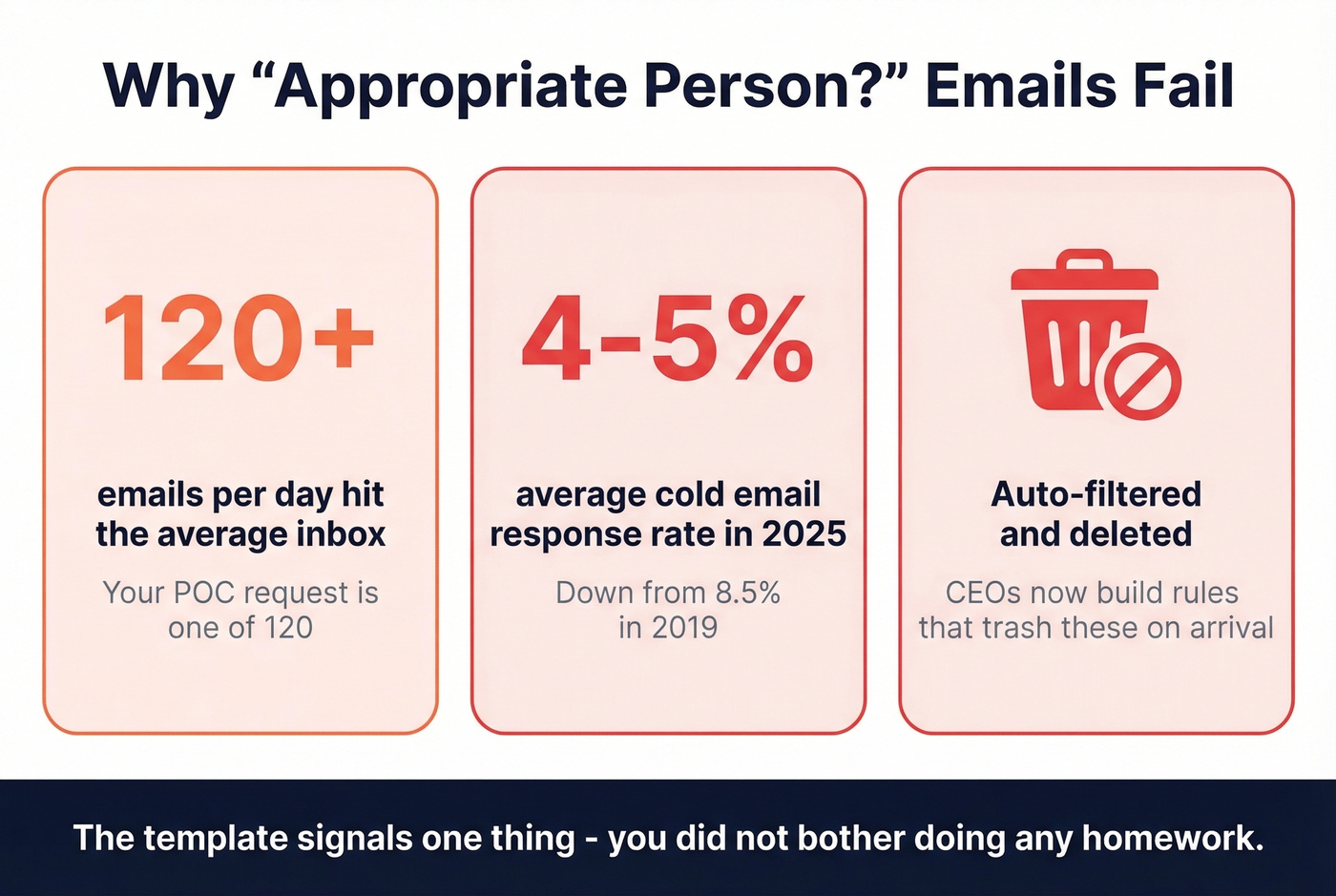
As Jeb Blount put it: "Statistically speaking it didn't work then and it doesn't work now." The template signals one thing to the recipient - you didn't bother doing any homework. Peter Mahoney, a CEO who got tired of receiving these, built an automated filter that deletes any email with "appropriate person" in the subject line. He's not alone. Spam filters and human filters both catch this pattern now, and if you're still using it, you're competing against a wall of identical emails that all say the same thing.
Rules for a POC Request That Gets Answered
1. Stay under 125 words. The sweet spot for cold emails is 50-125 words, but shorter often wins. One practitioner cut emails from 141 words to under 56 and saw reply rates double from 3% to 6%.
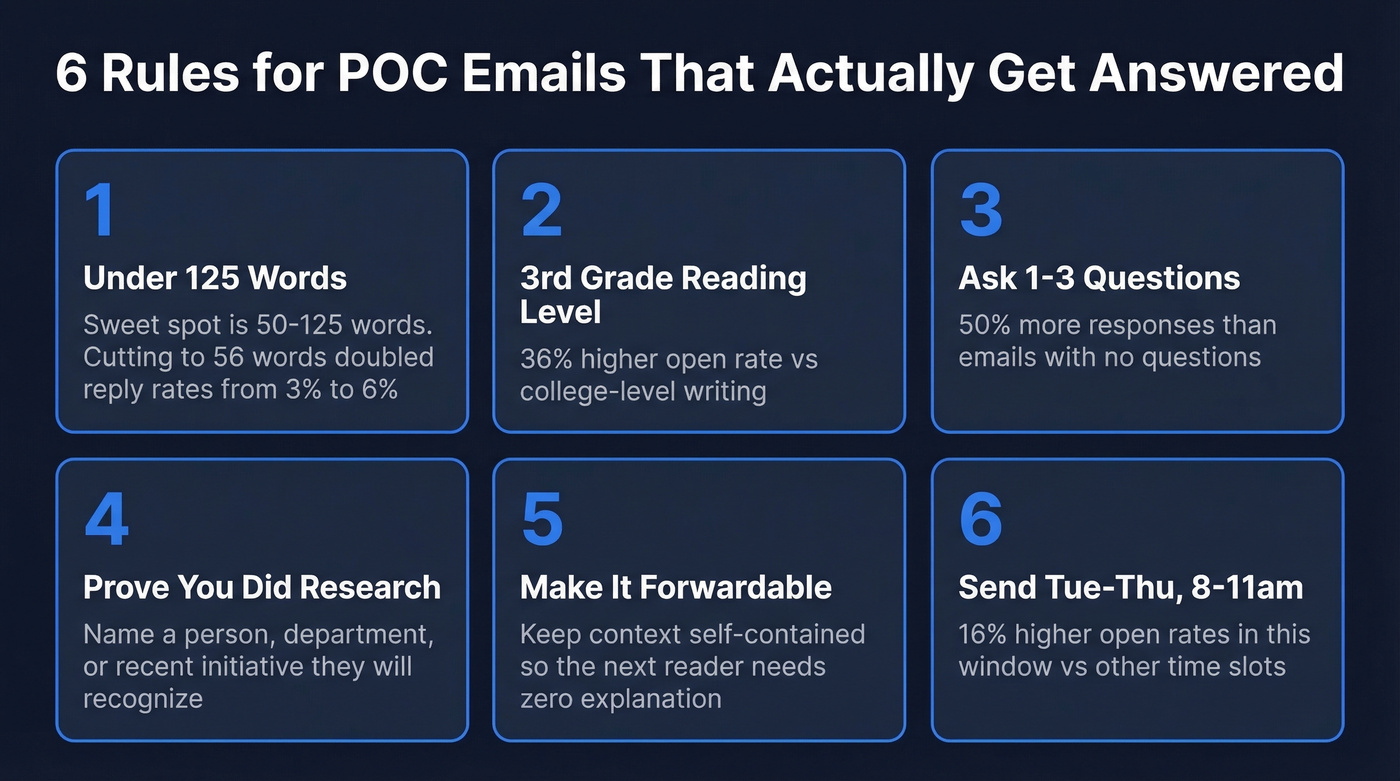
2. Write at a third-grade reading level. Emails written simply - short sentences, common words - see a 36% higher open rate than college-level prose. Don't try to sound impressive. Try to sound clear. If you want a tighter framework for clarity and structure, use these email copywriting principles.
3. Ask 1-3 questions. Emails with questions get 50% more responses than those without. A POC request is inherently a question - make it specific, not vague.
4. Prove you did research. Name a person, a department, or a recent initiative. "I saw your team just launched X" beats "I'm not sure who handles this" every time. This is the same logic behind personalized outreach.
5. Make it easy to forward. If the recipient isn't the right person, your email needs to work as a forwarded message. Keep context self-contained - don't assume the next reader saw your subject line.
6. Send Tue-Thu, 8-11am in the recipient's timezone. This window sees 16% higher open rates than other time slots. For POC requests specifically, mornings work because people triage email early and are more likely to fire off a quick redirect before their day fills up. For a deeper breakdown, see the best time to send cold emails.
In our experience, the emails that get forwarded fastest are the ones that require zero explanation - short enough to skim, specific enough to route.

Every POC request email adds days of delay and a 70-90% chance of silence. Prospeo's database lets you search 300M+ profiles with 30+ filters - job title, department, seniority - so you land in the decision-maker's inbox on the first touch.
Skip the gatekeeper. Find verified emails for $0.01 each.
Templates by Scenario
Cold Outreach to a Company
Subject: Quick question for [Company]'s [department] team
Hi [First Name],
I noticed [Company] recently [specific observation - new hire, product launch, funding round]. We help [type of company] with [one-line value prop].
I think [Name or Title] might be the right person to talk to about this - but if that's off, could you direct me to whoever owns [specific area]?
Happy to keep this brief.
Thanks, [Your name]
Why this works: The specific observation in the opening line proves you're not blasting a list. Naming a person or title as your best guess gives the recipient something to confirm or correct - much easier than asking them to think of someone from scratch. If you’re building a full outbound motion, pair this with sales prospecting techniques.
Internal Request
Sometimes the person you need is inside your own organization. The trick here is brevity and a clear reason for the ask - nobody wants to feel like they're being used as a human directory.
Hi [Name], I'm working on [project] and need to connect with whoever manages [specific function] on your side. Could you point me to the right person, or let me know if that's you? Any contact details will only be used for this project. Thanks!
Asking a Mutual Contact for an Intro
Subject: Could you intro me to someone at [Company]?
Hi [Name],
Only if you're comfortable - I'm trying to reach someone at [Company] who handles [area]. I know you've worked with their team.
I've drafted a short blurb below you can forward if it's easier:
"Hi [Contact], [Your Name] from [Your Company] asked me to connect you. They help [type of company] with [value prop] and wanted to see if it's relevant to your team. I'll let you two take it from here."
No pressure at all. Appreciate it either way.
The "I Forwarded Your Email" Dead End
This is the scenario every salesperson on r/sales dreads. Someone says "I've passed your email along" - and then silence. Give it 48 hours before following up. Here's the move:
Subject: Following up - [specific area] at [Company]
Hi [Name],
Thanks for forwarding my note. I haven't heard back yet - totally understand how busy things get.
Would [specific name or title] in [department] be the right person to follow up with directly? If you could share their name or email, I'll take it from here.
If I don't hear back by [specific date, ~3 business days out], I'll assume the timing isn't right and circle back next quarter.
If you want more options for the second touch, use these sales follow-up templates.
Subject Lines That Get Opened
- "Quick question" - 39% open rate. Short, curiosity-driven, low commitment.
- [Company name] + specific topic - 33% open rate. Proves relevance immediately.
- "Who handles [area] at [Company]?" - Direct and honest. Works well for requesting a point of contact.
- "Intro request - [your company] + [their company]" - Good for mutual-contact intros.
- "Partnership opportunity" - Under 19% open rate. Skip it. It screams template.
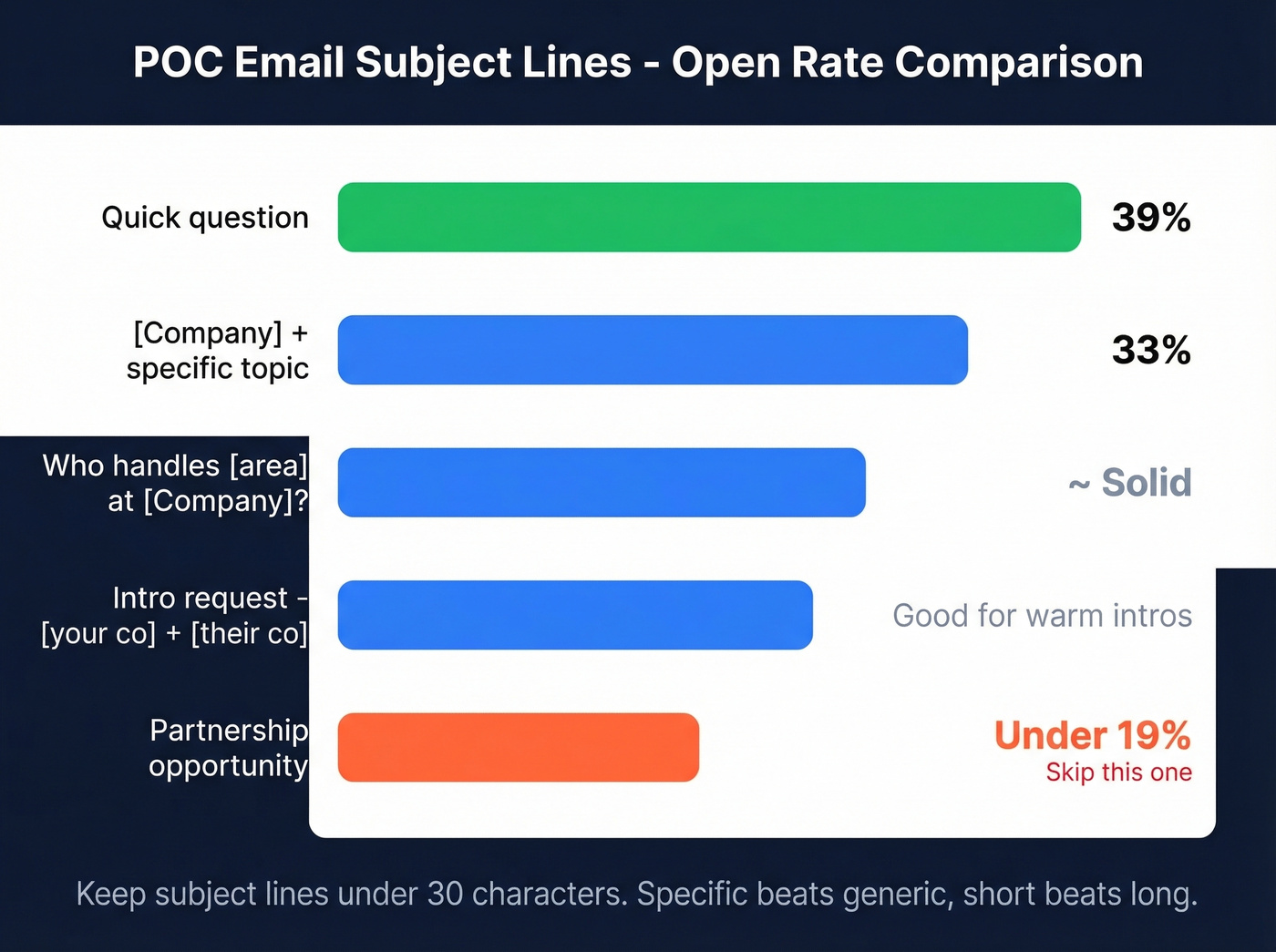
Keep subject lines under 30 characters when possible. The pattern is clear: specific beats generic, short beats long. For more tested options, browse these email subject line examples and prospecting email subject lines.
Skip the Ask Entirely
Here's the thing: if your average deal size is above $5k, it's usually smarter to stop sending POC-request emails and go straight to the decision-maker. Every time you email a gatekeeper asking "who handles X?", you're adding 2-4 touches and days of delay - and your redirect success rate is roughly 10-30%, meaning most of those emails go nowhere.
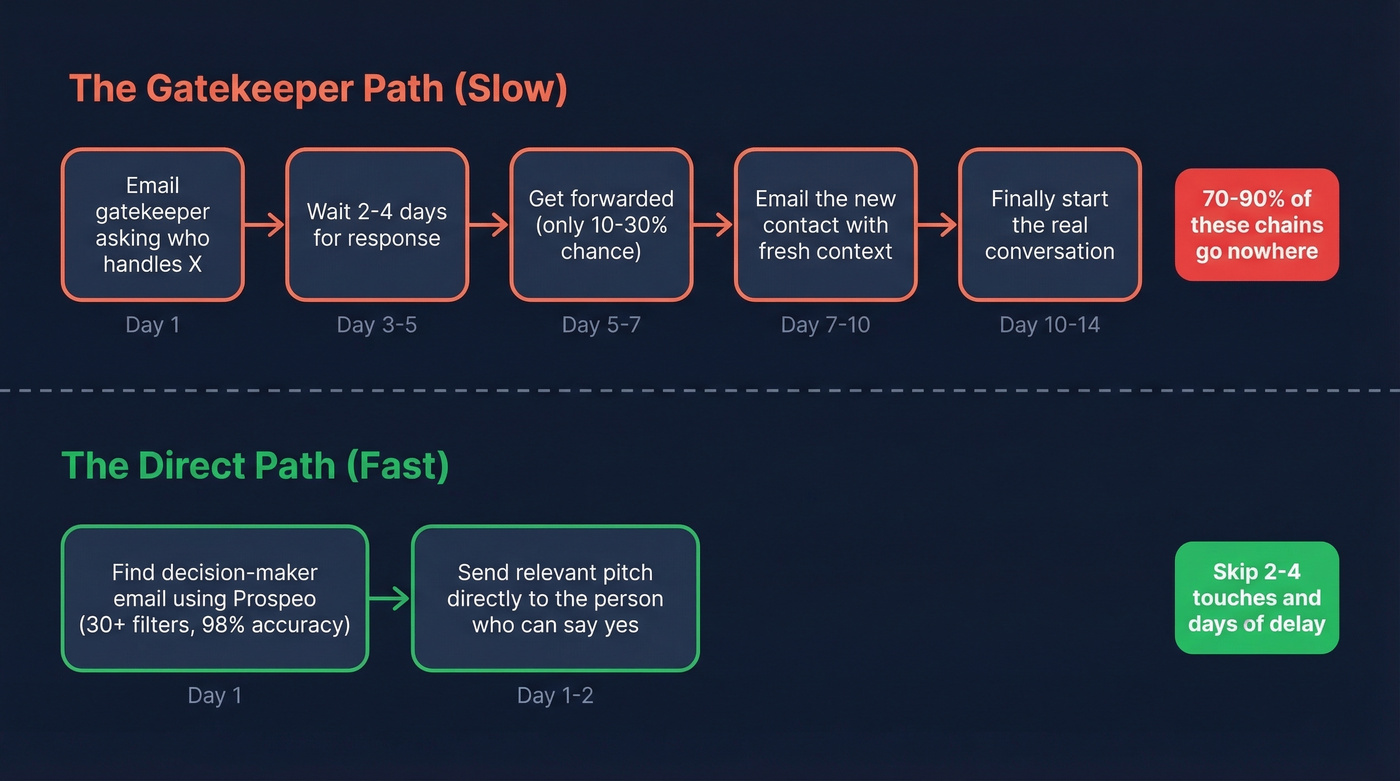
We've seen this play out across dozens of campaigns. The teams that skip the gatekeeper entirely and write directly to the VP of Engineering or the Head of Procurement have a fundamentally different conversation from the start. No "could you point me to the right person?" - just a relevant pitch to someone who can actually say yes. This is also why account-based selling tends to outperform generic outreach.
Prospeo's B2B database lets you search 300M+ professional profiles by company, department, and job title using 30+ filters, with 98% email accuracy and data refreshed every 7 days. That turns a multi-step gatekeeper dance into a single, targeted email.
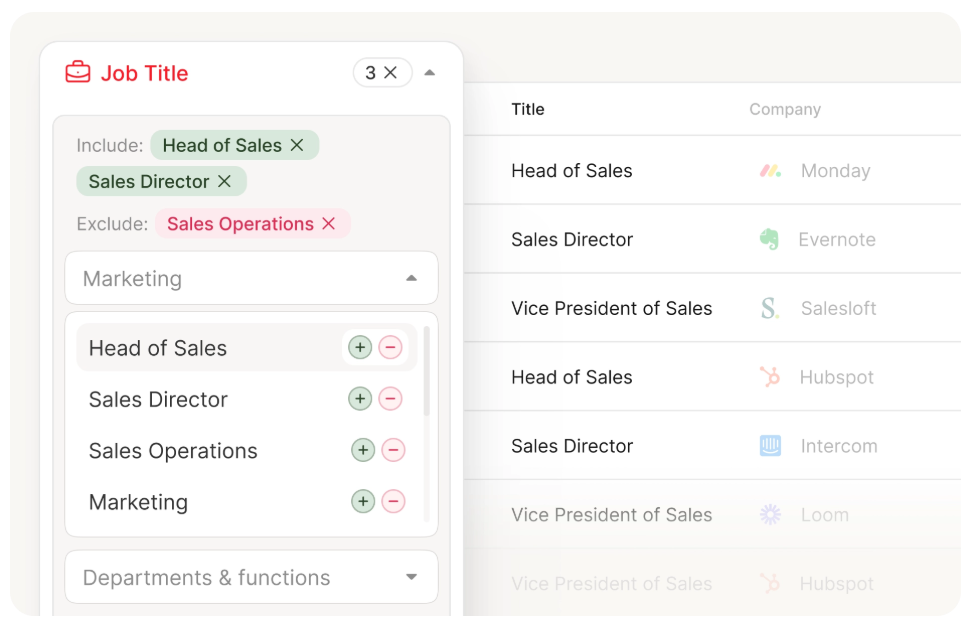
Your redirect success rate on POC emails is 10-30%. Meanwhile, Prospeo delivers 98% email accuracy on 143M+ verified addresses - so you can write directly to the VP, the Head of Ops, or whoever owns the budget. No forwarding chain required.
Stop asking who handles it. Start reaching them directly.
New Point of Contact Introduction
Sometimes you're on the other side - you've just taken over an account and need to let the client know. Keep it warm and action-oriented:
Subject: Your new point of contact at [Company]
Hi [Name],
I'll now be your primary point of contact at [Company]. [Previous contact] has brought me up to speed on your account.
I'd love to set up a brief three-way call with [Previous contact] and me so the transition is smooth. Would [date/time] work?
FAQ
How long should a POC request email be?
Aim for 50-125 words. Cut the "My name is..." intro, skip the company backstory, and get to your question in the first two sentences. Shorter emails also forward better, which matters when the recipient isn't the right person.
What if someone says "I forwarded your email" and goes silent?
Follow up within 48 hours with a specific name or department you think fits - give them something to confirm or correct. Set a soft deadline ("If I don't hear back by Friday, I'll assume the timing isn't right") so you're not chasing indefinitely. The consensus on r/sales is that two follow-ups max is the right number before you move on and try a different entry point.
Can I find the right contact without emailing a gatekeeper?
Yes. B2B data tools let you search by company, department, and job title to get verified emails directly - no gatekeeper required. Prospeo's free tier includes 75 email credits per month, enough to test the approach on real campaigns.
What's the best subject line for requesting a point of contact?
"Quick question" pulls a 39% open rate - the highest of any short-form subject line we've tracked. Pair it with the recipient's company name for even better results. Avoid generic phrases like "Partnership opportunity," which sit below 19%.