

What to Say Instead of "Following Up on My Previous Email"
You sent the proposal on Monday. It's Thursday. Nothing. So you open a new draft and type the six words that have never once made someone excited to reply: "following up on my previous email."
That phrase tells the recipient exactly nothing new - and 55% of all cold email replies come from follow-ups, not the first email. You can't afford to waste them on a sentence that's basically a shrug in text form.
The Short Version
- Wait 3 days before your first follow-up. Next-day follow-ups reduce replies by 11%, while a 3-day gap lifts them by 31%.
- Each follow-up should add new value, not just remind. Use the 5-objection rotation below.
- Keep it to 50-125 words. Shorter follow-ups feel human.
- Don't send the exact same email again.
Why Follow-Ups Outperform First Sends
Most people treat follow-ups as an afterthought - a polite nudge they send out of obligation. That's backwards.
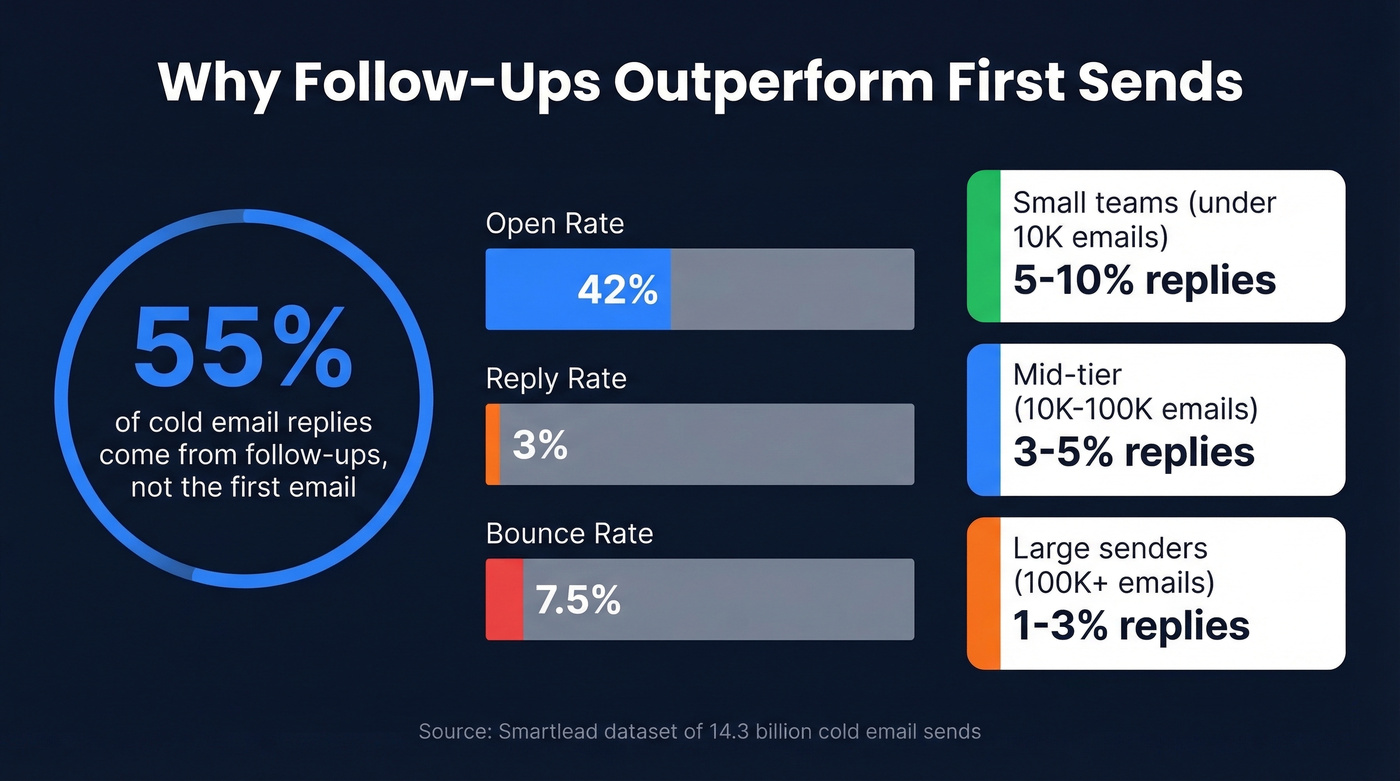
Across Smartlead's dataset of 14.3 billion cold email sends, global benchmarks land around 42% opens, 3% replies, and roughly 1% meetings booked, with a 7.5% bounce rate meaning a chunk of your emails never arrive at all. Reply rates vary by volume: small teams sending under 10,000 emails per month see 5-10% replies, mid-tier operations land at 3-5%, and large senders pushing 100k+ drop to 1-3%. But the pattern holds across every segment - follow-ups drive the bulk of positive responses. If you're only sending one email and moving on, you're leaving more than half your potential replies on the table.
The 5-Objection Follow-Up Strategy
Here's the thing: most people send the same message three times with slightly different wording. That's not a sequence. It's pestering.
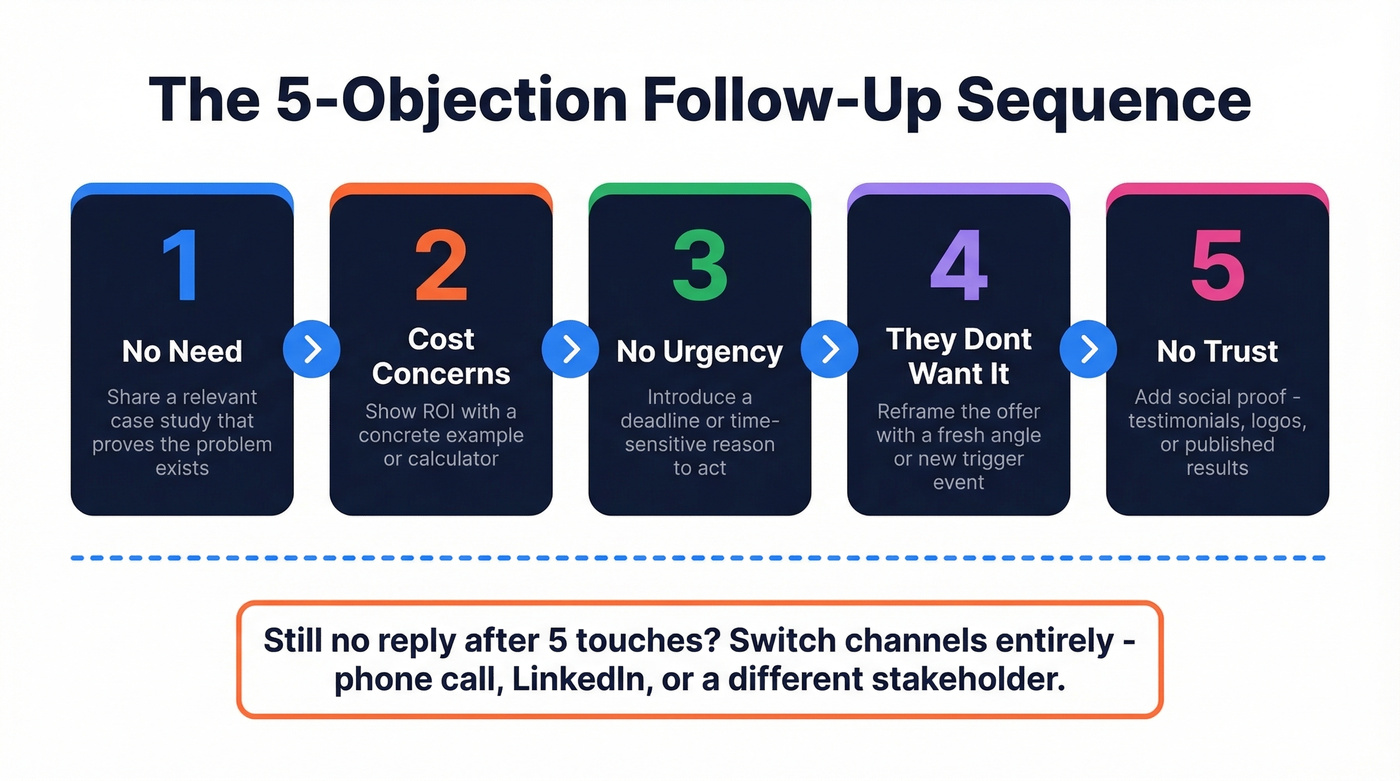
GMass outlines a smarter approach built around five objections every prospect holds, whether they voice them or not: no need, cost concerns, no urgency, they don't want it, and they don't trust you. Each follow-up addresses a different one. Your first might tackle "no need" with a relevant case study. The second handles cost with an ROI example. The third creates urgency with a deadline. The fourth reframes desire with a new angle. The fifth builds trust with social proof.
Each message stands on its own - a recipient who only reads your third email still has a reason to reply. If three emails get nothing, switch channels entirely. A phone call or a message through a different platform often breaks through where email can't.
When to Send Your Follow-Up
Timing isn't one-size-fits-all. A cold sales email and a job application operate on completely different clocks. As Rebecca Zucker noted in HBR, follow-up etiquette shifts depending on the relationship and context.
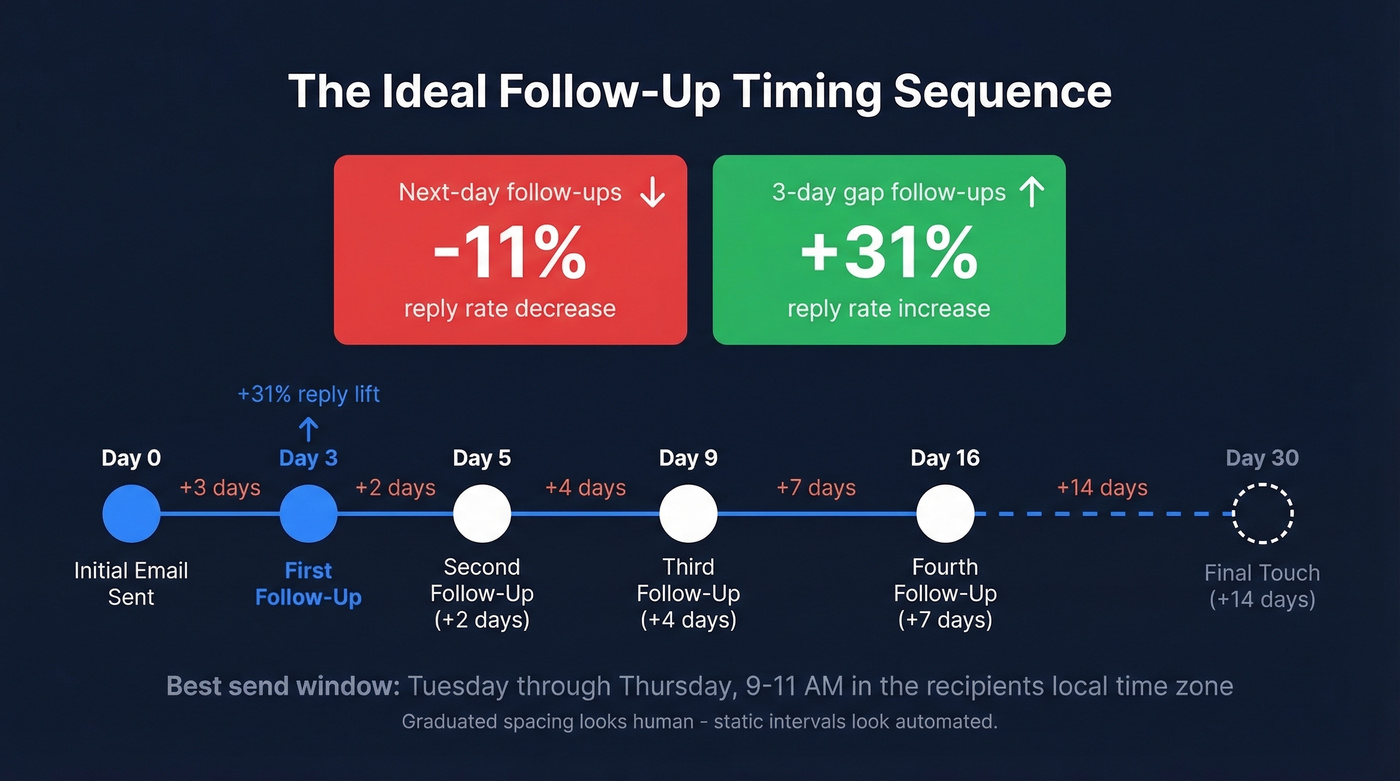
The data is clear on one thing: don't follow up the next day. Next-day follow-ups reduce reply rates by 11%. Waiting three days increases them by 31%. After that first follow-up, use graduated spacing - 2, 4, 7, then 14 days between touches. Static intervals look automated. Graduated spacing looks human.
For B2B outreach, Tuesday through Thursday between 9-11 AM in the recipient's local time zone pulls higher reply rates than Monday or Friday sends. (If you want a deeper breakdown, see best time to send cold emails.)
| Scenario | First Follow-Up | Max Emails |
|---|---|---|
| Cold email (sales) | 2-3 business days | 3 total |
| Inbound lead | Within 5 minutes | As needed |
| Job application | 5-10 business days | 2 total |
| Post-interview | Within 24 hours | 1-2 total |
| Client / vendor | 3-5 business days | 2-3 total |
| Internal request | 24-48 hours | 2 total |
| Proposal / quote | 5-7 business days | 2-3 total |
| Academic / research | 7-14 days | 2 total |

Follow-up timing and phrasing only matter if your email actually lands. With a 7.5% average bounce rate, bad data silently kills your sequences before prospects ever see them. Prospeo's 98% email accuracy and 7-day data refresh mean every follow-up reaches a real inbox.
Stop perfecting copy for emails that bounce. Fix the data first.
12 Better Phrases to Replace the Cliche
Let's retire the phrase bank that makes everyone cringe. One Reddit thread on r/antiwork catalogued the workplace phrases people hate most - "per my last email," "circle back," and "low-hanging fruit" all made the list. And if you're wondering about "kindly," skip it. In many workplace contexts it reads as condescending. "I haven't heard from you" lands somewhere between guilt-trippy and accusatory. Variants like "wanted to follow up on my previous email" or "just want to follow up" are only marginally better - they still add zero new information.
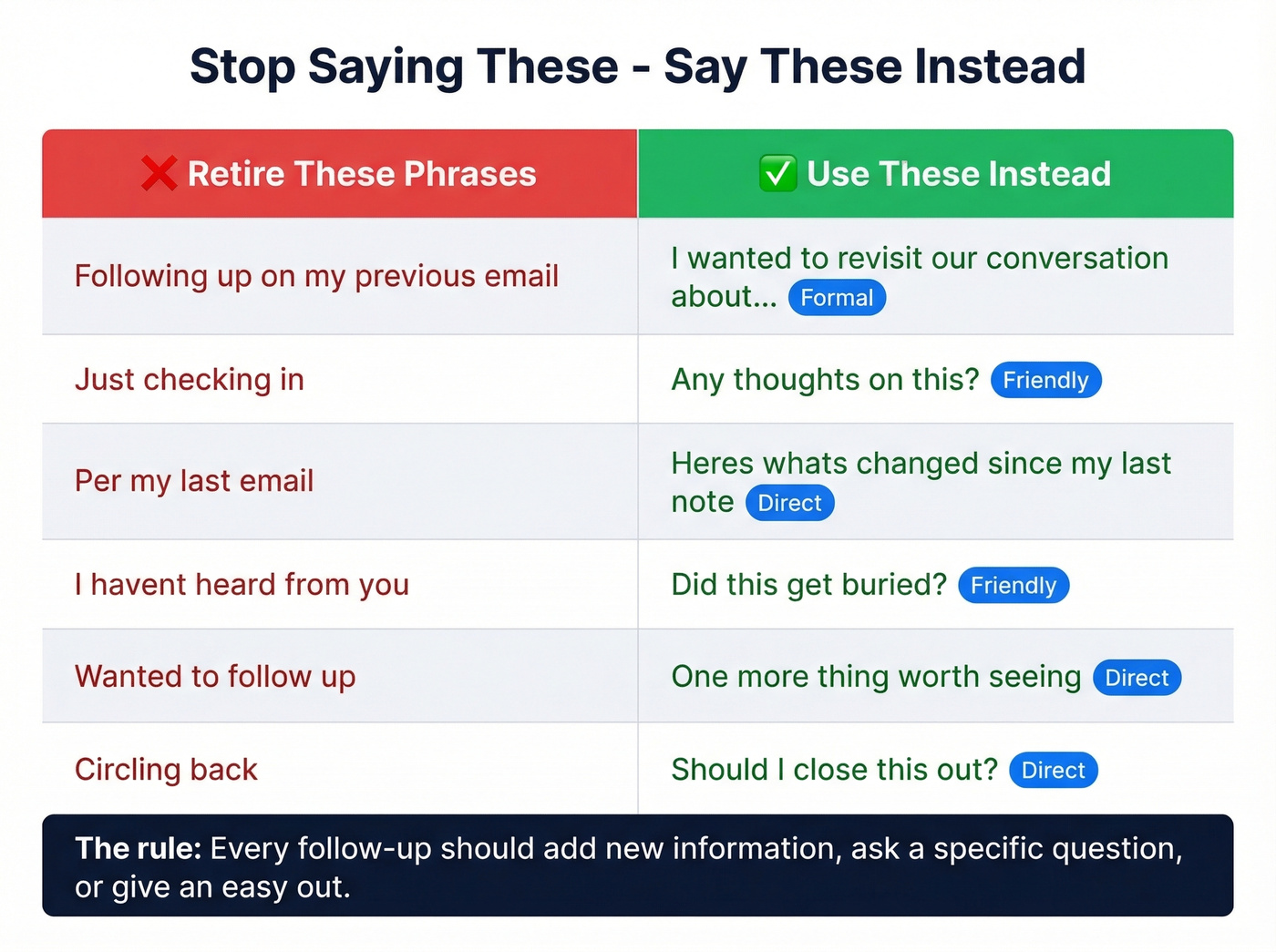
Every good follow-up either adds new information, asks a specific question, or gives the recipient an easy out. "Just checking in" does none of those. (For more options, see how to say just checking in professionally.)
Formal
- "I wanted to revisit our conversation about..." - I wanted to revisit our conversation about the Q2 rollout timeline.
- "I'd appreciate an update on..." - I'd appreciate an update on the contract review when you have a moment.
- "Returning to the matter of..." - Returning to the matter of the vendor selection - have you had a chance to review the proposals?
Friendly
- "Any thoughts on this?" - Wanted to bump this up - any thoughts on the draft?
- "Did this get buried?" - Totally understand if this got buried - just wanted to resurface it.
- "Quick question on [topic]" - Quick question on the timeline - are we still targeting March?
Direct
- "Here's what's changed since my last note" - Here's what's changed since my last note: we've added two new case studies relevant to your team.
- "I have a new angle on this" - I have a new angle on this - saw your team just hired a new VP of Ops.
- "Should I close this out?" - If the timing isn't right, no worries - should I close this out for now?
- "One more thing worth seeing" - One more thing worth seeing before you decide - our ROI calculator for teams your size.
- "Circling back with something new" - Circling back with something new - [Company X] just published results from a similar rollout.
- "Wanted to flag this before [deadline]" - Wanted to flag this before the pricing changes on the 15th.
Templates That Actually Get Replies
Each template below demonstrates the "add new value" principle. Adapt the brackets and send. (If you want more plug-and-play options, use these sales follow-up templates.)
Cold Outreach Follow-Up
Before you rewrite your follow-up for the third time, make sure the email's actually arriving. We've seen teams agonize over copy when the real problem was a 16.9% bounce rate torching their sender reputation. Prospeo's email verification catches bad addresses at 98% accuracy - the free tier gives you 75 verifications a month to start cleaning your list. If you're building a full sequence, start with a B2B cold email sequence.
Subject: [Specific benefit] for [Company]
Hi [Name], I shared a note last week about [specific topic]. Since then, [new data point / case study / relevant news about their company]. Thought it was worth flagging. Would a 15-minute call next week make sense, or is this not a priority right now?
Job Application Follow-Up
Subject: Following up - [Role Title] application
Hi [Name], I applied for the [Role] position on [date] and wanted to reiterate my interest. I noticed [something specific about the company's recent news]. My experience with [relevant skill] maps directly to that. Happy to share more detail if helpful.
Post-Meeting Follow-Up
Don't try to recap the entire discussion. They were there. Think of this as three beats: gratitude, deliverable, next step. Thank them for the conversation, attach whatever you promised, then make one specific ask with a deadline. That's it. (More examples: sales meeting follow-up email.)
Invoice / Payment Follow-Up
Subject: Invoice #[number] - quick check
Hi [Name], just surfacing invoice #[number] from [date], currently at [X] days outstanding. If there's an issue with the PO or approval process, happy to help sort it out. Otherwise, could you confirm expected payment timing?
The Breakup Email
In our experience, the breakup email gets more replies than any other message in the sequence. There's something about giving people a graceful exit that makes them actually engage.
Subject: Should I close this out?
Hi [Name], I've reached out a couple of times about [topic] and haven't heard back - totally fine if the timing's off. I'll close this out on my end unless I hear otherwise. If things change down the road, I'm easy to find.
Mistakes That Kill Your Reply Rate
Bumping with no new info. "Just checking in" is the email equivalent of knocking on someone's door and then standing there silently. Every follow-up needs a new reason to reply. (This is the core of how to add value in sales.)
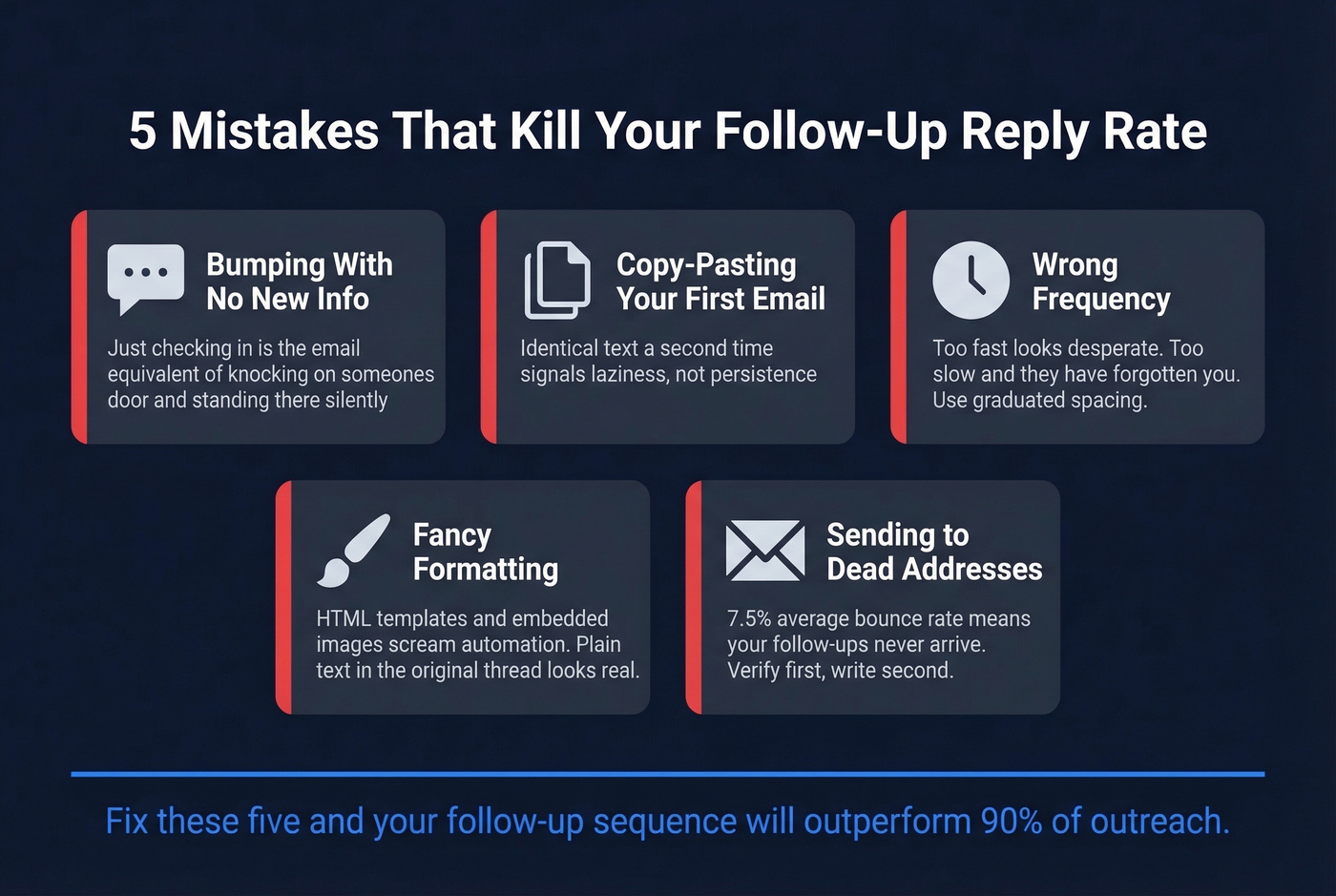
Copy-pasting your first email. Seeing identical text a second time doesn't help. It signals laziness.
Wrong frequency. Too fast looks desperate. Too slow and they've forgotten you. Use the graduated spacing framework above.
Follow-ups that don't look real. HTML templates, embedded images, and fancy formatting scream automation. Plain text, short paragraphs, sent as a reply to the original thread - that's what real follow-up emails look like.
Sending to dead addresses. 68% of marketers report better results from dynamic personalization, but personalization is worthless if the address bounces. Verify first, write second. (If you need a benchmark and fixes, see email bounce rate.)
The 5-objection strategy only works when you're reaching the right person at a verified address. Prospeo gives you 300M+ profiles with verified emails and direct dials - so your carefully crafted follow-ups actually connect with decision-makers, not dead inboxes.
Great follow-ups deserve great data. Get 75 free verified emails today.
Subject Lines That Get Opened
47% of recipients decide whether to open based on the subject line alone. "Following up" as a subject line is dead weight - it tells the reader nothing about why they should care this time. For more ideas, swipe from these email subject line examples.
These work better:
- Reference the specific topic: "Quick question on the Q2 rollout"
- Add a new hook: "New case study - [relevant company] saw 40% lift"
- Create curiosity: "One thing I forgot to mention"
- Use their name or company: "[Company] + [your company] - next step"
- Give them an out: "Should I close this out?"
One caveat on tracking: Apple Mail Privacy Protection inflates open rates with false positives. Don't obsess over opens. Reply rates are the metric that actually tells you something. (If you're measuring beyond opens, start with click rate formula in email marketing.)
FAQ
How many follow-up emails should I send?
For cold outreach, 2-3 follow-ups using the 5-objection rotation is the sweet spot. For job applications or internal requests, 1-2 is enough before switching channels - phone, in-person, or a different stakeholder.
Is "just checking in" unprofessional?
Not unprofessional, but ineffective. It adds zero new information and gets ignored. Replace it with a specific question or new value: "Had a thought on the implementation timeline - worth a quick call?"
What should I write instead of "following up on my previous email"?
Lead with new context. Something like "Since we last spoke, here's what changed..." gives the reader a reason to care. Reference a specific detail - a new case study, a deadline shift, or a question about their priorities. Each message should feel like a fresh conversation, not a reminder.
What if my follow-ups keep going unanswered?
First, verify the email address is valid. If the address is good, try a breakup email or switch channels entirely. After three unanswered attempts, it's time to move on.
Can I use "just a follow up on the email below" when forwarding?
You can, but it's weak. When forwarding a thread to a new stakeholder, add a one-sentence summary of what you need and why it matters to them specifically. A bare forward gives the new reader no reason to prioritize your message.
Your next follow-up is sitting in your drafts right now. Stop writing "following up on my previous email," rewrite the first line with something new, verify the address, and hit send.