

The Breakup Email: Overrated Tactic or Secret Weapon?
A buyer on r/sales put it bluntly: a breakup email felt "completely disrespectful, borderline insulting" - and they decided not to buy. Another thread compared the tactic to needy dating behavior, the kind of guilt-trip text you'd screenshot and send to your friends. Yet these final-touch messages consistently pull 10-33% reply rates, well above the cold email average.
So which is it - a deal-killer or a pipeline-saver? The answer depends on three things most template listicles never mention: your timing, your tone, and whether your emails actually reached the inbox in the first place.
TL;DR
Most breakup emails fail because they're written for the seller, not the buyer. Use the "Permission to close your file?" framing - Bryan Kreuzberger is credited with a 76% response rate for that subject line - after you've made enough real attempts that closing the loop is credible. But first, check your bounce rate. If it's above 5%, a lot of your earlier emails never arrived and no template will save you. Fix the data, then fix the messaging.
What Is a Breakup Email?
A breakup email is the final message in a sales sequence, signaling you're closing the loop on outreach. It's not a guilt trip or a dramatic goodbye. Think of it as pipeline hygiene - a structured way to confirm whether a prospect is genuinely uninterested or just busy, so you can reallocate your time.
The key distinction from a regular follow-up: this message explicitly communicates that it's the last outreach attempt and gives the prospect a clear, low-friction way to respond. It either reopens a conversation or lets you move on with a clean pipeline.
Do They Actually Work?
The numbers are hard to argue with. Close.com's guidance puts reply rates at 10-33%. HubSpot sees a 33% response rate on theirs. Ryan McKenzie at Tru Earth typically gets 10-15% from cold prospects. For context, Warmer AI's consultant data breaks cold email reply rates into tiers: the bottom 50% of senders land at 0.8-2.1%, the middle 40% hit 3.2-7.8%, and even the top 10% only reach 15.4-23.1%. A well-timed closing email pulling 10-33% outperforms nearly every tier.
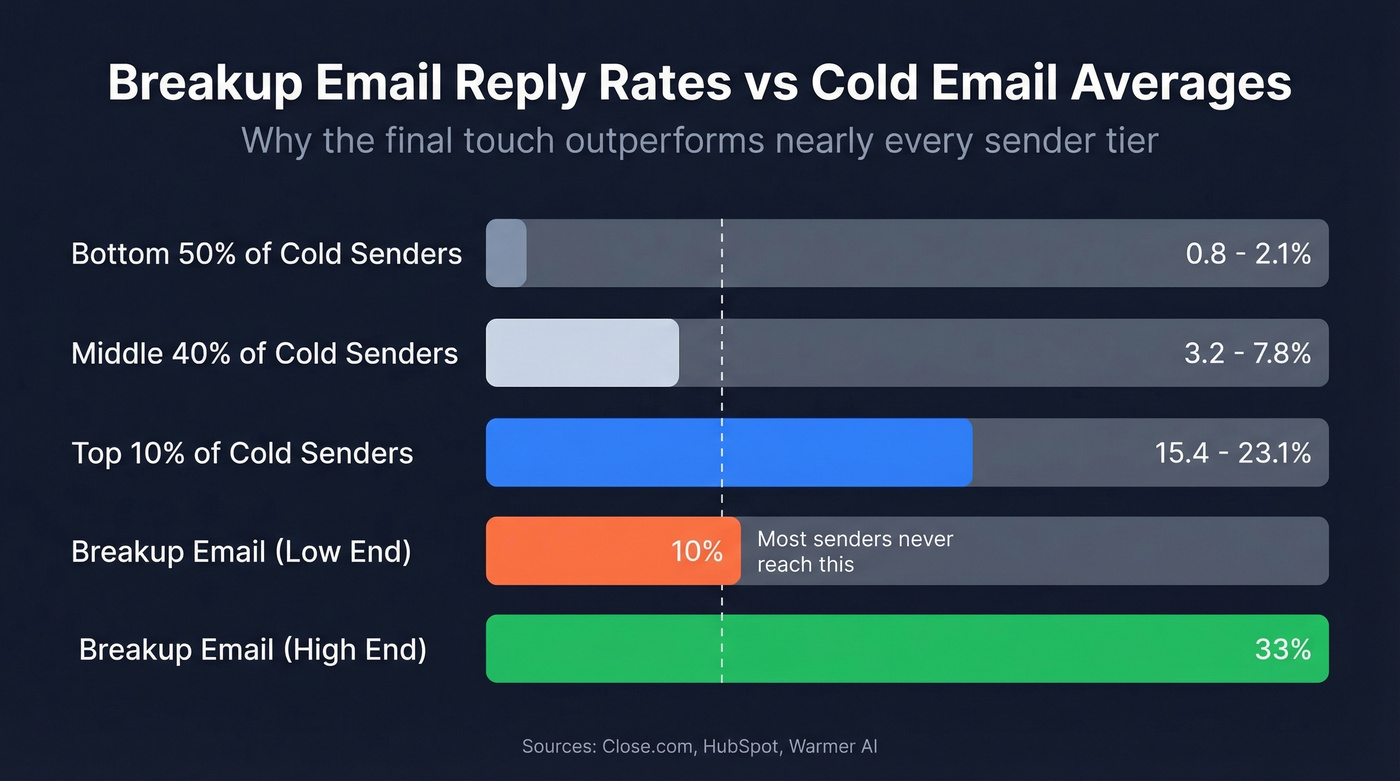
Here's why that happens. 80% of sales require 5+ follow-ups, but 92% of reps quit after four attempts. The final touch lands at touch #5 or #6 - exactly the inflection point where most sellers have already given up. You're not competing against other emails anymore. You're one of the few people still in the prospect's inbox.
The psychological mechanism is loss aversion. When someone realizes they're about to lose access to something - your attention, your offer, your solution - they're more likely to engage. That's not manipulation; it's how decisions work. But it only works if the earlier touches delivered genuine value and the closing message respects the prospect's time.
The Case Against Them
Not everyone's a fan. Anthony Iannarino argues on The Sales Blog that these emails "lower your status" with decision-makers. His point: threatening to stop communicating is an ultimatum with no real penalty, and it signals you're not the kind of salesperson a senior buyer wants to work with.
Reddit largely agrees with the skeptics. One poster called them "cringey at best and annoying at worst", comparing them to a guilt-trippy dating message. Retreva's take adds another layer: these final-touch emails create artificial endings that ignore buying cycles. 63% of prospects who request information won't purchase for at least three months. Your "final email" might arrive right when they're starting to evaluate.
Let's be honest - email-only prospecting doesn't cut it for complex deals. If your entire sequence is five emails and a sign-off, you haven't prospected. You've spammed. The tactic works best as one tool in a multi-channel cadence, not as the dramatic finale of an email-only approach.
When to Send One (and When Not To)
Timing matters more than the template. Here's the cadence that works:
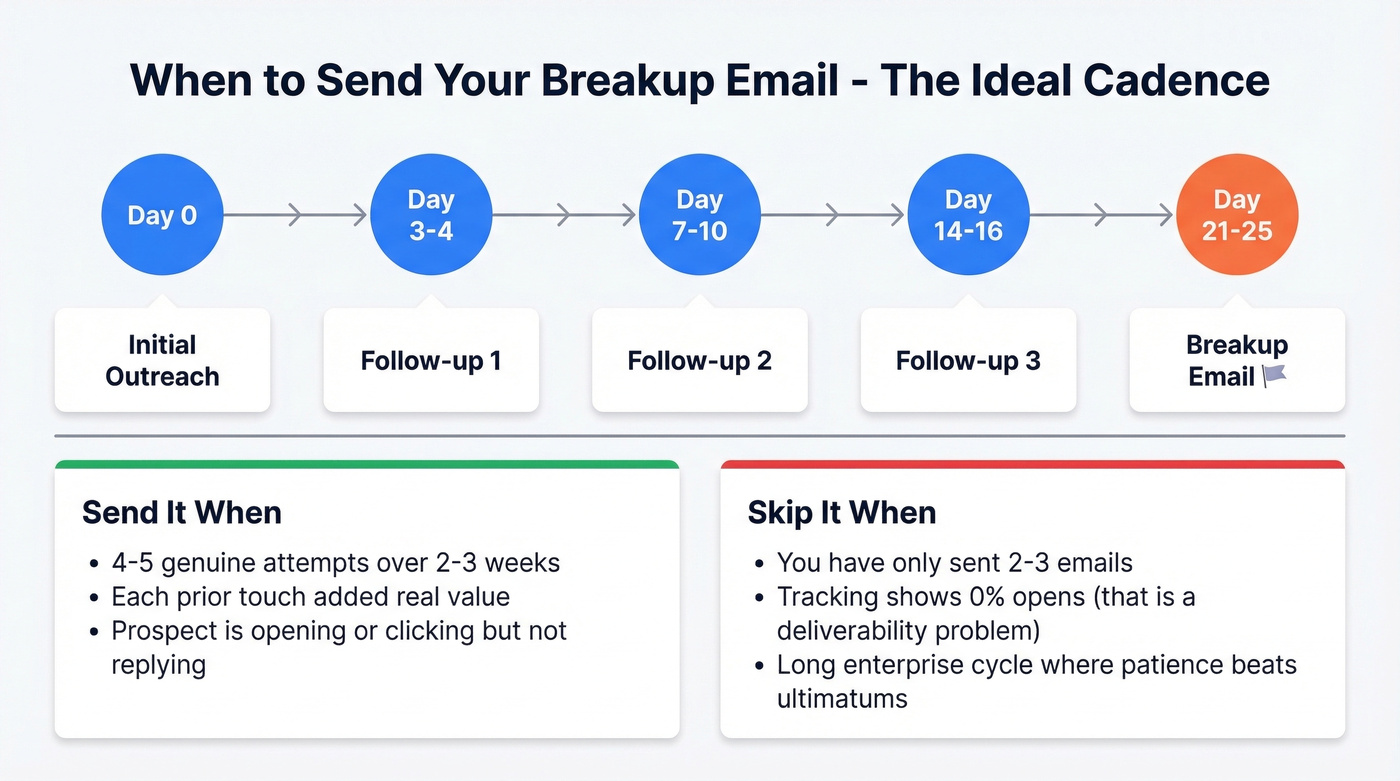
- Day 0: Initial outreach
- Day 3-4: Follow-up #1
- Day 7-10: Follow-up #2
- Day 14-16: Follow-up #3
- Day 21-25: Breakup email
Send it when you've made 4-5 genuine attempts across 2-3 weeks, each prior touch added value, and your tracking shows the prospect is engaging (opens/clicks) but not replying.
Skip it when you've only sent 2-3 emails. Too early - you haven't earned the right. Also skip it when your tracking shows 0% opens across the sequence (that's deliverability or targeting, not "they hate your copy"), or you're in a long enterprise cycle with a buying committee where patience beats ultimatums.
There's a deliverability angle too. ISPs track engagement. If you keep emailing contacts who never open, your sender reputation takes a hit. The closing email isn't just about the prospect - it's about protecting your domain for every other email you send. (If you need a full checklist, start with an email deliverability guide.)

If your bounce rate is above 5%, your breakup email never arrived - and neither did touches 1 through 4. Prospeo's 5-step email verification delivers 98% accuracy, so every message in your sequence actually hits the inbox.
Fix the data before you fix the template.
How to Write One Without the Cringe
Keep it under five sentences. That's not a suggestion - it's a rule. The moment your message turns into a paragraph-long recap of your product's features, you've lost.
Frame everything around the buyer's time, not your feelings. "I don't want to clutter your inbox" works. "I'll stop bothering you" doesn't - it's passive-aggressive guilt, and everyone can smell it. Restate your value proposition in one line, then give a single, simple CTA. "Would it make sense to reconnect in Q3?" is clean. "Let me know if you'd like to schedule a call, or if there's someone else on your team I should reach out to, or if the timing just isn't right" is three CTAs wearing a trench coat.
Avoid cutesy subject lines. "I guess we are breaking up" gets mocked on r/sales for a reason - it's trying to be clever about a professional interaction, and it reads as tone-deaf. Direct beats cute every time.
Here's the thing: this is the most over-templated message in outreach. Every rep sends the same "just checking in one last time" closer, and prospects can spot the formula from the subject line. The ones that actually work feel like they were written by a human who has other things to do - because they were. If you want more options, pull from these sales follow-up templates and adapt the tone.
Best Subject Lines
- "Permission to close your file?" - Bryan Kreuzberger's line, with a 76% response rate. It works because it implies a consequence without being dramatic.
- "Should I stay or should I go?" - Light enough to not feel heavy, direct enough to prompt action.
- "Closing the loop on [specific topic]" - Professional, no games.
- "Not a fit right now?" - Gives the prospect an easy out, which paradoxically increases replies.
- "One last question" - Curiosity-driven, low commitment.
- "Moving on - unless I'm wrong" - Confident, slightly provocative.
- "Quick yes or no" - The simplest possible ask.
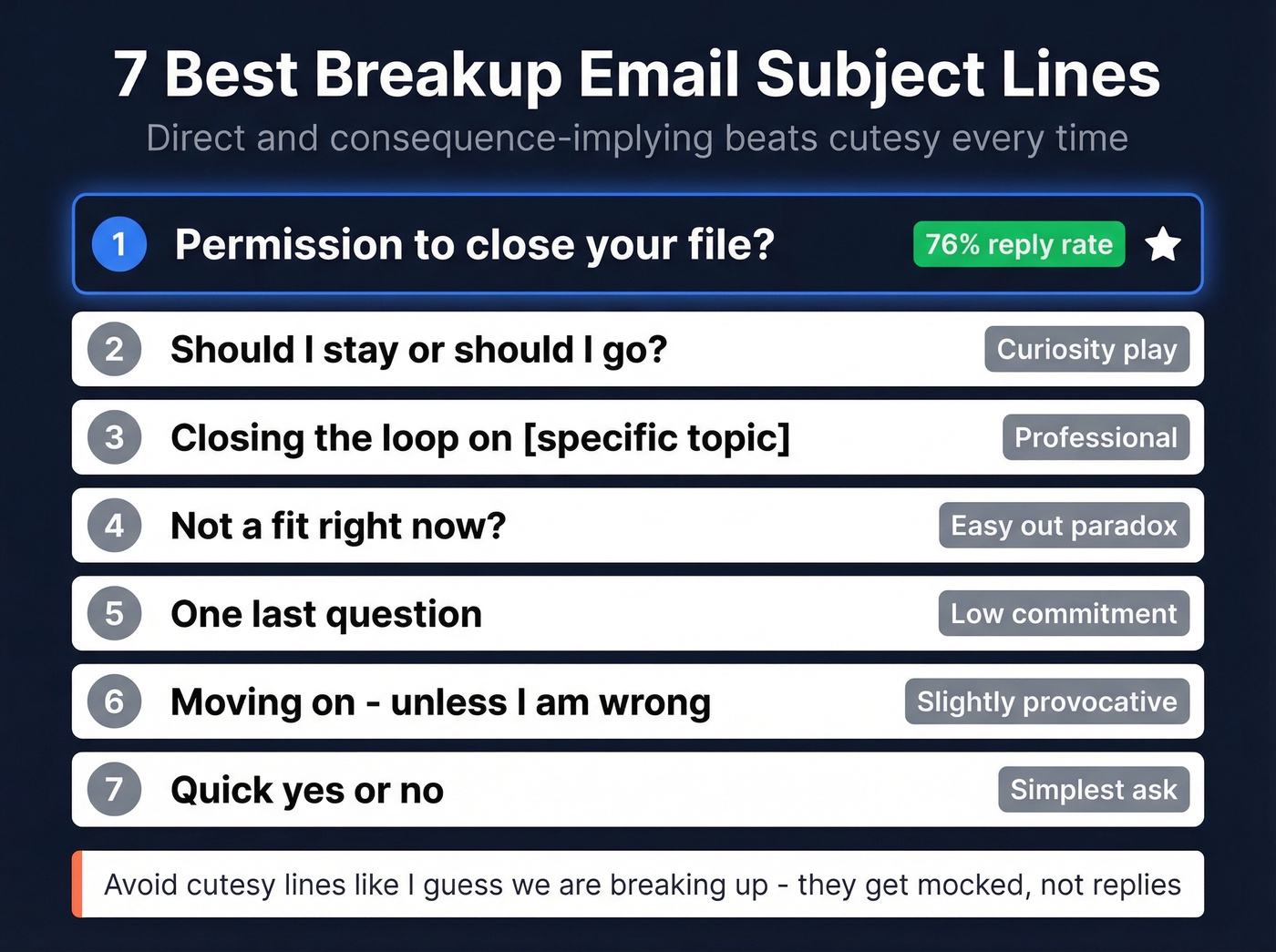
Line #1 is the only one with hard data behind it. The rest are practitioner-tested variations that follow the same principle: direct, consequence-implying subject lines consistently outperform the cutesy "breakup" framing. The prospect doesn't want to feel like they're in a romantic comedy. They want to know what you need from them in 3 seconds. (For more ideas, see these email subject line examples.)
7 Templates That Get Replies
Cold Prospect (No Prior Relationship)
Hi [Name], I've reached out a few times about [specific value prop] but haven't heard back. I'll close out my notes - if it makes sense to revisit later, just reply. No hard feelings either way.
No guilt, no drama. The "close out my notes" framing implies a real consequence without being manipulative.
Warm Lead Gone Silent
Hi [Name], we spoke on [date] about [topic] and I've followed up since. Should I check back in Q[X], or is this off the table?
Pair with subject line "Not a fit right now?" - the combination of a soft subject line and a direct two-option close gets replies.
Post-Demo Ghost
Here's what most reps send after a demo goes silent: a three-paragraph recap of every feature they showed, plus a calendar link. Here's what actually works:
Hi [Name], I sent over [resource/proposal] after our demo but haven't heard back. I'm going to pause outreach - if anything changes, I'm a reply away.
The difference? The bad version screams "I need this deal." The good version says "I respect your time."
Long-Cycle Enterprise
Hi [Name], I know [Company] has a lot of moving pieces. Rather than follow up on a timeline that doesn't match yours, I'll step back and circle back in [timeframe] unless you tell me otherwise.
For teams that sell into large orgs with 6-12 month buying cycles, this framing acknowledges reality instead of pretending your email sequence is the center of their universe.
Re-Engagement After Pause (90-Day Re-Entry)
Hi [Name], we last spoke about [topic] in [month]. A lot changes in 90 days - [mention a trigger: new funding, product update, industry shift]. Worth a quick conversation?
Value-Add Closing
Hi [Name], before I close this out - [one-sentence insight relevant to their industry]. If that's relevant, happy to share more. If not, I'll get out of your hair.
You're giving value on the way out the door. It reframes the closing as generosity, not an ultimatum.
The Direct Ask
Hi [Name], should I keep [Company] in my active pipeline, or close this out? A one-word reply works.
Pro tip: If this is a strategic account, consider sending this from a senior leader. A short, direct message from a CEO or VP changes the dynamic instantly - it signals the account matters enough for leadership to weigh in.
What to Do After Sending
The breakup email isn't the end. It's a pause.
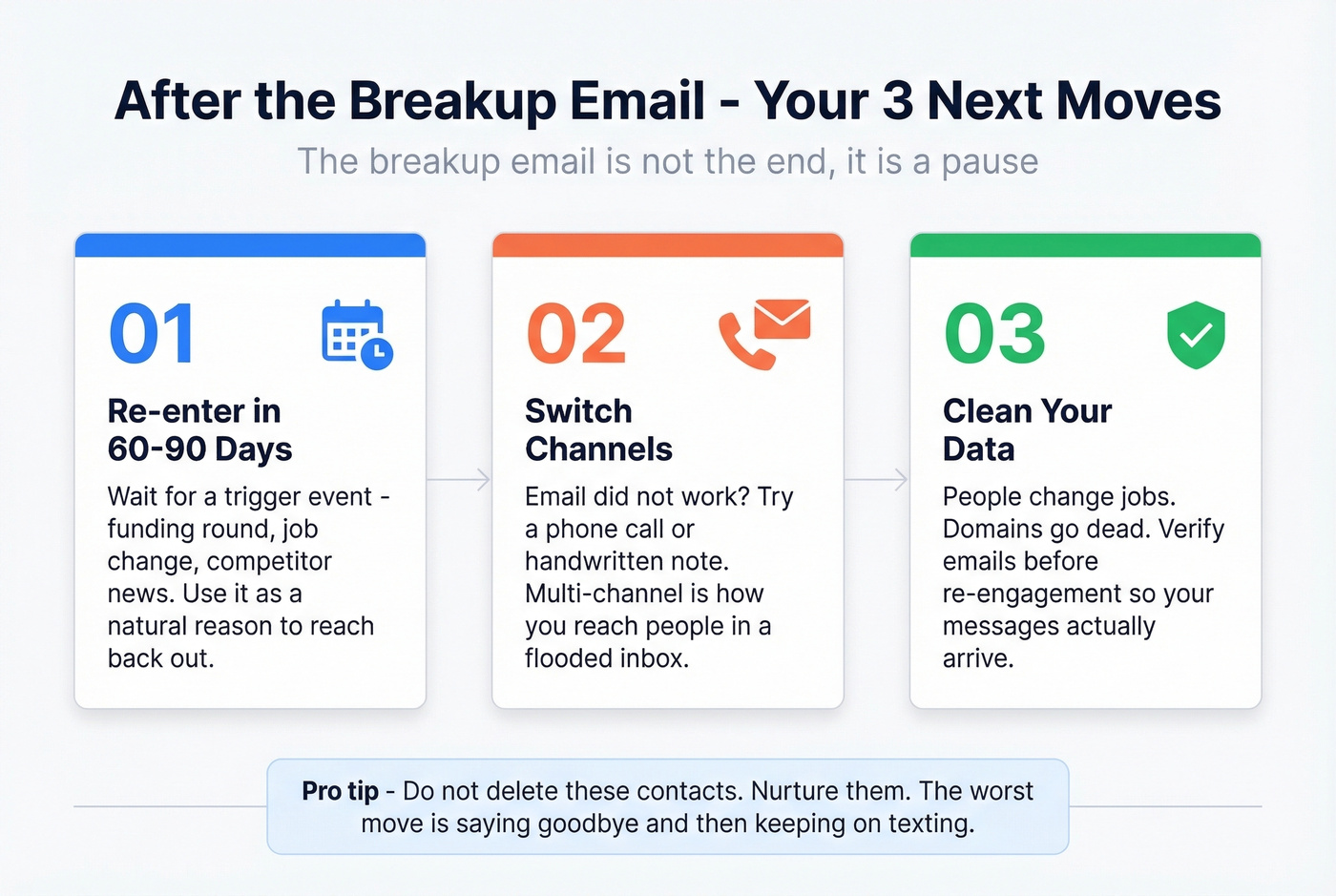
Don't delete these contacts - nurture them. Here are three moves that keep the door open without being the person who said goodbye and then kept texting.
Re-enter in 60-90 days with a trigger event. A funding round, a job change, a competitor announcement - anything that gives you a legitimate reason to reach back out. "I saw [Company] just raised a Series B - congrats. Wondering if [original pain point] is back on the radar" is a natural re-entry.
Switch channels. If email didn't work, try a phone call or a handwritten note. We've found that a well-timed call after a series of unanswered emails is often what finally starts the conversation. Multi-channel isn't a buzzword - it's how you reach people who live in a flooded inbox.
Clean your data before re-engagement. People change jobs. Domains go dead. If you're re-entering a prospect's inbox months later, verify their email first. Prospeo's 7-day refresh cycle means the address you pull today is current, not a stale record from six months ago - and that matters when your re-engagement email is the one shot you've got.
The Hidden Variable: Data Quality
We've seen this pattern over and over: a team obsesses over subject lines and templates while their bounce rate sits at 11%. They're performing a monologue in an empty theater.
One practitioner on r/Entrepreneur rebuilt their cold email system and watched their bounce rate drop from 11% to under 2% after manual verification. Reply rate doubled - from 3% to 6%. No template changes. No subject line A/B tests. Just making sure the emails actually arrived.
If your bounce rate is above 5%, it's a data problem, not a messaging problem. Meritt saw their bounce rate drop from 35% to under 4% after switching to verified data, and their pipeline tripled. The free tier at Prospeo gives you 75 emails per month - enough to clean a small list before your next sequence and see the difference for yourself. If you're comparing options, start with data enrichment services and an AI email checker to tighten inputs before you write another sequence.

Zero opens across your sequence isn't a copywriting problem - it's a data problem. Prospeo refreshes 300M+ profiles every 7 days, not every 6 weeks. Your closing email deserves contacts that are current, verified, and real.
Stop breaking up with prospects who never saw your first email.
FAQ
How many follow-ups before a breakup email?
Send 4-5 touches over 2-3 weeks. The breakup email should be touch #5 or #6, spaced a few days after your last follow-up. Sending one after only 2-3 attempts wastes the tactic's psychological impact - loss aversion only kicks in when the prospect genuinely believes this is the last message.
What's the best subject line?
"Permission to close your file?" - attributed to Bryan Kreuzberger with a 76% response rate. Direct, consequence-implying subject lines outperform cutesy ones like "I guess we are breaking up," which gets mocked more than it gets replies.
Should I email a prospect again after sending one?
Yes. Pause for 60-90 days, then re-enter with a trigger event - a funding round, job change, or company news. Verify their email before re-engaging; contacts go stale fast, and a bounced re-engagement email burns your domain reputation.
Do they work for cold outreach?
Expect 10-33% reply rates when timing and tone are right. But if your bounce rate is above 5%, fix your data first. No template saves an email that never arrives. The tactic only performs when every earlier touch in the sequence actually landed in the prospect's inbox.