Email Outreach Tips: What Still Works After Reply Rates Dropped 15%
You sent 500 emails last week and got 2 replies. One was an unsubscribe. Before you rewrite your subject lines for the tenth time, consider that copy probably isn't your problem. Infrastructure and data quality are.
A Belkins study of 16.5M cold emails across 93 business domains found the average reply rate fell to 5.8% in 2024, down from 6.8% the year before - a 15% drop. Email marketing still delivers 4,400% ROI, so the channel isn't dead. But the bar went up. The emails that still work aren't better written - they're better delivered, sent to verified addresses, and targeted with real signals.
Three Priorities, in Order
- Fix your infrastructure first - domain authentication, warm-up, and monitoring. Most emails fail before anyone reads them.
- Verify every email address before you send - bounces above 2% start hurting deliverability fast.
- Write short, lowercase subject lines and keep the body under 125 words with one CTA.
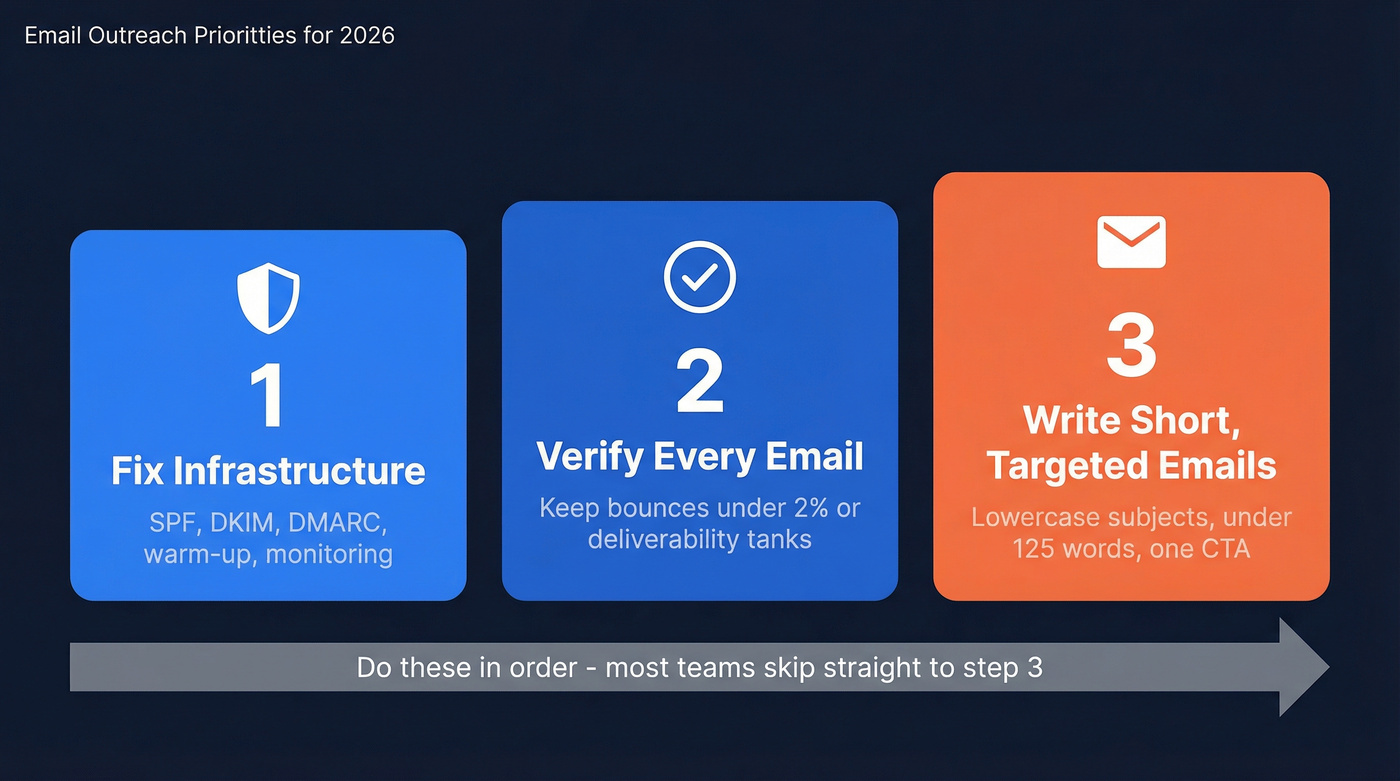
Get those three right and you're ahead of most outbound teams.
Fix Your Sending Infrastructure
SPF, DKIM, and DMARC aren't optional. If you haven't configured all three, stop reading and go do that now. Without them, Google and Microsoft are far more likely to route your emails to spam. If you need a step-by-step, use this SPF, DKIM, and DMARC setup guide.
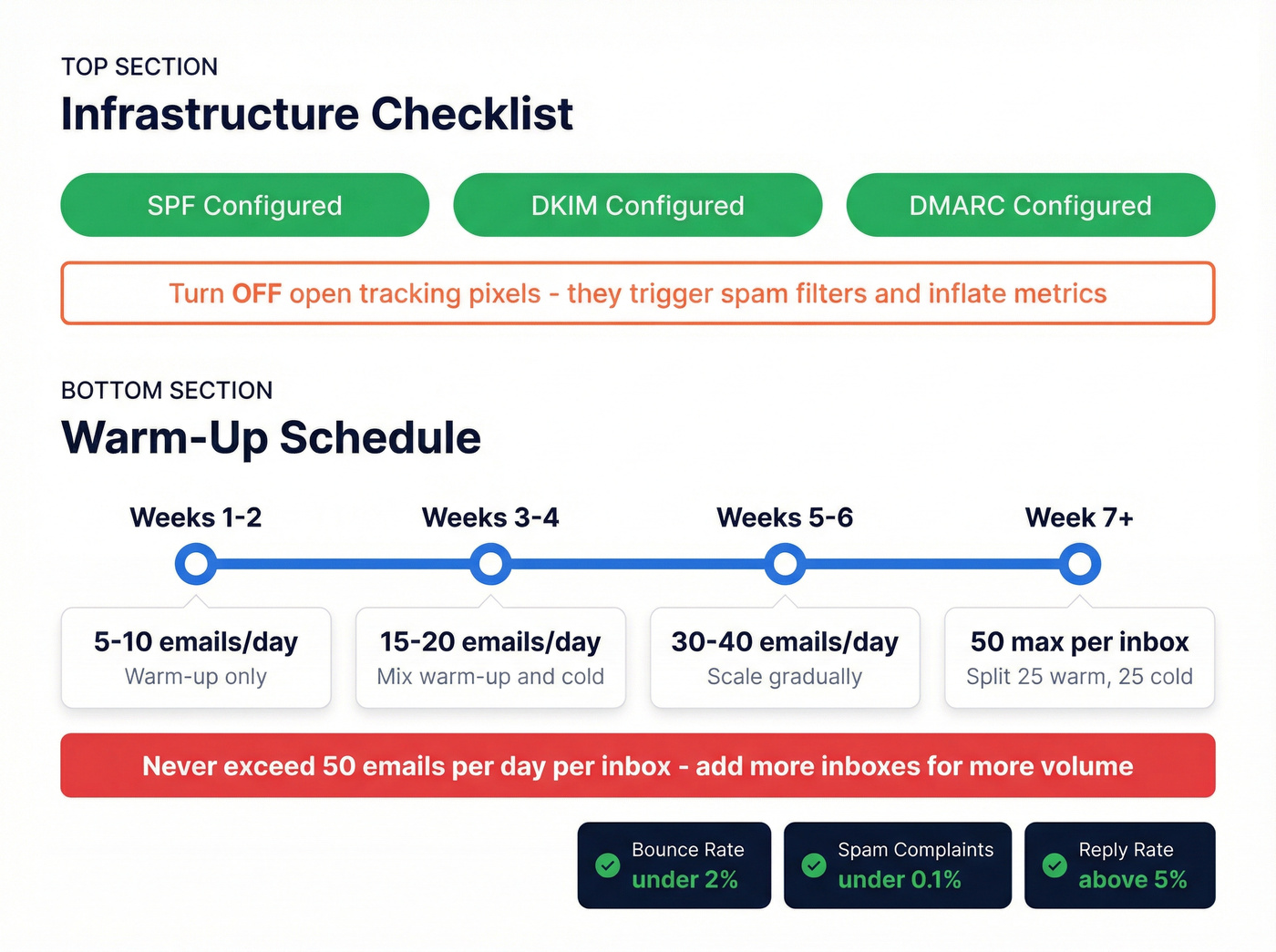
Once authentication is set, warm up your inbox slowly. This schedule works:
| Week | Emails/Day | Notes |
|---|---|---|
| 1-2 | 5-10 | Warm-up only |
| 3-4 | 15-20 | Mix warm-up + cold |
| 5-6 | 30-40 | Scale gradually |
| 7+ | 50 max | Split 25 warm / 25 cold |
Never exceed 50 emails per day per inbox. If you need more volume, add inboxes and rotate domains. (More on safe scaling in cold email volume best practices.)
Here's a tip most guides skip: turn off open tracking pixels. Belkins found campaigns without pixels saw roughly 3% higher response rates. Pixels trigger spam filters, and open rates are unreliable anyway since Apple's Mail Privacy Protection inflated them. Track replies instead - that's the metric that matters.
Avoid spam trigger words ("guarantee," "act now," "limited time"), keep formatting clean with minimal images, and monitor three numbers weekly using Google Postmaster Tools and Microsoft SNDS: bounce rate under 2%, spam complaints under 0.1%, reply rate above 5%. If any slip, pause and diagnose before you send another batch. If you're troubleshooting, this email deliverability checklist helps you isolate the cause fast.
Clean Your List Before Sending
Bad data destroys cold email campaigns before copy ever gets a chance. A bounce rate above 5% doesn't just waste sends - it actively damages your domain reputation, triggering blocks that can take weeks to recover from. We've seen teams blame their copy, their timing, their subject lines, when the real problem was that 20% of their list consisted of dead addresses. (This is exactly what B2B contact data decay looks like in practice.)
Meritt, an outbound agency, cut their bounce rate from 35% to under 4% after switching to Prospeo's email finder, and their pipeline tripled from $100K to $300K per week. The 5-step verification process - catch-all handling, spam-trap removal, honeypot filtering - delivers 98% email accuracy with data refreshing every 7 days, compared to the 6-week industry average. Verified emails cost about $0.01 each. If you're comparing tools, start with these email ID validators.

Bounce rates above 2% silently destroy your domain reputation. Prospeo's 5-step verification delivers 98% email accuracy with data refreshed every 7 days - not the 6-week industry average. Verified emails cost ~$0.01 each.
Stop blaming your copy when your data is the problem.
Subject Lines (From 85M Emails)
A 30MPC analysis of 85M+ cold emails found that top reps consistently hit 58%+ open rates. The patterns are clear. If you want copy-paste options, use these outreach email templates.
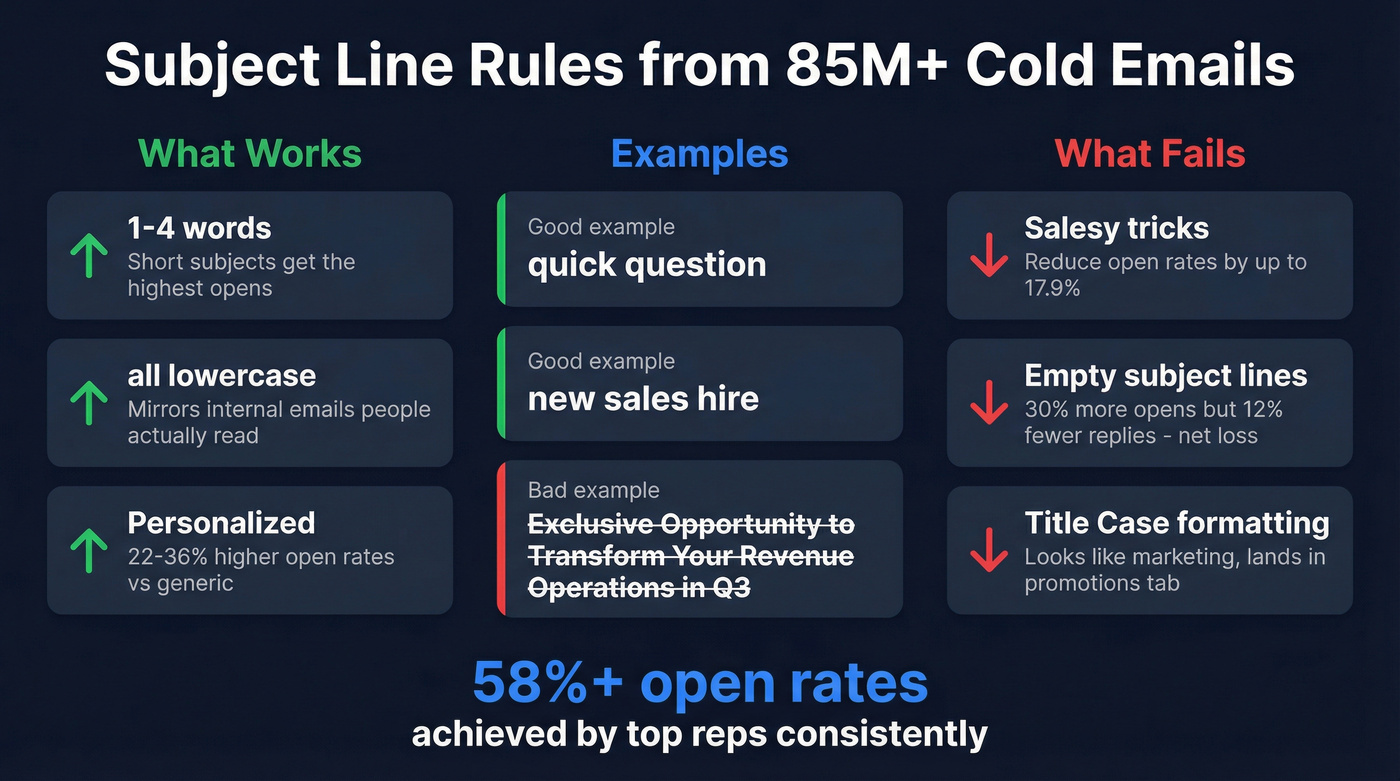
Keep it short. One to four words performs best. Think "quick question" or "new sales hire" - not "Exclusive Opportunity to Transform Your Revenue Operations in Q3."
Go lowercase. All-lowercase subject lines outperform title case. Internal emails don't use title case, and your cold email should look like it belongs in the recipient's inbox, not their promotions tab. The 30MPC team calls this "internal camouflage" - mirror the style of emails people actually read.
Skip the gimmicks. Salesy techniques reduce open rates by up to 17.9%. The empty subject line trick boosts opens by 30% but drops replies by 12% - a net loss. Personalized subject lines see 22-36% higher open rates compared to generic ones. If you're getting flagged, review these words to avoid in email subject lines.
Write Emails That Get Replies
Keep It Short and Pain-First
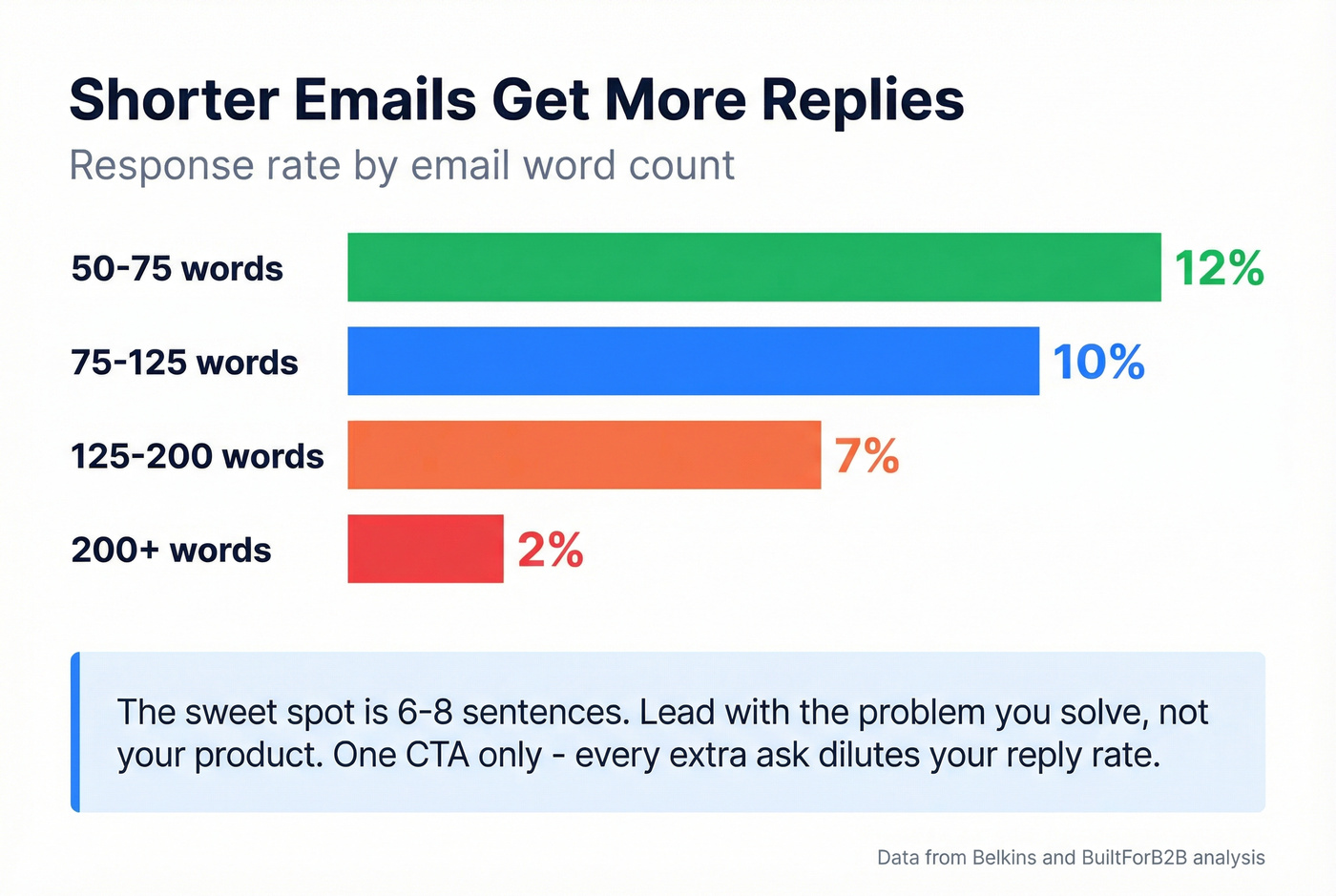
The Belkins data is unambiguous: 6-8 sentences drove a 6.9% reply rate, the best in their dataset. BuiltForB2B's analysis breaks it down further:
| Word Count | Response Rate |
|---|---|
| 50-75 | 12% |
| 75-125 | 10% |
| 125-200 | 7% |
| 200+ | 2% |
Lead with the problem you solve, not your product. No attachments on the first send. One CTA - every additional ask dilutes the one thing you actually want them to do: reply. For a tighter framework, follow this sales email structure.
Personalization That Scales
Generic AI-written emails see 90% lower response rates than thoughtfully personalized ones. But a rep can only manually research and write 10-15 truly personalized emails per day. That math doesn't work at scale.
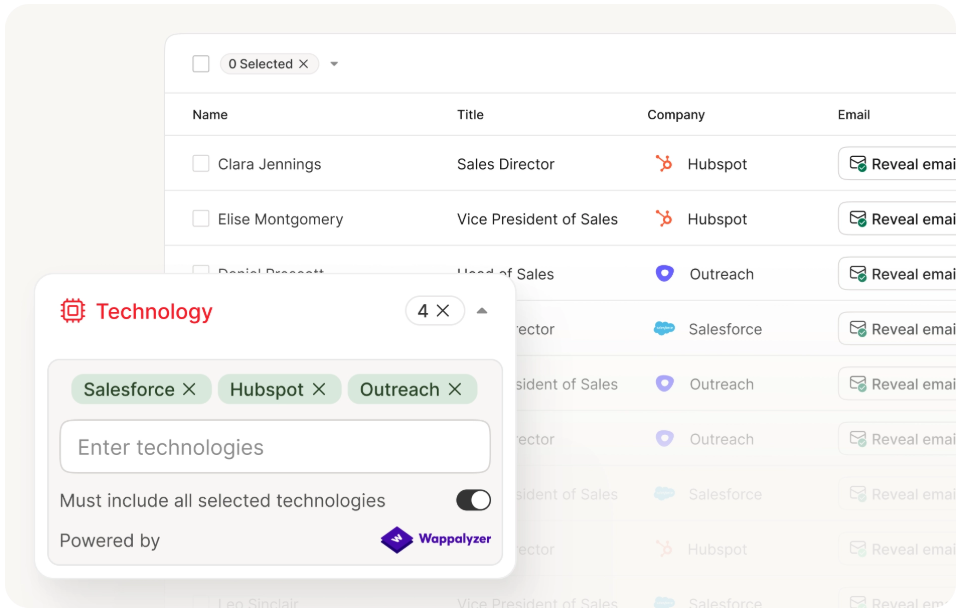
The answer isn't "use AI to write emails." It's "use AI to research prospects, then write emails yourself." Trigger events - funding rounds, executive hires, tech stack changes - are your best personalization signals. Prospeo's B2B database offers 30+ search filters including buyer intent, technographics, and job changes, so you're personalizing based on real signals rather than guessing from a job title. If you want a system for this, use a signal-based outbound playbook.
Belkins found that targeting 1-2 contacts per company yielded a 7.8% reply rate, while blasting 10+ contacts at the same company dropped to 3.8%. Done right, multithreading reduces sales cycles by 15-30% and lifts win rates by 8-15 points. But sending the same email to five people at one company isn't multithreading. It's spam.
Follow-Up Cadence That Works
About 60% of replies come after the first follow-up. That's the good news. The bad news: spam complaints rise from 0.5% on the first email to 1.6% by the fourth, and returns diminish fast after the second follow-up.
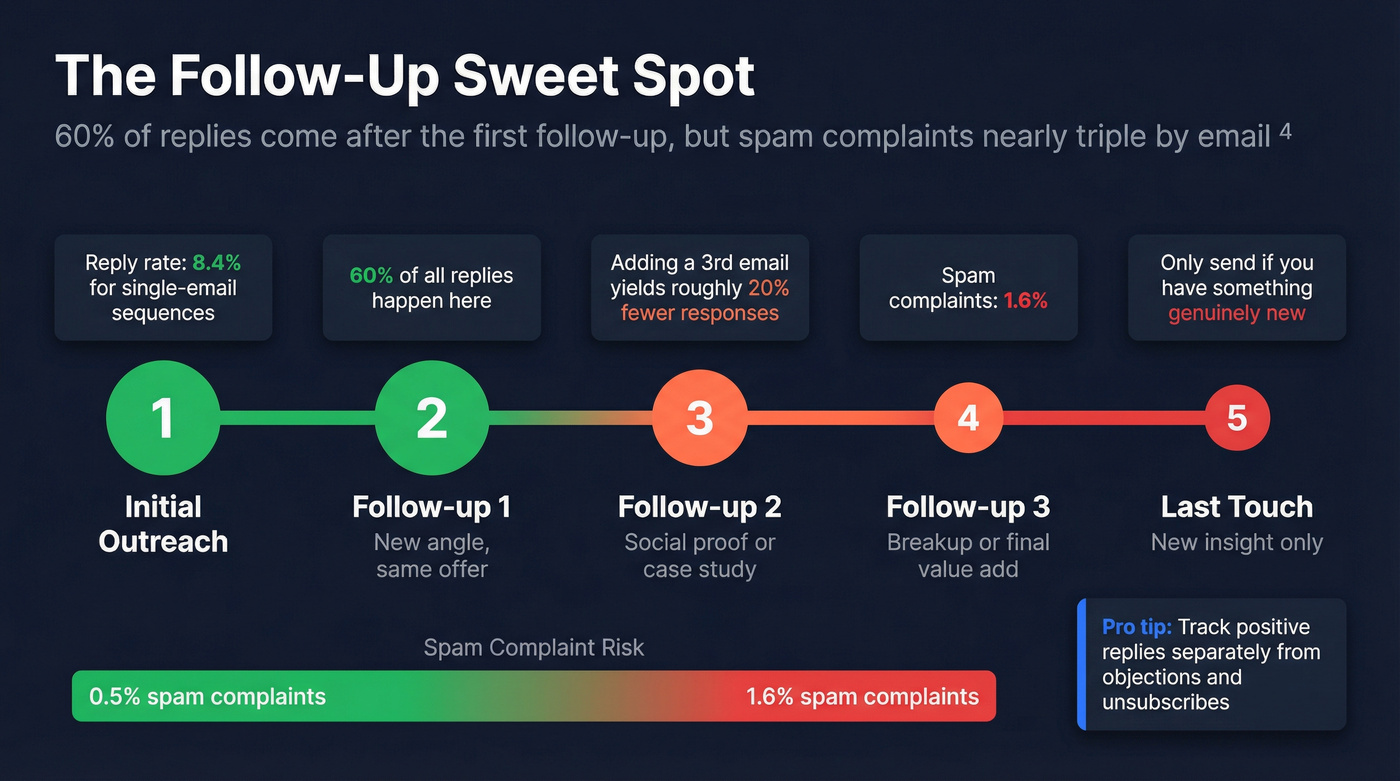
| Step | Day | Purpose |
|---|---|---|
| Email 1 | Day 1 | Initial outreach |
| Follow-up 1 | Day 3 | New angle, same offer |
| Follow-up 2 | Day 6 | Social proof or case study |
| Follow-up 3 | Day 10 | Breakup / final value add |
| Follow-up 4 | Day 15 | Last touch - new insight only |
Three to four follow-ups is the practical max. Belkins found that 1-email sequences actually had the highest reply rate at 8.4%, and adding a third email produced roughly 20% fewer responses. After four emails, you're not being persistent - you're getting flagged. If you want timing rules, see when should i send a follow up email.
Not all replies are equal, either. Track positive replies separately from objections and unsubscribes so you know what's actually working versus what's just generating noise. (Use positive response rate as your north-star metric.)
Timing and Testing
Tuesdays and Thursdays pull the highest reply rates - Thursday peaks at 6.87%, while Monday lags at 5.29%. The surprise? Emails sent between 8-11 PM hit 6.52%. Execs catch up on email after the kids are in bed. For more benchmarks, see the best time to send prospecting emails.
Let's be honest: if your deal size is under $10K, you probably don't need a 12-step multichannel sequence. Start with a batch of 100 contacts. If you're seeing 70%+ opens but zero positive replies after 100 sends, change the message and test another 100. If the second batch also flatlines, kill the hypothesis and move on. We've wasted weeks optimizing sequences that should've been scrapped after the first hundred sends.
The biggest lever most teams ignore is going multichannel. Email-only campaigns average 4-6% response rates. Add phone and social touches and that jumps to 10-12%. The consensus on r/sales backs this up - pure cold email without any other channel is increasingly a losing game.
Personalization based on job titles is guessing. Prospeo's 30+ search filters - buyer intent, technographics, job changes, funding signals - give you the real triggers that drive 58%+ open rates and 7.8% reply rates.
Send fewer emails to better-targeted prospects and triple your pipeline.
FAQ
What's a good reply rate for cold email in 2026?
The average across 16.5M emails is roughly 5-6%, with top-performing campaigns hitting 8-12%. Benchmarks vary by vertical: SaaS teams see 10-12%, professional services 8-11%, and financial services 5-8%. If you're below 3%, investigate infrastructure and list quality before rewriting copy.
How many follow-ups should I send?
Three to four maximum. About 60% of replies come after the first follow-up, and spam complaints nearly triple by the fourth email (0.5% to 1.6%). Diminishing returns hit hard after the second follow-up - more emails means more risk to your domain, not more pipeline.
How do I keep cold emails out of spam?
Configure SPF, DKIM, and DMARC on every sending domain. Warm up new inboxes over 6-7 weeks before scaling volume. Then fix your data - bounces above 2% erode deliverability fast. Verify addresses at 98% accuracy before you send, keeping bounce rates low and domain reputation intact.