

Best Cold Calling Techniques That Book Meetings in 2026
It's 10:15 AM on a Tuesday. You've got a fresh list, a decent opener, and four hours before the window closes. The average cold calling success rate sits at 2.3% - 97 out of 100 dials go nowhere. But teams combining verified data with multichannel follow-up push that closer to 6.7% in large-scale analyses. The difference isn't talent. It's framework. The best cold calling techniques are backed by datasets, not vibes - and the core methods below prove it.
The 60-Second Version
If you only have a minute, do these three things:
- Verify your phone list. Half your dials are hitting dead numbers. Use a data provider with a weekly refresh cycle - test it free before your next call block.
- Call Tuesday-Thursday, 10 AM-4 PM. A 1.4M-call analysis confirms it.
- Open with "How have you been?" instead of "Did I catch you at a bad time?" A 90K-call study found it converts at 6.6x the baseline. The "bad time" opener? 0.9%.
That's the 80/20. Let's break down each piece.
Start With Clean Data
Your opener doesn't matter if half your numbers are disconnected. Around 80% of cold calls go to voicemail on the first attempt. That's already brutal math. Layer in stale data - numbers that changed jobs, switched carriers, or simply aged out - and you're burning hours dialing ghosts.
Your list matters more than your script. We've watched teams go from single-digit connect rates to 20-25% just by fixing their data. Meritt is a good example - they tripled pipeline from $100K to $300K per week after switching to verified numbers, and their connect rates jumped to that 20-25% range. The variable that changed wasn't the script or the reps. It was the list.
Prospeo maintains 125M+ verified mobile numbers on a 7-day refresh cycle, delivering a 30% pickup rate. The industry average refresh is six weeks. That gap matters more than any talk track tweak. (If you want the benchmarks behind this, see B2B contact data decay and prospect data accuracy.)
Optimal Day and Time to Call
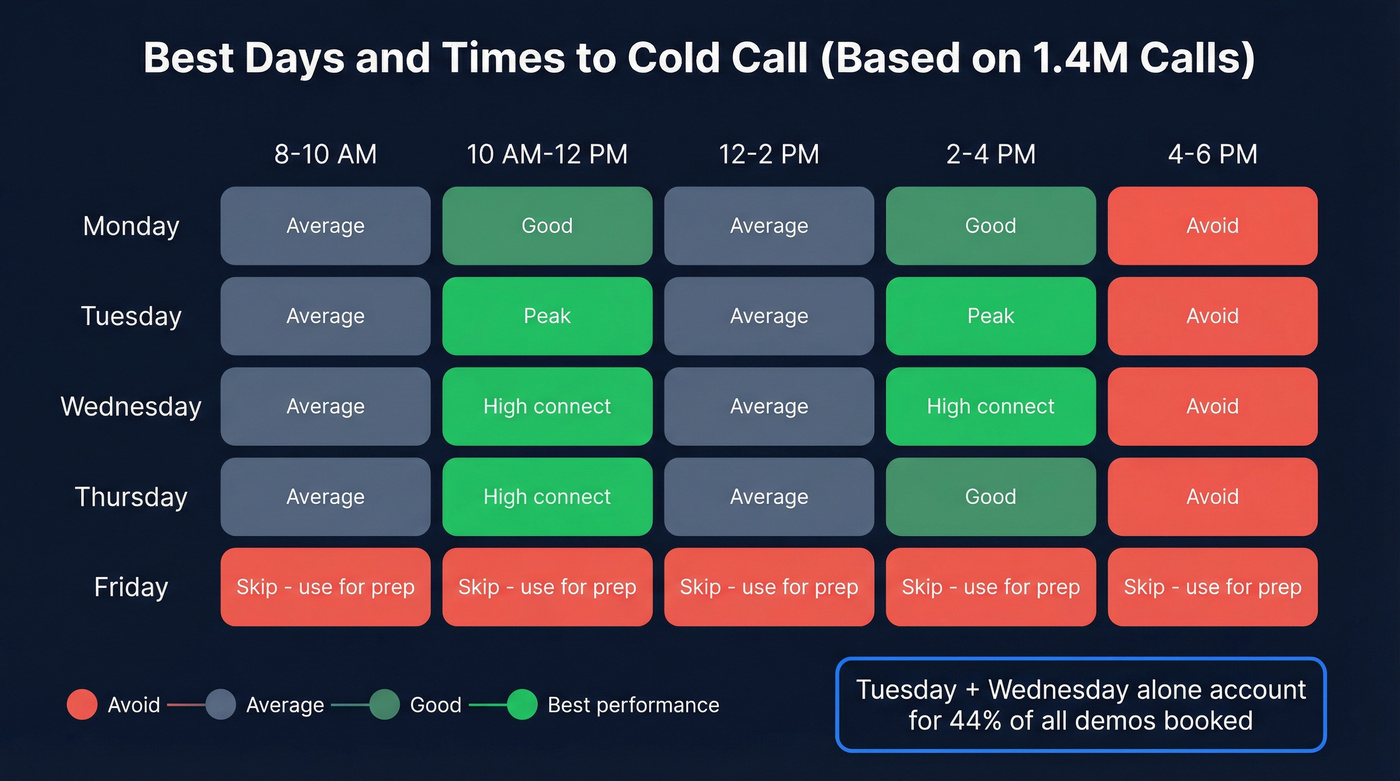
ZoomInfo analyzed 1.4M outbound calls to new business accounts. The patterns are clear enough to plan your week around.
| Day | Verdict |
|---|---|
| Monday | Best call-to-demo rate (1.19%) |
| Tuesday | Top overall - highest connect rates + strong demo output |
| Wednesday | Strong - in EMEA, Wednesday improves on key metrics |
| Thursday | Solid |
| Friday | Worst - use for research/prep |
Tuesday and Wednesday alone account for 44% of total demos in the dataset. Late morning (10 AM-12 PM) and early afternoon (2-4 PM) local time consistently outperform early morning and end-of-day slots. Friday is the worst day across the board - use it for list building, research, and prep instead of dialing. Timing alone won't guarantee results, but it stacks the odds meaningfully in your favor.
Do 5 Minutes of Research First
Generic pitches die on arrival. Before each call block, spend five minutes reviewing your top 10 accounts: recent news, job changes, tech stack signals. Hyperbound's analysis of common cold call failures found that even minimal personalization - referencing a recent company event or a shared connection - dramatically reduces early hang-ups.
Here's the thing most sales content won't give you: if your average deal size is under $10K, you probably don't need a 20-minute research deep dive per prospect. Five minutes across your top 10 dials is the sweet spot. Anything more and you're procrastinating. Anything less and you sound like every other robo-caller. (Use a simple pre call research checklist so reps don't overthink it.)
Use intent data to prioritize your dial list by buying signals before you even start researching. When you know which accounts are actively evaluating solutions in your category, your five minutes of research go much further - and your "cold" call becomes warm-ish.

The article above proves it: clean data beats a perfect script every time. Prospeo gives you 125M+ verified mobile numbers with a 30% pickup rate - refreshed every 7 days, not every 6 weeks. At $0.01 per lead, you stop burning call blocks on disconnected numbers and start booking meetings.
Fix your list before you fix your opener.
Nail the First 10 Seconds
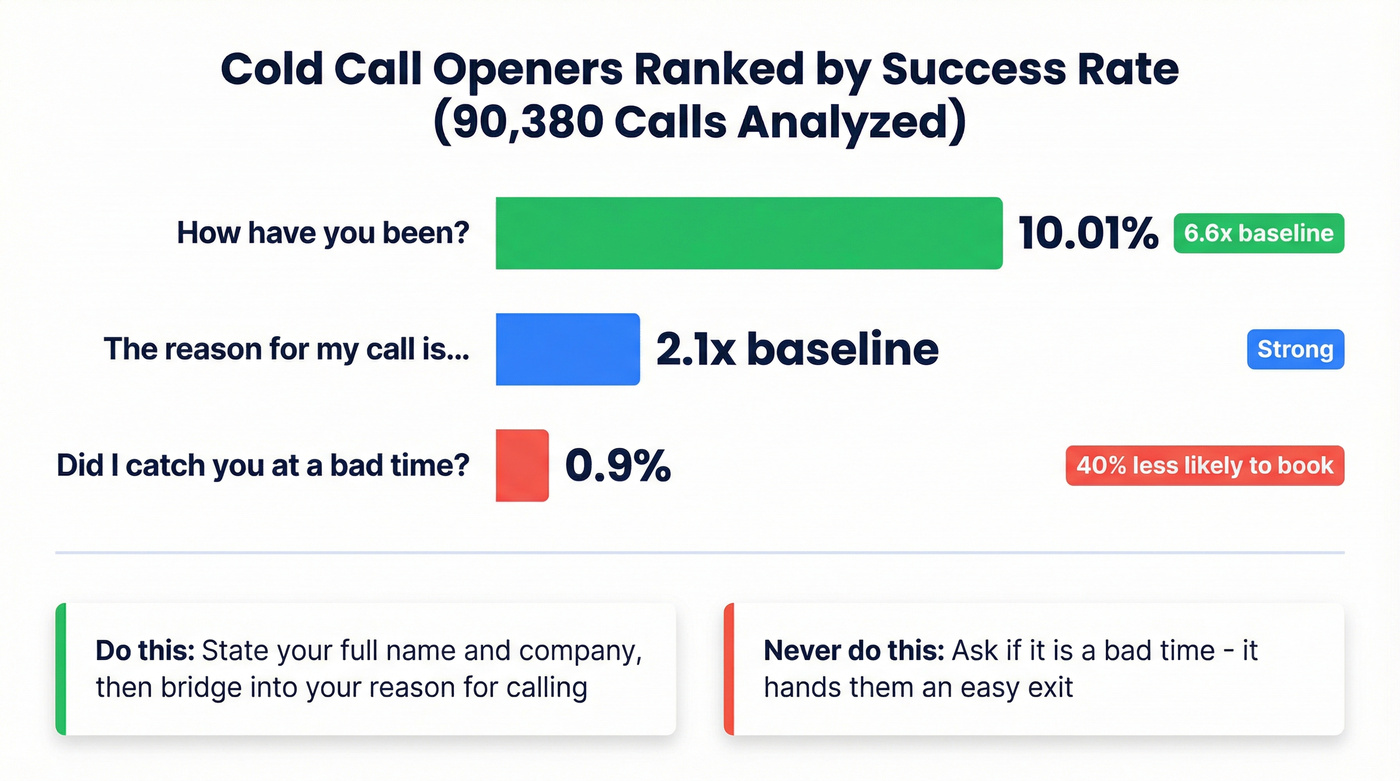
Gong analyzed 90,380 cold calls and found that your opener determines the trajectory of the entire conversation. (For more openers, see sales pitch opening lines.)
| Opener | Success Rate | Verdict |
|---|---|---|
| "How have you been?" | 10.01% (6.6x baseline) | Best performer |
| "The reason for my call is..." | 2.1x baseline | Strong - gives you control |
| "Did I catch you at a bad time?" | 0.9% (40% less likely to book) | Never say this |
"Did I catch you at a bad time?" is the worst opener in sales. Stop saying it.
It hands the prospect an easy exit and signals you don't believe your own call is worth their time. State your full name and company immediately - it prevents the prospect from hijacking the conversation with "who is this?" and keeps you in control. Then bridge into your reason for calling. That two-sentence sequence buys you the next 20 seconds, which is where the meeting gets made or lost.
One more mistake the same dataset flagged: opening with "Is this [first name]?" triggers defensiveness. Use their full name instead, or skip the name check entirely and lead with your reason for calling.
The 35-Second Script Framework
You don't need 25 scripts. You need one framework you can customize per persona and execute 50 times a day without thinking:
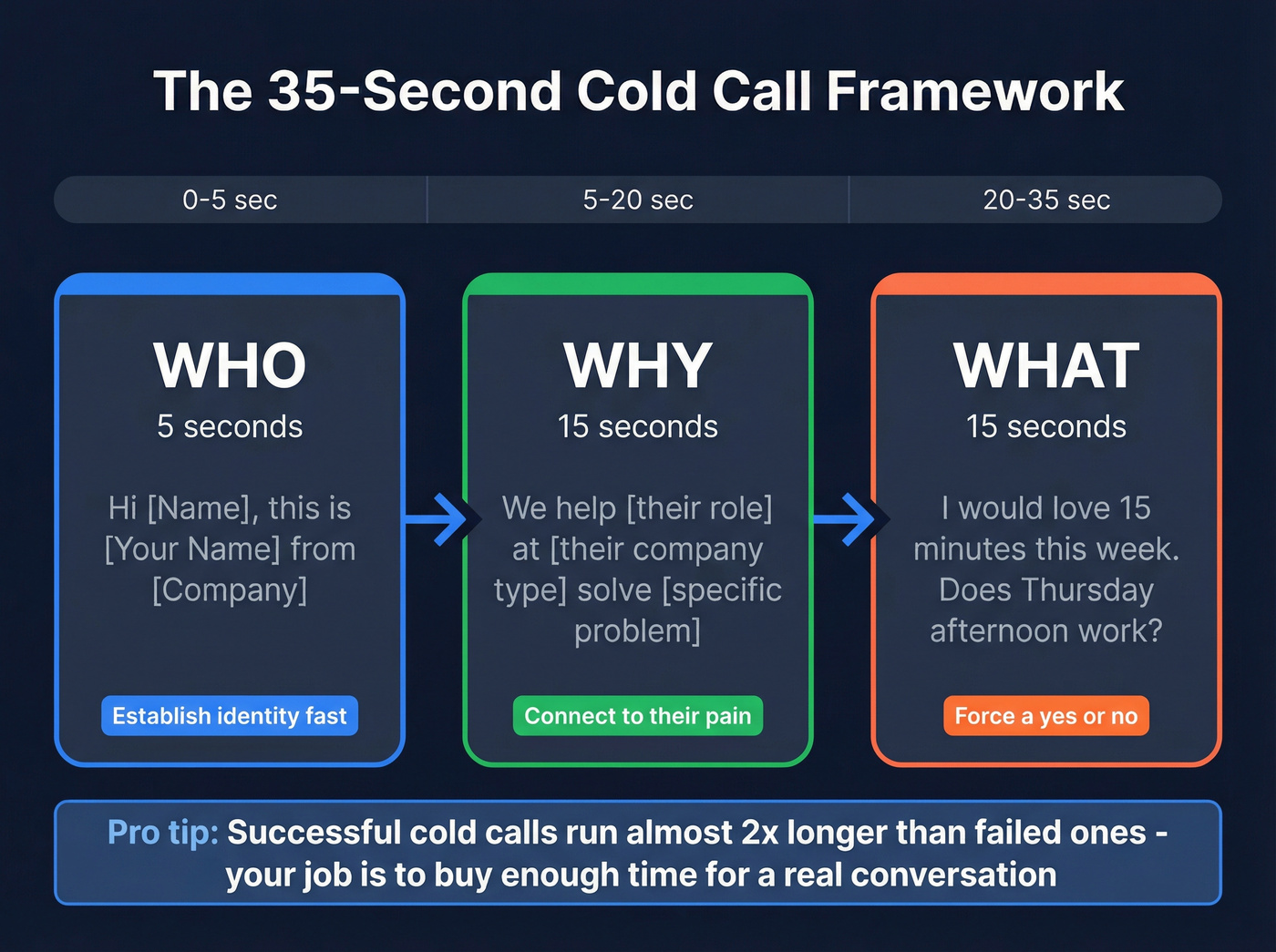
- Who (5 sec): "Hi [Name], this is [Your Name] from [Company]."
- Why (15 sec): "We help [their role] at [their company type] solve [specific problem]."
- What (15 sec): "I'd love 15 minutes this week to show you how. Does Thursday afternoon work?"
The closing question matters. "Do you have your calendar handy?" outperforms vague asks like "would you be open to a chat sometime?" Give a specific day and time - "Does Thursday afternoon work?" forces a yes/no decision instead of a maybe-later deflection. Successful cold calls run almost twice as long as unsuccessful ones, so your job in those first 35 seconds is to buy enough time to have a real conversation. (If you want a deeper playbook, use this B2B cold calling guide.)
Handling Objections
A lot of cold calls hit "I'm not interested" early. The framework: listen, clarify, respond with value. Don't argue. Don't pitch harder. Sell the meeting, not the product. (This pairs well with handling sales objections with curiosity.)
- "I'm not interested" - "If I could show you how to [benefit], would you give me 90 seconds?"
- "Send me an email" - "Could I ask one quick question first that might shift your perspective on [topic]?"
- "We already use [competitor]" - "We work with customers of [competitor] - still makes sense to get introduced."
- "I don't have time" - "Totally fair. Can I have 30 seconds to tell you why I called, and you decide if it's worth a longer conversation?"
- "What's the price?" - "It depends on your setup. That's exactly what the 15-minute call covers - no commitment."
Every rebuttal redirects toward the meeting, not toward a feature dump. The moment you start explaining pricing or features on a cold call, you've already lost. The consensus on r/sales backs this up - the reps who try to "handle" objections by selling harder are the ones who burn out fastest. Redirect, don't wrestle.
Follow Up or Lose the Deal
93% of leads convert after six or more attempts. That stat should change how you think about your entire cadence.
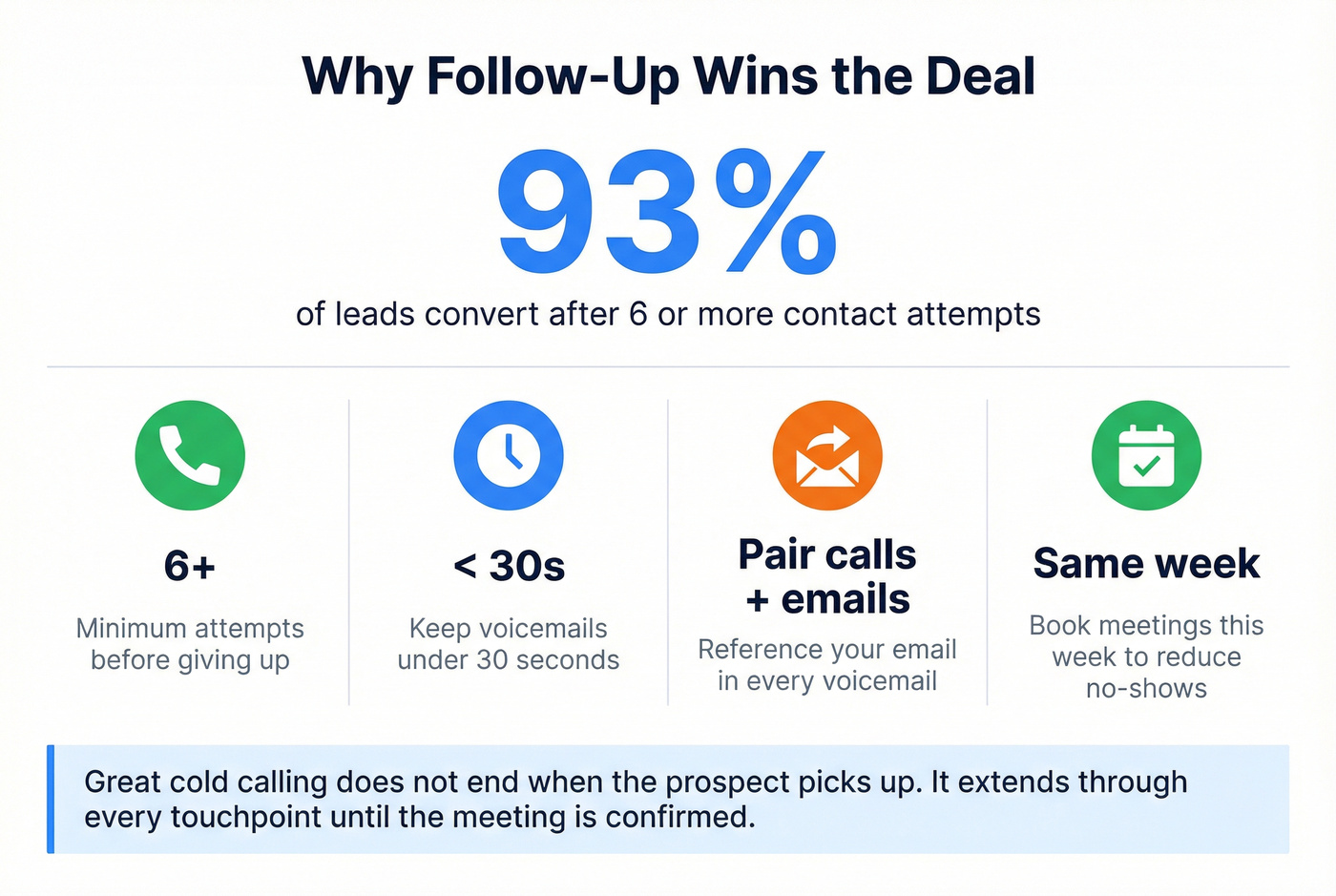
Leave voicemails under 30 seconds. Reference your email so they can respond asynchronously. Pair your call cadence with verified email sequences so you're not guessing at addresses - bad emails waste the goodwill a decent voicemail just earned. Record your calls and review two or three per week. You'll catch verbal tics and missed buying signals you'd never notice in the moment. (If you're building a repeatable cadence, start with a sales cadence example and an SDR follow-up strategy.)
For meetings that do get booked, reduce no-shows by sending an agenda immediately and scheduling same-week whenever possible. Great cold calling doesn't end when the prospect picks up. It extends through every touchpoint until the meeting is confirmed and the calendar hold survives.
Choose the Right Dialer
Parallel dialers are overrated for most teams. The math looks great on paper - 5-10x more dials - but the AI bridge creates a 1-2 second pause that signals robocall behavior. One widely shared benchmark puts power dialing at 6.4% connect-to-meeting versus 3.8% for parallel dialing. Carrier flagging can burn your numbers within months, and iOS call screening keeps making unknown-number outbound harder.
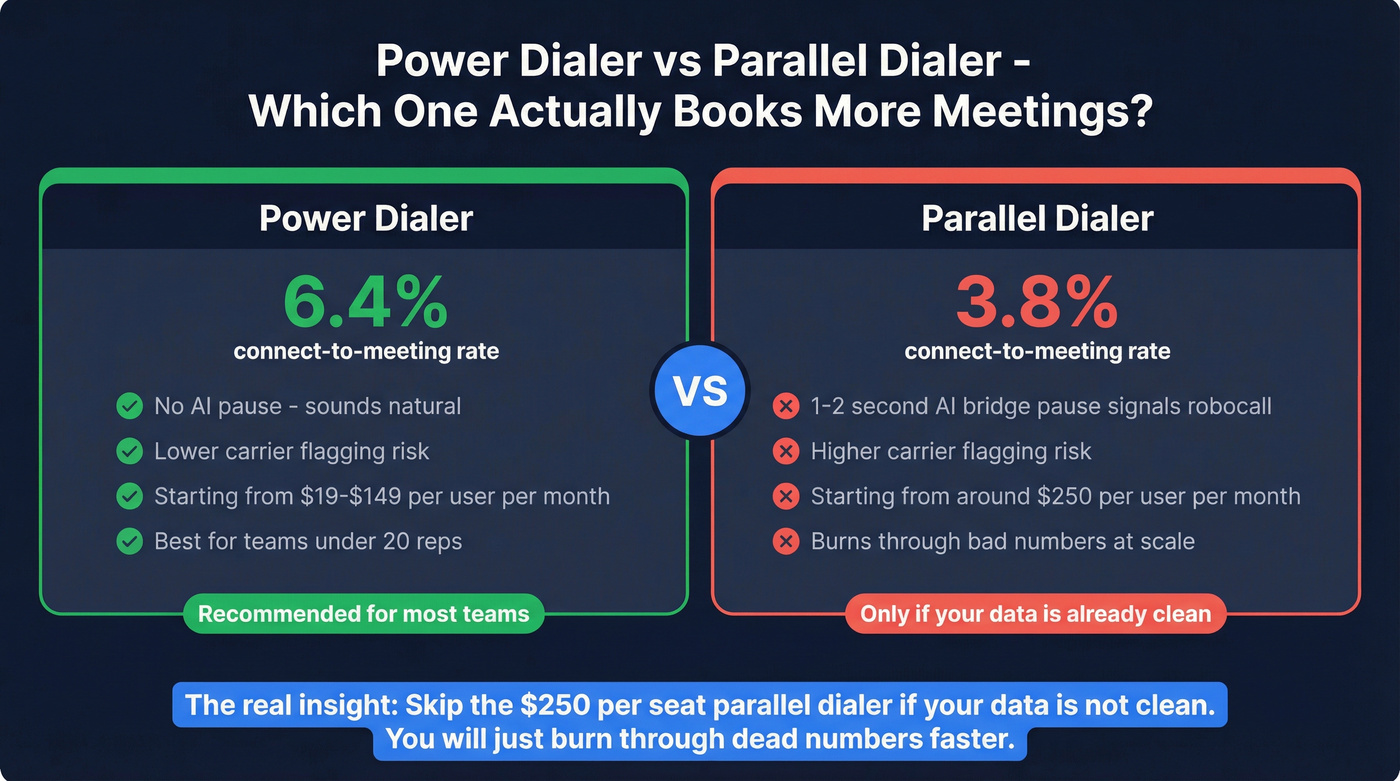
In our experience, the dialer decision gets way too much attention compared to list quality. Skip the $250/seat parallel dialer if your data isn't clean - you'll just burn through dead numbers at scale. (If you're evaluating setups, see dynamic dialer and outbound calling strategy.)
| Tool | Category | Starting from |
|---|---|---|
| JustCall | Cloud phone/dialer | $19/user/mo |
| Dialpad | Cloud phone/dialer | $27/user/mo |
| Kixie | Power dialer | $29/user/mo |
| Aircall | Cloud phone/dialer | $30/user/mo |
| PhoneBurner | Power dialer | $149/user/mo |
| Orum | Parallel dialer | ~$250/user/mo |
For most teams under 20 reps, a power dialer paired with clean data outperforms a parallel dialer paired with a mediocre list every time.
Intent data turns cold calls into warm ones. Prospeo tracks 15,000 buying topics so you know which accounts are actively in-market before you dial. Layer that with verified direct dials and 30+ filters - job changes, headcount growth, tech stack - and your 5 minutes of pre-call research actually moves the needle.
Stop dialing blind - call prospects who are already looking.
FAQ
What are the best cold calling techniques in 2026?
Start with verified phone data - stale numbers kill connect rates before your opener matters. Call Tuesday-Thursday between 10 AM and 4 PM, and open with "How have you been?" which converts at 6.6x the baseline across 90K+ analyzed calls. Layer in a 35-second script framework, intent-based dial prioritization, and multichannel follow-up to outperform 90% of SDR teams still winging it.
What's the best day and time to cold call?
Tuesday through Thursday, between 10 AM and 4 PM local time. A 1.4M-call analysis found Tuesday delivers the highest connect rates and strong demo volume. Friday is the worst day on every metric - save it for research and list prep.
How do I improve my cold call connect rate?
Start with verified phone numbers - stale data is the #1 connect-rate killer. Then optimize timing (Tue-Thu, 10 AM-4 PM) and your opener. These improvements compound: each one multiplies the impact of the others.
Do I need to worry about cold calling compliance?
Yes. In the US, scrub your list against the National Do Not Call Registry and follow TCPA guidelines - violations cost $500-$46,000 per call. In the EU, GDPR requires a legitimate interest basis for B2B cold calls, and you must honor opt-out requests immediately. Use a GDPR-compliant data provider and maintain an internal DNC list.