

5 Email Nurture Sequence Examples You Can Steal Today
Most email nurture sequence examples give you vague frameworks and tell you to "add value." You don't need philosophy - you need sequences with timing, subject lines, and benchmarks you can load into your ESP this afternoon. 73% of B2B leads aren't ready to buy immediately, nurtured leads make 47% larger purchases, and they move 23% faster through the sales cycle. These sequences aren't optional. They're revenue infrastructure.
Pick Your Sequence Type
Match your business type and start:
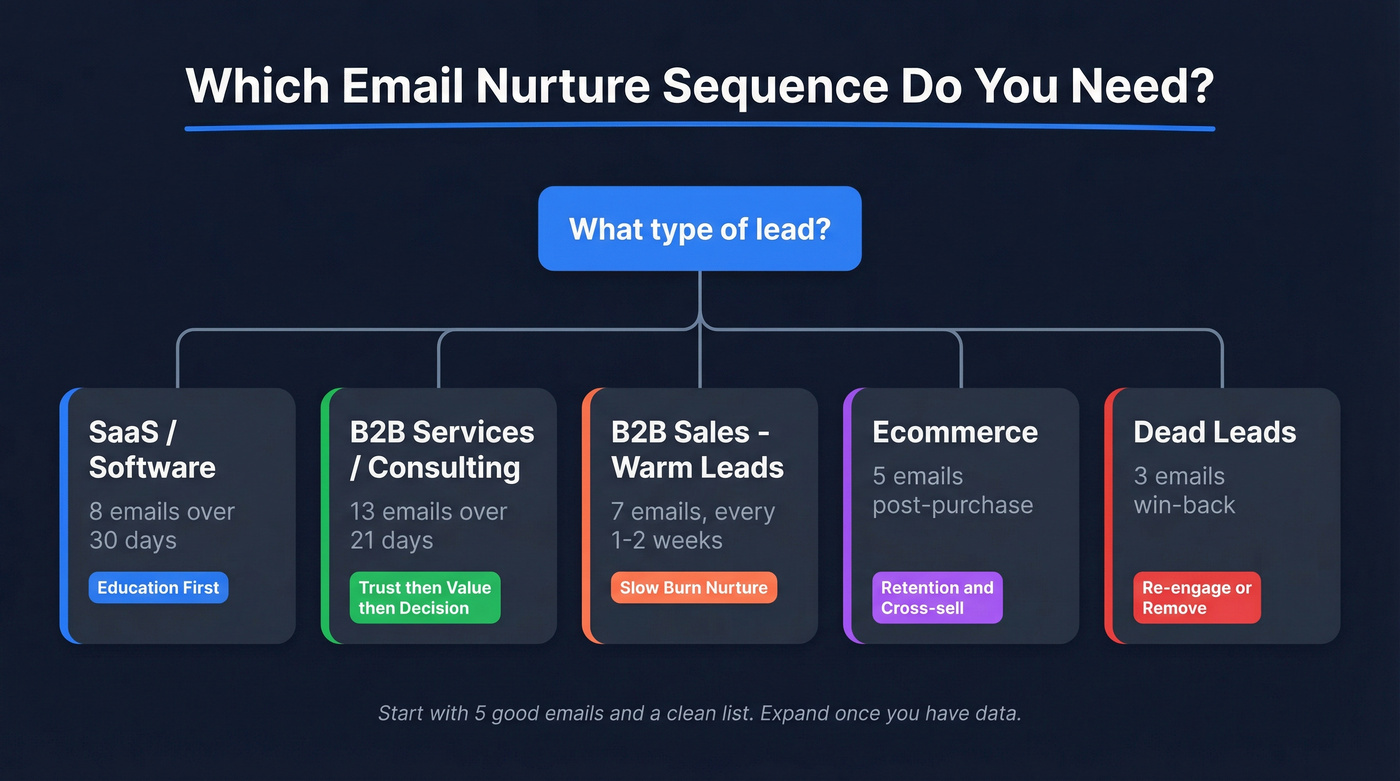
- SaaS / software: Example 1 - 8 emails over 30 days, educational-first
- B2B services / consulting: Example 2 - 13 emails over 21 days, trust then value then decision
- B2B sales, warm leads: Example 3 - 7 emails, every 1-2 weeks
- Ecommerce: Example 4 - post-purchase retention, where the real money hides
- Dead leads: Example 5 - win-back before you write them off
Here's the hot take: you don't need 13 emails. You need 5 good ones and a clean list. Start short, expand once you have data.
Benchmarks Before You Build
Calibrate expectations with the latest HubSpot averages:
| Metric | All Industries | B2B Services | SaaS |
|---|---|---|---|
| Open rate | 42.35% | 39.48% | 38.14% |
| CTR | 2.3% | 2.21% | 1.19% |
| CTOR | 5.3% | 5.63% | 6.81% |
| Bounce | 2.48% | 0.5% | 0.5% |
Here's the thing: Apple Mail Privacy Protection covers 46% of email clients and inflates open rates by roughly 18 points. That "42% open rate" is probably closer to 25% in reality. Stop obsessing over opens - CTR is the metric that actually correlates with pipeline. The per-email data below is something you won't find in most resources.

That 2.48% bounce rate benchmark? Teams using Prospeo average under 4% - because every email goes through 5-step verification with spam-trap and honeypot removal. Your nurture sequence dies the moment emails bounce. Start with 98% accurate data.
Stop nurturing inboxes that don't exist. Verify before you send.
The 5 Sequences
1. SaaS Educational Nurture
Eight emails over 30 days for leads who downloaded a resource, started a trial, or attended a webinar. Education first, product second. Per-email performance data from Sequenzy:
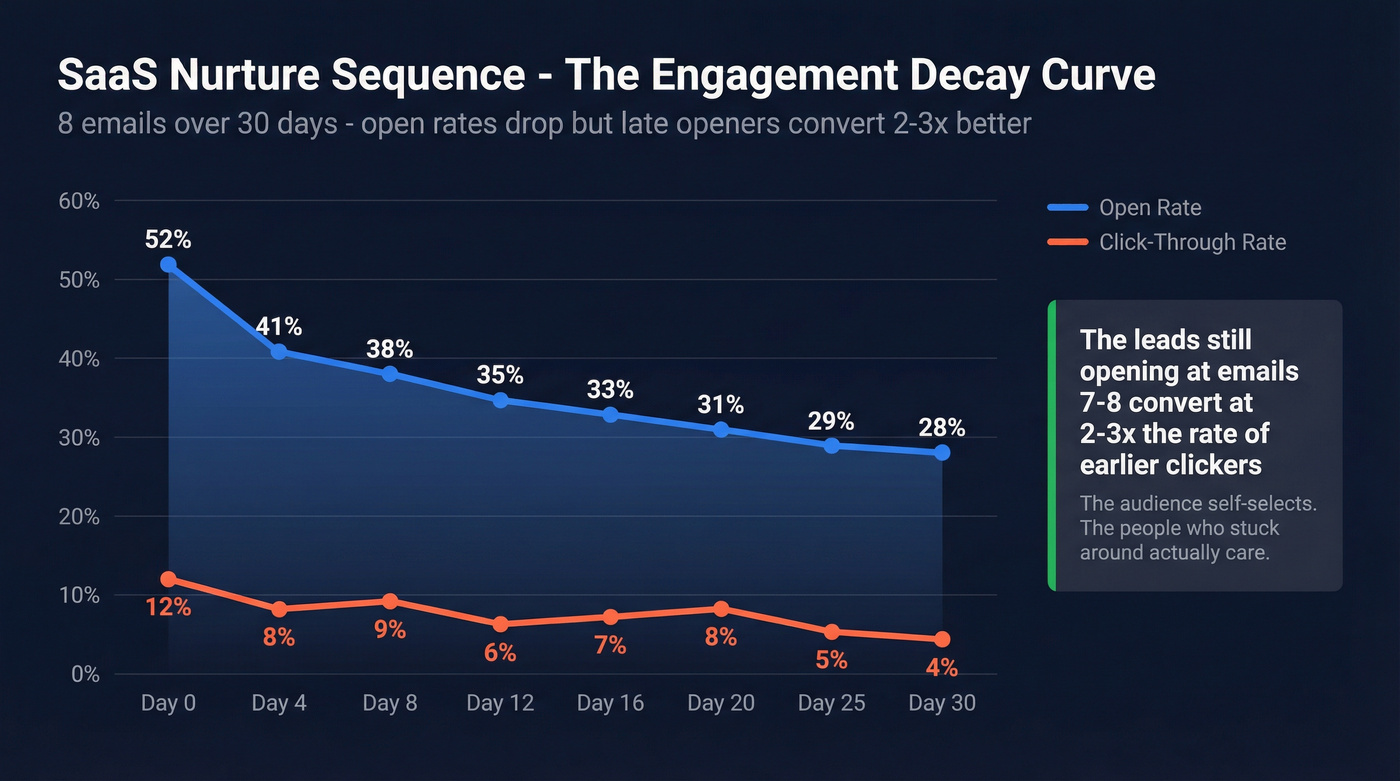
| Day | Purpose | Subject Line | Open | CTR |
|---|---|---|---|---|
| 0 | Deliver resource | "Your report + what most miss" | 52% | 12% |
| 4 | Expand on topic | "The metric nobody tracks" | 41% | 8% |
| 8 | Framework/how-to | "3-step framework for [X]" | 38% | 9% |
| 12 | Mini case study | "[Company] did this in 2 weeks" | 35% | 6% |
| 16 | Common mistake | "Stop doing this with [X]" | 33% | 7% |
| 20 | Advanced insight | "What top 5% teams do differently" | 31% | 8% |
| 25 | Soft product intro | "How we solve [pain point]" | 29% | 5% |
| 30 | CTA / next step | "Ready to see it in action?" | 28% | 4% |
Open rates dropping from 52% to 28% is the normal decay curve. In our experience, the leads still opening at emails 7-8 convert at 2-3x the rate of earlier clickers because the audience has self-selected. The people who stuck around actually care. Notice the subject lines: curiosity-driven lines outperform benefit-driven ones by 18-23% (https://www.digitalapplied.com/blog/ai-nurture-sequences-lead-to-client-email-kit), which is why "The metric nobody tracks" beats "How to improve your metrics."
2. B2B Service/Consulting Nurture
High-ticket services need more trust-building. This three-phase structure moves leads from stranger to client across 13 emails in 21 days:
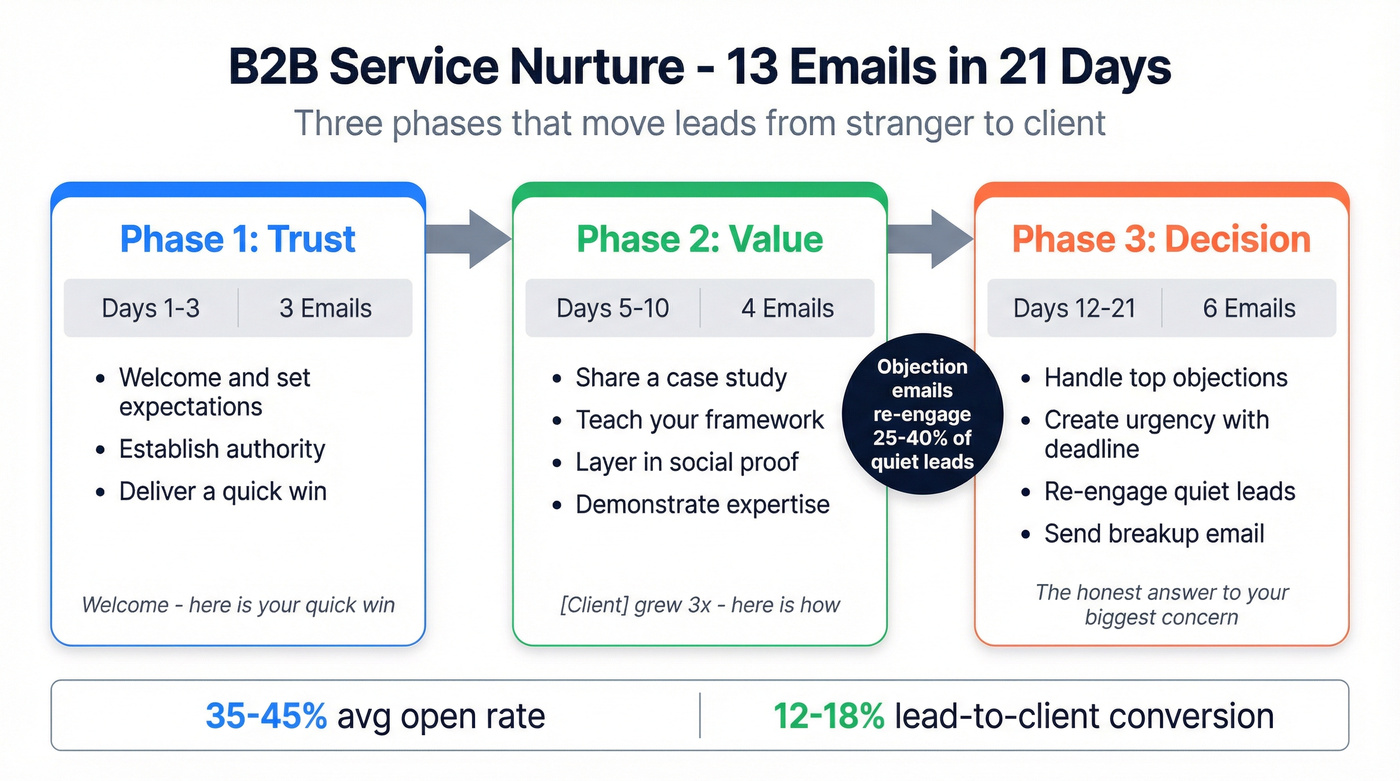
| Phase | Days | Emails | Focus | Example Subject Lines |
|---|---|---|---|---|
| Trust | 1-3 | 3 | Welcome, authority, quick win | "Welcome - here's your quick win" / "The #1 mistake in [industry]" |
| Value | 5-10 | 4 | Case study, framework, social proof | "[Client] grew 3x - here's how" / "Our framework for [X]" |
| Decision | 12-21 | 6 | Objection handling, deadline, breakup | "The honest answer to your biggest concern" / "Last chance" |
Target 35-45% average open rates and 12-18% lead-to-client conversion. The objection-handling emails in days 12-17 re-engage 25-40% of leads who've gone quiet - that's where deals get saved. End with a breakup email on day 21. It creates urgency without being pushy, and this structure works especially well for agencies and consultancies with deal cycles longer than two weeks.
3. B2B Lead Nurture (Slow Burn)
For quality leads that didn't convert on first contact. This follows Cognism's structure and runs every 1-2 weeks across 7 emails: brand intro, free high-value content, introduce your solution, case study, competitive positioning, industry insights, then handle the top 3-5 objections.
You're not asking for anything until email 3, and even then it's a soft introduction. We've seen this pattern outperform aggressive pitch-first sequences consistently in B2B. The consensus on r/sales is that teams starting with 13-email sequences almost always cut to 5-7 after seeing the engagement data. Trust the data, not the "more is more" instinct.
4. Ecommerce Post-Purchase
Your order confirmation email hits ~70% open rates. Don't waste it on a receipt - include product tips, usage guides, or a personalized recommendation. Repeat customers drive 40% of ecommerce revenue, so this is where the real margin lives.
| Trigger | Open Rate | |
|---|---|---|
| Purchase complete | Order confirmation | ~70% |
| Shipped | Shipping update | ~65% |
| 24-48 hrs post-delivery | Check-in + tips | - |
| 7 days post-delivery | Review request | ~50% |
| 14 days post-delivery | Cross-sell / bundle | - |
Brands focusing on post-purchase engagement see 15-25% revenue increases over acquisition-only strategies. Skip this sequence if you're selling one-time products with no cross-sell potential - your energy is better spent on the win-back below.
5. Win-Back / Re-Engagement
45% of subscribers who receive a win-back email will open future emails from your brand. That stat alone justifies the effort. Define "dormant" as 3-6 months of inactivity, then find the window where 75-85% of customers would repurchase and trigger your sequence there.
| Approach | Subject Line Example | |
|---|---|---|
| 1 | Soft check-in | "Fancy seeing you again" |
| 2 | Exclusive offer | "We miss you. Here's $20." |
| 3 | Final chance | "This is the last email you'll see" |
Those subject lines are from real win-back campaigns by Our Place, Girlfriend Collective, and Shhhowercap. If email 3 gets no response, remove the contact. A smaller, engaged list beats a bloated one every time.
How to Set Your Cadence
| Lifecycle Stage | Frequency |
|---|---|
| Awareness | Every 2-3 days |
| Consideration | Weekly |
| Retention | Monthly / quarterly |
| 30-60 days inactive | Halve your frequency |
| 90+ days inactive | Re-engage or remove |
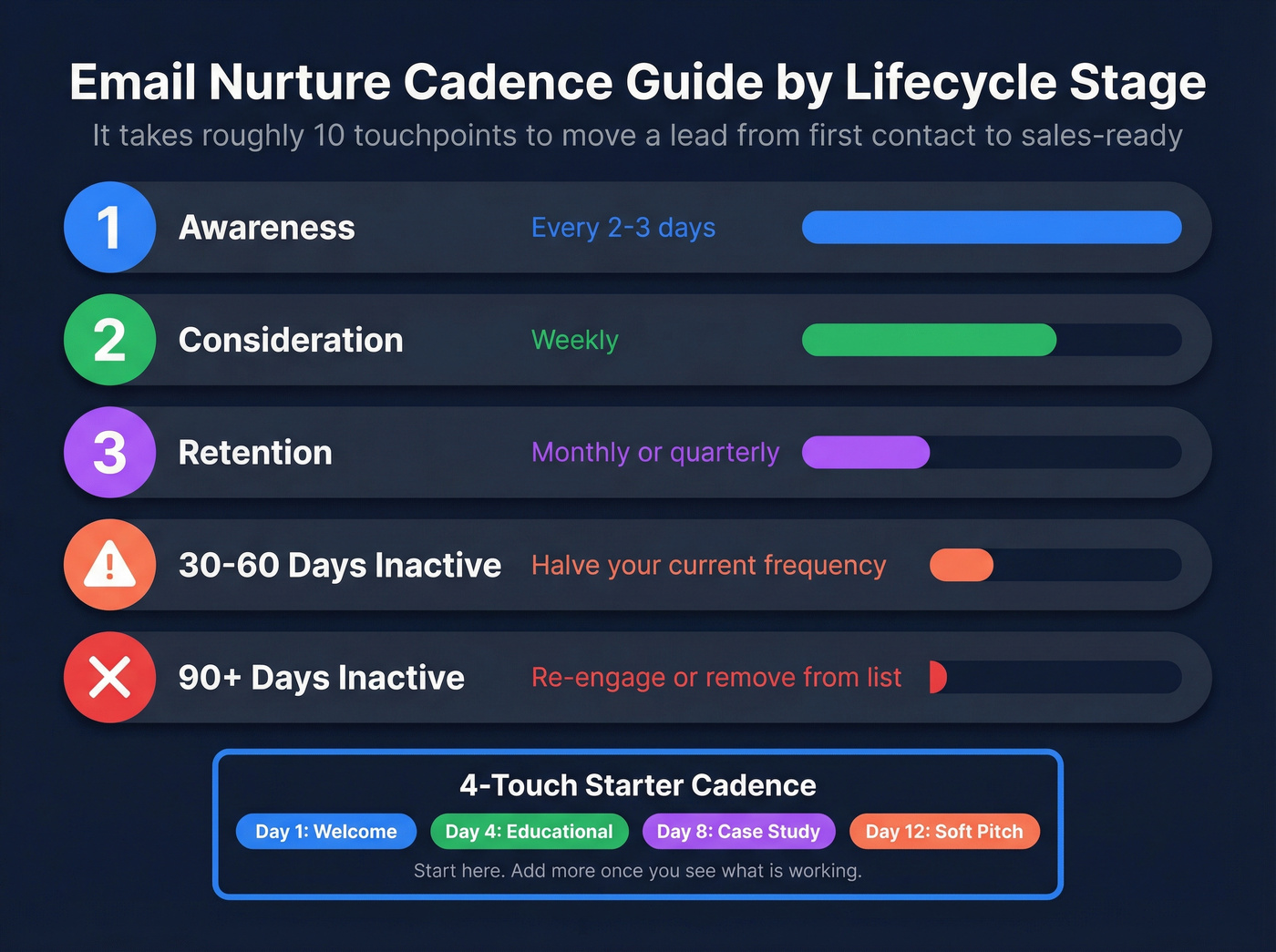
It takes roughly 10 marketing touchpoints to move a lead from first contact to sales-ready. For teams starting from scratch, try this 4-touch starter cadence: Day 1 welcome, Day 4 educational, Day 8 case study, Day 12 soft pitch. That's it. You can always add more once you see what's working.
Mistakes That Kill Nurture Sequences
Sending decision-stage content to awareness-stage leads. A pricing comparison on day 2 feels desperate. Match content to funnel stage.
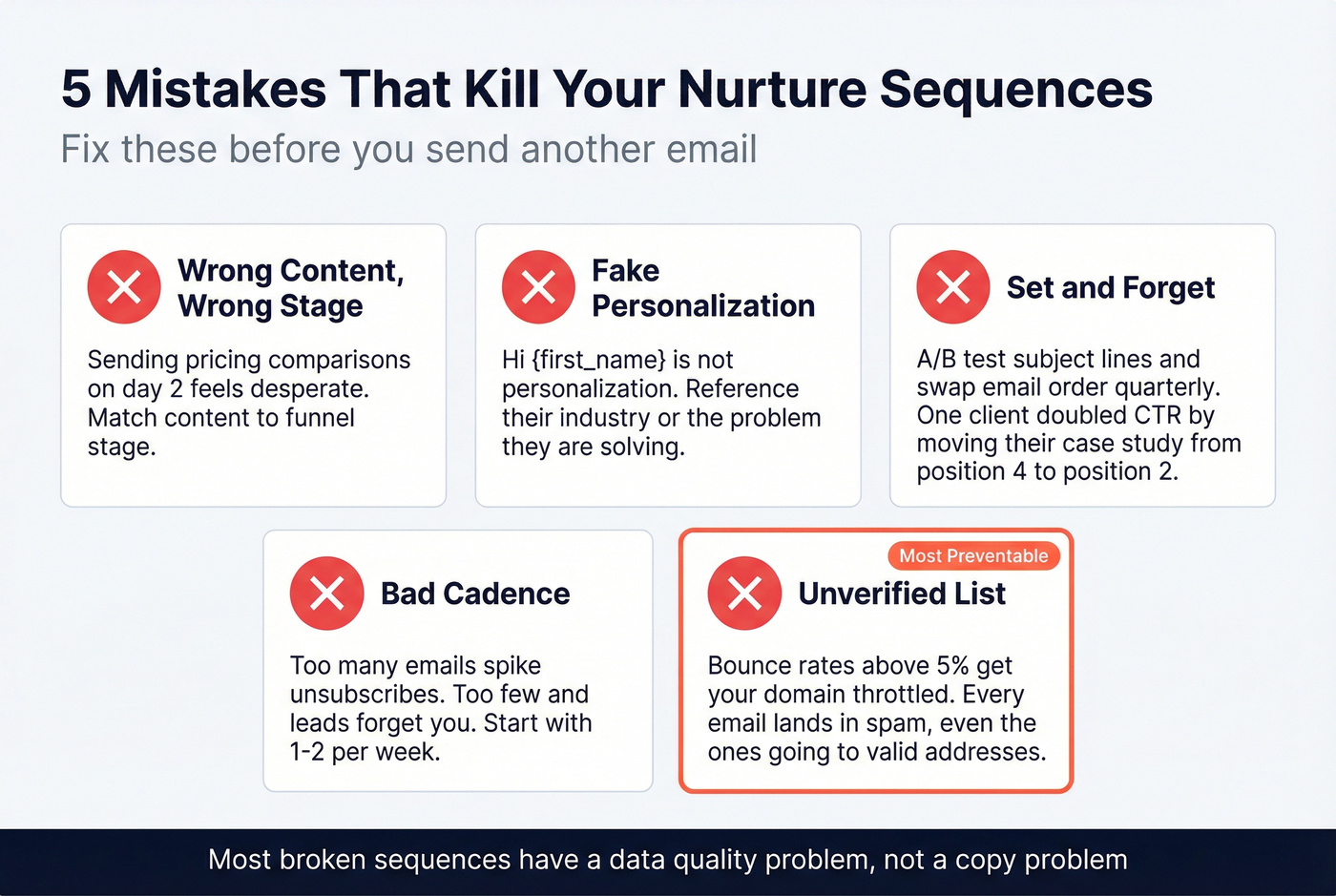
Fake personalization. "Hi {first_name}" isn't personalization. Reference their industry, the content they downloaded, or the problem they're solving. Real talk: if your "personalization" is just a merge tag, you're fooling nobody. (If you want a system, start with personalization.)
No iteration. A/B test subject lines, swap email order, adjust timing. Teams that iterate quarterly crush the ones that "set and forget." We've watched a client double their CTR just by moving their case study email from position 4 to position 2.
Ignoring cadence. Too many emails spike unsubscribes. Too few and leads forget you exist. Start with 1-2 per week and adjust based on engagement.
Launching on an unverified list. This one's painful because it's so preventable. If your bounce rate exceeds 5%, inbox providers throttle your domain and every subsequent email lands in spam - including the ones going to perfectly valid addresses. Prospeo's 5-step verification catches invalid addresses, spam traps, and honeypots at 98% accuracy, and the free tier handles 75 verifications per month so you can test before you scale. If you need a deeper playbook, use this email deliverability checklist and run a proper email validity check.
You just found 5 sequences worth stealing. Now you need the contacts to fill them. Prospeo gives you 300M+ profiles with 30+ filters - buyer intent, job changes, tech stack - so every lead entering your nurture flow actually matches your ICP.
Great sequences with bad lists produce nothing. Fix the list first.
FAQ
How many emails should a nurture sequence have?
Five to eight emails covers most use cases. Start with five, then expand once open and CTR data reveal where engagement drops. Longer sequences of 10-13 emails work for high-ticket B2B with buying cycles stretching 30-60+ days, but don't build long just because you can.
What's a good open rate for nurture emails?
First email: 40-52%. By emails 5-8, expect 28-33%. That decay is normal and healthy - late openers convert at 2-3x higher rates because they've self-selected. Focus on CTR (target 2-3%+) since Apple Mail Privacy Protection inflates opens across 46% of email clients.
How do I fix a sequence that isn't converting?
Let's break this down into three checks. First, is your list verified? Bounce rates above 5% destroy deliverability. Second, are you matching content to funnel stage? Awareness leads need education, not pricing pages. Third, review your cadence: start weekly and adjust based on engagement data from the examples above. Most broken sequences have a data quality problem, not a copy problem.