How to Cold Email Restaurant Owners and Actually Get Replies
You sent 200 emails to info@thaiplacedowntown.com and got exactly zero replies. That's not a cold email problem - it's a list quality problem. The owner never saw your message because info@ goes to a hostess, a manager, or nobody at all. Fix the contact, and cold email for restaurants works just like it works everywhere else.
Three things separate restaurant cold emails that get replies from ones that get deleted:
- Write mobile-length emails that lead with a specific problem you noticed about their restaurant - not a generic pitch about "helping restaurants grow."
- Send on Thursdays between 2-4 PM, between lunch and dinner service. One great email beats five mediocre follow-ups.
The stack is simple: verified contacts, sending tool, lightweight CRM. Let's build each layer.
Build Your Restaurant Email List
The hardest part of restaurant email outreach isn't writing the email - it's finding who to send it to. Most restaurant owners don't publish their direct email on the website. Here's how to find it anyway.
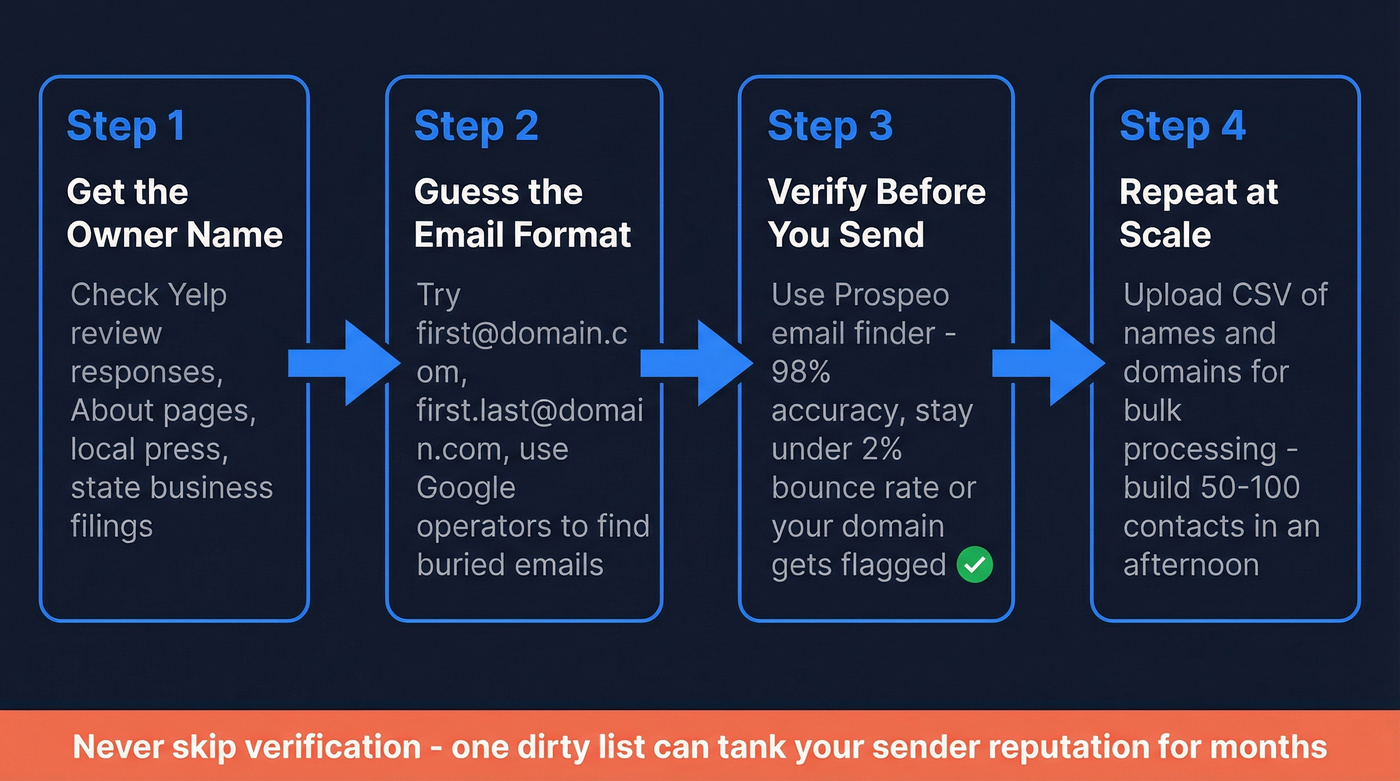
Step 1: Get the owner's name. Go to the restaurant's Yelp or TripAdvisor page and scroll to the review responses. Owners and managers often reply to negative reviews, and they sometimes sign with their name. You can also check the "About" page on the restaurant's website, local press mentions, or the business's state registration (most are public record).
Step 2: Guess the email format. Most restaurants use simple patterns: first@domain.com, first.last@domain.com, or firstinitiallast@domain.com. For a restaurant called Basil & Vine owned by Maria Chen, you'd try maria@basilandvine.com or maria.chen@basilandvine.com. If you want a safer workflow, follow this Guess the email format guide.
Google operators can surface buried emails too. Try site:basilandvine.com filetype:pdf email or "Maria Chen" "Basil & Vine" email. You'd be surprised how often an email shows up in a catering PDF or press kit.
Step 3: Verify before you send. This is non-negotiable. Sending to unverified addresses tanks your sender reputation, and once your domain is flagged, every future email suffers. You need to stay under a 2% bounce rate.
Prospeo handles both the finding and the verifying. Paste the owner's name and the restaurant's domain into the email finder, and it returns a verified address with 98% accuracy. The free tier gives you 75 emails per month plus 100 Chrome extension credits, enough to test a local restaurant campaign before you commit a dollar.
Step 4: Repeat at scale. Once you've got a workflow - name from Yelp, email from Prospeo, verified and exported - you can build a list of 50-100 restaurant owners in an afternoon. Upload a CSV of names and domains for bulk processing instead of searching one by one. (If you’re building bigger lists, these list building tools can help.)
Set Up Your Sending Infrastructure
Don't send cold emails from your primary Gmail. Set up a dedicated sending domain such as outreach.yourcompany.com and configure three things before you send a single message:
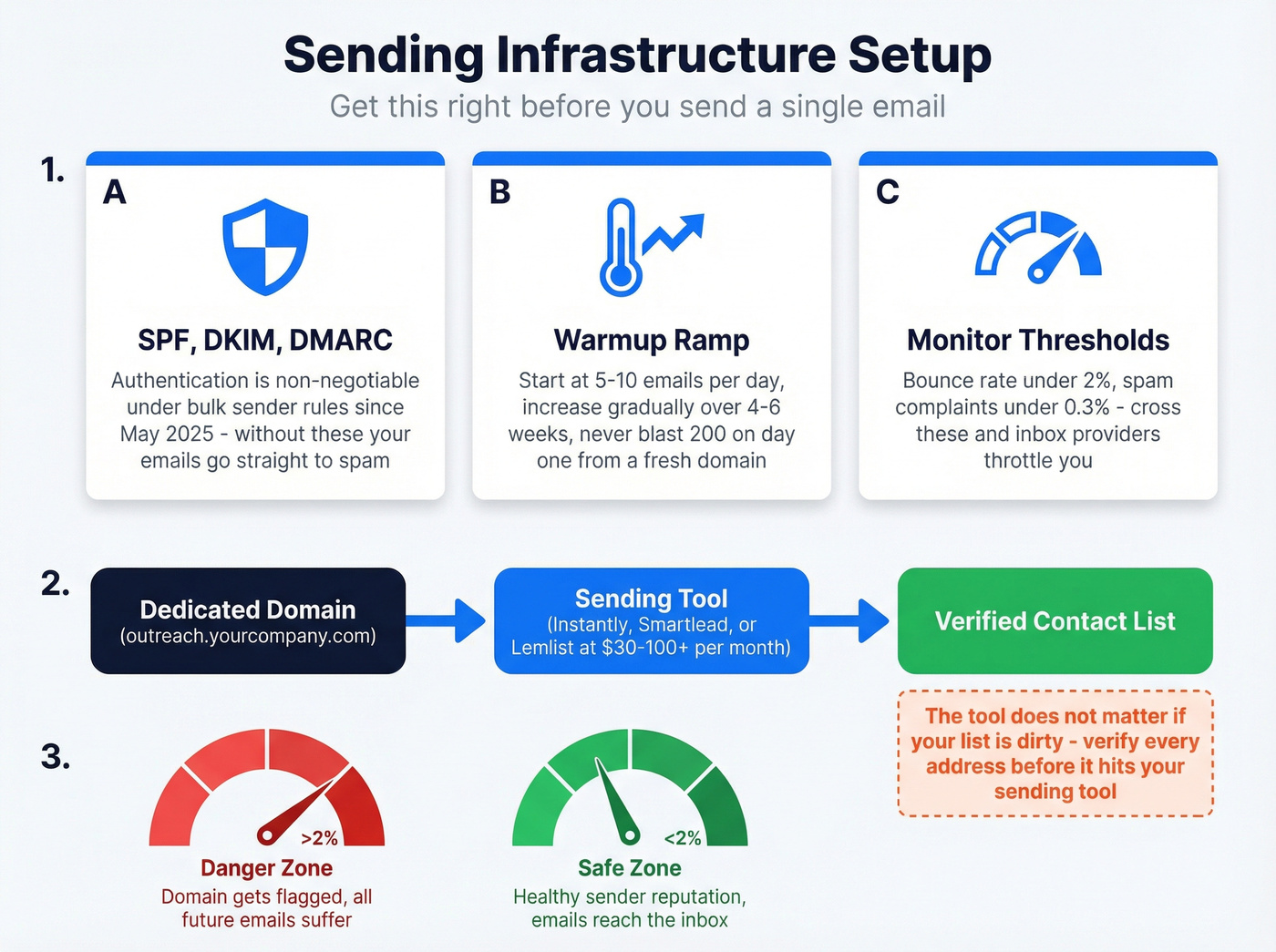
- SPF, DKIM, and DMARC authentication - non-negotiable under bulk sender rules enforced since May 2025. Without them, your emails go straight to spam. (If you need the setup steps, use this SPF, DKIM, and DMARC walkthrough.)
- Warmup ramp - start at 5-10 emails per day and increase gradually over 4-6 weeks. Don't blast 200 emails on day one from a fresh domain. (More detail here: automated email warmup.)
- Bounce rate under 2%, spam complaints under 0.3% - these are the hard thresholds. Cross them and inbox providers throttle you. If you ever get throttled, run a quick blacklist alert check.
For sending tools, Instantly, Smartlead, and Lemlist all work well, typically in the ~$30-$100+/mo range depending on seats and features. They handle warmup, rotation, and scheduling. But the tool doesn't matter if your list is dirty - verify every address before it hits your sending tool. That single step keeps you under the 2% bounce ceiling.
Write Emails Restaurant Owners Actually Read
The Two Buyer Mindsets
Restaurant owners fall into two camps when they read a cold email. Some are future-seeking - they want to grow, try new tech, attract more covers. Others are problem-solving - something's broken and they need it fixed. Your email needs to signal which camp you're speaking to within the first sentence.
The pain points that get attention are specific and financial. Labor often runs 30-35% of restaurant revenue. Third-party delivery commissions take 15-30% per order. Online review management is a time sink that directly impacts foot traffic. Pick one. Reference it with a number. That's your hook.
One quick writing heuristic we've found makes a measurable difference: use 2x more "you/your" than "I/my" in every email. Restaurant owners can smell a self-centered pitch from the subject line. If you want more angles, borrow a few from these cold email tactics.
The "Baseball Card" Structure
Restaurant operators read email on their phones, usually between rushes. Your email needs to look like a baseball card on a mobile screen - compact, scannable, done in 10 seconds.
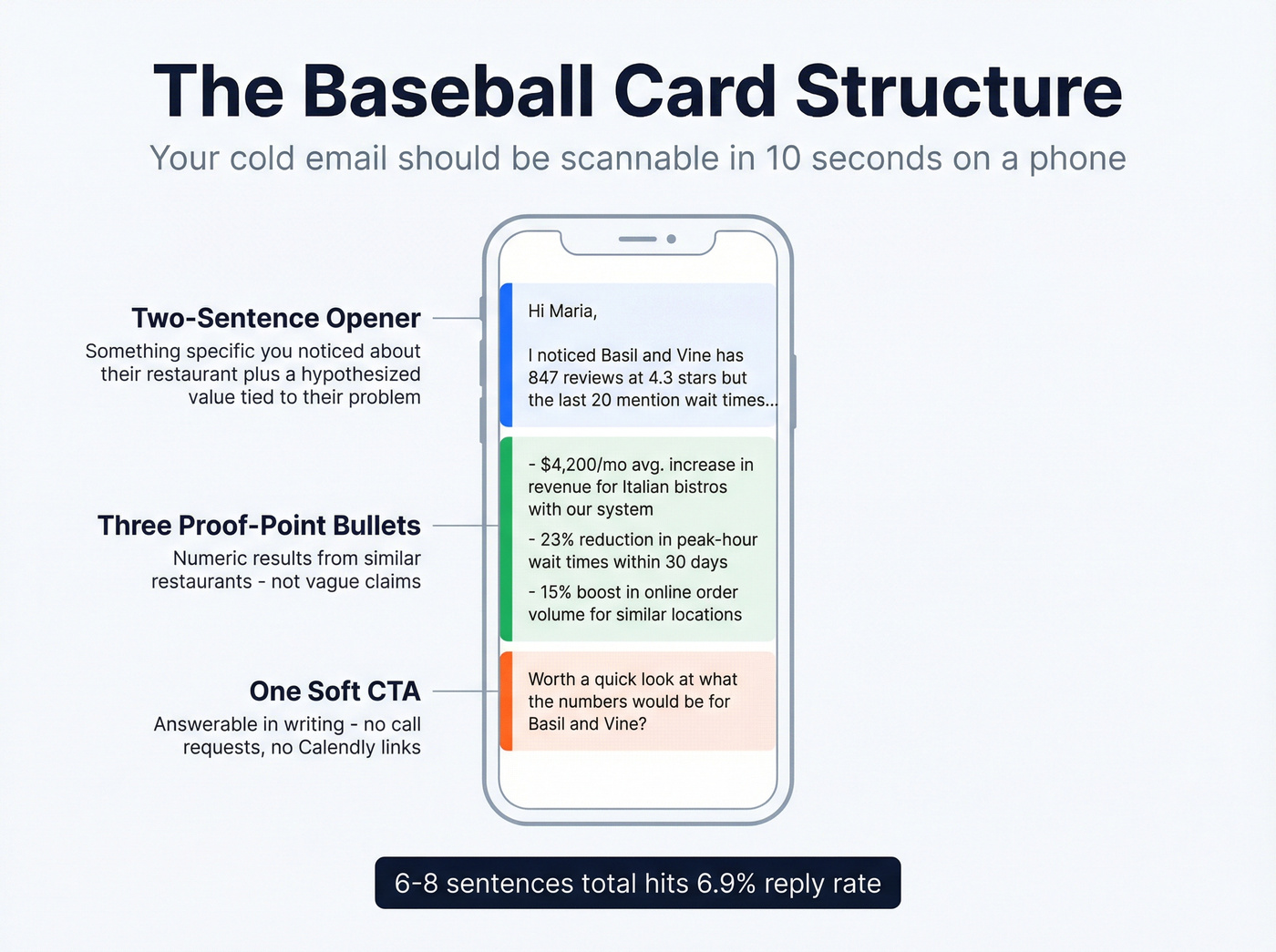
Two-sentence opener: Something specific you noticed about their restaurant, followed by a hypothesized value tied to a problem they probably have.
Three proof-point bullets: Numeric results you've delivered for similar businesses. Not vague claims - actual numbers.
One CTA: Answerable in writing. Not "let's hop on a call" - that's too much commitment for a cold email. Try "Would it be worth seeing how this works for [restaurant name]?" or "Want me to send a quick breakdown?"
The sweet spot is 6-8 sentences total. In Belkins' analysis of 16.5 million cold emails, that length hit a 6.9% reply rate - the highest of any bracket. For more copy/paste options, see these outreach email templates.
What NOT to Do
- No attachments. They trigger spam filters and restaurant owners won't open them anyway.
- No multiple links. One link maximum. Zero is better for email #1.
- No Calendly link cold. You haven't earned the right to book their time yet. (If you need meeting language, use these schedule meeting email examples.)
- No phone call request in email #1. Operators are on their feet 12 hours a day - asking for a call in a cold email is asking them to give up their only break.
- No generic "I help restaurants" opener. If your email could be sent to any restaurant in America without changing a word, it's going in the trash.
The Restaurantology framework suggests spending up to 30 minutes per introductory email on personalization. That sounds extreme, but for high-value accounts it's the difference between a reply and the spam folder.

Building a restaurant owner list from Yelp reviews and Google searches takes hours. Prospeo's email finder turns an owner name + restaurant domain into a verified email with 98% accuracy - keeping your bounce rate well under that 2% threshold. The free tier gives you 75 verified emails per month, enough to test your first restaurant campaign tonight.
Stop guessing email formats. Verify before you send.
Restaurant Cold Email Templates
The template you use depends on what you're selling. Here are three proven structures for the most common scenarios.
SaaS / Tech Vendors
Use this when you can identify their current tech stack from job postings, review sites, or their website footer.
Subject: Quick question about [current POS/system they use]

Hi [First Name],

I noticed [Restaurant Name] is running [current system - e.g., Toast, Square].
A few of our restaurant clients switched from [system] and cut processing
costs by 18-22% in the first quarter.

- [Client A] saved $2,400/mo on payment processing
- [Client B] reduced order errors by 34%
- [Client C] cut staff training time from 2 weeks to 3 days

Would it be worth seeing a quick comparison for [Restaurant Name]?

[Your Name]
Marketing Agencies
This works when you can pull specific review data - star ratings, review volume, complaint patterns.
Subject: Your Google reviews for [Restaurant Name]

Hi [First Name],

I was reading [Restaurant Name]'s reviews - you've got 847 reviews at 4.3
stars, but the last 20 skew toward wait time complaints. That pattern
usually costs 10-15% of new walk-in traffic.

- We helped [similar restaurant] move from 4.1 to 4.6 stars in 90 days
- Their weekend reservations increased 23%

Want me to send a quick breakdown of what we'd do for [Restaurant Name]?

[Your Name]
Food / Equipment Suppliers
Best for restaurants where you can infer cost structure from the menu - seafood-heavy, farm-to-table, high-protein concepts.
Subject: Cutting [Restaurant Name]'s food costs by 12%

Hi [First Name],

[Restaurant Name] runs a seafood-heavy menu - typically that means food
costs north of 35%. We work with similar concepts and consistently bring
that number down.

- [Client A] cut seafood costs 12% without changing suppliers
- [Client B] reduced waste by 28% with our portioning system

Worth a quick look at what the numbers would be for your menu?

[Your Name]
Best Time to Send and Follow Up
Thursday pulled a 6.87% reply rate in the 16.5M email dataset, compared to 5.29% on Monday. The Belkins data showed 8-11 PM got the most replies overall, but for restaurant owners, that's the middle of dinner service. Send between 2-4 PM when they're between lunch cleanup and dinner prep - that's the window where they're actually checking email. (If you want more timing data, see best time to send prospecting emails.)
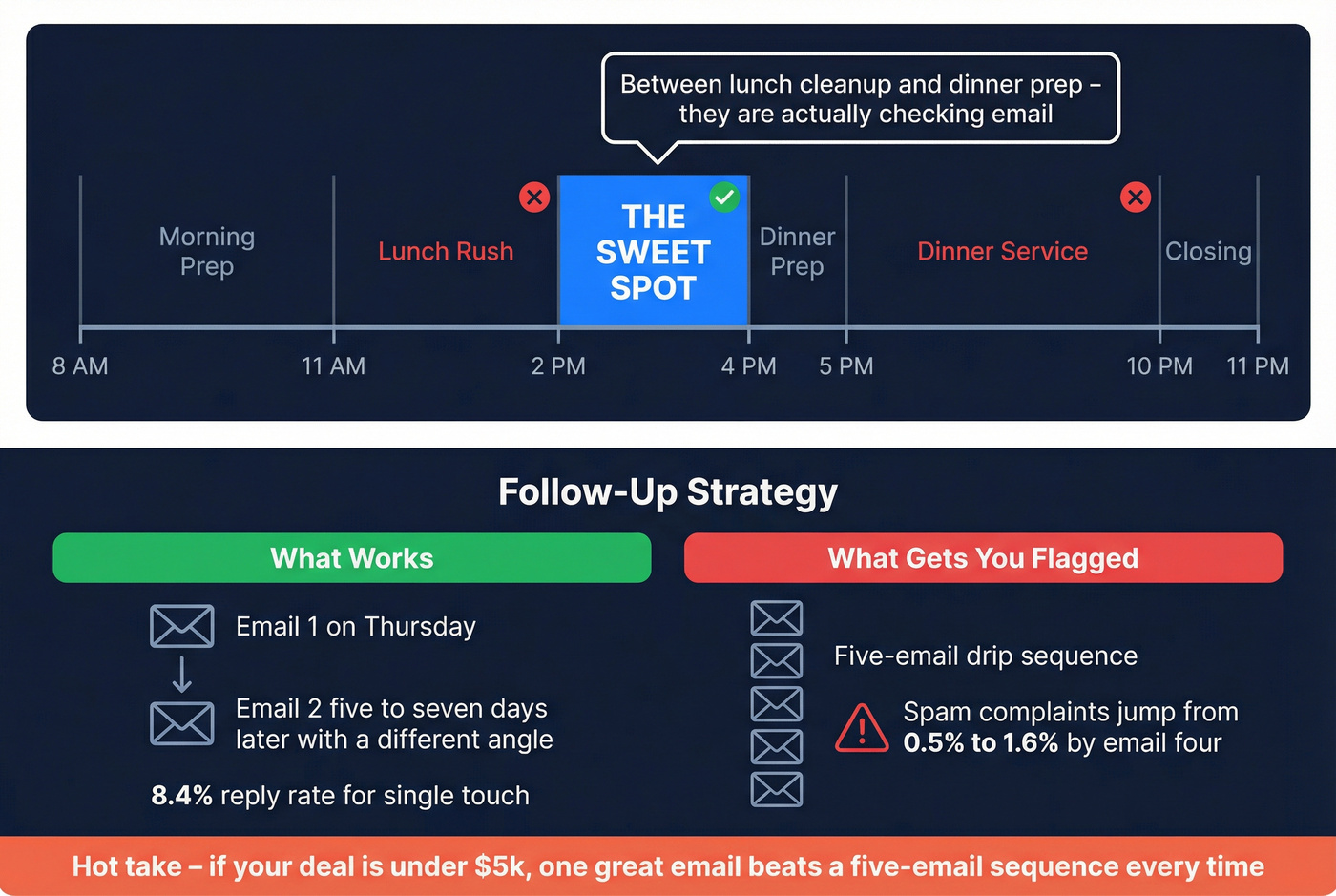
Here's my hot take: if your deal size is under $5k, you probably don't need more than one email. Single-touch emails had the highest reply rate in the study at 8.4%. Each additional follow-up increases spam complaints - from 0.5% on the first email to 1.6% by the fourth. We've seen this play out repeatedly. One great email outperforms a five-email drip sequence every time.
If you do follow up, cap it at two total touches. A second email 5-7 days later with a different angle is fine. A five-email sequence is how you get marked as spam.
Cold Email Benchmarks for 2026
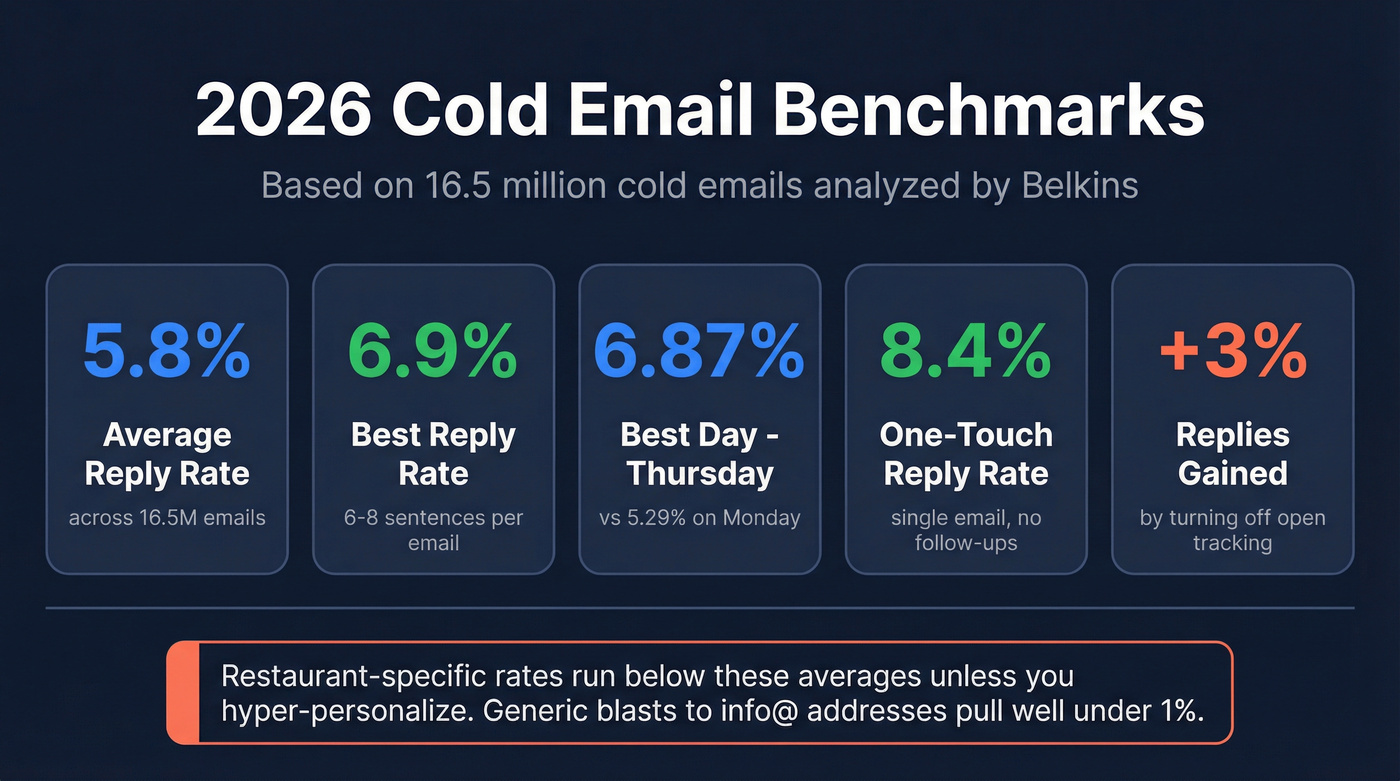
Here's what "good" looks like, based on 16.5 million cold emails analyzed:
| Metric | Benchmark |
|---|---|
| Avg reply rate | 5.8% |
| Best email length | 6-8 sentences (6.9% reply) |
| Best day | Thursday (6.87% reply) |
| One-touch reply rate | 8.4% |
| Open tracking impact | Tracking off = ~3% more replies |
Restaurant-specific rates run below these averages unless you're hyper-personalizing. Generic blasts to info@ addresses pull well under 1%. But a verified-owner, personalized campaign using the baseball card structure? You can match or beat the 5.8% average.
One more thing: turning off open tracking pixels produced roughly 3% higher response rates. For restaurant outreach where every percentage point matters, turn it off. (More context: does open tracking hurt cold email.)
CAN-SPAM Compliance in 60 Seconds
Cold email is legal in the US under CAN-SPAM, but violations carry penalties up to $50,120 per email.
- Identify yourself clearly with a real name, real company, and physical address
- Don't use misleading subject lines
- Include a functional unsubscribe link in every email - consider adding a one-click unsubscribe header if your sending tool supports it
- Process opt-outs within 10 business days
- If you're emailing EU restaurants, GDPR applies with fines up to EUR 20M or 4% of annual revenue
Real talk: CAN-SPAM is an opt-out framework, meaning you don't need prior consent to send a cold email. But you do need to honor every unsubscribe immediately. The fastest way to get in trouble isn't a lawsuit - it's getting your domain blacklisted because you ignored opt-outs.
Dirty lists kill restaurant outreach before your copy even gets a chance. Prospeo's 5-step verification catches invalid addresses, spam traps, and catch-all domains so you stay under the 2% bounce ceiling and 0.3% complaint threshold. At $0.01 per email, verifying 500 restaurant contacts costs less than a single appetizer.
Protect your domain reputation - verify every address before it hits your sending tool.
FAQ
Does cold email for restaurants actually work?
Yes - with verified owner emails and personalized messages. Generic blasts to info@ addresses bounce or get ignored. Across 16.5 million cold emails, the average reply rate is 5.8%. Restaurant outreach matches that when you use the baseball card structure and send to the owner directly.
How do I find a restaurant owner's email?
Find the owner's name from Yelp or TripAdvisor review responses, then use an email finder to locate and verify their direct address. A 5-step verification process with catch-all handling, spam-trap removal, and honeypot filtering keeps your bounce rate under 2%. Free tiers typically cover 75 lookups per month, which is plenty for a local campaign.
How many follow-ups should I send?
Cap it at two total touches. One-touch emails had the highest reply rate (8.4%) in the 16.5M email study. Each additional follow-up increases spam complaints - from 0.5% on email one to 1.6% by email four. Send one great email, follow up once if needed, then move on.