Inside Sales Reps: What They Earn, How They're Measured, and What They Need in 2026
Your first week as an SDR, someone hands you a spreadsheet with 2,000 "leads." Half the emails bounce. A third of the phone numbers ring to fax machines. You're told to hit 80 dials a day and book 15 meetings this month. Welcome to inside sales - where your success depends less on hustle and more on the systems around you.
Inside sales isn't shrinking. The BLS projects 1.8 million sales job openings per year, and Glassdoor pegs median total pay for inside sales reps at $102,000. The bad news: most reps still work with broken tools, vague quotas, and data that went stale before they ever dialed it.
The Cheat Sheet
- Comp reality: SDR/BDR median OTE is $85K. SMB AE median OTE is $130K. Enterprise AEs hit $265K. The $14K-$144K range on job boards is useless - ignore it.
- The KPI that matters: Stop counting dials. Qualified meetings booked is the metric that correlates with quota attainment. Forty calls to verified direct dials beats 100 calls to switchboards every time.
What Is an Inside Sales Rep?
An inside sales rep sells remotely - phone, email, video, chat. No territory drives, no airport lounges, no expensed steakhouse dinners. The entire sales cycle happens from a desk or a home office.
So what does an inside sales representative actually do day to day? They run discovery calls, multi-touch sequences, demos, negotiations, and relationship building across weeks or months. This isn't telemarketing. The deals are real, the objections are complex, and the skill ceiling is high.
| Inside Sales | Outside Sales | |
|---|---|---|
| Channels | Phone, email, video | In-person meetings, events, travel |
| Travel | Minimal to none | Higher travel requirements |
| Typical deal size | Often smaller to mid-sized | Often larger, especially enterprise |
| Cycle length | 30-90 days | Typically longer cycles |
| Cost per rep | Lower (no T&E) | Higher (travel, meals) |
Inside sales keeps taking share because the economics work better for a lot of B2B deal sizes - especially when you can demo and run the full process on a screen. The lower cost per rep lets companies scale their sales force faster than a field team that requires travel budgets and territory planning.
A typical day looks something like this: 8:30-9:00 reviewing pipeline and prepping for calls, 9:00-11:30 in a protected calling block, 11:30-12:00 logging CRM activity and sending follow-ups, afternoon split between demos, discovery calls, and sequenced outreach, with the last 30 minutes updating forecasts and planning tomorrow's targets. The best reps guard their morning calling hours ruthlessly.
SDR vs. BDR vs. AE: Role Taxonomy
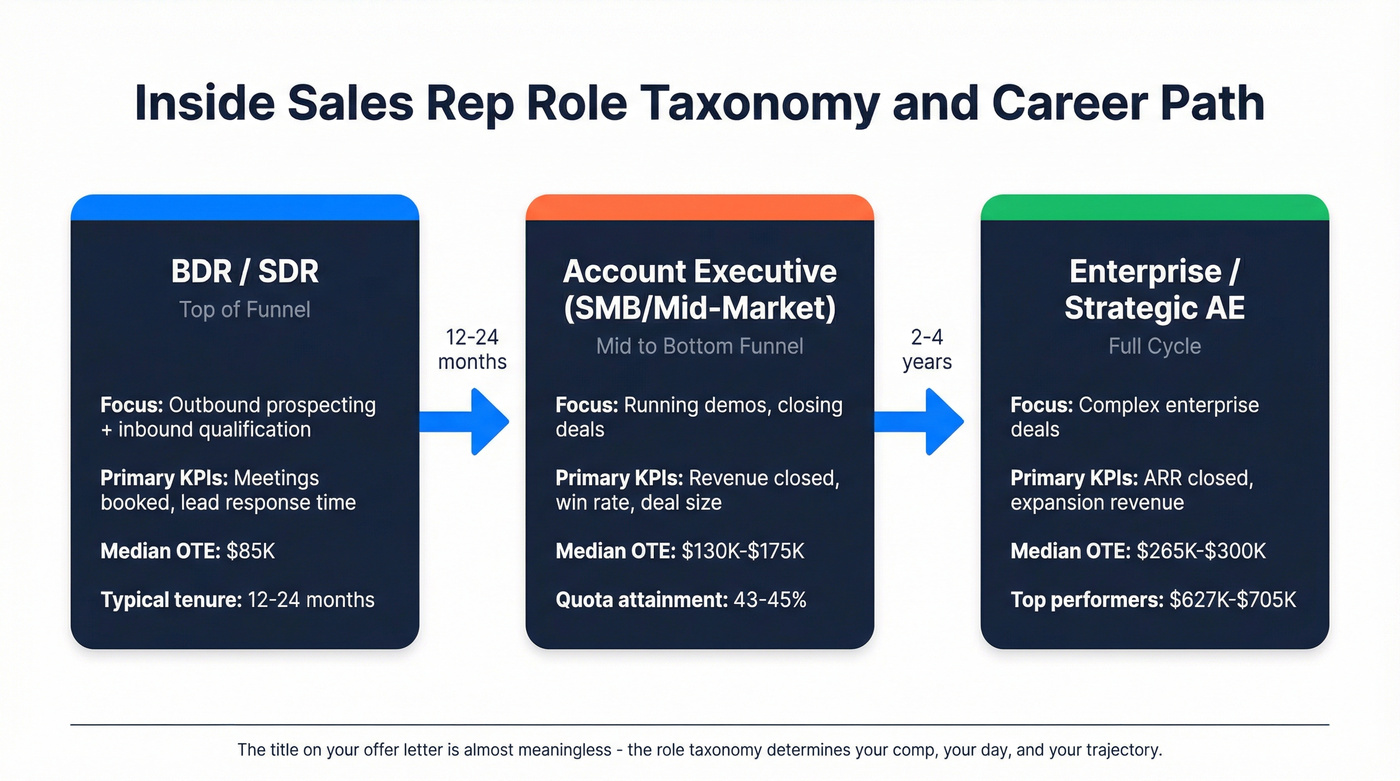
"Inside sales rep" is an umbrella term covering dramatically different jobs, comp structures, and career stages.
| Role | Focus | Funnel Position | Primary KPIs |
|---|---|---|---|
| BDR | Outbound prospecting | Top of funnel | Meetings booked, outreach volume |
| SDR | Inbound qualification | Top to mid-funnel | Lead response time, qualified opps |
| AE | Closing deals | Mid to bottom | Revenue closed, win rate, deal size |
The BDR is the hunter - cold outbound, building pipeline from scratch. The SDR is the qualifier - routing and converting inbound leads into opportunities. The AE is the closer - running demos, handling objections, negotiating contracts.
Some orgs blend SDR and BDR into a single role responsible for both inbound and outbound. When they're separated, the inbound/outbound split is the key differentiator. Either way, the career path flows the same direction: BDR/SDR to AE, typically after 12-24 months of hitting pipeline targets.
Here's the thing most new reps don't realize: the "inside sales rep" title on your offer letter could mean you're booking meetings at $85K OTE or closing six-figure deals at $265K OTE. The title is almost meaningless. The role taxonomy determines your comp, your day, and your trajectory.
Compensation in 2026
What Reps Actually Earn
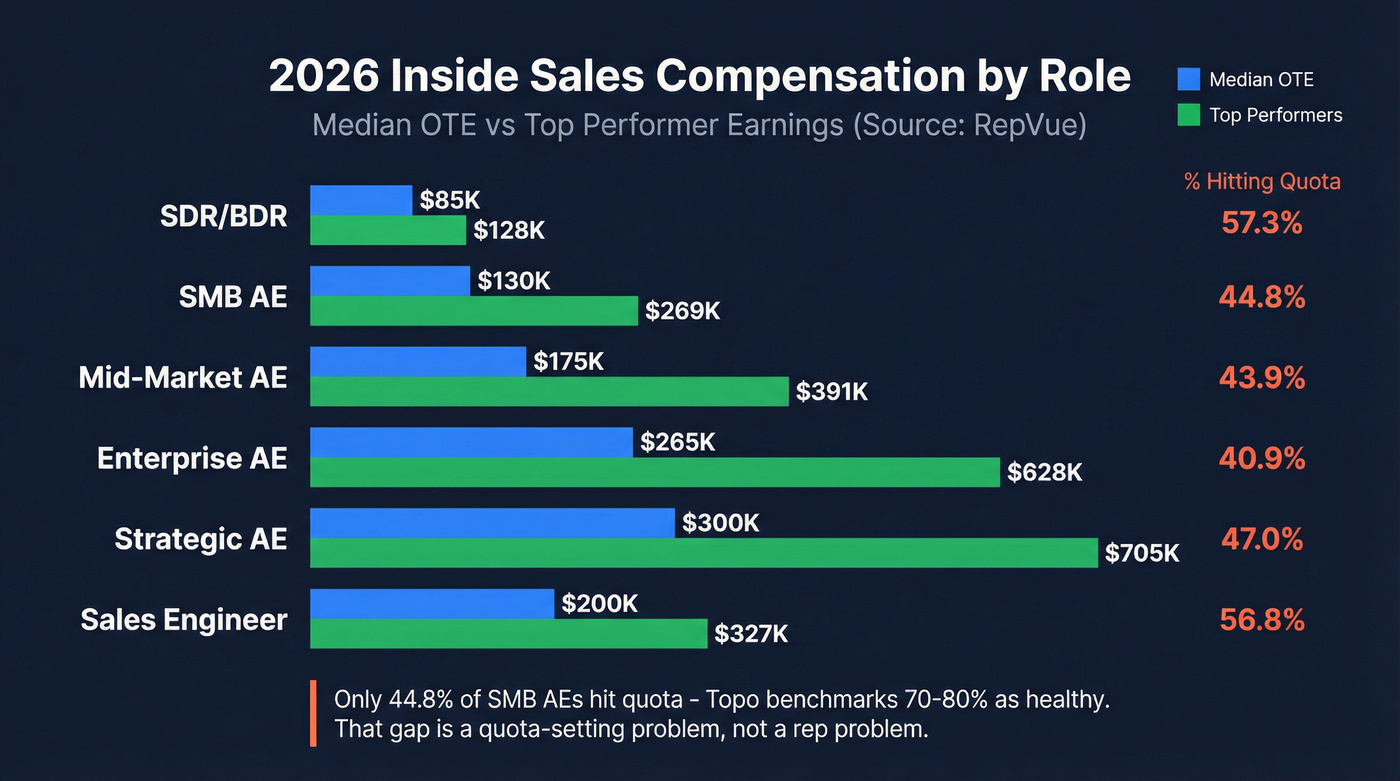
Forget the $14K-$144K range on job boards. That range is so broad it's functionally useless. RepVue's compensation data tells a more honest story:
| Role | Median Base | Median OTE | Top Performers | % Hitting Quota |
|---|---|---|---|---|
| SDR/BDR | $60,000 | $85,000 | $127,955 | 57.3% |
| SMB AE | $70,000 | $130,000 | $269,489 | 44.8% |
| Mid-Market AE | $90,000 | $175,000 | $391,399 | 43.9% |
| Enterprise AE | $135,000 | $265,000 | $627,527 | 40.9% |
| Strategic AE | $150,000 | $300,000 | $705,215 | 47.0% |
| Sales Engineer | $145,000 | $200,000 | $327,388 | 56.8% |
Look at the quota attainment column. Only 44.8% of SMB AEs hit quota - and Topo benchmarks 70-80% attainment as healthy. That gap isn't a rep problem; it's a quota-setting problem. 87% of sales leaders set quotas without a structured method, then blame reps for missing. If your company gives you a scraped spreadsheet and expects you to hit quota, the problem isn't you.
For context, TTEC's experience-based data shows entry-level total comp around $44K, climbing to $58K at 20+ years - but those numbers include roles with minimal commission upside and skew far below what SaaS reps earn.
How Commission Structures Work
Most inside sales comp follows a 50/50 base-to-variable split. In SaaS, the standard commission rate runs about 10%, with a 5x quota-to-OTE ratio. If your OTE is $120K, expect a $600K quota and $60K in potential commission at plan.
SDRs and BDRs tend to skew slightly higher on base - sometimes 60/40 or even 70/30 - because their variable comp is tied to meetings booked rather than closed revenue. AEs sit closer to true 50/50 because their upside is directly tied to deal value.
Sales turnover runs about 35%, nearly triple the 13% average across all industries. Comp transparency - knowing exactly how your plan works and what realistic attainment looks like - is a huge lever for retention. Yet most companies still treat commission plans like state secrets.
KPIs That Actually Matter
Activity Benchmarks
The old playbook was simple: more dials, more deals. That math doesn't hold anymore. Current benchmarks look like this:
- Calls/day: 30-50 for high-value accounts, 80-100 for high-volume motions
- Emails/day: 30-50 for most reps
- Qualified meetings/month: A fully ramped SDR should target 10-20. Below 10 consistently signals a data, targeting, or messaging problem.
Stop obsessing over call volume. Forty calls with verified direct dials beats 100 calls to unverified numbers. The real KPI is qualified meetings, not activity for activity's sake.

Conversion Benchmarks
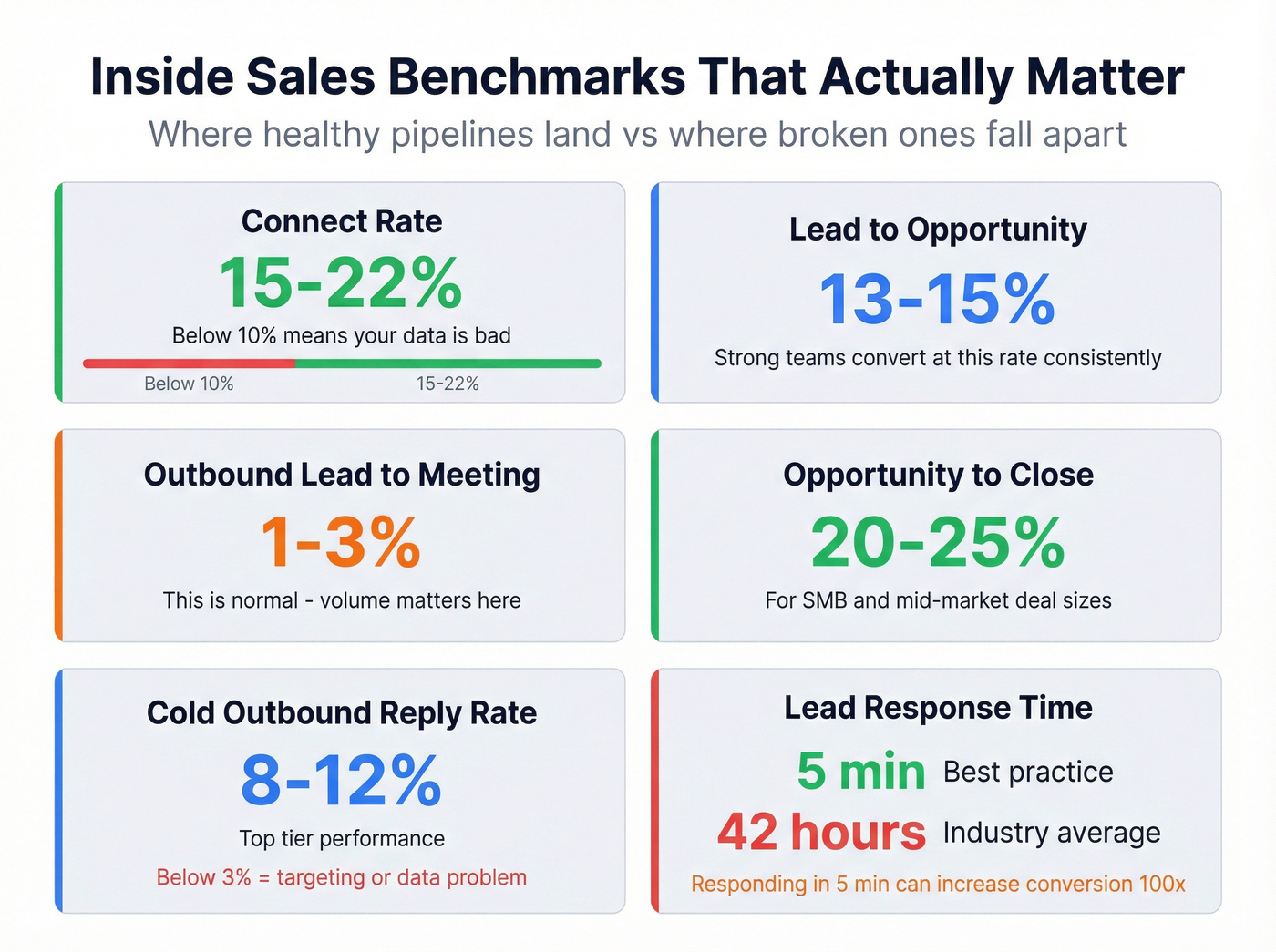
This is where you separate healthy pipelines from broken ones. Connect rate should land between 15-22% across a typical sales org - below 10% means your data is bad. Strong teams convert leads to opportunities at 13-15%, while outbound lead-to-meeting rates run 1-3%. Opportunity-to-close sits at 20-25% for smaller deals. Cold outbound reply rates of 8-12% represent top-tier performance; below 3% means your targeting, messaging, or data has a serious problem.
Efficiency Benchmarks
Cycle length: 30-90 days for most inside sales deals; mid-market SaaS often lands at 60-90 days. Pipeline coverage: Healthy reps maintain 3-4x coverage against quota. Lead response time: Contacting within 5 minutes can increase conversion up to 100x versus waiting 30 minutes. The average lead response time? 42 hours. That's not a benchmark - it's a failure mode.

You read it above: 40 calls to verified direct dials beats 100 calls to switchboards. Prospeo gives your inside sales reps 125M+ verified mobile numbers with a 30% pickup rate and 98% email accuracy - refreshed every 7 days, not every 6 weeks.
Fix your reps' data and watch qualified meetings double.
The Essential Tech Stack
Your tech stack either multiplies your effort or wastes it. Bad data and unclear process are two of the fastest ways to kill performance in any sales org.
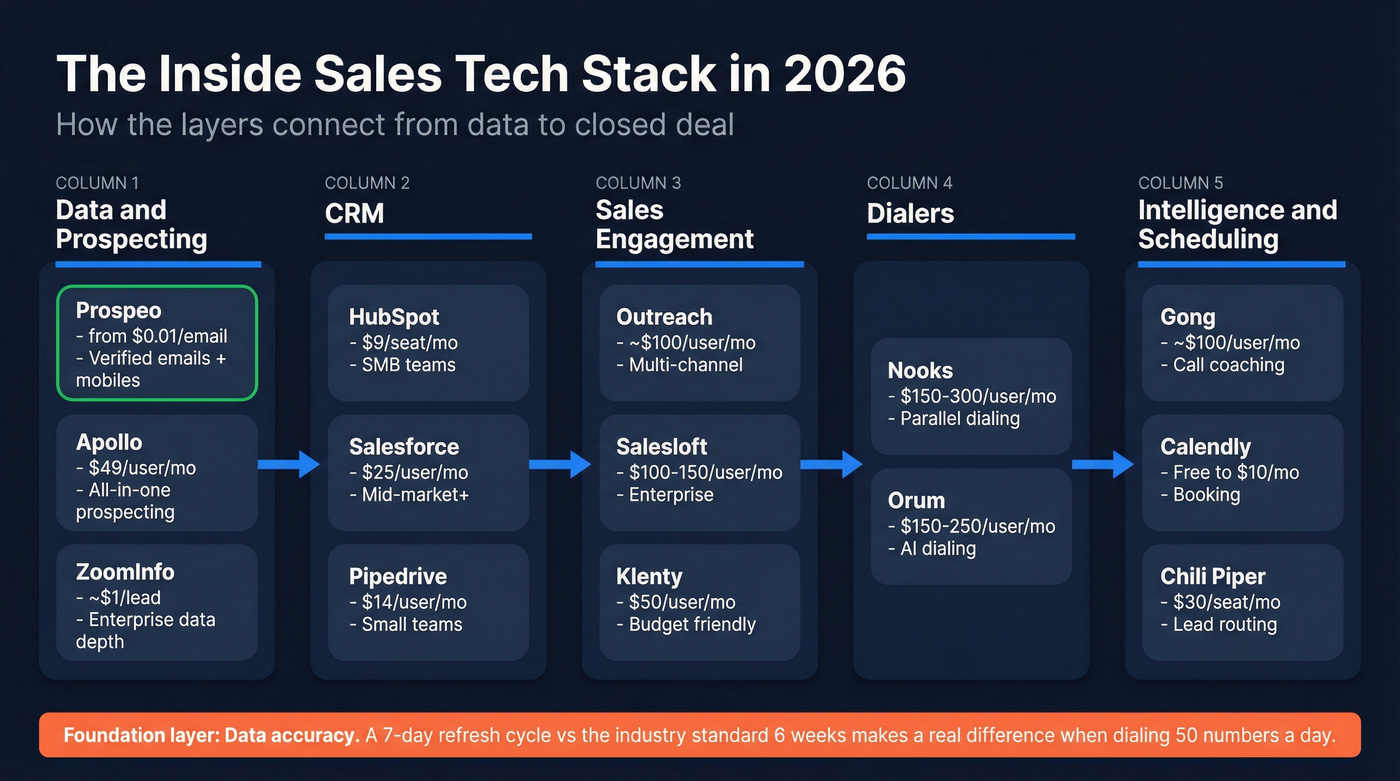
| Category | Tool | Starting Price | Best For |
|---|---|---|---|
| Data & Prospecting | Prospeo | Free; ~$0.01/email | Verified emails + mobiles |
| Data & Prospecting | Apollo | Free; $49/user/mo | All-in-one prospecting |
| Data & Prospecting | ZoomInfo | Custom; ~$1/lead | Enterprise data depth |
| CRM | HubSpot | $9/seat/mo | SMB teams, ease of use |
| CRM | Salesforce | $25/user/mo | Mid-market to enterprise |
| CRM | Pipedrive | $14/user/mo | Small teams, simplicity |
| Sales Engagement | Outreach | Custom; ~$100/user/mo | Multi-channel sequences |
| Sales Engagement | Salesloft | Custom; ~$100-150/user/mo | Enterprise workflows |
| Sales Engagement | Klenty | $50/user/mo | Budget-friendly sequences |
| Dialers | Nooks | Custom; ~$150-300/user/mo | Parallel dialing |
| Dialers | Orum | Custom; ~$150-250/user/mo | AI-powered dialing |
| Conversation Intel | Gong | Custom; ~$100/user/mo | Call coaching + analytics |
| Scheduling | Calendly | Free; $10/user/mo | Simple booking |
| Scheduling | Chili Piper | $30/seat/mo | Inbound lead routing |
We've run bake-offs where the "best database" lost because half the phone numbers were disconnected. If your connect rate is below 10%, the problem is almost certainly your data, not your pitch. Data accuracy is the foundation everything else sits on - a 7-day refresh cycle versus the industry-standard 6 weeks makes a real difference when you're dialing 50 numbers a day.

Skills That Separate Quota Crushers
Every job posting lists "excellent communication skills." That's table stakes. Here's what actually separates reps who hit quota from those who don't.
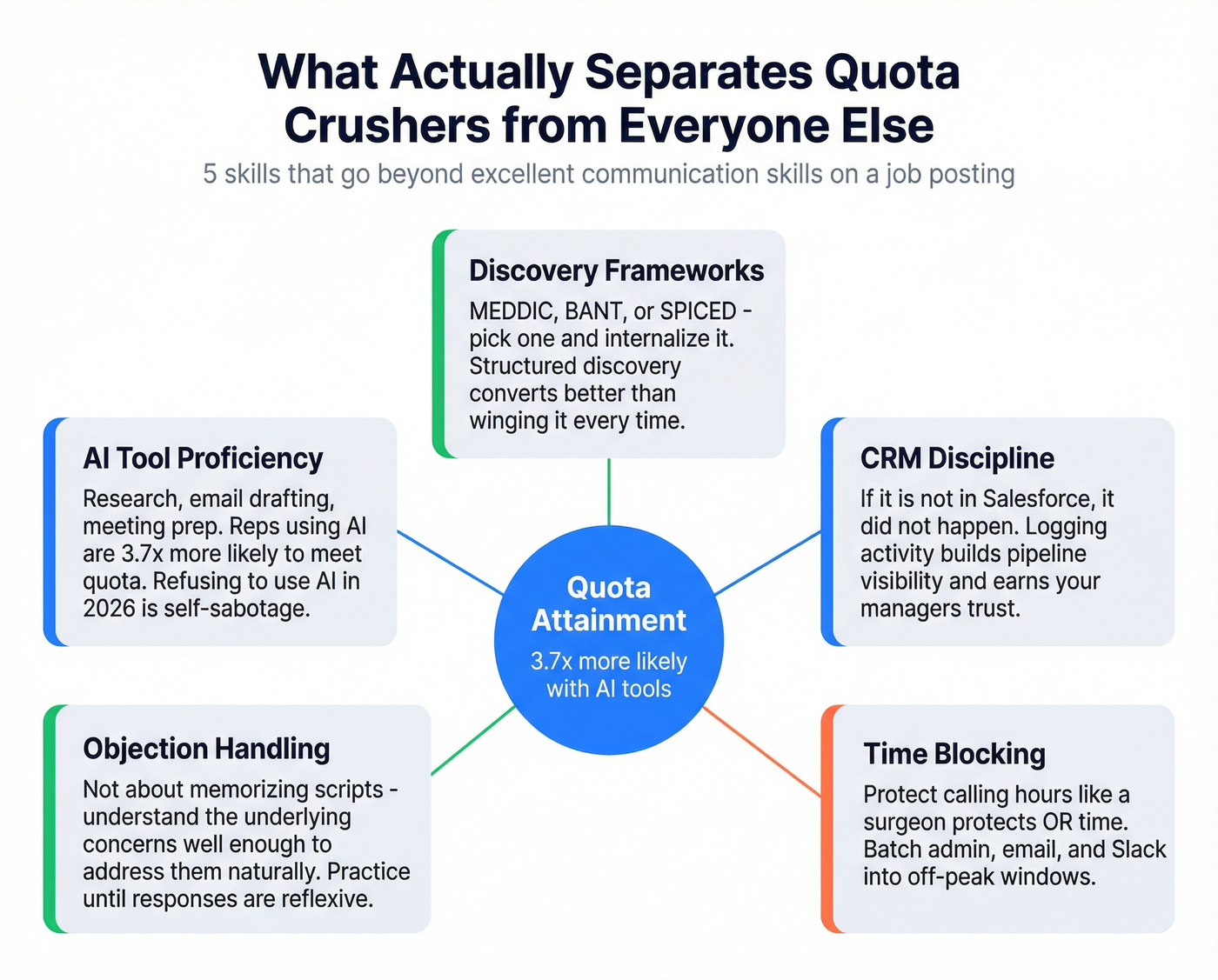
Discovery frameworks. MEDDIC, BANT, SPICED - pick one and internalize it. Reps who run structured discovery convert better than those who wing it. CRM discipline. If it's not in Salesforce, it didn't happen. Logging activity isn't busywork - it's how you build pipeline visibility and earn your manager's trust. Time blocking. The best reps protect their calling hours like surgeons protect OR time. Admin, email, and Slack get batched into off-peak windows.
Objection handling isn't about memorizing scripts - it's understanding the underlying concerns well enough to address them naturally. Practice with AI tools or peers until the responses are reflexive. AI tool proficiency is no longer optional. Reps who use AI for research, email drafting, and meeting prep are 3.7x more likely to meet quota. In 2026, refusing to use AI isn't principled - it's self-sabotage.
And one that's underrated: marketing alignment. The best reps understand how marketing generates and scores leads, so they can prioritize effectively and give feedback that improves lead quality over time.
Common Mistakes New Reps Make
Prospecting from bad lists. Bounced emails hurt your domain reputation. Dead dials waste your best calling hours. Verify contact data before it enters your CRM - fewer bounces, higher connect rates, less wasted time. If your company hands you an unverified spreadsheet, verify it yourself before you touch a single record.
Skipping discovery. Jumping straight to the pitch feels productive. It isn't.
Not logging CRM activity. Your manager can't coach what they can't see. Your pipeline reviews become guesswork. And when you get promoted, your replacement inherits chaos.
Ignoring lead response time. The average response time is 42 hours. Elite teams respond in under 5 minutes. That gap is where deals die.
Treating all leads equally. An inbound demo request from a VP at a target account isn't the same as a content download from a student. Prioritize ruthlessly. Skip the "work every lead in order" approach - it's a trap that burns your best hours on your worst prospects.
Only 44.8% of SMB AEs hit quota - and bad data is a massive reason why. Prospeo's 300M+ profiles with 30+ filters let inside sales teams target the right buyers from day one. At $0.01 per email, it costs less than a single wasted hour dialing dead leads.
Stop blaming reps for quota misses caused by stale data.
Career Path: SDR to CRO
Inside sales has one of the clearest career ladders in business. A team lead role often serves as the first step into management, bridging the gap between individual contribution and people leadership.
| Stage | Typical Timeline | Median OTE | What Changes |
|---|---|---|---|
| SDR/BDR | 12-18 months | $85,000 | Pipeline generation, outreach |
| SMB AE | 2-3 years | $130,000 | Full-cycle closing, $5K-$50K deals |
| Mid-Market AE | 2-3 years | $175,000 | Larger accounts, longer cycles |
| Enterprise AE | 2-4 years | $265,000 | 6-12 month cycles, $100K+ deals |
| Sales Manager | Varies | $180K-$250K | Coaching, forecasting, hiring |
| VP Sales to CRO | Varies | $300K-$500K+ | Strategy, org design, board reporting |
The SDR-to-AE jump is the critical inflection point. It typically happens after 12-18 months of consistently hitting pipeline targets. The reps who get promoted fastest aren't just the ones booking the most meetings - they're the ones who demonstrate deal sense, ask smart questions during ride-alongs, and show they understand the full SaaS sales process.
Let's be honest about something: if your average deal is under $15K, you probably don't need an enterprise data platform or a 14-tool tech stack. A CRM, a verified data source, and a sequencer will get you to $1M ARR faster than a bloated stack with six overlapping tools. Complexity is the enemy of early-stage sales velocity. A five-person team closing $8K deals shouldn't mimic the playbook of a squad running $500K enterprise cycles.
The 35% annual turnover in sales means companies that don't offer clear career paths lose their best people to companies that do. If your org doesn't have a defined promotion timeline, ask for one. If they can't articulate it, that tells you something.
How AI Is Reshaping the Role in 2026
AI isn't replacing inside sales reps. It's replacing the ones who refuse to use it.
81% of sales teams have implemented or are experimenting with AI, and teams using it are 1.3x more likely to see revenue growth. The AI SDR market alone is projected to hit $15B by 2030.
What AI actually does for reps today: it summarizes account history and contact insights before every call, drafts signal-personalized outreach that hits 15-25% reply rates versus 3-5% for generic cold email, automates sequences that adapt based on prospect engagement, and generates pipeline reports in seconds instead of hours. AI role-play tools also let reps rehearse tough objections without burning real prospects. For international teams working across time zones, AI-powered scheduling and localized messaging make it far easier to run multi-region outreach without ballooning headcount.
The pattern we see repeatedly: reps who adopt AI tools early don't just hit quota more often - they get promoted faster because they have more time for the high-judgment work that managers notice.
FAQ
What's the difference between inside sales and outside sales?
Inside sales reps sell remotely using phone, email, and video. Outside sales reps meet prospects in person, travel to client sites, and attend events. Inside sales typically runs shorter cycles (30-90 days), while outside sales focuses on larger deals with longer, more relationship-heavy cycles.
How much do inside sales reps make in 2026?
Median OTE ranges from $85,000 for SDR/BDR roles to $265,000 for Enterprise AEs, based on RepVue's 2026 compensation data. Glassdoor puts the overall median total pay at $102,000. Top performers at the enterprise level exceed $600K.
What tools do inside sales reps need?
Three essentials: a CRM like HubSpot or Salesforce, a verified data platform for accurate emails and direct dials, and a sales engagement tool like Outreach or Salesloft for multi-touch sequences. Add a dialer and conversation intelligence as your team scales.
How long does it take to go from SDR to AE?
Typically 12-18 months of consistently hitting pipeline targets. The fastest path involves demonstrating deal sense beyond just booking meetings - asking smart discovery questions, understanding the full sales cycle, and building relationships with AEs who can advocate for your promotion.
Is inside sales a good career in 2026?
Yes. The BLS projects 1.8 million sales job openings annually, and AI is a tailwind rather than a threat, automating admin work while amplifying the human skills that close deals. The comp ceiling is high ($265K+ OTE at enterprise level), the career path is clear, and remote flexibility is standard.