Cold Calling Quality vs Quantity: What 90,000+ Calls Actually Prove
The average cold call success rate dropped from 4.82% to 2.3% in a single year. Meanwhile, 72% of cold calls never reach a human. If you're still treating the cold calling quality vs quantity debate as an either-or choice, you're asking the wrong question - and the data proves it.
The Short Answer
It's a false binary. Data from 90,000+ cold calls shows specific quality levers that 2-3x your booking rate - but only if your contact data is accurate enough to reach the right person in the first place. Fix your data, apply the 5-minute research rule, then dial with intensity.
Why Volume Alone Fails
Let's start with the raw numbers, because they're humbling. Bridge Group benchmarks show it takes 209 calls to book a single appointment. The average inside sales rep makes 33 calls per day and has 6.6 actual conversations. Baylor University puts it at 7.5 hours of dialing per appointment.
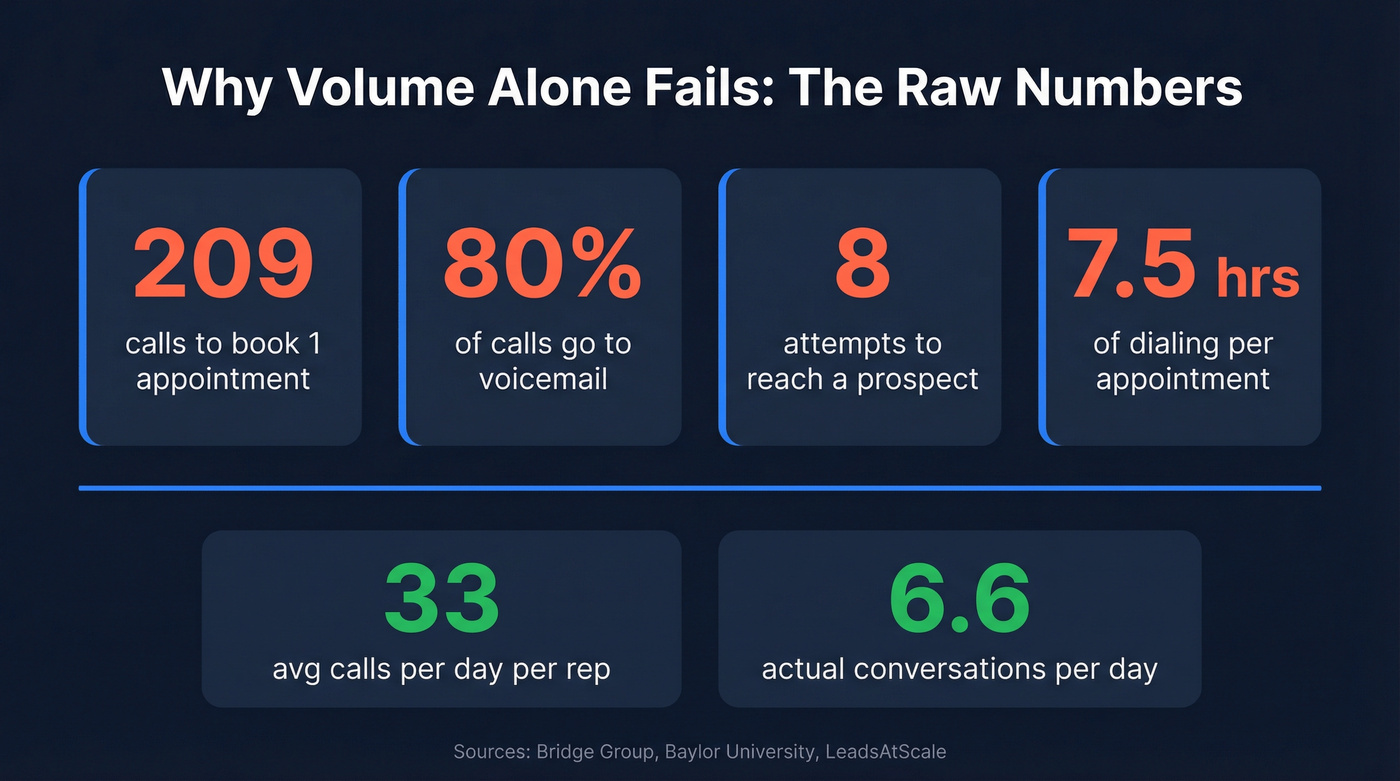
The friction is brutal. 80% of cold calls go to voicemail. It takes an average of 8 attempts just to reach a prospect. That means most of your "calling time" isn't calling at all - it's listening to rings, leaving messages, and updating dispositions in your CRM.
None of this means volume doesn't matter. It means volume alone is punishingly inefficient. The teams that hit quota aren't choosing between quality and quantity - they're stacking quality levers on top of disciplined volume. We've talked to enough SDR leaders to know the pattern: high-volume dialers who don't personalize burn out fast, but low-volume "researchers" who make 15 perfect calls a day never build enough pipeline either. The best teams refuse to pick a side.
Quality Levers That Actually Move the Needle
An analysis of 90,380 cold calls by Gong found that small changes in the first 10 seconds create massive outcome swings. The opener "How have you been?" produced a 10.01% success rate - 6.6x the baseline in that dataset. Asking "Did I catch you at a bad time?" dropped success to 0.9%, making you 40% less likely to book a meeting. Simply stating "the reason for my call is..." lifted success rates by 2.1x.
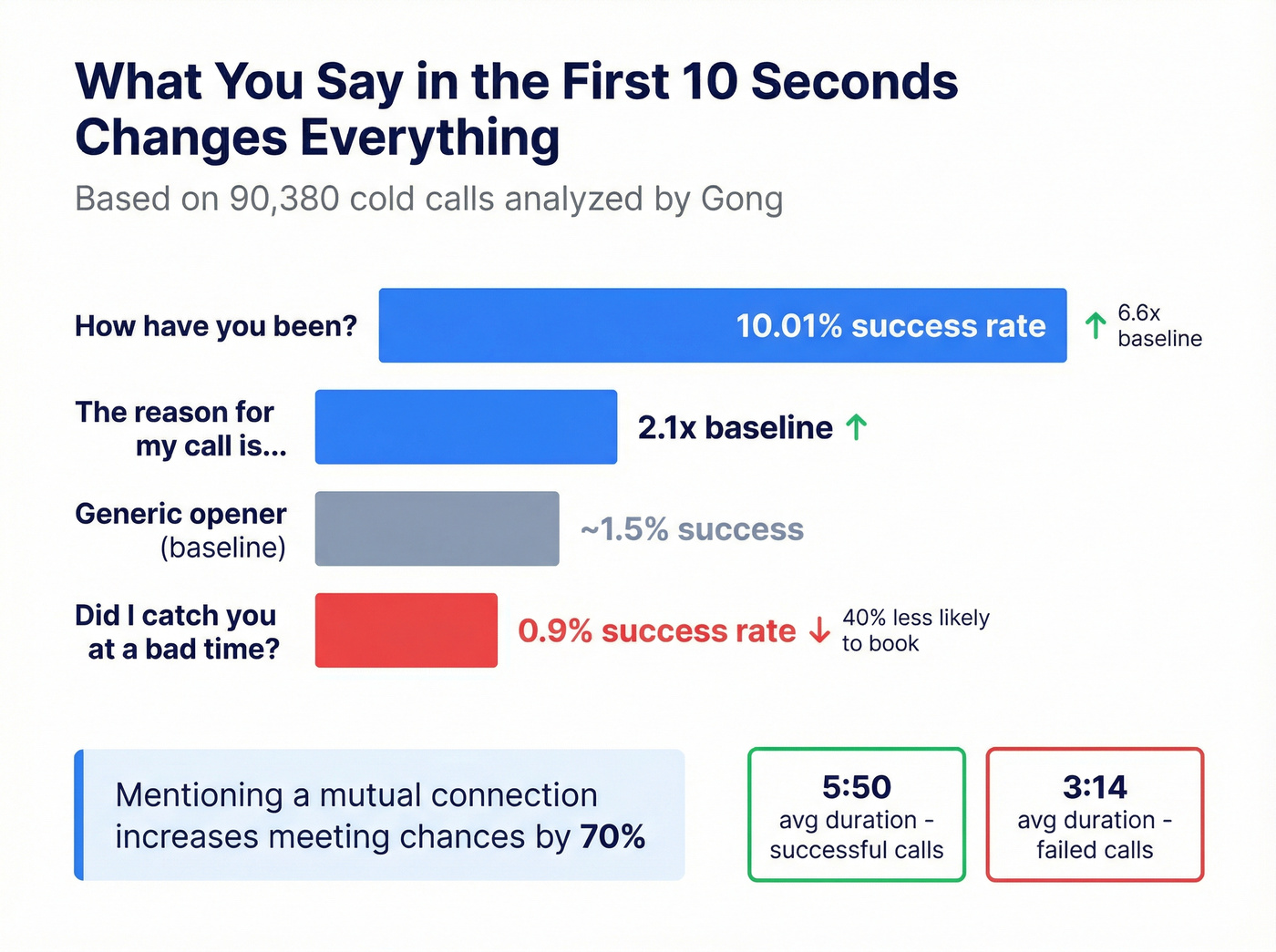
Here's the single highest-leverage quality move almost nobody does systematically: mentioning a mutual connection increases meeting chances by 70%, according to Sales Insights Lab.
Duration tells a story too. Successful cold calls in the same Gong dataset averaged 5:50 in length. Failed ones averaged 3:14. That extra two and a half minutes is where discovery happens - where you earn the meeting instead of pitching into a void.
The practical framework that balances personalization with throughput is the 5-minute research rule: scan for recent company news, confirm the prospect's role, and find one personalization hook. That's it. You're not building a dossier - you're finding one sentence that proves you didn't pull their name from a random spreadsheet. For high-value accounts, expand this into a one-page prep sheet with attendee names, likely use cases, primary questions, and possible objections. Then run a tight 3-minute call structure: intro with value, one or two qualifying questions, propose the meeting.
Quality doesn't end when the call does. Send a relevant article within the hour, reference a competitor's recent move, or loop in another stakeholder to keep momentum. The follow-up is where most reps drop the ball.

Every quality lever in this article - your opener, your research, your call structure - compounds on one thing: actually reaching the right person. Prospeo's 125M+ verified mobile numbers refresh every 7 days, not every 6 weeks. Teams using Prospeo see connect rates triple to 20-25%.
Stop perfecting your script for numbers that don't connect.
The Variable Nobody Talks About: Data
Every article about this debate obsesses over scripts and openers. Almost none address the variable that determines whether your call even connects: data quality.
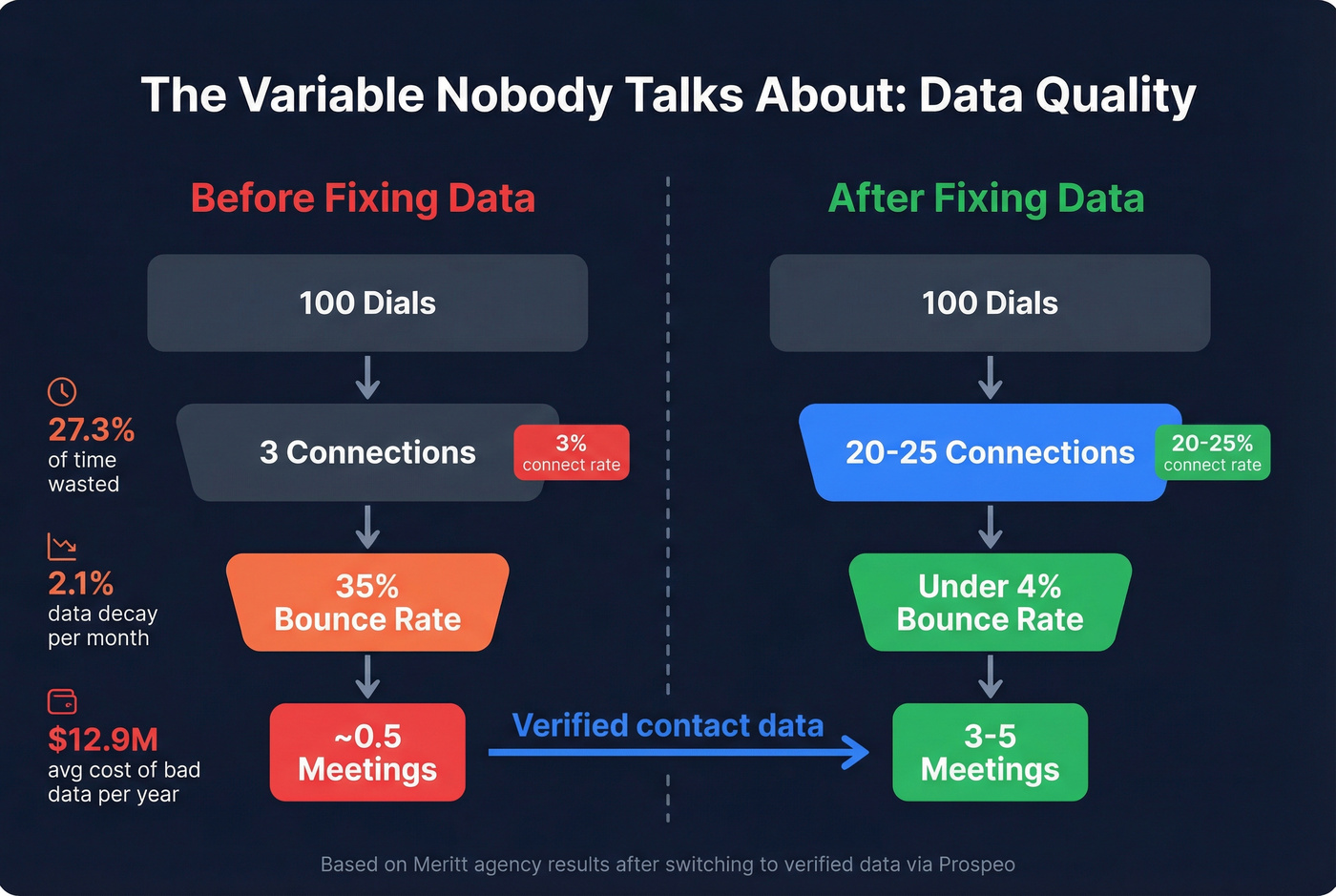
Reps lose 27.3% of their productive time to bad contact data. B2B data decays at roughly 2.1% per month - that's ~22.5% of your list going stale every year. The financial toll is staggering: the average cost of bad data runs $12.9M/year across organizations, and 62% of companies are working with lists that are 20-40% incomplete or inaccurate.
You can have the perfect opener, the perfect script, and the perfect cadence. None of it matters if you're dialing a number that belongs to someone who left the company six months ago.
This is where the math changes. Meritt, an outbound agency, saw their connect rate triple to 20-25% and their bounce rate drop from 35% to under 4% after switching to verified contact data through Prospeo. We've seen this pattern repeatedly: teams assume they have a script problem when they actually have a data problem. When your connect rate jumps from 3% to 12%, every other optimization - your opener, your research, your call structure - compounds on a larger base.

Reps lose 27% of their time to bad data. At $0.01 per email and 10 credits per verified mobile, Prospeo costs less than a single wasted hour of dialing dead numbers. 98% email accuracy, 30% mobile pickup rate, 7-day refresh cycle.
Fix your data before you fix your script - start free with 75 credits.
How to Measure Call Quality
Tracking dials per day without tracking quality metrics is like measuring a runner's stride count without timing the race. Here's the scorecard that actually tells you whether your team is improving:
| Metric | Formula | Healthy Benchmark |
|---|---|---|
| Conversation Rate | Conversations / Dials | 8-15% |
| Meeting Conversion | Meetings / Conversations | 15-30% |
| Talk-to-Listen Ratio | SDR talk time % | 45-55% |
| Avg Call Duration | Talk time / connected calls | ~5:50 (successful calls) |
| List Penetration | Contacts dialed / total list | Track weekly |
| Call-to-Connection | Connections / dials x 100 | Varies by data quality |
Conversation rate is your single best diagnostic metric. Below 8%? The problem is almost certainly data quality or targeting - not your script. Meeting conversion between 15-30% separates strong outbound teams from average ones.
Watch the talk-to-listen ratio closely. If your reps are talking 70%+ of the call, they're pitching, not qualifying. The 45-55% range means they're asking questions and actually listening to the answers. And list penetration is the metric most teams ignore entirely - if you're only dialing 30% of your list before refreshing, you're wasting the other 70%. Track it weekly and hold reps accountable to working their full territory.
Hot take from our team: If your average deal size is under $10k, you probably don't need a $20k/year sales engagement platform. You need clean data, a $30/month dialer, and a rep who can hold a conversation. The tooling arms race is a distraction for most SMB teams.
Tools That Change the Math
The sales engagement platform market hit $7.22B in 2025, and 56% of sales professionals now use AI daily - those who do are 2x more likely to exceed targets. The cold calling stack breaks into three layers, and you need all three working together.
Data layer. This is the foundation. Garbage data makes everything downstream worse. In our experience, fixing the data layer alone - before touching scripts or dialers - is the highest-ROI move a team can make. Prospeo fits here with 125M+ verified mobile numbers at a 30% pickup rate, refreshed every 7 days. At ~$0.01 per verified email and 10 credits per mobile number, you can test it on the free tier before committing budget.
Dialer layer. Parallel and AI dialers can 3-5x your live conversations per hour, pushing talk time from 10-15 minutes/hour to 40-50 minutes. Local presence numbers boost pickups by 15-40%. For teams running fewer than 50 dials a day, a simple click-to-call setup works fine - skip this if you're a small team that doesn't need the overhead.
Coaching layer. Conversation intelligence tools let you audit what's actually happening on calls and coach to the quality metrics in your scorecard. This is where Gong's 90,380-call dataset came from - recorded calls analyzed at scale. If you want a lightweight alternative to start, build a cold call coaching routine around a scorecard and weekly call reviews.
| Tool Category | Examples | Starting Price |
|---|---|---|
| SMB Dialers | Aircall, JustCall, Dialpad | $25-$30/user/mo |
| Mid-Market Dialers | PhoneBurner, Nextiva | ~$30-$140/user/mo |
| Parallel Dialers | Orum (3-seat min) | ~$250/user/mo |
| Enterprise SEPs | Salesloft, Outreach | $20k+/year |
| Conversation Intel | Gong | ~$100-$150/user/mo |
The Quality + Quantity Playbook
- Verify your list first. If your connect rate is below 8%, the problem is data, not your script. Clean the list before optimizing anything else. If you need a deeper benchmark-driven view, see our guide on B2B contact data decay.
- Apply the 5-minute research rule. Company news, role confirmation, one personalization hook. No more, no less. Use a pre call research checklist if your team needs consistency.
- Use the 3-minute call structure. Intro with value, one or two qualifying questions, propose the meeting. Don't monologue. Keep a bank of cold call qualifying questions so reps don’t default to pitching.
- Track quality KPIs alongside volume. Conversation rate, meeting conversion, and talk-to-listen ratio belong on the same dashboard as dials per day. If you want the full system, start with our B2B cold calling guide.
- Match your dialer to your volume. Under 50 dials/day? Click-to-call is fine. Over 100? A parallel dialer pays for itself in the first week.
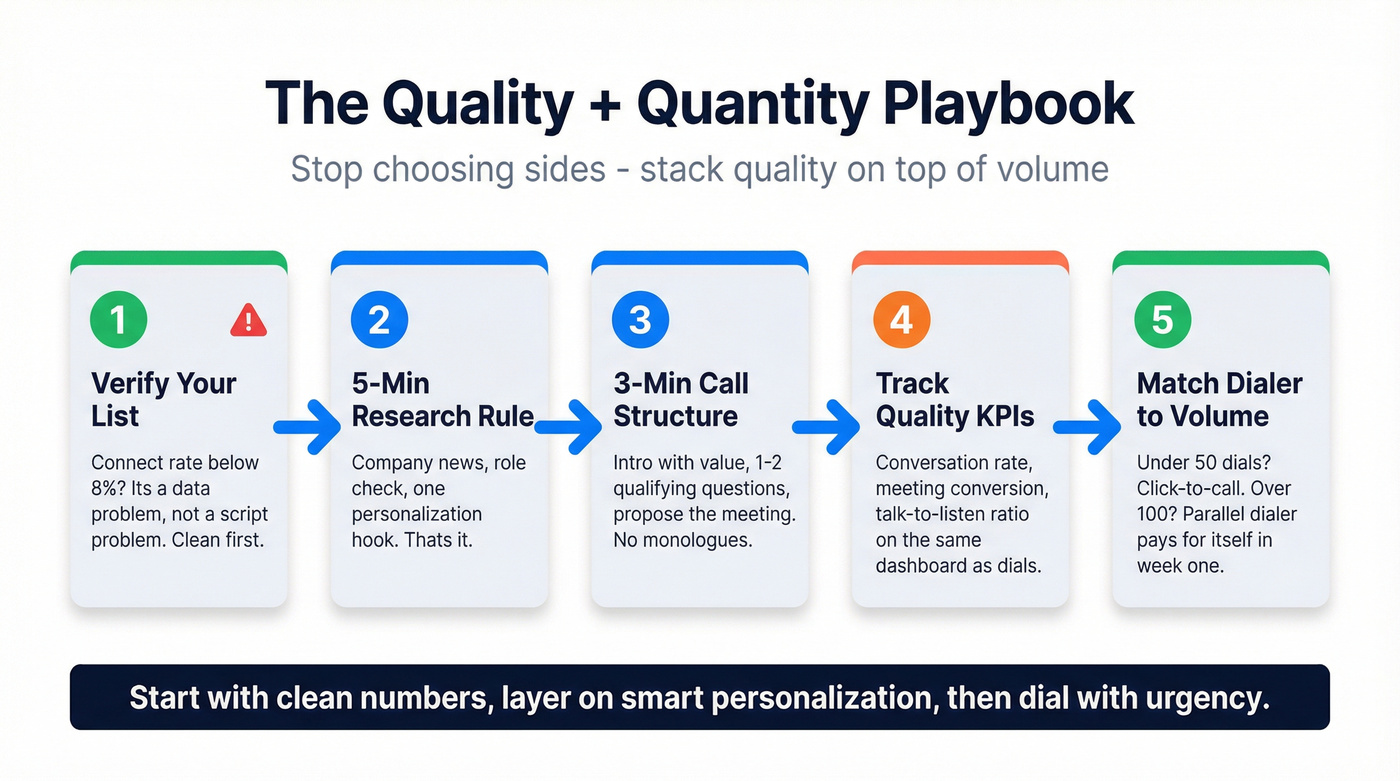
The cold calling quality vs quantity question isn't one you answer once. It's a balance you recalibrate as your data, team, and market shift. Start with clean numbers, layer on smart personalization, then dial with urgency.
FAQ
How many cold calls should an SDR make per day?
Bridge Group benchmarks put the average at 33 calls per day for inside sales reps. High-volume teams running parallel dialers push 100-200+. The right number depends on your data quality and connect rate - 50 well-targeted dials with a 12% connect rate outperform 150 dials at 3%.
What's a good cold call conversion rate?
The industry average sits at roughly 2.3%. Strong teams with optimized openers and clean contact data see 6-10%. For conversation-to-meeting conversion specifically, 15-30% is the benchmark for well-run outbound teams.
How do you improve cold call quality without sacrificing volume?
Start with verified contact data - that alone eliminates the 27% time waste from bad numbers and outdated records. Layer on the 5-minute research rule for personalization, then use a parallel dialer to maintain volume. The consensus on r/sales is that data quality is the most underrated variable in cold calling, and we'd agree.
Does cold calling still work in 2026?
Yes - 82% of buyers accept meetings from cold outreach when the timing and relevance align. The 2.3% average success rate is low, but teams combining verified direct dials, personalized openers, and disciplined follow-up consistently hit 6-10% booking rates. The channel works. Lazy execution doesn't.