Sales Prospecting: The Practitioner's Guide for 2026
84% of reps missed quota last year. Not because they can't sell - because they're prospecting with bad data, inconsistent cadences, and a process that hasn't been updated since 2022. Prospecting isn't complicated. It's just hard to do consistently with clean data and real discipline.
Sales Prospecting 101: What You Need
Prospecting is finding and engaging buyers who fit your ICP - it's sales-owned, not marketing-owned. Marketing fills the top of funnel with leads. You turn those leads into qualified conversations and pipeline. That distinction matters because it determines who's accountable when pipeline dries up.
Three things actually move the needle: clean data, a multi-channel cadence, and follow-up discipline. Everything else - the AI tools, the fancy sequences, the intent signals - is optimization on top of those three fundamentals. Get those wrong and no amount of tooling saves you.
If you only do one thing after reading this, audit your data. Pull your last 1,000 outbound emails and check the bounce rate. If it's above 5%, stop and fix that before you touch your messaging. A 15% bounce rate doesn't just waste rep time - it torches your domain reputation and tanks deliverability for every email you send after.
What Is Sales Prospecting?
Sales prospecting is the process of identifying potential buyers who match your ideal customer profile and initiating contact to start a sales conversation. The meaning comes down to one thing: finding the right people and starting a conversation about a problem you can solve. It's the first real step in any outbound sales cycle - before discovery calls, before demos, before proposals. Without it, your pipeline is whatever marketing hands you, and that's rarely enough.
The key word is "fit." This isn't blasting 10,000 emails to a purchased list. It's finding the 200 people at companies that look like your best customers, who hold the right titles, and who might actually have the problem you solve. The more precise your targeting, the higher your conversion at every stage downstream.
Prospect vs. Lead
A lead is anyone who's entered your orbit - downloaded a whitepaper, visited your pricing page, got scraped into a database. They haven't been qualified. A prospect is a lead you've confirmed fits your ICP and is worth pursuing. Every prospect was once a lead, but most leads never become prospects. The distinction matters because treating unqualified leads like prospects wastes the most expensive resource in your org: rep time.
Prospecting vs. Lead Generation
These terms get used interchangeably, and it causes real confusion in planning meetings. They're different activities owned by different teams.
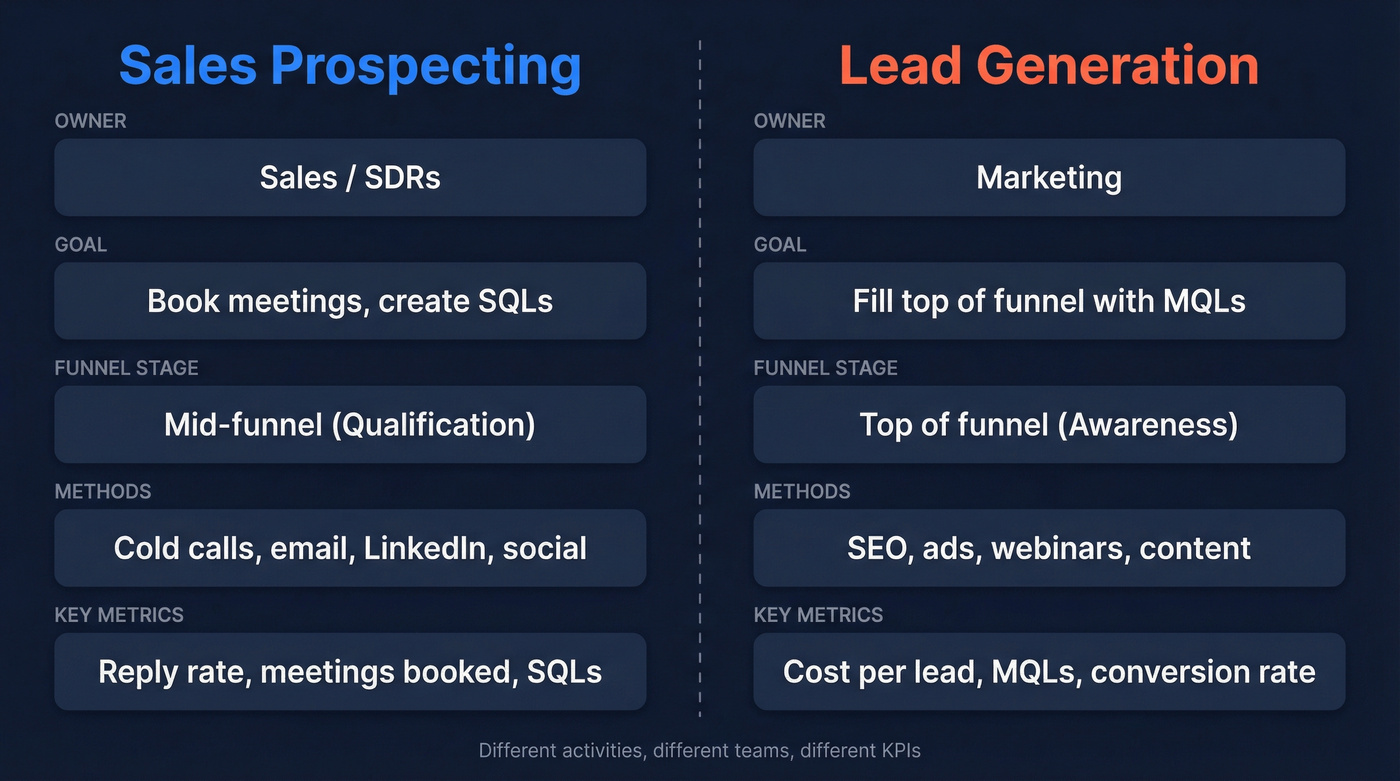
| Prospecting | Lead Generation | |
|---|---|---|
| Owner | Sales / SDRs | Marketing |
| Goal | Book meetings, create SQLs | Fill top of funnel with MQLs |
| Funnel stage | Mid-funnel (qualification) | Top of funnel (awareness) |
| Methods | Cold calls, email, social | SEO, ads, webinars, content |
| KPIs | Reply rate, meetings, SQLs | CPL, MQLs, conversion rate |
Focus on lead gen when you're entering new markets or your pipeline is thin and you need volume. Focus on outbound outreach when you've got a database of contacts, you're running ABM, or you need faster qualification and shorter time-to-meeting.
What's Changed in 2026
The buying environment has shifted dramatically. Gartner projected that 80% of B2B sales interactions would happen through digital channels by 2025 - and the data suggests they were right. Buyers now use an average of 10 interaction channels during a purchase, up from 5 in 2016. They're doing more homework on their own, talking to reps less, and expecting every touchpoint to be relevant.
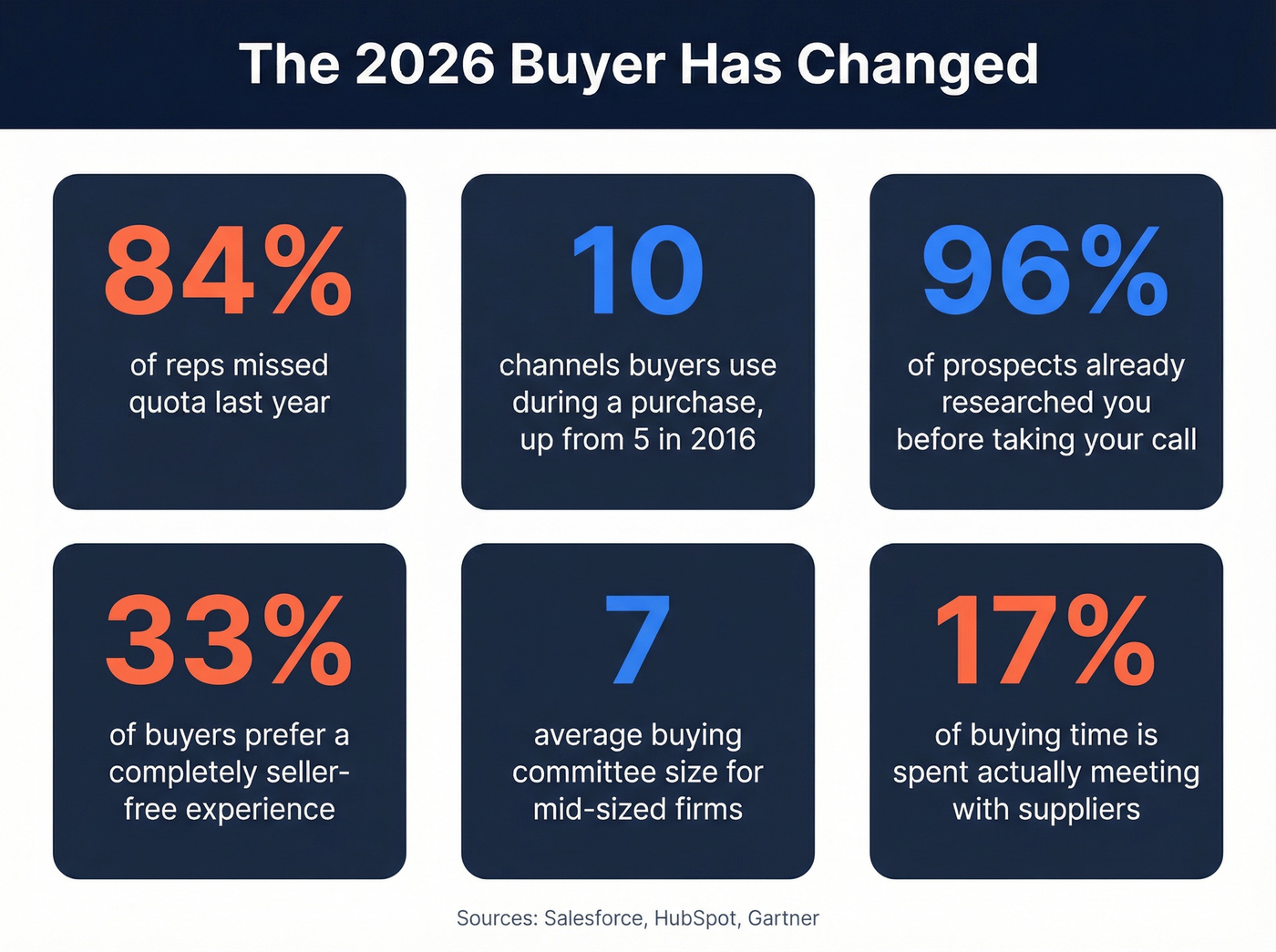
Here's the thing: 33% of all buyers prefer a completely seller-free experience. For millennial buyers, that number jumps to 44%. They spend only 17% of their buying time actually meeting with suppliers. By the time a prospect takes your call, 96% have already researched your company and your competitors.
Buying committees have expanded to an average of 7 people for mid-sized firms. Your single-threaded outreach to the VP of Sales might land a meeting, but it won't close a deal. You need to multi-thread across the committee - and that starts during initial outreach, not in the deal cycle. Companies committed to hybrid sales models are seeing up to 50% higher revenue growth, which is why 90% of B2B orgs plan to keep them.
The quota crisis is real. 84% of reps missed quota last year. 67% don't expect to hit it this year. And 89% of B2B buyers report at least one deal stalling in the past year, often due to budget freezes. The reps who are still hitting number aren't doing anything magical - they're working with better data, more channels, and more persistence than everyone else.
Who Owns Prospecting?
The traditional model is straightforward: SDRs prospect, qualify, and book meetings. AEs run discovery, demo, and close. In practice, it's messier.
Budget tightening through 2024 and 2025 pushed many orgs to scale back SDR teams and shift outbound responsibility onto AEs. If you're at a company with fewer than 50 reps, there's a good chance your AEs are doing their own outreach - and resenting it, because nobody trained them for it and their comp plan doesn't reward the activity.
At startups, founders and C-suite often prospect directly. This actually works well early on because founders can speak to the problem with an authenticity that no SDR script can replicate. The challenge is that it doesn't scale past the first 20-30 customers.
The right model depends on your deal size and sales cycle. For teams selling deals under five figures with a 30-day cycle, AE-led outreach with light SDR support works. For enterprise deals with 6+ month cycles, dedicated SDRs are worth the investment because the motion is complex enough to be a full-time job. For anything in between, a hybrid model where SDRs handle initial outreach and AEs take over after the first meeting is the most common setup we see working.

You just read it: if your bounce rate is above 5%, fix your data before touching your messaging. Prospeo delivers 98% email accuracy through 5-step verification, catches catch-all domains, and refreshes every 7 days - not 6 weeks. At $0.01 per email, cleaning up your prospecting foundation costs less than one bounced sequence costs your domain.
Stop prospecting on stale data. Start with emails that actually land.
The Prospecting Process in 7 Steps
1. Define your ICP. Start with your best 20 customers. What do they have in common? Industry, headcount, tech stack, funding stage, growth rate. Your ICP isn't a persona document that sits in a Google Drive - it's a set of filters you can actually apply to a database.
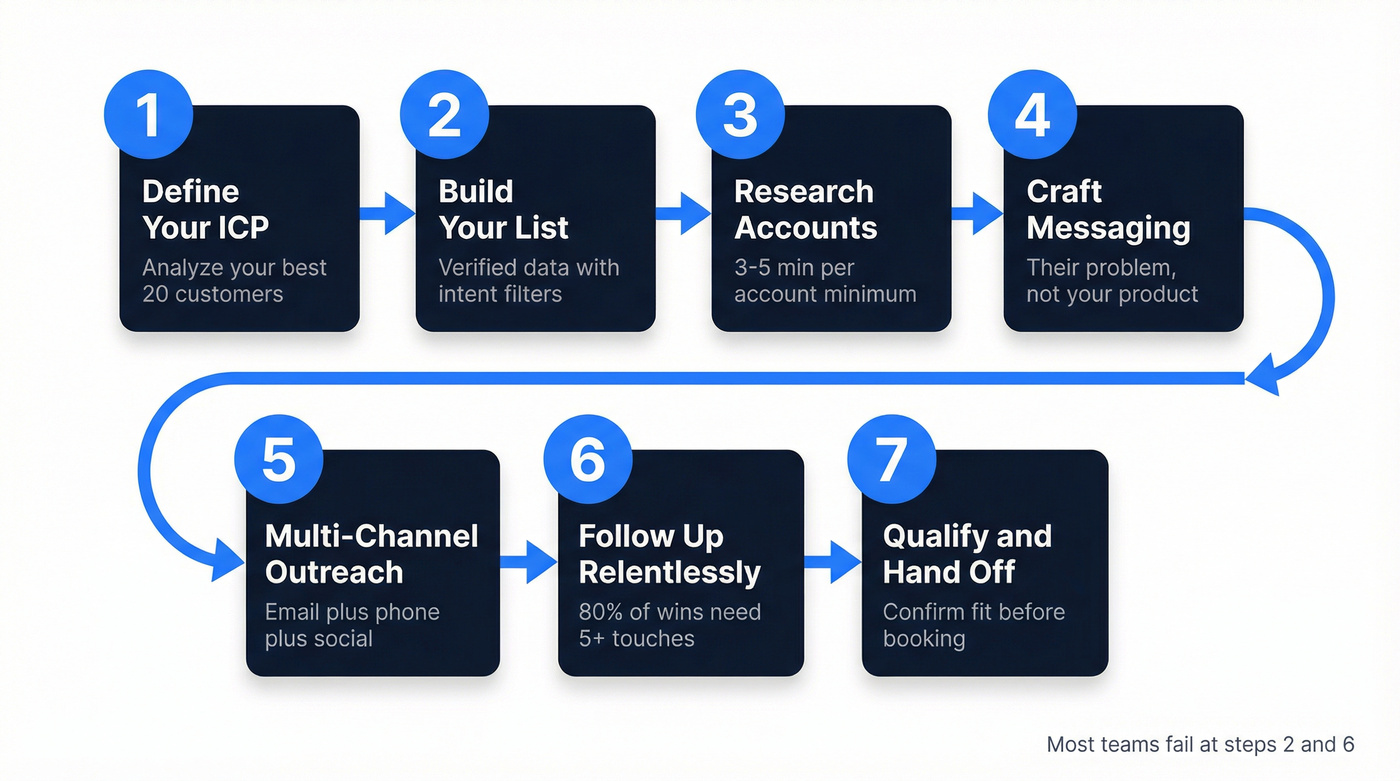
2. Build your list. This is where most teams already go wrong. They export a stale CSV from a database they haven't updated in months, or they pull contacts without verifying emails or phones. Use a verified data provider with intent and technographic filters. The list is the foundation; everything downstream depends on it.
3. Research accounts. Spend 3-5 minutes per account before outreach. Check recent funding, leadership changes, job postings that signal priorities, and tech stack. This isn't optional - 81% of prospects research you before they'll take a meeting. The least you can do is return the favor.
4. Craft your messaging. Your first email or call isn't about your product. It's about their problem. Reference something specific - a job posting, a recent expansion, a competitor they're losing to. Generic "I help companies like yours" messaging gets deleted.
5. Execute multi-channel outreach. Don't rely on email alone. Combine email, phone, and social touches in a structured cadence. The exact template is in the next section.
6. Follow up relentlessly. 80% of successful sales require 5+ follow-ups. Yet 48% of reps never follow up at all. This is the single easiest competitive advantage - just keep showing up. (If you want a system, start with a follow-up cadence.)
7. Qualify and hand off. Once a prospect engages, qualify them against your ICP criteria and budget/timeline before booking a meeting. A bad meeting wastes everyone's time.
Outbound Methods With 2026 Benchmarks
Cold Calling
Cold calling isn't dead - it's just harder than it used to be, and the variance between average and top teams is enormous.
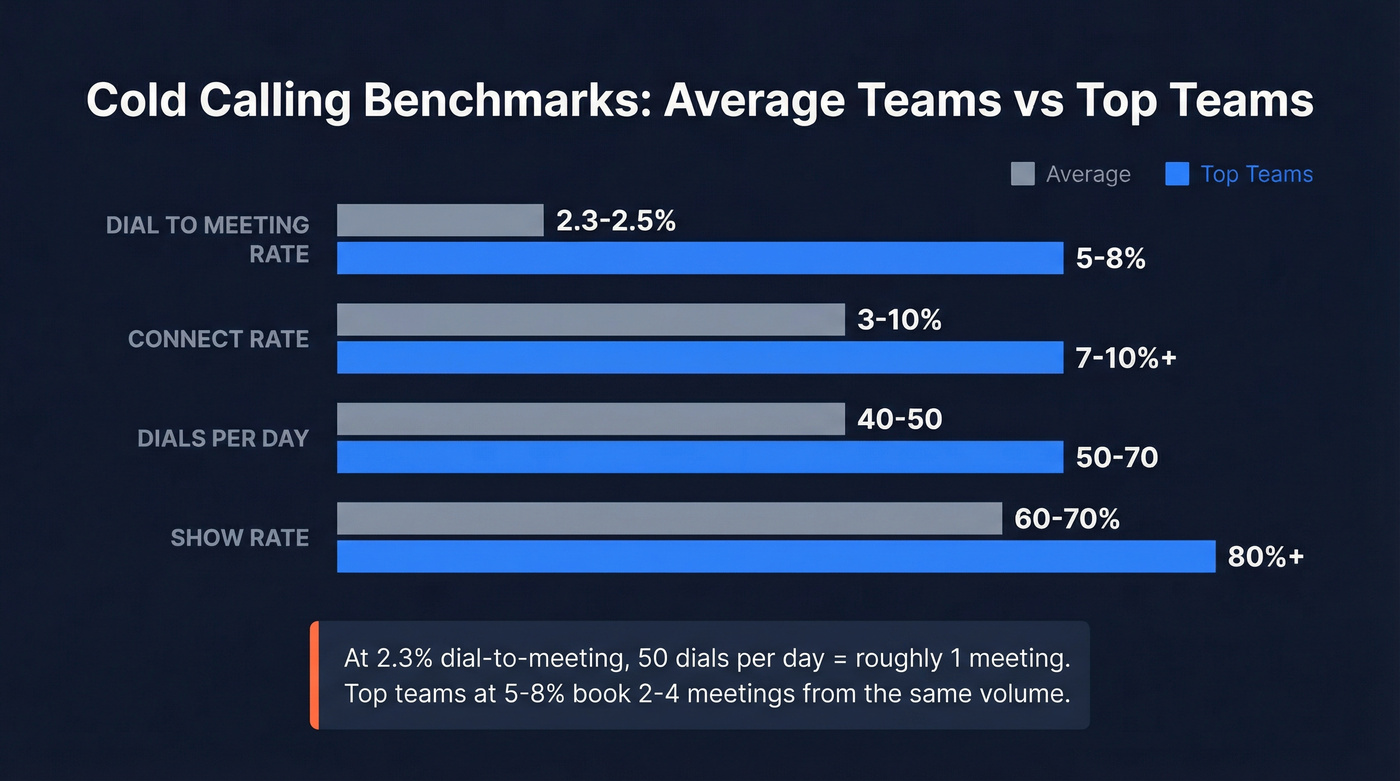
| Metric | Average | Top Teams |
|---|---|---|
| Dial-to-meeting | 2.3-2.5% | 5-8%+ |
| Connect rate | 3-10% | 7-10%+ |
| Dials per day | 40-50 | 50-70 |
| Show rate | 60-70% | 80%+ |
| Attempts to reach | 8+ | 8+ (they just don't quit) |
The best calling windows are 8-9am and 4-5pm in the prospect's time zone, which can lift connect rates 40-70% compared to random dialing. That's not a marginal improvement - it's the difference between 3 connects per day and 5-6.
At a 2.3% dial-to-meeting rate, an SDR making 50 dials per day books roughly one meeting per day. Top teams hitting 5-8% are booking 2-4 meetings daily from the same activity volume. The gap comes down to three things: data quality (are you calling real direct dials?), timing, and the first 15 seconds of the call. 25% of sales pros say getting direct contact info for decision-makers is a top challenge - which is why verified mobile numbers matter more than database size.
Cold Email
Cold email is getting harder. 69% of senders report year-over-year performance declines due to tighter spam filtering and AI-generated email fatigue. Inboxes are noisier than ever, and providers like Google and Microsoft are aggressively filtering bulk senders.
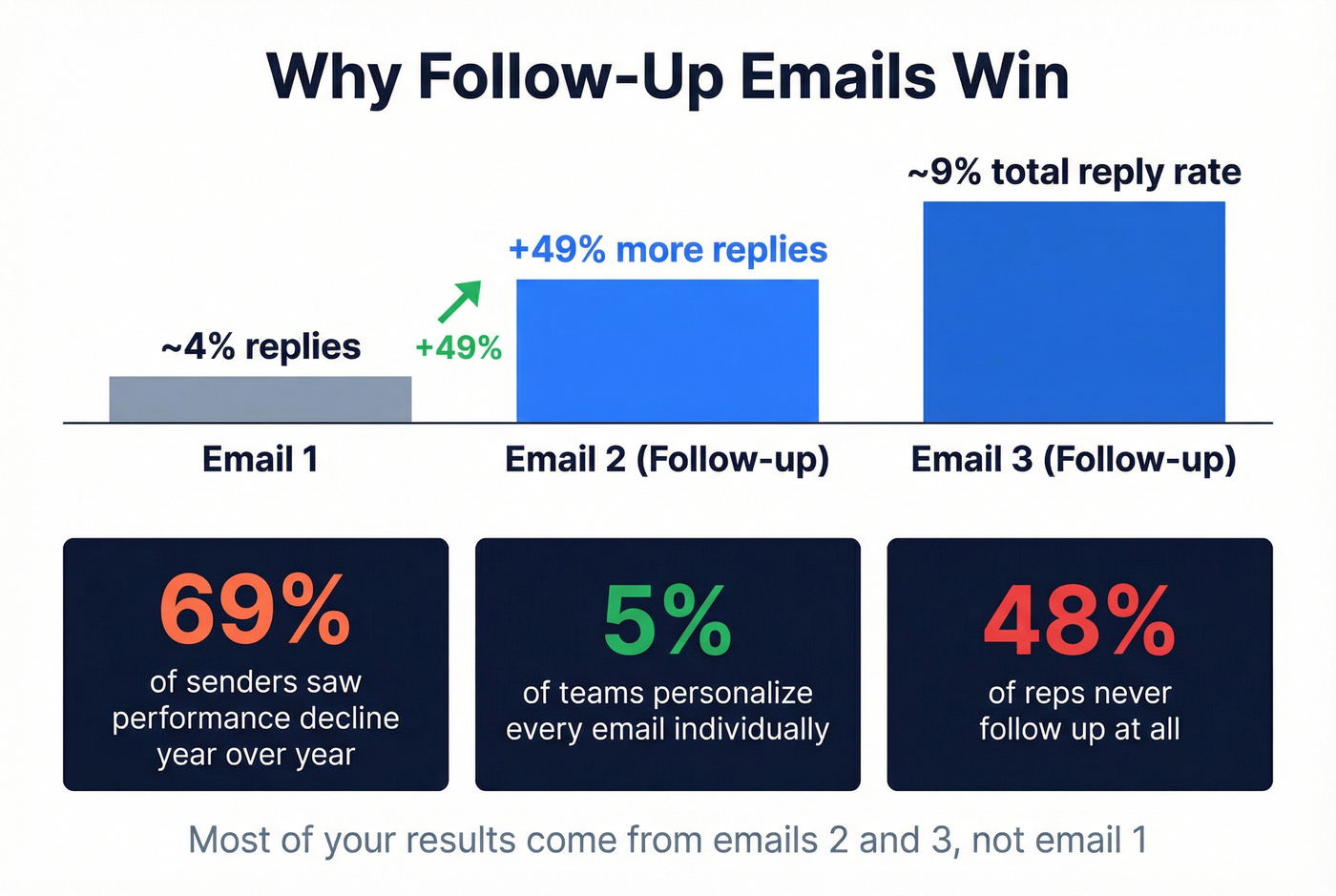
Only 5% of sales teams personalize every email individually. The rest send variations of the same template with a {first_name} merge field and wonder why reply rates are flat.
A 3-round cold email campaign averages about a 9% reply rate. The first follow-up alone increases replies by 49%, which means most of your results come from emails two and three, not email one. The teams hitting 12-15% reply rates do three things differently: they send from domains with clean reputations, they use verified data with under 2% bounce rates, and they write emails that reference something specific about the prospect's business. None of that is revolutionary. It's just work that most teams skip.
Cold Email Deliverability Checklist
Before you send a single cold email, make sure you've checked every box:
- SPF, DKIM, and DMARC - all three are mandatory. Not optional. If you're missing any of these, your emails are going to spam. (If you need the setup steps, use this SPF, DKIM, DMARC guide.)
- One-click unsubscribe header (RFC 8058) - required for bulk senders. Microsoft began enforcing this for senders of 5,000+ messages/day on May 5, 2025.
- Spam complaints under 0.3% - monitor this weekly via Gmail Postmaster Tools. One bad campaign can spike your complaint rate and tank deliverability for weeks.
- Bounce rate under 2% - non-negotiable. If you're bouncing above 5%, stop sending and fix your list. (Start with an email checker tool.)
- Domain warmup - new domains start at 5-10 emails/day and ramp over 4-6 weeks. Rushing this is the #1 mistake teams make with new sending infrastructure. (More detail: automated email warmup.)
- Inbox placement testing - target 80%+ inbox placement. Tools like GlockApps or Instantly's warmup feature can help you monitor this.
Multi-Channel Cadence Template
Email alone converts at 1-3%. Phone alone converts at 5-8%. A coordinated multi-channel approach converts at 4-7% and drives 30%+ higher meeting conversion rates than any single channel. Here's a 3-week cadence you can adapt:
| Day | Channel | Action |
|---|---|---|
| Day 1 | Personalized intro email | |
| Day 2 | Phone | Call + voicemail |
| Day 3 | Social | Connect request + note |
| Day 5 | Follow-up with value add | |
| Day 7 | Phone | Second call attempt |
| Day 9 | Case study or social proof | |
| Day 11 | Social | Engage with their content |
| Day 14 | Phone | Third call attempt |
| Day 16 | Breakup email | |
| Day 18 | Phone | Final call |
The key is coordination, not volume. Each touch should build on the last. Your Day 5 email should reference the voicemail you left on Day 2. Your social engagement on Day 11 should be genuine - comment on something they actually posted, don't just "like" a random update.
Five Mistakes That Kill Pipeline
1. Targeting the wrong people. If your ICP is VP-level at SaaS companies with 200-1,000 employees, and half your list is directors at manufacturing firms, no amount of great messaging will fix your conversion rate. Bad targeting is the most expensive mistake because it wastes every downstream activity.
2. Leading with an irrelevant offer. Your prospect doesn't care about your product. They care about their problem. If your opening email talks about your features instead of their pain, you've already lost.
3. Giving up too soon. 43% of buyers who accept meetings say it's okay to be contacted 5+ times before getting through. 80% of successful sales take 5+ follow-ups. Yet 48% of reps never follow up at all, and 44% give up after just one attempt. Persistence isn't annoying - quitting is.
4. Impersonal outreach. Generic emails get generic results: the delete button. LinkedIn's own data shows that mentioning at least one commonality - a shared connection, same school, mutual interest - yields a 46% lift in InMail acceptance. That same principle applies to email and phone.
5. Showing up unprepared. 58% of sales meetings aren't valuable to buyers. You fought to get 30 minutes on their calendar. Don't waste it by asking questions you could've answered with 5 minutes of research. Know their tech stack, their competitors, their recent news, and their likely objections before you dial in.
Data Quality: The Variable Nobody Talks About
Monday morning. Your SDR team makes 200 dials. Six connects. The team isn't lazy - they're calling dead numbers. We've seen this kill pipeline at companies that otherwise have strong reps and solid messaging.
Bounce rates of 35-40% are common on legacy databases. More than a third of your emails never reach a human. Worse, every bounce damages your sender reputation, making it harder for your good emails to land in inboxes. It's a compounding problem - bad data doesn't just waste today's outreach, it poisons tomorrow's.
The proof is in the turnarounds. Snyk - 50 AEs working outbound 4-6 hours per week - was running a 35-40% bounce rate. After switching to verified data from Prospeo, bounce dropped to under 5%, AE-sourced pipeline jumped 180%, and the team was generating 200+ new opportunities per month. Meritt saw pipeline triple from $100K to $300K per week after cutting bounce from 35% to under 4%.

If your average deal is under $10K, you probably don't need ZoomInfo-level data spend. But you absolutely need verified data. The difference between a $14,995/yr platform and a $0.01/email tool isn't features - it's whether you'll actually use what you're paying for. Most teams won't.
If your bounce rate is above 5%, stop sending and fix your data first. Everything else is optimization. This is the foundation.
Best Prospecting Tools for 2026
The right stack has three components: a verified data provider, a sequencing platform, and your CRM. That's it. Don't overcomplicate this.
| Tool | Best For | Starting Price | Key Stat |
|---|---|---|---|
| Prospeo | Email accuracy, mobiles | Free; ~$0.01/email | 98% email accuracy, 7-day refresh |
| Apollo.io | All-in-one + free tier | Free; $49/mo paid | 275M+ contacts |
| ZoomInfo | Enterprise data + intent | $14,995/yr | 135M+ phone numbers |
| Lusha | Quick lookups | Free; $36/mo paid | Chrome extension lookups |
| Clay | Workflow automation | $149/mo | 100+ enrichment sources |
| Cognism | European mobiles | ~$1K-3K/mo | 50M+ US mobiles |
| Hunter.io | Email finding | Free; $34/mo paid | Domain search |
| Snov.io | Email + sequences | $30/mo | Email finding + drip campaigns |
| RocketReach | Broad database | $39/mo | Large contact database |
| Seamless.AI | Real-time search | $147/mo | Real-time contact search |
Prospeo
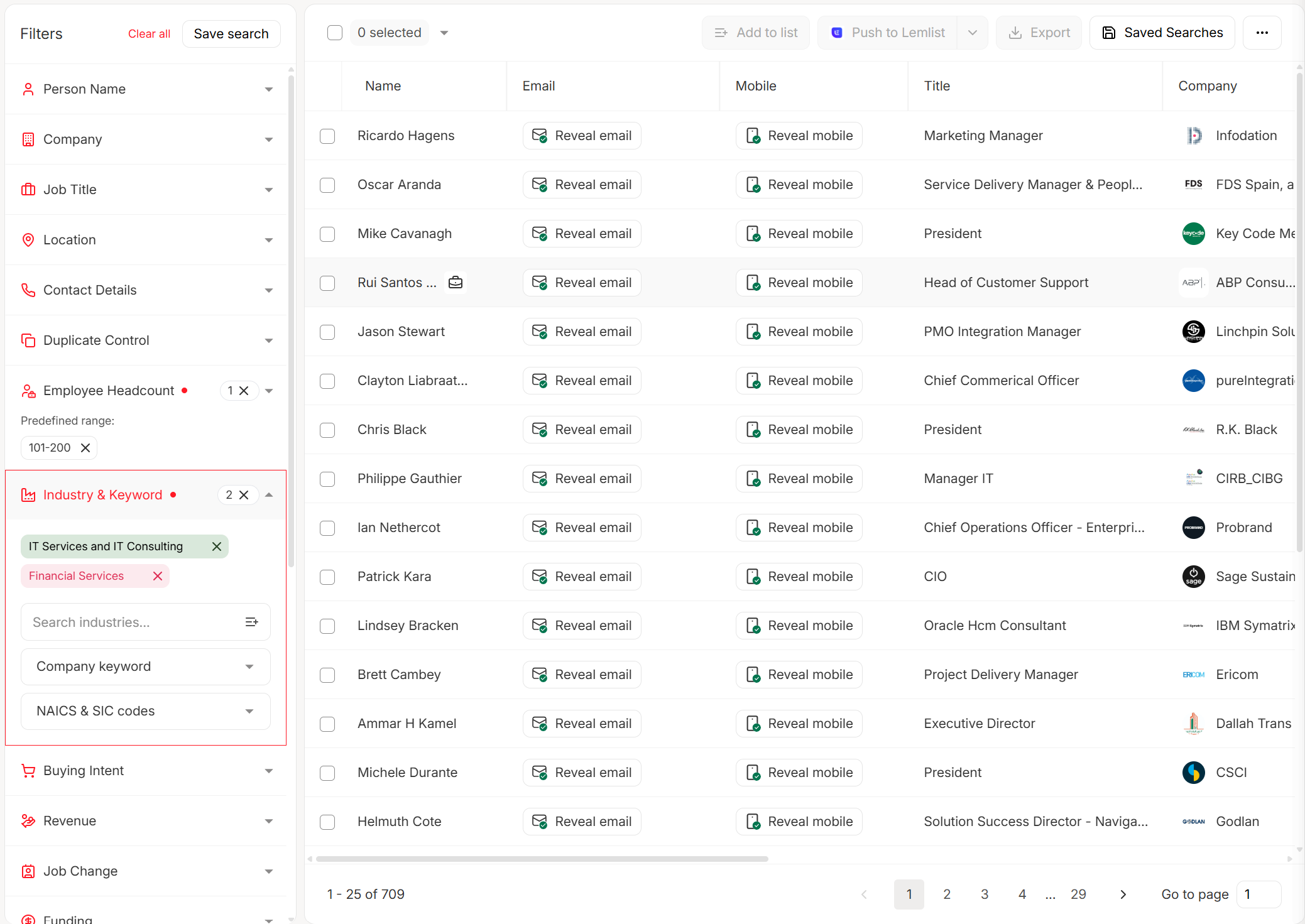
Use this if you care about data accuracy above all else and want self-serve access without annual contracts. Prospeo's database covers 300M+ professional profiles, 143M+ verified emails, and 125M+ verified mobile numbers, with 98% verified email accuracy and a 7-day refresh cycle. The 30+ search filters - including buyer intent powered by Bombora across 15,000 topics, technographics, job changes, and headcount growth - let you build lists that are targeted and clean from the start.
The Chrome extension works across any website, professional profiles, and CRMs for one-click contact discovery, and native integrations with Salesforce, HubSpot, Instantly, Smartlead, Lemlist, Clay, Zapier, and Make mean your data flows straight into your stack. The free tier gives you 75 emails + 100 Chrome extension credits per month to test it. Skip this if you need a built-in sequencer - Prospeo is a data platform, not an outreach tool, so you'll pair it with something like Instantly or Smartlead for sending.
Apollo.io
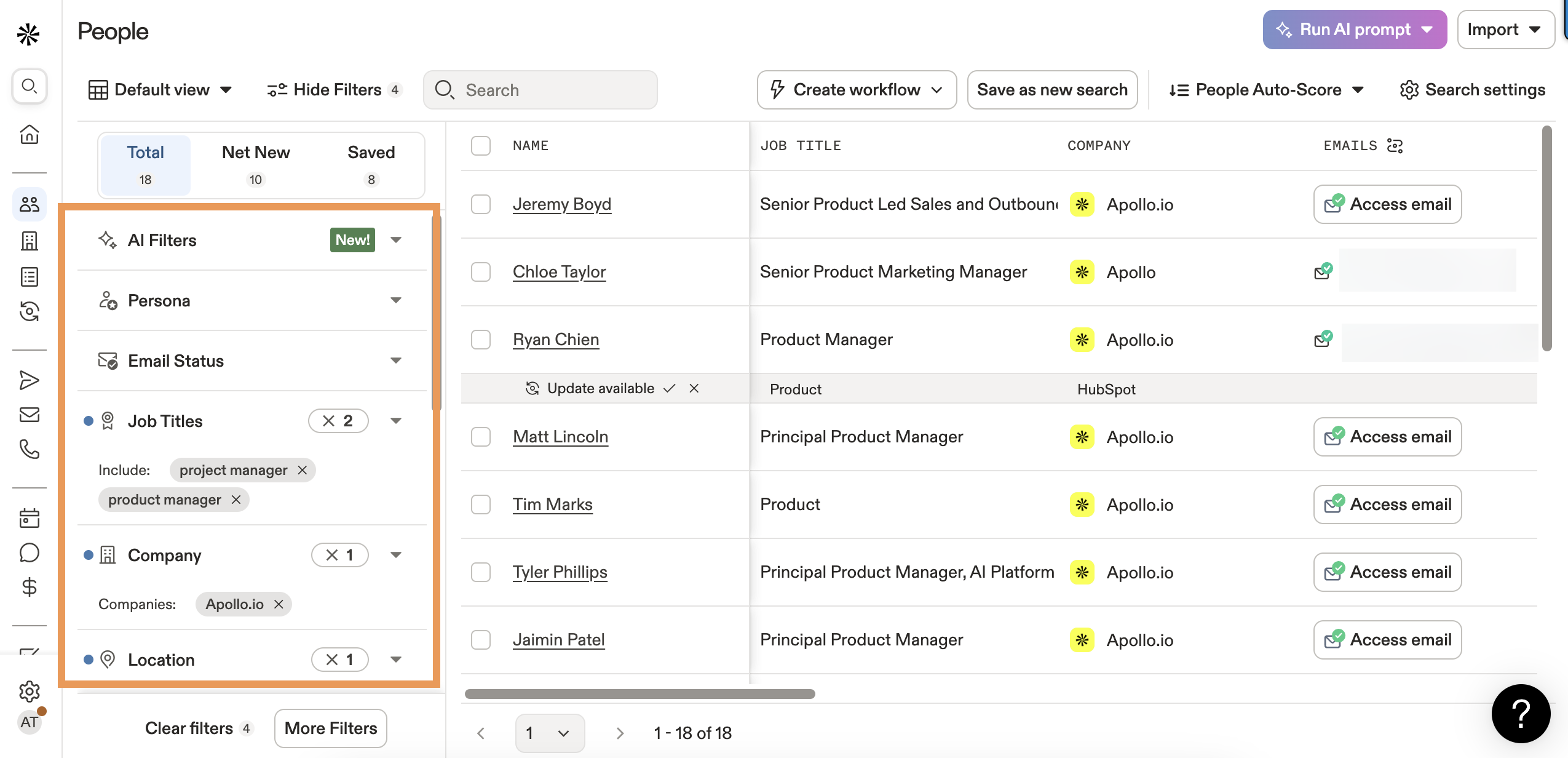
Apollo is the best value play for startups or SMBs that want one platform instead of three. The database covers 275M+ contacts. Paid plans start at $49/mo with built-in email sequences, a dialer, and workflow automation.
The trade-off is data quality. In our experience, Apollo's email verification isn't as tight as dedicated tools - expect higher bounce rates on larger exports, especially for catch-all domains. Data freshness also varies; some records feel months old. For teams sending under 500 emails per week, this is manageable. For high-volume outbound, you'll want a dedicated data provider alongside Apollo's sequencing.
ZoomInfo
Let's start with the number that matters: $14,995/year minimum. A 10-seat contract with intent data and mobile numbers runs $40-60K/year easily. You can't buy without talking to sales, and the #1 complaint on r/sales and G2 is paying for modules you don't use.
That said, if you have the budget, ZoomInfo's 135M+ phone numbers and company data are hard to beat at scale. The intent signals and advanced filtering make it the default for large ABM programs. Org charts, technographics, and workflow tools are all built in. Data refreshes around 4-6 weeks, which is slower than some competitors but acceptable for enterprise accounts that don't change roles weekly. If you're a team under 20 reps or your budget is under $30K/year, look elsewhere.
Other Tools Worth Considering
Lusha is the fastest path from "I need this person's number" to having it. The Chrome extension is snappy, the free tier is useful for light outreach, and paid plans start at $36/mo. Best for individual reps doing targeted outreach rather than high-volume campaigns.
Clay isn't a database - it's a workflow automation layer that pulls from 100+ enrichment sources and lets you build custom workflows with AI. Starts at $149/mo. Best for RevOps teams who want to chain data sources together. Overkill for a 3-person sales team.
Cognism is the pick for European mobile data and GDPR compliance. Their phone-verified mobile numbers in EMEA are stronger than what ZoomInfo or Apollo offer in that region. Typically $1K-3K/mo for small teams. If you're selling into the UK, Germany, or France, Cognism deserves a trial.
For lighter needs, Hunter.io ($34/mo) does domain-based email finding well and cheaply. Snov.io ($30/mo) bundles email finding with basic drip campaigns - solid for solopreneurs. RocketReach ($39/mo) has a broad database but accuracy is inconsistent on deeper searches. Seamless.AI ($147/mo) runs a real-time contact search engine - the concept is interesting, but accuracy reports from users are mixed, so test before committing.
For sequencing, you'll want a dedicated tool alongside your data provider: Instantly (~$30/mo), Smartlead (~$39/mo), or Lemlist (~$39/mo) handle warmup, rotation, and multi-inbox sending. If you want a broader shortlist, see our cold email marketing tools.
Step 2 says build your list right or everything downstream breaks. Prospeo gives you 300M+ profiles with 30+ filters - buyer intent, technographics, headcount growth, funding, job changes - so your ICP definition becomes an actual exportable list. Multi-thread across buying committees with verified emails and 125M+ direct dials.
Turn your ICP into a verified prospect list in minutes, not hours.
FAQ
What is prospecting in sales?
Prospecting is the process of identifying potential buyers who match your ideal customer profile and initiating direct contact - calls, emails, social touches - to book qualified meetings. It's sales-owned, targeted, and sits mid-funnel between lead generation and discovery calls. Unlike marketing-driven lead gen, reps control the targeting, messaging, and follow-up cadence.
How does prospecting differ from lead generation?
Lead generation is marketing-owned (SEO, ads, webinars) and fills the top of funnel with MQLs at scale. Prospecting is sales-owned (calls, email, social outreach) and qualifies specific individuals mid-funnel into SQLs and booked meetings. Lead gen casts a wide net; outbound outreach is a spear aimed at ICP-fit buyers.
How many touches does it take to book a meeting?
On average, it takes 8+ attempts across multiple channels. 80% of successful sales require 5+ follow-ups, yet 48% of reps never follow up at all. A coordinated email-phone-social cadence over 2-3 weeks drives 30%+ higher meeting conversion than any single channel alone.
What's a good cold email reply rate in 2026?
A 3-round cold email campaign averages about 9% reply rate. Top performers hit 12-15%+ by combining verified data with under 2% bounce, strong personalization, and proper deliverability setup (SPF, DKIM, DMARC). Teams using weekly-refreshed data typically maintain sub-2% bounce rates, which keeps sender reputation intact and inbox placement high.
What's the best free tool for sales prospecting?
Prospeo's free tier (75 emails + 100 Chrome extension credits/month) offers the strongest accuracy at no cost - 98% verified emails with weekly data refresh. Apollo.io also has a generous free plan with broader features but lower email accuracy. Hunter.io gives 25 free searches/month for basic email lookups.