Best GTM Strategy Tools for 2026
The average enterprise runs 120+ marketing apps. Marketers use roughly a third of what they're paying for. 42% of sales reps feel overwhelmed by their tool count - and overwhelmed sellers are 45% less likely to hit quota.
The problem isn't finding GTM strategy tools. It's picking the four or five that matter and ignoring everything else.
This guide focuses on sales-led and outbound GTM stacks, where tool selection has the highest impact on pipeline. If you're running pure product-led growth, your stack looks different - but most B2B teams still need what follows.
Our Picks
| Tool | Best For | Starting Price |
|---|---|---|
| Prospeo | Data accuracy and freshness | Free (75 emails/mo) |
| Apollo | All-in-one under 50 reps | Free / $49/user/mo |
| Clay | Custom enrichment workflows | Free / $149/mo |
How We Evaluated
Five criteria, weighted toward what actually moves pipeline:
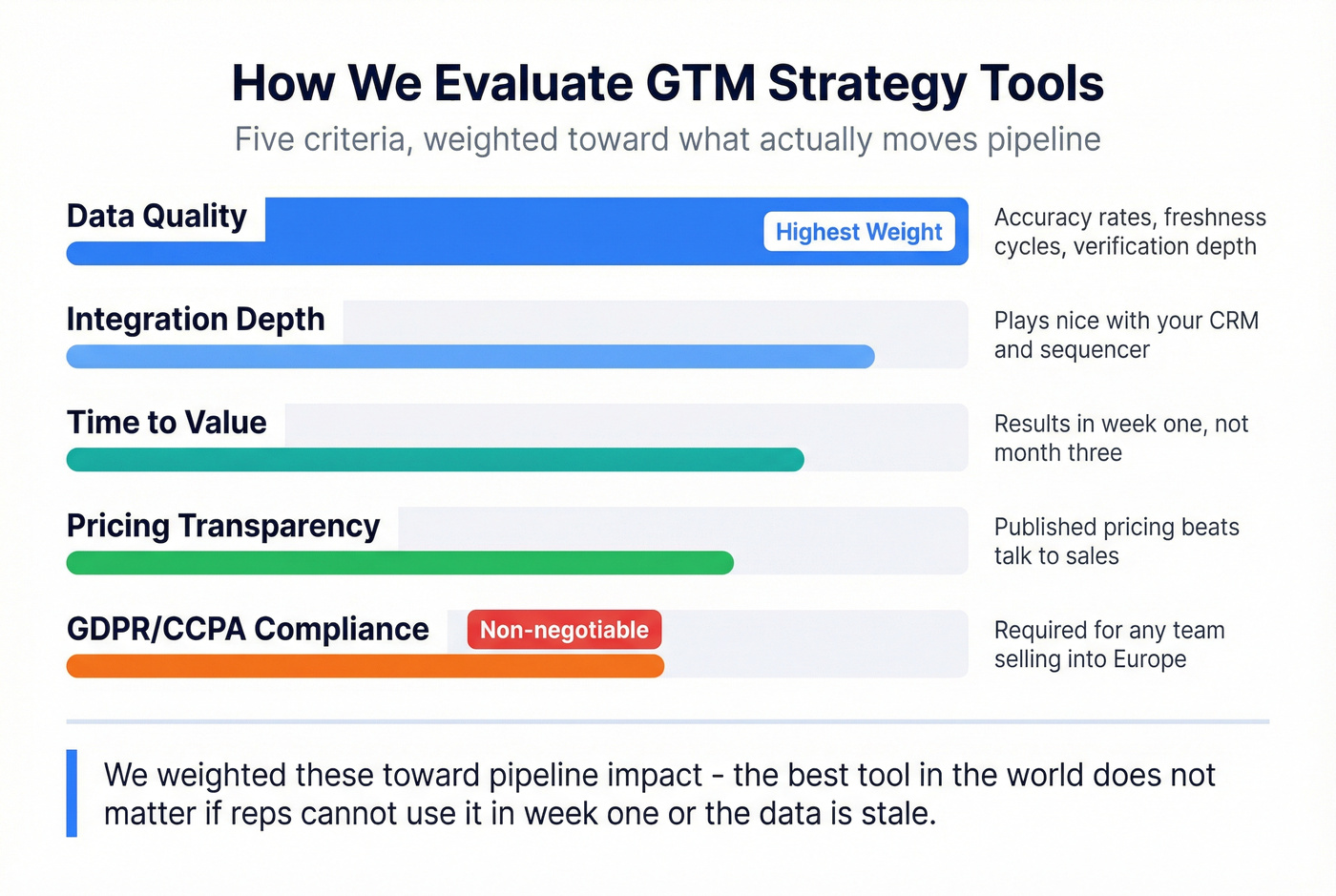
- Data quality - accuracy rates, freshness cycles, verification depth (see data quality)
- Integration depth - does it play nice with your CRM and sequencer? (use a sales tools checklist to audit fit)
- Time-to-value - can a rep get results in week one, not month three?
- Pricing transparency - published pricing beats "talk to sales"
- GDPR/CCPA compliance - non-negotiable for any team selling into Europe
Best Go-to-Market Tools by Category
B2B Data and Enrichment
Prospeo
Your GTM stack is only as good as the data feeding it. Prospeo covers 300M+ professional profiles with 143M+ verified emails, 98% email accuracy, and a 7-day data refresh cycle. The industry average sits around six weeks. That gap matters when B2B contact data decays roughly 30% per year - stale records mean bounced emails, burned domains, and wasted rep time (more on B2B contact data decay).

The platform includes 125M+ verified mobile numbers with a 30% pickup rate, intent data across 15,000 Bombora topics, and 30+ search filters covering buyer intent, technographics, job changes, and funding signals. It's GDPR compliant, self-serve, and integrates natively with Salesforce, HubSpot, Clay, Instantly, Lemlist, Zapier, and Make - plus a Chrome extension used by 40K+ prospectors. Pricing is credit-based at roughly $0.01/lead with a free tier and no contracts.
Real-world proof: Snyk's 50-person AE team dropped bounce rates from 35-40% to under 5% and grew AE-sourced pipeline 180% after switching their data layer. That's not a marginal improvement - it's a different business.
Use this if you want the highest-accuracy data foundation without enterprise pricing.
Apollo
Apollo's the obvious starting point for SMB teams that want database, sequencing, and dialing in one platform. The database covers 270M+ contacts, and the free tier gives you 10,000 credits/month - generous enough to actually test. Paid plans run $49-$119/user/month.
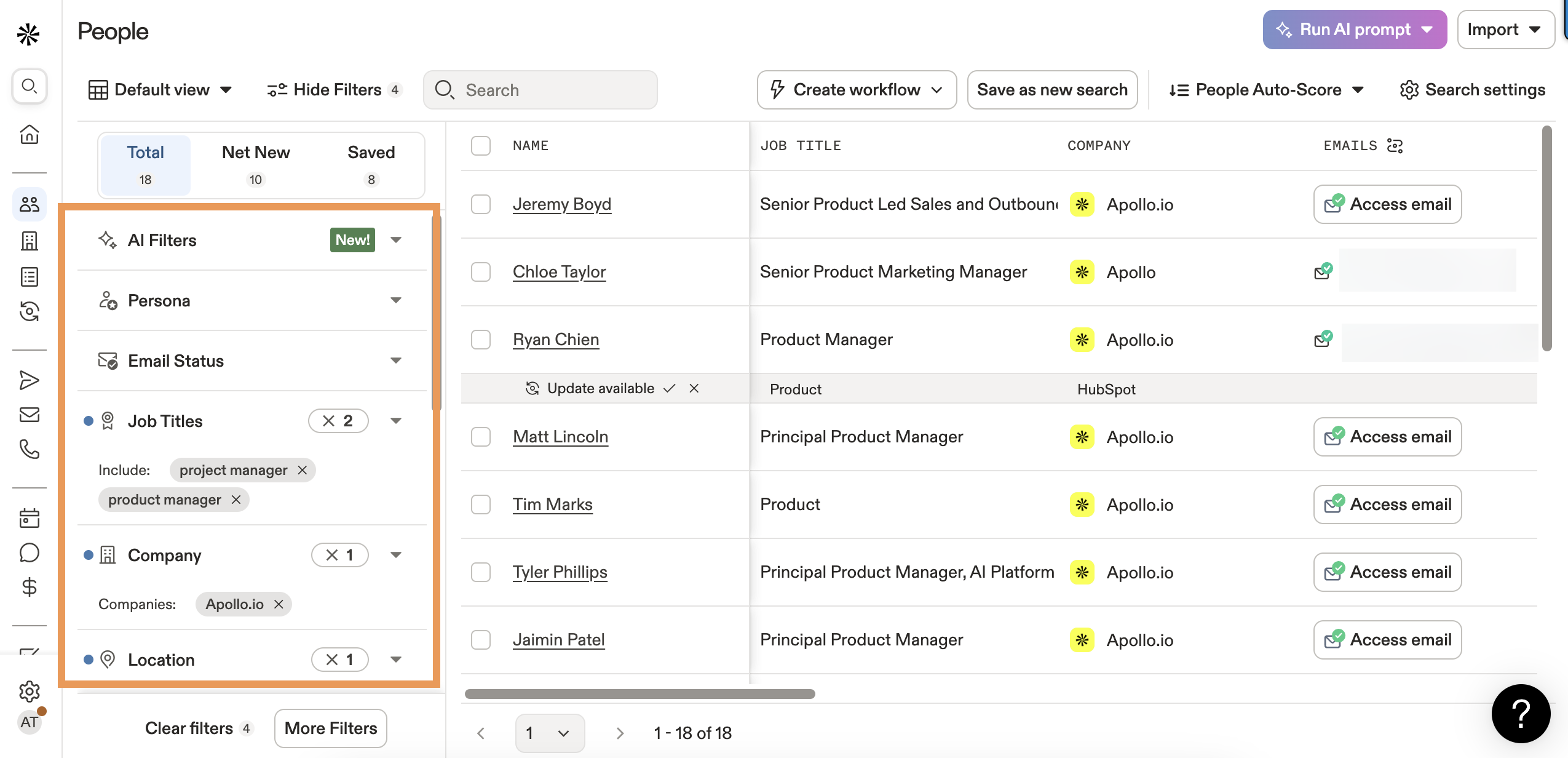
Here's the thing: data quality gets inconsistent outside North America. We've seen EMEA and APAC match rates drop noticeably compared to US coverage. If your ICP is global, pair Apollo's sequencing with a stronger data provider for international contacts.
Use this if you need an all-in-one and your team is under 50 reps. Skip this if you're selling heavily into EMEA or APAC.
ZoomInfo
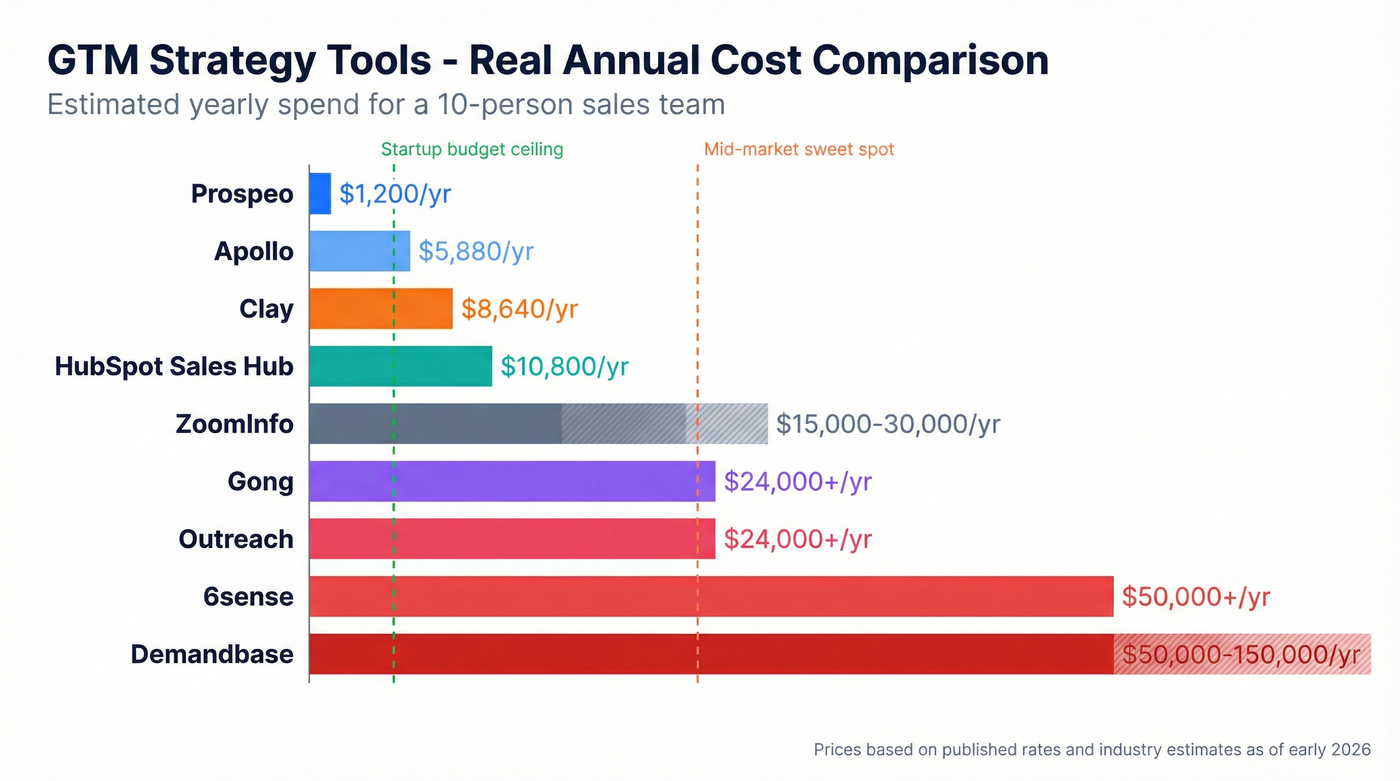
ZoomInfo's database runs 300M+ contacts with 500+ integrations - the broadest ecosystem in the category. Pricing starts around $15K/year and climbs fast with modules and seats. A mid-market contract with intent data easily hits $30K+.
The consensus on r/sales isn't kind - "incredibly buggy, half the contacts are inaccurate" is a common refrain, and annual contracts with limited flexibility don't help. Worth it for enterprise teams with budget to match and US-heavy ICPs. For everyone else, the ROI math doesn't hold up (compare options in our sales prospecting platforms guide).
Clay
Forget databases. Clay is a logic engine. Feed it a signal - pricing page visit, job change, funding round - and it runs waterfall enrichment across multiple data providers, scores the lead, and pushes it to your sequencer. Think of it as programmable middleware between your data sources and your CRM (see data enrichment for cold email).
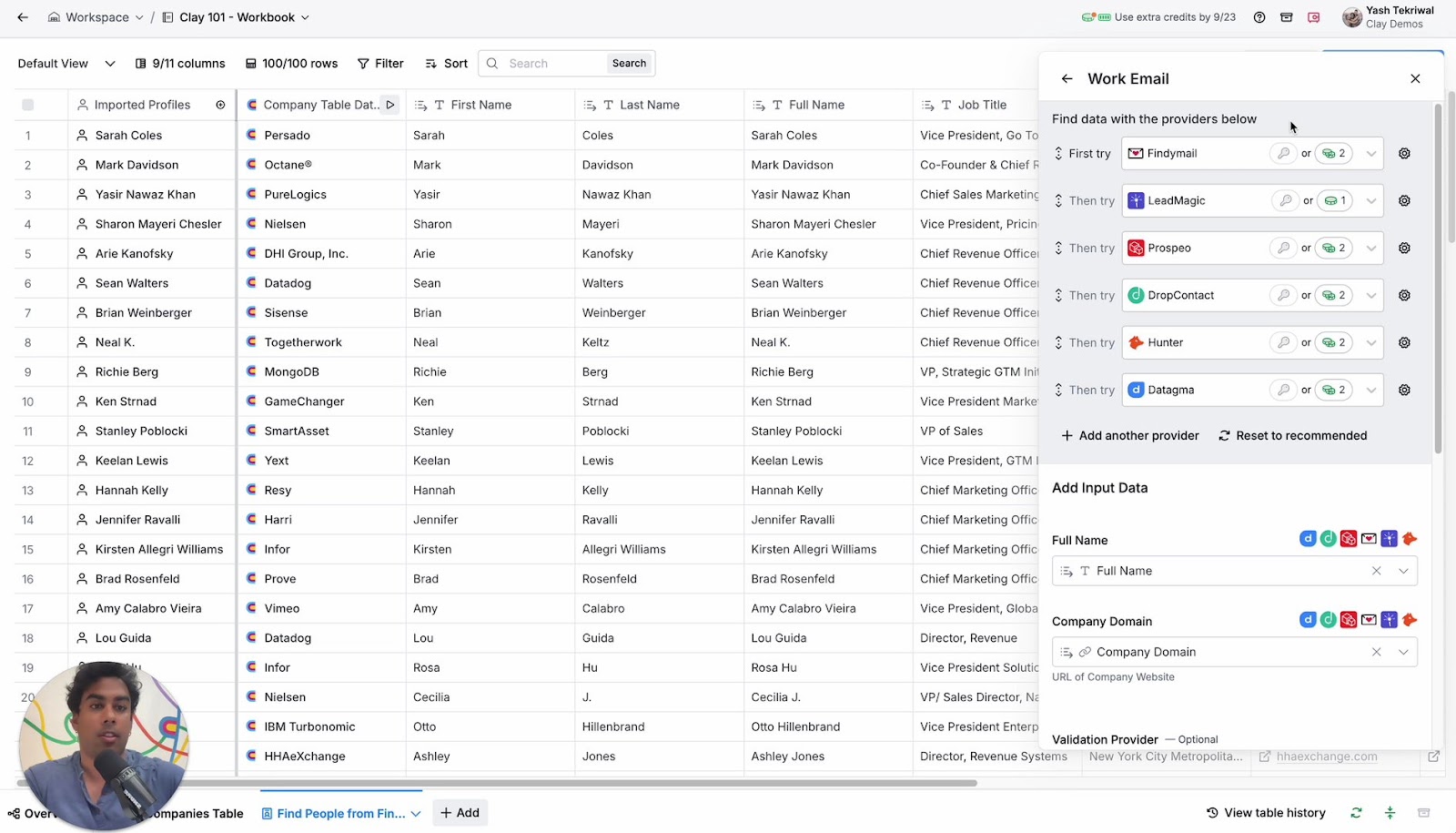
Pricing starts free with 100 credits/month, then $149/month for Starter, scaling to $720/month for Pro. Enterprise contracts average around $30K/year. Watch your credit usage carefully; top-ups carry roughly a 50% markup over your plan rate.
Skip this if you just need a contact database. Clay adds complexity you won't use.
ABM and Intent Data
6sense
6sense's 6signal Graph detects anonymous website visitors and RevenueAI predicts buying stages - powerful stuff for enterprise ABM. Pricing starts at $50K+/year.
Let's be honest: every "best go-to-market tools" list includes 6sense. Most don't mention that it's wildly inappropriate for startups or even most mid-market teams. If you have fewer than 10 reps and aren't running sophisticated ABM programs, stop letting vendor marketing convince you otherwise (use an ABM maturity model to sanity-check fit).
Demandbase
Full ABM platform competing directly with 6sense. Expect $50-150K/year depending on modules. Enterprise-only.
Bombora
Standalone intent data provider tracking content consumption across 5,000+ B2B sites. Runs $25-75K/year as a standalone product, though it's often bundled into other platforms like Prospeo, which layers Bombora's 15,000 intent topics into its search filters (see intent signals).
Sales Intelligence and Engagement
Gong
Revenue intelligence done right. Gong records and analyzes sales conversations, surfaces deal risk, and sharpens forecasting. Pricing runs roughly $1,600/user/year plus a platform fee - a 15-rep team is looking at $30K+ annually. Worth it once you have enough conversation volume to generate real insights. For teams under 10 reps, the ROI gets shaky fast.
Outreach
The dominant sales engagement platform for multi-step sequences across email, phone, and social. Custom pricing, typically $100-200/user/month at scale. Smaller teams often start with Instantly or Lemlist and graduate to Outreach when they've outgrown simpler tools (see how to choose a sales engagement platform).
CRM and Marketing Automation
HubSpot
HubSpot's free CRM remains the best starting point for startups. Sales Hub starts around $90/month/seat, and Marketing Hub starts around $800/month depending on tier. It's the most accessible platform for teams that need CRM, marketing automation, and basic reporting without Salesforce-level complexity. Pair it with a dedicated data provider and you've got a functional stack for around $500/month.

Most GTM stacks fail at the data layer. Prospeo gives you 300M+ profiles with 98% email accuracy, a 7-day refresh cycle, and intent data across 15,000 topics - all at ~$0.01/lead with no contracts. Snyk's 50 AEs grew pipeline 180% after switching.
Stop feeding your GTM stack stale data. Fix the foundation first.
Pricing Comparison
| Tool | Starting Price | Model | Best For |
|---|---|---|---|
| Prospeo | Free (75 emails/mo) | ~$0.01/email, no contracts | Data accuracy |
| Apollo | Free / $49/user/mo | Per-user + credits | All-in-one SMB |
| Clay | Free / $149/mo | Credit-based | Enrichment workflows |
| ZoomInfo | ~$15K/year | Annual contract | Enterprise data |
| 6sense | ~$50K+/year | Annual contract | Enterprise ABM |
| Gong | ~$1,600/user/yr | Per-user + platform fee | Revenue intelligence |
| Demandbase | ~$50-150K/year | Annual contract | Enterprise ABM |
| Bombora | ~$25-75K/year | Annual contract | Intent data |
| Outreach | ~$100-200/user/mo | Custom | Sales engagement |
| HubSpot | Free / ~$90/seat/mo | Tiered | CRM + marketing |
Build Your Stack by Stage
B2B contact data decays roughly 30% per year, which means your data layer isn't optional - it's the foundation everything else sits on. Well-integrated stacks are 42% more likely to boost sales productivity, so fewer tightly connected tools beat a bloated stack every time (start with a B2B sales stack blueprint).
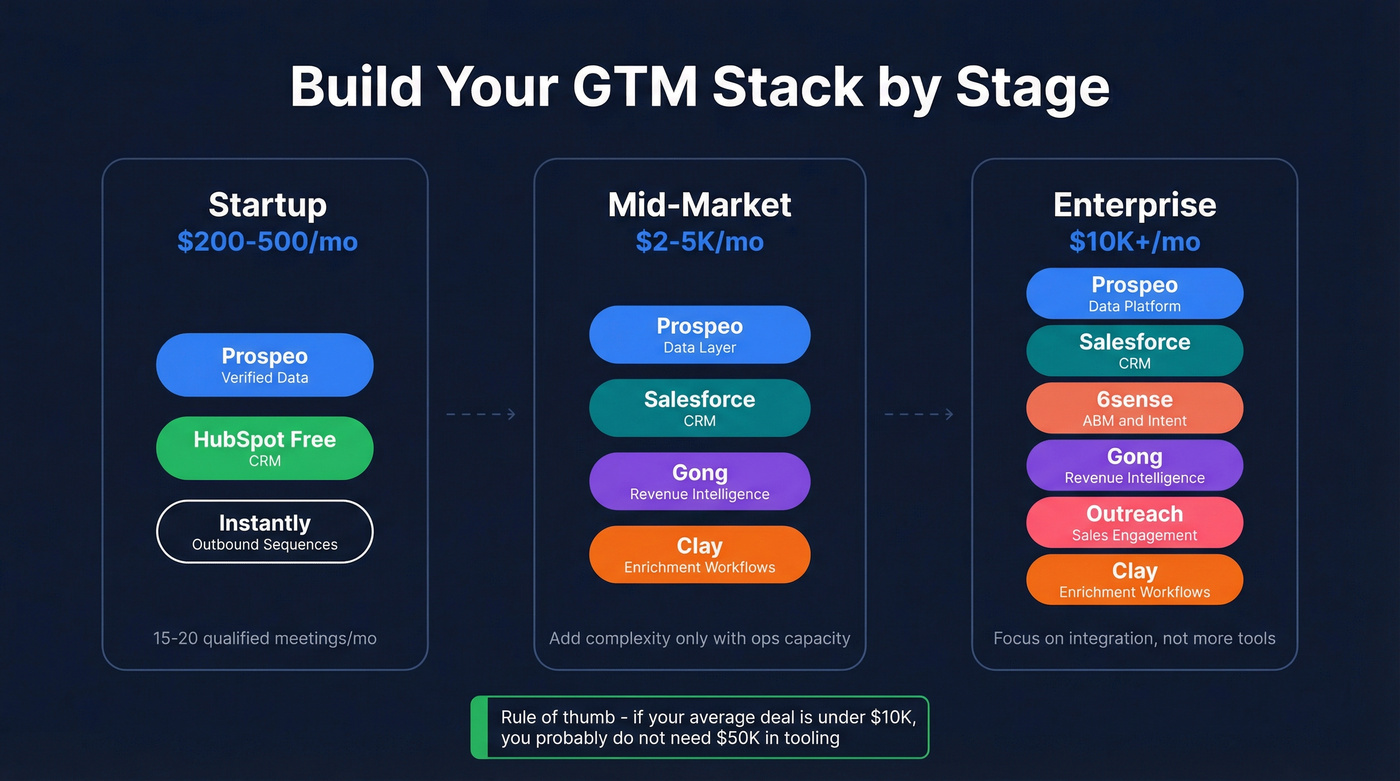
Startup ($200-500/month): A verified data provider + HubSpot free + Instantly for outbound. Total cost under $400/month for verified contacts, a CRM, and sequences that won't burn your primary domain. We've seen early-stage teams run this exact setup and book 15-20 qualified meetings per month.
Mid-market ($2-5K/month): Your data provider + Salesforce + Gong + Clay. Add complexity only when you have the ops capacity to maintain it. If nobody on your team can build Clay workflows, you're paying for a tool that'll collect dust.
Enterprise ($10K+/month): Data platform + Salesforce + 6sense + Gong + Outreach + Clay. The key at this stage isn't adding tools - it's integrating the ones you have so data flows cleanly between them.
One thing we keep seeing: if your average deal size is under $10K, you almost certainly don't need ZoomInfo-level data or 6sense-level ABM. A $200/month data provider and a good sequencer will outperform a $50K stack that your three reps barely log into.
Mistakes to Avoid
Buying enterprise tools on a startup budget. 6sense at $50K/year when you have three reps is lighting money on fire. We've watched startups sign these contracts and regret it within 90 days.
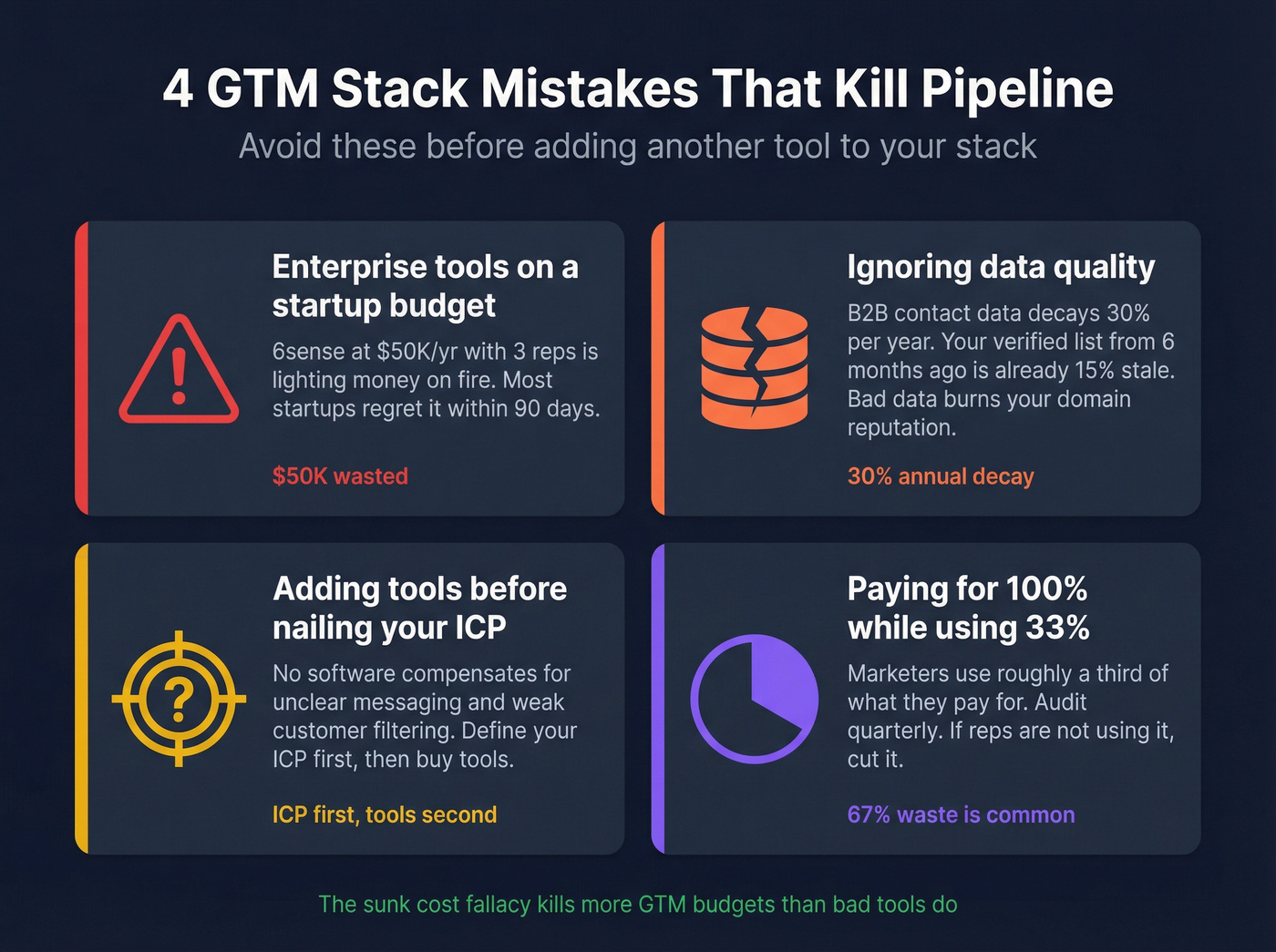
Ignoring data quality. With 30% annual decay, your "verified" list from six months ago is already 15% stale. Bad data doesn't just waste time - it damages your domain reputation and tanks deliverability across every campaign you run (see email deliverability checklist).
Adding tools before fixing positioning and ICP. No amount of software compensates for unclear messaging and weak customer filtering. Get your ICP nailed down first. Then buy tools.
Paying for 100% of a platform while using 33%. Audit quarterly. If reps aren't using it, cut it. The sunk cost fallacy kills more GTM budgets than bad tools do.
You don't need 120 tools. You need four or five that work - starting with data that actually connects reps to buyers. Prospeo integrates natively with HubSpot, Salesforce, Clay, Instantly, and Lemlist so your entire GTM stack runs on verified contacts, not guesswork.
Build a lean GTM stack on data your reps can trust.
FAQ
What is a GTM strategy tool?
Software that helps you identify, reach, and convert target buyers - spanning data enrichment, outreach automation, ABM, CRM, and revenue intelligence. The best stacks combine three to five tightly integrated tools rather than one platform that tries to do everything.
How much does a GTM tech stack cost?
Startups can build a functional outbound stack for $200-500/month using a verified data provider, a free CRM, and a sequencer. Mid-market teams typically spend $2-5K/month, while enterprise stacks with ABM and revenue intelligence run $10K+ monthly.
What's the most important tool category?
B2B data and enrichment. Every downstream tool - your sequencer, CRM, ABM platform - depends on accurate contact data. If your emails bounce at 15%+ and your phone numbers don't connect, nothing else in the stack matters.
How many tools does a team actually need?
Four to six for most sales-led teams: a CRM, a data provider, an outreach tool, and optionally an analytics or intent platform. A data provider plus HubSpot plus a sequencer like Instantly covers 80% of what a startup needs for under $400/month. More than six tools usually means stack bloat.