

Database Providers: B2B Data, Cloud DBaaS, and DBMS Compared
"Database providers" means three completely different things depending on who you ask. Sales leaders want verified contact data. Engineers want managed Postgres. CTOs want the right engine for a new product. Most articles mash all three together and help nobody.
We've spent years working in the B2B data space and evaluating tools across all three categories, so let's break this down properly. 28% of B2B email addresses decay annually, costing organizations an average of $12.9M per year in wasted outreach and lost pipeline. On the infrastructure side, 60% of B2B sales companies are shifting to data-driven approaches. Picking the right provider - in any category - has real revenue implications.
Our Picks (TL;DR)
B2B contact data: Prospeo. 98% email accuracy, 7-day data refresh, ~$0.01 per lead, no contract.
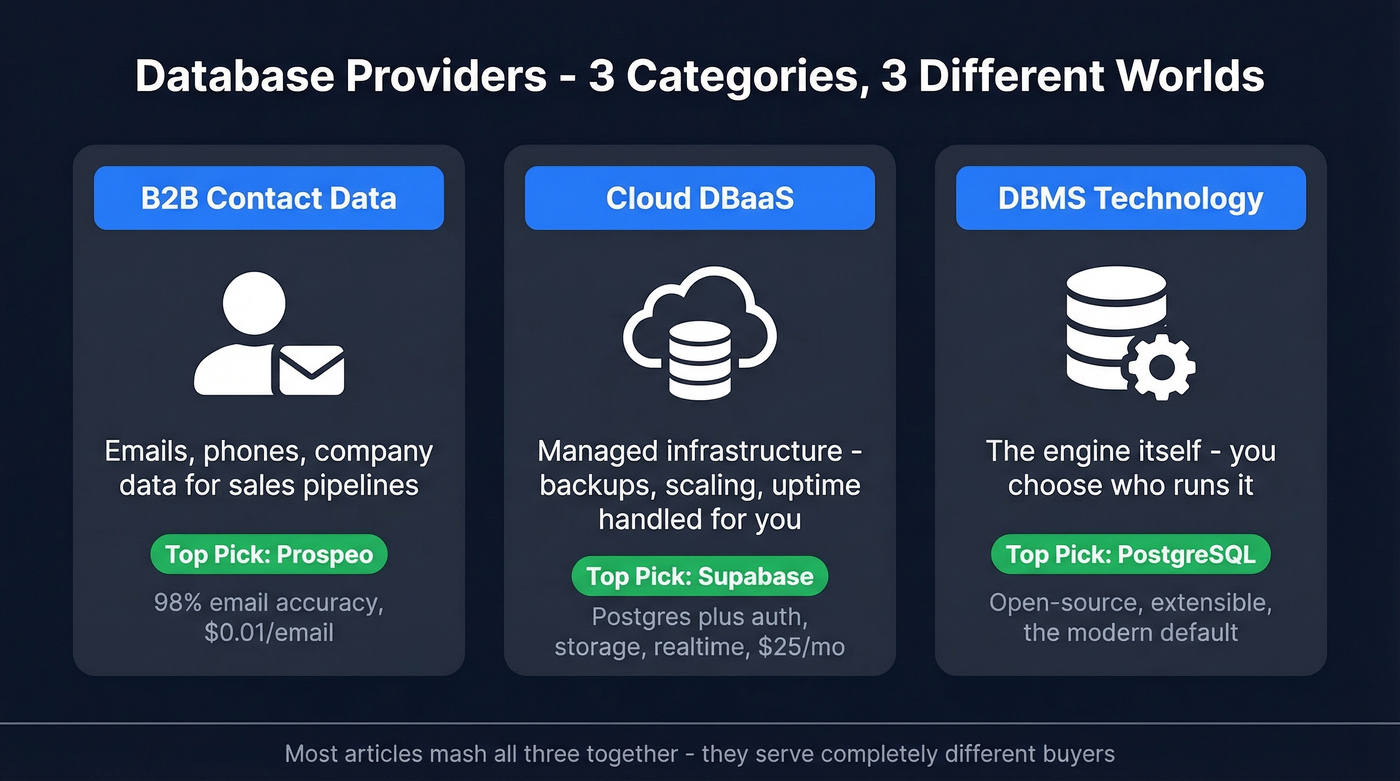
Cloud DBaaS: Supabase. Postgres plus auth, storage, realtime, and edge functions. Free tier at 500MB, Pro at $25/mo.
DBMS technology: PostgreSQL. Open-source, top-tier in DB-Engines rankings, and supported across every major cloud ecosystem. The safe bet for a reason.
Best B2B Contact Data Providers
You need emails, phone numbers, and company data to fill your pipeline. The spread between B2B contact vendors is enormous - from free tiers to $60K/year enterprise platforms. Data quality matters far more than database size claims suggest, and we've seen teams burn through entire quarters chasing leads with bad contact info before figuring that out.

Prospeo
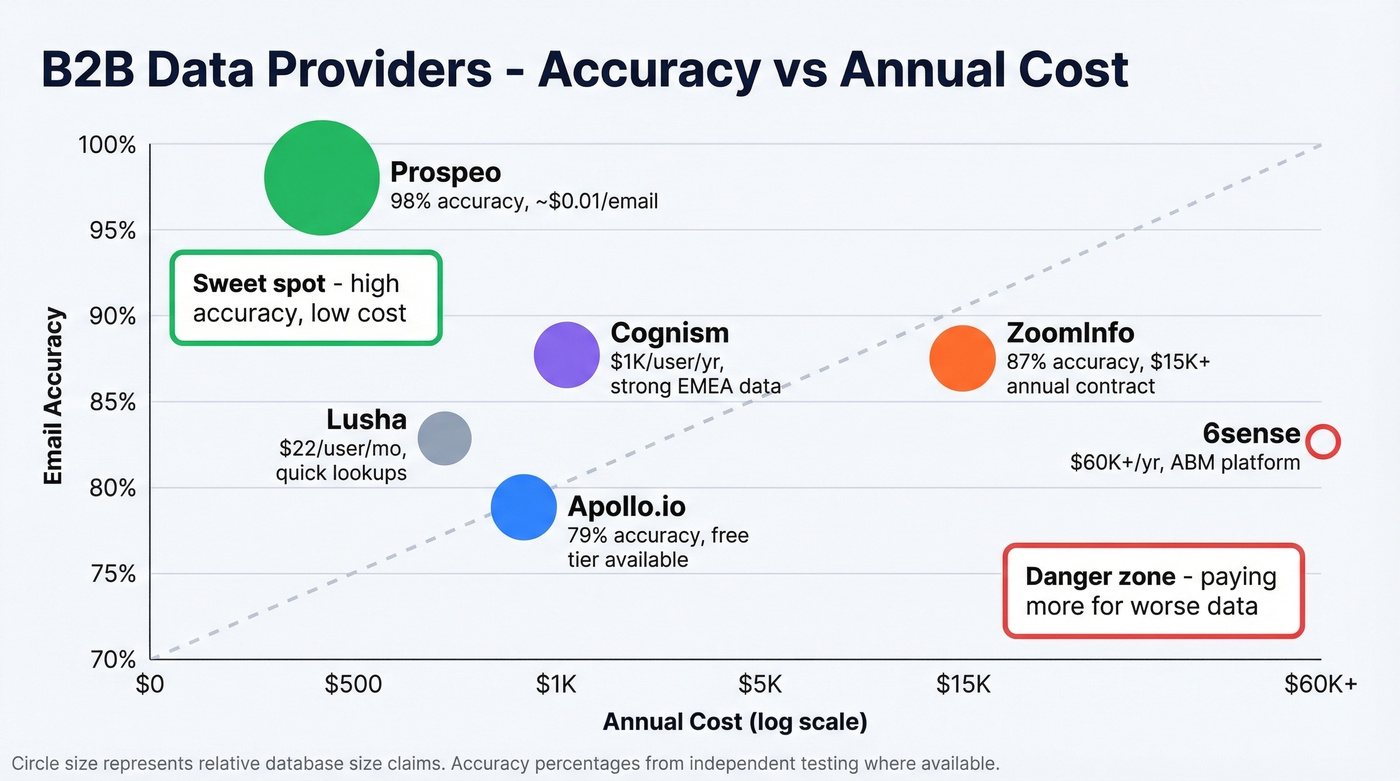
Prospeo runs 300M+ professional profiles through a 5-step verification process - catch-all handling, spam-trap removal, honeypot filtering - delivering 98% email accuracy and 125M+ verified mobile numbers with a 30% pickup rate. Every record refreshes on a 7-day cycle; the industry average is six weeks. When a VP of Sales changes companies, you've got about a week before their old email bounces. Prospeo catches that.
Real numbers from Snyk: 50 AEs saw bounce rates drop from 35-40% to under 5%, AE-sourced pipeline jumped 180%, and the team generated 200+ new opportunities per month. The free tier gives you 75 emails to test. Paid plans run ~$0.01 per email with no annual contract, which makes it easy to validate before scaling spend.
Apollo.io
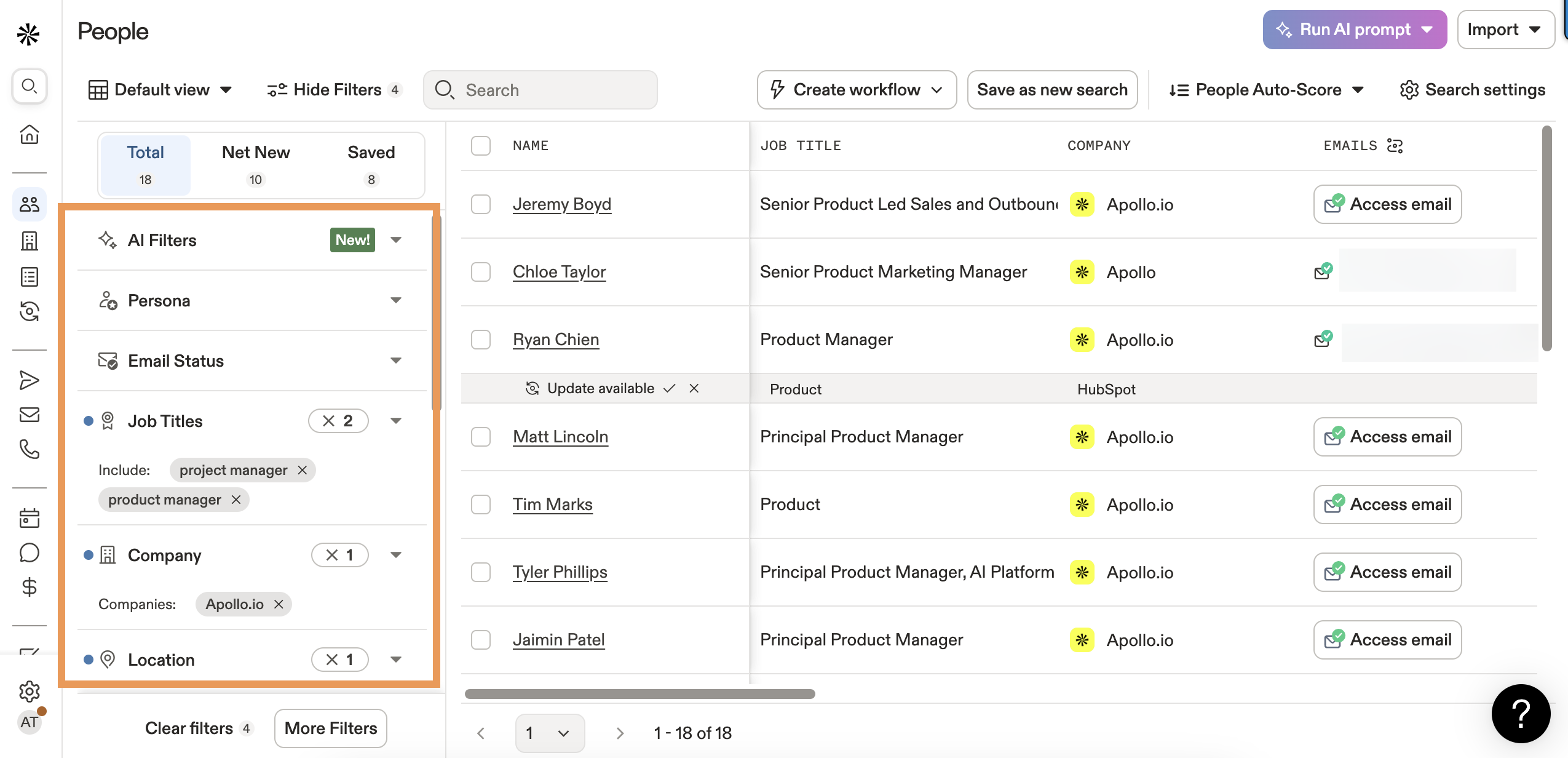
Use this if you're an SMB team that needs a free starting point. Apollo's free plan includes 1,200 credits/month across 275M+ contacts with 65+ filters. Paid plans: $49/user/mo (Basic), $79 (Professional), $119 (Organization), billed annually.
Skip this if email accuracy is critical for your outbound. In head-to-head testing, Apollo's 79% email accuracy trails dedicated data platforms significantly - expect higher bounce rates on cold campaigns and potential domain reputation damage over time.
ZoomInfo
The largest B2B database on paper, and the most expensive by a wide margin. Professional starts around $15,000/year for 3 users with 5,000 annual credits. Advanced runs ~$25K, Elite ~$40K. Annual contracts only.
Here's the thing: the #1 complaint on r/SalesOperations is paying for modules you don't use. Add-on paywalls for intent data and advanced filters mean the sticker price is rarely the final price. If you're running 50+ reps and need the deepest US database with a full GTM suite, ZoomInfo earns its keep. For everyone else, you're overpaying.
Lusha
The quickest path to a single contact. Lusha's Chrome extension is genuinely fast for one-off lookups. Free tier: 40 credits/month. Pro: ~$22/user/mo with 3,000 annual credits. It isn't a database you'll build campaigns from, but it's unbeatable for ad-hoc prospecting speed.
Cognism
Selling into EMEA? Cognism's European data coverage - particularly Diamond-verified mobile numbers in the UK, DACH, and Nordics - outperforms ZoomInfo internationally. Pricing starts around $1,000/user/year on annual contracts. The tradeoff: thinner US coverage and no monthly option.
Coresignal & 6sense
Coresignal is API-first raw data for developers - 839M employee records, 75M company records, 176ms average response time, from $49/mo. Think of it as B2B data infrastructure, not a prospecting tool. It sits alongside specialized vendors like Bombora (intent signals) and BuiltWith (technographics) for teams building custom data stacks.
6sense is enterprise-only ABM with intent data at its core, starting ~$60K/year. Overkill for teams under 100 reps, but powerful for large orgs running account-based plays with buying committee identification.
Our honest take: If your average deal size is under $10K, you don't need ZoomInfo-level pricing. A $39/mo plan with 98% accuracy will outperform a $15K/year platform with 87% accuracy every time - because deliverability drives pipeline, not database size.
B2B Provider Comparison
| Tool | Database Size | Email Accuracy | Starting Price | Contract? |
|---|---|---|---|---|
| Apollo.io | 275M+ contacts | 79% | Free / $49/user/mo | Monthly or annual |
| ZoomInfo | Not disclosed | 87% | ~$15K/yr | Yes, annual |
| Lusha | 100M+ contacts | Not public | Free / $22/user/mo | Monthly or annual |
| Cognism | 400M+ profiles | Not public | ~$1K/user/yr | Yes, annual |
| Coresignal | 839M+ records | N/A (raw data) | $49/mo | No |
| 6sense | Intent-driven | N/A (platform) | ~$60K/yr | Yes, annual |

You just saw the full B2B database provider landscape - and the accuracy gap is massive. Prospeo's 5-step verification delivers 98% email accuracy on 300M+ profiles, refreshed every 7 days. Snyk's 50 AEs cut bounce rates from 40% to under 5% and added 200+ opportunities per month.
Test it against your current provider - 75 free emails, no credit card.
Every database provider on this list makes big claims about size. But 28% of B2B emails decay annually, and size means nothing if contacts bounce. Prospeo refreshes every 7 days - 6x faster than the industry average - so your pipeline runs on live data, not stale records.
Stop paying enterprise prices for decayed data. Start at $0.01/email.
Best Cloud Database Providers (DBaaS)
Different world entirely. Here you're choosing managed database infrastructure - someone else handles backups, patching, scaling, and uptime. AWS, Microsoft, and Google control 63% of cloud infrastructure spend, but the developer-first challengers are gaining ground fast.
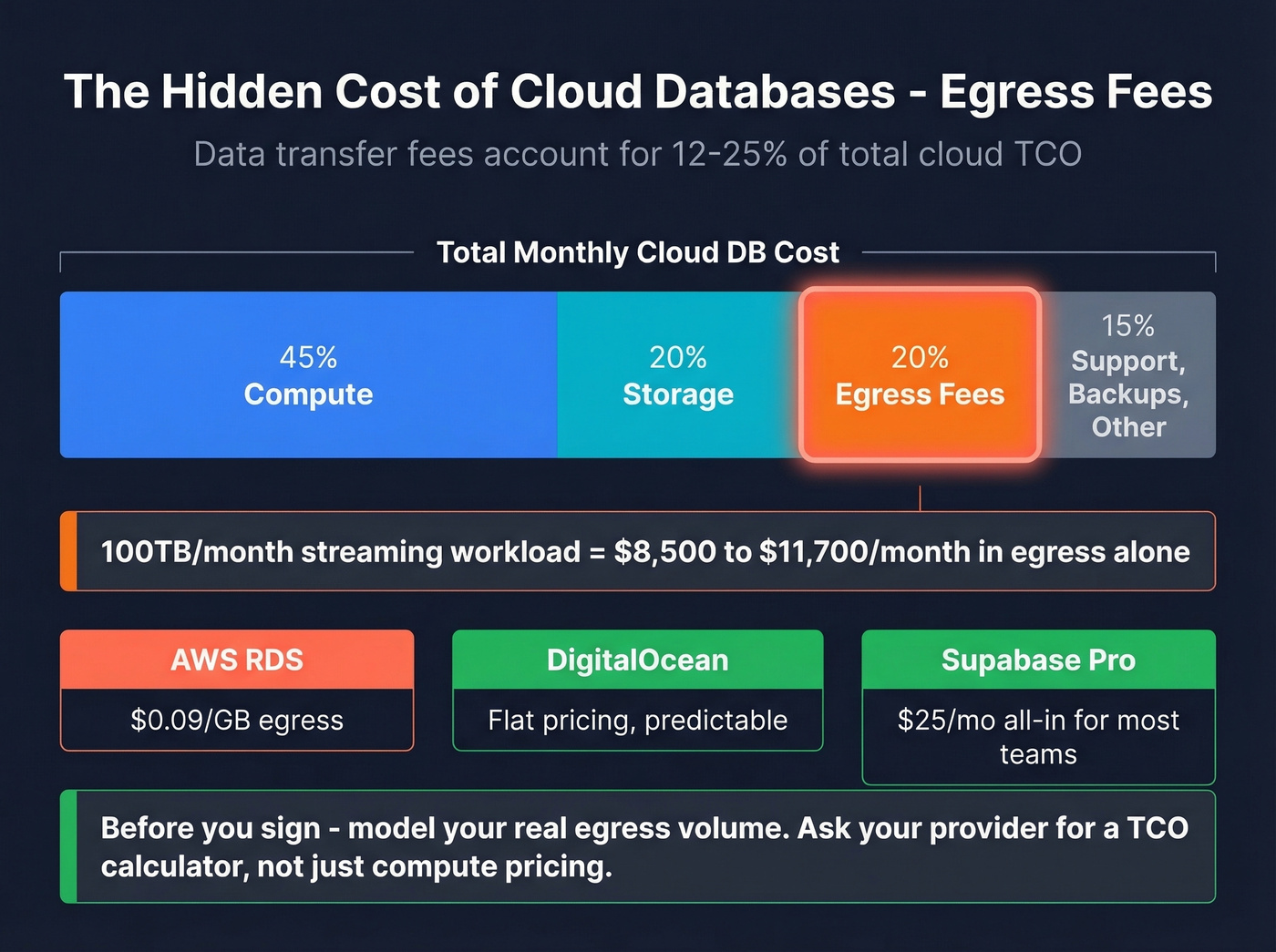
One cost most teams underestimate: egress. Data transfer fees account for 12-25% of total cloud TCO. A 100TB/month streaming workload costs $8,500-$11,700/month in egress alone - and that number sneaks up on you.
Supabase
The best integrated developer platform in DBaaS right now. You get Postgres plus auth, file storage, realtime subscriptions, and edge functions in one dashboard. Free tier: 500MB database, 1GB file storage, 50,000 monthly active auth users. Pro at $25/mo, Enterprise from $599/mo with SSO and point-in-time recovery.
Supabase replaces your entire backend, not just your database. For teams that want to ship fast without stitching together five different services, it's the obvious pick.
Neon
The better pure database. Neon's serverless Postgres separates compute from storage, enabling true scale-to-zero - compute shuts down after 5 minutes of inactivity. Branching lets you spin up full database copies for testing in seconds. Free tier at 500MB, Pro from $19/mo usage-based.
The tradeoff vs Supabase: Neon is a better database, Supabase is a better platform. Pick based on what you need beyond Postgres.
AWS RDS and Others
AWS RDS is the safest enterprise choice - managed Postgres, MySQL, or Aurora with predictable SLAs. Expect ~$0.544/hr for an 8 vCPU/32GB instance, plus egress at $0.09/GB. Not exciting, but battle-tested.
PlanetScale runs Vitess-based MySQL with a $5/mo dev tier and $60/mo HA tier. MongoDB Atlas offers a free 512MB tier with usage-based pricing (~$0.10/million reads) - strong for document-model workloads. DigitalOcean Managed Databases keeps it simple from ~$15/mo with flat, predictable pricing. For budget-conscious teams that don't need AWS-scale features, DigitalOcean's simplicity is genuinely refreshing.
DBaaS Comparison
| Provider | Engine | Free Tier | Paid From | Scale-to-Zero? |
|---|---|---|---|---|
| Supabase | Postgres | 500MB | $25/mo | No |
| Neon | Postgres | 500MB | $19/mo | Yes |
| AWS RDS | Multi-engine | No | ~$0.544/hr | No |
| PlanetScale | MySQL (Vitess) | No | $5/mo | Yes |
| MongoDB Atlas | MongoDB | 512MB | ~$0.10/M reads | Yes |
| DigitalOcean | Multi-engine | No | ~$15/mo | No |
DBMS Platforms
A DBMS is the engine; a provider is who runs it for you. Here's the quick hierarchy by adoption.
PostgreSQL is the modern default - open-source, extensible, and widely supported in managed offerings. In the March 2026 DB-Engines ranking, the top systems by score are Oracle, MySQL, Microsoft SQL Server, PostgreSQL, and MongoDB. MySQL remains ahead of Postgres in that popularity ranking, but Postgres continues to be the go-to choice for new application development. Oracle Database still powers massive enterprise workloads in finance and government, but licensing costs are brutal. SQL Server is the Microsoft ecosystem play. MongoDB leads the document database category for teams needing flexible schemas and horizontal scaling.
One 2026 trend worth watching: polyglot persistence - running multiple database engines within a single application, each optimized for its workload. AI-driven query tuning is also maturing, with tools like OtterTune and EverSQL automating index and configuration optimization. For most new projects, PostgreSQL remains the right default.
How to Choose the Right Provider
Start with data model fit. Relational databases handle structured queries; document stores handle flexible schemas; time-series engines handle metrics. Don't force a square peg.
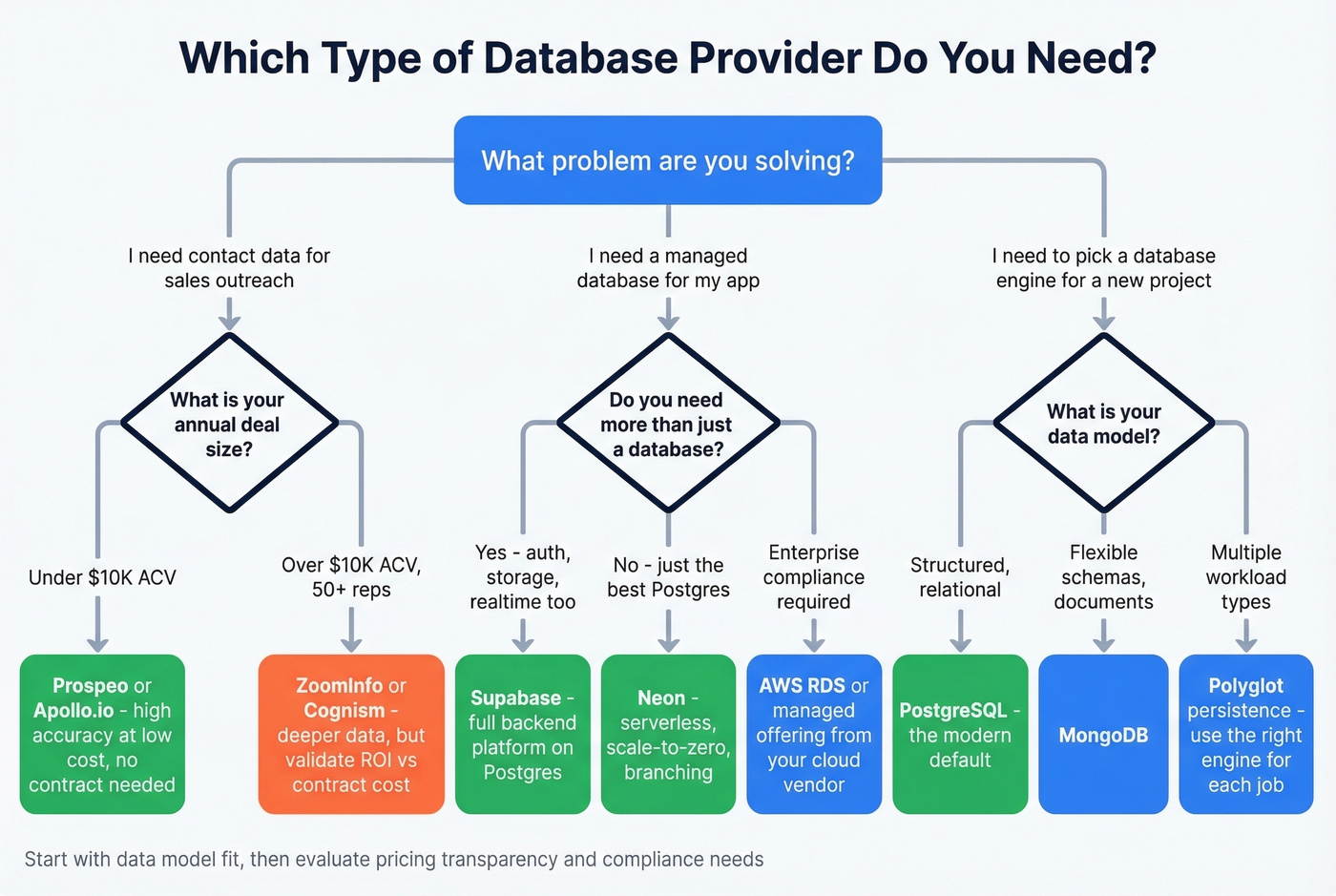
Pricing transparency matters just as much. If you can't estimate your monthly bill before signing, that's a red flag - watch for egress fees, support tiers, and credit systems that obscure true cost. We've seen teams get locked into annual contracts only to discover their actual spend was 2x the quoted price once add-on modules and overage charges kicked in.
For B2B contact data vendors, freshness is everything. Ask any vendor how often they re-verify records and what their bounce rate guarantee looks like. Compliance requirements - GDPR, HIPAA, SOX, data residency - are non-negotiable for regulated industries. Model the real TCO before you commit: add-on modules, overage charges, and support tiers can double your bill beyond the landing page price.
FAQ
What's the difference between a database provider and a DBMS?
A DBMS is the software engine - PostgreSQL, MongoDB, MySQL. A database provider hosts, manages, or sells data through that engine. AWS RDS is a provider running PostgreSQL; Apollo is a provider selling B2B contact data. The DBMS is the technology; the provider is the service layer on top.
How much do B2B database providers cost?
Free tiers exist at Apollo (1,200 credits/mo) and Prospeo (75 emails/mo). Most mid-market teams spend $49-$200/user/month. ZoomInfo requires $15K+ annual contracts. Enterprise ABM platforms like 6sense start at ~$60K/year. Benchmarking across multiple vendors before committing prevents overpaying.
Are serverless databases reliable for production?
Yes. Neon, Supabase, and PlanetScale all offer production-grade SLAs with 99.95%+ uptime guarantees. The main tradeoff is cold-start latency - roughly one second when scaling from zero - which is acceptable for most APIs, dashboards, and internal tools.
Is ZoomInfo worth the price?
For large sales orgs running 50+ reps with complex GTM motions, ZoomInfo's depth justifies the cost. For teams under 20 reps, the ROI rarely pencils out. Prospeo delivers 98% email accuracy at ~$0.01/lead with no contract, generating better deliverability and pipeline results at a fraction of the spend.
Which providers serve both sales and marketing teams?
Platforms like Apollo.io, ZoomInfo, Cognism, and Prospeo straddle both functions. They offer enrichment, prospecting, and audience-building features that serve sales development and demand generation workflows under a single license - reducing tool sprawl and keeping contact data consistent across teams.