

Contact Data: What It Is, Why It Decays, and How to Keep It Accurate
You're paying thousands per year for a contact database, and about a quarter of it goes stale before the year's out. B2B contact data decays at 22.5% annually - the list you built in January will have roughly one in four records outdated by December. That's not a rounding error. That's a pipeline killer.
Here's how to understand, measure, and fix the problem before it tanks your outbound.
What Is Contact Data?
Contact data is the information you use to reach a specific person: name, work email, phone number, job title, and company. Depending on your stack, it might also include mobile numbers, mailing addresses, department, and seniority level.
A few terms get confused here. "Contact information" typically refers to basic communication fields like email and phone. Contact data is broader - it can include firmographic and demographic attributes attached to those fields. When people talk about professional-grade records, they usually mean verified business emails, direct dials, and job titles tied to a specific company. Customer data covers transaction history, product usage, and relationship context for people who've already bought. Most sales and marketing teams care about reaching the right person first, because nothing else matters if you can't get through.
What You Need (Quick Version)
Records decay at ~2.1% per month. Three things to do right now:
- Audit your CRM for duplicates and ownerless records. Most databases have both in alarming quantities.
- Automate verification before new contacts enter your CRM. Run emails through real-time verification to catch invalid addresses, spam traps, and catch-all handling.
- Run quarterly hygiene cycles. Monthly bounce-rate checks, quarterly full audits. Assign an owner. Put it on the calendar.
Skip any of these three and you're building pipeline on a foundation that's crumbling at 2% per month.
Why Data Quality Matters
A study of 1,000 business cards found that 70.8% had at least one change within 12 months. The most dramatic shift was job titles - 65.8% changed. Beyond that, 42.9% had phone number changes, 41.9% had address changes, 37.3% had email changes, and 29.6% changed companies entirely.
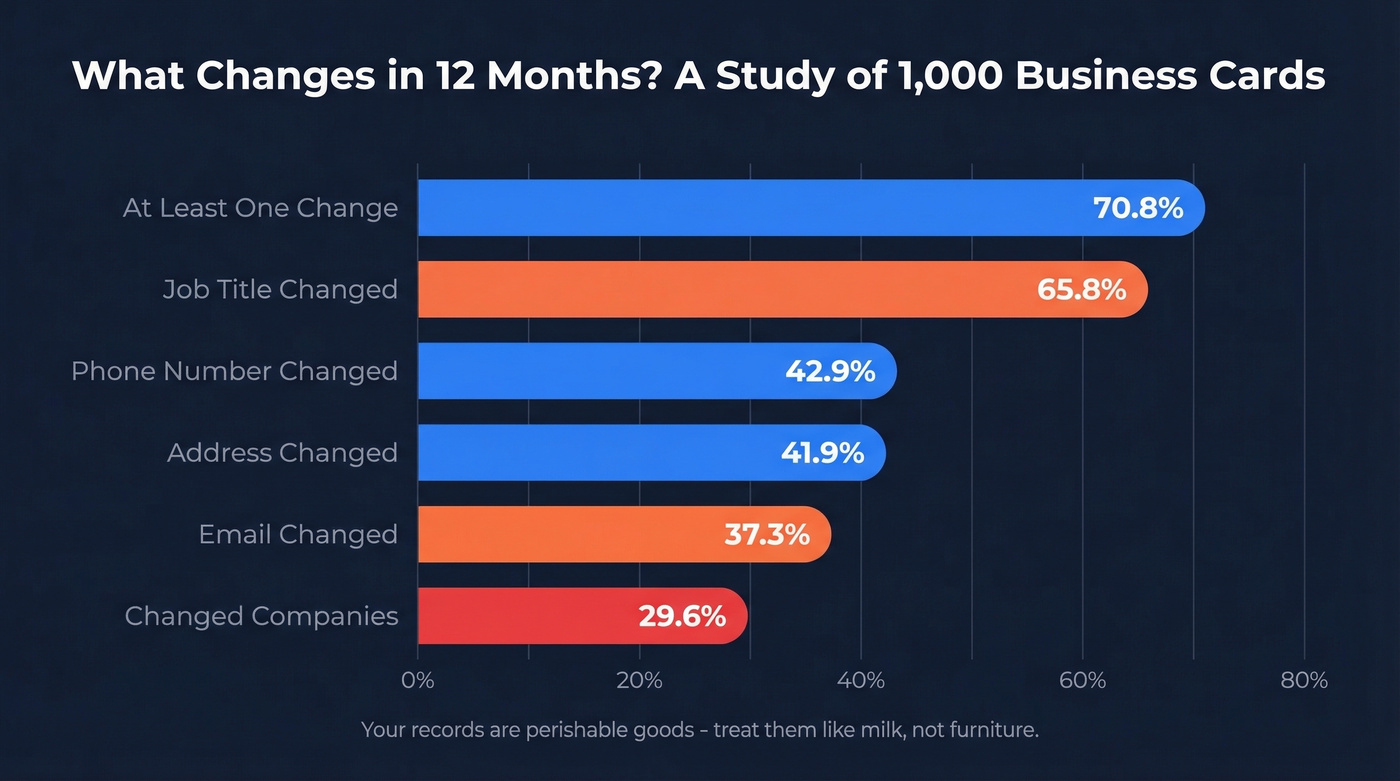
Your records aren't a static asset. They're a perishable good. Treat them like milk, not furniture.

The financial damage is staggering. IBM pegs the cost of bad data at $3.1 trillion per year across U.S. businesses. Gartner narrows it to an average of $15 million per year per organization. And 94% of businesses suspect their customer and prospect data is inaccurate - they're right. When you consider that a single verified B2B email can drive hundreds of dollars in pipeline, the cost of letting good records rot becomes painfully concrete.
Reps spend 5.5 hours per week searching for or entering prospect details. That's nearly 300 hours a year per rep, wasted on data janitorial work. Meanwhile, 40-60% of CRM contacts have no owner assigned and over 70% have no lifecycle stage.
Most CRMs aren't databases. They're graveyards.

Your CRM loses 22.5% of its contact data every year. Prospeo's 5-step verification and 7-day refresh cycle keep records accurate at 98% - while the industry average refresh takes 6 weeks. Snyk cut bounce rates from 35-40% to under 5% after switching.
Stop building pipeline on data that's already rotting.
How Fast Records Decay
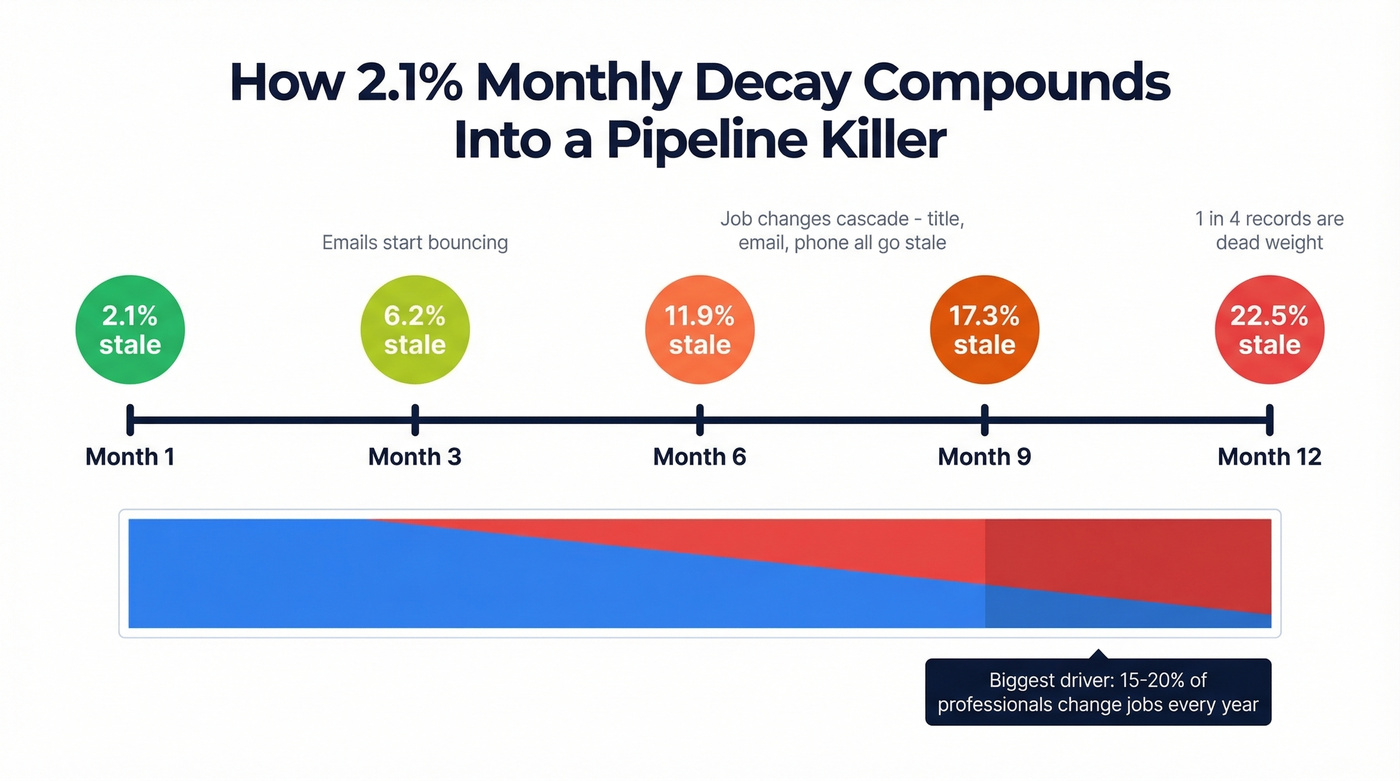
The Dun & Bradstreet benchmark puts B2B contact data decay at roughly 2.1% per month, compounding to 22.5% annually. But that's an average. Different fields decay at different rates, and we've seen this play out firsthand across our own enrichment workflows.
| Field | Annual Decay |
|---|---|
| Work email | 20-30% |
| Job title | 15-25% |
| Direct phone | 15-20% |
| Company | 10-15% |
| Mobile phone | 5-10% |
The biggest driver is job mobility - 15-20% of professionals change employers every year. When someone leaves a company, their work email bounces, their direct line gets reassigned, and their title becomes irrelevant. A single job change can invalidate three or four fields simultaneously, which is why monthly decay compounds so brutally.
How to Manage Contact Data
Let's be honest: training reps to "keep the CRM clean" doesn't work. It increases friction and produces low-quality entries. Gartner found that 40% of organizations lack formal data policies, which explains why most CRMs look the way they do. Automation beats compliance mandates every time.
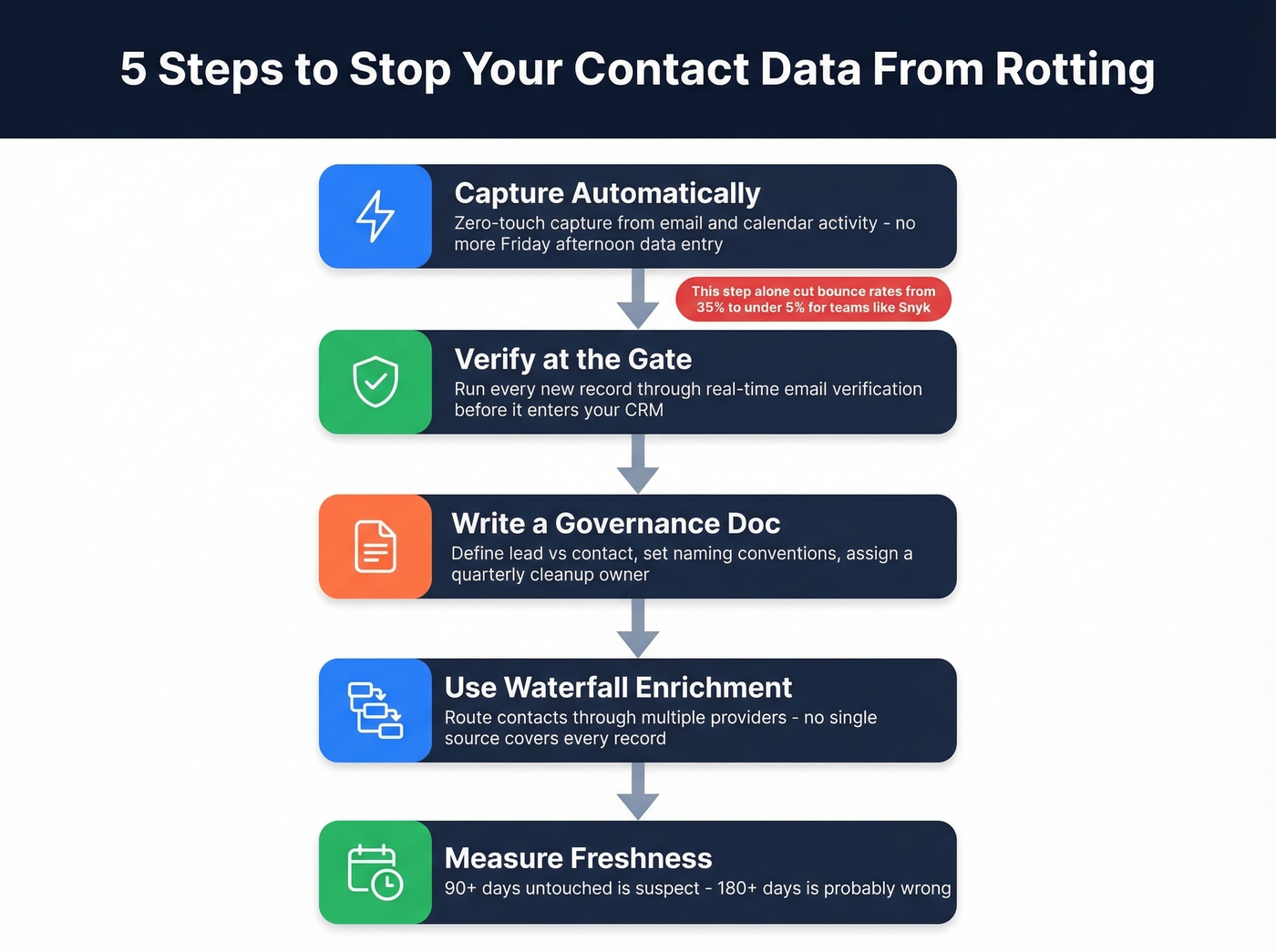
Here's what actually works:
Capture automatically. Use zero-touch capture from email and calendar activity to populate CRM records without manual entry. This eliminates the biggest source of garbage data - reps typing half-remembered details into Salesforce at 5 PM on a Friday.
Verify at the gate. Run every new record through real-time email verification before it enters your CRM. Prospeo's 5-step verification catches invalid addresses, spam traps, and catch-all handling at 98% email accuracy, with a 7-day refresh cycle that keeps records far fresher than the ~6-week industry average. Teams like Snyk cut bounce rates from 35-40% to under 5% just by adding this step before CRM import. (If you want to compare options, start with an email verifier.)
Write a governance doc. Define what counts as a lead versus a contact. Set naming conventions. Assign a quarterly cleanup owner. This takes an afternoon and saves hundreds of hours over the year.
Consider waterfall enrichment. Route contacts through multiple providers sequentially to push accuracy above any single source. No one provider covers every record perfectly, and this layered approach ensures you're not relying on a single B2B database with blind spots.
Measure freshness. Export records sorted by last-updated date. Anything untouched for 90+ days is suspect. Anything over 180 days is probably wrong. (This is also where data validation automation pays for itself.)
Choosing a Contact Data Provider
The sales intelligence market sits at $4.85 billion and is growing at 11.3% annually. There's no shortage of providers. The challenge is picking one that doesn't quietly rot your database while charging you enterprise prices for the privilege.
| Provider | Starting Price | Best For | G2 Rating | Refresh Cycle |
|---|---|---|---|---|
| Prospeo | Free (75/mo); ~$0.01/lead | Verified emails + mobiles, self-serve teams | - | 7 days |
| Apollo.io | Free-$119/user/mo | SMB prospecting | 4.7/5 (9,477) | ~4-6 wks |
| Lusha | $22.45/user/mo | Browser extension | - | ~4-6 wks |
| ZoomInfo | ~$15K-$45K+/yr | Enterprise teams | 4.5/5 (9,035) | ~4-6 wks |
| Hunter.io | $49/mo | Domain email search | - | - |
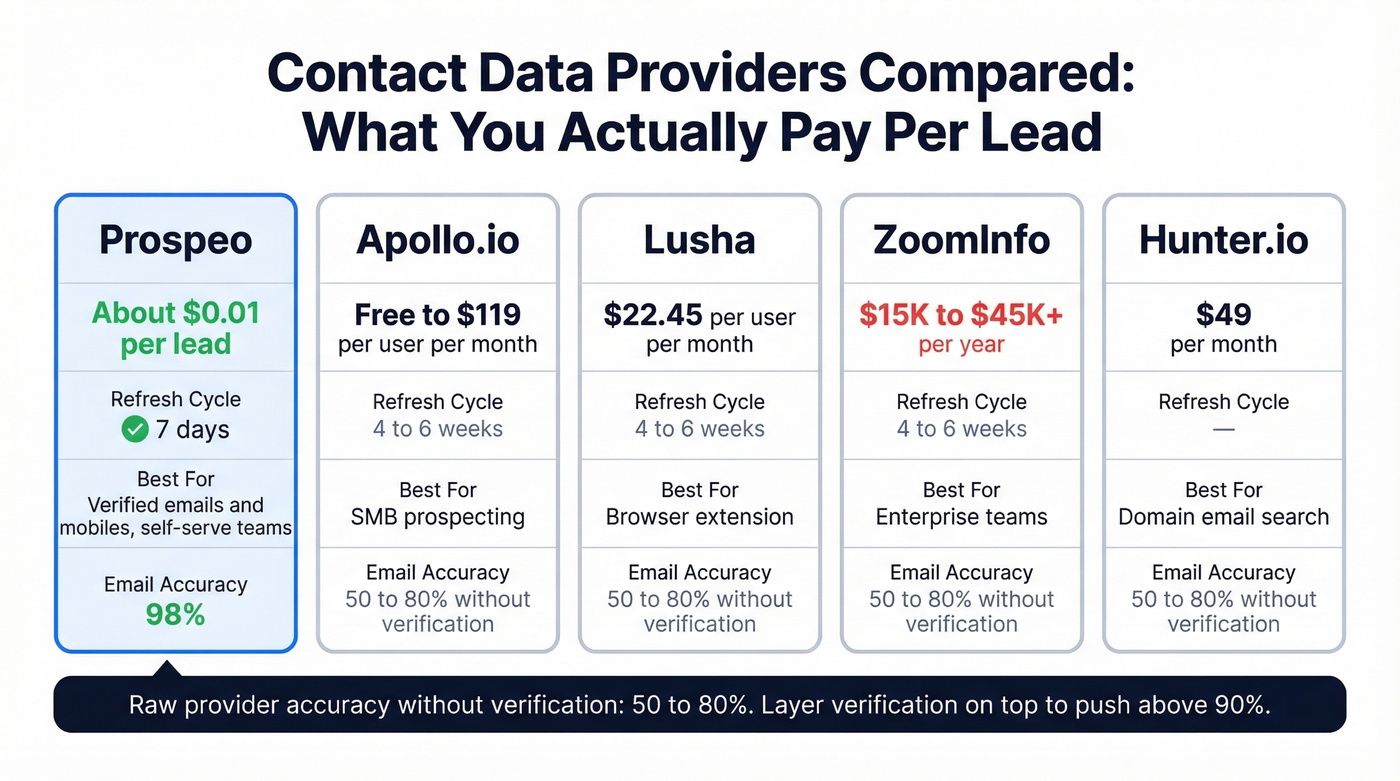
Here's the thing: ZoomInfo is still the most comprehensive all-in-one platform. But most teams don't need all-in-one - they need accurate emails and phones that don't bounce. If your team is under 50 reps, ZoomInfo's price tag is burning money you could spend on actual pipeline. At roughly $0.01 per lead versus ZoomInfo's ~$1 per lead, Prospeo delivers 98% email accuracy and 125M+ verified mobile numbers at a fraction of the cost.
For most teams, start with Apollo for prospecting and layer in verification before anything hits your CRM. That combination covers most use cases without enterprise pricing. What you're really paying for isn't access to records - it's the ability to know which ones are current and which are dead weight.
Raw provider accuracy without verification typically runs 50-80%. Layer email verification on top of any database and you can push deliverability above 90%. (If you're building lists at scale, pair this with a cold email lead list building workflow.) On Reddit, recruiting teams report testing multiple providers and finding significant accuracy gaps - one team on r/recruiting switched tools entirely after their primary provider's personal email coverage fell short for candidate outreach. G2 reviewers consistently note that even ZoomInfo still serves occasional outdated contacts, while Apollo gets praised for filters and workflow speed but dinged on data freshness.
Watch for credit traps. Monthly expiration on unused credits and 10-20% renewal increases are standard across the industry. If you're an SMB, skip the annual contract lock-ins entirely - self-serve tools with transparent pricing will save you both money and negotiation headaches.
Compliance Essentials
GDPR and CCPA take fundamentally different approaches. GDPR requires explicit opt-in consent before processing personal data, with penalties up to EUR 20 million or 4% of global turnover. CCPA operates on an opt-out model - you can process data but must provide a "Do Not Sell or Share My Personal Information" mechanism, with penalties of $7,500 per intentional violation.
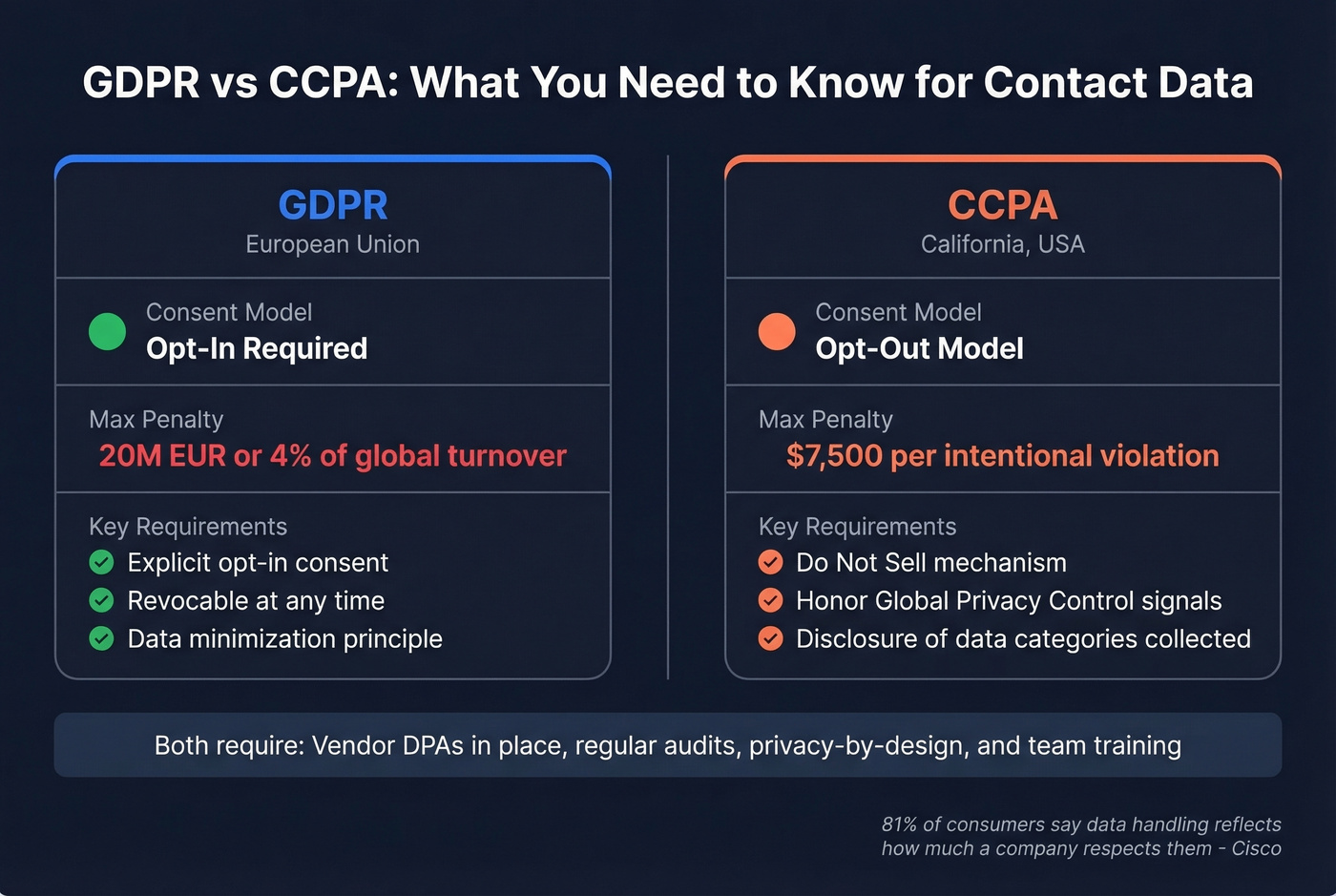
Cisco's survey found that 81% of consumers believe how an organization treats personal data reflects how it respects them. Compliance isn't just legal risk - it's trust.
Your operational checklist:
- GDPR: Explicit opt-in, revocable consent, data minimization
- CCPA: Opt-out mechanism, honor Global Privacy Control signals
- Both: Vendor DPAs in place, regular audits, privacy-by-design, team training on handling procedures (use a GDPR Compliant Database checklist when evaluating vendors)
At ~$0.01 per verified email, Prospeo gives you 300M+ profiles, 125M+ verified mobiles, and 143M+ verified emails - all refreshed weekly. That's 90% cheaper than ZoomInfo with higher accuracy and no annual contracts.
Replace your decaying database with contacts that actually connect.
FAQ
How often should I clean my contact data?
Run monthly bounce-rate checks and quarterly full audits. At 2.1% monthly decay, waiting longer than a quarter means 6%+ of your database is already stale. Assign a specific owner for each cycle - unowned hygiene tasks don't get done.
What's the difference between contact data and customer data?
Contact data is how you reach someone - email, phone, title, company. Customer data includes transaction history, product usage, and relationship context. The first gets you in the door; the second helps you stay and expand.
Can I use B2B data providers and stay GDPR compliant?
Yes, if the provider sources data lawfully, offers Data Processing Agreements, and you maintain opt-out mechanisms. Always verify your provider meets these standards before importing records into your workflows.
How much is a verified B2B email worth?
Verified B2B email addresses routinely drive $50-$500+ in pipeline value per address when used in targeted outbound campaigns. The real cost isn't the per-lead price - it's the lost revenue from bounced emails and missed conversations caused by stale records.