

B2B Data in 2026: The Practitioner's Guide to Cost, Accuracy, and Compliance
You build a list of 5,000 contacts, load them into your sequencer, and hit send. Three days later, 800 emails have bounced, your domain reputation is tanking, and your SDR manager is asking what went wrong. The answer is almost always the same: the B2B data was stale before you ever touched it. Poor data quality costs U.S. businesses $3.1 trillion annually, and most of that damage happens quietly - one bad list at a time.
One sales team on r/b2b_sales reported reply rates doubling after they started verifying and enriching their lists. Invalid emails and wrong titles had been the silent killer all along. Here's what business-to-business data actually costs in 2026, how accurate the major providers really are, and how to test any vendor before you commit a dollar.
What You Need (Quick Version)
- All-in-one prospecting + sequencing: Apollo.io - free tier; Basic plan includes 5,000 credits, paid plans from $49/user/mo, 275M+ contacts.
- Enterprise-grade everything with $15k+ budget: ZoomInfo - one of the deepest US databases, intent signals, GTM workflows/automation, and a price tag to match.
- EMEA-heavy territories: Cognism - strong coverage for European decision-makers, GDPR-first compliance posture, phone-verified mobile numbers (Diamond Data).
If you already know your use case, start a free trial with one of those and run the bake-off framework in Section 8. If you want to understand why these recommendations hold up, keep reading.
What Is B2B Data?
B2B data is any information about businesses and the people who work at them that you use to find, qualify, and sell to prospects. That's the simple version. The useful version requires breaking it into three layers.
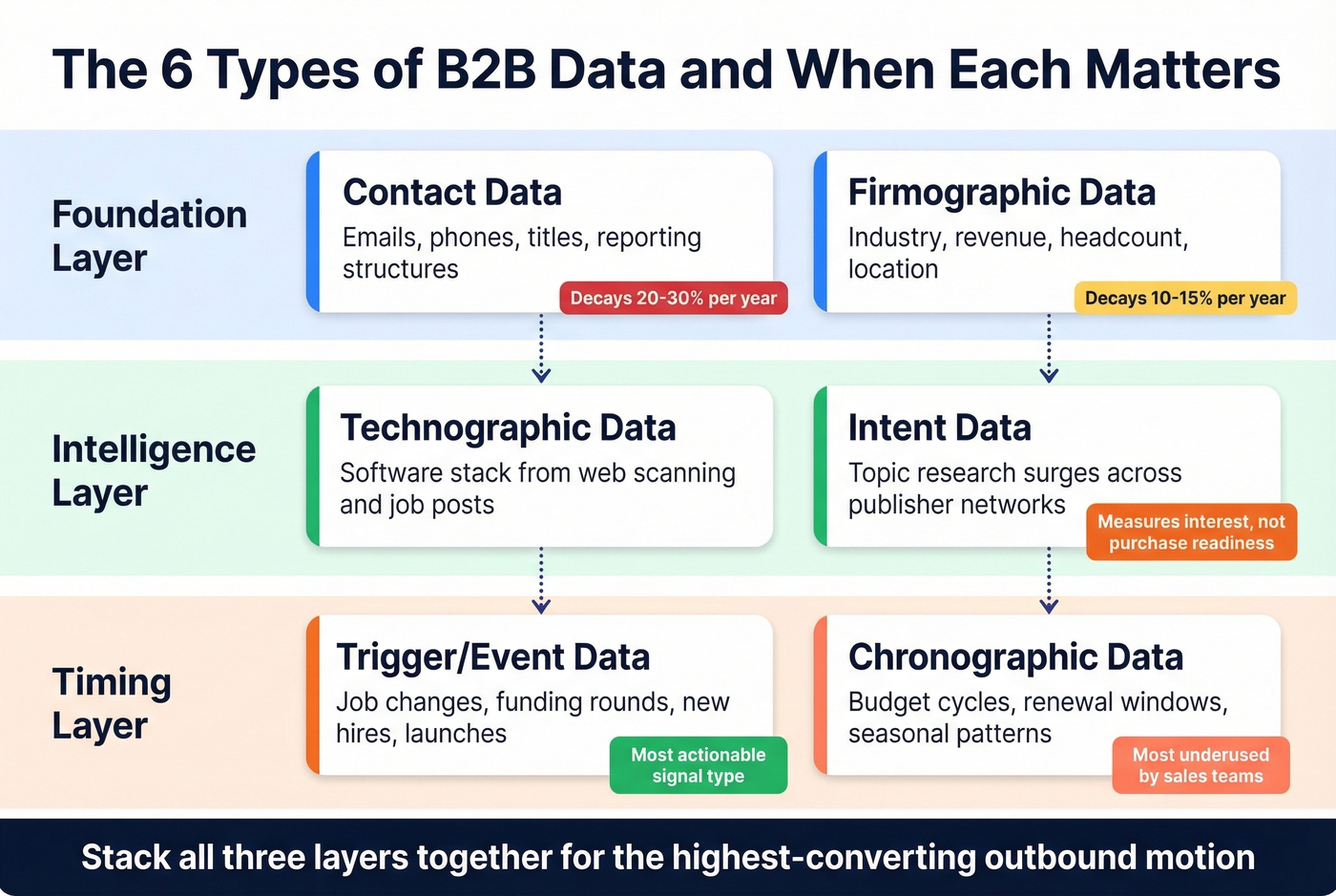
Contact data is the stuff that goes into your sequencer: names, emails, phone numbers, job titles. Company data (firmographics) tells you whether a business fits your ICP: industry, revenue, headcount, location. Signal data tells you when to reach out: intent surges, funding rounds, leadership changes, hiring spikes.
Most providers blend these layers, but they aren't equally good at all three. A tool with great contact data might have weak intent signals. A platform with excellent firmographics might serve you stale phone numbers. The Datarade taxonomy breaks business-to-business data into even finer categories, but for practical buying decisions, those three layers - contacts, companies, and signals - are what matter.
The 6 Types of B2B Business Data
Contact Data
Emails, direct dials, mobile numbers, job titles, and reporting structures. This is the foundation of every outbound motion, and it's also the layer that decays fastest. Work emails churn at 20-30% per year, and job titles aren't far behind at 15-25%. A "verified" email from six months ago might already be a bounce waiting to happen.
Firmographic Data
Industry classification, annual revenue, employee headcount, headquarters location, subsidiary structure. Firmographics are how you define your ICP at the account level. They decay slower than contact data - company-level attributes shift at roughly 10-15% annually - but mergers, acquisitions, and rebrands can make an entire account record obsolete overnight.
Technographic Data
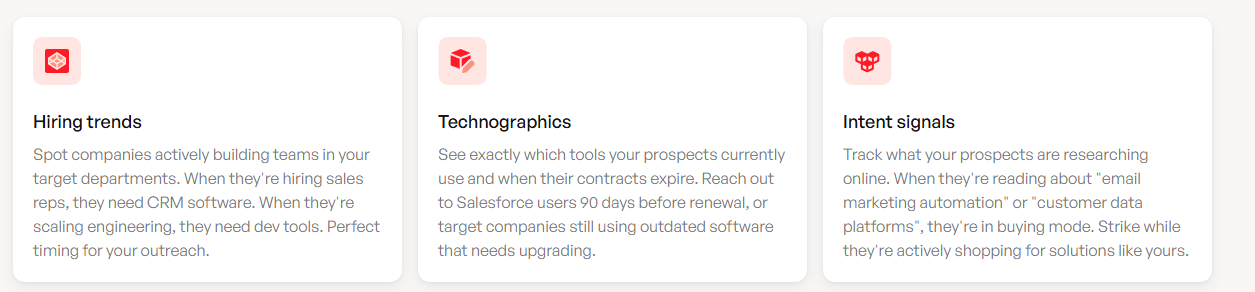
What software a company runs. Technographic signals come from two main sources: web-scanning tools like Wappalyzer that detect technologies on a company's site, and job posting analysis that infers stack decisions from hiring patterns. If a company posts three Snowflake engineer roles in a month, they're almost certainly a Snowflake customer - even if their website doesn't reveal it.
If you want a deeper breakdown of sources and vendors, see our guide to technographic data tools.
Intent Data
Intent data tracks when a company is researching a topic at above-baseline levels. Bombora's co-op network spans 5,000+ publisher sites and classifies activity across around 12,000 topics.
Here's the thing: intent data measures topic interest, not purchase readiness. A "surge" could be a competitor doing research, a journalist writing a piece, or an intern working on a school project. DemandScience calls this the "Marketing Data Mirage" - shallow signals that create activity but don't convert. Intent works best when combined with ICP fit and patterns over time, not as a standalone trigger. Stacking intent on top of firmographic and contact records is how you separate real buying signals from noise.
For a practical framework, use our playbook on how to identify buyer intent signals.
Trigger/Event Data
Job changes, funding rounds, new office openings, executive hires, layoffs, product launches. Triggers are the most actionable signal type because they represent a concrete change in a company's situation. A new VP of Sales who just started three weeks ago is far more receptive to a cold email than someone who's been in the role for two years.
If job changes are a core motion for you, build a system around automated champion tracking.
Chronographic Data
Time-based buying patterns and seasonal cycles - budget cycles, contract renewal windows, industry-specific seasonality. This category is underused by most teams, but it's incredibly powerful for timing outreach. Selling to education? June through August is when procurement decisions happen. Selling to retail? You're too late if you start in November.
Why B2B Data Goes Stale
Business contact records decay at roughly 22.5% per year - about 2.1% per month. That's an average. High-turnover industries like tech startups can see decay rates of 30-40% annually, and in extreme cases it runs as high as ~70%. The math is brutal: buy a list of 10,000 contacts in January and don't refresh it, and roughly 2,250 records will be wrong by December.
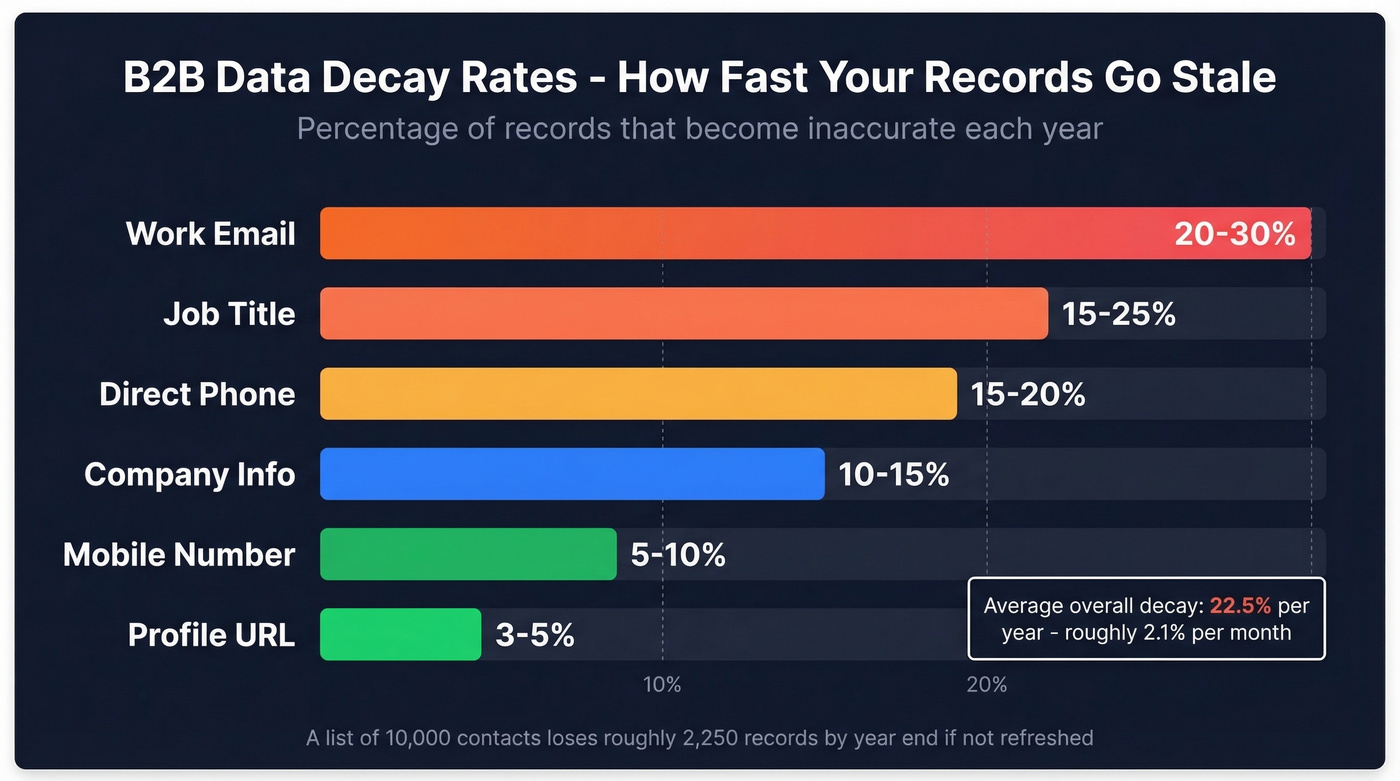
The biggest driver is job changes. The average professional changes jobs every 18-24 months, which means any contact list older than a year has a significant chunk of people who've already moved on. When someone switches roles, their work email, title, phone number, and sometimes even their company all change simultaneously. One job change can invalidate four or five fields at once.
Sales reps waste 27.3% of their time - about 546 hours per year - pursuing leads built on bad data. That's not just an efficiency problem; it's a $12.9 million annual cost per organization, according to Gartner research. Lists older than 90 days often drift into 5-8% bounce rates, and that's enough to start damaging sender reputation.
If you're seeing bounces creep up, use this guide on soft bounce rate to diagnose what's happening.
| Data Field | Annual Decay Rate |
|---|---|
| Work Email | 20-30% |
| Job Title | 15-25% |
| Direct Phone | 15-20% |
| Company | 10-15% |
| Mobile | 5-10% |
| Professional Profile URL | 3-5% |
The industry-average refresh cadence is around every six weeks. If your provider can't tell you their refresh cadence, or if the answer is "quarterly," you're working with records that are already decaying by the time you pull them. We've seen this firsthand - one customer, Snyk, saw bounce rates drop from 35-40% to under 5% after switching to a 7-day refresh cycle. That's the power of prioritizing freshness at scale.

The article above shows B2B data decays at 22.5% per year. Most providers refresh every 6 weeks - Prospeo refreshes every 7 days. That's why teams like Snyk cut bounce rates from 35% to under 5% and generated 200+ new opportunities per month. 300M+ profiles, 98% email accuracy, starting at $0.01 per email.
Stop sending campaigns built on stale data. Test the difference free.
How Accurate Is B2B Data, Really?
Vendor accuracy claims are marketing. Every provider says they're 95%+ accurate. The independent benchmarks tell a different story.
A Salesfinity benchmark tested phone data across 9 providers using 307 verified contacts. Accuracy ranged from 63% to 91%. That's a 28-percentage-point spread across tools that all market themselves as "accurate." A Cleanlist test of 1,000 records found that single-source databases could only locate 62% of emails, while waterfall enrichment - running the same records through multiple sources - hit 98%.

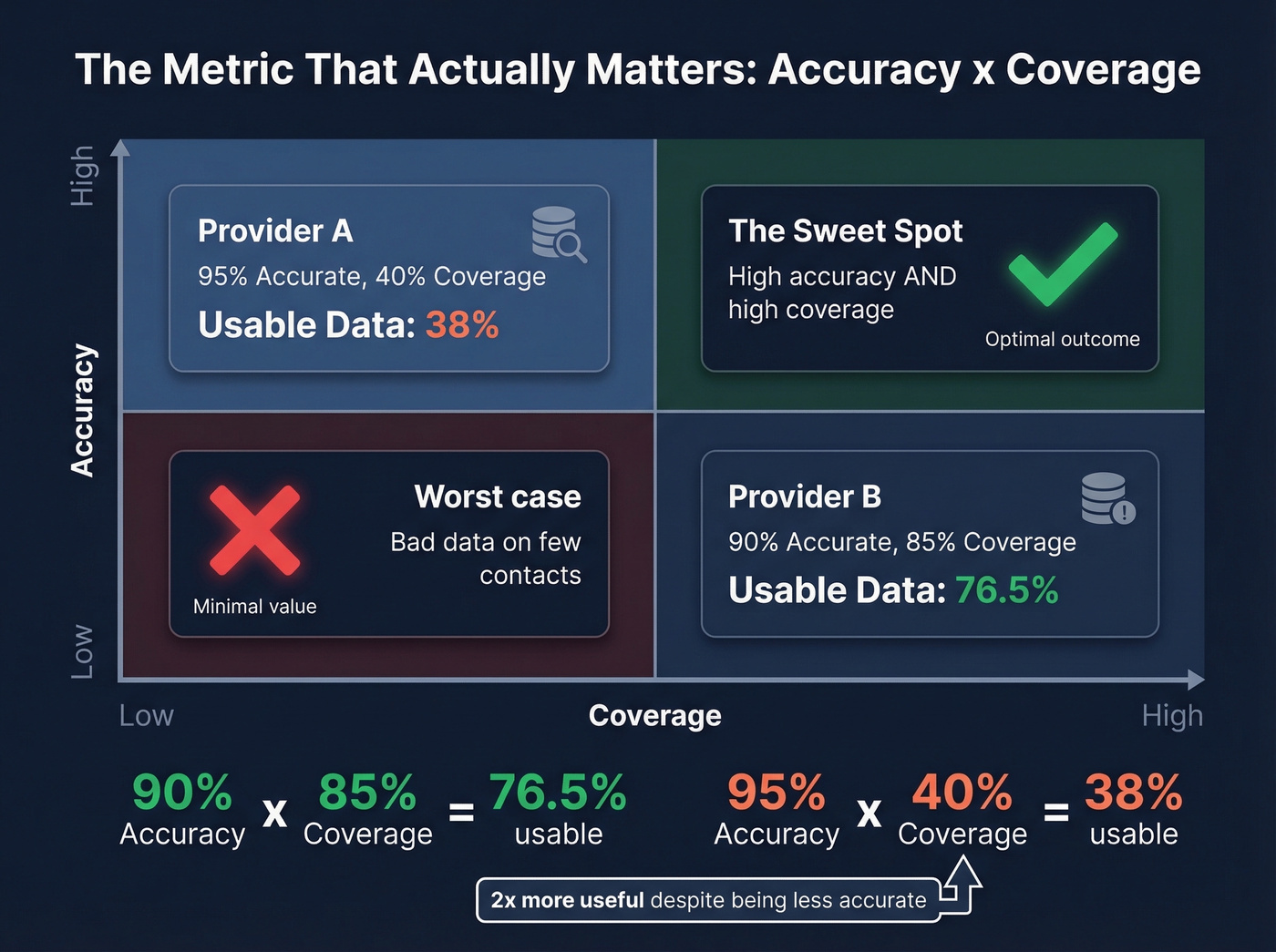
The metric that actually matters isn't accuracy alone - it's Accuracy x Coverage. A provider that's 95% accurate but only matches 40% of your list gives you usable data on 38% of your targets. A provider that's 90% accurate on 85% coverage gives you usable data on 76.5% of your targets. The second provider is twice as useful despite being "less accurate."
Reddit threads on r/SalesOperations consistently put Apollo's email accuracy around 65-70% and Lusha around 60-65% in real-world usage. Those numbers are significantly lower than what either vendor markets. The gap between claimed accuracy and experienced accuracy is the single biggest source of frustration when buying contact databases - and it's why running your own test matters more than reading any vendor's marketing page, including ours. We've run this test across dozens of providers, and the gap between claimed and actual accuracy never stops surprising us.
If you're comparing vendors, our ranked list of the best B2B database options goes deeper on accuracy tradeoffs.
What B2B Data Costs in 2026
Pricing ranges from free tiers to six-figure enterprise contracts. The gap between what vendors charge and what you actually need is often enormous.
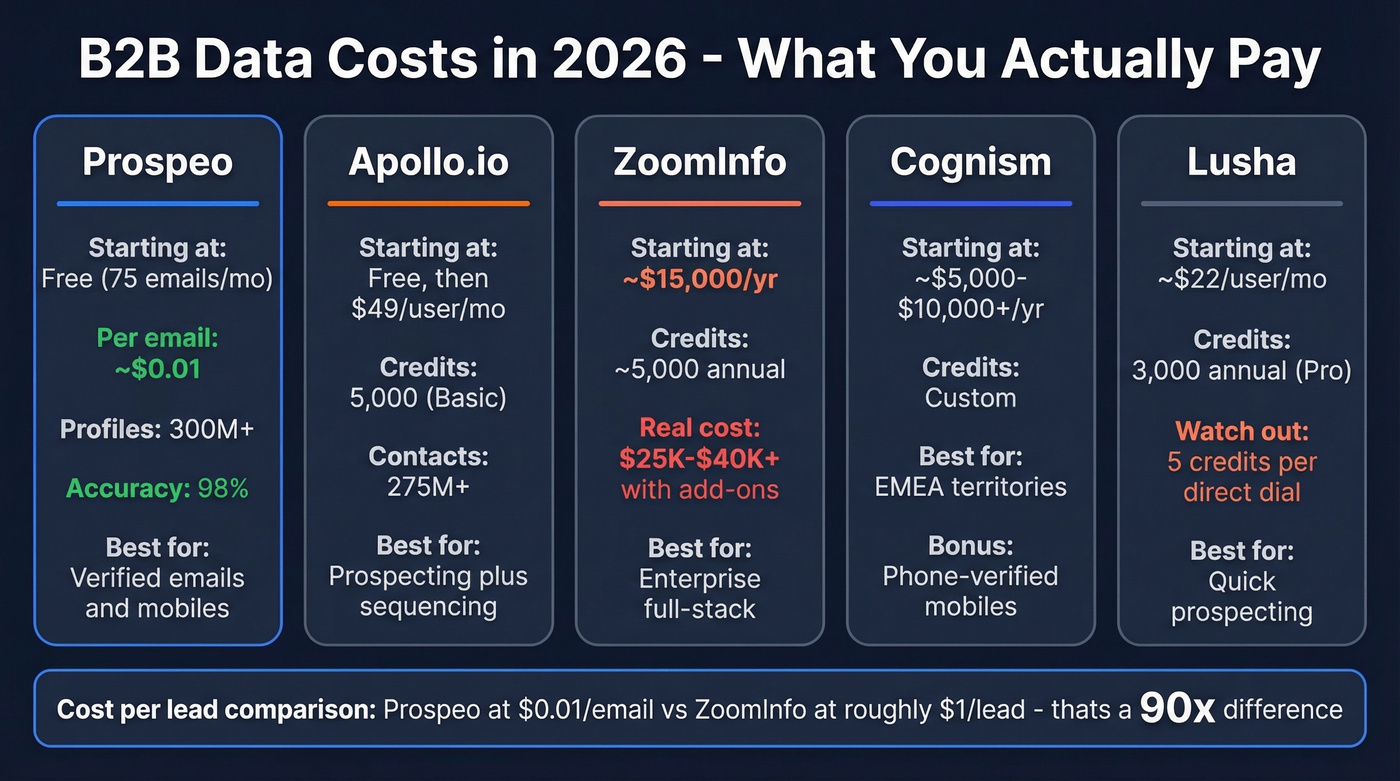
| Provider | Starting Price | Credits/Contacts | Best For | Notes |
|---|---|---|---|---|
| Prospeo | Free (75 emails/mo); ~$0.01/email | Pay-per-use, no lock-in | Verified emails + mobiles | 98% email accuracy, 7-day refresh, 300M+ profiles |
| ZoomInfo | ~$15,000/yr | ~5,000 annual credits, up to 3 users | Enterprise full-stack | Auto-renewal clauses; add-ons push cost to $25K-$40K+ |
| Apollo.io | Free; $49/user/mo | 5,000 (Basic) | Prospecting + sequencing | 275M contacts; two data breaches (2018, 2021) |
| Cognism | ~$5,000-$10,000+/yr | Custom | EMEA territories | Phone-verified mobiles; strong GDPR compliance |
| Lusha | ~$22/user/mo | 3,000 annual (Pro) | Quick prospecting | 1 credit/email but 5 credits/direct dial; credits expire annually |
| Seamless AI | ~$150/mo | Custom by plan | AI-powered list building | Real-time search; mixed accuracy reviews |
| Breeze (Clearbit) | ~$30/mo (100 credits) | Credit packs to 10,000 | HubSpot enrichment | Best if you're already in HubSpot |
| UpLead | ~$99/mo | Varies by plan | SMBs, accuracy guarantee | 95% accuracy guarantee with refund policy |
| Lead411 | ~$49/mo | Varies | Budget intent data | Bombora intent included at lower price points |
Let's be honest: ZoomInfo is still one of the deepest all-in-one platforms for US data. But most teams don't need all-in-one. If your average deal size is under $15k, you're probably paying for features you'll never touch. A focused tool with better accuracy at 10% of the cost will outperform a bloated platform every time.
If you prefer usage-based pricing, compare options in our guide to pay-as-you-go B2B data.
The cost-per-lead math makes this concrete. At $0.01 per verified email versus roughly $1 per lead on ZoomInfo, that's a 90x difference. For a Series A company running 5,000 contacts per month through outbound sequences, the annual cost difference is tens of thousands of dollars.
ZoomInfo's "custom quote" model is one of the most opaque in the industry. Professional tier starts around $15,000/year. Add-ons for intent data, advanced analytics, and additional seats push real costs to $25,000-$40,000+ for most mid-market teams. Auto-renewal clauses and narrow cancellation windows are the #1 complaint on Reddit - and for good reason.
Watch out for credit model pitfalls too. Lusha charges 1 credit per email but 5 credits per direct dial - a team that needs phone numbers will burn through credits fast. Those credits expire annually, so you're paying for them whether you use them or not.
How to Test a B2B Data Provider
Don't trust marketing pages. Don't trust this article. Test the data yourself.
Start by building a test sample of 100-200 records from your actual ICP. Include a mix of titles, industries, and company sizes that represent your real target market. Critically, include 20-30 "control" contacts - people whose information you already know is correct - so you can measure accuracy against ground truth.
Run the same list through 2-3 providers simultaneously and pull the results side by side. You're measuring two things: how many records each provider could match (coverage), and how many of those matches are correct (accuracy). Cross-check titles and companies against professional profiles and corporate leadership pages - titles are the most commonly wrong field, and someone listed as "VP of Marketing" might have been promoted to CMO six months ago.
Then run independent email verification on the results. Don't trust the vendor's "verified" label. Use a separate verification tool and check for bounces, catch-all domains, and spam traps. The test most teams skip is the most revealing: call 10-15 phone numbers. If half the direct dials go to a main switchboard or a disconnected line, you have your answer.
If you need a vendor shortlist first, start with these data enrichment tools and work backward into your bake-off.
After that, calculate Accuracy x Coverage for each provider. The provider with the highest combined score wins - not the one with the highest accuracy on a small subset.
Finally, ask about refresh cadence. If a vendor can't tell you how often their data is updated, or if the answer is vague, that tells you everything. Prospeo's free tier gives you 75 verified emails per month - enough to run a proper bake-off without spending a dollar or signing a contract.
Skip any vendor that won't let you test before you commit. The good ones are confident enough to let their data speak for itself.
You just read that bad B2B data costs $12.9M per organization annually. Prospeo's 5-step verification, catch-all handling, and spam-trap removal deliver 98% email accuracy - compared to 87% from ZoomInfo and 79% from Apollo. Layer in intent data across 15,000 Bombora topics, technographics, and job change signals with 30+ search filters.
Run your own bake-off. 75 free emails, no credit card, no sales call.
B2B Data Compliance in 2026
Compliance isn't optional, and California's CPPA regulations tightened significantly heading into 2026.
GDPR still governs B2B prospecting in Europe under the "legitimate interest" basis. You can use third-party data for outreach if you can justify the purpose, ensure traceability of the data's origin, and provide recipients with access, objection, and deletion rights. Legitimate interest isn't a blank check - you need a documented rationale, and "we wanted to sell them something" isn't sufficient on its own.
If you're building a process around this, use a GDPR compliant database checklist to pressure-test vendors.
CCPA enforcement escalated through 2025 and into 2026. The CPPA Board approved a $1.35 million settlement with Tractor Supply Company, signaling that enforcement is real and growing. New regulations covering cybersecurity audits, risk assessments, and automated decision-making technology are now in effect, with substantive changes effective Jan 1, 2026. California is unique in that it applies privacy law to HR and B2B contexts - unlike most states, business contact data isn't exempt.
Key compliance dates to track:
- Jan 1, 2026: New processing activities require completed risk assessments before you begin processing.
- Jan 1, 2027: ADMT requirements take effect - any technology that replaces or substantially replaces human decision-making in "significant decisions" falls under new rules.
- Apr 1, 2028: Businesses with $100M+ revenue must submit cybersecurity audit certifications to the CPPA, plus attestations and summaries of risk assessments for 2026 and 2027.
When evaluating any provider, ask these questions: Where does the data come from - public sources, partnerships, purchased lists? What opt-out mechanism exists for contacts who don't want to be in the database? Can they provide a Data Processing Agreement? How do they handle deletion requests, and what does their data provenance documentation look like?
If a vendor can't answer these clearly, they're a compliance liability - regardless of how good their data is. For a broader view, see our guide to B2B compliance.
FAQ
Is B2B data legal to buy and use?
Yes, under both GDPR (legitimate interest basis) and CCPA, with conditions. You need a justifiable purpose for outreach, must honor opt-out requests, and should verify your provider's data provenance. California applies privacy law to business contacts specifically, so teams selling into the US need to treat professional emails with the same care as consumer data.
How often should contact records be refreshed?
Weekly is the gold standard; quarterly is the bare minimum. At 22.5% annual decay, a list refreshed only once a year means roughly 1 in 4 records is stale. A 7-day refresh cycle versus the 6-week industry average can cut bounce rates by 80%+, as Snyk's results showed.
What's the difference between first-party and third-party data?
First-party data comes from your own interactions - website visits, form fills, CRM records, event attendees. Third-party data is purchased from providers who aggregate from public and private sources. First-party is more accurate but limited in scale. Third-party gives you reach but requires verification. The best outbound teams blend both.
Can I test a provider before committing?
Yes - and you absolutely should. Most providers offer free tiers or trials. Build a 100-200 record test from your ICP, run it through 2-3 vendors simultaneously, and compare Accuracy x Coverage. Prospeo's free tier (75 verified emails/month) and Apollo's free plan both let you run a meaningful bake-off at zero cost.
Why do enterprise vendors hide their pricing?
They use custom quotes to vary pricing based on company size, seat count, and modules selected. If a vendor won't publish pricing, expect $10,000+ annual contracts with lock-in clauses and narrow cancellation windows. Transparent, self-serve pricing - like credit-based models - is still the exception, not the norm.