

How to Identify Buyer Intent Signals (and Actually Act on Them)
Your SDR opens the dashboard Monday morning. There are 150 accounts flagged with buyer intent signals overnight. By Wednesday, she's worked through 40 - bounced 9 emails, reached 2 voicemails with disconnected numbers, and discovered that the "intent surge" on 6 accounts was a single blog visit from three weeks ago. Only 59% of intent data users report being even "somewhat satisfied" with their solution. That's not a rounding error. That's a category failing its buyers.
Most teams collect intent signals but lack three things: a scoring model, decay logic, and verified contact data to actually reach the person behind the signal. We've watched this pattern play out across dozens of outbound teams, and the fix isn't buying a bigger platform - it's building the right operational workflow first. Track 3-5 Tier 1 signals (demo requests, pricing page visits, competitor comparisons), score them with decay windows, and reach out within 48 hours with verified contacts. Skip the $50K enterprise platform until you've proven the workflow with self-serve tools.
What Are Buyer Intent Signals?
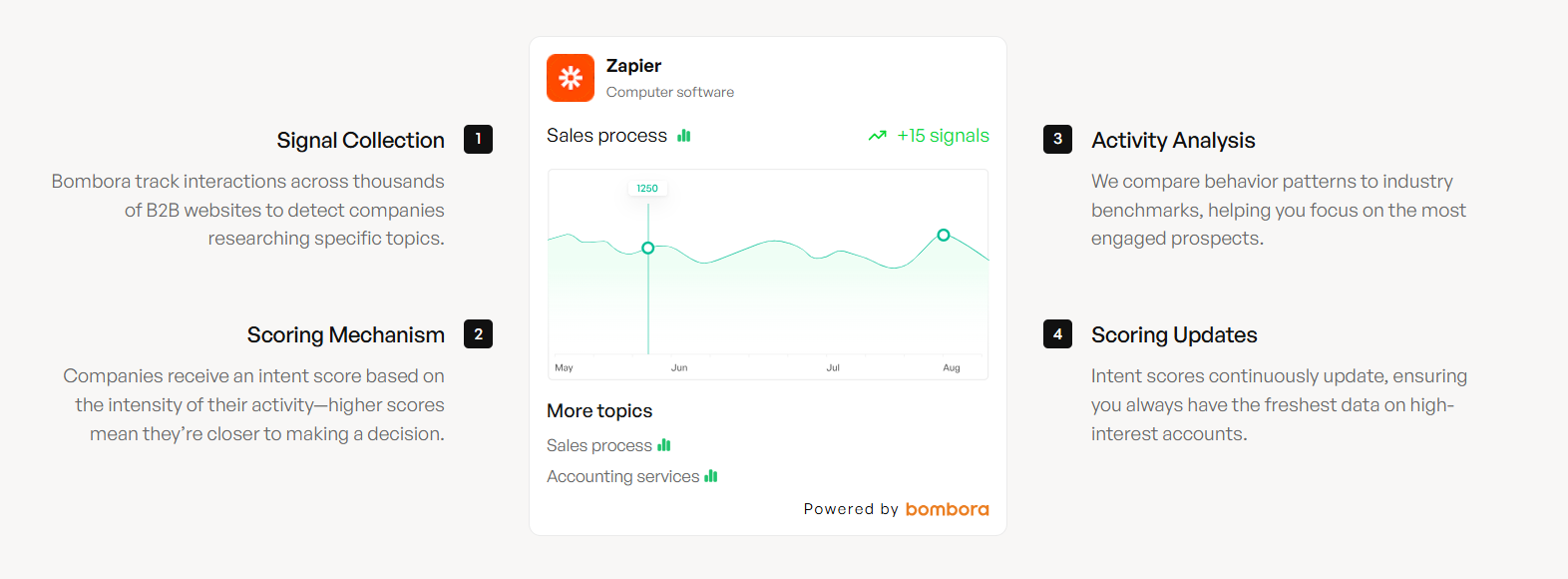
Buyer intent signals are behavioral data points revealing a company or individual is actively researching a problem your product solves. Intent data should answer three questions: what a company is researching, how intensely they're engaging across frequency, depth, and recency, and who within the organization is involved.
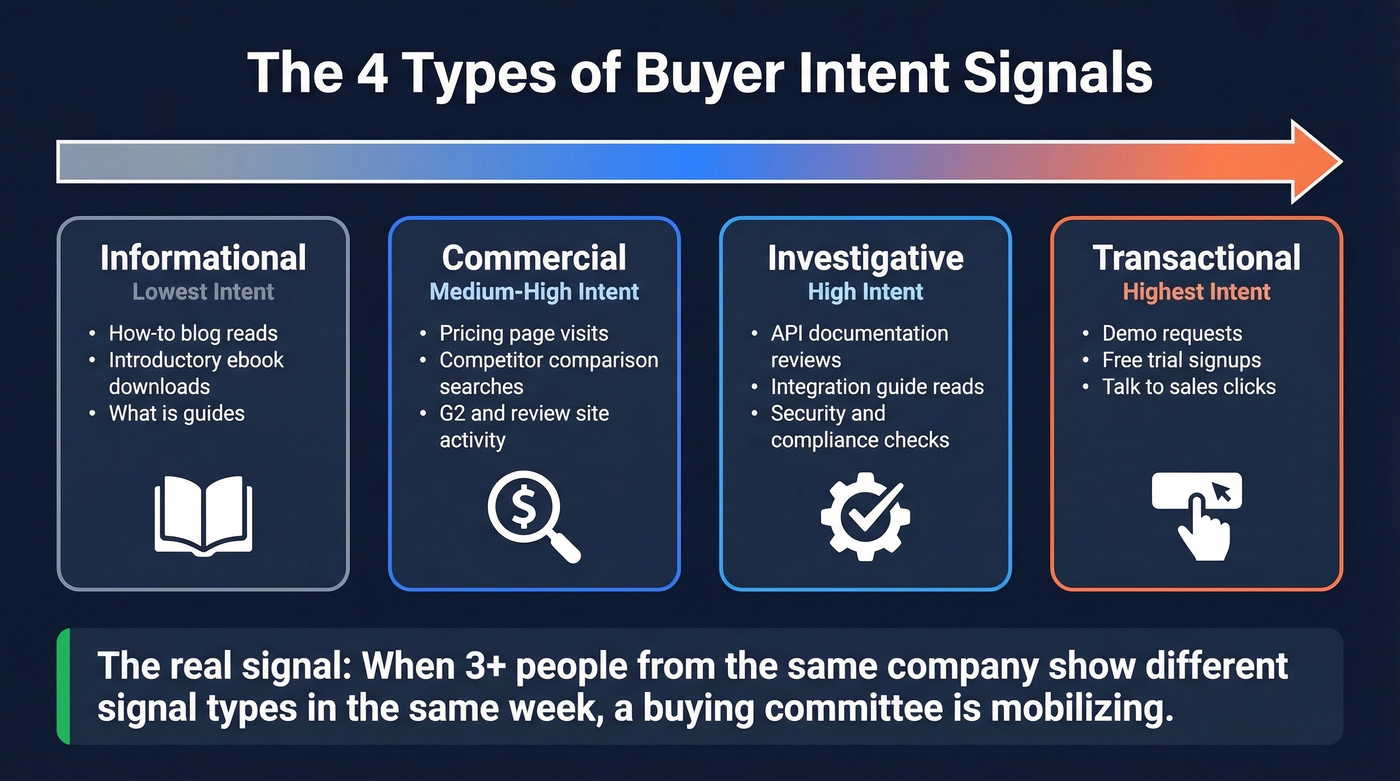
Demandbase breaks intent into three categories: active (pricing page visits, demo requests, competitor comparisons), passive (newsletter signups, webinar registrations), and awareness-based (how-to blog reads, early-stage content consumption). The category matters because 77% of B2B buyers won't talk to sales until they've done their own research. If you're only tracking active signals, you're seeing the tail end of a process that started months ago.
Four Types of Intent Signals
Informational Signals
Early-stage breadcrumbs - someone reads a "what is" guide, browses a how-to post, or downloads an introductory ebook. A single blog visit means nothing. But when they cluster across the same company, with multiple readers and escalating topics over two weeks, a team is educating itself on a problem space.
Commercial Signals
Pricing page visits, competitor comparison searches, review site activity on G2 or TrustRadius, "alternatives to [your competitor]" queries. These are the online buying signals that indicate a buyer who's past education and into evaluation.
Commercial signals deserve immediate attention and higher scoring weight. A pricing page visit is typically far more valuable than an informational read because it signals evaluation, not curiosity. When the consensus on r/sales is that "intent data is just noise," it's usually because teams are weighting informational and commercial signals equally - and drowning in low-quality alerts.
Investigative Signals
Picture your CTO reviewing API docs at 11pm, your IT lead reading integration guides, your security team checking SOC 2 status. Investigative signals come from the buying committee's technical evaluators and often appear mid-funnel. When you see them alongside commercial signals from the same account, that deal is getting serious internally.
Transactional Signals
Demo requests, free trial signups, contact form submissions, "talk to sales" clicks. Highest intent. If you're not routing these to a rep within hours, you're leaving pipeline on the table.
The multi-stakeholder pattern is the real tell: when IT reads comparisons, the CFO downloads pricing guides, and the CTO reviews technical docs simultaneously, that account is in active buying mode. One person browsing is curiosity. Three people from the same company browsing different evaluation content in the same week is a buying committee mobilizing.
First-Party vs. Third-Party Intent Data
An Insight Collective survey of 200 senior marketers found that 55% use a combination of first-party and third-party intent data, 26% rely on first-party only, and 19% use third-party exclusively. Of those using both, 75% lean more heavily on first-party.
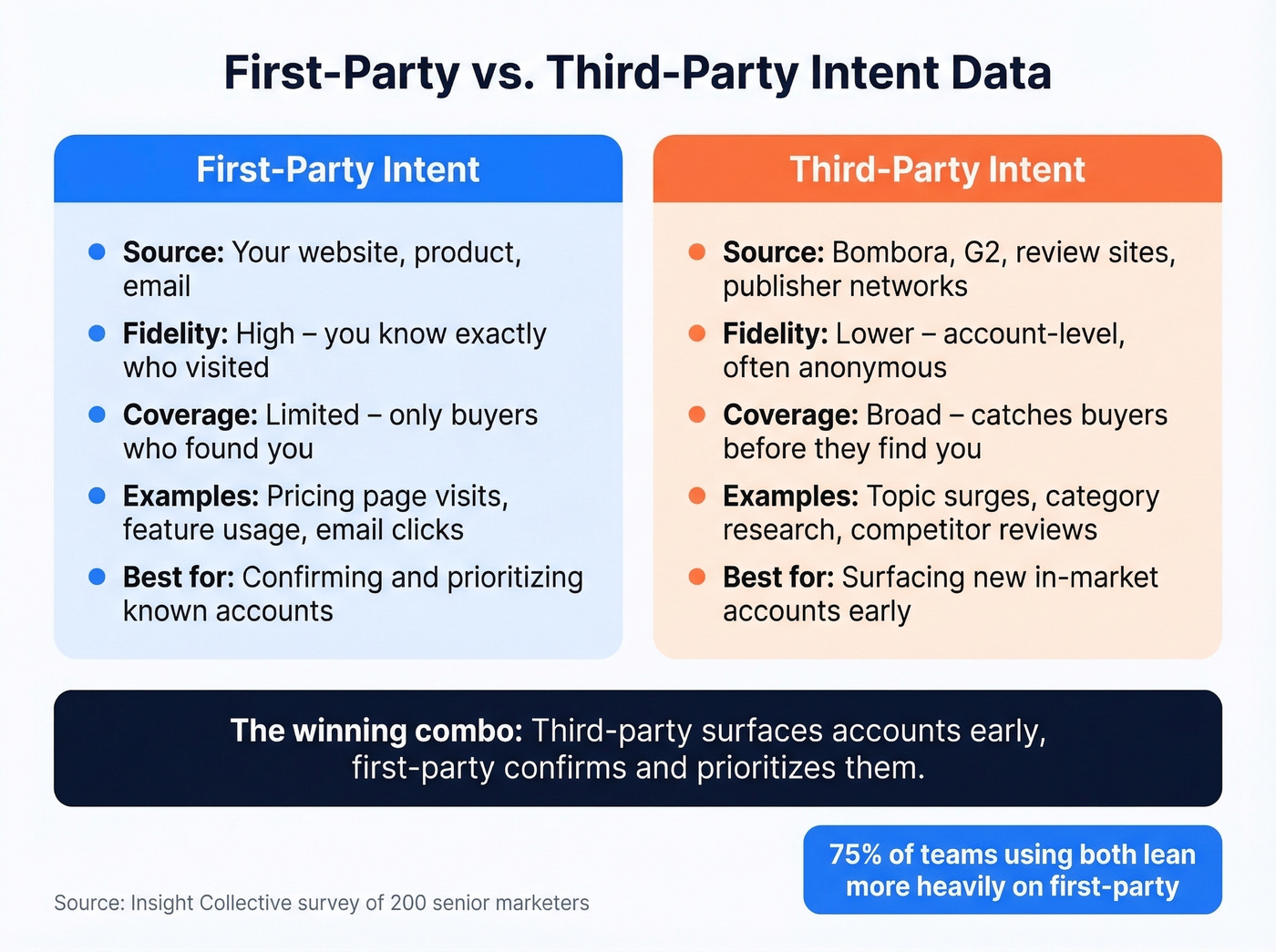
That split makes sense. First-party intent from your website analytics, product usage, and email engagement is higher fidelity - you know exactly who visited your pricing page and how long they stayed. Third-party intent from sources like Bombora topic surges, G2 category research, and review site activity gives you broader, earlier coverage of companies researching your category before they ever hit your site.
Here's the thing: you need both. First-party alone means you only see buyers who've already found you. Third-party alone gives you noisy, account-level signals with no context about your specific product. The combination - third-party to surface in-market accounts early, first-party to confirm and prioritize - is what actually works.
The Dark Funnel Problem
Buyers spend roughly 73% of their journey researching anonymously, conducting an average of 12 online searches before visiting a brand's website. The average B2B buying journey spans 13 months, involves buying groups of 12.8 people, and generates around 1,280 interactions before a deal closes.
Most of that activity is invisible to your CRM. Buyers research in communities, Reddit threads, Slack groups, review sites, and peer conversations that no tracking pixel can reach. These anonymous journey signals - peer recommendations, private Slack threads, dark social shares - shape vendor preferences long before anyone fills out a form. They've largely set their requirements and often identified a preferred vendor before they ever interact with your site.
A consistent frustration with traditional intent programs is that intent data often tells you a company is interested, but not who at that company to call. Anonymous signals at the account level are useful for prioritization, but they don't give your rep a name to dial. The solution isn't to track everything (you can't). It's to build a signal stack that layers what you can see with what third-party providers can surface, then act fast enough that timing compensates for incomplete visibility.

Intent signals are worthless without verified contacts behind them. Prospeo pairs 15,000 Bombora intent topics with 143M+ verified emails and 125M+ direct dials - so you go from "Company X is researching" to calling the right buyer in minutes, not days.
Stop flagging accounts. Start reaching the actual buyers behind the signal.
Building Your Intent Signal Stack
Layer 1: Website Visitor Tracking
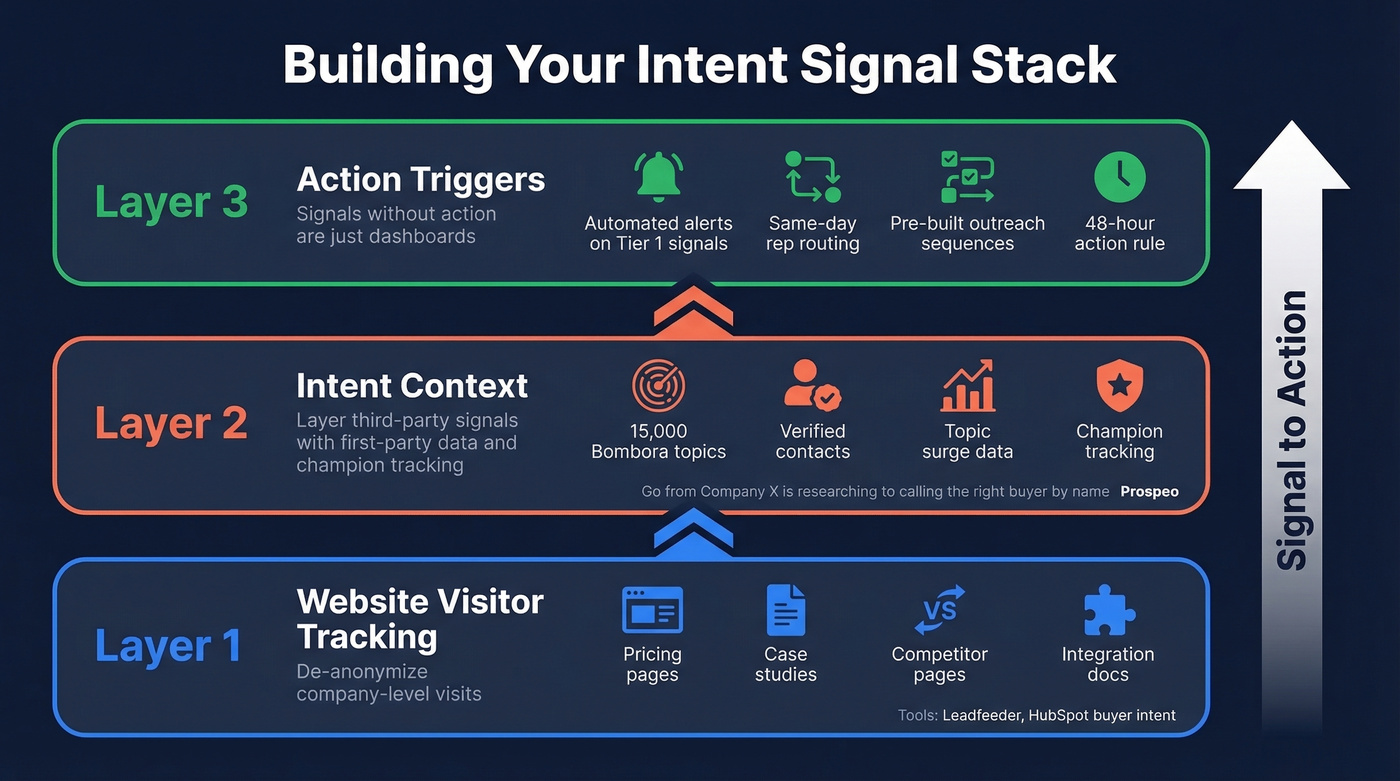
Start with de-anonymizing company-level website visits. Tools like Leadfeeder or HubSpot's buyer intent features can match website visits to companies, turning anonymous prospect behavior into actionable account-level data. Prioritize the right pages - pricing, competitor comparisons, case studies, and integration docs signal real evaluation. A homepage bounce means nothing.
Layer 2: Intent Context
Raw visitor data isn't enough. You need to layer in third-party intent signals alongside first-party engagement data and champion tracking. Prospeo's intent data covers 15,000 Bombora topics paired directly with verified contact data - so instead of "Company X is researching sales engagement," you get the verified email and direct dial for the VP of Sales at Company X. That's how you convert anonymous demand signals into named contacts your reps can actually reach.
Layer 3: Action Triggers
Signals without action are just dashboards. Build prioritized daily plays: automated alerts when a Tier 1 signal fires, same-day routing to the assigned rep, and pre-built sequences ready to deploy. The 48-hour rule is non-negotiable - if a high-intent signal sits in a queue for a week, it's already stale.
How to Score Intent Signals
You don't need more signals. You need fewer, better ones with a clear scoring model and decay logic. Here's a framework we've tested across multiple outbound teams:
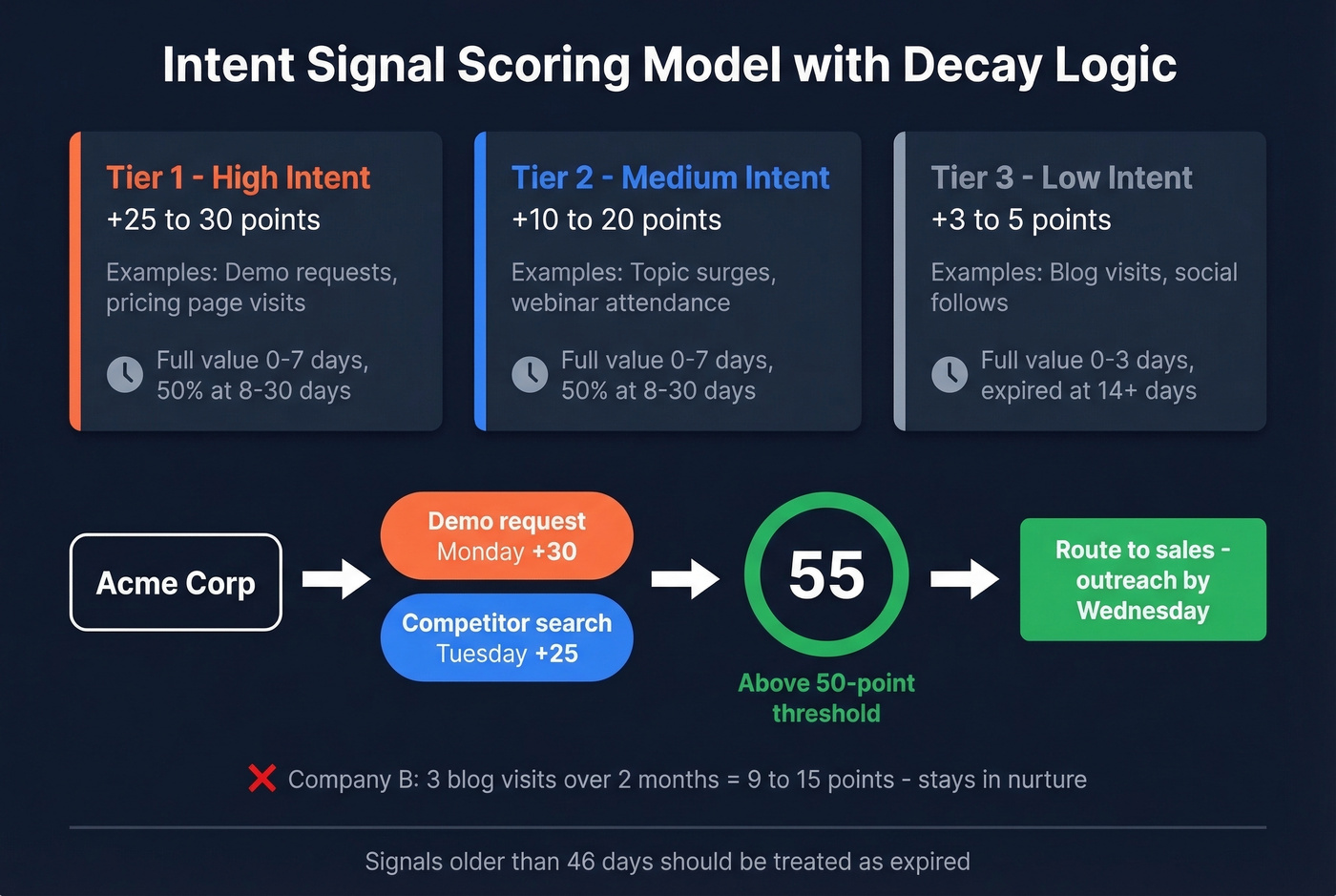
| Signal Tier | Points | Examples | Decay |
|---|---|---|---|
| Tier 1 (High) | +25-30 | Demo requests, pricing visits | Full 0-7d, 50% at 8-30d |
| Tier 2 (Medium) | +10-20 | Topic surge, webinar attendance | Full 0-7d, 50% at 8-30d |
| Tier 3 (Low) | +3-5 | Blog visit, social follow | Full 0-3d, expired at 14d+ |
The decay windows matter more than the point values. A pricing page visit from yesterday is worth 30 points. That same visit from three weeks ago? Worth 15 at best. Signals should be treated as expired after 46+ days - otherwise every company in your TAM eventually looks "high intent," which is the same as no intent at all.
Set your activation threshold at 50 points and route anything above it to sales within 48 hours. Say Acme Corp submits a demo request on Monday (+30) and runs a competitor comparison search on Tuesday (+25). That's 55 points - immediate outreach on Wednesday. A company with three blog visits over two months scores 9-15 points and stays in nurture. The math keeps your reps focused on accounts that are actually buying.
Let's be honest: most teams would generate more pipeline by tracking 5 signals well than by subscribing to an enterprise intent platform that surfaces 500 signals they never act on. 35% of teams say a top challenge is turning intent signals into actionable outcomes. The problem isn't data volume. It's operational discipline.
Intent Data Mistakes That Kill Pipeline
Five mistakes show up repeatedly, and Forrester's research confirms most of them:
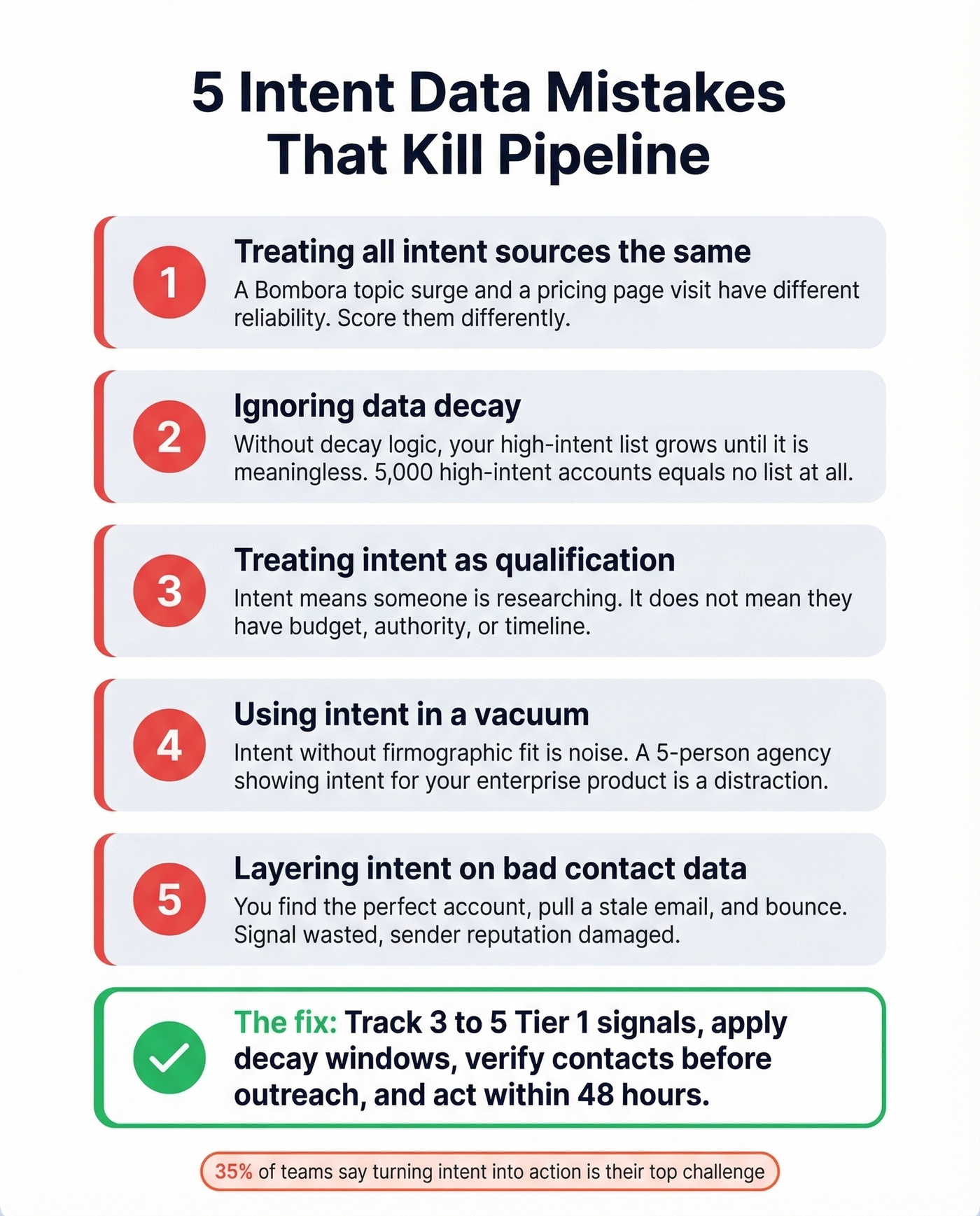
Treating all intent sources the same. A Bombora topic surge and a pricing page visit have different reliability and different decay rates. Score them differently.
Ignoring data decay. Without decay logic, your "high-intent" list grows until it's meaningless. We've seen teams with 5,000 "high-intent" accounts - which is the same as having no list at all.
Treating intent as qualification. Intent means someone is researching. It doesn't mean they have budget, authority, or timeline. Intent accelerates outreach; it doesn't replace qualification. (If you need a tighter qualification system, use a deal qualification framework your reps can run consistently.)
Using intent in a vacuum. Intent without firmographic fit is noise. A 5-person agency showing intent for your enterprise product isn't a lead - it's a distraction. Skip those accounts no matter how high they score. (This is where a clear Ideal Customer Profile prevents wasted cycles.)
Layering intent on bad contact data. You identify the perfect high-intent account, pull an email from a stale database, and bounce. Signal wasted, sender reputation damaged. If your bounce rate is above 5%, fix the contact layer before you invest another dollar in intent data. (Start with an email verifier and a repeatable data enrichment workflow.)
Intent Data Tools and Pricing
The B2B intent data market is projected at $4.49B in 2026, on track to reach $20.89B by 2035 at 16.6% CAGR. Forrester's 2026 Wave lists leaders including Intentsify, 6sense, Bombora, TechTarget, and Demandbase. More tools, more noise, more confusing pricing - here's what things actually cost.
Self-Serve / Starter Stack
| Tool | What It Does | Pricing | Contract |
|---|---|---|---|
| Prospeo | Intent + verified contacts | Free tier; ~$0.01/email | No contract |
| Apollo.io | Database + basic intent | Free tier; $49/user/mo | Monthly |
| Leadfeeder | Website visitor ID | Free tier; ~$99/mo | Monthly |
| GA4 | First-party analytics | Free | N/A |
Enterprise Platforms
| Tool | What It Does | Pricing | Contract |
|---|---|---|---|
| Bombora | Topic-level intent surges | $25K-$80K/yr | Annual |
| 6sense | Full ABM + intent platform | $35K-$150K+/yr | Annual |
| Demandbase | ABM + intent + advertising | $40K-$120K/yr | Annual |
| ZoomInfo Intent | Streaming intent + database | $7.2K-$36K/yr | Annual |
| G2 Buyer Intent | Category research signals | $10K-$87K+/yr | Annual |
Our recommended starter stack for teams proving out intent workflows: GA4 for first-party signals, Prospeo for third-party intent plus verified contacts, and G2 Buyer Intent if you're listed on their marketplace. You can run a complete intent workflow for under $100/month before scaling to enterprise tools - and 67% of intent data users say data quality is the most important attribute of their solution, not platform breadth. (If you're comparing sources, start with the best B2B database and verified contact databases benchmarks.)
From Signal to Outreach
Here's where most intent programs fall apart. You've identified that Acme Corp is showing intent. You've scored them at 55 points. Now what?
The gap between "this account is in-market" and "here's a verified email for the right decision-maker" is where teams lose momentum. 96% of B2B marketers report success with intent data, yet most stop at signal identification and never close the gap to outreach. Knowing how to identify buyer intent signals is only half the battle - the other half is having the operational workflow to act on them before they decay. (If you want a full system, map it to a RevOps tech stack instead of buying tools ad hoc.)
The workflow should be: identify signal, score against threshold, verify contact for the right persona, route to sales same day. Snyk ran this playbook with 50 AEs prospecting 4-6 hours per week - bounce rates dropped from 35-40% to under 5%, and AE-sourced pipeline jumped 180%. That's not a theoretical improvement. That's what happens when you close the gap between signal and outreach with verified data.
Intent data layered on bad contact data is worse than no intent data at all. You burn the signal, damage your domain reputation, and train your reps to distrust the system. Get the contact layer right first. (If deliverability is slipping, run an email reputation check before scaling volume.)
Your intent stack surfaces in-market accounts, but 35% of your emails bounce and half your phone numbers are disconnected. Prospeo's 7-day data refresh and 98% email accuracy mean your reps reach real people within the 48-hour window that matters.
Act on intent signals before they decay - with contacts that actually connect.
FAQ
What's the difference between first-party and third-party intent data?
First-party intent data comes from your own properties - website visits, product usage, email engagement. Third-party comes from external sources like Bombora topic surges, G2 category research, and review site activity. Of teams using both, 75% lean more heavily on first-party for higher fidelity, but third-party gives you earlier coverage of in-market accounts before they visit your site.
How quickly do intent signals lose value?
High-intent signals carry full value within 0-7 days, drop to roughly 50% at 8-30 days, and should be treated as expired after 46 days. A pricing page visit from three weeks ago is noise, not signal. Build decay logic into your scoring model from day one.
Do I need an enterprise platform to get started?
No. Start with GA4 for first-party signals and a self-serve tool for third-party intent data plus verified contacts. You can run a complete intent workflow for under $100/month. Scale to platforms like 6sense or Demandbase after you've proven the workflow generates pipeline.
How do I act on anonymous intent signals?
Anonymous signals - like account-level topic surges or unidentified website visits - require an enrichment step before outreach. Use a visitor identification tool to match activity to a company, then use a contact data provider to find verified emails and direct dials for the right personas. The goal is to resolve anonymous activity into a named contact your rep can reach within 48 hours.
How many signals should I track?
Track 3-5 Tier 1 signals maximum - demo requests, pricing page visits, and competitor comparisons are the highest-value starting points. Tracking everything creates noise that overwhelms your scoring model. Discipline around fewer, well-scored signals with 48-hour routing matters more than signal volume.