

Deal Qualification Framework: What Actually Drives Revenue in 2026
It's Thursday afternoon. You're staring at the pipeline review. There's a Stage 3 deal that's been "still evaluating" for 11 weeks, a champion who stopped returning calls, and an economic buyer nobody's ever spoken to. Half the pipeline is fiction, and everyone in the room knows it.
That gut feeling has numbers behind it. The MQL-to-SQL conversion rate sits around 15% - the single biggest drop-off in the B2B funnel. Median B2B conversion overall? Just 2.9%. The problem isn't your reps. It's that nobody agreed on what a qualified deal actually looks like, and the resulting gaps let bad opportunities linger for months. Choosing the right deal qualification framework fixes that.
The Quick Version
The framework you pick matters far less than whether your team actually uses it. But here's the shortcut:
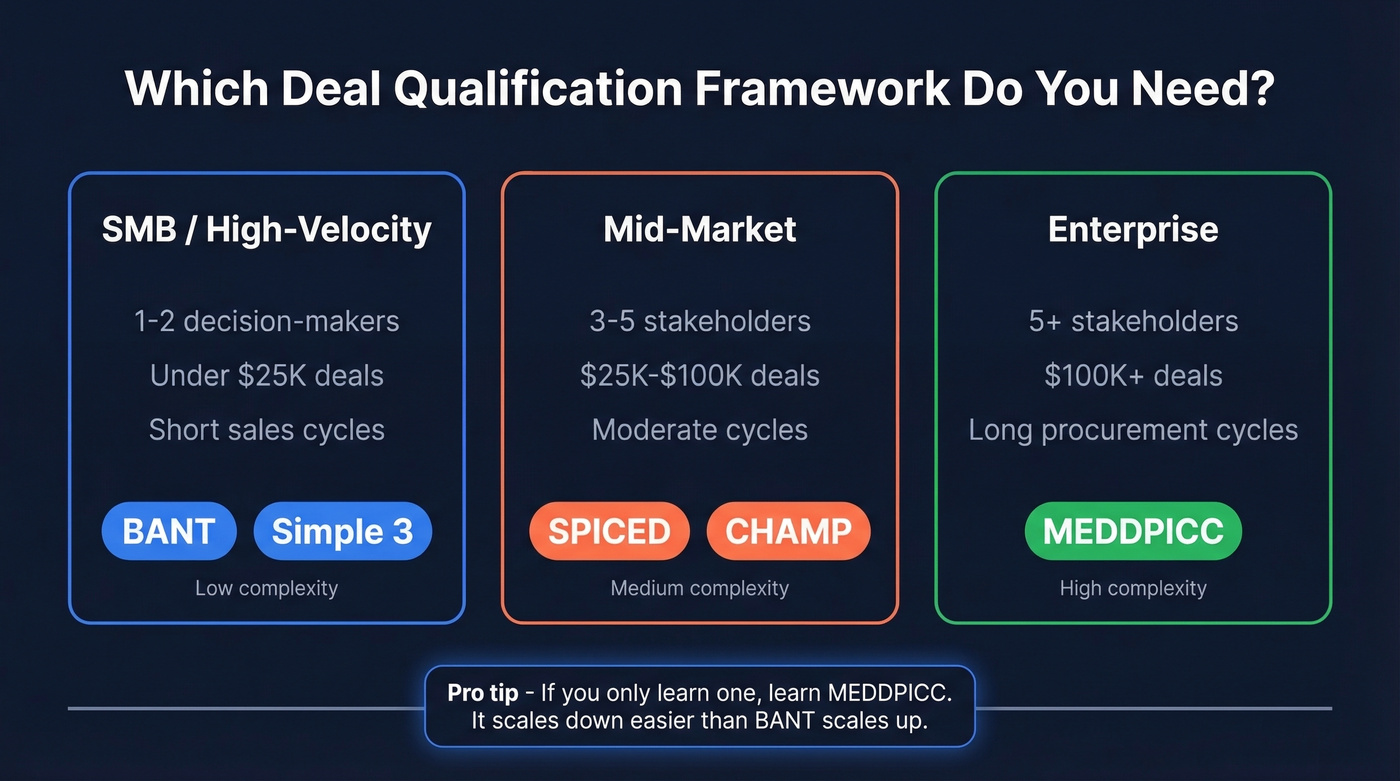
- Enterprise (5+ stakeholders, $100K+ deals): MEDDPICC
- Mid-market (3-5 stakeholders): SPICED or CHAMP
- SMB / high-velocity (1-2 decision-makers): BANT or the Simple 3
If you only learn one, learn MEDDPICC. It scales down easier than BANT scales up.
What Is Deal Qualification?
A deal qualification framework is a structured set of criteria your team uses to decide whether an opportunity deserves more time - or needs to be killed. It's not lead qualification, which covers the MQL-to-SQL handoff, and it's not a sales methodology, which governs how you sell. Think of it as a stack of sieves: each layer filters out deals that won't close, and the criteria get stricter as you move deeper into the pipeline.
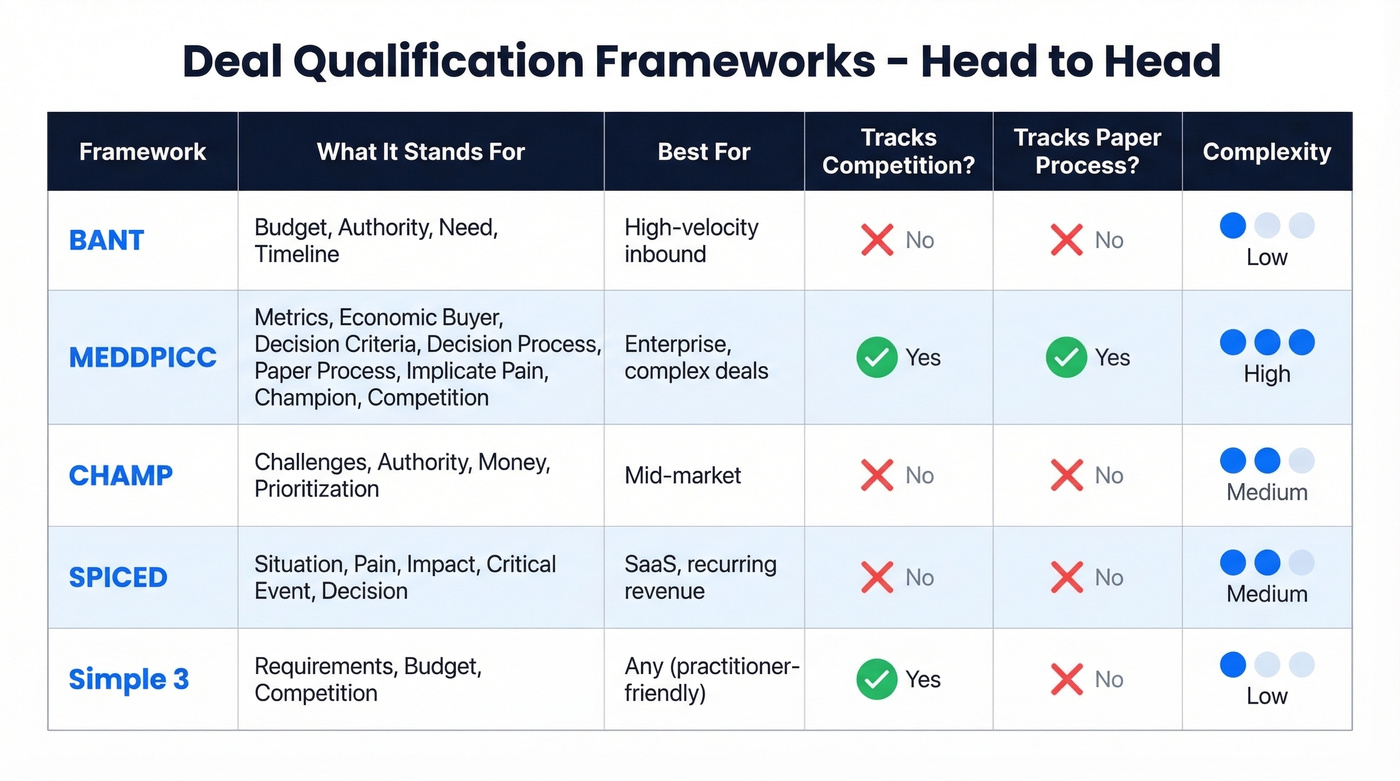
Five Frameworks Worth Knowing
| Framework | Best For | Complexity |
|---|---|---|
| BANT | High-velocity, inbound | Low |
| MEDDPICC | Enterprise, complex | High |
| CHAMP | Mid-market | Medium |
| SPICED | SaaS, recurring rev | Medium |
| Simple 3 | Any (practitioner) | Low |
BANT - The Baseline
Use this if you're running high-velocity inbound with one or two decision-makers and need reps qualifying fast on day one. Skip it if your deals involve buying committees or competitive bake-offs - BANT has no mechanism for either. It's not outdated. It's just incomplete for complex sales.
MEDDPICC - The Enterprise Standard
MEDDIC originated at PTC in 1996, during a run from $300M to $1B in four years. MEDDPICC evolved from it by adding Paper Process and Competition, and the distinction matters more than most people realize.
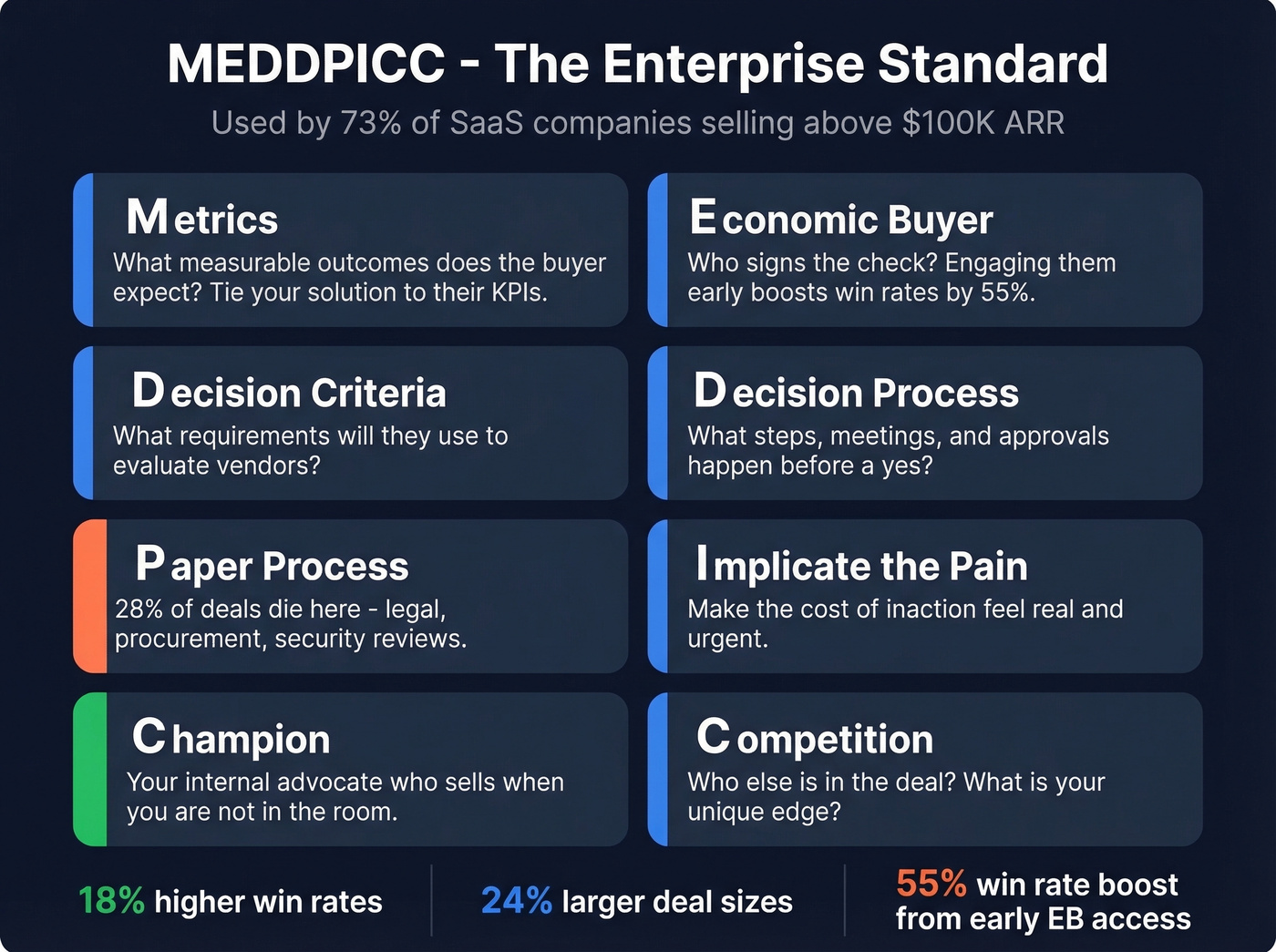
It stands for Metrics, Economic Buyer, Decision Criteria, Decision Process, Paper Process, Implicate the Pain, Champion, and Competition. 73% of SaaS companies selling above $100K ARR use some version of it, and full adoption correlates with 18% higher win rates and 24% larger deal sizes. The "Paper Process" addition alone justifies the upgrade from MEDDIC - 28% of deals fail when buyers can't navigate internal approval, and engaging the economic buyer early boosts win rates by 55%.
Frameworks like GPCTBA/C&I were built as an expansion of HubSpot's GPCT, but we've never seen a team actually use one in the wild. MEDDPICC dominates enterprise for a reason.
CHAMP - Challenges First
CHAMP (Challenges, Authority, Money, Prioritization) flips BANT by leading with pain instead of budget. Zorian Rotenberg introduced it in 2007, and it's ideal for mid-market teams whose reps kill conversations by asking about money too early. The limitation: it doesn't track paper process or competition, so it tops out below enterprise complexity.
SPICED - The Underrated One
SPICED (Situation, Pain, Impact, Critical Event, Decision) comes from Winning by Design, and it's the framework most teams haven't tried but should. Where BANT and MEDDIC focus on deal mechanics, SPICED captures the emotional and situational context that actually drives buying decisions - the "risk of no change" angle that closes deals. Teams that adopt SPICED consistently report 78% more ARR.
We've seen teams layer SPICED discovery onto MEDDPICC deal stages and get dramatically better forecast accuracy. SPICED doesn't replace MEDDPICC; it sharpens it.
The Simple 3
A practitioner on r/sales shared the framework they used for 20 years: (1) Requirements - what, why, and when; (2) Budget - what they've invested before; (3) Competition - who else is in the deal. The disqualification rule is the best part: if you lack relative strengths on core requirements versus the competition, walk away. Budget discovery uses phrasing like "What was the investment for your existing setup?" rather than the clumsy "What's your budget?"

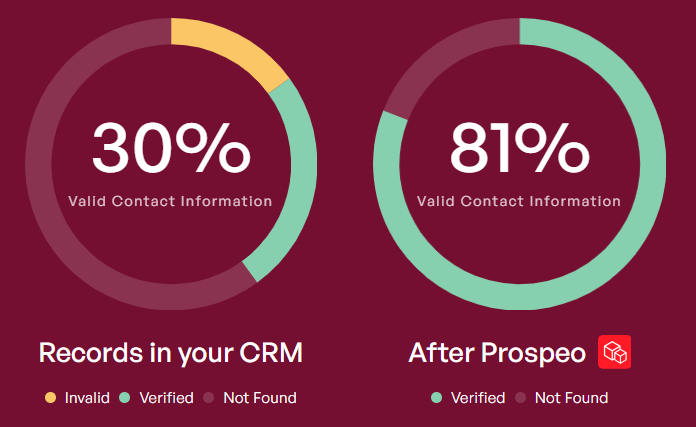
MEDDPICC, SPICED, BANT - none of them work if your CRM is full of stale data. Prospeo auto-enriches every contact with 50+ data points on a 7-day refresh cycle, so reps spend time qualifying real buyers instead of Googling job titles.
Stop qualifying deals against outdated data. Start with 300M+ verified profiles.
How to Choose
The decision comes down to deal size, buying committee size, and sales cycle length.
For fewer than 3 decision-makers, BANT or the Simple 3 give you speed without overhead. When you're dealing with 3-5 stakeholders, CHAMP or SPICED add nuance without drowning reps in fields. Once you hit 5+ stakeholders, nothing else handles procurement, legal, and multi-threaded champion building the way MEDDPICC does.
Companies using structured qualification consistently see 20-30% higher conversion rates compared to ad-hoc approaches. The specific framework matters less than having one at all.
Discovery Questions That Work
The best reps use frameworks as a compass, not a script. One practitioner put it well: "My client doesn't know I'm doing it and I'm very real with them."
MEDDPICC: "What key metrics define success for this project?" / "Who has final sign-off, and can we get them into the next conversation?" / "Are there legal, security, or compliance reviews we should anticipate?"
SPICED: "What frustrates you most about the current process?" / "How much time does this problem cost your team per week?" / "By when does a solution need to be live?"
Simple 3 budget discovery: "What was the investment for your existing setup?"
Let's be honest - most reps default to the same three questions regardless of framework. Print these on a card. Tape it to the monitor. Whatever it takes.
Make It Stick in Your CRM
Frameworks die when they live in a slide deck instead of your CRM.
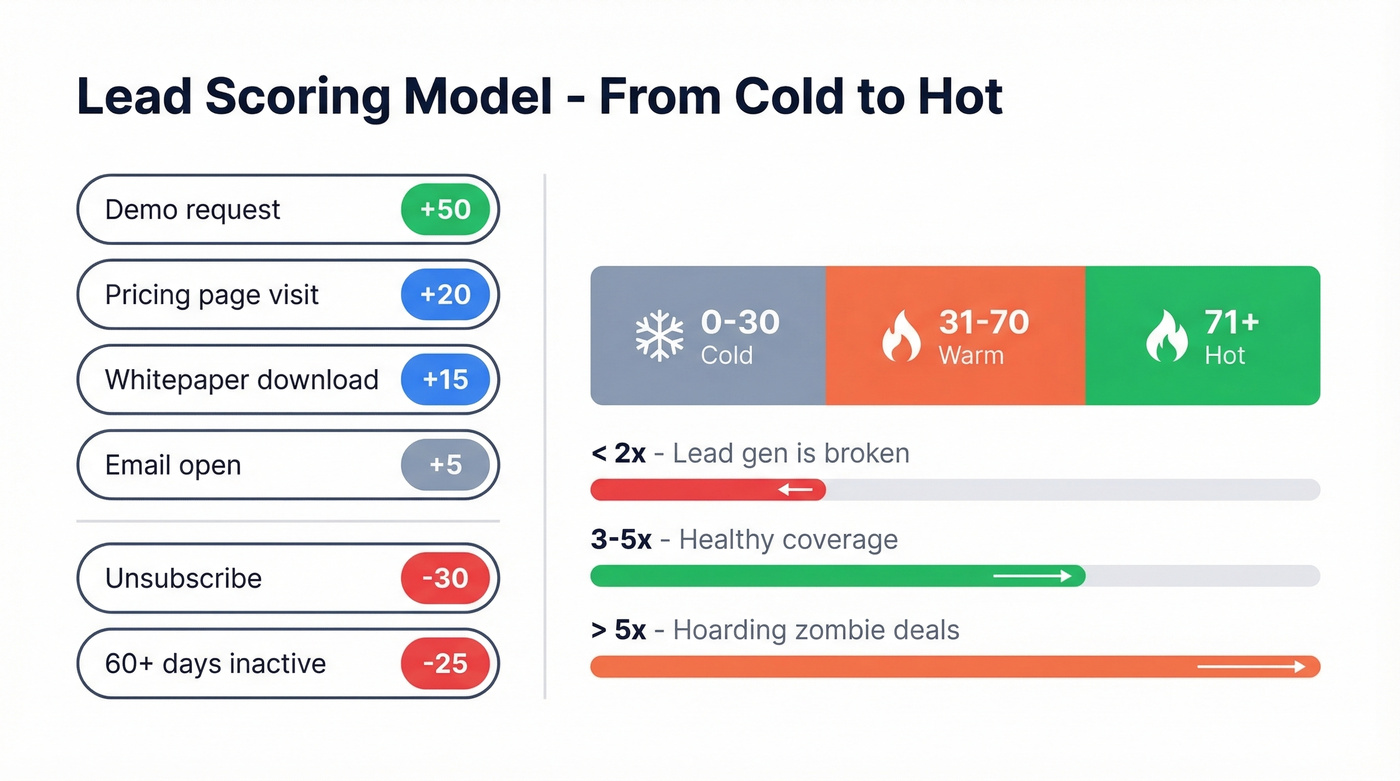
Lead scoring: Assign points based on intent signals - demo request (+50), pricing page visit (+20), whitepaper download (+15). Build in negative scoring for unsubscribes, bounces, and 60+ days of inactivity. Set thresholds: 0-30 cold, 31-70 warm, 71+ hot. Weight high-intent actions exponentially higher than passive engagement. Maintain 3-5x pipeline coverage against quota. Below 2x means your lead gen is broken; above 5x means you're hoarding zombie deals.
Here's the thing nobody talks about: qualification fields are only useful if the data behind them is accurate. Reps currently spend only 28-30% of their time actually selling, and a huge chunk of the rest goes to manual research and data entry. Prospeo's CRM enrichment fills those fields with 50+ data points - company size, industry, technographics, funding, headcount growth - across 300M+ professional profiles on a 7-day refresh cycle. That's hours clawed back every week that reps can spend on actual discovery calls.
Closing the Gaps That Kill Deals
CRM checkbox theater. MEDDPICC fields become homework reps fill to make managers happy, not tools that drive deal decisions. The consensus on r/sales is clear: MEDDIC becomes "hard labor" when managers treat it as paperwork instead of a coaching tool. If your reps treat qualification like bureaucracy, you've implemented it wrong.
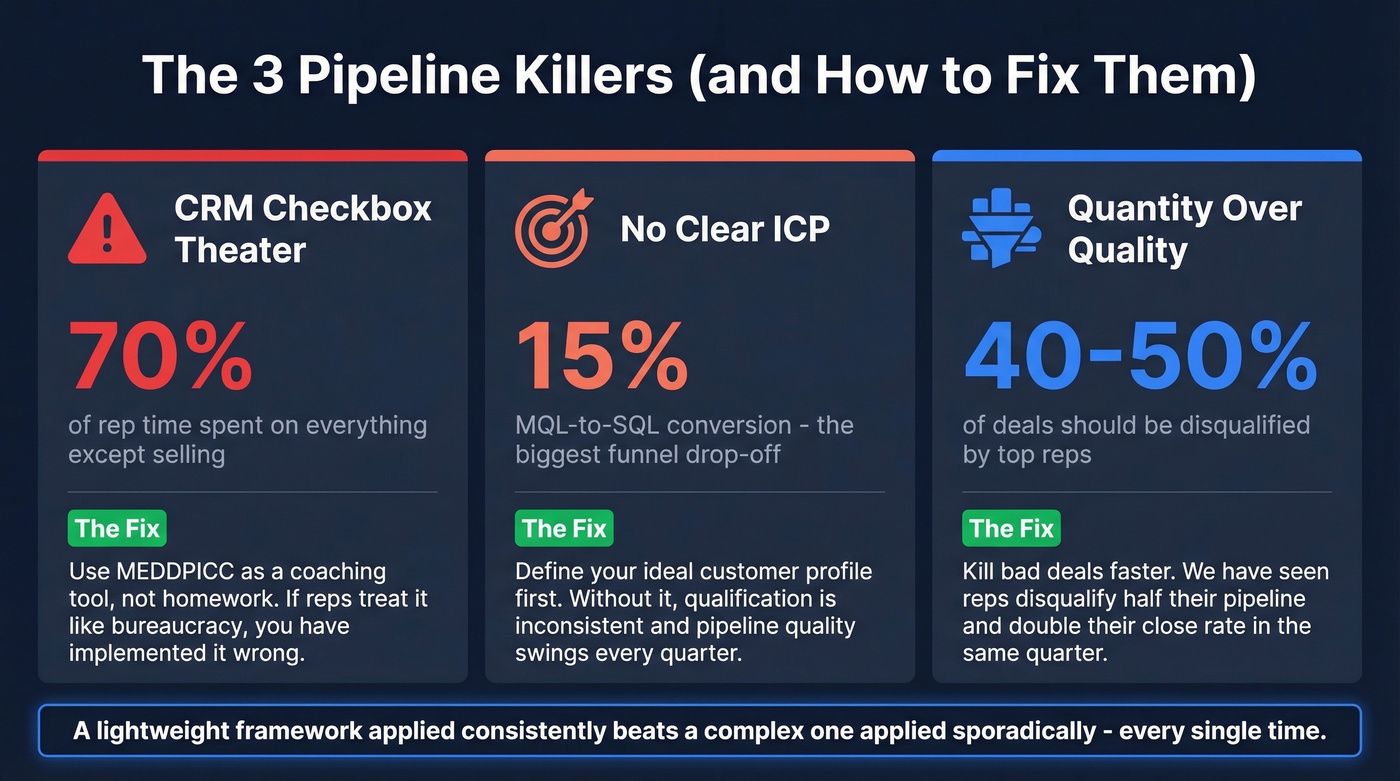
No clear ICP. Without a defined ideal customer profile, qualification is inconsistent and pipeline quality swings wildly quarter to quarter.
Quantity over quality. Bloated pipelines feel good in reviews but produce declining win rates. We've watched reps disqualify half their pipeline and double their close rate in the same quarter - counterintuitive until you see it happen. The best reps kill 40-50% of their deals and close more because of it.
Here's our hot take: if your average contract value is under $15K, you probably don't need MEDDPICC-level rigor. A lightweight framework applied consistently will outperform a complex one applied sporadically every single time. Stop debating which framework is best. Start disqualifying faster.
Reps spend 70% of their time on everything except selling - mostly manual research and data entry. Prospeo fills your qualification fields automatically: company size, funding, headcount growth, technographics, and more across 300M+ profiles at 98% email accuracy.
Give your reps the data to qualify faster and close 26% more meetings.
FAQ
What's the difference between deal qualification and lead qualification?
Lead qualification filters inbound interest at the MQL-to-SQL handoff - typically marketing's job. Deal qualification assesses whether an active sales opportunity will actually close, applying stricter criteria deeper in the pipeline where rep time is most expensive.
Is BANT still relevant in 2026?
Yes, for high-velocity sales with simple buying committees and average deal sizes under $25K. For deals involving 5+ stakeholders or lengthy procurement cycles, MEDDPICC gives you the multi-threading and paper-process tracking BANT lacks.
How do I qualify deals when my contact data is unreliable?
Bad data prevents the discovery calls where qualification happens. You can't qualify a deal if you can't reach the economic buyer. Tools like Prospeo verify emails at 98% accuracy on a 7-day refresh cycle, and 125M+ verified mobile numbers deliver a 30% pickup rate - so reps actually connect with the stakeholders they need to qualify.
Can I combine multiple frameworks?
Absolutely - many top-performing teams layer SPICED discovery questions onto MEDDPICC deal stages. Use SPICED to uncover emotional urgency during early calls, then map findings to MEDDPICC fields for pipeline management and forecasting.