

The Best Verified Contact Databases for B2B Sales in 2026
A RevOps lead we know ran a bake-off last quarter across three data providers. The "biggest" database - 300M+ contacts, impressive demo - bounced 31% on the first outbound sequence. The cheapest tool had better connect rates. That's the thing about a verified contact database: it's only as good as its verification methodology, and most vendors are vague about theirs on purpose.
Poor data quality costs organizations an average of $12.9M annually, and B2B contact data decays at roughly 2.1% per month per Dun & Bradstreet. The databases below are ranked by how well they solve that problem - not by how many records they claim.
Our Top Picks
| Pick | Best For | Starting Price | Standout Metric |
|---|---|---|---|
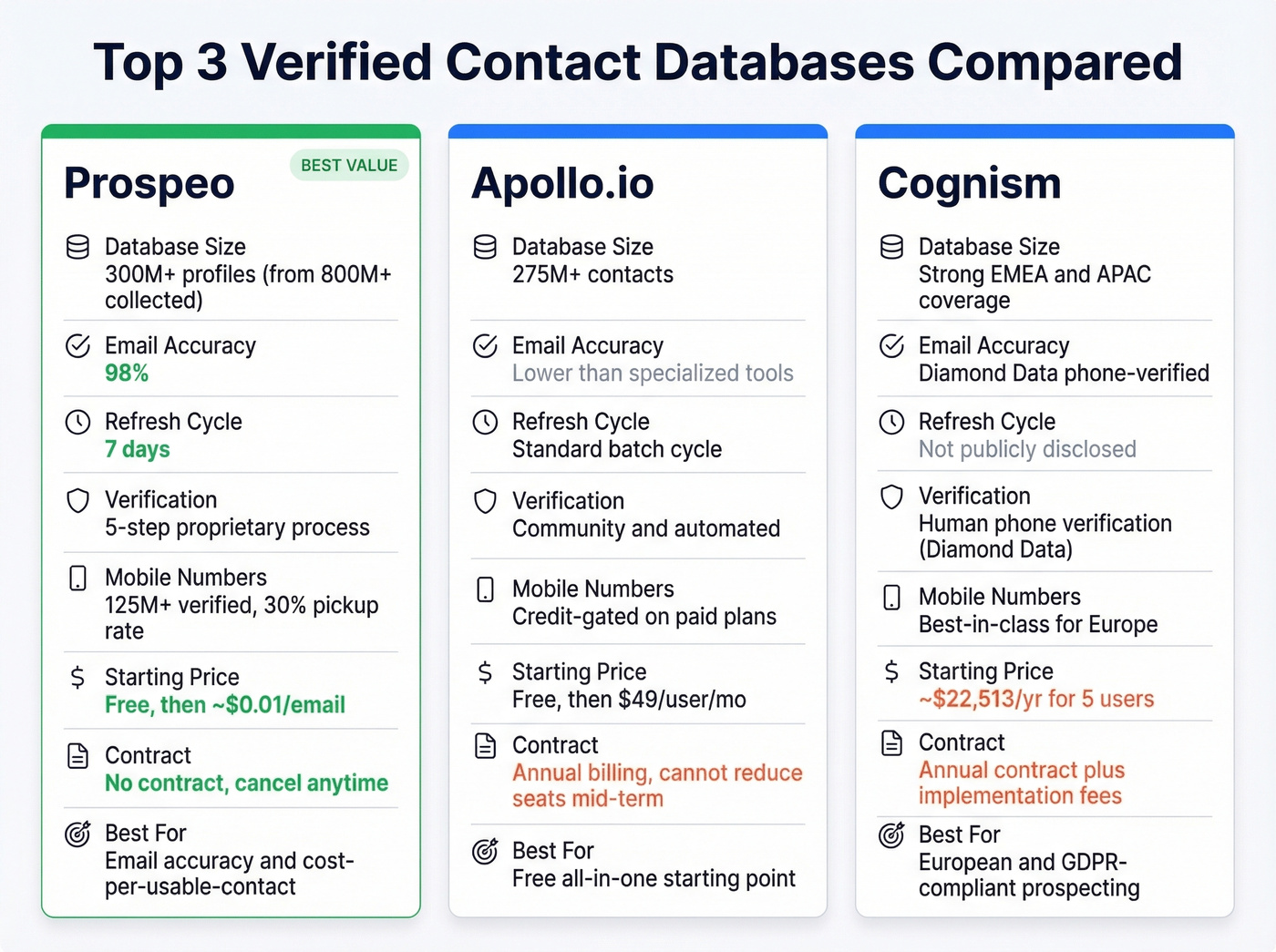
| Prospeo | Email accuracy & freshness | Free; ~$0.01/email | 98% email accuracy, 7-day refresh |
| Apollo.io | Free all-in-one starting point | Free; $49/user/mo | 275M+ contacts, built-in sequencer |
| Cognism | European prospecting | ~$22,513/yr (5 users) | Diamond Data phone-verified mobiles, GDPR |
Short on time? Prospeo wins on data quality and cost-per-usable-contact. Apollo wins on breadth and free-tier generosity. Cognism wins if your ICP lives in EMEA.
Here's our honest take: most teams don't need a $25k+ "all-in-one" platform. They need accurate emails that don't bounce. If your average deal size sits below $15k, you'll get more pipeline from a $50/month tool with 98% accuracy than a $25k platform with 85%.
What "Verified" Actually Means
Not all verification is equal, and vendors love to blur the lines.
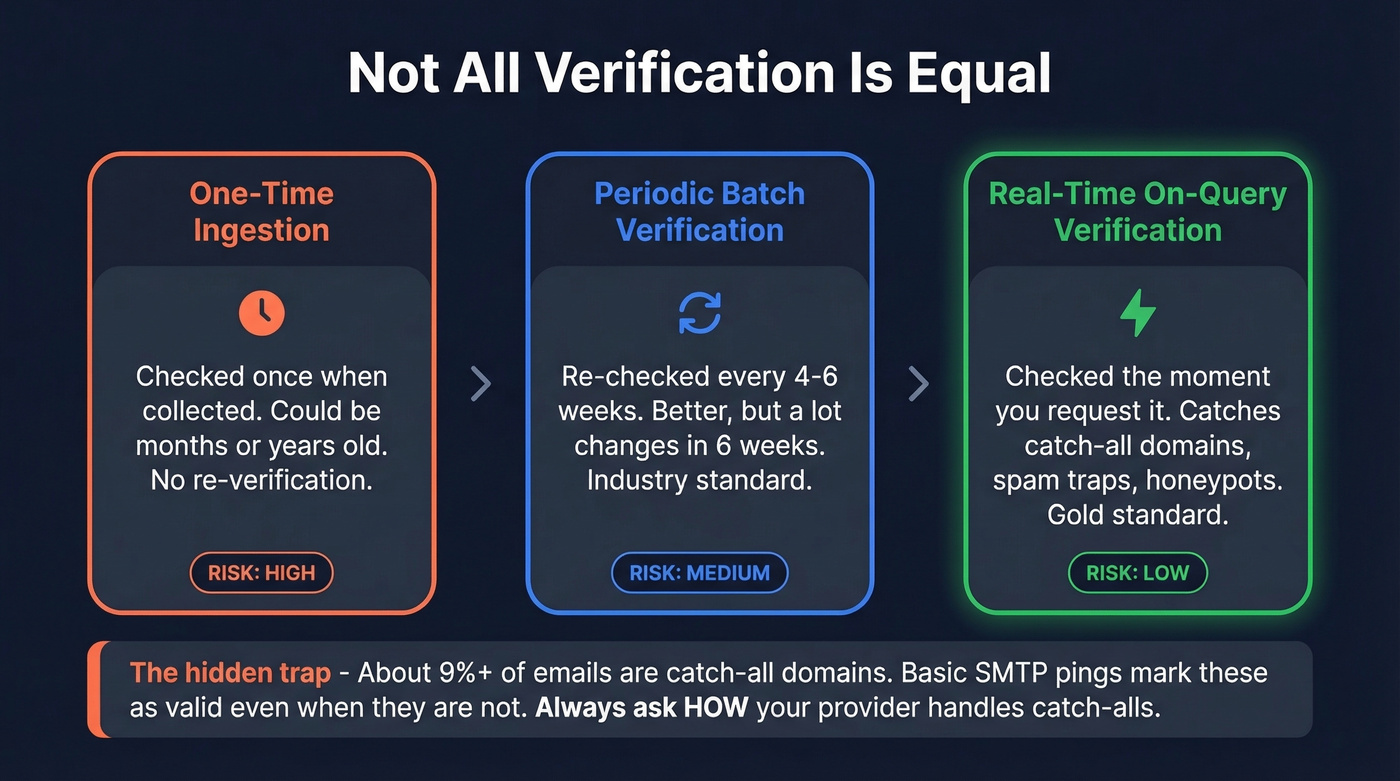
One-time ingestion means the provider checked data when they first collected it - maybe months or years ago. Periodic batch verification re-checks records every 4-6 weeks, which is better, but a lot changes in six weeks. Real-time on-query verification checks the contact the moment you request it. That's the gold standard.
Some vendors market "triple-verified" data, but that phrase has no standard definition. What matters is the specific steps: Does the provider handle catch-all domains? Filter spam traps and honeypots? Use proprietary infrastructure or resell third-party data? A Salesfinity benchmark tested 9 phone data providers across 307 contacts and found accuracy ranging from 63% to 91%. That's a massive spread for tools that all call themselves "verified."
The differentiator most buyers miss is catch-all domain handling. Catch-all domains accept any email address, so a basic SMTP ping returns "valid" even for addresses that don't exist. About 9%+ of emails checked fall into this category. If your provider marks these as "valid" without further checks, your bounce rate will spike. Always ask vendors when and how they verify - "verified" on a marketing page means nothing without those answers.
Why Your Database Is Decaying Right Now
ZeroBounce analyzed 11 billion+ emails and found at least 23% of an email list degrades yearly. For B2B, the numbers are worse in high-turnover industries.
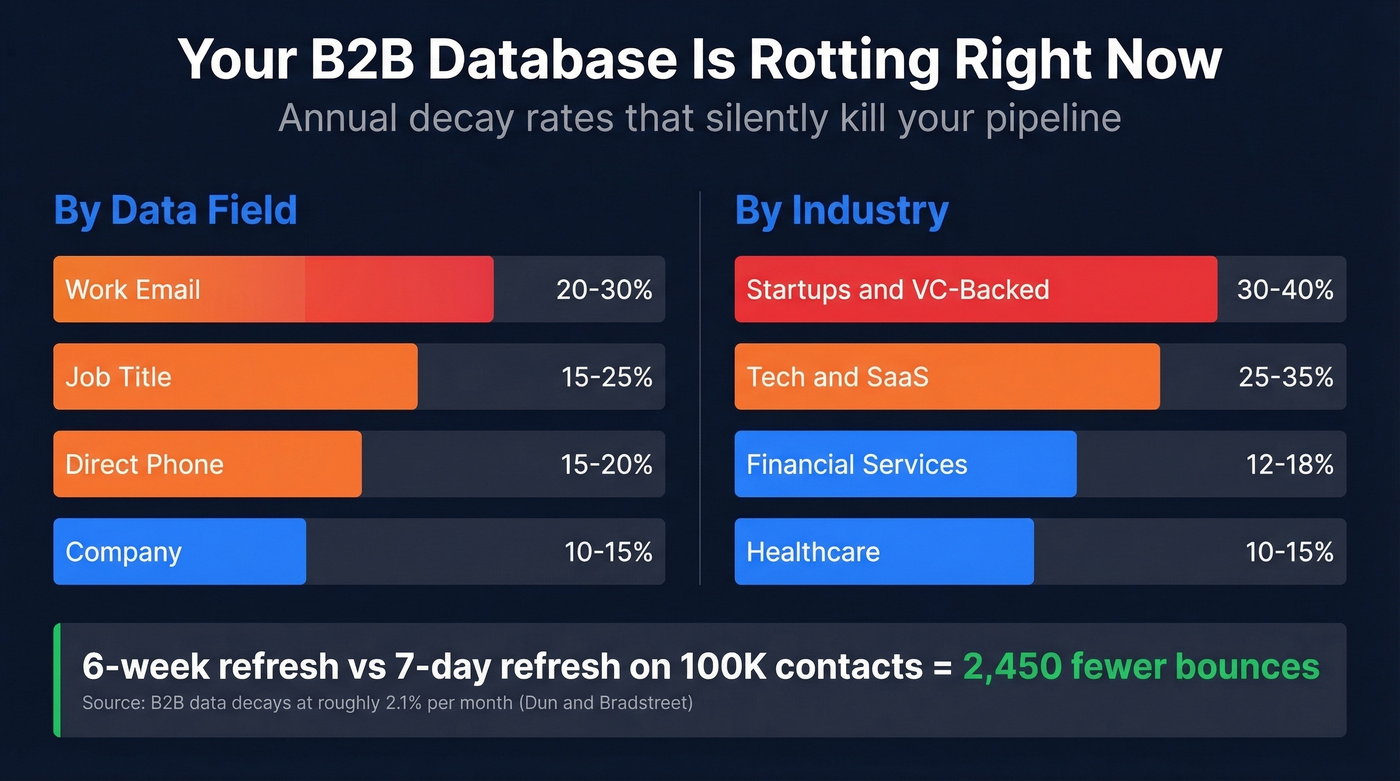
| Data Field | Annual Decay | Industry | Annual Decay |
|---|---|---|---|
| Work email | 20-30% | Tech / SaaS | 25-35% |
| Direct phone | 15-20% | Startups / VC-backed | 30-40% |
| Job title | 15-25% | Financial services | 12-18% |
| Company | 10-15% | Healthcare | 10-15% |
If you're selling into tech or startups, a third of your database is wrong by year-end. That's not a data quality problem - it's a pipeline problem.
Refresh frequency is the metric that matters most. The industry average refresh cycle is about six weeks, but the difference between a 6-week and 7-day refresh on a 100,000-contact database means catching roughly 2,450 additional changes before they turn into bounces. Treat refresh cadence as a non-negotiable requirement, not a nice-to-have.

B2B contact data decays 2.1% per month. Most providers refresh every 6 weeks - Prospeo refreshes every 7 days. That's 2,450 fewer bounces per 100K contacts. 98% email accuracy, 5-step verification, catch-all handling, spam-trap removal.
Stop paying for contacts that bounce. Start with 75 free verified emails.
10 Best Verified B2B Contact Databases
1. Prospeo
Prospeo's database covers 300M+ professional profiles filtered from 800M+ collected records through a 5-step verification process, including 143M+ verified emails and 125M+ verified mobile numbers. The numbers speak for themselves: 98% email accuracy, a 30% mobile pickup rate, and a 7-day data refresh cycle. Teams book 26% more meetings compared to ZoomInfo and 35% more compared to Apollo. Prospeo runs proprietary email-finding infrastructure rather than reselling third-party data, which is why accuracy stays consistent across regions.
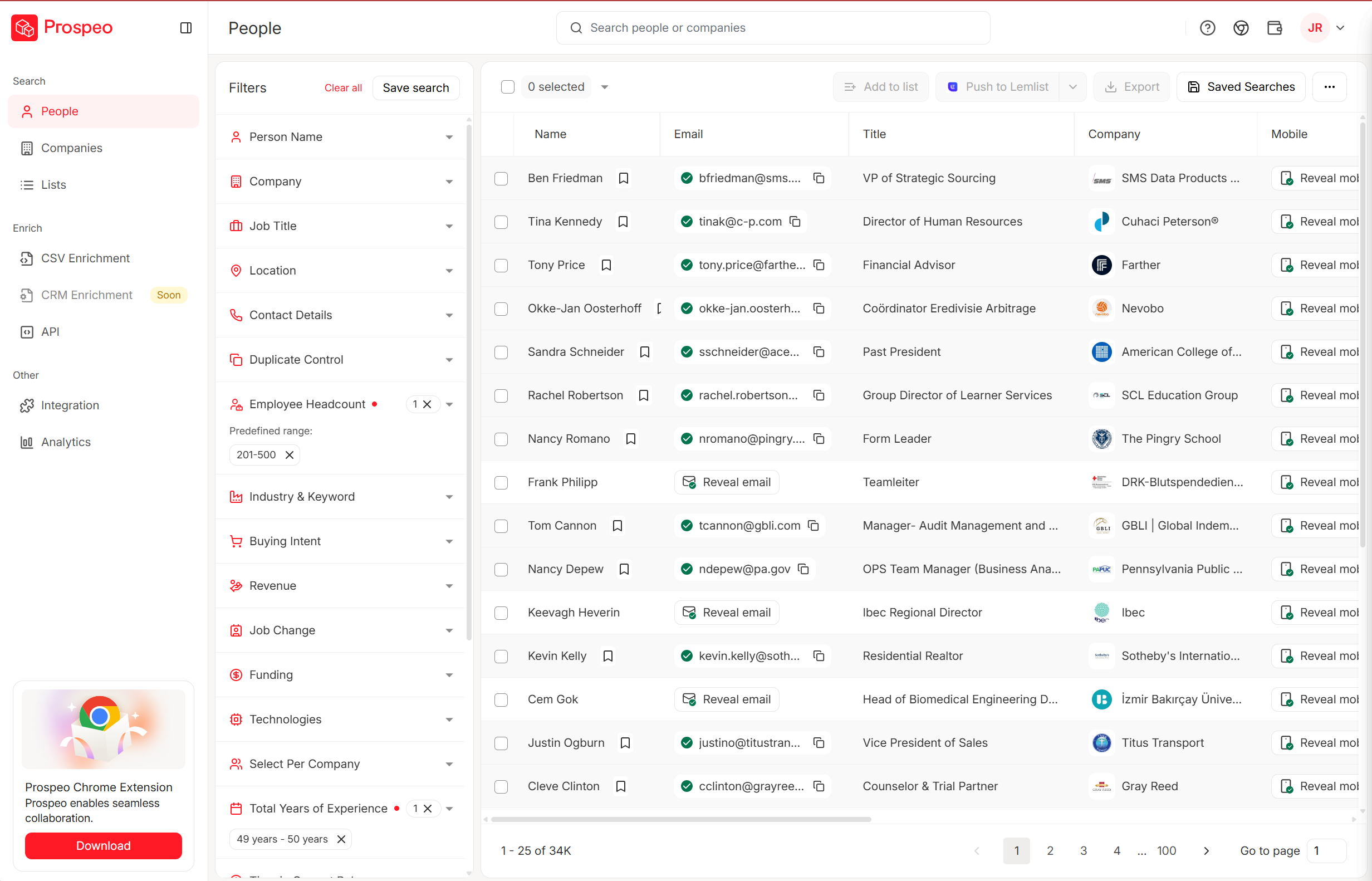
30+ search filters cover buyer intent via 15,000 Bombora topics, technographics, job changes, and headcount growth. You build targeted lists without exporting garbage. The Chrome extension - used by 40,000+ people - works across company websites and professional profiles for one-click prospecting. CRM enrichment returns 50+ data points per contact with a 92% API match rate, with native integrations into Salesforce, HubSpot, Smartlead, Instantly, Lemlist, Clay, Zapier, and Make.
Real results: Meritt went from a 35% bounce rate to under 4%, and their pipeline tripled from $100K to $300K per week. Snyk's 50-person AE team cut bounce rates from 35-40% to under 5% and added 200+ new opportunities per month.
Pricing: ~$0.01 per email. Free tier includes 75 emails and 100 Chrome extension credits per month. No contracts, no sales calls, cancel anytime.
Meritt cut their bounce rate from 35% to under 4% and tripled pipeline to $300K/week. Snyk's 50 AEs added 200+ opportunities per month. The difference? A verified contact database with proprietary infrastructure - not resold third-party data. At $0.01/email, Prospeo is 90% cheaper than ZoomInfo with higher accuracy.
Build lead lists that actually connect. No contracts, no sales calls.
2. Apollo.io
Apollo is the obvious starting point for most SMB teams. The free tier is genuinely useful - 275M+ contacts, built-in email sequencing, and a basic dialer without spending a dollar.
Use this if you're a startup that needs prospecting, sequencing, and a dialer in one platform and can't afford three separate tools. For teams just getting started with outbound, it's hard to argue against free.
Skip this if you need consistently fresh data. Stale records are a recurring complaint with broad databases, and Apollo's email accuracy runs below tools with tighter verification loops. You also can't reduce seats mid-term on paid plans, which burns teams that scale down after a hiring freeze.
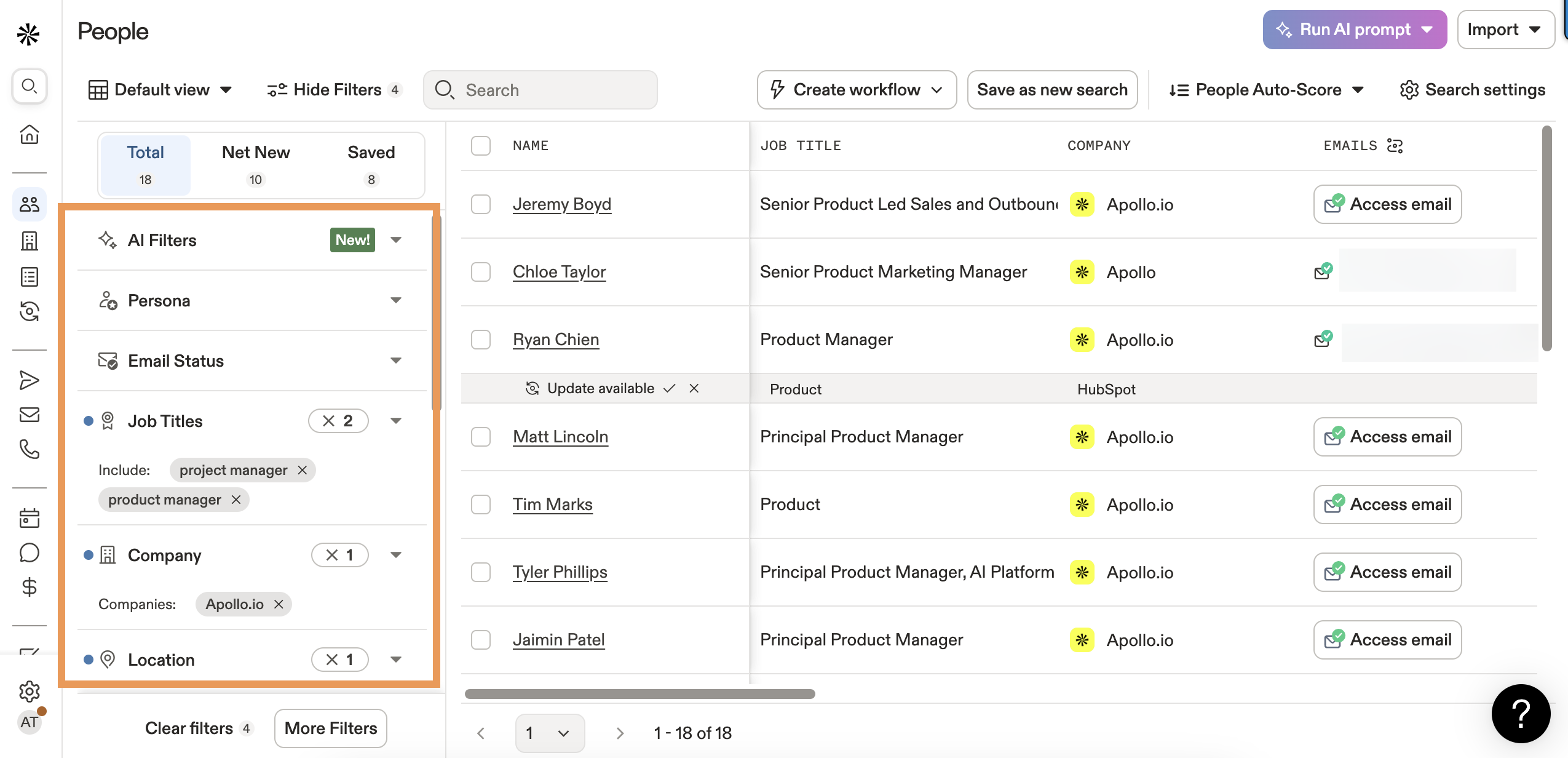
Pricing: Free tier available. Paid plans run $49-$119/user/month on annual billing, $59-$149 monthly. Email credits are "unlimited" under fair use; mobile numbers and exports are credit-gated.
3. Cognism
Cognism is the pick for teams selling into Europe. Full stop. GDPR-first compliance, strong EMEA and APAC coverage, and Diamond Data phone-verified mobiles make it the safest bet for international outbound. Diamond Data means a human has verified the mobile number connects to the right person - not just that the number exists. For teams that need verified business contacts across European markets, that compliance-first approach is hard to beat.
Where Cognism wins over ZoomInfo: EMEA compliance and mobile verification quality. Where ZoomInfo still wins: US database depth and raw workflow breadth.
Skip this if you're a US-only team on a tight budget. A 5-user Grow plan runs about $22,513/year; Elevate hits ~$37,498/year. Implementation fees run $500-$1,500, and intent topic add-ons cost $200-$400 per topic annually. Fair-use limits cap exports at roughly 2,000 records per user per month.
4. ZoomInfo
The enterprise incumbent with the deepest US direct dial coverage. If you have budget, a US-heavy ICP, and need a full GTM platform with intent, org charts, and workflows, ZoomInfo delivers.
The catch: plans start at ~$14,995/year, annual commitment only. Advanced tiers run $22,000-$28,000/year; Elite hits $35,000-$45,000+. Auto-renewals with 10-20% increases are the norm, and the consensus on r/sales is that renewal negotiations are painful. One practitioner described signing at $24k for 5 seats, then getting a renewal quote at $38k - up 18% - with only 3 reps actually using it. The annual contract with a 60-day cancellation window they missed made it inescapable.
If you're spending under $20k/year on data or selling primarily into EMEA/APAC, look elsewhere.
5. Kaspr
Best for: Individual SDRs who live in a Chrome extension and need quick phone numbers from professional profiles. Worst for: Bulk prospecting or list building - Kaspr is a lookup tool, not a database.
Free plan gives 15 B2B email and 5 phone credits per month. Starter is $49/user/month with 100 phone credits; Business is $79/user/month with 200. Phone credit add-ons at about $0.14-$0.16 each add up fast at scale.
6. Lusha
Think of Lusha as ZoomInfo Lite - simpler interface, lower price, less depth. You're trading filtering power and intent data for a faster learning curve and a $37/user/month starting price. The community-verified data model works well for US contacts but thins out internationally. A limited free plan lets you test before committing.
7. Lead411
Lead411 is a solid pick if you want contacts plus intent and trigger-style prospecting workflows in one place. It's often priced around $49/user/month, with annual plans positioned as better value for teams that want to avoid credit anxiety. The contact volume is smaller than Apollo or ZoomInfo, but it performs well for signal-based outbound where timing matters more than volume.
8. RocketReach
A decent budget option for individual email lookups starting around $29/user/month, but not built for bulk prospecting or intent-driven workflows. No intent data, limited filtering. Fine for one-off research.
9. Seamless.AI
Real-time search engine model that finds contacts on demand. Free tier exists; paid plans run an estimated $100-$200+/user/month. Seamless is also known for aggressive sales motions and rigid contract terms - we've heard enough complaints to recommend testing carefully before signing anything annual.
10. Datagma
Pay-per-result model: you don't pay if they can't find the data, which eliminates wasted spend. Plans start around $25-$50/month for low-volume API usage. Strong as a supplementary enrichment layer, not a primary database.
Pricing Comparison
| Tool | Starting Price | Contract | Credit Model | Watch For |
|---|---|---|---|---|
| Prospeo | Free; ~$0.01/email | None (monthly) | Pay per result | - |
| Apollo.io | Free; $49/user/mo | Annual for discount | Email unlimited; mobile gated | Can't reduce seats |
| Cognism | ~$22,513/yr (5 users) | Annual | Fair-use ~2K/user/mo | Implementation fees, intent add-ons |
| ZoomInfo | $14,995+/yr | Annual only | Bulk credits by tier | Auto-renew + 10-20% hikes |
| Kaspr | Free; $49/user/mo | Monthly available | Phone credits capped | Add-on credit costs |
| Lusha | Free; ~$37/user/mo | Monthly available | Credit-based | Limited free tier |
| Lead411 | ~$49/user/mo | Annual for discount | Varies by plan | Smaller database |
| RocketReach | ~$29/user/mo | Monthly available | Credit-based | No intent data |
| Seamless.AI | Free; ~$100-200/user/mo | Annual typical | Credit-based | Contract terms |
| Datagma | ~$25-50/mo (API) | Flexible | Pay only if found | Not a full database |
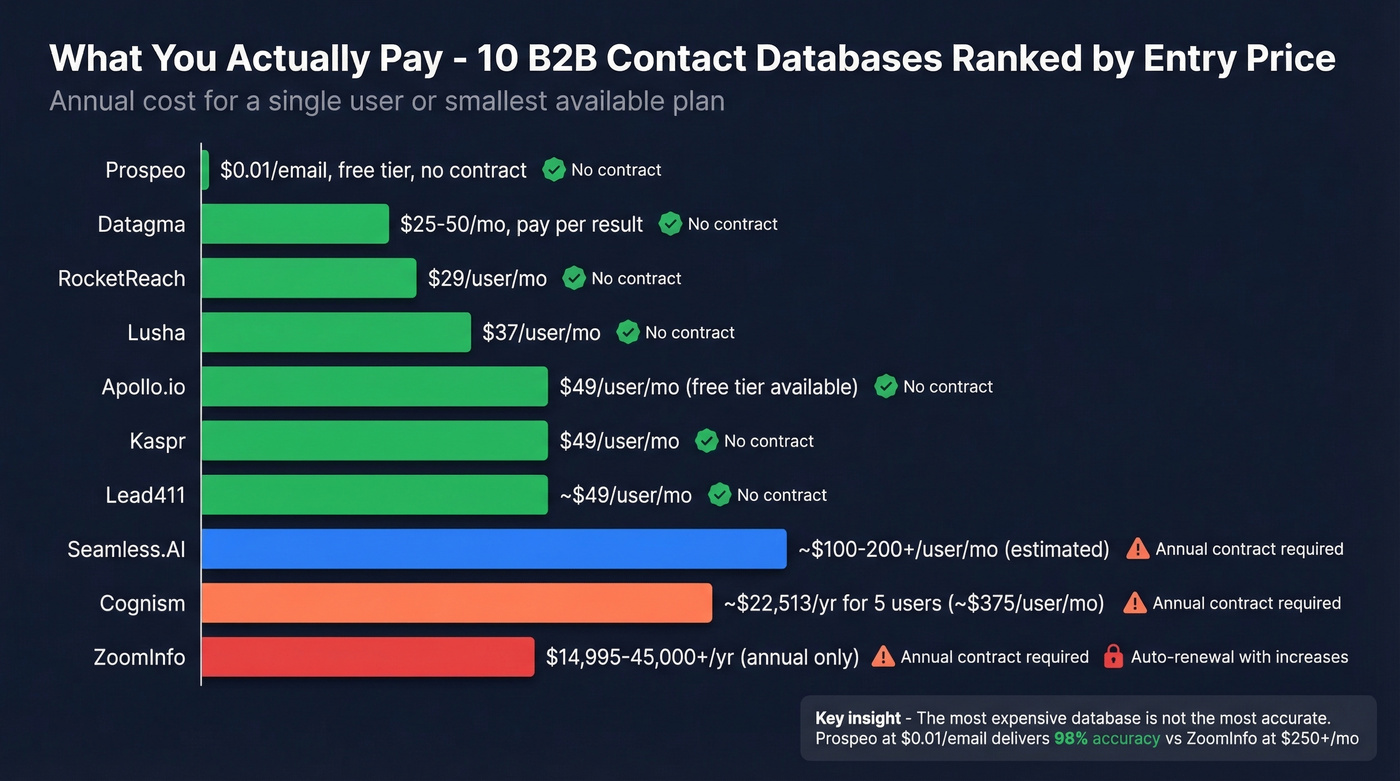
Let's be real about the math. Cost-per-usable-contact matters more than sticker price. At ~$0.01/email with 98% accuracy, you get roughly 980 usable contacts per 1,000 credits. A platform charging ~$1/lead with 87% email accuracy delivers closer to 870 - and you're paying 100x more per working contact.
How to Evaluate Any B2B Data Provider
Before you sign anything, run every vendor through these checks.
Ask "how often is data re-verified?" - not "how big is your database?" A 7-day refresh cycle catches changes that a 6-week cycle misses entirely. Then dig into verification methodology: SMTP ping alone isn't enough. Multi-step verification that handles catch-all domains, spam traps, and honeypots is the difference between 80% and 98% accuracy.

Calculate cost per usable contact, not cost per credit. If a tool charges $0.50/credit but 20% bounce, your real cost is $0.63 per working contact. A Cleanlist test of 1,000 B2B records found single-source databases matched 62% of emails versus 98% for waterfall enrichment - so ask whether your provider checks multiple sources. Finally, favor monthly contracts while you're evaluating. Annual lock-ins with auto-renewal clauses are how vendors trap you into paying for data you've outgrown.
Mistakes That Burn Your Budget
One practitioner on r/b2bmarketing shared that they spent $15k on lead databases and got generic emails, outdated contacts, and the same leads every competitor was hitting. Response rate: 2-3%. After switching to a signal-based approach, they hit 8-12%.
The "overused contacts" problem is real and it's frustrating. Large databases serve the same decision-makers to thousands of customers simultaneously. Your "exclusive" prospect list is anything but. The Salesfinity benchmark showing accuracy as low as 63% across some providers confirms what many of us already suspected - the worst tools aren't just inaccurate, they're actively wasting your reps' time. Investing in a provider with transparent verification methodology is the simplest way to stop throwing budget at dead leads.
FAQ
What's the difference between a contact database and an email finder?
A contact database stores pre-built profiles you search and filter by criteria like title, industry, or intent signals. An email finder locates a specific person's email on demand. Many tools combine both, but the quality of the underlying data determines whether records convert to conversations.
How fast does B2B contact data go stale?
About 2.1% per month, or 22.5% annually, per Dun & Bradstreet. Tech and startup sectors decay faster at 25-40% per year due to higher job turnover. Weekly refresh cycles dramatically outperform monthly or quarterly ones.
Are free-tier databases accurate enough for outbound?
Free tiers from Apollo or Kaspr work for testing workflows, but credit limits and data freshness gaps make them unreliable at scale. If you're validating your outbound motion before scaling spend, look for a free plan that doesn't downgrade verification quality on the free tier.
What's a good email bounce rate for outbound?
Under 5% is the target for maintaining domain reputation. Above 8% risks deliverability damage that can take weeks to recover from. Databases with weekly refresh cycles and multi-step verification consistently keep teams well under that threshold.
Do I need a database with intent data?
If you're doing outbound at scale, yes. Intent signals let you prioritize prospects actively researching solutions like yours instead of spraying cold emails at everyone in your ICP. The lift from timing alone can double reply rates.