

Compliant B2B Data: The Operational Guide Most Teams Actually Need
€6.2 billion in GDPR fines between 2018 and mid-2025 - and over 60% of that total landed after January 2023. TikTok got hit for €530M . LinkedIn took a €310M penalty for insufficient legal basis. And it's not just Big Tech anymore: Your Consulting SRL, a small Romanian firm, was fined €3,000 in February 2026 for inadequate security measures. Regulators are working down the food chain.
Here's the thing most teams miss: legally sourced records aren't a cost center. They're a deliverability strategy. Clean data means fewer bounces, fewer spam complaints, and a sender reputation that actually survives Q3. The IAPP reports global spending on privacy technology has surpassed $15B, yet most of that budget goes to tools - not the operational workflows that prevent fines.
What You Need (Quick Version)
- Document a Legitimate Interest Assessment per outbound campaign. Not per quarter - per campaign. Each audience and message combination needs its own justification. (If you need the broader framework, start with B2B compliance.)
- Use a provider that refreshes records at least weekly and can show provenance documentation on request. Stale data means you're emailing people who've opted out, and that's regulatory exposure, not just a quality problem. If you're evaluating sources, compare options in our guide to the best B2B databases.
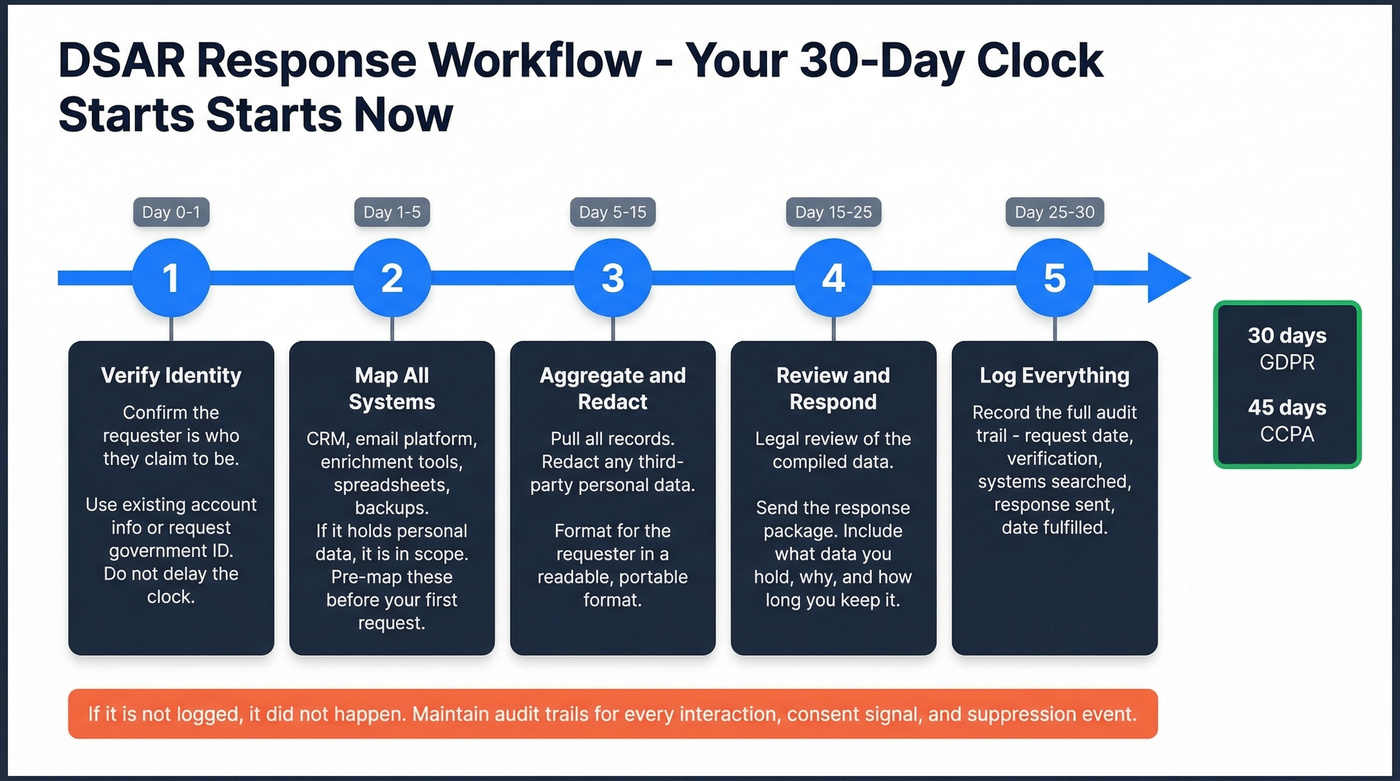
- Build a DSAR response workflow now. You've got 30 days under GDPR, and CCPA/CPRA requests have strict statutory deadlines. That clock starts the moment the request hits your inbox.
The 2026 Regulatory Patchwork
The patchwork is getting denser. Eight US states went live with comprehensive privacy laws in 2025 alone, and three more joined them on January 1, 2026 - Indiana, Kentucky, and Rhode Island. California's SB 361 expanded data broker registration requirements, including a 45-day window for processing opt-out requests through the CPPA deletion mechanism.
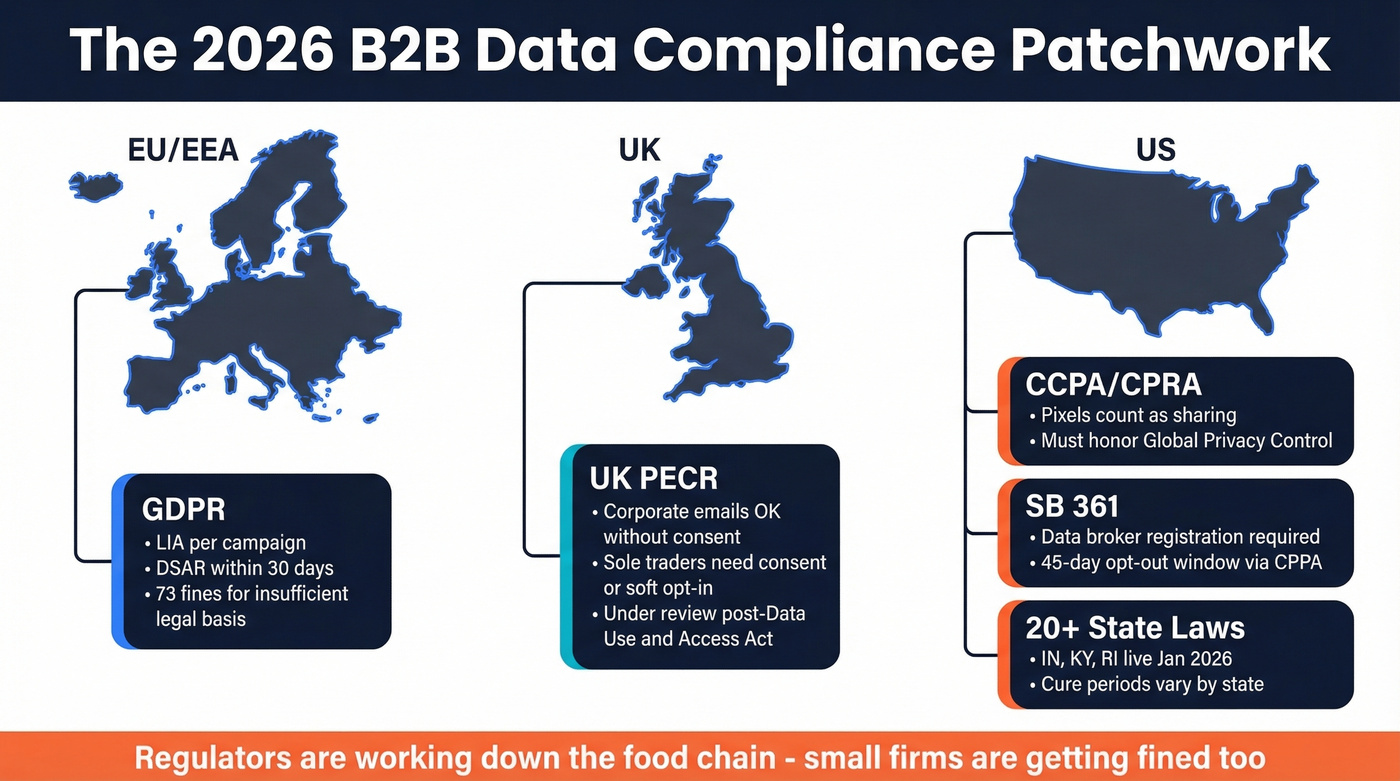
In the UK, PECR rules create a distinction most teams miss entirely. Corporate subscribers - companies, LLPs, Scottish partnerships - can receive unsolicited marketing emails. But sole traders and some partnerships are treated as individual subscribers, meaning you need consent or a soft opt-in. The ICO's PECR guidance is also under review following the Data (Use and Access) Act coming into law on 19 June 2025.
On the US side, CCPA's definition of "sharing" captures retargeting pixels and cross-context behavioral advertising. If you're running website tracking that feeds ad platforms, that's a "share" requiring opt-out support - including honoring Global Privacy Control signals.
| Regulation | Jurisdiction | Key B2B Implication |
|---|---|---|
| GDPR | EU/EEA | LIA recommended for each outbound use case; DSAR within one month |
| UK PECR | UK | Corporate emails OK; sole traders need consent |
| CCPA/CPRA | California | Pixels = sharing; GPC must be honored |
| SB 361 | California | Data broker registration + 45-day opt-out window via CPPA |
| State laws (20+) | US (various) | Cure periods vary; some have no sunset |
The Legitimate Interest Assessment
This is where most teams fall short. Seventy-three GDPR fines have been issued specifically for "insufficient legal basis." The LIA is your documentation that you've done the work, and the burden of proof sits entirely on your business. If you want a deeper checklist, use our GDPR compliant database audit guide.
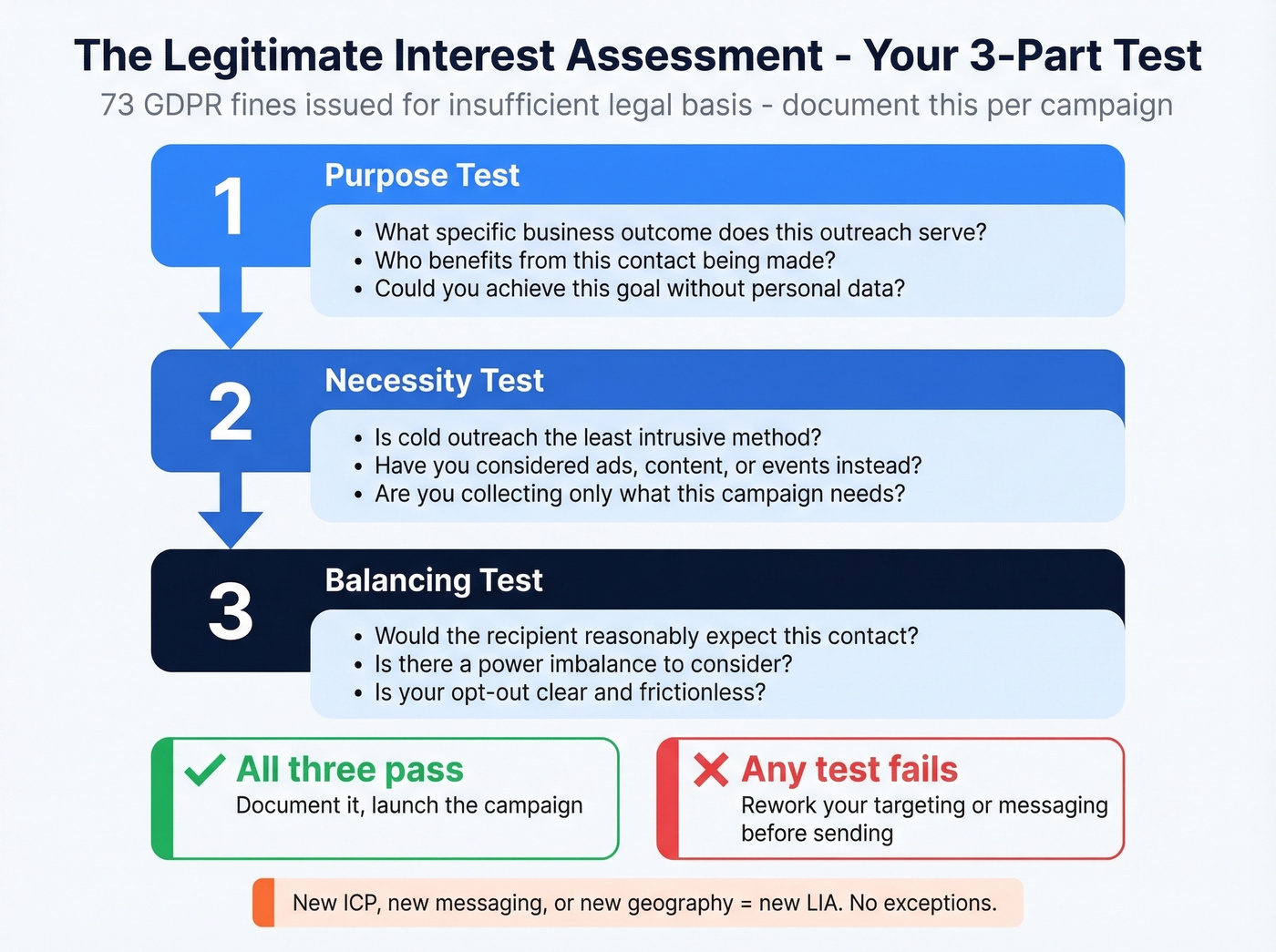
The assessment follows a three-part test:
Purpose test - Define the specific business outcome this outreach serves. Who benefits? Could this purpose be achieved without processing personal data?
Necessity test - Is cold outreach the least intrusive way to reach this audience? Have you considered alternatives like content marketing, paid ads, or events? Are you collecting only the data you need for this specific campaign? (This is also where a tight Ideal Customer Profile reduces risk.)
Balancing test - This is the one that matters most. Would the recipient reasonably expect this type of contact? A VP of Engineering getting a relevant SaaS pitch is very different from a sole trader getting a mass blast. Consider the power imbalance, and make sure you've provided a clear, frictionless opt-out.
Each outbound campaign needs its own LIA. If your ICP shifts, your messaging changes, or you're targeting a new geography, that's a new assessment. In our experience, teams that document LIAs per campaign spend less time on regulatory responses, not more - the thinking is already done when a question arrives.

Every campaign needs its own LIA - and every LIA needs data you can actually defend. Prospeo refreshes 300M+ profiles every 7 days, provides DPAs upfront, and enforces global opt-outs automatically. At 98% email accuracy, your outreach stays compliant and your sender reputation stays intact.
Stop building compliance cases on data that's already six weeks stale.
Operationalizing Data Compliance
Definitions don't protect you. Workflows do.
Every contact in your CRM should have a record of where and when it was acquired. When someone asks "how did you get my email?" - and they will - you need an answer in seconds, not days. (If your CRM is messy, CRM automation software can help enforce the logging.) The consensus on r/GrowthHacking is that most compliance failures aren't about intent; they're about sloppy record-keeping and slow suppression processing.
Opt-out processing needs to happen in minutes, not end-of-day. If someone unsubscribes at 9:03 AM and gets another email at 9:47 AM, that's a compliance failure with a paper trail. We've seen this exact scenario trigger formal complaints that took months to resolve. If you're formalizing this, build and maintain a dedicated suppression list.
For DSARs, map every system that holds personal data before the first request arrives. The workflow looks like this: identity verification, cross-system data aggregation, redaction of third-party data, response logging, and fulfillment within 30 days. Maintain a full audit trail for every interaction, every consent signal, every suppression event. If it isn't logged, it didn't happen.
Choosing a Compliant Data Provider
A vendor slapping "GDPR compliant" on their homepage means nothing without operational proof. Before you sign anything, verify four things: they can produce a Data Processing Agreement without weeks of legal back-and-forth, they can explain their data provenance chain, they can demonstrate their suppression methodology for opt-outs and DNC lists, and they hold SOC 2 Type II, ISO 27001, or ISO 27701 certifications. (For a broader vendor short-list, see our breakdown of B2B list providers.)
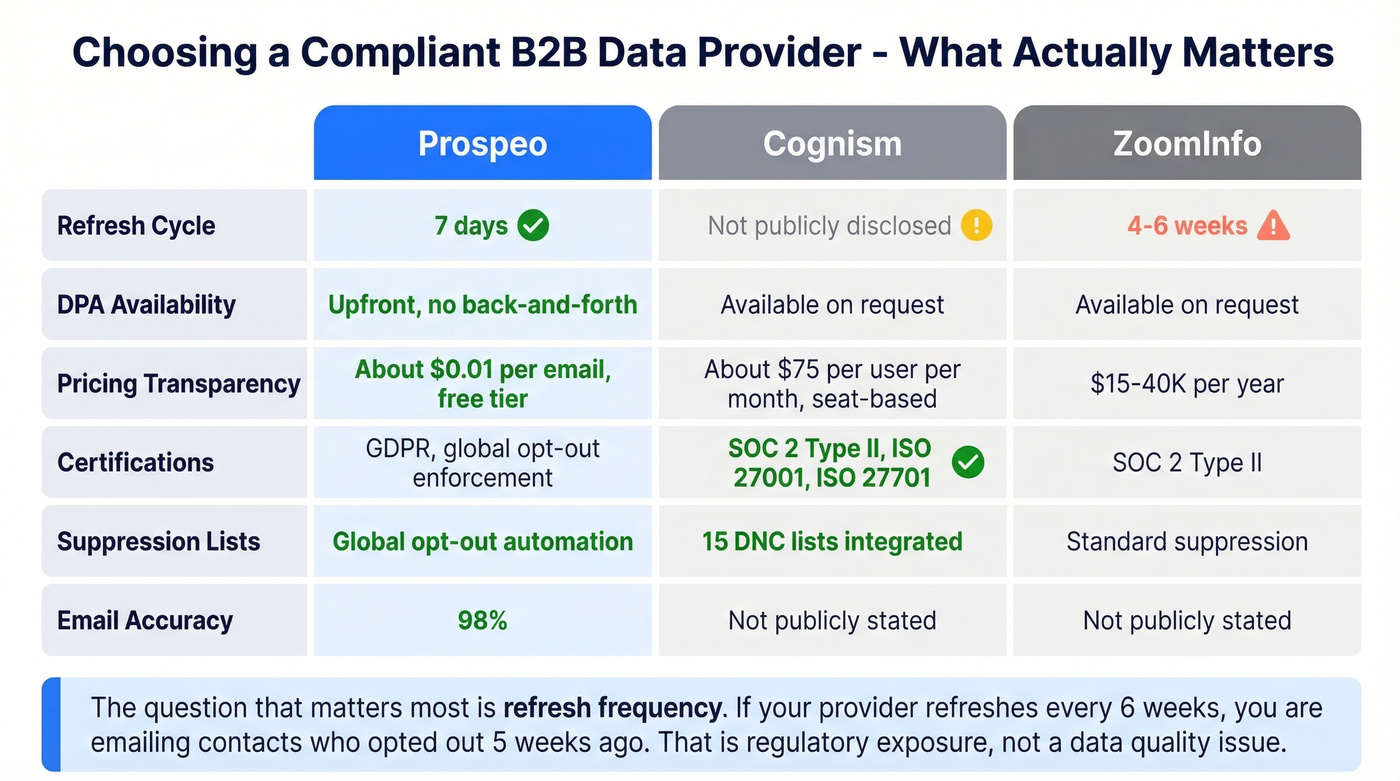
But the question that matters most? Refresh frequency.
Data freshness is the compliance mechanism most teams overlook. If your provider refreshes records every six weeks - the industry average - you're emailing contacts who opted out five weeks ago. That's not a data quality issue. That's regulatory exposure. And it circles back to deliverability: stale records tank your sender reputation just as fast as they create legal risk. If you're seeing bounce spikes, start with a check bounce workflow.
Prospeo runs a 7-day refresh cycle across 300M+ professional profiles with 98% email accuracy and DPAs available upfront. At roughly $0.01 per email with a free tier, the pricing is transparent enough that procurement usually doesn't need a long negotiation.
| Provider | Refresh Cycle | Pricing | Compliance |
|---|---|---|---|
| Prospeo | 7 days | ~$0.01/email; free tier | DPA upfront; GDPR; global opt-out |
| Cognism | Not publicly disclosed | ~$75/user/month (seat-based) | SOC 2 Type II; ISO 27001; ISO 27701; 15 DNC lists |
| ZoomInfo | ~4-6 weeks | $15-40K/year | SOC 2 Type II |
Common Compliance Pitfalls
Bought lists without provenance. If you can't trace where every contact came from, you can't defend your legal basis. The cheapest list is the most expensive one when a regulator asks for documentation you don't have. We've watched teams lose entire domains over lists they couldn't trace back to a legitimate source. If you're building lists internally, follow a safer process with cold email lead list building.
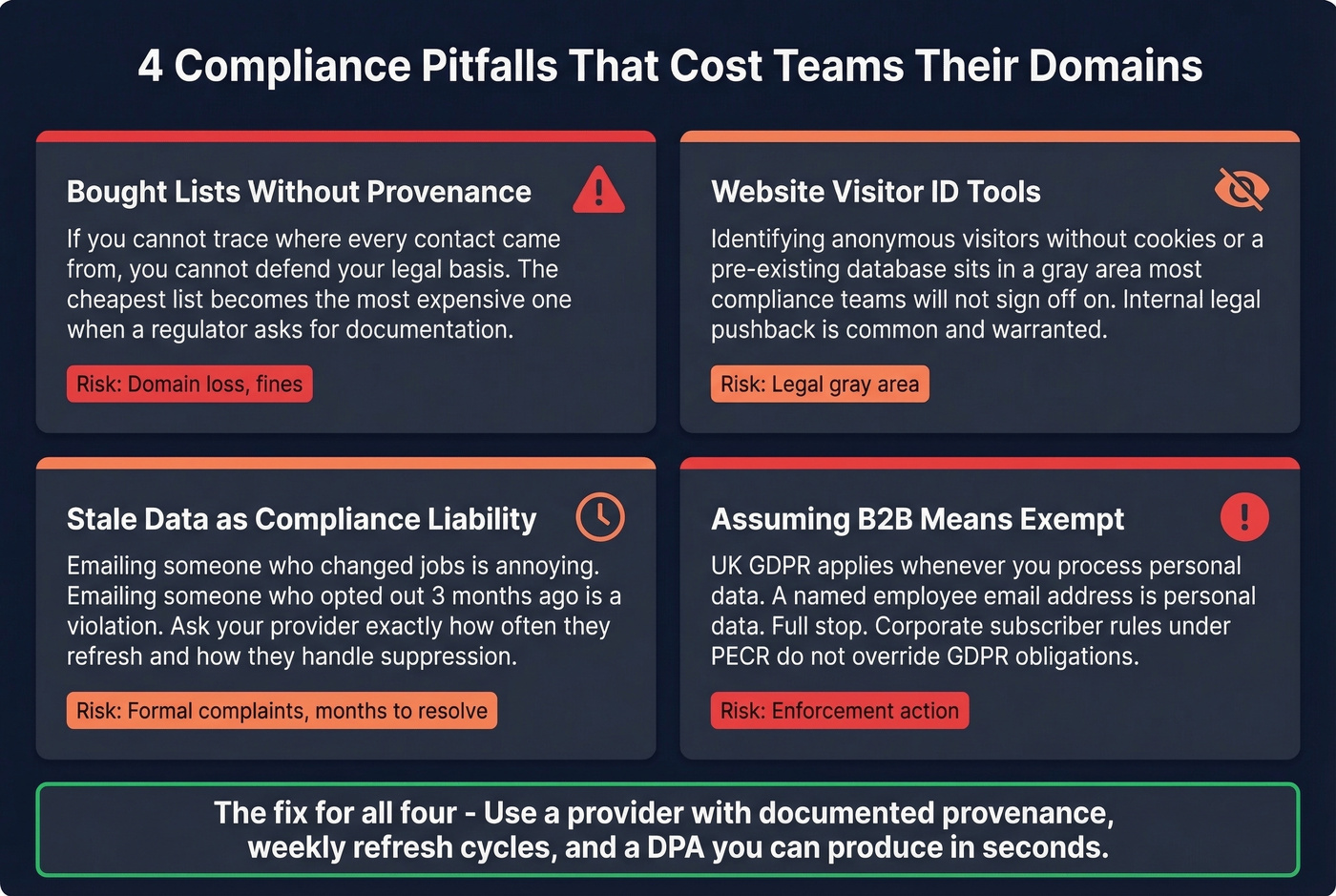
Website visitor ID tools. Let's be honest - the skepticism on Reddit is warranted. Identifying anonymous visitors without cookies or a pre-existing database often triggers internal legal pushback and sits in a gray area that most compliance teams won't sign off on.
Stale data as a compliance liability. Emailing someone who changed jobs three months ago is annoying. Emailing someone who opted out three months ago is a violation. Skip any provider that can't tell you exactly how often they refresh and how they process suppression requests. If you're cleaning lists, use data enrichment tools to keep fields current.
Assuming "B2B = exempt." It doesn't. UK GDPR applies whenever you process personal data, and a named employee's email address is personal data. Full stop.
Stale data isn't just a quality problem - it's regulatory exposure. While the industry average refresh cycle is 6 weeks, Prospeo refreshes every 7 days at roughly $0.01 per verified email. DPAs are available upfront, no legal back-and-forth required.
Fresh data, clean compliance, and a free tier to prove it yourself.
Compliant B2B Data FAQ
Is cold email legal under GDPR?
Yes, with a valid legal basis - typically legitimate interest for B2B outreach. You need a documented LIA per campaign showing your outreach is necessary, proportionate, and doesn't override the recipient's rights. Without that documentation, even well-targeted emails carry enforcement risk.
Do I need consent for B2B outreach in the UK?
Not always. Under PECR, corporate subscribers (limited companies, LLPs) can receive unsolicited marketing emails without prior consent. Sole traders and certain partnerships are treated as individuals and require consent or a soft opt-in first.
What's the biggest compliance risk with B2B data?
Stale records. If your provider refreshes every 4-6 weeks, you're likely emailing contacts who've opted out or changed roles. Weekly refresh cycles reduce this exposure dramatically and protect your sender reputation at the same time.
How do I verify a provider is actually GDPR compliant?
Request their DPA, data provenance documentation, suppression methodology, and refresh cadence. Any provider worth working with will hand these over without hesitation - if they stall, that tells you everything you need to know.