

Waterfall Enrichment: What It Is, When It Works, and When You Don't Need It
Your SDR manager just pinged you. Forty percent of the emails from last night's export bounced. The sequence is paused, the domain's warming period is wasted, and the reps are back to manual research. Poor data quality costs the US economy an estimated $3.1 trillion annually, and your team just felt a sliver of that firsthand.
Waterfall enrichment - querying multiple data providers in sequence until you get a verified match - is the standard fix. But it's not always the right one.
The Short Version
This approach queries multiple data providers in a cascade: if Source A misses, Source B fires, then Source C. Practitioner tests show 88% accuracy vs. 65-75% from single sources. But it adds complexity and cost.
Here's the principle most guides bury: provider order matters more than provider count. Start with your highest-accuracy source first. And the contrarian take - if your primary source already hits 85%+ accuracy with fresh data, you probably don't need a waterfall at all.
What Is Waterfall Enrichment?
You feed a contact record - name, company, maybe a domain - into Provider A. If Provider A returns a verified email, you stop. If it doesn't, the record cascades to Provider B, then Provider C, and so on until you get a match or exhaust your sources. You only pay for the next lookup when the previous one fails.
This differs from parallel enrichment, where you blast the same record to every provider simultaneously and pick the "best" result. Parallel approaches create data deduplication headaches and burn credits on every provider for every record. The sequential method is conditional and cheaper by design.
Most teams run waterfalls for emails and phone numbers, but the logic applies to any data type: technographics, job postings, firmographics, funding data. Email waterfalls are the most common because deliverability is binary - an email either delivers or it doesn't.
How Does It Work?
A record enters the waterfall, hits Source A, and gets an email back. The system checks confidence - is this a verified deliverable address or a catch-all domain guess? If confidence is high, the record exits with that email attached. If confidence is low or the source returns nothing, the record drops to Source B. Repeat until a match clears the threshold or the cascade runs dry.
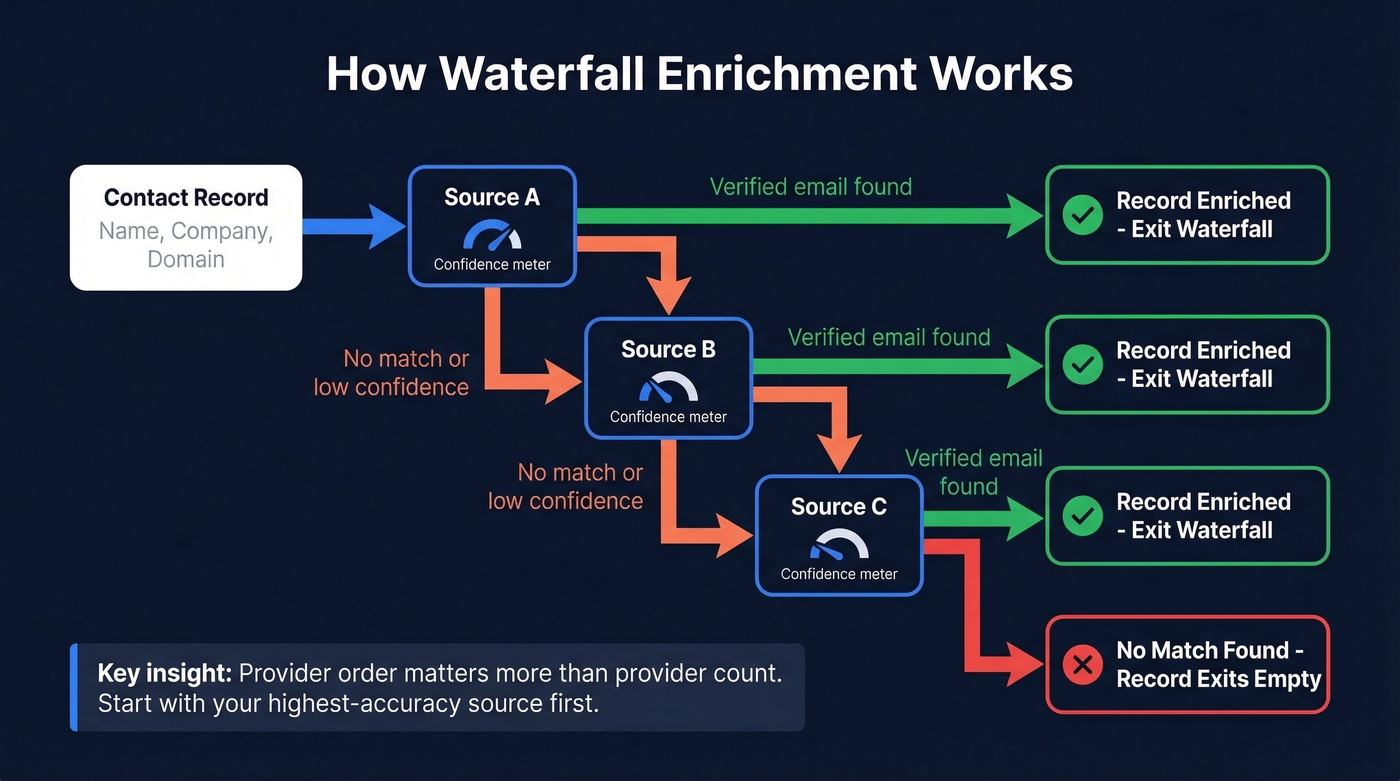
The insight that separates good implementations from expensive ones: provider order matters more than provider count. Starting with a weak source contaminates everything downstream. If Source A returns a plausible-looking but unverified email, some systems accept it and stop - meaning your waterfall is only as good as your worst first provider.
This also explains why two platforms using the same underlying providers produce different results. The sequencing logic, confidence thresholds, and stop conditions are where the real differentiation lives. Three well-ordered providers will outperform fifteen overlapping sources in practice. Smart waterfalls also route by data type and geography - one provider might excel at US tech company emails while another dominates EMEA mobile numbers.
The Benchmark Data
A 6-week practitioner test on r/SaaS compared three approaches head-to-head for building lists of 500 accounts:
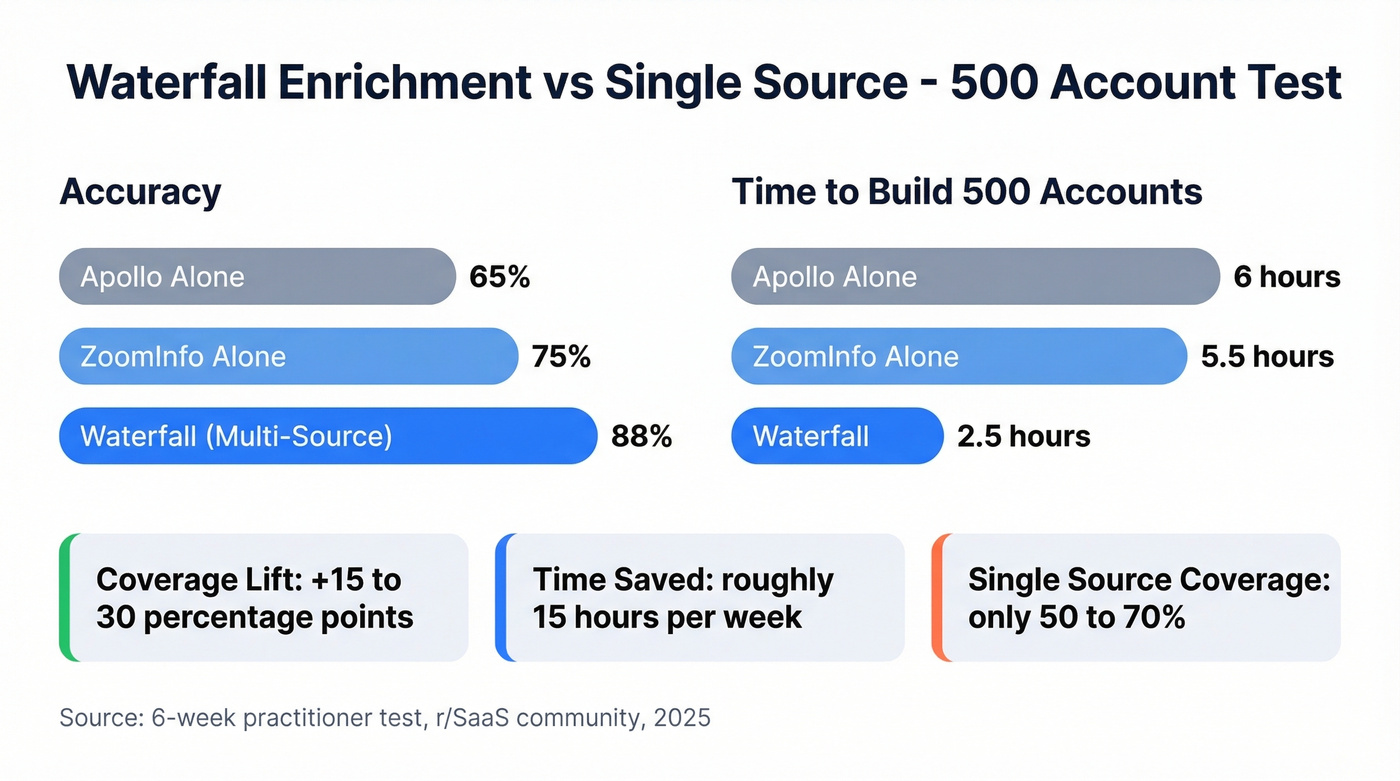
| Approach | Accuracy | Time (500 accounts) |
|---|---|---|
| Apollo alone | ~65% | 6h (2h build + 4h verify) |
| ZoomInfo alone | ~75% | 5.5h (3h build + 2.5h verify) |
| Waterfall | ~88% | 2.5h (30m config + 1h auto + 1h check) |
The accuracy lift is meaningful, but the time savings are the real story. Once configured, the waterfall automated most of the verification grunt work, saving roughly 15 hours per week across the team.
A separate 1,000-contact test across 15 providers measured actual deliverability and found Cleanlist's waterfall hitting 98% accuracy, compared to ZoomInfo at 85%, Cognism at 90%, and Apollo at 80%. A SyncGTM test across 12 platforms reported 35% higher coverage from waterfall versus any single source.
The general ranges we've seen across these tests: single-source email coverage runs 50-70%, while waterfall pushes to 85-95%. For phone numbers, single-source covers 20-40% of records; multi-provider cascading gets you to 50-70%.
Let's make this concrete with funnel math. If 40% of your leads are missing contact data, you need to build a list 2.5x larger to hit the same pipeline number. That's not a data problem - it's a revenue leak.

That 40% bounce rate your SDR manager flagged? Prospeo's 98% email accuracy and 7-day data refresh eliminate the coverage gap that drives teams to waterfall enrichment. At $0.01 per email, you get single-source simplicity with multi-source results.
Stop cascading through five providers when one already delivers 98%.
Waterfall vs. Single Source
Build a waterfall if:
- Your single-source coverage is below 75%
- You're enriching 500+ contacts per month
- You sell into multiple geographies where no single provider dominates
- Your bounce rate consistently exceeds 5%
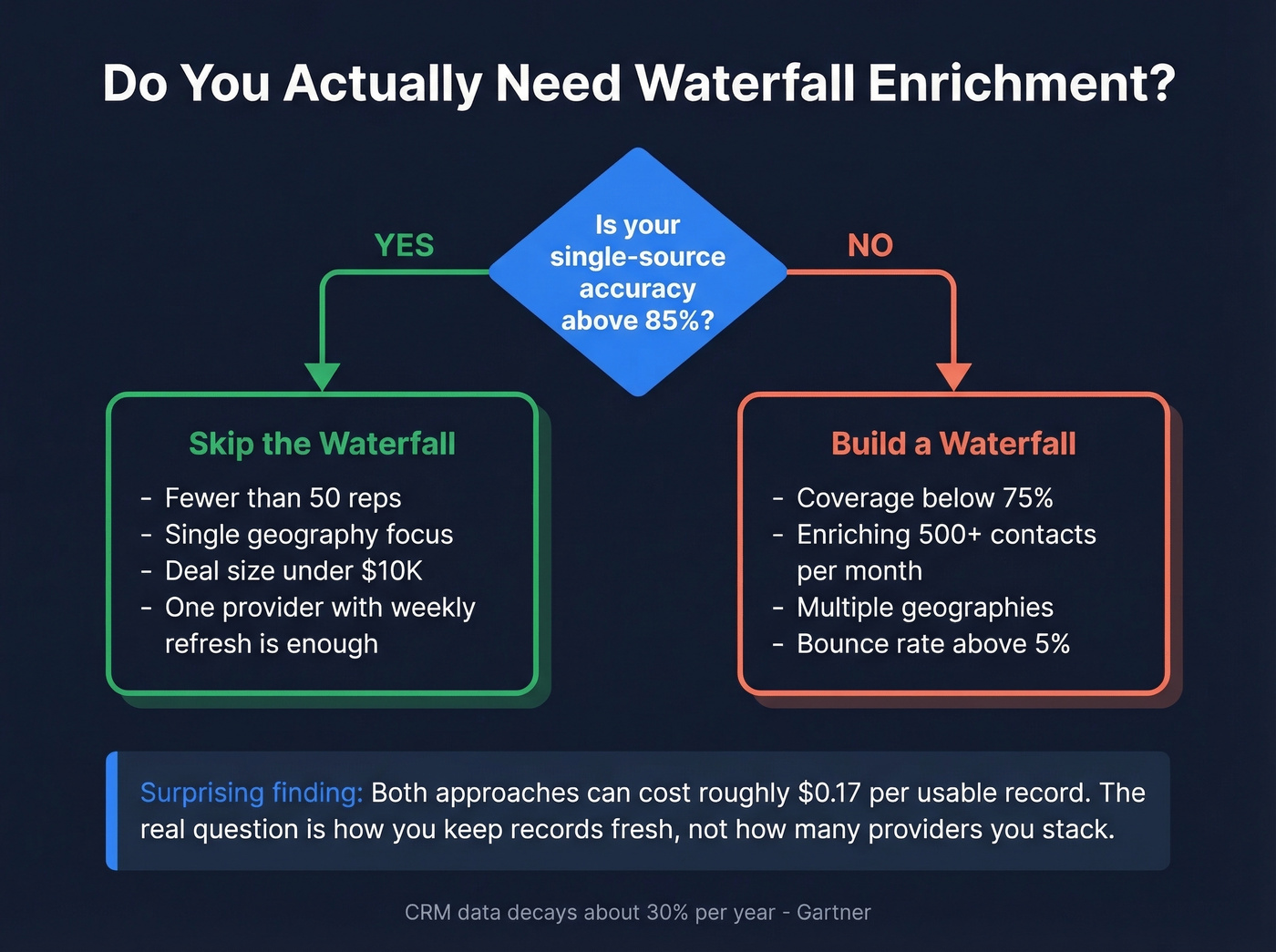
Skip the waterfall if:
- Your primary source already delivers 85%+ accuracy with fresh data
- You have fewer than 50 reps and limited ops bandwidth
- You're selling into a single geography where one provider has deep coverage
The cost math is surprisingly close. Both approaches can net to roughly $0.17 per usable record - the waterfall yields more usable records but burns credits across multiple providers to get there. CRM data decays about 30% per year, so the real question isn't "waterfall or not" but "how do I keep records fresh?" (If you want the deeper mechanics, see B2B contact data decay.)
Here's our honest take: if your average deal size is under $10K, you usually don't need a cascading enrichment setup. A single high-accuracy provider with weekly data refreshes will get you to 85%+ coverage at a fraction of the operational overhead. Save the multi-provider approach for enterprise teams selling into multiple geographies with five-figure ACVs.
Pros and Cons
What it gets right: Coverage jumps 15-30 percentage points over single-source approaches. Accuracy improves when you lead with a strong primary provider. At scale, you get more usable records per dollar. And you can swap underperforming providers without rebuilding your stack.
What goes wrong in practice: The first match isn't always the best match - the cascade stops at "good enough," not "best available." Conflicting data across providers creates merge headaches in your CRM. Maintenance overhead is real: API keys, contracts, rate limits, provider-specific quirks. Sequential calls add latency - individual records take 2-30 seconds, and bulk runs take 5-15 minutes for 1,000 records. Credit burn is unpredictable when providers charge per lookup regardless of result quality. And data provenance gets murky, making it harder to trace where a specific email or phone number originated.
Mistakes That Blow Up Your Budget
Trigger architecture costs more than the waterfall itself. As one r/SalesOperations user put it, the same account hits multiple workflow steps and sync rules, causing three or four debits for a single record. Optimizing your provider sequence is only half the fix.
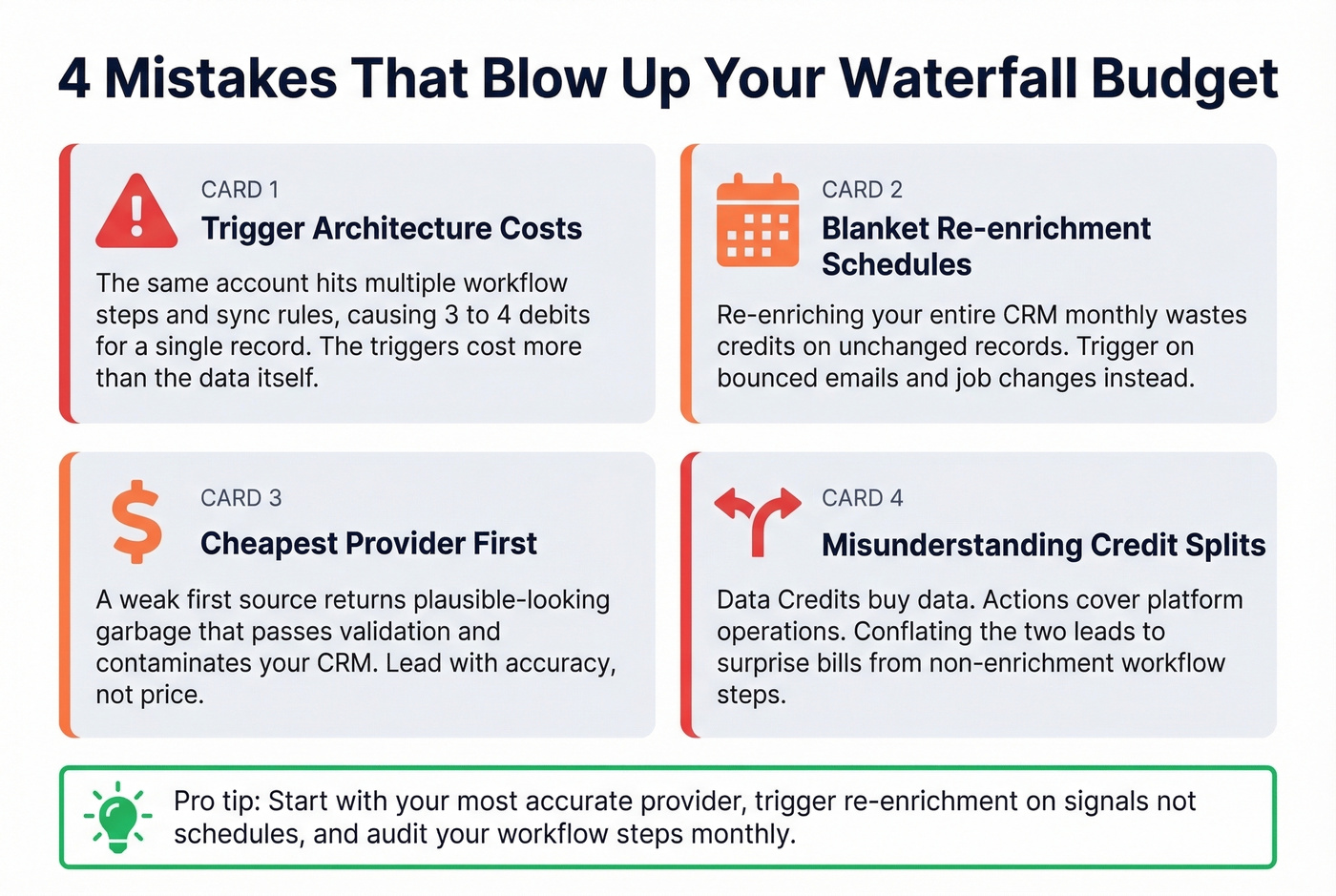
Blanket re-enrichment schedules. Re-enriching your entire CRM on a monthly cadence wastes credits on records that haven't changed. Trigger re-enrichment on signals like bounced emails, job change alerts, and engagement drops - not on a calendar.
Starting with your cheapest provider instead of your most accurate. A weak first source returns plausible-looking garbage that passes basic validation and contaminates your CRM. Lead with accuracy, not price. We've seen teams waste thousands of credits downstream because they tried to save $50/month on their first provider.
Not understanding Clay's credit split. Data Credits buy data; Actions cover platform operations. Teams who conflate the two get blindsided by bills from workflow steps that have nothing to do with enrichment.
Best Tools for 2026
Prospeo
Prospeo is the strongest starting point for any waterfall - or the reason you don't need one. The 98% email accuracy comes from proprietary email-finding infrastructure that doesn't rely on third-party email providers, so you're not getting the same recycled data as everyone else. The 5-step verification process includes catch-all handling, spam-trap removal, and honeypot filtering.

With 300M+ profiles refreshed every 7 days, the data stays current without manual re-enrichment. The 83% match rate means four out of five records come back with a usable email or phone on the first pass - and teams using Prospeo book 26% more meetings than ZoomInfo users and 35% more than Apollo users. When Meritt switched, their bounce rate dropped from 35% to under 4% and their pipeline tripled from $100K to $300K per week. For lead enrichment, starting with this level of accuracy means fewer records ever need to cascade downstream.
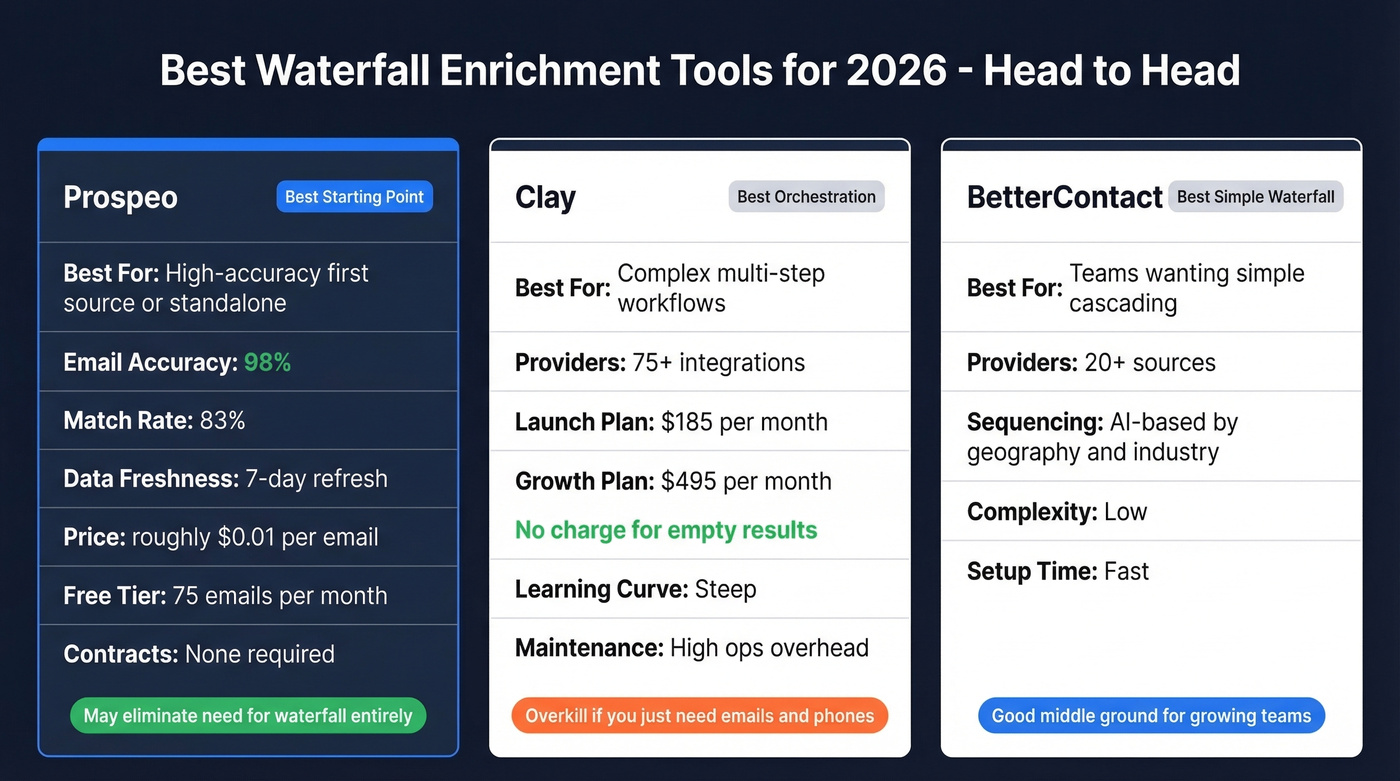
Pricing runs ~$0.01 per email and 10 credits per mobile number. Free tier with 75 emails per month, no credit card required. No annual contracts.
Clay
Clay is the most powerful orchestration platform for waterfall data enrichment, and the easiest to overspend on. The March 2026 pricing overhaul introduced Launch at $185/mo for 2,500 Data Credits plus 15,000 Actions, and Growth at $495/mo for 6,000 Data Credits plus 40,000 Actions.
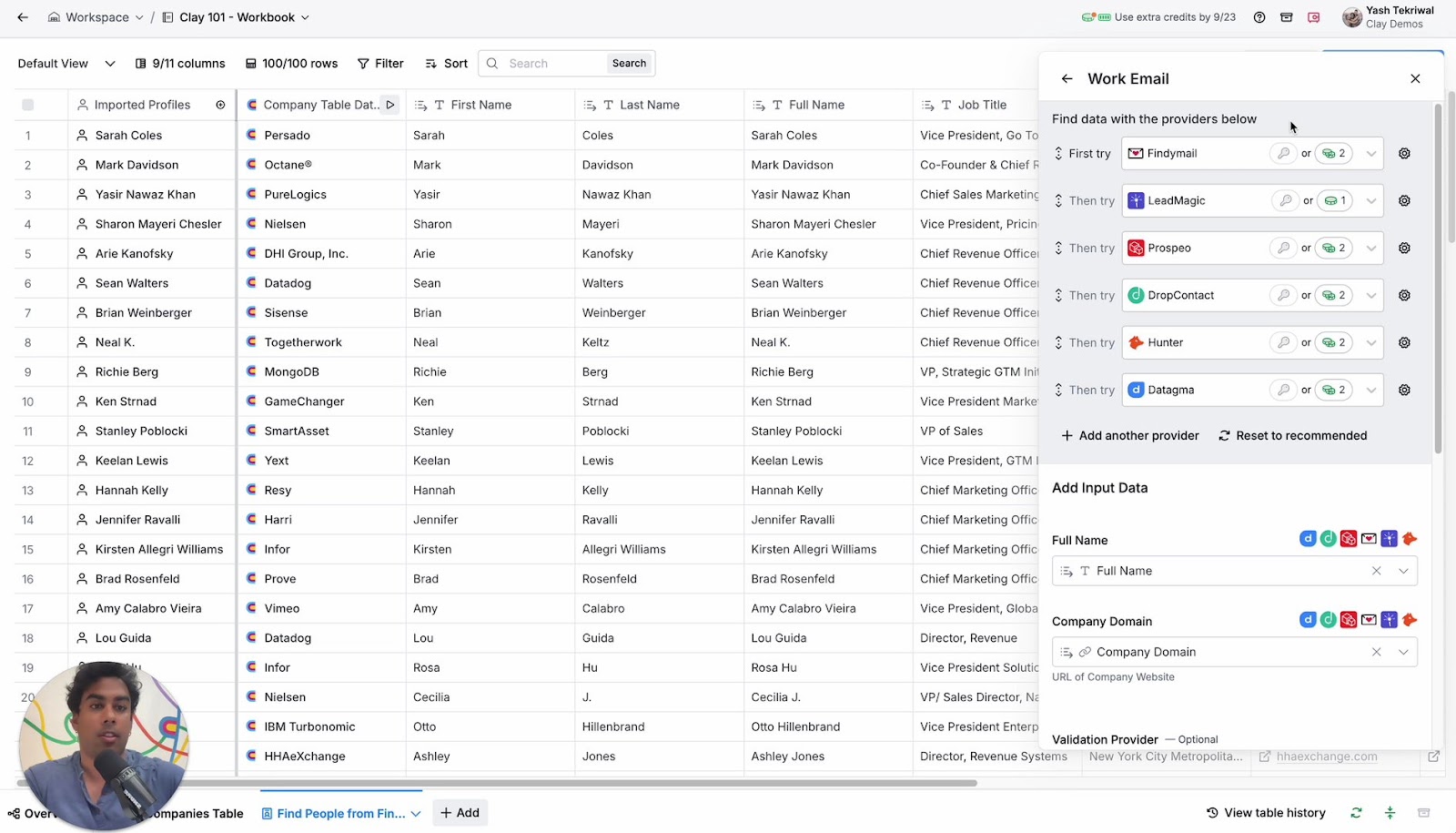
If an enrichment returns no result, you're not charged Data Credits or Actions. That's generous. But the trigger architecture racks up Action costs fast if you're not careful with workflow design. Clay is the right tool for teams that need complex, multi-step orchestration across dozens of data sources and workflow triggers. It's overkill if you just need emails and phones - and the consensus on r/SalesOperations is that most teams underestimate the ops time required to maintain Clay workflows once they're built.
BetterContact
BetterContact is the simpler, cheaper option for teams that don't need Clay's orchestration power. It routes records across 20+ providers with AI-based sequencing by geography, industry, and company size. Starter runs $15/mo for 200 credits; Pro is $49/mo for 1,000 credits. One credit per email lookup; phone lookups cost 10 credits. Credits roll over month-to-month, capped at 2x your plan.
The trade-offs: it excludes Gmail and Yahoo addresses entirely, and there's no native Salesforce sync. For teams running outbound to business domains only, the Gmail exclusion is actually a feature. For anyone targeting small businesses or freelancers, it's a dealbreaker.
FullEnrich
FullEnrich takes a credit-efficient approach with transparent unit pricing: 1 credit per work email, 10 per mobile, 3 per personal email. You're only charged when they find a result - invalid data doesn't cost you. They report an average find rate of roughly 80% across geographies. Plans start at $29/mo. FullEnrich doesn't store contact data and audits providers for GDPR and CCPA compliance, which matters if your legal team is breathing down your neck about data provenance.
Apollo
Apollo offers a built-in cascade within its broader sales platform. Free tier gives you 100 credits per month; paid plans run $59-$149/user/mo. Accuracy benchmarks put it around 80%. It's the all-in-one play, not the accuracy play. If you're already deep in Apollo's ecosystem for sequences and CRM, adding their enrichment is frictionless. If you need best-in-class data, look elsewhere. (If you're evaluating it specifically for data, see Apollo.io accuracy.)
ZoomInfo
Enterprise-grade data with enterprise-grade pricing. Starts around $15K/year and scales to $40K+. Benchmarks show roughly 85% email accuracy. Strong firmographic data and US coverage, but the cost structure makes it hard to justify as just one node in a multi-provider setup. Skip this if your team is under 20 reps or your annual enrichment budget is under $10K. If you're planning a migration, read how to switch from ZoomInfo.
| Tool | Starting Price | Email Accuracy | Best For |
|---|---|---|---|
| Prospeo | Free (75/mo) | 98% | Primary source or standalone |
| Clay | $185/mo | Varies by provider | Complex multi-step orchestration |
| BetterContact | $15/mo | Varies | Simple cascade on a budget |
| FullEnrich | $29/mo | ~80% find rate | Credit-efficient enrichment |
| Apollo | Free (100/mo) | ~80% | All-in-one sales platform |
| ZoomInfo | ~$15K/yr | ~85% | Enterprise teams with budget |
Compliance Risks You Can't Ignore
Multi-provider enrichment multiplies your compliance surface area. Every provider in your cascade is a data source you need to vet for lawful data collection, and the provenance chain gets murky when a contact record has been touched by four different vendors.
GDPR requires a lawful basis for processing, purpose limitation, data minimization, and accuracy. That accuracy obligation isn't optional - it's a legal requirement that makes verification a compliance function, not just a deliverability one. Penalties reach EUR 20 million under GDPR and $7,988 per intentional violation under CCPA. Over 20 US states now have comprehensive privacy laws. (If you're building processes around this, start with ethical data collection.)
Here's the thing most guides ignore: country-level variation inside the EU. If your cascade enriches contacts across multiple EU markets, you need country-level compliance logic - not just a blanket "we're GDPR compliant" checkbox. Multi-vendor enrichment doesn't exempt you from any of this. If anything, it increases your exposure because you're responsible for data accuracy regardless of which provider sourced it.
The article says skip the waterfall if your primary source hits 85%+ accuracy with fresh data. Prospeo delivers 98% verified emails across 300M+ profiles, refreshed every 7 days - not the 6-week industry average that forces you into multi-provider workarounds.
Replace your entire waterfall stack with one source that actually stays fresh.
FAQ
Is waterfall enrichment worth the complexity?
For teams enriching 500+ outbound contacts per month whose single-source coverage falls below 75%, yes. Practitioner tests show 88% accuracy and 60% time savings over manual verification. For smaller teams, a high-accuracy single source with 98% email accuracy and an 83% match rate delivers comparable results with far less overhead.
How many providers should a cascade include?
Three to four well-ordered providers outperform fifteen overlapping ones. Start with your most accurate source, then add complementary providers covering different geographies or data types. Each provider should fill a distinct coverage gap rather than duplicate what the others already offer.
What's the best provider order?
Lead with your most accurate email source - this prevents low-quality data from contaminating downstream results. Layer phone-specific providers second. End with broad-coverage fallbacks. A weak first source is the single most expensive mistake in any sequential enrichment workflow.
How often should I re-enrich my CRM?
CRM data decays roughly 30% per year. Re-enrich based on engagement signals like bounced emails, job changes, and dropped reply rates - not on a blanket monthly schedule. Providers with weekly data refresh cycles reduce the need for frequent re-enrichment runs compared to those refreshing every 4-6 weeks.