

Firmographic Data: The Practitioner's Guide to Getting It Right
Your team targeted "healthcare companies with 200-500 employees" and the reply rate was 2%. Half the contacts bounced, a third of the "healthcare" companies were actually insurance brokers, and the employee counts were 18 months stale. That's not a messaging problem - it's a firmographic data problem.
Firmographic data is the foundation of every B2B go-to-market motion. Get it right and you're talking to the right companies at the right time. Get it wrong and you're burning budget, rep hours, and domain reputation on accounts that were never going to buy.
What Is Firmographic Data?
Think of firmographics as the B2B equivalent of demographics. Where demographics describe individuals - age, income, location - firmographics describe companies. They're the structural attributes that tell you whether an organization fits your ideal customer profile before you ever pick up the phone.
The most common firmographic variables include industry classification using NAICS or SIC codes, company size by employee count, annual revenue, headquarters and office locations, and ownership type - public, private, PE-backed, or nonprofit. Beyond the basics, firmographics also cover growth stage, year founded, hiring velocity, recent layoffs, and market presence. These fields form the backbone of every ICP definition, territory plan, and TAM analysis in B2B sales and marketing.
The tricky part isn't collecting these attributes - it's keeping them accurate. Companies grow, shrink, get acquired, pivot industries, and move offices constantly. A snapshot from six months ago can already be wrong in three or four fields.
Why Bad Data Costs You Money
The numbers on data quality are brutal. Poor data costs organizations an average of $12.9M annually, according to Gartner research. IBM estimates the total cost of bad data to the US economy at $3.1T per year. And CMOs estimate that 45% of the data their teams use is incomplete, inaccurate, or outdated.
The flip side is equally striking: teams that use firmographic segmentation for personalization see 5-8x ROI on their campaigns - but only if the underlying data is accurate.
For outbound teams, the damage is direct. B2B email addresses decay at roughly 28% per year. Build a 10,000-contact list in January and nearly 3,000 of those emails won't work by December. Every bounced email chips away at your sender reputation, which tanks deliverability for the emails that are still valid.
Here's the thing: most teams don't realize they have a data problem. They A/B test subject lines for weeks when the real issue is that 30% of their list is dead on arrival.

Firmographic vs. Technographic vs. Intent Data
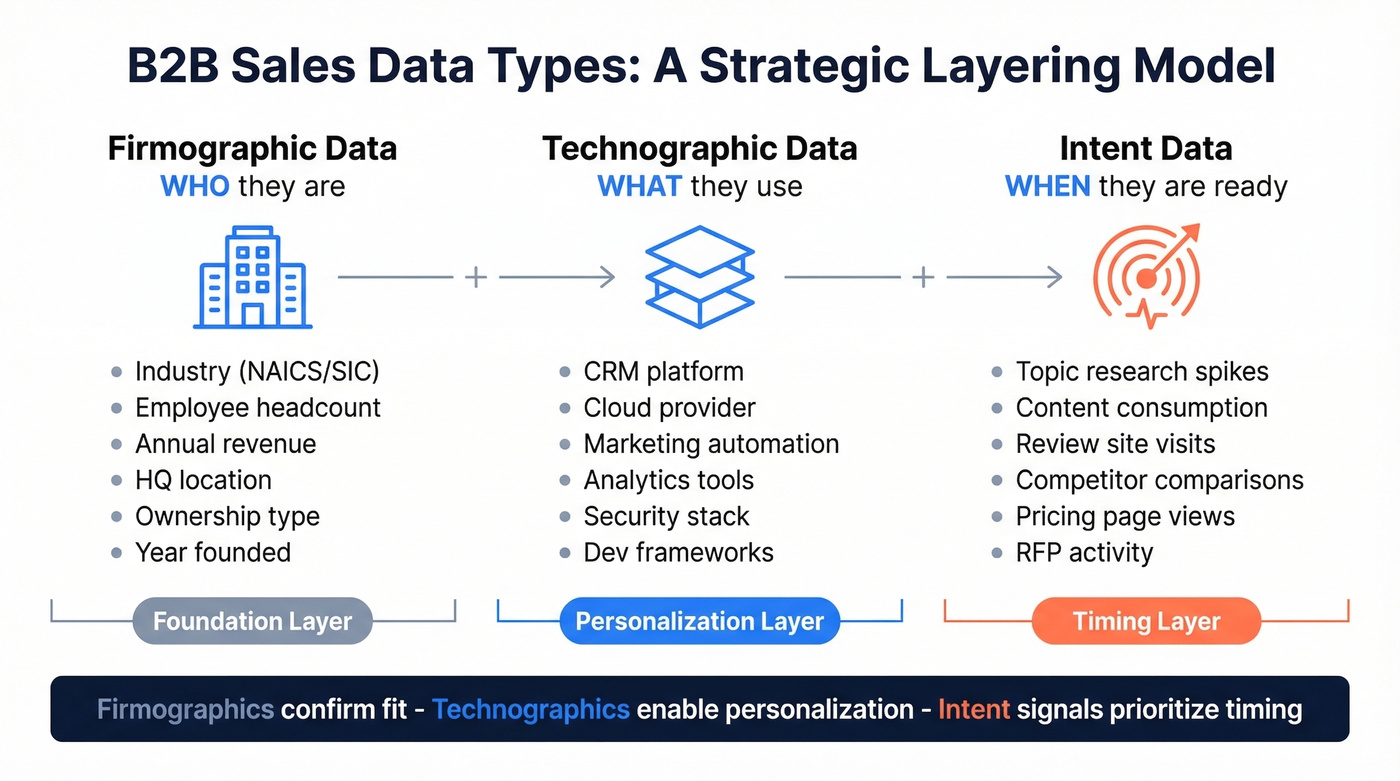
Most teams start with firmographics and stop there - which is why their outbound feels like spray-and-pray. Firmographic data tells you who a company is. Technographic data tells you what tools they use. Intent data tells you when they're actively researching a solution.
| Data Type | Focus | Examples | Best For |
|---|---|---|---|
| Firmographic | Company identity | Industry, revenue, headcount, location | ICP fit, segmentation, TAM |
| Technographic | Tech stack | CRM, cloud provider, marketing tools | Personalization, displacement plays |
| Intent | Buying signals | Topic research, content consumption | Timing, prioritization |
Firmographics alone confirm fit but rarely indicate buying timing. Two companies can match your ICP perfectly on paper - same industry, same size, same revenue band - but one is actively evaluating solutions while the other just signed a three-year contract with your competitor. That's why the best teams treat firmographics as the foundation and layer technographic and intent signals on top for prioritization.
How to Segment Using Firmographic Variables
Step 1: Analyze your best customers. Pull your top 20 closed-won accounts and look for common patterns. We did this exercise internally and found 14 of our top 20 were B2B SaaS companies with 100-500 employees and $10-50M in revenue - that became our ICP filter. You'll usually find 60%+ share at least three attributes.
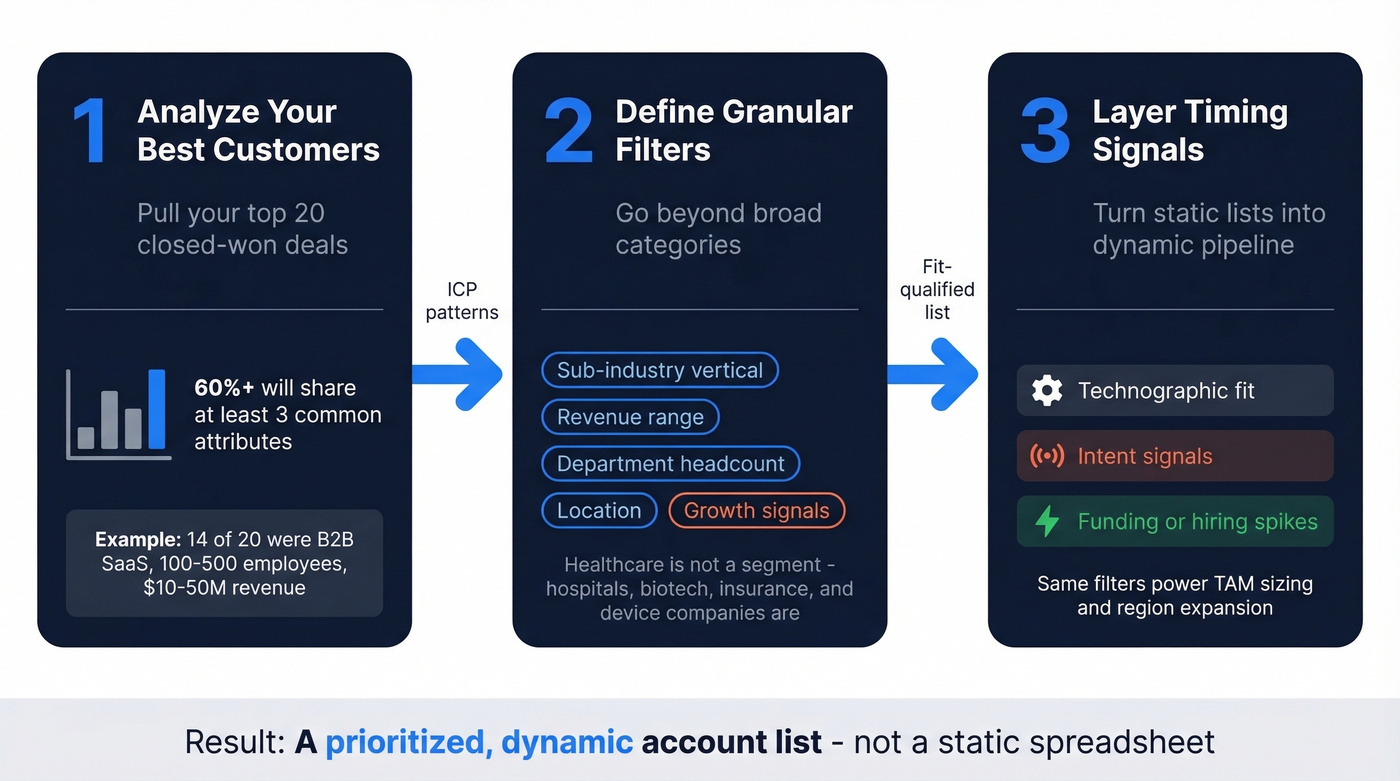
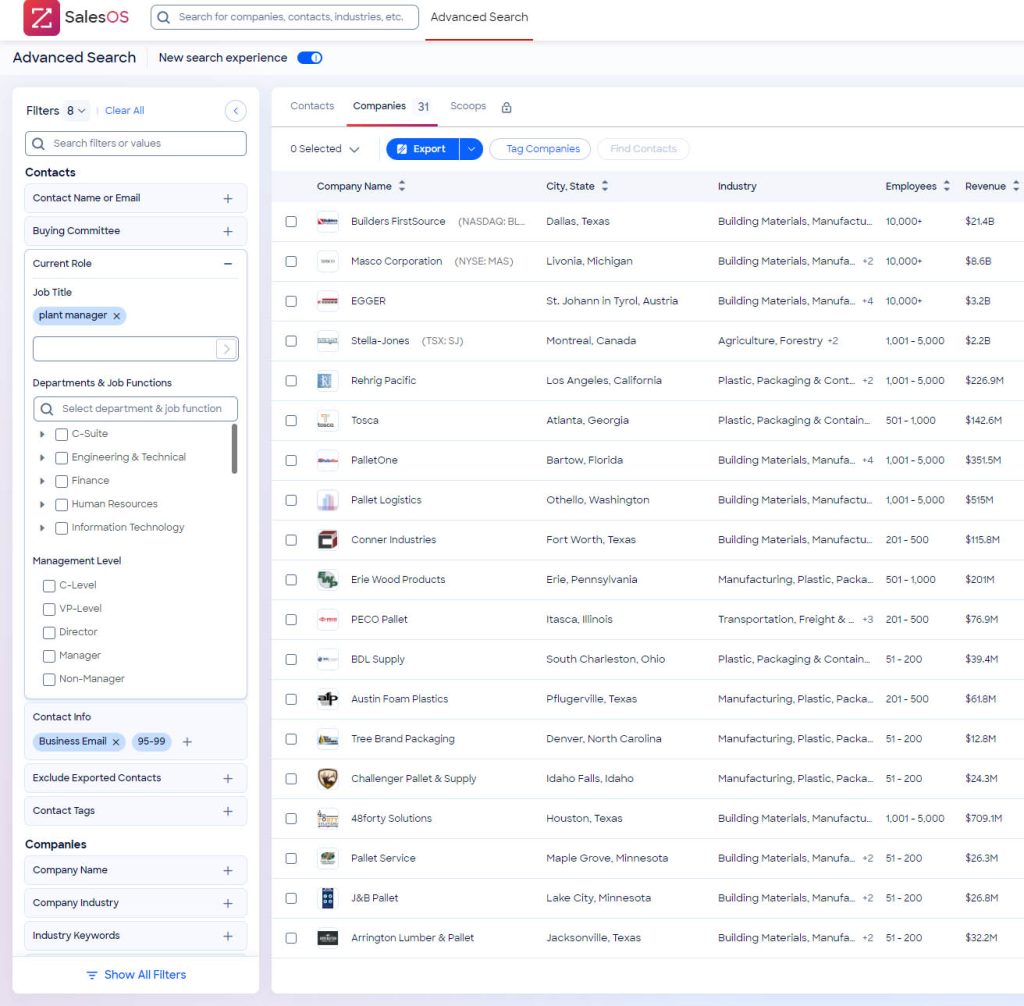
Step 2: Define granular filters. "Healthcare" isn't a segment - it spans hospitals, biotech startups, insurance carriers, and medical device manufacturers. Filter by sub-industry vertical, revenue range, department headcount (not just total), location, and growth signals like recent funding or hiring spikes. Sub-vertical firmographic segmentation is where real targeting precision begins.
Step 3: Layer timing signals. Once you've got a fit-qualified list, add technographic and intent data to prioritize accounts that are actually in-market. This turns a static list into a dynamic pipeline. The same filters power TAM sizing and region expansion planning - helping you quantify how many accounts fit your ICP in a new market before you commit budget.


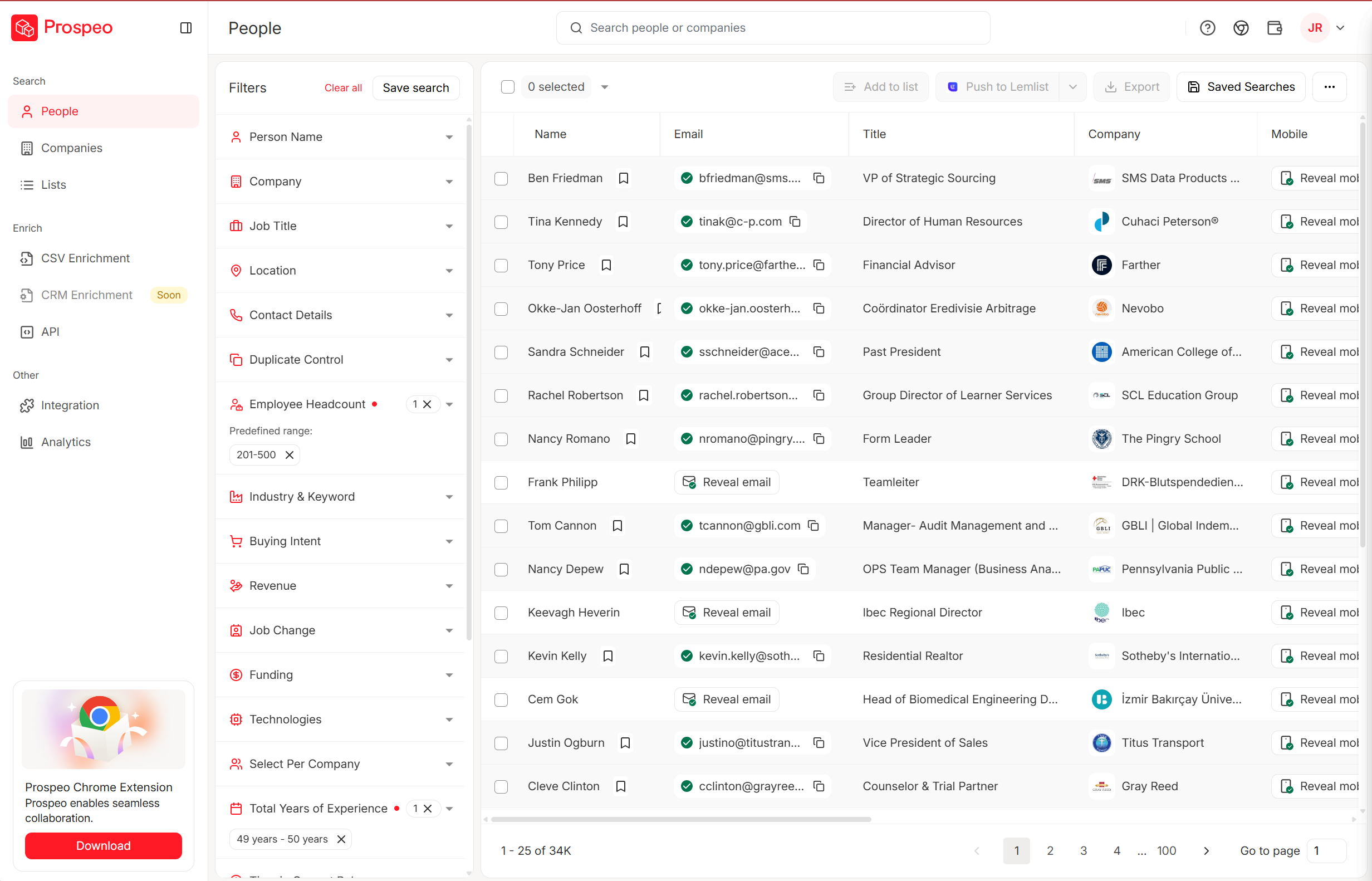
Your firmographic filters are only as good as the data behind them. Prospeo's B2B database gives you 30+ filters - industry, revenue, headcount, department size, funding, and growth signals - across 300M+ profiles refreshed every 7 days. At 98% email accuracy and $0.01/email, you stop burning budget on bounced contacts and stale company records.
Filter by the firmographics that matter, with data you can trust.
Five Mistakes That Kill Your Pipeline
1. Using total headcount without department breakdown. A 500-person company with 10 people in IT is a completely different prospect than one with 200 engineers. Filter by department headcount when your product targets a specific function.
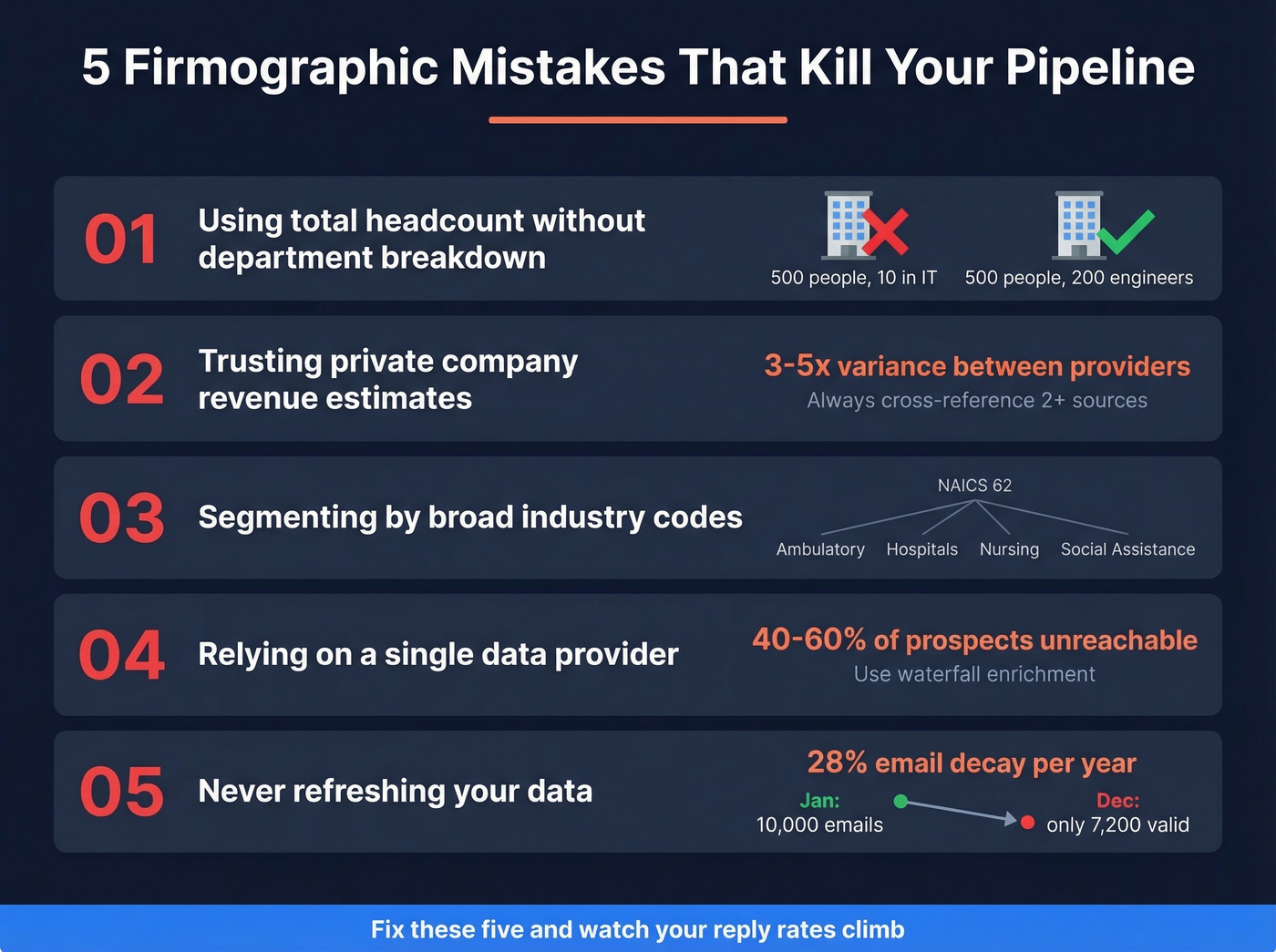
2. Trusting private-company revenue estimates at face value. Revenue data for private companies is almost always estimated. We've seen estimates vary by 3-5x between providers for the same company. Cross-reference at least two sources.
3. Segmenting by broad industry codes. NAICS code 62 (Health Care and Social Assistance) covers everything from ambulatory services to hospitals to nursing and residential care. Sub-industry granularity is where the real targeting precision lives.
4. Relying on a single data provider. Single-source reliance typically leaves 40-60% of qualified prospects unreachable. Waterfall enrichment exists for a reason.
5. Never refreshing your data. With 28% annual email decay, a list that's even six months old has significant rot. Quarterly refresh is the minimum; for high-velocity outbound, monthly or event-driven updates are better.
How to Collect and Maintain Firmographics
There are three sourcing channels. Public filings - SEC documents, Companies House records, state registrations - give you verified basics for free but cover a narrow slice. Third-party providers aggregate and enrich data at scale, trading cost for coverage. Self-reported data from forms and inbound leads fills gaps but introduces bias.
The smartest teams run waterfall enrichment: query your primary provider first, then pass unmatched records to a second and third source until you've got verified data for each contact. In our experience, single-provider accuracy never closes coverage gaps, and layering sources is the only way to get both coverage and correctness.
Refresh cadence matters as much as initial accuracy. For mid-market and SMB segments, quarterly refreshes are the minimum. High-velocity outbound teams should refresh monthly or trigger updates based on funding rounds, M&A activity, or hiring spikes. Location data is especially prone to drift - companies open and close offices frequently, and targeting based on stale HQ addresses sends reps chasing accounts in the wrong region.
Firmographic Data Providers Compared
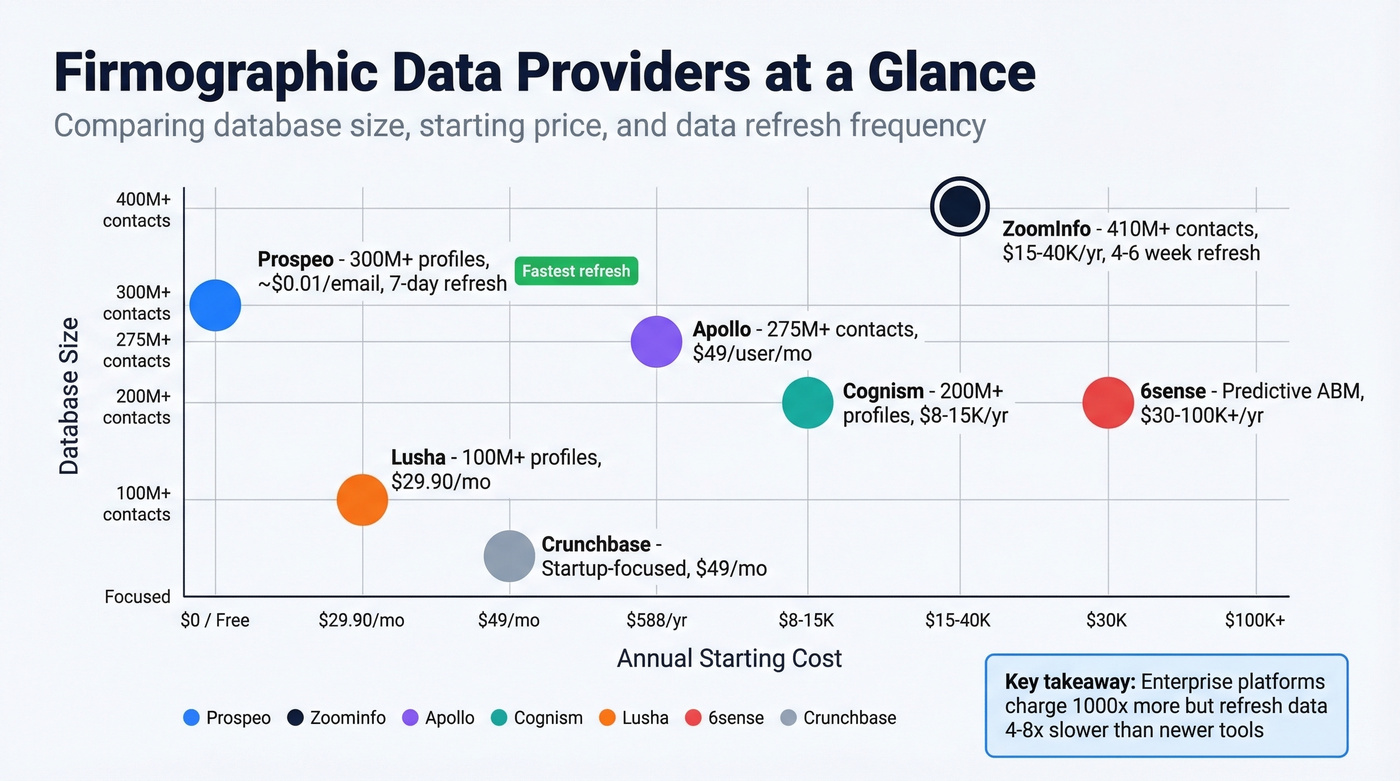
Let's be honest: ZoomInfo is still the strongest all-in-one enterprise platform. But most teams don't need all-in-one - and they definitely don't need a $25K annual contract to build filtered prospect lists. Pick the tool that matches your stage and budget.
| Provider | Database Size | Starting Price | Best For | Refresh |
|---|---|---|---|---|
| Prospeo | 300M+ profiles | Free; ~$0.01/email | Verified data + filters | 7 days |
| ZoomInfo | 410M+ contacts | ~$15-40K/yr | Enterprise ABM | ~4-6 weeks |
| Apollo | 275M+ contacts | $49/user/mo | All-in-one prospecting | ~Monthly |
| Cognism | 200M+ profiles | ~$8-15K/yr | EMEA + GDPR | ~Monthly |
| Lusha | 100M+ profiles | $29.90/mo | Individual reps | ~Monthly |
| Crunchbase | Startup-focused | $49/mo (annual) | Funding/startup data | Daily (funding) |
| 6sense | Not public | ~$30-100K+/yr | Predictive ABM | Real-time signals |
| Dun & Bradstreet | Deep company records | $49/mo (300 credits) | Legacy firmographics | ~Quarterly |
| Clearbit/Breeze | Not public | Included w/ HubSpot | HubSpot enrichment | Real-time |
Prospeo
Prospeo covers 300M+ professional profiles with 143M+ verified emails and 125M+ verified mobile numbers. The 30+ search filters go beyond basic firmographic variables - you can layer buyer intent across 15,000 Bombora topics, technographics, job changes, and department-level headcount growth into a single search. A 7-day data refresh cycle, 98% email accuracy, and a 92% API match rate mean you're reaching real people at verified addresses. Pricing runs at roughly $0.01 per email with a free tier, no contracts, and no sales calls required.
ZoomInfo
ZoomInfo is the incumbent for a reason: 110M+ companies, 410M+ contacts, 35M+ non-HQ locations, and company hierarchy mapping that's genuinely hard to replicate. If you're running enterprise ABM with multiple buying committees across subsidiaries, ZoomInfo's org chart depth is unmatched.
The tradeoff is cost and complexity. Mid-market contracts run $15-40K/year, and the fact that ZoomInfo doesn't publish pricing frustrates teams trying to budget. Their databases typically refresh on a 4-6 week cycle, which means the data you're paying premium prices for isn't always as fresh as you'd expect.
Apollo
Use this if you want prospecting, sequencing, and a dialer in one platform and your team is under 20 reps. Apollo's 275M+ contacts and 73M+ companies give you solid coverage, and the built-in outreach tools can replace a separate outbound sales platform for many teams. Free tier offers limited credits to test the waters, and paid plans start at $49/user/month.
Skip this if data accuracy is your top priority - the consensus on r/sales is that Apollo's email data needs a verification layer on top. If you're optimizing for deliverability, pair it with a dedicated email verifier tool.
Cognism
Cognism is a strong option for teams selling into European markets, with a focus on GDPR-friendly prospecting. Custom pricing runs $8-15K/year. If your pipeline is primarily EU-based, Cognism deserves a serious look.
Lusha
Lusha starts at $29.90/month and targets individual reps or small teams who need a lightweight way to find contact data. It's not a firmographic powerhouse, but for quick lookups and basic list building, it gets the job done without a procurement process.
Crunchbase
Crunchbase starts at $49/month billed annually. If you're targeting venture-backed companies, Crunchbase's funding data is unmatched - funding rounds, investors, and growth signals that other providers treat as secondary fields.
6sense is an enterprise ABM platform with predictive intent, typically $30-100K+/year. Overkill for most SMBs, but powerful for large marketing teams running account-based programs.
Dun & Bradstreet starts at $49/month for 300 credits - deep company records but a complex product catalog that takes time to navigate.
Clearbit (now HubSpot Breeze) comes included with HubSpot Starter+ plans, offering real-time enrichment built natively into HubSpot. If you're already in that ecosystem, it's a no-brainer add.
The article says single-provider accuracy never closes coverage gaps. Prospeo's 5-step verification and proprietary email infrastructure deliver a 92% API match rate and 83% enrichment coverage - returning 50+ data points per contact. Layer Bombora intent data across 15,000 topics on top of your firmographic segments to reach buyers who are actually in-market.
Turn static firmographic lists into live pipeline with intent and enrichment built in.
Compliance: GDPR, CCPA, and Your Data
Company-level firmographics - revenue, headcount, industry classification - aren't personal data under GDPR or CCPA. But the moment you attach a name, email, or phone number to that record, you're handling personal data, and the rules apply.
| Requirement | GDPR | CCPA/CPRA |
|---|---|---|
| Basis | Lawful basis required (consent or legitimate interest) | Opt-out model |
| B2B exemption | None - same rules as B2C | Expired - B2B data treated like consumer data |
| Key rights | Access, deletion, portability | Know, delete, opt-out of sale |
| Outbound sales | Legitimate interest with balancing test + documentation | Privacy disclosure at or before collection |
The average cost of a data breach is $4.88M globally. Even if you never get fined, the operational cost of a DSAR flood or a breach notification process can cripple a lean GTM team. Use providers that enforce opt-outs and maintain GDPR compliance by default - it's cheaper than fixing it after the fact.
Firmographic Data FAQ
What's the difference between firmographic and demographic data?
Firmographics describe companies - industry, size, revenue, location, ownership type. Demographics describe individuals - age, gender, income, education. Firmographics are the B2B equivalent of demographics, helping you segment and target accounts the same way demographics help B2C marketers segment consumers.
How often should I refresh my data?
At minimum, quarterly. Key fields like employee count, revenue, and contact details shift constantly - 28% of B2B emails go stale every year. For high-velocity outbound, monthly or event-driven refreshes tied to funding rounds, leadership changes, or hiring spikes deliver better results.
Is firmographic data subject to GDPR?
Company-level attributes like revenue, headcount, and industry classification aren't personal data under GDPR. Contact details attached to those records - names, emails, phone numbers - are personal data. If you're prospecting in the EU, you need a lawful basis (typically legitimate interest) and must honor access and deletion requests.
Can I get reliable firmographics for free?
Public sources like SEC filings, Companies House, and state registrations provide basic company attributes at no cost, but coverage is limited to publicly reporting entities. For enriched, verified data at scale, several providers offer free tiers - Prospeo gives you 75 verified emails per month, and both Crunchbase and Apollo have limited free plans worth evaluating.