

CRM Data Enrichment: Why Your Data Is Rotting and How to Fix It
It's Q2 pipeline review. Your VP of Sales pulls up the target account list, and half the contacts have the wrong title, a dead phone number, or an email that bounced three sequences ago. The CRM looks full. It's actually full of ghosts.
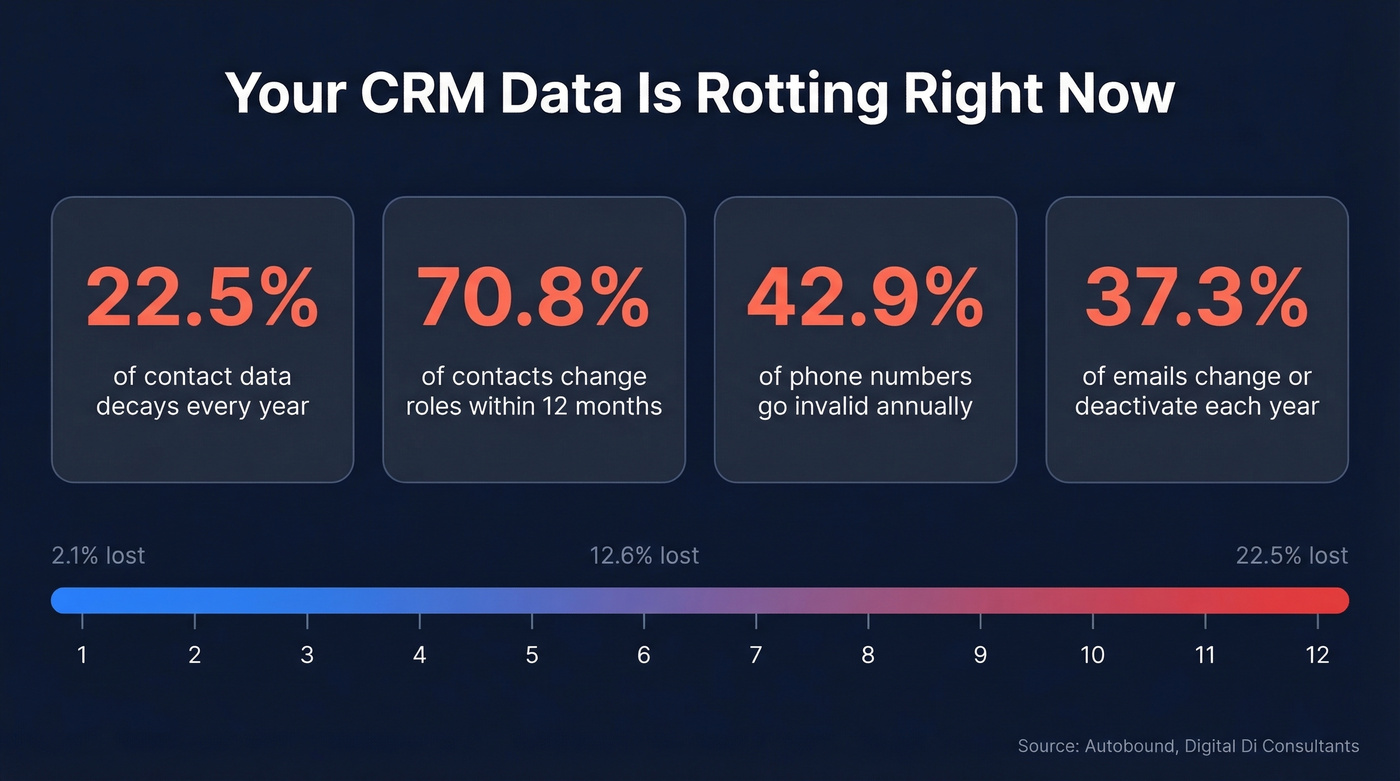
B2B contact data decays at roughly 22.5% per year. That's not a slow leak - it's a structural problem that compounds every quarter you ignore it. Browse any sales subreddit or RevOps community and you'll find the same question asked over and over: "how do I keep my CRM data clean?" The answers are usually vague. If you're not actively running CRM data enrichment, you're building pipeline on a foundation that's crumbling underneath you.
What You Need (Quick Version)
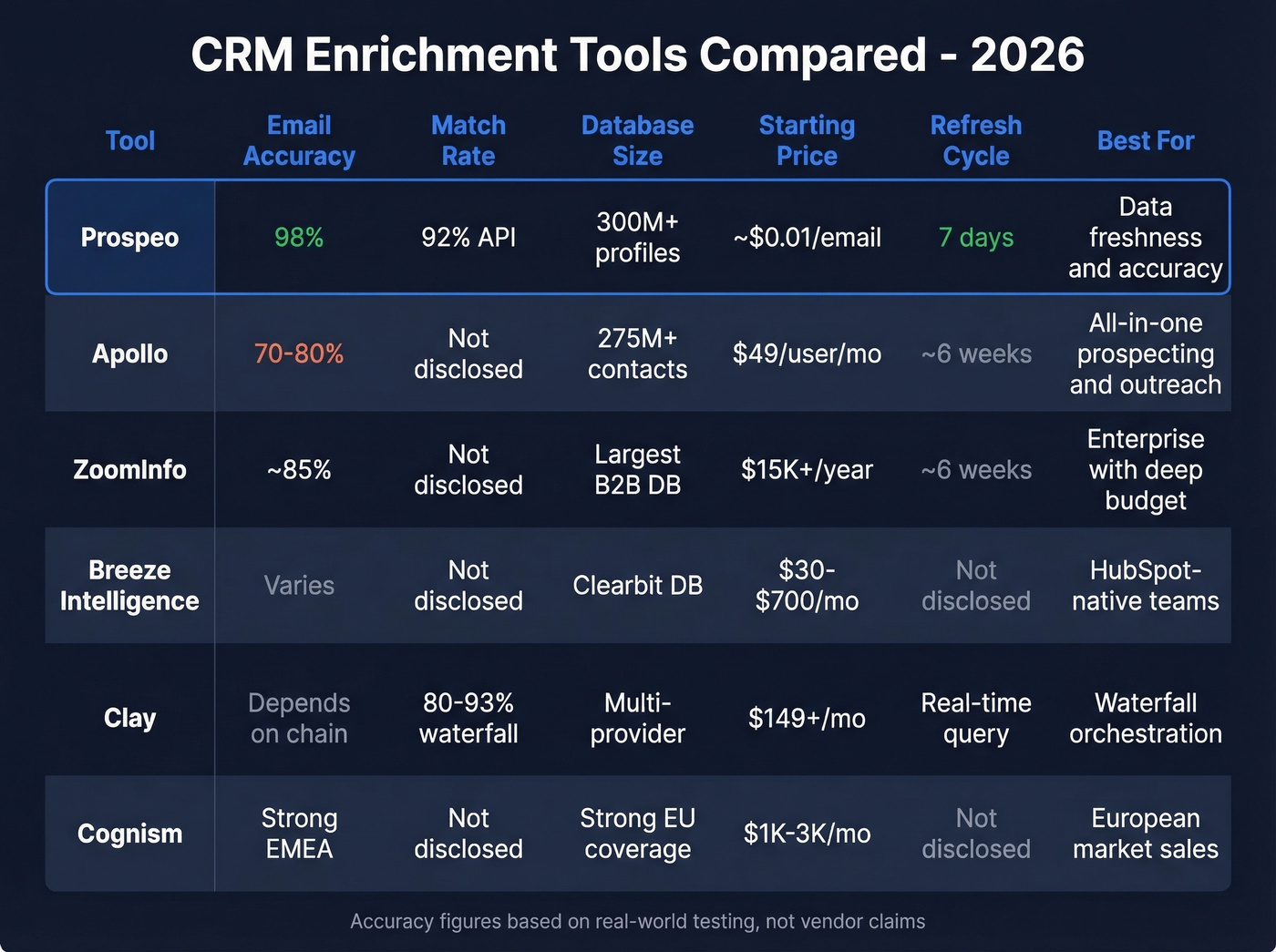
- Freshest, most accurate email data: Prospeo - 98% email accuracy, 7-day refresh cycle, ~$0.01/email
- Enrichment + outreach in one platform: Apollo - free tier available, 70-80% email hit rate
- Deepest database, budget isn't the constraint: ZoomInfo - $15K-$45K+/year
- HubSpot-native convenience: Breeze Intelligence - $30-$700/month depending on credit volume
What Is CRM Data Enrichment?
CRM data enrichment is the process of filling in, updating, and expanding the records already sitting in your CRM with verified external data. You've got a name and a company. Enrichment gives you the direct dial, the current title, the tech stack they're running, the funding round they just closed, and whether they're actively researching your category. It transforms a sparse lead record into something your reps can actually work. Five categories of enrichment data matter most:
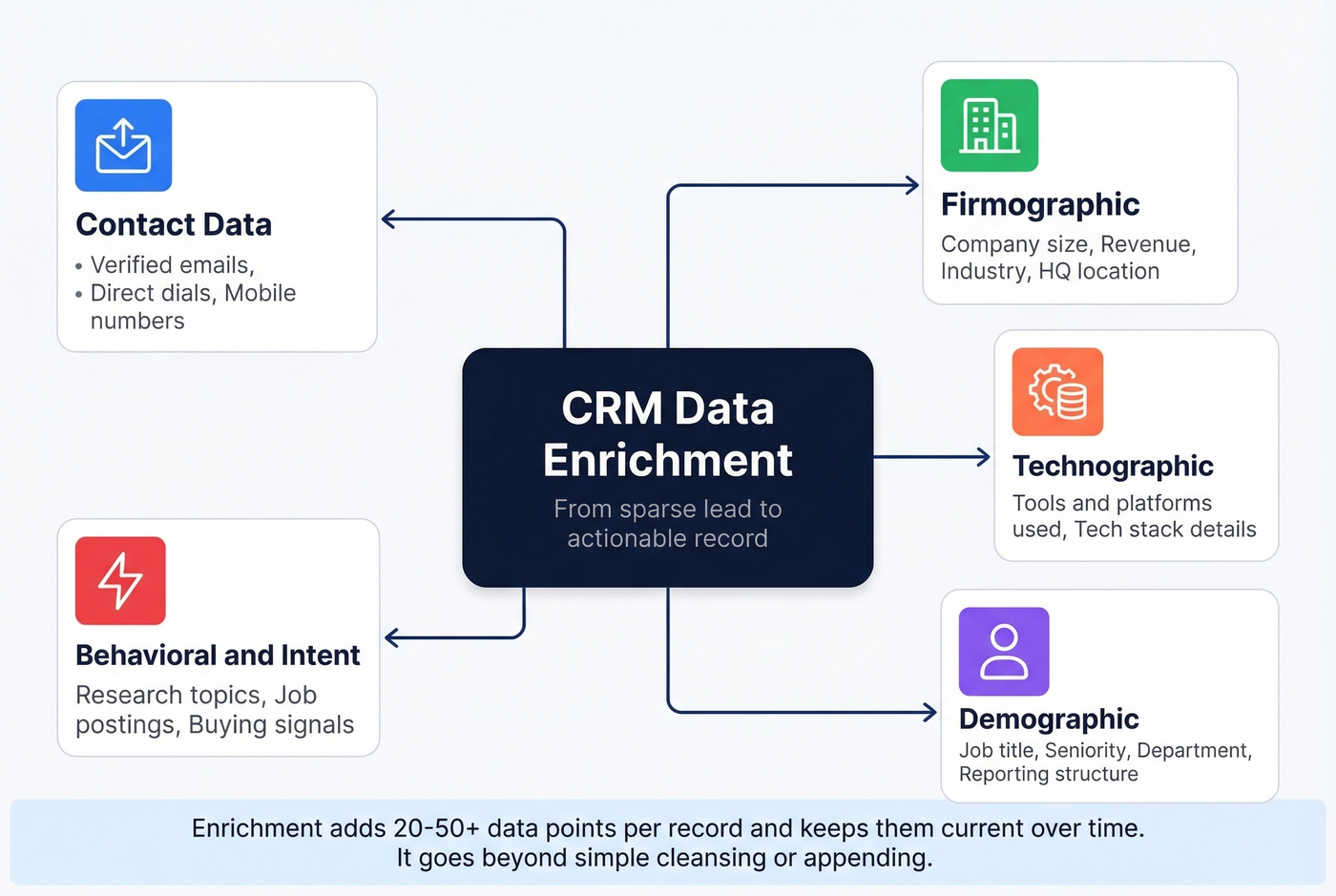
- Contact data - verified emails, direct dials, mobile numbers
- Firmographic - company size, revenue, industry, HQ location
- Technographic - tools and platforms a company uses
- Demographic - job title, seniority, department, reporting structure
- Behavioral/intent - topics they're researching, job postings that signal buying intent
One distinction worth making: enrichment isn't the same as cleansing or appending. Cleansing removes duplicates and fixes formatting errors. Appending adds a single missing field to an existing record. Enrichment does both and goes further - it layers on 20-50+ new data points per record and keeps them current over time.
A newer approach gaining traction in 2026 is AI-driven enrichment from unstructured data. NLP models extract job titles, phone numbers, and company details from email signatures, meeting transcripts, and even business card images. This doesn't replace database enrichment, but it captures context that no third-party provider has because it lives inside your own communications. If your CRM supports it, turn it on. It's free signal.
Why Enriching CRM Data Matters
The numbers on data decay are worse than most teams realize. CRM contact data rots at about 2.1% per month. That compounds to 22-25% annually. Within 12 months, 70.8% of business contacts have changed roles, companies, or responsibilities. 42.9% of phone numbers go invalid. 37.3% of emails change or deactivate.
The financial impact cuts both ways. Gartner pegs the cost of poor data quality at $12.9M per year for the average organization. That's not just bounced emails - it's misrouted leads, wasted rep time, blown sequences, and pipeline that looks healthy in the dashboard but collapses at the forecast. On the flip side, teams that invest in enrichment see up to a 20% lift in campaign response rates and a 15% improvement in close rates within six months.
The ROI case isn't theoretical.
The data enrichment solutions market hit $2.37B in 2023 and is projected to reach $4.58B by 2030 at a 10.1% CAGR. Every vendor claims 95%+ accuracy. Then you run a bake-off and half the phone numbers are dead. That gap between marketed accuracy and real-world accuracy is where pipeline goes to die.
Single-Source vs. Waterfall Enrichment
Single-source enrichment is a dead end for serious teams. Any individual provider - ZoomInfo, Apollo, Clearbit - structurally caps email accuracy at roughly 80-85%. No single database covers every contact at every company, and the data ages at different rates depending on the source.
Waterfall enrichment solves this by querying multiple providers sequentially until a verified result is found. The match-rate lift is dramatic: single-source providers typically deliver 30-60% match rates, while waterfall approaches push that to 80-93%. The average B2B sales team now uses 2.7 data providers simultaneously, up from 1.3 in 2022.
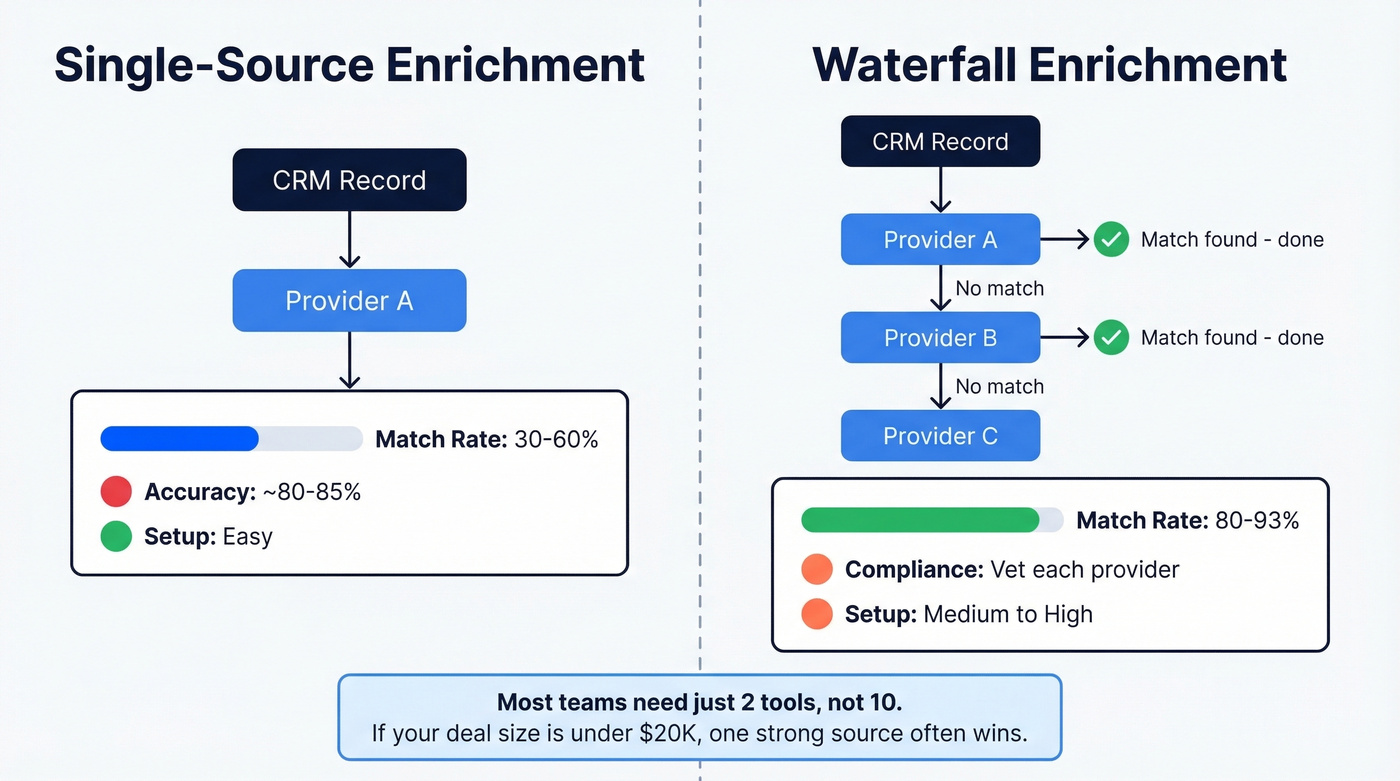
| Factor | Single-Source | Waterfall |
|---|---|---|
| Email match rate | 30-60% | 80-93% |
| Email accuracy | ~80-85% | Varies by chain |
| Setup complexity | Low | Medium-High |
| Compliance risk | Lower | Higher (vet each provider) |
| Cost model | Per-seat or per-credit | Pay-for-success or stacked |
Waterfall isn't free of tradeoffs, though. Each provider in the chain has different data sourcing practices, and if one of them isn't GDPR or CCPA compliant, that's your problem now. You need to vet every provider's data processing agreement before chaining them together.
Here's the thing: most teams don't need waterfall. If your average deal size is under $20K and your TAM fits in a single vertical, one strong primary source with 90%+ accuracy will outperform a janky five-tool waterfall every time. Two tools, not ten.

Your CRM loses 2.1% of its contact data every month. Prospeo enriches records with 50+ data points at 92% match rate, refreshes every 7 days, and delivers 98% email accuracy - all at ~$0.01 per email. No contracts. No sales calls.
Stop building pipeline on decaying data. Enrich your CRM now.
Best Tools for CRM Data Enrichment in 2026
Prospeo
Prospeo's 7-day refresh cycle directly attacks the data decay problem. While the industry average refresh cycle runs about 6 weeks, Prospeo re-verifies its entire database weekly - the 2.1% monthly decay rate barely gets a chance to accumulate. The accuracy numbers back this up: 98% email accuracy, a 92% API match rate, and an 83% enrichment match rate returning contact data with 50+ data points per enriched record. The database covers 300M+ professional profiles, 143M+ verified emails, and 125M+ verified mobile numbers.
For enrichment workflows, Prospeo integrates natively with Salesforce, HubSpot, Clay, Zapier, and Make. Bombora-powered intent data tracks 15,000 topics so you can prioritize accounts that are actively in-market.
Pricing is self-serve and transparent: ~$0.01 per email, 10 credits per mobile number. The free tier gives you 75 emails and 100 Chrome extension credits per month - enough for a real test. No contracts, no sales calls. Snyk cut their bounce rate from 35-40% to under 5% after switching, and their AE-sourced pipeline jumped 180%.
Use this if: You care about data freshness and email accuracy above all else, and you want self-serve pricing without annual lock-in.
Snyk dropped their bounce rate from 35-40% to under 5% with Prospeo. 300M+ profiles, 125M+ verified mobiles, and native Salesforce and HubSpot integrations mean your CRM stays enriched without duct-taping five tools together.
One source. 98% accuracy. 7-day refresh. That's the fix.
Apollo
Apollo is the obvious starting point for teams that want enrichment and outreach in a single platform. You search, enrich, build a sequence, and send - all without leaving the tool. That's genuinely valuable when you're a 5-person SDR team and nobody wants to manage three integrations.
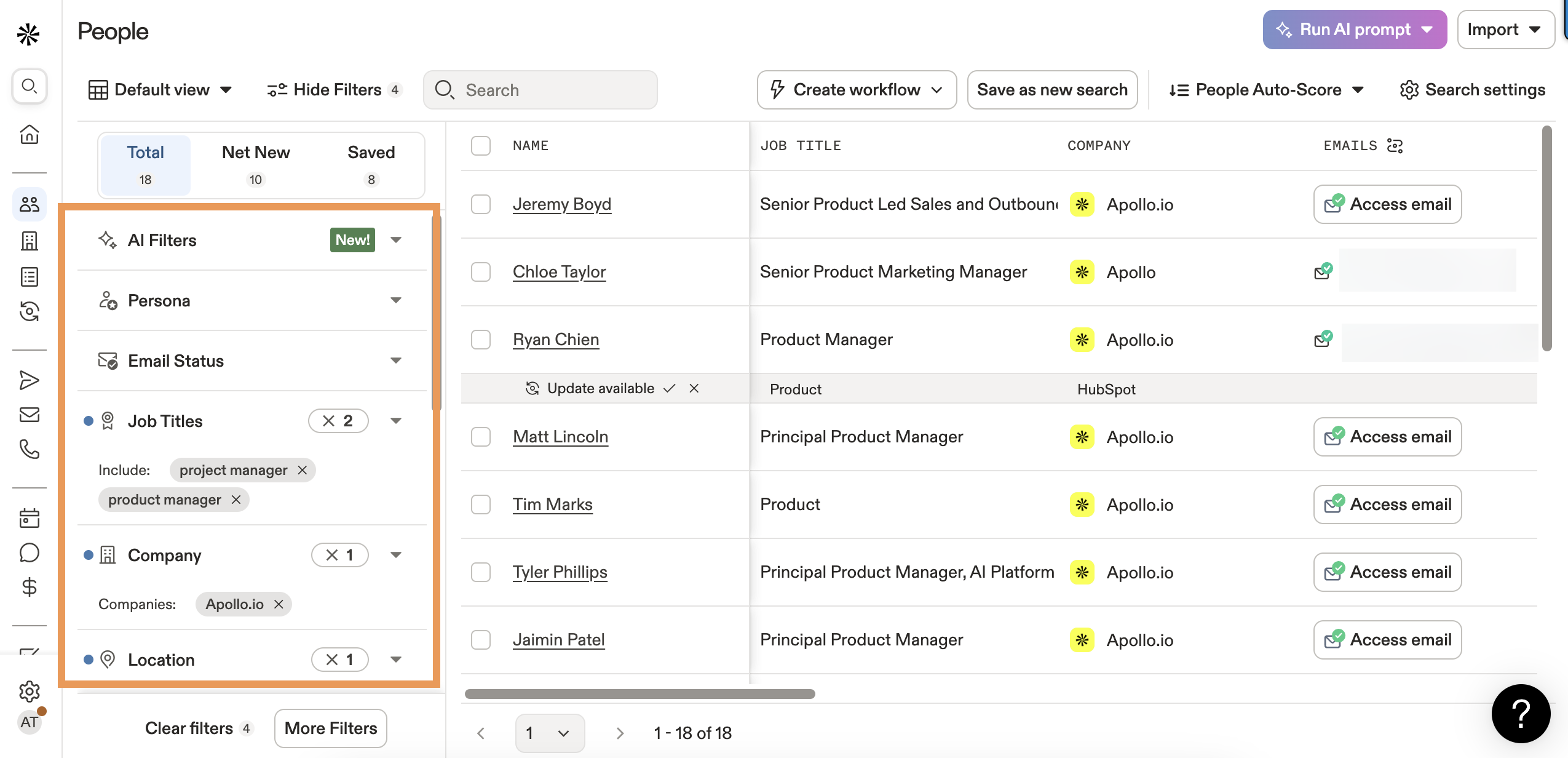
The database is large, and real-world email hit rates land around 70-80%. Solid for a tool that also handles sequencing, but noticeably below dedicated data platforms. The free tier (100 credits/month) is generous enough to test. Paid plans run $49/user/month for Basic, $79 for Professional, and $119 for Organization, all billed annually.
Use this if: You want one platform for prospecting, enrichment, and outreach. Skip this if: Email accuracy is your top priority - Apollo's 70-80% hit rate means you'll still need a verification layer on top.
ZoomInfo
ZoomInfo remains the deepest B2B database on the market and the default choice for enterprise sales orgs. Email accuracy sits around 85% - strong for a single source. The consensus on r/sales is that nobody knows what ZoomInfo actually costs until they're on a call. Professional plans start around $15K/year, Advanced runs ~$25K, and Elite hits $35-45K+. Expect 10-20% annual renewal increases.
Use this if: You're enterprise, budget isn't the constraint, and you need the broadest possible coverage. Skip this if: You're a Series A company - that $25K+ is better spent on reps.
Breeze Intelligence
Breeze Intelligence is Clearbit rebranded and absorbed into HubSpot. If you're already running HubSpot, enrichment happens inside the CRM without any middleware - no integrations to manage, no data syncing to debug. One credit equals one record enrichment, and credit packs range from 100 to 10,000 at $30-$700/month. Breeze carries a 4.4/5 on G2 across 626 reviews, though HubSpot Community feedback highlights reduced control over which fields get enriched after the transition.
The tradeoff is real. Credits expire monthly with no rollover, which punishes teams with variable enrichment needs. And you're locked into HubSpot's ecosystem entirely - if you ever migrate CRMs, this enrichment layer doesn't come with you.
Clay
Clay isn't a data provider. It's a waterfall orchestration layer that queries multiple providers sequentially until it finds a verified result. The table-based UI is flexible but becomes unwieldy at scale; we've heard from practitioners who say it gets unmaintainable past 100K accounts. Free plan available, then Starter at $149/month, Explorer at $349, and Pro at $800. It also isn't API-first for trigger-based workflows, which limits automation for teams that need event-driven enrichment.
Cognism
Cognism is the pick for teams selling into European markets. Their GDPR-first approach includes DNC list checking across multiple countries, and their mobile number coverage in EMEA is stronger than most US-centric providers. Where Cognism wins over ZoomInfo: EMEA compliance and mobile verification. Where ZoomInfo still wins: US database depth. Custom pricing, typically $1,000-3,000/month for small teams.
FullEnrich
Budget waterfall enrichment that checks 20+ sources sequentially. Practitioners report 85%+ match rates, and credits roll over month-to-month - a rarity in this space. Starts at $29/month. Best for bootstrapped teams wanting waterfall without Clay's complexity.
Kaspr
EU-focused, affordable entry point for individual SDRs or small teams. Free plan available, paid plans from $49/user/month. Integrates with HubSpot, Salesforce, and Pipedrive. Best for prospecting European contacts on a tight budget.
Pricing Comparison
| Tool | Starting Price | Credit Model | CRM Integrations | Refresh Cycle |
|---|---|---|---|---|
| Prospeo | Free; ~$0.01/email | Pay per verified result | SF, HS, Clay, Zapier | 7 days |
| Apollo | Free; $49/user/mo | Expire each cycle | SF, HS | Not public |
| ZoomInfo | ~$15K/year | Annual contract + seats | SF, HS, others | ~6 weeks |
| Breeze | $30/mo (100 credits) | Expire monthly | HubSpot only | Not public |
| Clay | Free; $149/mo | Per enrichment | SF, HS, Zapier | Per query |
| Cognism | ~$1K/mo (custom) | Annual contract | SF, HS, Outreach | Not public |
| FullEnrich | $29/mo | Roll over | Via API/Zapier | Per query |
| Kaspr | Free; $49/user/mo | Per plan | HS, SF, Pipedrive | Not public |
The refresh cycle column is the one most teams overlook. If your provider updates records every 6 weeks and data decays at 2.1% per month, you're always running behind.
How to Set Up Enrichment
1. Audit current data quality. Pull a sample of 500-1,000 records and check email validity, phone connectivity, and title accuracy. If more than 15% of emails bounce, you've got a cleansing problem before you have an enrichment problem.
2. Define enrichment fields and overwrite rules. This is the operational detail that separates good enrichment from data chaos. Decide which fields your enrichment tool can overwrite and which it can't. A common mistake we've seen repeatedly: letting enrichment overwrite a manually entered direct dial with a generic switchboard number. Set field-level rules in your CRM - most support "enrich only if blank" logic. Get this wrong and your reps will stop trusting the CRM entirely, which is worse than having no enrichment at all.
3. Choose single-source vs. waterfall. For most teams, start with a strong single source. If match rates aren't hitting 80%+, layer in a waterfall tool like Clay or FullEnrich. Don't start with five providers - you'll create more data conflicts than you solve.
4. Set a refresh cadence. Choose a provider with automated refresh cycles rather than scheduling manual re-enrichment runs. At minimum, re-enrich quarterly. Anything less and you're losing 5-6% of records per cycle to decay.
5. Monitor accuracy and credit consumption. Track bounce rates, phone connect rates, and enrichment match rates monthly. If bounce rates creep above 5%, your data source has a freshness problem. Watch credit burn too - some tools eat credits on failed lookups, which quietly destroys your unit economics.
Compliance Essentials for B2B Enrichment
CRM data enrichment operates in a regulatory environment that's getting stricter, not looser. GDPR fines run up to EUR 20M. CCPA penalties hit $7,988 per intentional violation. Neither is theoretical - enforcement is active.
Four principles to build your enrichment program around:
Data minimization - only enrich fields you'll actually use. Don't pull 50 data points if you only need 10. Purpose limitation - enrichment data should serve a documented business purpose like prospecting, account scoring, or routing. Accuracy - GDPR requires "every reasonable step" to keep personal data accurate, and automated refresh cycles are your best defense here. Transparency - your privacy policy must disclose that you use third-party data enrichment. Most companies skip this.
If you're running waterfall enrichment, the compliance surface area multiplies. Each provider in the chain has different sourcing practices, and you need a valid data processing agreement with every one of them. Cognism's waterfall enrichment analysis flags this explicitly - tools like Clay that chain multiple providers can create compliance gaps if any partner isn't fully compliant.
Let's be honest: compliance isn't optional, and "we didn't know our data provider was scraping" isn't a defense that holds up.
FAQ
What is CRM data enrichment?
CRM data enrichment is the practice of augmenting existing CRM records with verified external data - direct dials, emails, firmographics, technographics, and intent signals. It matters because B2B contact data decays at 22.5% per year; without regular enrichment, pipeline forecasts, routing rules, and outreach sequences all degrade alongside the data.
How often should I re-enrich CRM records?
At minimum quarterly, ideally on a rolling basis. With 2.1% monthly decay, waiting longer than 90 days means 5-6% of records are already wrong. Tools with weekly auto-refresh handle this automatically, eliminating manual re-enrichment cycles entirely.
What's the difference between enrichment and cleansing?
Enrichment adds missing data points - job title, company size, direct dial, tech stack. Cleansing fixes or removes existing bad data like duplicates, invalid emails, and outdated records. You need both: cleanse first to remove garbage, then enrich to fill gaps and add intelligence.
Can free tools handle CRM enrichment effectively?
Yes, for testing and small-scale use. Apollo offers 100 credits/month free, Prospeo provides 75 verified emails plus 100 Chrome extension credits, and Kaspr has a free tier. These are enough to run a bake-off with real data and compare match rates before signing an annual contract.
Is enrichment GDPR compliant?
It can be, if you use providers with proper data processing agreements, limit enrichment to fields you'll actually use, and disclose third-party data sourcing in your privacy policy. Vet each provider's compliance documentation individually - especially when chaining multiple sources in a waterfall setup.