

The 10 Best Identity Resolution Software Tools in 2026
Your marketing team just realized 30% of your CRM is duplicates. Your sales reps are emailing people who left their jobs two quarters ago. And poor data quality costs companies 15-25% of annual revenue - money that evaporates before anyone notices.
The average person carries nearly 7 connected devices and 12 different identifiers. Duplicate records account for 15-30% of most contact databases. 40% of CRM data goes stale every year. Every identity resolution software tool below includes real pricing, because the fact that almost no vendor in this category publishes numbers tells you everything about how this market operates.
Here's the thing: you might not even need a full identity resolution platform. If your problem is really "bad B2B contact data," the answer is different from "stitch anonymous consumer profiles across channels." This list sorts that out.
Our Picks
| Use Case | Tool | Why | Starting Price |
|---|---|---|---|
| B2B contact resolution | Prospeo | 300M+ profiles, 98% accuracy | Free (75 emails/mo) |
| Enterprise marketing (B2C) | Salesforce Data 360 | G2 leader, Salesforce-native | ~$500 entry-level |
| Warehouse-native | Hightouch | Runs in your warehouse | Free tier, ~$350/mo paid |
| Ad-tech connectivity | LiveRamp | Audience onboarding standard | ~$100K-$500K+/yr |
| Free option | FullContact | Free identity resolution API | Free tier, ~$99/mo paid |
| Easiest setup | Retention.com | Visitor ID, minimal config | ~$500 entry-level |
What Identity Resolution Does
Identity resolution software takes fragmented customer data - scattered across your CRM, ad platforms, website analytics, email tools, and support systems - and stitches it into unified profiles. The core output is an identity graph: a persistent map connecting every identifier back to a single person or account. With 12 identifiers per person spread across nearly 7 devices, the stitching problem is harder than most teams expect.
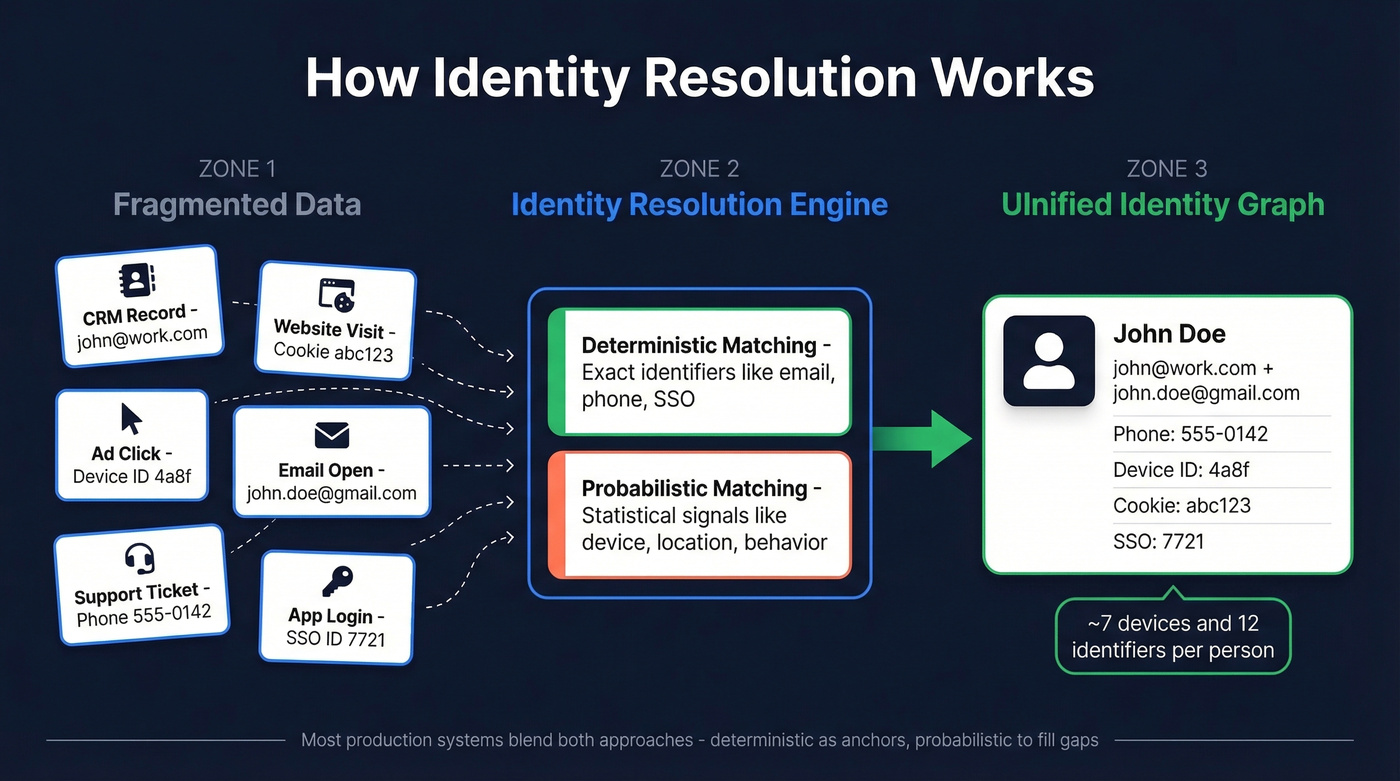
Two matching approaches dominate. Deterministic matching links records using exact identifiers - same email address, same phone number, same SSO login. It's precise but misses a lot. Probabilistic matching uses statistical models to infer connections from partial signals like device type, browsing patterns, and location clusters. It catches more matches but introduces false positives. Most production systems blend both, using deterministic links as anchors and probabilistic scoring to fill gaps.
How to Evaluate These Tools
Two common buyer pain points in this category: opaque pricing and implementation timelines that stretch for months. We built our evaluation criteria around those frustrations. The cost of bad identity data escalates fast - $1 to prevent, $10 to fix, $100 to recover from - so getting the evaluation right matters more than getting it fast.
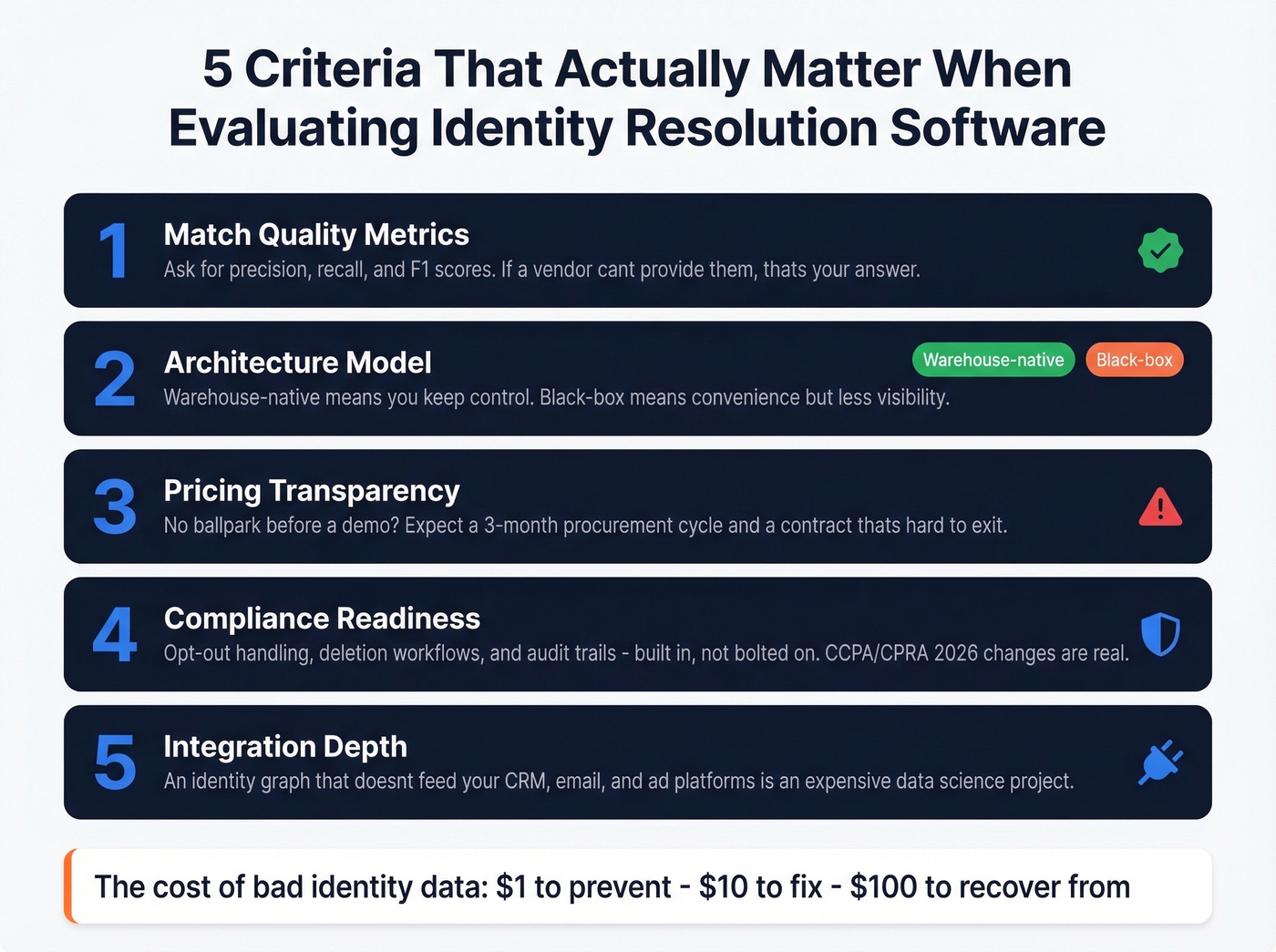
Five criteria matter more than feature checklists:
Match quality metrics. Ask for precision, recall, and F1 scores during your evaluation. If a vendor can't provide them, that's your answer. Precision tells you how many matches are correct; recall tells you how many true matches you're finding.
Architecture: warehouse-native vs. black-box. Warehouse-native tools run on top of your Snowflake or BigQuery without storing your data. Black-box platforms ingest your data, process it in their environment, and return results. The trade-off is control vs. convenience. If your security team cares about data residency, warehouse-native wins.
Pricing transparency. If a vendor won't give you a ballpark before a demo, expect a long sales cycle and a contract that's hard to exit. We've seen teams spend 3 months in procurement for tools they could've evaluated in a week.
Compliance readiness. With CCPA/CPRA changes in 2026, your resolution tool needs opt-out handling, deletion workflows, and auditability for risk assessments built in - not bolted on.
Integration depth. An identity graph that doesn't feed your activation tools - CRM, email, ad platforms - is an expensive data science project. Check native integrations before you check match rates.
One directional data point: Hightouch published a case example where a major health company replaced LiveRamp and saved over $400K annually while improving match rates. That's the kind of ROI swing that comes from picking the right architecture.

40% of CRM data goes stale every year. Prospeo refreshes 300M+ profiles every 7 days - not every 6 weeks like the industry average. With 98% email accuracy and a 92% API match rate, you resolve B2B identities without a six-figure platform or a multi-month implementation.
Stop stitching stale data. Start with profiles that are already resolved.
The 10 Best Tools for 2026
We evaluated dozens of platforms and narrowed to these 10 based on match quality documentation, pricing accessibility, and real-world deployment evidence. We excluded pure-play data brokers like Acxiom, Experian, and TransUnion, along with tools that don't fit the use cases in this guide.
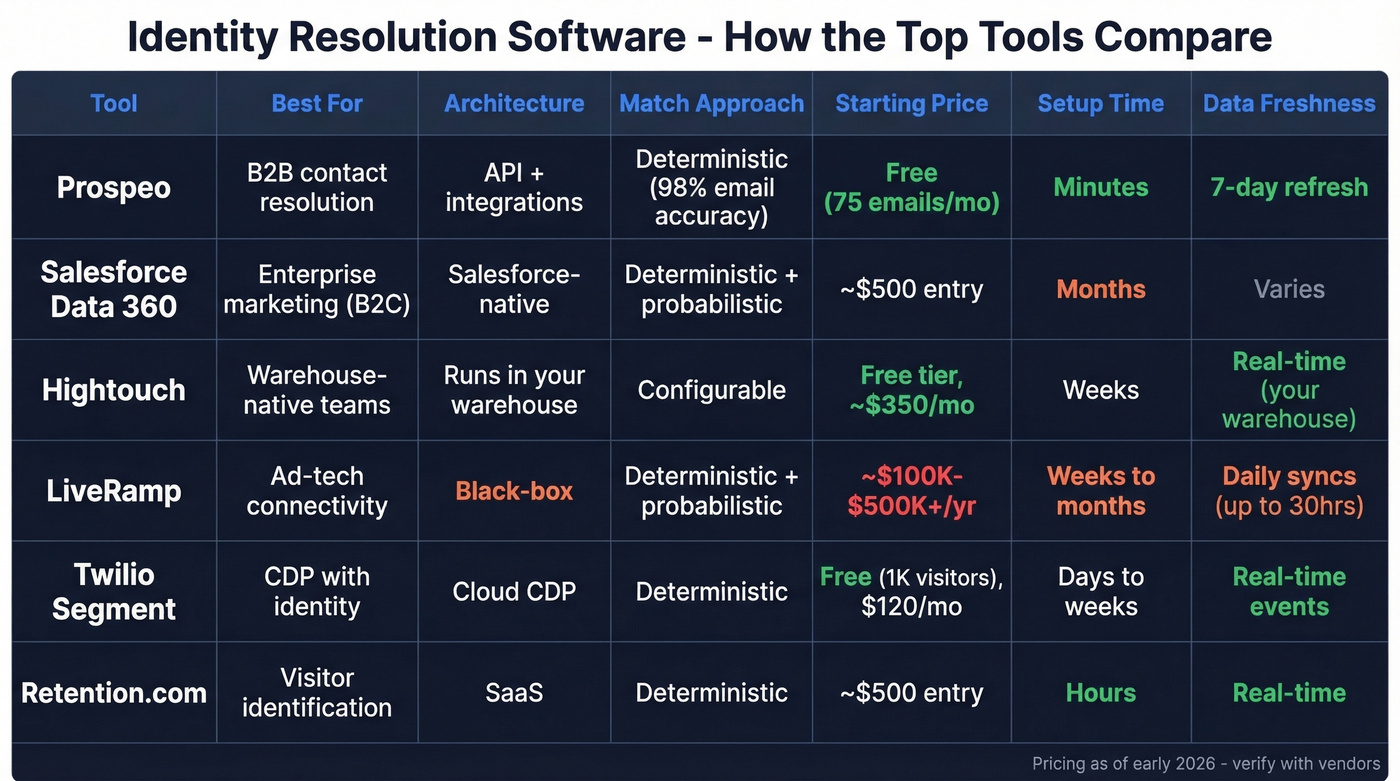
A note for B2B teams: Most of you evaluating identity resolution platforms don't actually need one. You need accurate contact data with a fast refresh cycle. If your average deal size is under $50K and you're not running cross-channel consumer campaigns, skip the six-figure platforms and start with a B2B database. You'll get ROI in weeks instead of quarters.
Salesforce Data 360 - Enterprise Marketing
Use this if you're already deep in the Salesforce ecosystem and need identity resolution that feeds directly into Marketing Cloud, Service Cloud, and your existing flows. The integration is tight because it's Salesforce-native, which eliminates middleware and manual exports. G2 rates it 4.3/5 across 209 reviews with a Leader badge in the identity resolution category.
Skip this if you're not a Salesforce shop, your team is small, or you need something running in under a month. The top complaint themes on G2 include learning curve, complex setup, and cost - and those aren't minor gripes. The entry-level price sits around $500, but enterprise deployments with full Data Cloud capabilities run significantly higher. Expect a multi-month implementation with dedicated admin resources.
Prospeo - B2B Contact-Level Resolution

Here's a pattern we see constantly: a B2B sales or RevOps team starts evaluating identity resolution tools built for consumer marketing and ad-tech, then realizes their actual problem is much simpler. They don't need to stitch anonymous website visitors across devices. They need to resolve professional identities - match a name to a verified email, a direct dial, a current company, and a job title.
Prospeo's database covers 300M+ professional profiles with 143M+ verified emails and 125M+ verified mobile numbers. Email accuracy runs at 98%, with a 92% API match rate for enrichment workflows. Every record refreshes on a 7-day cycle - the industry average is six weeks, which means most competitors are serving you data that's already decaying by the time you get it.
The platform includes 30+ search filters covering buyer intent via 15,000 Bombora topics, technographics, job changes, headcount growth, and funding signals. CRM enrichment returns 50+ data points per contact, and native integrations push directly into Salesforce, HubSpot, Smartlead, Instantly, Lemlist, and Clay. Teams using it for outbound report bounce rates dropping from 35% to under 5% and pipeline increases of 140-180%. Mobile numbers cost 10 credits each (roughly $0.10), charged only when found. Pricing is transparent and self-serve: ~$0.01 per email, free tier with 75 emails/month, no contracts.
LiveRamp - Ad-Tech Data Connectivity
Use this if you're a large advertiser or agency that needs to onboard first-party data to walled gardens like Google, Meta, and The Trade Desk with high match rates. LiveRamp is the standard for cross-platform audience matching, and its connectivity model is built for large-scale activation.
Skip this if you're not running eight-figure ad budgets. LiveRamp's top 95 customers carry annual contracts exceeding $1M. Mid-market deals typically land in the $100K-$500K/year range depending on volume. The pricing is consumption-based and scales with data volume, but there are no public dollar figures on their pricing page.
The operational realities matter here. Audience syncs run once per day and can take up to 30 hours. Initial syncs can stretch to three days. Audiences with fewer than 25 unique members won't sync at all. The "black-box matching" criticism is legitimate - you're trusting LiveRamp's infrastructure with your customer PII and getting limited visibility into how matches are made. For teams outside the Fortune 500, you're probably overpaying for capabilities you don't use.
Hightouch - Warehouse-Native Option
Use this if your data team lives in Snowflake, BigQuery, or Redshift and you want identity resolution without moving data into a vendor's environment. Hightouch earned G2's "Top Trending" badge for good reason - the warehouse-native architecture avoids the data duplication and security concerns that plague black-box platforms. Your resolution logic runs in your warehouse; Hightouch doesn't store your data.
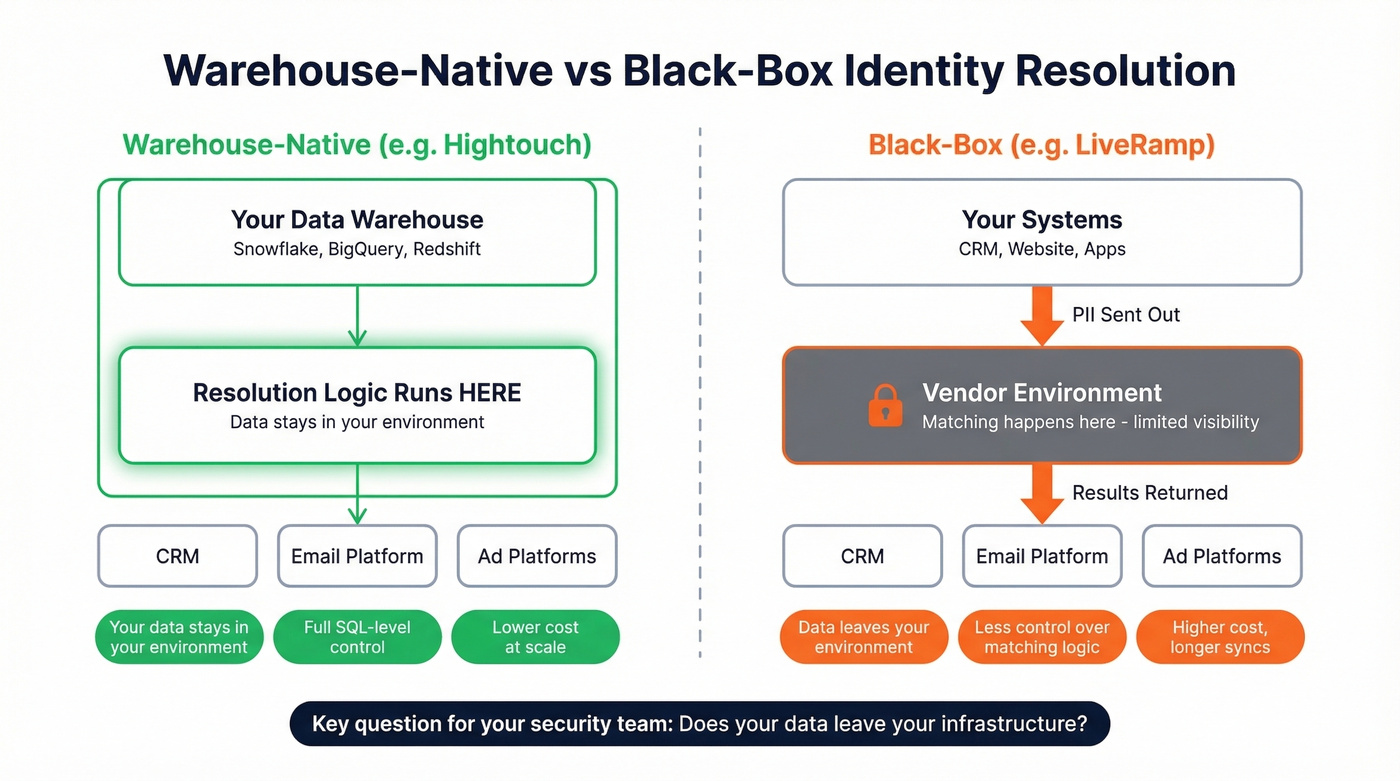
Skip this if you don't have a data team. This isn't a plug-and-play tool for marketers who want to upload a CSV and get results. You need someone comfortable writing SQL and managing warehouse infrastructure. Pricing starts with a free tier, with paid plans from ~$350/mo - a fraction of what LiveRamp typically costs.
The right call for technical teams who want control. The wrong call if "data warehouse" isn't in your daily vocabulary.
Twilio Segment - CDP With Built-In Identity
Segment is a CDP first and an identity resolution tool second - and that distinction matters. Its identity graph stitches user events across devices and sessions using deterministic matching on known identifiers, which works well if Segment is already your event collection layer. The free tier handles 1,000 visitors/month, Team plans start at $120/mo, and Business tier runs $12K-$120K+/year depending on event volume and sources.
Don't buy Segment just for identity resolution. Buy it if you need a CDP and want the capability included.
Retention.com - Easiest to Set Up
Retention.com earned G2's "Easiest to Use" badge, and the product backs it up. It focuses on identifying anonymous website visitors and matching them to contact records - a narrower problem than full identity resolution, but one that drives immediate pipeline. A published case study showed 12% anonymous visitor identification, $75K in pipeline within three months, and conversion rates jumping from 1% to 6%. Entry-level pricing starts around $500. For teams that want fast time-to-value without a data engineering project, this is where to start.
FullContact - Best Free Option
FullContact holds G2's "Best Free Software" badge in the identity resolution category. The free tier gives you API access to their resolution engine - useful for startups and dev teams testing the concept before committing budget. Paid plans start around ~$99/mo. The API-first approach means you're building your own workflows, which is either a feature or a limitation depending on your team's technical depth. The consensus on r/sales and similar communities skews positive for lightweight use cases but flags coverage gaps at scale.
Amperity - AI-Driven Matching
Amperity's AmpID system uses ML-based matching to resolve identities across massive consumer datasets - think retail, CPG, and hospitality brands with millions of customer records across dozens of touchpoints. The machine learning approach handles messy, inconsistent data better than rule-based systems, which matters when you're dealing with misspelled names, outdated addresses, and shared household devices.
Enterprise pricing runs $100K-$300K+/year. This is purpose-built for B2C brands with complex, high-volume consumer data. B2B teams should look elsewhere.
mParticle - Mid-Market CDP Identity
mParticle's IDSync feature handles cross-platform identity resolution within its CDP framework. It's positioned for mid-market to enterprise B2C teams managing multi-channel customer journeys. Pricing runs $50K-$200K+/year. A solid middle ground between Segment's developer-first approach and Amperity's enterprise AI matching - though with fewer reviews (25 on TrustRadius), the track record is thinner.
Tealium - Enterprise Tag + Identity
Tealium is an enterprise CDP with identity resolution and consent management baked in. Expect $50K-$250K+/year based on event volume and modules. Best suited for large organizations that need tag management, data orchestration, and identity resolution in one platform. If you're already using Tealium for tag management, adding resolution is a natural extension. If you're not, the platform is too heavy for identity resolution alone.
If your real problem is duplicate records and outdated contacts, you don't need a $100K+ identity graph. Prospeo's CRM enrichment returns 50+ data points per contact at $0.01/email - with verified emails, direct dials, and job changes tracked in real time.
Get enterprise-grade identity resolution at 90% less than legacy platforms.
Pricing Comparison
The pricing gap in this category is staggering - from free to seven figures. That spread alone tells you these tools solve fundamentally different problems.
| Tool | Pricing Model | Starting Price | Free Tier? |
|---|---|---|---|
| Prospeo | Credit-based | ~$0.01/email | Yes (75/mo) |
| Salesforce Data 360 | Subscription | ~$500 entry-level | No |
| LiveRamp | Consumption | ~$100K-$500K+/yr | No |
| Hightouch | Tiered | ~$350/mo | Yes |
| Twilio Segment | Event-based | Free / $120/mo | Yes (1K visitors) |
| Retention.com | Subscription | ~$500 entry-level | No |
| FullContact | API calls | ~$99/mo | Yes |
| Amperity | Custom | ~$100K-$300K+/yr | No |
| mParticle | Custom | ~$50K-$200K+/yr | No |
| Tealium | Custom | ~$50K-$250K+/yr | No |
Open-Source Alternatives
For technical teams with data engineering resources who want full control over matching logic, three open-source options are worth evaluating.
Dedupe is a Python library with ~3.2K GitHub stars and an MIT license. It uses active learning - you label a small set of record pairs, and the model generalizes from there. Good for deduplication and record linkage on datasets that fit in memory. Spark parallelization isn't built in, so you'll need to engineer that yourself for large-scale jobs.
Zingg runs on Spark with ~1.2K GitHub stars and supports both deterministic and probabilistic matching. Its blocking model reduces comparisons to 0.05-1% of the possible pair space, which makes it practical for large datasets. The AGPL v3.0 license has implications for commercial use - run it past legal before deploying in production.
Senzing offers a managed option with a free tier up to 100K records. It's the most accessible path for teams that want open-source-level control without building everything from scratch.
2026 Privacy Changes That Matter
If your identity graph stores IP addresses or device IDs, your compliance obligations just expanded. The tools you choose in 2026 must account for these regulatory shifts from day one.
Opt-out confirmation is mandatory as of January 1, 2026 under CCPA/CPRA. You must visibly confirm that an opt-out was processed.
Global Privacy Control enforcement is now non-negotiable. Businesses must detect, honor, and confirm GPC signals after multi-state enforcement sweeps in late 2025.
ADMT risk assessments are required for activities including selling or sharing personal information, processing sensitive data beyond disclosed purposes, and training automated decision-making technology.
IP addresses and device IDs are treated as PII under stricter regulatory definitions, which means identity graphs built on these signals carry heavier compliance burdens.
The DELETE Act data broker obligations kicked in with the DROP platform available January 1, 2026, and brokers must access it every 45 days starting August 1, 2026.
Audit your resolution stack against these requirements now, not after an enforcement action.
FAQ
What's the difference between deterministic and probabilistic matching?
Deterministic matching links records using exact identifiers like email, phone, or SSO login - high accuracy, lower coverage. Probabilistic matching uses statistical models to infer connections from partial signals like device type and browsing behavior. Most production systems combine both, using deterministic matches as anchors and probabilistic scoring to expand coverage.
How much does identity resolution software cost?
It ranges from free to $1M+/year. Most mid-market tools land between $50K-$250K annually. B2B-focused tools like Prospeo start at ~$0.01/email with a free tier of 75 emails/month, while consumer-scale platforms charge based on event volume or data throughput.
Do I need a full platform or just better data quality?
If your main problem is duplicate CRM records, bounced emails, or decayed contact data, start with a data quality or enrichment tool - you'll get faster ROI. Full identity resolution platforms make sense when you're stitching identities across channels, devices, and touchpoints at consumer scale. B2B teams with deal sizes under $75K typically get more value from accurate contact databases than from six-figure resolution platforms.
What is warehouse-native identity resolution?
Your data stays in your own warehouse - Snowflake, BigQuery, or Redshift - and the tool runs queries against it without copying data to a vendor environment. Hightouch is the leading example. The trade-off: you need a data team to manage it, but you get full control over matching logic and avoid vendor lock-in.