

Lead Enrichment APIs: What Actually Works (and What Doesn't)
You export 1,000 leads from your shiny new data provider. You load them into your sequencer, hit send, and 350 bounce. Your domain reputation takes a hit that takes weeks to recover from. The lead enrichment API market is racing toward $16.72B by 2034, but most of that spend goes toward data that decays before your reps even touch it.
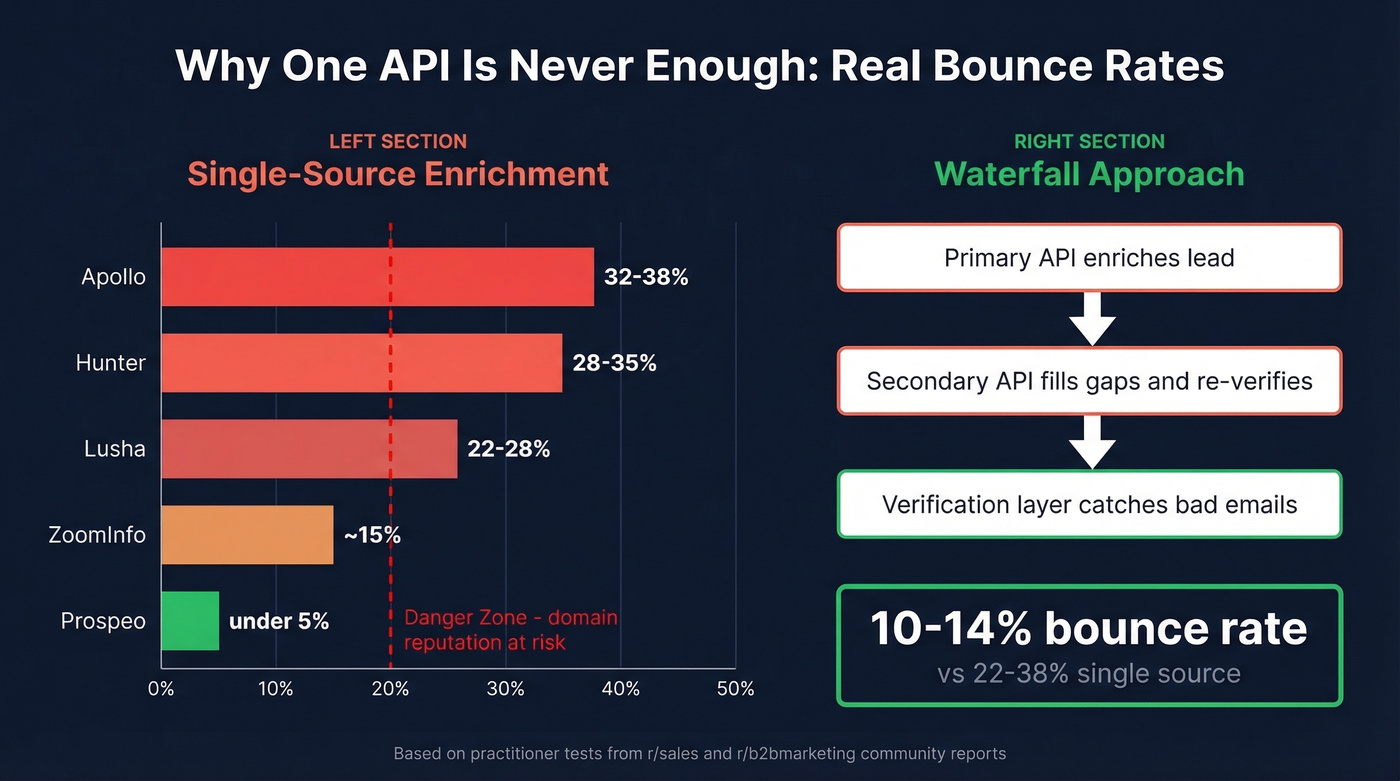
Here's the thing: the problem isn't that enrichment APIs don't work. It's that most teams pick one, trust it blindly, and never verify the output. We've seen it over and over - single-source bounce rates run 22-38% in practitioner tests, while a waterfall approach drops that to 10-14%. One API is never enough.
What You Need (Quick Version)
How a Lead Enrichment API Works
A lead enrichment API is a programmatic interface that takes a minimal identifier - an email, domain, or name - and returns a complete contact and company profile with 50+ data points. It automates the process of filling in missing fields like job title, company revenue, tech stack, and verified contact information.
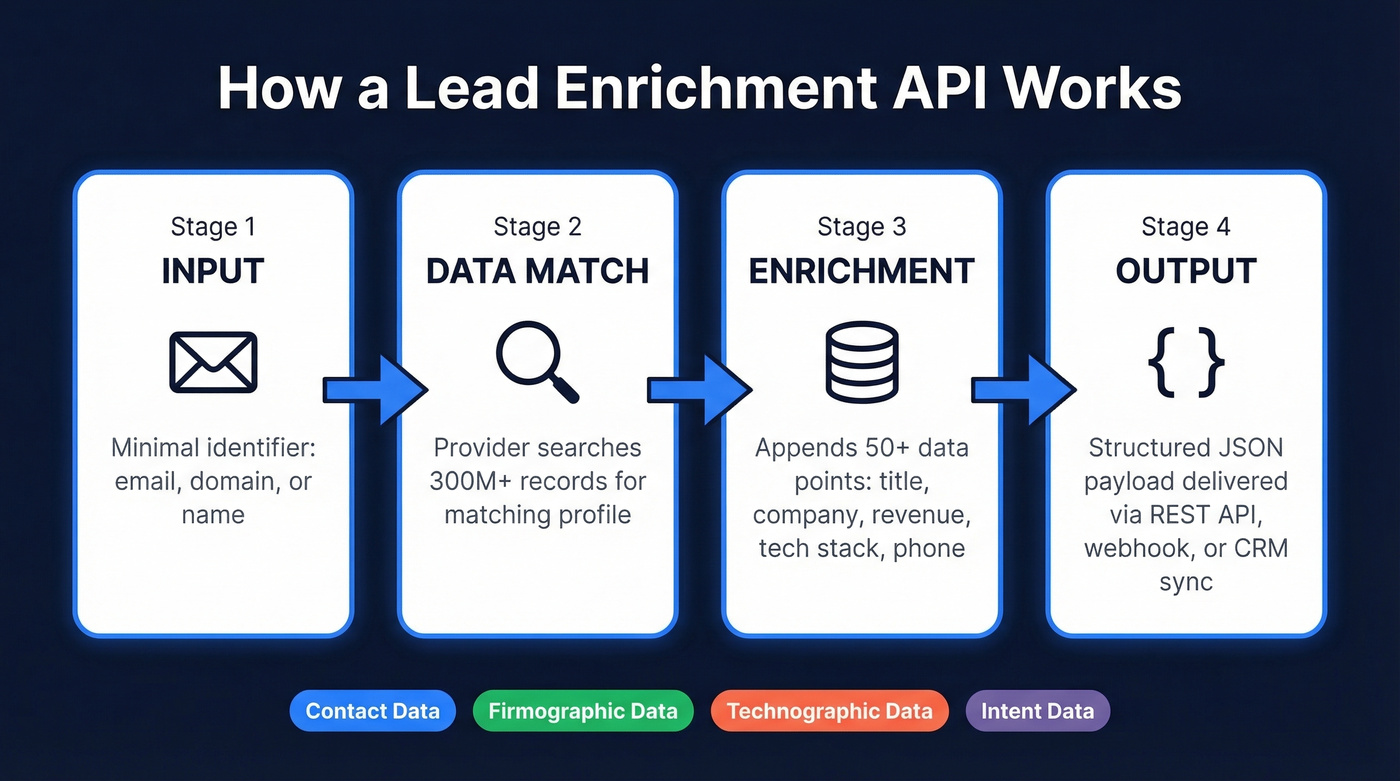
The workflow follows four stages: input, data match, enrichment, and output. You send a minimal identifier via API call. The provider searches their database for a matching record. Matched records get appended with additional data points. You receive a structured JSON payload with everything the provider found.
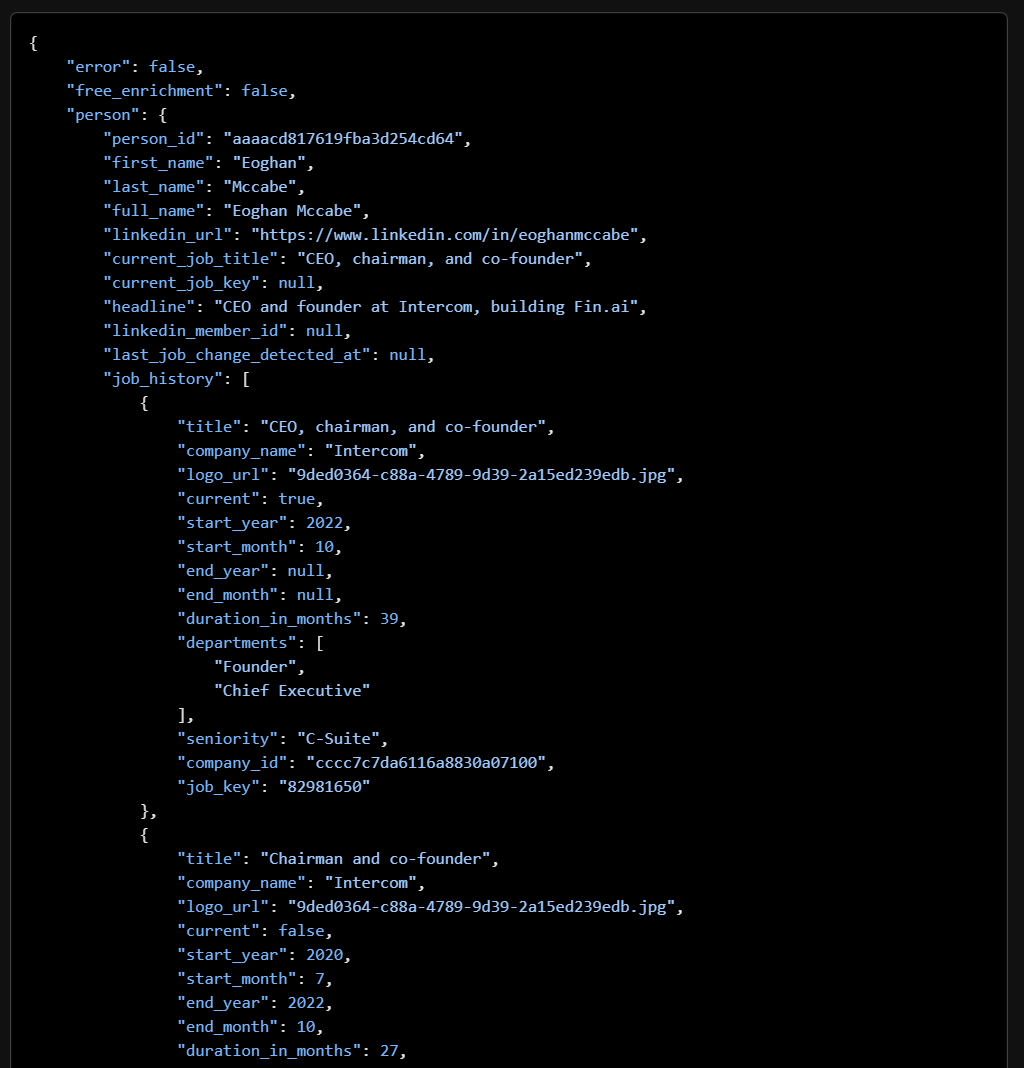
Here's what that looks like in practice:
{
  "email": "jane.doe@acme.com",
  "email_status": "verified",
  "first_name": "Jane",
  "last_name": "Doe",
  "title": "VP of Marketing",
  "seniority": "VP",
  "department": "Marketing",
  "company": "Acme Corp",
  "industry": "SaaS",
  "employee_count": 450,
  "revenue_range": "$50M-$100M",
  "hq_location": "San Francisco, CA",
  "technologies": ["HubSpot", "Snowflake", "Gong"],
  "phone_direct": "+1-415-555-0142",
  "confidence_score": 0.96
}
The data types fall into four categories. Contact data covers verified emails, direct dials, job titles, and seniority levels. Firmographic data includes company size, revenue, industry, and headquarters location. Technographic data reveals the tools and platforms a company runs - useful for targeting by tech stack. Intent data signals which accounts are actively researching topics relevant to your product.
Most providers deliver data through REST API endpoints you call on demand. Some also support webhook push delivery, where enriched data gets sent to your endpoint automatically when a match completes - better for real-time routing. Others offer native CRM sync that writes directly to Salesforce or HubSpot fields without middleware. The right delivery method depends on your stack: webhooks for speed, polling for simplicity, native sync for teams that want enrichment without coding custom integrations.
A good enrichment API returns 50+ data points per contact with a match rate above 80%. A mediocre one returns a name, a guessed email, and a job title that's six months stale.
Why One API Is Never Enough
B2B contact data decays at roughly 2.1% per month - that's 22-25% annually. People change jobs, companies rebrand, phone numbers rotate. Gartner pegs the cost of poor data quality at $12.9M per year for the average organization. That's not just bounced emails. It's wasted rep time, missed routing, and broken scoring models.
Stop comparing database sizes. Start comparing refresh cycles.
A 300M-record database refreshed every seven days beats a 321M-record database refreshed every six weeks. By the time your reps call that "verified" number from a stale database, the prospect has already changed roles.
68% of enrichment APIs claim 95%+ accuracy. The reality is uglier. Practitioner tests on r/sales and r/b2bmarketing tell a different story: Apollo exports bounce at 32-38% with email accuracy perceived around 65-70%. Hunter and Snov run 28-35%. Even Lusha, which performs better on mobile numbers, bounces 22-28% on email. The gap between claimed accuracy and real deliverability is 10-30 percentage points wide.
One r/b2bmarketing thread described a real stack spanning ZoomInfo for contacts, Clearbit for firmographics, BuiltWith for technographics, and 6sense for intent - four subscriptions with manual coordination. Messy, but it works better than trusting a single source.
Best Lead Enrichment APIs in 2026
| Tool | Per-Record Cost | Free Tier | Database Size | Email Accuracy | Best For |
|---|---|---|---|---|---|
| Prospeo | ~$0.01/email | 75 emails/mo | 300M+ profiles | 98% | Email deliverability |
| People Data Labs | $0.20-$0.28 | No | 1.5B+ records | ~90% | Raw dataset depth |
| Apollo | ~$0.04-$0.08 | Yes (limited) | 275M+ contacts | ~65-70% | Free starting point |
| Hunter | ~$0.03-$0.05 | Yes (limited) | 100M+ emails | ~70-75% | Domain email patterns |
| ZoomInfo | ~$1.00+ | No | 321M profiles | ~85% | Enterprise all-in-one |
| Clearbit/Breeze | $0.45/credit | No | Not disclosed | ~85% | HubSpot-native teams |
| Cognism | ~$0.50-$1.00 | No | 400M+ profiles | ~90% | EMEA compliance |
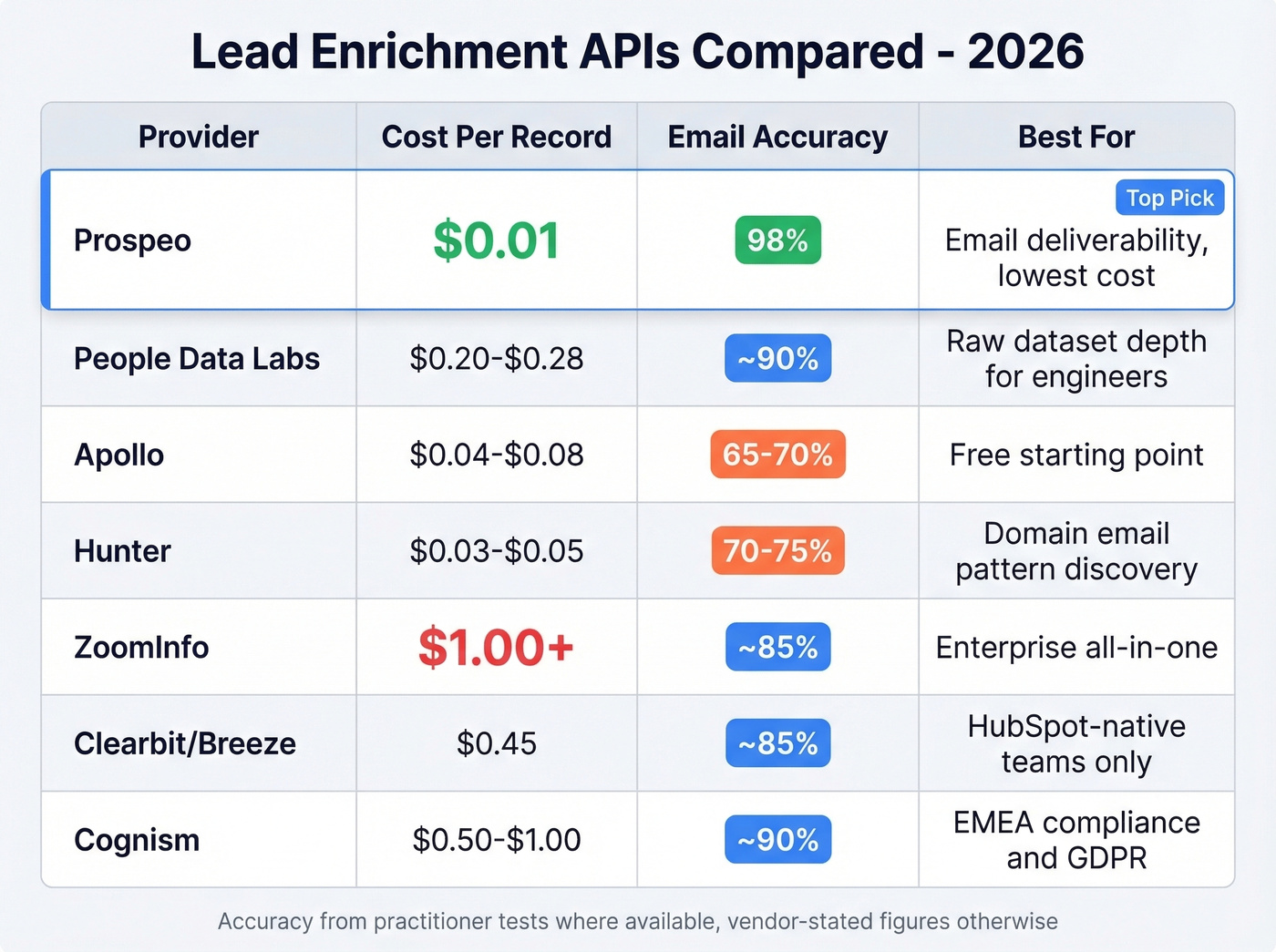
Email accuracy figures from practitioner tests and community reports where available; vendor-stated figures used where independent data isn't available.
Prospeo
Prospeo's enrichment API returns 50+ data points per contact with a 92% match rate and 98% email accuracy. When Snyk's 50-person AE team switched over, they went from 35-40% bounce to under 5%, with AE-sourced pipeline up 180% and 200+ new opportunities per month.
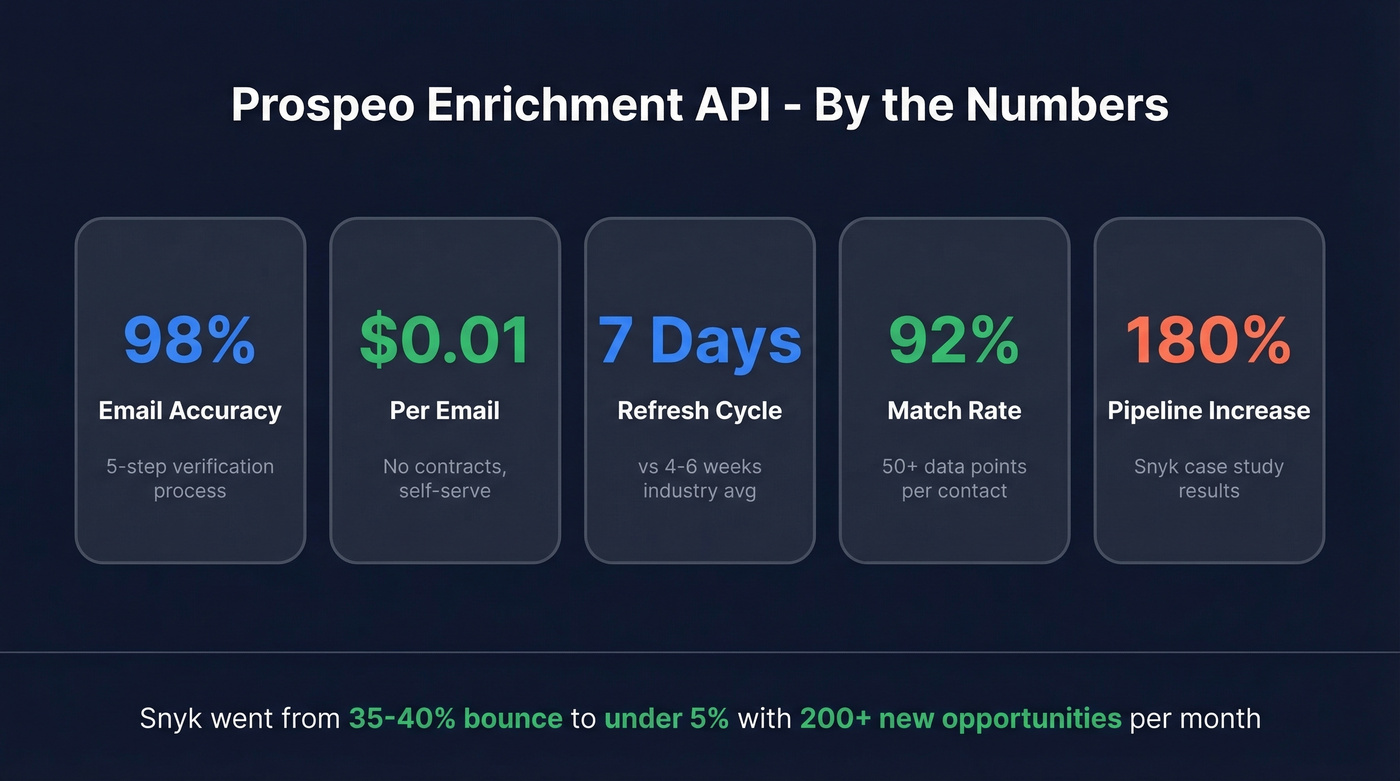
The differentiator is the 7-day data refresh cycle. While most providers refresh every four to six weeks, Prospeo re-verifies its entire 300M+ profile database weekly using proprietary infrastructure - no third-party email providers in the chain. The 5-step verification process catches catch-all domains, spam traps, and honeypots that other providers miss entirely, which is why the accuracy numbers hold up in production, not just in demos.
Use this if: You need the highest email deliverability at the lowest per-record cost. At ~$0.01/email with a free tier of 75 emails/month, it's the obvious choice for teams that have been burned by bounced data. No contracts, self-serve onboarding, and native integrations with Salesforce, HubSpot, Clay list building, and every major sequencer.
Pair it with: Your sequencer of choice - native integrations with Smartlead, Instantly, Lemlist, and Outreach make this plug-and-play.

Single-source enrichment APIs bounce 22-38% of emails. Prospeo's enrichment API returns 50+ data points per contact at a 92% match rate with 98% email accuracy - refreshed every 7 days, not 6 weeks.
Stop paying $1/record for data that decays before your reps use it.
People Data Labs
People Data Labs has the most transparent pricing model in the enrichment API space. Person enrichment runs $0.20-$0.28/credit depending on volume and billing cycle. Company enrichment drops to $0.05-$0.10/credit. You only get charged on a successful match (HTTP 200 response), which means zero waste on empty lookups.
The Search API is where PDL gets interesting - and potentially expensive. A single search request can consume 1-100 credits depending on the size parameter you set. Developers love the granular control, but you need to watch your credit consumption carefully. Across 1.5B+ records, PDL's depth is hard to match, but that depth comes at a premium.
The verdict: PDL is built for engineers building custom enrichment infrastructure, not sales reps clicking buttons. If you want the deepest raw dataset with predictable, per-credit economics, this is your pick. If you want plug-and-play, look elsewhere.
Apollo
Apollo is the best free on-ramp in the space. The free tier gives you 50 mobile credits and 10 export credits per month - enough to test workflows before committing. Paid plans start at $49/user/month (Basic) and $79/user/month (Professional), with 275M+ contacts in the database.
Here's the trap nobody warns you about: Apollo runs two separate credit types. Mobile credits unlock direct dials. Export credits unlock email downloads. They're not interchangeable, and the allocations are stingy - Basic gives you roughly 100 mobile and 1,000 export credits per month. The enrichment endpoints like v1/people/match and v1/organizations/enrich consume credits per call.
The bigger issue is deliverability. Apollo bounce rates consistently land in the 32-38% range when verified through third-party tools like NeverBounce, with practitioners reporting email accuracy around 65-70%. The database is massive, but massive and accurate aren't the same thing. Use Apollo as your first pass, then verify everything downstream.
Hunter
Hunter's strength is domain-level email discovery - give it a company domain and it surfaces the email patterns and individual addresses associated with it. The API is clean, well-documented, and doesn't require a premium plan just to access.
The problem is enrichment depth. Hunter finds emails well but returns thin firmographic and technographic data compared to full-stack providers. Bounce rates in practitioner tests run 28-35%, and multiple Reddit threads mention the finding rate has gotten worse over the past year. Good for email pattern discovery, not for full-profile enrichment. Paid plans start at $49/month.
ZoomInfo
ZoomInfo has the largest database - 321M active professionals across 104M companies. It's the enterprise default for a reason.
But let's be honest: if your average deal size is under $15k, you almost certainly don't need ZoomInfo-level data, and you definitely don't need ZoomInfo-level pricing. A small team contract starts around $25k/year, with larger deployments running $58k+. The consensus on r/sales is blunt - "$15k+ annually is insane for small teams." If you need a company data enrichment API with deep firmographic coverage and can justify the spend, ZoomInfo delivers. Most teams just don't need all-in-one.
Clearbit / Breeze Intelligence
Clearbit has largely shifted from a standalone product to Breeze Intelligence inside HubSpot. Pricing starts at $45/month for 100 credits with no rollover. Reddit users describe endpoints disappearing, prices climbing, and slower support. Skip it unless you're already deep in HubSpot and don't want to manage external integrations.
Cognism
Cognism is the compliance-first option for teams targeting European markets. GDPR is baked into the product, with strong mobile verification in EMEA. Custom pricing typically runs $15k-$25k/year for mid-market packages. Worth evaluating if your ICP is primarily in the UK, DACH, or Nordics. For North American-focused teams, you'll find better value elsewhere.
Snyk's 50 AEs cut bounce rates from 35-40% to under 5% and added 200+ opportunities per month after switching their enrichment pipeline to Prospeo. No third-party email providers. No contracts. Just verified data at $0.01/email.
Build your waterfall on the API with the highest accuracy in the stack.
What You'll Actually Pay
The per-record cost tells you half the story. The other half is the enrichment tax - the cost of verifying enriched data after the fact because you don't trust the provider's accuracy claims.
| Tool | Per-Record | Free Tier | Annual Contract | Charge on Fail |
|---|---|---|---|---|
| Prospeo | ~$0.01 | Yes (75/mo) | No | No |
| People Data Labs | $0.20-$0.28 | No | Optional | No (HTTP 200) |
| Apollo | ~$0.04-$0.08 | Yes (limited) | No | Varies |
| Hunter | ~$0.03-$0.05 | Yes (limited) | No | Varies |
| ZoomInfo | ~$1.00+ | No | Yes | Yes |
| Clearbit/Breeze | $0.45 | No | Yes (HubSpot) | No (re-enrich) |
| Cognism | ~$0.50-$1.00 | No | Yes | Yes |
If you're running Apollo at $0.05/record but 35% bounce, your effective cost per deliverable email is closer to $0.08. Add a verification step at $0.005/email and you're at $0.085 - nearly double the sticker price. ZoomInfo's math gets ugly fast on small contracts: $25,000/year at 500 enrichments per month works out to about $4.17 per enriched lead before you add any verification or downstream tooling.
Prospeo's $0.01/email with 98% accuracy means your effective cost barely moves.
Build a Waterfall Enrichment Pipeline
The practitioners who report 10-14% bounce rates aren't using magic. They're running waterfall enrichment - calling multiple APIs sequentially and using the first successful, verified match. In our experience, this is the single biggest lever for improving deliverability.
Here's the architecture. A form submission or CRM event triggers a webhook. That webhook hits your first enrichment API. If the match comes back with a verified email, you're done. If not, it cascades to a second provider, then a third. The enriched record gets pushed back to your CRM with a confidence score, and downstream routing and scoring kick in.
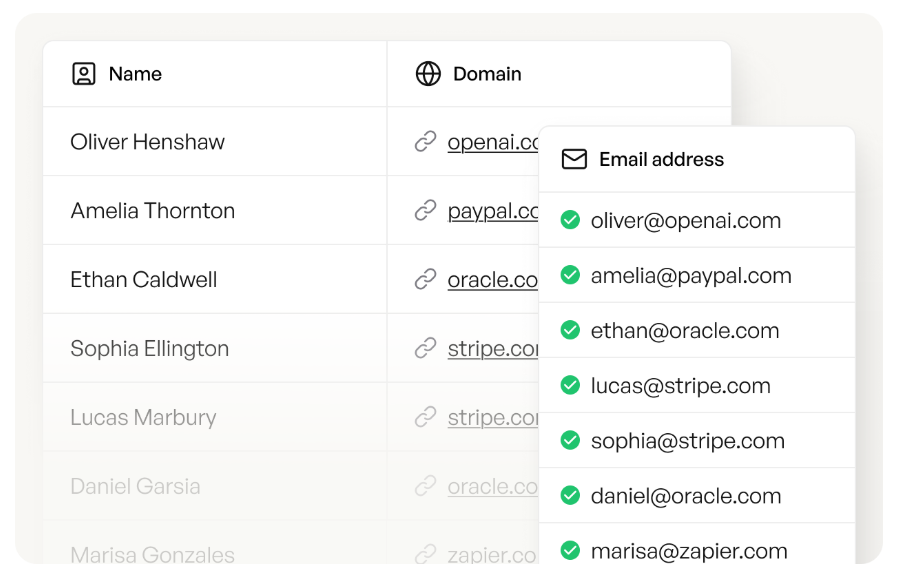
Some providers bundle verification into the enrichment call itself - a single-step process where you get back only verified data. Others require a separate verification pass after enrichment, adding a second API call and additional cost. Knowing which model your provider uses changes how you architect the waterfall.
CRM-specific implementation notes matter here. HubSpot requires Operations Hub Pro or Enterprise to use the "Send a webhook" action in workflows - Starter won't cut it. Salesforce handles webhooks via Apex triggers or Flow Builder with HTTP callouts, and you'll need to configure named credentials and remote site settings. Zoho's webhook support is more limited: you're capped at 10 CRM fields per webhook, which forces you to prioritize which enrichment fields actually matter.
Tools like Clay make waterfall orchestration easier if you don't want to build custom middleware. Even a simple Zapier, Make, or n8n workflow that calls two APIs sequentially will outperform any single-source approach.
Real-Time vs. Batch
Use real-time enrichment for inbound form fills and live lead routing. When a prospect fills out a demo request form, you want enriched data hitting your CRM and routing logic fast - not hours later. Webhooks are the right pattern here, though API latency stacks if you're running a waterfall.
Use batch enrichment for list imports, quarterly CRM hygiene, and campaign prep. Upload a CSV, let the API process overnight, review results in the morning. Batch pricing is often cheaper per record and doesn't require webhook infrastructure. For a 50,000-record CRM cleanup, batch is the only practical option.
Most teams need both. Real-time for the front door, batch for the housekeeping.
Enrichment APIs for ABM
Account-based marketing programs live or die on data quality. An enrichment API for ABM lets you build complete account profiles - firmographics, technographics, and buying committee contacts - before your reps ever make first touch.
The workflow is straightforward: feed your target account list into a company data enrichment API to fill in revenue, headcount, and tech stack. Then run each account's domain through a contact enrichment endpoint to surface the buying committee by seniority and department. Layer in intent signals from providers like 6sense or Bombora, and your reps know exactly who to call and what to say. We've seen teams cut their research time from 15 hours a week to 2-3 hours using this exact approach.
If you’re building this motion, it helps to align enrichment with your account-based selling workflow and your Ideal Customer Profile scoring.
Data Quality Checklist
Before you commit to any provider, verify these six things:
- Match confidence scoring - Does the API return a confidence score with each match? Without it, you're treating a 60% match the same as a 99% match.
- Email verification status - A returned email isn't the same as a verified email. Look for providers that verify in real time, not just at the time of database ingestion. (If you need a dedicated verifier, compare options in our guide to email verification.)
- Data freshness timestamp - When was this record last verified? If the API doesn't tell you, assume the worst.
- Catch-all domain handling - Catch-all domains accept any email address, which means a "valid" response is meaningless. Your provider should flag these explicitly. (More on remediation in our spam trap removal playbook.)
- Partial match handling - What happens when the API returns a name and company but no email? Do you still get charged? How do you handle incomplete records in your workflow?
- Credit consumption on failed matches - Some providers only charge on successful matches. Others charge per request regardless. This difference can double your effective cost.
If you’re tying enrichment to outbound, make sure it ladders into your email deliverability setup and your email bounce rate monitoring.
FAQ
Is lead enrichment GDPR compliant?
Yes, if you have a lawful basis - legitimate interest is the most common for B2B outreach. Require a Data Processing Agreement from your provider, honor opt-out requests, and document your processing purpose. GDPR-compliant providers like Cognism enforce opt-outs globally and provide DPAs on request.
What's a good match rate?
Anything above 80% is solid. Top-tier APIs hit 92%+ match rates on verified records. If you're seeing rates below 70%, you're wasting credits on empty lookups and should add a second provider via waterfall.
How often should I re-enrich my CRM?
At minimum, quarterly. B2B data decays at ~2.1% per month, so a six-month-old record has about a 13% chance of being stale. APIs with weekly refresh cycles reduce this risk significantly. Set a calendar reminder - CRM hygiene isn't glamorous, but it's the difference between 15% bounce and 5%.
Can I use multiple enrichment APIs together?
Yes, and you should. This is called waterfall enrichment, and it's the single most effective thing you can do for data quality. Stack two or three APIs sequentially, use the first successful verified match, and add a verification layer before records hit your sequencer. Practitioners consistently report bounce rates dropping from 30%+ to 10-14% with this approach.
Can I enrich data without coding?
Absolutely. Tools like Clay, Zapier, Make, and n8n let you connect enrichment APIs to your CRM and sequencer through visual workflow builders - no engineering resources required. Many providers also offer native CRM integrations that sync enriched fields directly into Salesforce or HubSpot with zero code.