

B2B Prospecting Strategies: The Data-Backed Playbook for 2026
84% of reps missed quota last year. Reply rates dropped from 6.8% to 5.8% across 16.5M cold emails. If you're still running volume-first outbound with unverified data, high bounce rates, and too many follow-ups, you aren't just wasting time - you're torching sender reputation and pushing future campaigns into spam. The B2B prospecting strategies that worked in 2023 are actively hurting you now.
Here's what's replacing the old playbook, with numbers attached to every recommendation.
The Three Things That Matter
Signal-based targeting, structured multi-channel cadences, and deliverability hygiene. That's it.
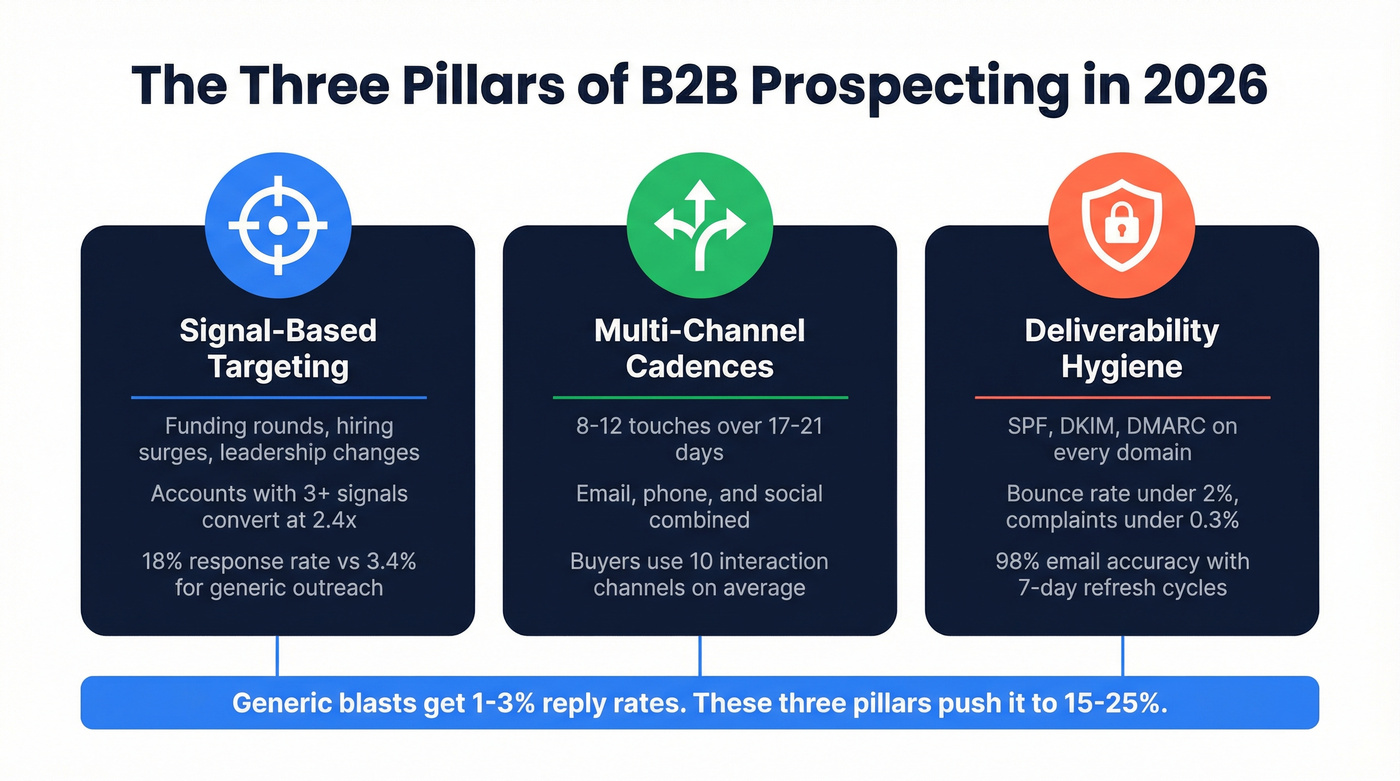
Generic blasts get 1-3% reply rates. Signal-based personalization pushes that to 15-25%. Everything below is about closing that gap.
Strategies That Actually Move Pipeline
Start With a Tight ICP
Untargeted lists get 67% fewer replies than smaller, focused segments. That's not marginal - it's the difference between a pipeline and a spam folder.
The average B2B buying committee involves 7 people, so you don't just need the right company; you need the right roles within it. Map your ICP down to title, department, and seniority before you pull a single contact. We've watched teams burn through thousands of leads because they skipped this step and went straight to blasting VPs who'd never touch their product. Don't be that team.
Use Signals, Not Spray
Signal-based outreach generates an 18% response rate vs. 3.4% for generic cold outreach. Same rep, same product, same email tool - 5x the results.
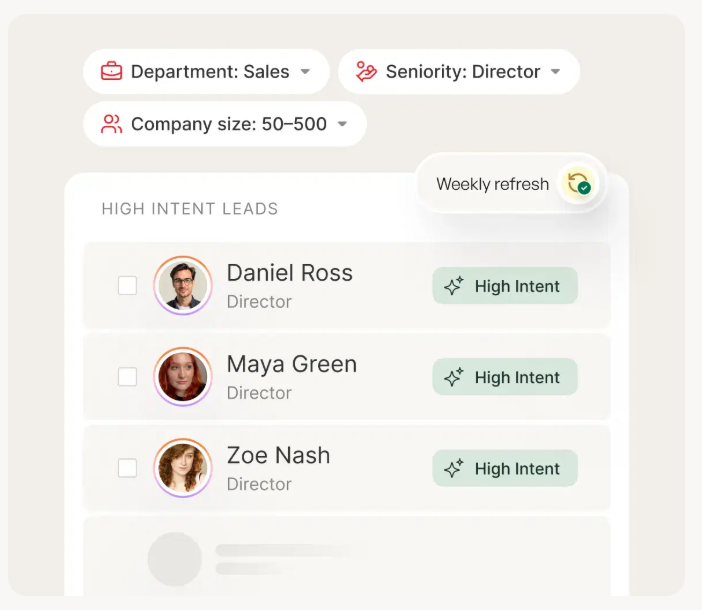
The signals that matter: funding rounds, hiring surges, leadership changes, job changes into target accounts, new tech adoption, and competitor mentions. Accounts with 3+ active buying signals convert at 2.4x the rate of single-signal accounts.
Here's why timing is everything: 92% of buyers start with at least one vendor already in mind, and the vendor ranked first on day one wins roughly 80% of the time. The first seller to reach a prospect after a trigger event is 5x more likely to close. This isn't about clever subject lines. It's about showing up at the right moment with a relevant reason to talk.
The Personalization Ladder
Everyone says "personalize your outreach." Almost nobody quantifies what that means.
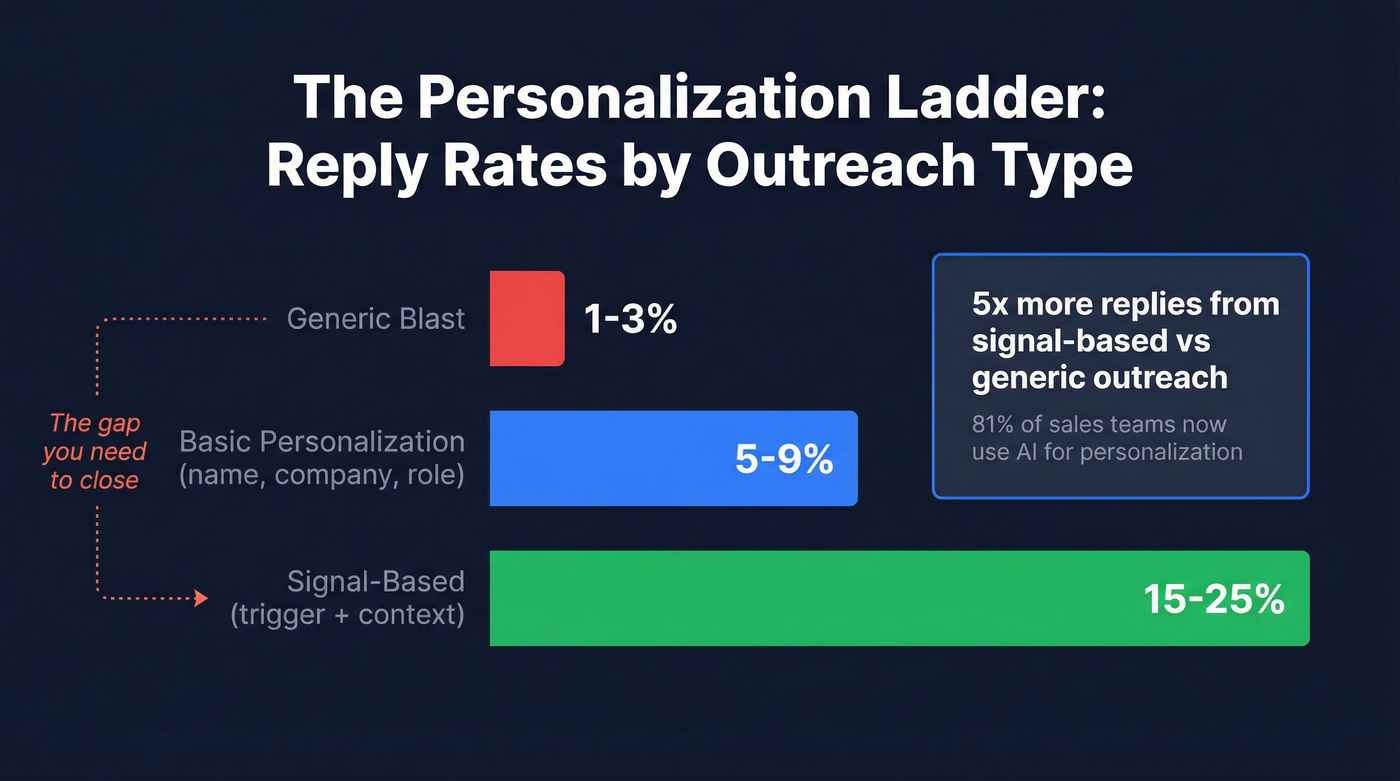
| Personalization Level | Typical Reply Rate |
|---|---|
| Generic blast | 1-3% |
| Basic (name, company, role) | 5-9% |
| Signal-based (trigger + context) | 15-25% |
81% of sales teams now use AI for personalization, and daily AI users are 2x more likely to exceed quota. But let's be honest - "Hi {first_name}, I noticed {company} is growing" isn't personalization. It's a mail merge. Real personalization references a specific signal and connects it to a specific problem your product solves. The difference shows up in every metric that matters.
If you want a deeper framework for doing this consistently, start with personalization and then move into signal-based outbound.
Build a Multi-Channel Cadence
Buyers spend just 17% of their time meeting suppliers. The rest is independent research, internal discussions, and evaluating options without you in the room. Your cadence needs to reach them where they already are - and they use an average of 10 interaction channels. Outreach's data shows 8-12 touchpoints over 17-21 days is the sweet spot.
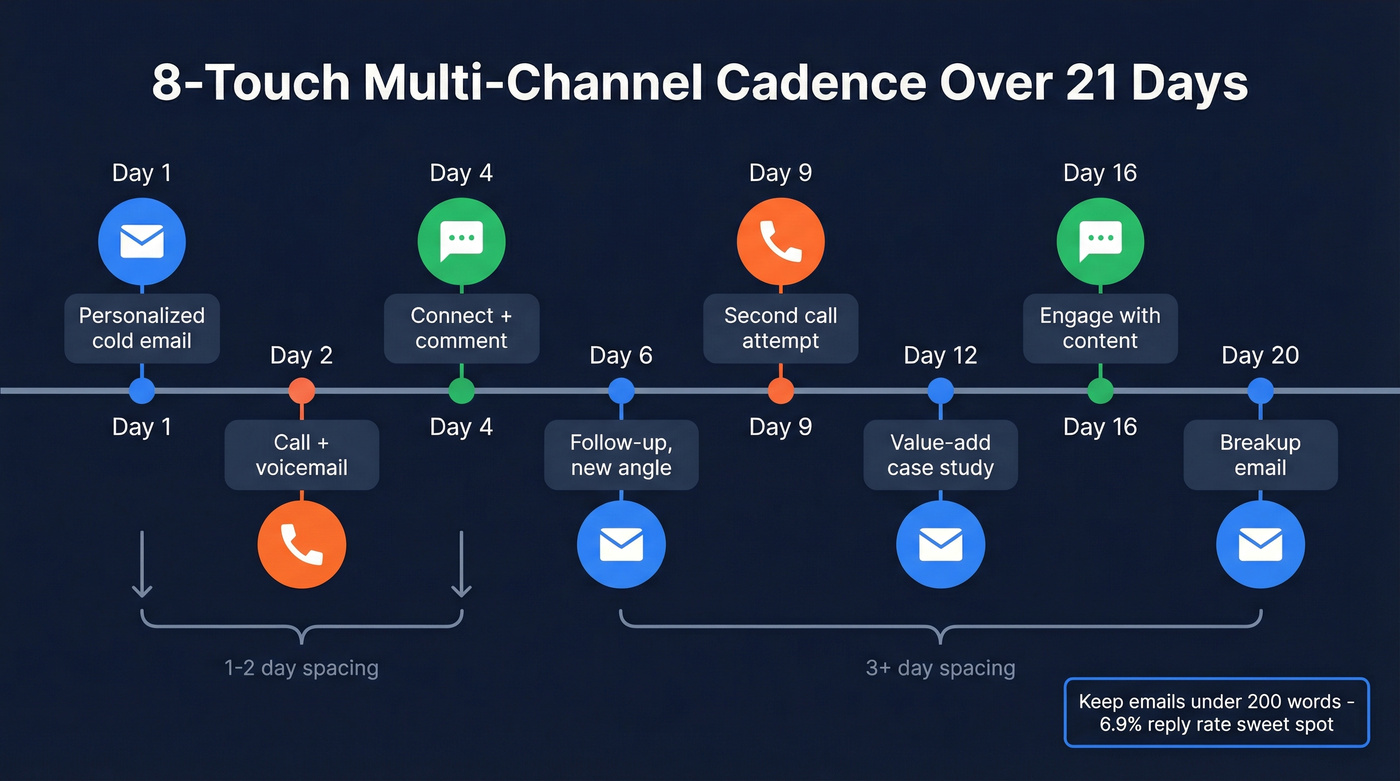
| Day | Channel | Touch |
|---|---|---|
| 1 | Personalized cold email | |
| 2 | Phone | Call + voicemail |
| 4 | Social | Connect + comment |
| 6 | Follow-up (new angle) | |
| 9 | Phone | Second call attempt |
| 12 | Value-add (case study) | |
| 16 | Social | Engage with content |
| 20 | Breakup email |
Keep cold emails under 200 words. Belkins found 6-8 sentence emails hit a 6.9% reply rate in their dataset, and shorter messages consistently outperformed longer ones. Start with 1-2 day spacing between early touches, then widen to 3+ days.
For more templates and structure, use a proven sales cadence and keep your messaging tight with a clear sales email structure.
One stat that should change how you think about follow-ups: spam complaint rates rise from 0.5% on the first email to 1.6% by the fourth. Smarter spacing beats more volume every single time.
Deliverability: The Setup Nobody Talks About
Deliverability isn't an IT task. It's the foundation your entire outbound strategy sits on. We've seen teams lose months of outbound momentum from a single bad send because they skipped this checklist:
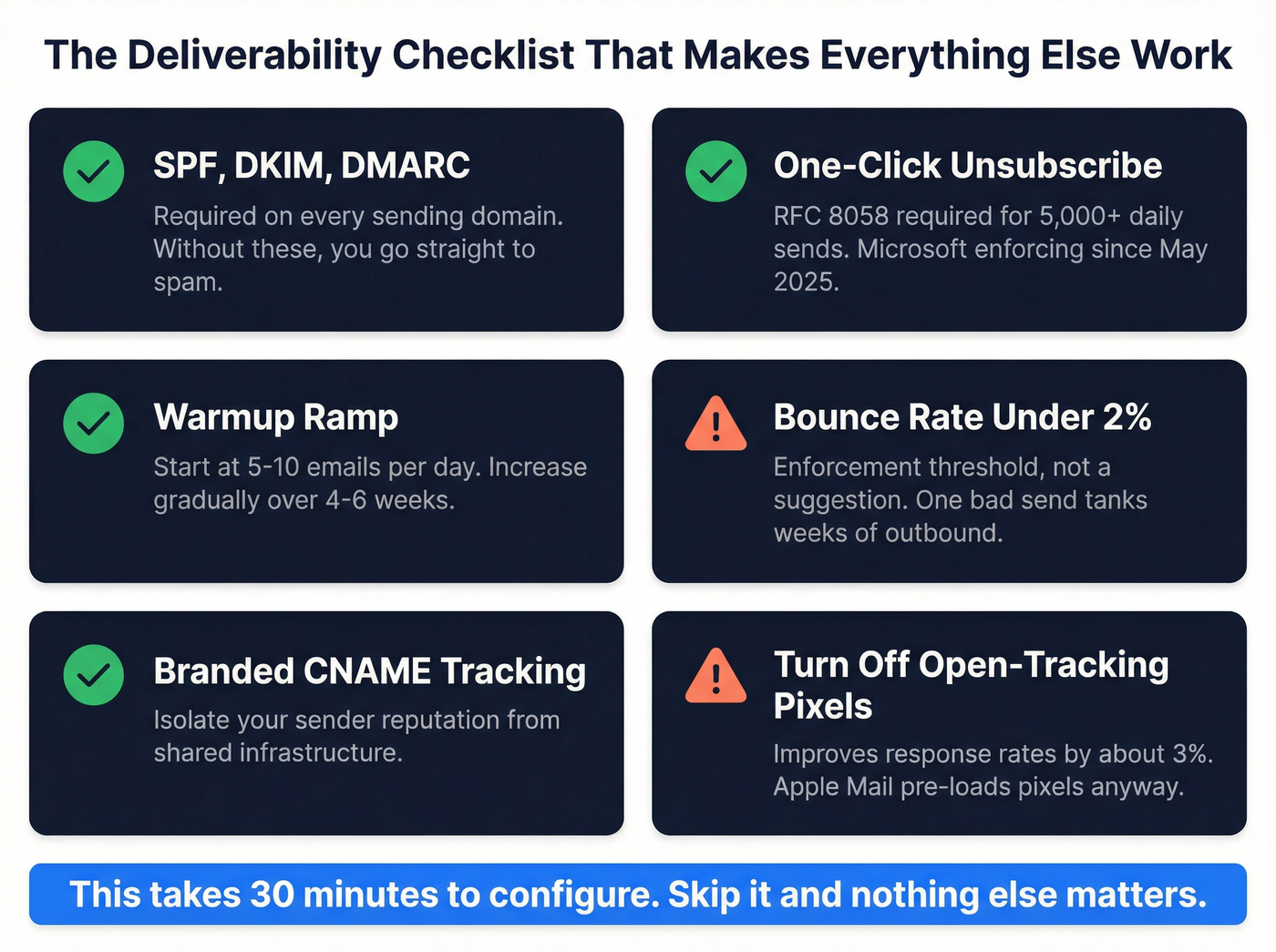
- SPF, DKIM, and DMARC on every sending domain. Without these, you're going straight to spam under Google, Yahoo, and Microsoft's bulk sender rules. (If you need the step-by-step, use this SPF, DKIM, DMARC guide.)
- One-click unsubscribe (RFC 8058) - required for bulk senders. Microsoft started enforcing this in May 2025 for anyone sending 5,000+ daily messages.
- Warmup ramp - start new domains at 5-10 emails/day, increase gradually over 4-6 weeks. Use an automated email warmup process to avoid guesswork.
- Bounce rate under 2% and spam complaints under 0.3%. For bulk senders, these are enforcement thresholds, not suggestions. If you're troubleshooting, start with hard bounces.
- Branded CNAME tracking domain to isolate your sender reputation from shared infrastructure.
- Turn off open-tracking pixels. Belkins found this alone improved response rates by ~3%. Open rates are vanity metrics now that Apple Mail pre-loads pixels anyway. (More detail: Does Open Tracking Hurt Cold Email?)
This takes 30 minutes to configure. Skip it and nothing else in this article will matter.

You just saw the numbers: deliverability thresholds demand under 2% bounce rates, and signal-based outreach hits 15-25% reply rates. None of that works if your contact data is stale. Prospeo's 5-step verification delivers 98% email accuracy across 143M+ verified addresses - refreshed every 7 days, not the 6-week industry average.
Stop torching sender reputation. Start with data you can trust.
Fix Your Data First
Here's the thing most prospecting content won't tell you: if your deal sizes are under five figures, your biggest ROI isn't a better sequencer or a fancier AI writer. It's cleaner data.
You can nail the cadence, the personalization, the deliverability setup, and still blow it because your contact data was stale or unverified. "Verified" lists from plenty of providers still produce double-digit bounce rates - and that's how domains get burned. No amount of sophisticated prospecting technique will save you from bad data.
Picture this: you pull 500 contacts, 40 bounce on the first send. That's an 8% bounce rate. Mailbox providers flag your sender. Now your next three campaigns land in spam regardless of copy quality. We've seen this exact scenario play out dozens of times, and it's infuriating every time because it's so preventable.
Prospeo's 5-step verification with catch-all handling, spam-trap removal, and honeypot filtering delivers 98% email accuracy across 143M+ verified addresses, refreshed every 7 days versus the 6-week industry average. Snyk's team of 50 AEs saw bounce rates drop from 35-40% to under 5% after switching, with AE-sourced pipeline up 180%.
If you're diagnosing why lists go stale so fast, start with data decay and then implement a repeatable email verification for outreach workflow.
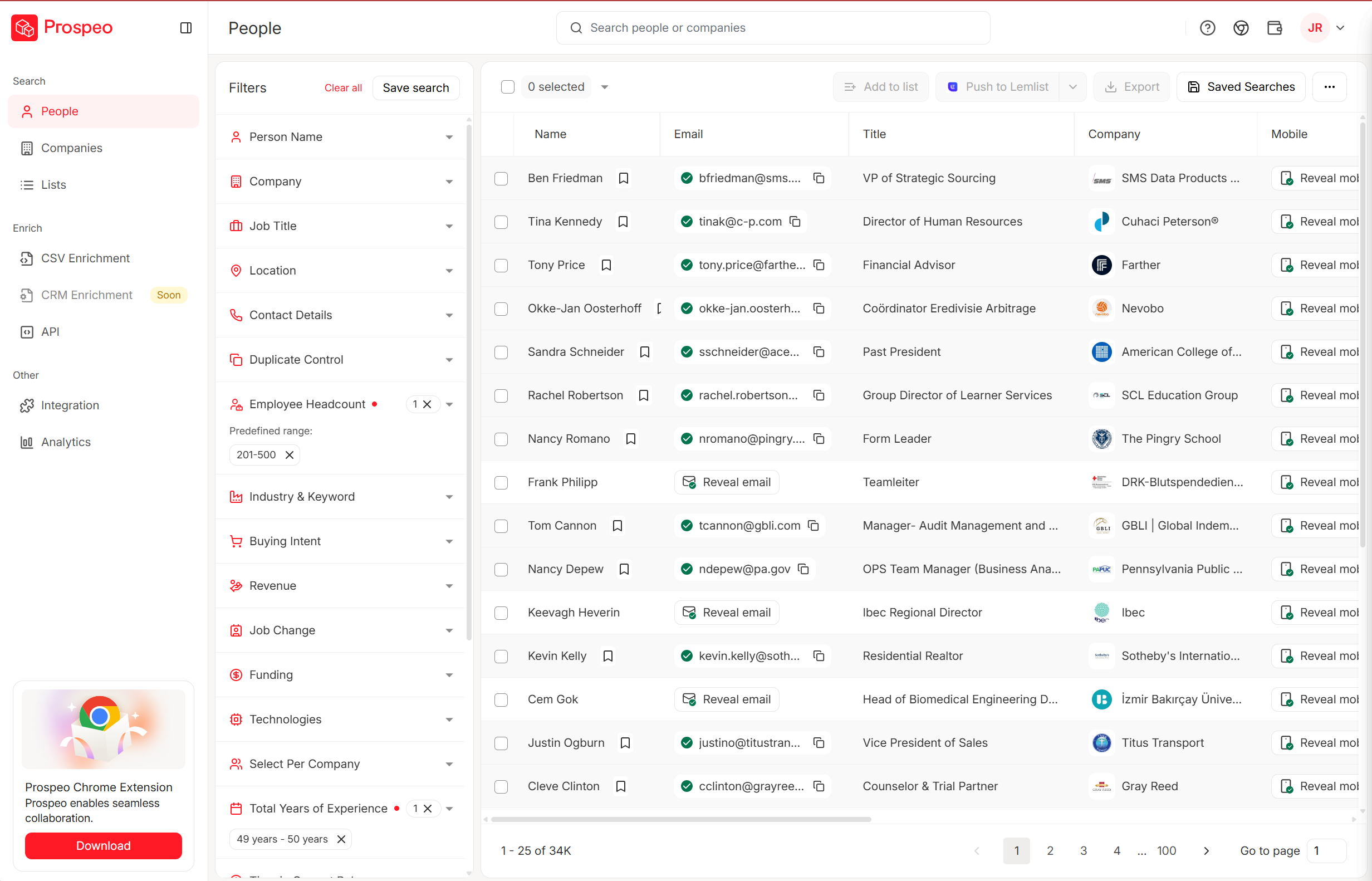
Snyk's 50 AEs cut bounce rates from 35-40% to under 5% and grew AE-sourced pipeline 180%. Stack Optimize built a $1M agency with sub-3% bounce rates and zero domain flags. The difference wasn't better copy or smarter cadences - it was accurate data at $0.01 per email with 30+ filters to nail every ICP segment.
Layer intent signals, technographics, and job changes into every list you build.
What to Stop Doing
Most of these are obvious. Teams keep doing them anyway.
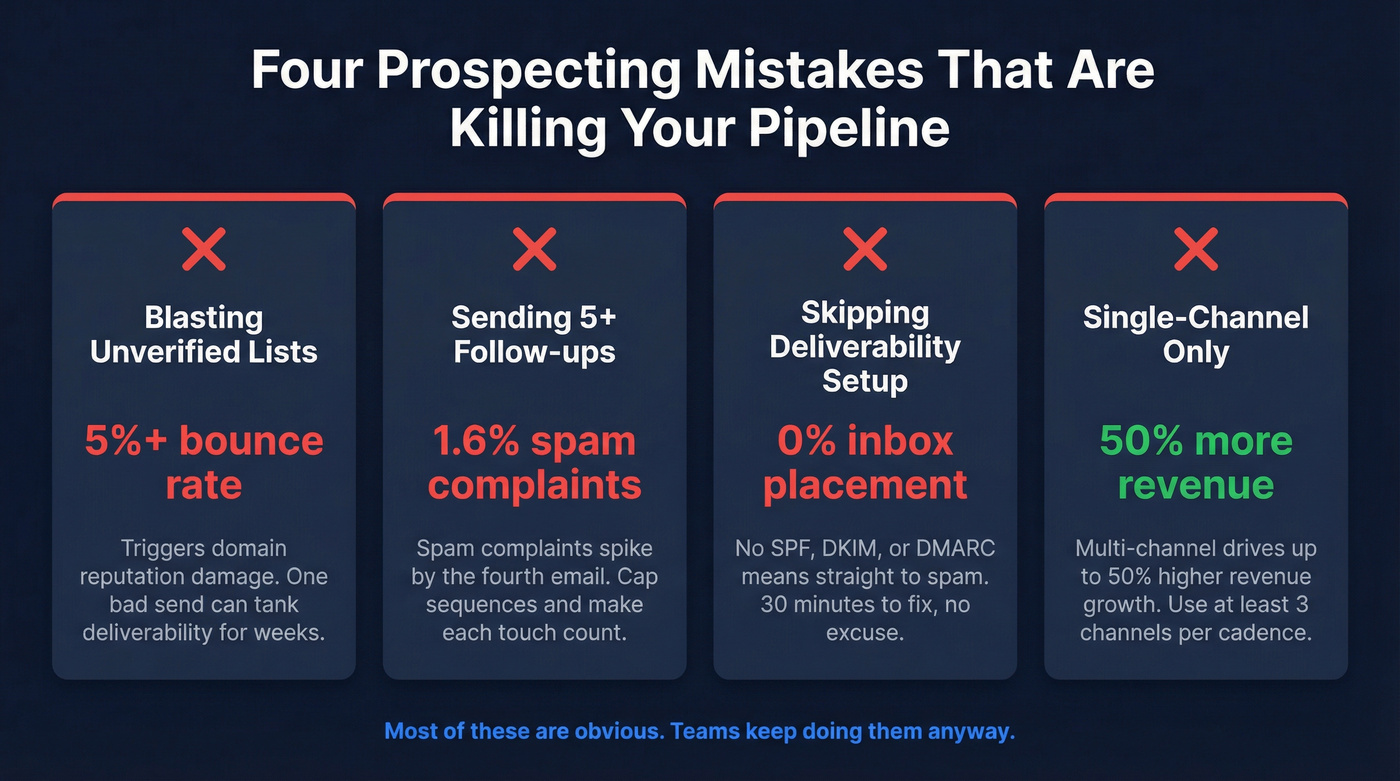
Blasting unverified lists. Bounce rates above 5% trigger domain reputation damage. One bad send can tank deliverability for weeks.
Sending 5+ follow-ups per sequence. Spam complaints hit 1.6% by the fourth email. Cap your sequences and make each touch count. If you need a system, use this prospect follow up playbook.
Skipping deliverability setup. No SPF/DKIM/DMARC means your emails go straight to spam. This takes 30 minutes to configure and there's no excuse for skipping it.
Running single-channel outreach. 90% of companies plan to stick with hybrid sales models because they drive up to 50% higher revenue growth. If you're only sending emails, you're leaving pipeline on the table. Use at least three channels in every cadence.
Tools for B2B Prospecting
You don't need 12 tools. You need one per category, connected properly.
| Category | Tool | Pricing Range |
|---|---|---|
| CRM | HubSpot / Salesforce | Free-$300+/user/mo |
| Data & verification | Prospeo | Free tier, ~$0.01/email |
| Intent signals | Bombora / 6sense | ~$30-100K+/yr (enterprise) |
| Enrichment | Clay | $149+/mo |
| Sequencing (SMB) | Instantly / Smartlead | $30-97/mo |
| Sequencing (mid-market) | Outreach / Salesloft | $100-$200+/user/mo |
Enterprise data providers charge $15-50K/year for annual contracts with seat minimums. For most teams under 50 reps, a self-serve platform with transparent per-credit pricing is the better math - and it's what we recommend to anyone who asks. The consensus on r/sales tends to agree: don't lock into an annual contract until you've proven your outbound motion works.
If you're evaluating options, compare sales prospecting platforms and keep your stack lean with a modern B2B sales stack.
FAQ
How many touchpoints to book a B2B meeting?
Eight touches across multiple channels over 17-21 days is the benchmark backed by Outreach's data. Start with tight spacing of 1-2 days, then widen to 3+ days to reduce fatigue and spam complaints.
What's a good cold email reply rate in 2026?
The industry benchmark is 5.8%, down from 6.8% the prior year. Signal-based outreach with real personalization pushes reply rates to 15-25% - roughly 3-4x the average.
How do I keep cold emails out of spam?
Configure SPF, DKIM, and DMARC on every sending domain, warm up new domains for 4-6 weeks, and keep bounce rates under 2% using verified contact data. A 7-day data refresh cycle helps teams stay well below that threshold.
What are the most effective B2B prospecting strategies in 2026?
Signal-based targeting, multi-channel cadences of 8-12 touches, and deliverability hygiene drive the highest conversion rates. Generic volume outreach is dead - precision and timing win consistently.
Does multilingual prospecting improve reply rates?
Writing in the prospect's native language lifts reply rates significantly in non-English-speaking markets. This is especially effective in EMEA and LATAM, where English-only outreach often gets ignored entirely.