

Handwritten Notes to Prospects: 15+ Examples That Actually Get Replies
A RevOps lead we spoke with spent $14,000 on a cold email platform last year. His team sent 40,000 emails across six months. Total replies that turned into meetings: 47. Meanwhile, a three-person SDR team at a Series B company sent 200 handwritten cards over the same period and booked 31 meetings. The average office worker now receives 120+ emails per day but fewer than 10 pieces of personal mail per year. The math isn't close.
Handwritten cards can outperform cold email by 2-5x on response rates when you mail a verified, tightly targeted list. The secret isn't volume - it's trigger-based timing paired with tight targeting. Every note should follow a simple five-part formula: Context, Specificity, Value, CTA, Sign-off. But send to a verified list, not a spray-and-pray batch.
At roughly $3 per card, cost per reply lands around $10-$20 at a 15-30% response rate. A $3 card sent to the wrong person is just expensive recycling.
Why Handwritten Notes Outperform Digital Outreach
Handwritten letters get opened over 99% of the time - compared to roughly 22% for marketing emails. That scarcity is the entire advantage, and it's growing. Cold email reply rates dropped from 6.8% to 5.8% year-over-year according to Belkins' analysis of 16.5 million emails. Handwritten mail wins because so few people bother.
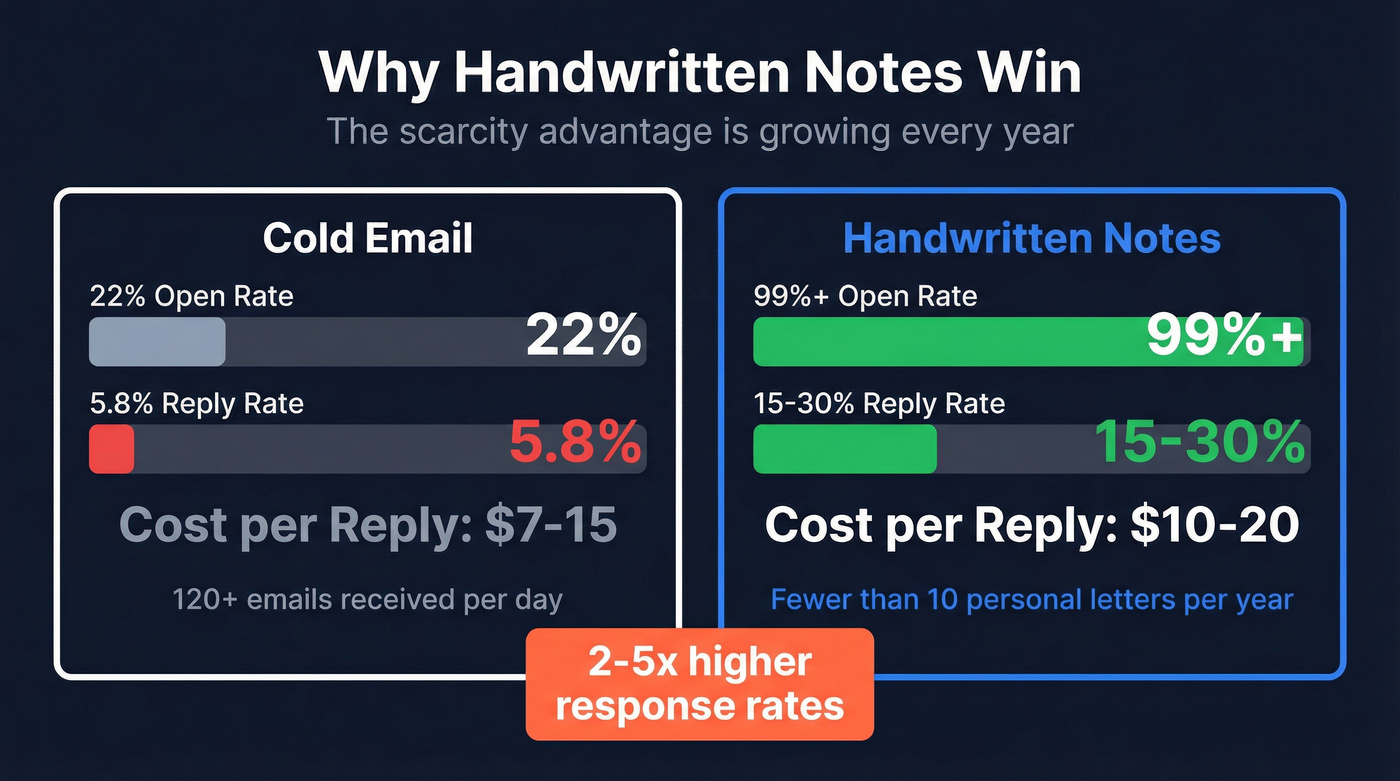
A South Korean study on handwritten thank-you notes found they drove a 2x lift in subsequent customer spending. Even more surprising: high-quality photocopies of handwritten notes drove similar spending lifts to originals, meaning you can test this tactic with a photocopied template before investing in a robot-pen service. In B2B prospecting, handwritten outreach to a tightly targeted list can pull 15-30% response rates when you're sending them at high-leverage moments - post-demo, stalled deals, exec-to-exec, event follow-up - instead of blasting cold.
The channel works because it doesn't scale easily. That friction is what makes it valuable.
Anatomy of a Great Prospecting Note
Every effective note follows the same five-part structure:
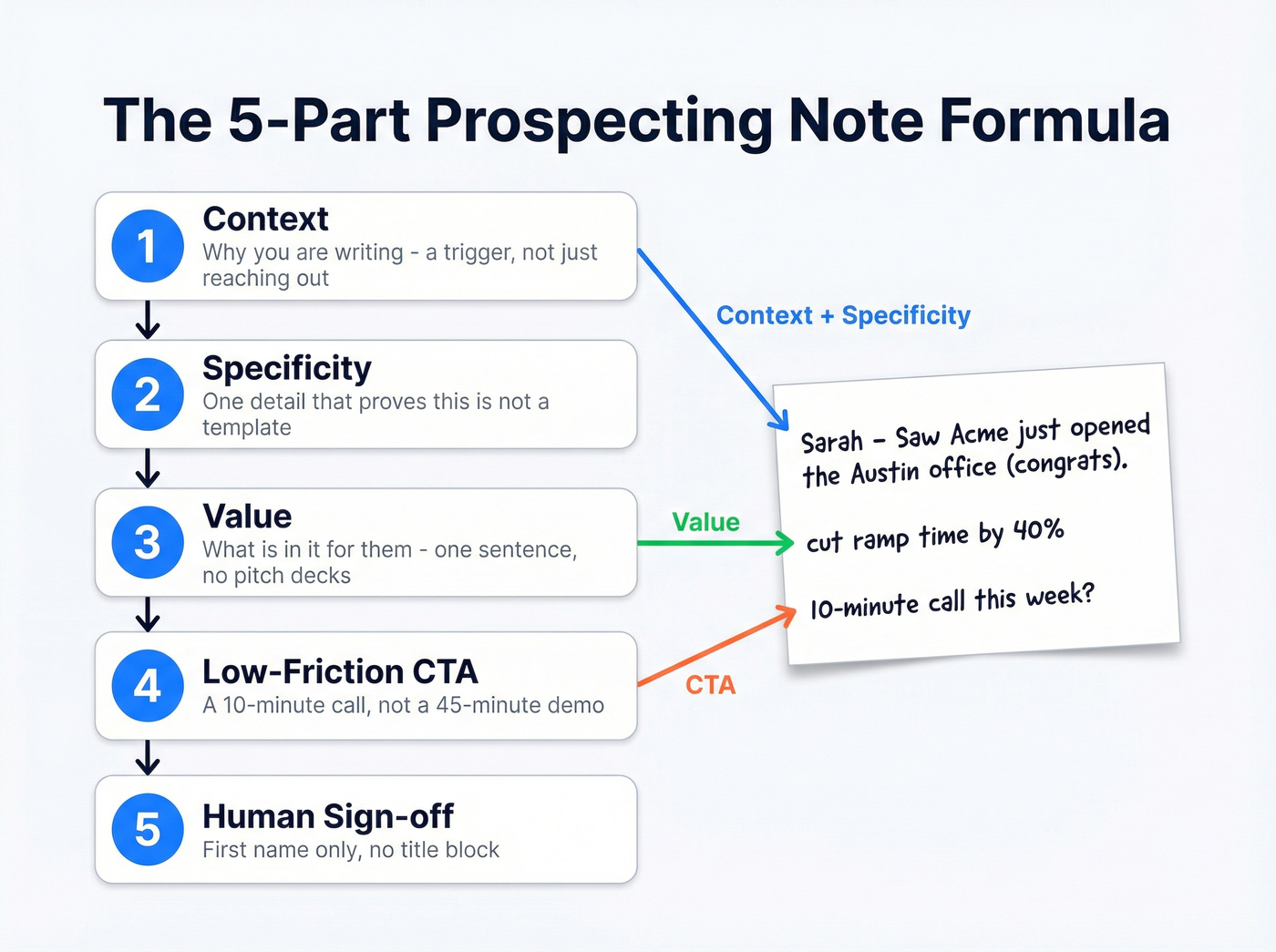
- Context - Why you're writing (a trigger, not "just reaching out")
- Specificity - One detail that proves this isn't a template
- Value - What's in it for them, one sentence, no pitch decks
- Low-friction CTA - A 10-minute call, not a 45-minute demo
- Human sign-off - First name only, no title block
In practice, that looks like this:
"Sarah - Saw Acme just opened the Austin office (congrats). We helped [similar company] cut their ramp time for new-market SDR teams by 40%. Worth a 10-minute call this week? - Mike"
"Saw Acme just opened the Austin office" is context plus specificity in one line. "We helped [similar company] cut ramp time by 40%" is value. "Worth a 10-minute call this week?" is a low-friction CTA. And "-- Mike" is the human sign-off.
One guardrail worth remembering: the "receipt test." If your personalization would feel creepy printed on a receipt - like referencing someone's vacation photos - it's too much. Stick to safe sources: call notes, public announcements, job posts, and company pages.
15+ Copy-Paste Examples by Scenario
Cold Outreach (First Touch)
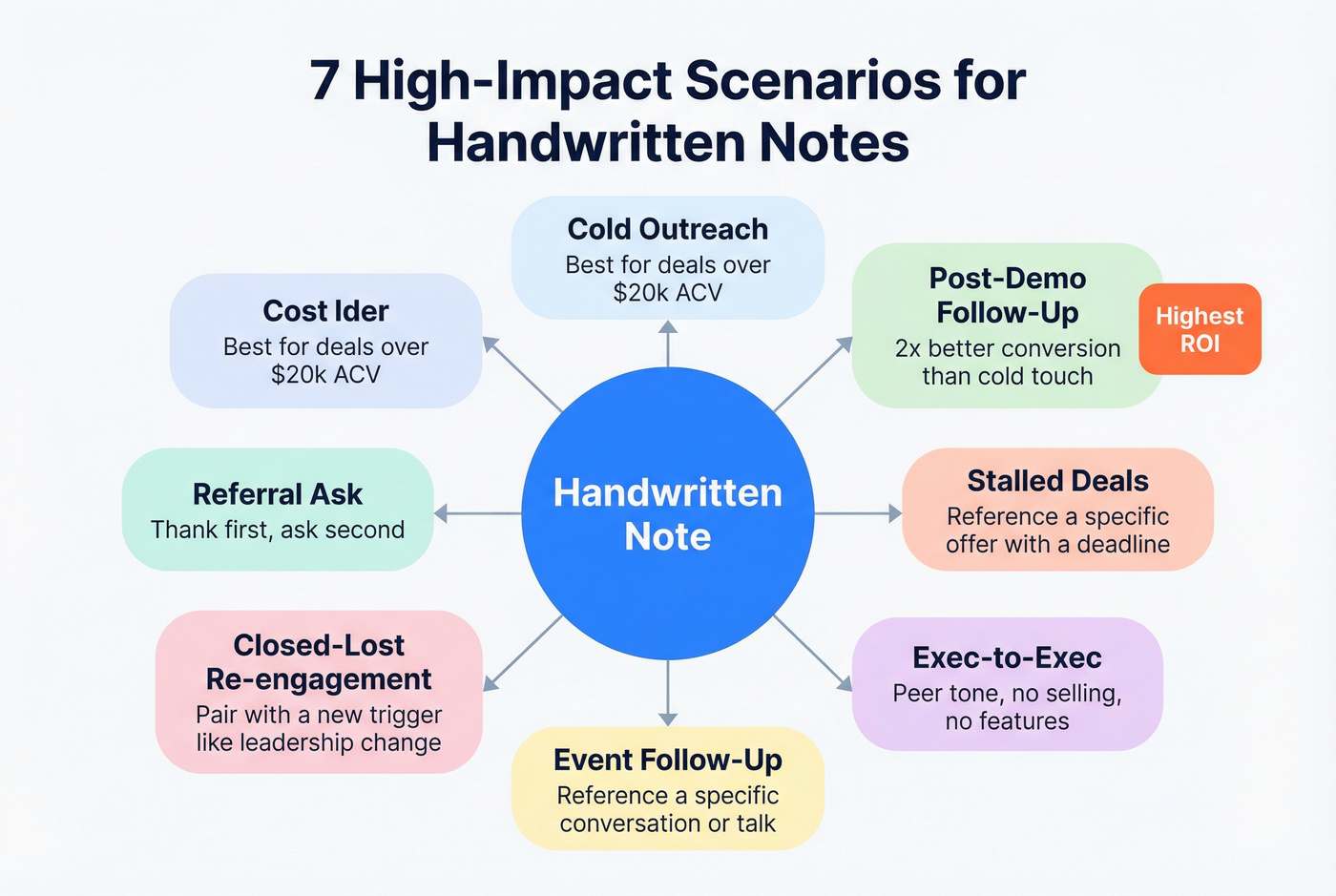
Cold handwritten notes are worth the $3/card when the deal size justifies it. For accounts worth $20k+ annually, a handwritten first touch is a no-brainer. For sub-$5k deals, save them for later in the funnel.
Exec-level cold outreach:
"David - Your Q3 earnings call mentioned doubling headcount in EMEA by year-end. That's exactly the scaling challenge we solve for [similar company]. Would 15 minutes next week be useful? - Rachel"
Peer-level cold outreach:
"Hey Marcus - I run outbound at [your company] and noticed your team just posted 4 SDR roles. We went through the same growth phase last year and learned a few things the hard way. Happy to share what worked over a quick call. - Jake"
Referral-based cold outreach:
"Lisa - Tom Chen suggested I reach out. He mentioned you're rebuilding your tech stack after the merger. We helped his team through a similar transition last quarter. Worth connecting? - Priya"
Post-Demo Follow-Up
This is the highest-ROI scenario. A card that lands a few days after a demo keeps you top-of-mind while the committee deliberates. We've seen post-demo notes convert around 2x better than cold first-touch cards, and the consensus on r/sales backs that up - reps consistently say post-demo is where handwritten outreach earns its keep.
Standard follow-up:
"James - Thanks for walking me through your pipeline challenges on Tuesday. The bottleneck you described between MQL handoff and first SDR touch is exactly what our workflow engine was built for. Looking forward to the next conversation. - Anika"
Multi-stakeholder follow-up:
"Catherine - Great meeting with you and the RevOps team yesterday. Your point about needing real-time sync between Salesforce and your sequencer stuck with me - that's a problem we've solved for 3 teams your size this quarter. I'll send the case study to your inbox. - Derek"
Champion reinforcement:
"Sam - I know you're carrying this internally, and I appreciate it. The ROI model we built together should give your CFO what she needs. Let me know how I can help you make the case. - Nadia"
Re-Engaging Stalled Deals
Here's the thing: handwritten cards shine on stalled deals because the upside per conversion is high and there's usually a real trigger signal to reference. A generic "checking in" email gets deleted. A card on someone's desk doesn't.
What NOT to write vs. what works (14-day stall):
❌ "Hi Alex, just checking in to see if you had any thoughts on our proposal. Let me know! Best, Chris"
✅ "Alex - I know things get busy after initial conversations. Just wanted you to know the pilot program we discussed is still available through end of month. Happy to pick up where we left off whenever timing works. - Chris"
The first version is a generic nudge that could be an email. The second references a specific offer with a deadline - it gives the prospect a reason to act now.
30-day stall:
"Morgan - It's been a few weeks since our last conversation about your EMEA expansion. I recently put together a playbook for exactly that scenario - happy to send it over, no strings attached. - Taylor"
Executive-to-Executive Outreach
The tone here is peer-level. No selling. No features. Just one leader acknowledging another.
"Karen - Congrats on the Series C. Scaling from 50 to 200 people is a ride - we went through it two years ago. Would love to compare notes over coffee if you're ever in Chicago. - Brian"
"Daniel - Your talk at SaaStr on product-led growth was the most practical session I attended. The framework you shared on activation metrics changed how we think about our own onboarding. Just wanted to say thanks. - Michelle"
Event / Conference Follow-Up
Met at booth:
"Ryan - Great chatting at the Pavilion booth on Wednesday. Your question about multi-threading into procurement stuck with me - I've got a framework that might help. Want to jump on a call next week? - Jen"
Attended their talk:
"Olivia - Your panel on outbound in a down market was the highlight of the conference for me. The 'signal-first' approach you described is exactly what we're building toward. Would love to continue the conversation. - Matt"
Closed-Lost Re-Engagement
"Kevin - I know the timing wasn't right six months ago when we talked about your enrichment workflow. Noticed you just brought on a new VP of Sales - new leadership often means new priorities. Happy to reconnect if it makes sense. - Laura"
"Stephanie - Since we last spoke, we launched a feature that directly addresses the integration gap you flagged. No pressure, but thought you'd want to know. - Rob"
Referral Ask
"Tom - Thanks again for being such a great partner this year. If anyone in your network is dealing with similar pipeline challenges, I'd love an intro. Either way, appreciate you. - Sarah"
Industry-Specific Variations
SaaS
"Hi Dana - Saw your team just shipped the new API. Congrats. We help SaaS companies like yours turn product launches into pipeline - specifically by targeting accounts already evaluating your category. Worth 10 minutes? - Eric"
Keep SaaS notes focused on growth triggers: product launches, funding rounds, new hires, and expansion signals.
Real Estate
"Hi Mr. and Mrs. Patel - I noticed your home on Maple Drive has been beautifully maintained. I recently helped your neighbors at 412 Maple sell above asking in 18 days. If you've ever considered exploring your options, I'd love to chat. - Jessica"
Real estate templates work best with neighborhood-specific personalization and recent comparable sales - both safe, public data points that don't feel invasive.
Agency / Consulting
"Mark - Your company's rebrand caught my eye. The positioning shift toward enterprise is smart. We've helped three agencies navigate that exact transition this year. Happy to share what we've learned. - Amy"
Agency notes land best when they reference a public strategic move and position your expertise as peer-level insight, not a service pitch.

Every example above works best when you're mailing verified contacts at the right company. Prospeo's 30+ search filters - including job changes, funding rounds, and headcount growth - surface exactly the trigger-based prospects these handwritten notes are designed for. 98% email accuracy means your follow-up sequence lands too.
Build the tightly targeted list first. The $3 card writes itself.
When Handwritten Outreach Is Worth the Cost
Handwritten notes make sense when the deal size exceeds $10k annually, you're following up on a demo or meeting, there's a clear trigger like a job change or funding round, you're reaching a C-suite buyer who ignores cold email, or the account sits in your top 20% by potential value.
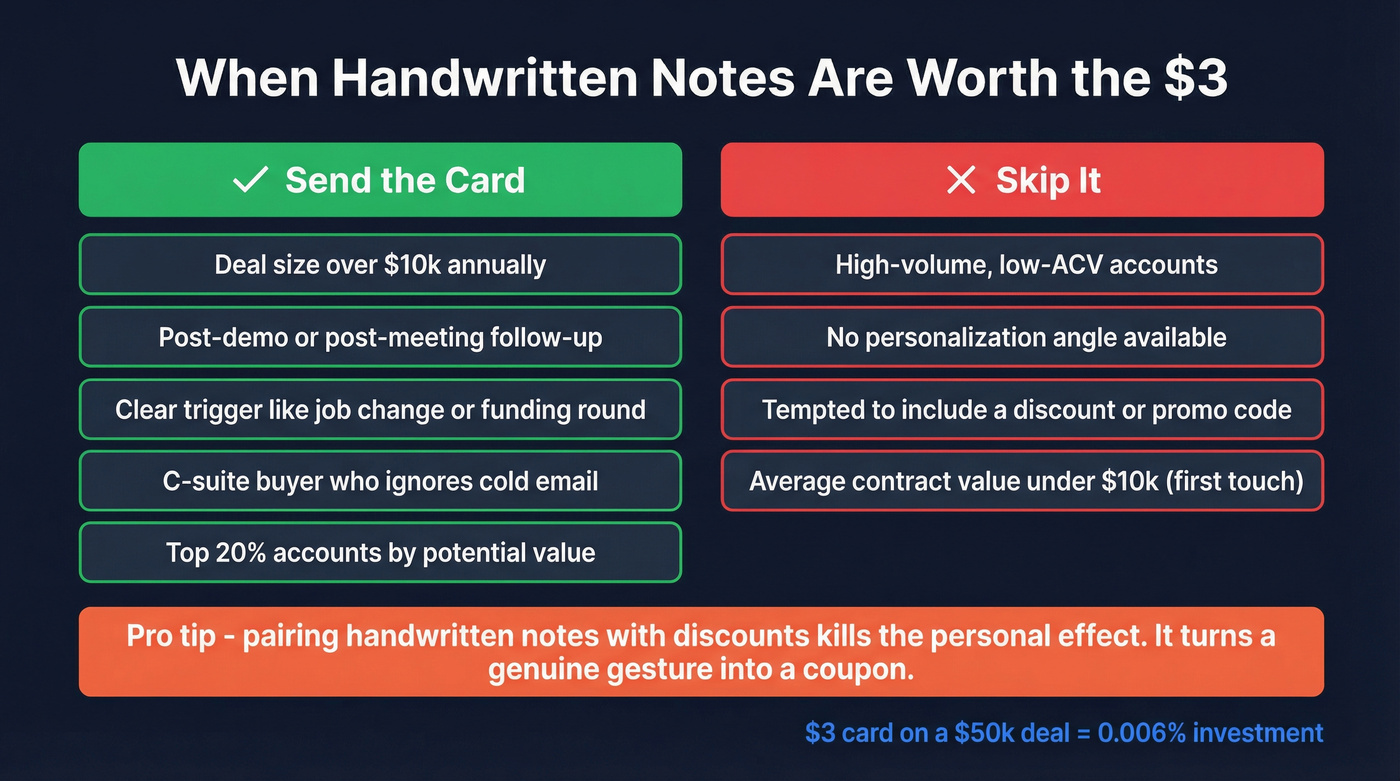
Skip them when you're prospecting high-volume, low-ACV accounts, when there's no personalization angle, or when you're tempted to include a discount or promo code. Research shows pairing handwritten notes with discounts kills the personal effect - it turns a genuine gesture into a coupon.
Let's be honest: if your average contract value is under $10k, you probably don't need handwritten first-touch cards at all. Save them for post-demo follow-ups and stalled deals where the unit economics actually work. A $3 card on a $5k deal is a 0.06% investment. On a $50k deal, it's a rounding error that could tip the decision.
How to Get Prospect Mailing Addresses
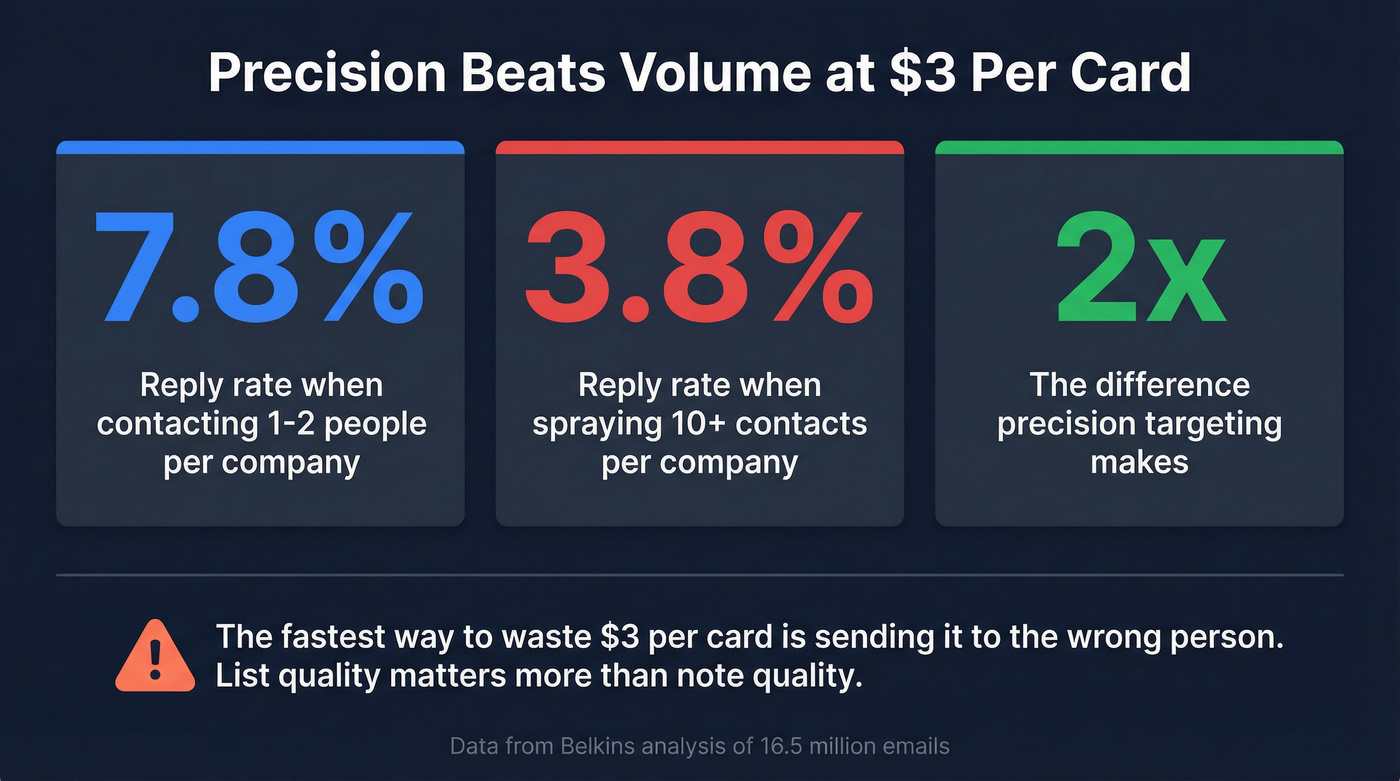
The fastest way to waste $3 per card is sending it to the wrong person. We've seen teams burn hundreds of dollars on cards to outdated addresses, which is why list quality matters more than note quality. Belkins' data shows that contacting 1-2 people per company produces a 7.8% reply rate versus 3.8% when you spray 10+ contacts. Precision matters even more at $3/card.
Here's how to build a list worth mailing to:
- Identify the right contacts. Use a B2B database with intent signals and job-change filters to narrow your list to people who actually match your ICP. Prospeo's B2B database covers 300M+ profiles with 30+ filters including buyer intent and headcount growth, and its 7-day data refresh cycle means you're not wasting cards on contacts who've moved on.
- Export with verified data. Pull verified contact information and cross-reference company addresses via your CRM records or business registries.
- Validate before sending. Confirm the mailing address is a current office location, not a co-working space the company left six months ago. A quick check on the company's website or Google Maps takes 30 seconds and saves $3.
The goal is to make sure every card reaches the right desk, not just the right building.

Handwritten notes pull 15-30% response rates - but only when sent to the right person. Prospeo's database of 300M+ profiles refreshes every 7 days, so you're never mailing a prospect who changed roles last month. At $0.01 per verified email, your digital follow-up costs less than the stamp.
Stop sending $3 cards to stale contacts. Get fresh data now.
Handwritten Note Services Compared
Once you're sending more than 15-20 notes per week, manual writing becomes a bottleneck. Most services use robots with real pens and real ink on real cardstock, so the output looks convincingly handwritten. Don't obsess over perfect handwriting or pristine stationery, either. Slightly imperfect notes feel more authentic, and that's the whole point.
IgnitePOST is the strongest pick for CRM-triggered automation. Their prepaid pricing runs $1.75-$4.39 per card, with subscription tiers at $109/mo (300 cards/year), $457/mo (1,500 cards/year), and $1,744/mo (6,000 cards/year). The Salesforce and Zapier integrations mean you can trigger a card automatically when a deal hits a specific stage - say, "demo completed" or "proposal sent." They aim to ship within 24-48 hours, with USPS First Class delivery usually taking about 3 days after that.
Handwrytten offers a wide style variety and strong API access, running roughly $2-5 per card depending on volume and card type. It's a solid choice for teams that want design flexibility without enterprise pricing.
| Service | Price/Card | CRM Integration | Best For |
|---|---|---|---|
| IgnitePOST | $1.75-$4.39 | API, Zapier, Salesforce | CRM-triggered automation at scale |
| Handwrytten | ~$2-$5 | API, Zapier | Volume + style variety |
| Handwrite | From $1.99 | API | Budget-friendly entry point |
| Simply Noted | ~$2-$4 | API, Zapier | International shipping options |
| Scribeless | Custom | Custom/enterprise | Enterprise ABM campaigns |
| DIY (manual) | ~$2.50-$4.50 | N/A | Small batches (<20/wk) |
For teams just testing the waters, skip the enterprise plans. Buy 50 cards from Handwrytten or Handwrite, send them to your hottest stalled deals, and measure response rates before committing to a monthly subscription.
Mistakes That Kill Response Rates
Marketing-speak. "We're excited to introduce our industry-leading solution" belongs in a press release, not a handwritten card. Write like a human.
No CTA or a vague one. "Let's connect sometime" gives the prospect nothing to act on. "Worth a 10-minute call Thursday?" does.
Pairing with a discount. It turns a personal gesture into a coupon. The warmth disappears instantly.
Writing a novel. Four to six sentences. That's it. If your note fills both sides of the card, you've lost them.
Zero personalization. A handwritten note with no personal detail is just expensive junk mail. In our experience, even one specific detail - a recent hire, a product launch, a conference session - is enough to separate your card from everything else on their desk.
Sending to a bad list. Wrong person, wrong title, bad address. This is the most expensive mistake because you don't find out for a week, and you've already spent the money.
If you're pairing cards with email, treat it like multi-channel prospecting: one message, one CTA, consistent timing.
FAQ
How many handwritten notes should I send per week?
Start with 10-15 per week to high-value prospects, focused on trigger-based sends like post-demo follow-ups and job changes. Quality targeting matters far more than quantity. Scale once you know which scenarios convert best for your deal size.
Do handwritten note services use real handwriting?
Most services use robotic pens with real ink on real cardstock - not printed fonts. IgnitePOST and Handwrytten both produce output that's nearly indistinguishable from human handwriting. IgnitePOST also uses real USPS First Class postage stamps for added authenticity.
What's the best way to find accurate prospect addresses?
Start by identifying the right contacts through a verified B2B database, filtering by job title, company size, and intent signals. Then cross-reference company addresses via CRM records or business registries. Sending to outdated addresses is the most expensive mistake in handwritten outreach.
Are handwritten prospecting letters worth it for small deals?
For deals under $10k annually, skip handwritten first-touch cards and reserve them for post-demo follow-ups or stalled opportunities. At $3 per card with a 15-20% response rate, the cost per reply is $15-$20 - which only makes sense when the contract value justifies the investment.