

The Spintax Tool Guide: Syntax, Strategy, and What Actually Moves the Needle
You spent 45 minutes crafting spintax variations for a cold email sequence. Three of the six versions read like a robot wrote them. Meanwhile, your SDR already sent 500 emails from the other campaign - 40 bounced, and your domain reputation just took a hit. The right spintax tool was supposed to protect deliverability, not create busywork that distracts you from the real problem.
Spintax still works in 2026, but the tools have changed. AI variation generators are replacing manual spinning for most teams, and the biggest deliverability lever was never your copy - it was your data.
What You Need (Quick Version)
- If you want AI to handle spinning: Instantly or GMass SpinMax. Both generate variations automatically so you never touch a curly brace.
- If you want a free generator to preview manual spintax: Salesforge or Folderly's free spintax generator. Paste, spin, preview, done.
- If your bounce rate is above 2%, fix your data first. Spinning syntax can't save you from bad addresses. A tool like Prospeo, with 98% email accuracy and a 7-day data refresh cycle, fixes the problem spintax never could. (If you need a shortlist, start with these email checker tools or email ID validators.)
What Is Spintax?
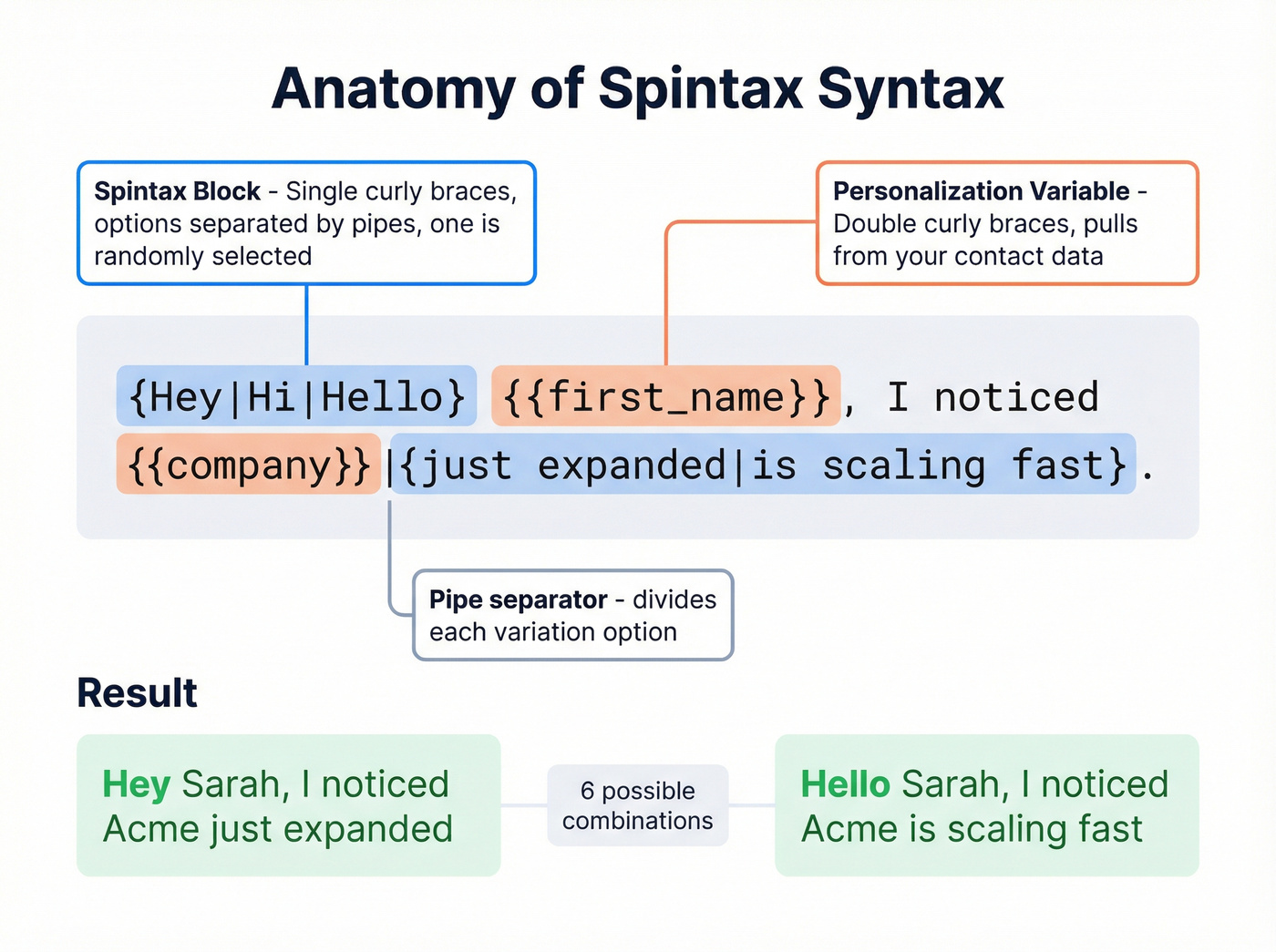
Spintax - short for "spinning syntax" - lets you define multiple text variations inside a single template. The sending tool randomly selects one option per block, so every recipient gets a slightly different email. Here's the basic format:
{Hey|Hi|Hello} {first_name}, I noticed your team {just raised a round|is scaling fast|recently expanded}.
That one line produces 9 possible combinations. Scale that across a full email with four or five spintax blocks and you're generating dozens to thousands of unique versions from a single template.
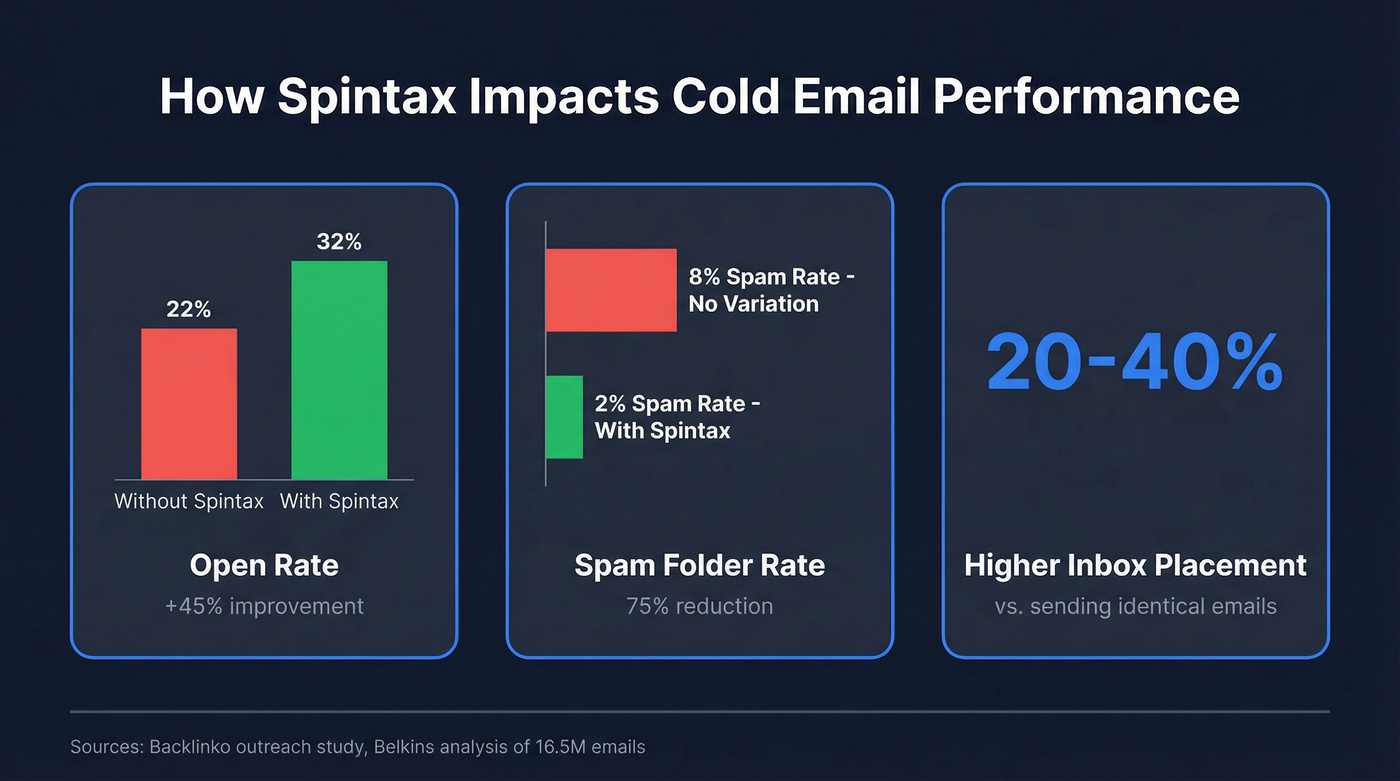
Does it actually move the needle? Campaigns using spintax achieve 20-40% higher inbox placement rates compared to sending identical emails. One benchmark showed open rates jumping from 22% to 32% and spam rates dropping from 8% to 2% when variations were properly implemented. For baseline context, a Backlinko outreach study found an average cold email response rate near 8.5%, and Belkins' analysis of 16.5M emails showed reply rates clustering in the mid-single digits.
Spintax won't turn a bad offer into a good one. But it helps keep a good offer out of the spam folder. (For the bigger picture, use this email deliverability checklist.)
Spintax Syntax Guide
Basic Syntax and a Full Email Example
Standard spintax uses curly braces {} with pipe separators |. Each block selects one option at send time. Convention tip: single braces {} are for spintax, while double braces {{}} are typically reserved for personalization variables like {{first_name}} or {{company}}.
Here's a complete cold email with section-level spintax:
{Hey|Hi|Hello} {{first_name}},

{I noticed {{company}} just expanded the sales team|Saw that {{company}} is hiring aggressively on the revenue side|Looks like {{company}} is scaling outbound}   -   {congrats on the growth|that's exciting|impressive trajectory}.

{We help teams like yours cut list-building time by 80%|Our platform gives sales teams verified contact data without the ZoomInfo price tag|Most teams at your stage are overpaying for B2B data   -   we fix that}.

{Worth a quick chat this week?|Open to a 15-minute call?|Would it make sense to connect Thursday or Friday?}

{Best|Cheers|Thanks},
{Your Name}
Two possible rendered versions:
Version A: "Hey Sarah, I noticed Acme just expanded the sales team - congrats on the growth. We help teams like yours cut list-building time by 80%. Worth a quick chat this week?"
Version B: "Hi Sarah, Saw that Acme is hiring aggressively on the revenue side - impressive trajectory. Our platform gives sales teams verified contact data without the ZoomInfo price tag. Open to a 15-minute call?"
Same message. Same intent. Two distinct emails that won't look like carbon copies. (If you want more proven structures, grab these outreach email templates.)
Nested Spintax for Grammar
Nesting lets you group dependent phrases to keep grammar correct. The classic example from Postmaker's guide solves the "a" vs. "an" problem:
Would you like {a {lion|tiger|zebra}|an {ostrich|emu|iguana}}?
The outer block picks between the "a" group and the "an" group, so you'll never get "a ostrich" or "an tiger." That said, nesting adds complexity fast - if you're spending more time debugging nested syntax than writing emails, you've crossed the line. Reserve nesting for grammar-sensitive spots like article usage and verb conjugation. For everything else, flat spintax with section-level variation is simpler and just as effective.
Syntax Differences by Platform
Not all tools parse spintax the same way. This trips people up when switching platforms - your carefully crafted variations can break silently.
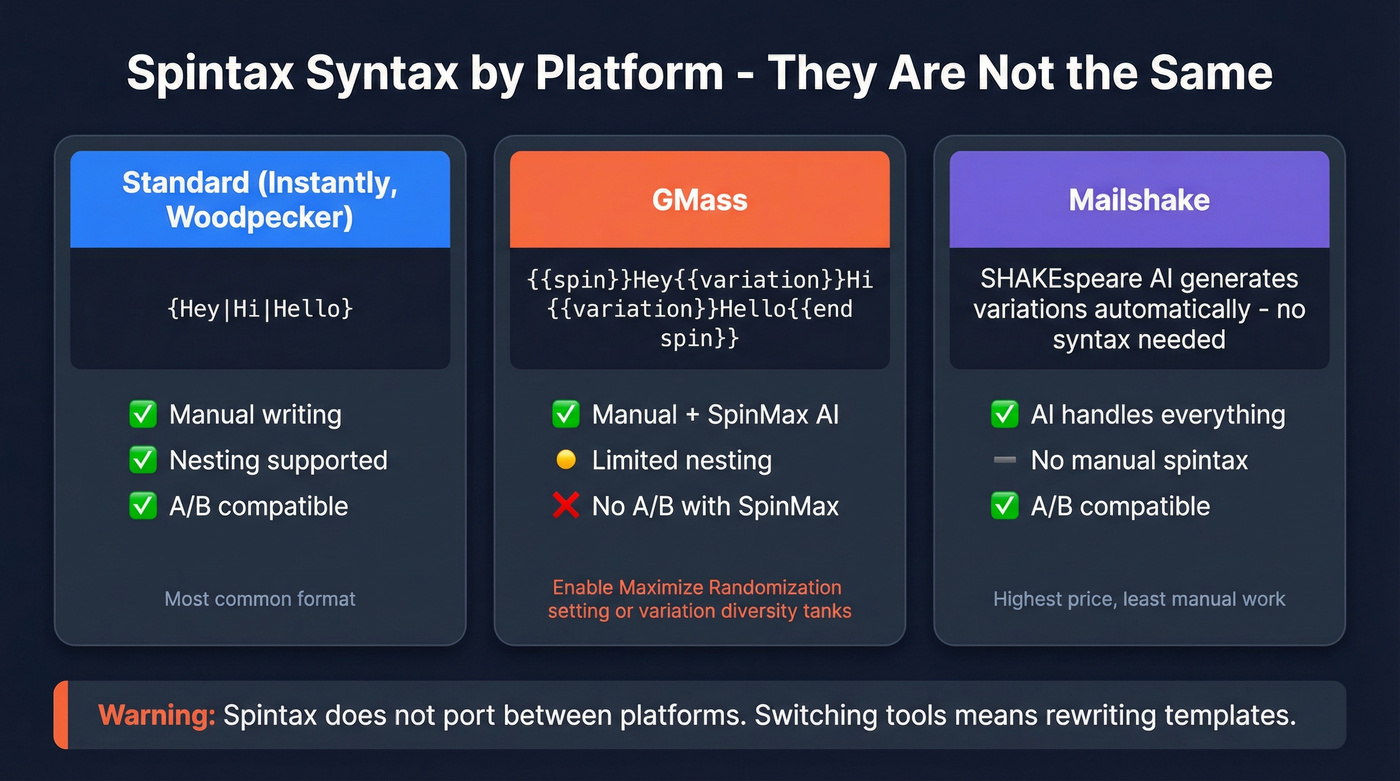
| Feature | Standard (Instantly, Woodpecker) | GMass | Mailshake |
|---|---|---|---|
| Syntax | {a\|b\|c} |
{{spin}}...{{end spin}} |
SHAKEspeare AI variations |
| Manual writing | Yes | Yes (or SpinMax) | Yes |
| Nesting | Yes | Limited | N/A |
| A/B compatible | Yes | Not with SpinMax | Yes |
GMass uses a completely different tag-based format - {{spin}}Hello{{variation}}Hi{{variation}}Hey{{end spin}} instead of the standard curly-brace approach. They also have an account-level "Maximize spintax randomization" setting that changes how GMass mixes options across multiple blocks. Without it enabled, GMass pairs first options together across blocks, then second options, and so on - which tanks variation diversity.
Here's the thing: spintax doesn't port between platforms. If you're migrating from Woodpecker to GMass, plan to rewrite your templates. It's annoying, but it's a 30-minute job, not a week-long project. (If you're evaluating platforms, start with these cold email marketing tools.)

Spintax protects deliverability - but only if the emails you're sending to actually exist. With a 98% email accuracy rate and a 7-day data refresh cycle, Prospeo eliminates the bounces that tank your domain before spintax even gets a chance to help.
Stop spinning copy for addresses that bounce. Start with clean data.
Personalization Strategy That Works
Most teams get spintax wrong in the same way: they spin individual words instead of entire sections. Swapping "Hi" for "Hey" doesn't fool anyone. Email providers detect low-effort variation, so you need meaningful differences at the sentence and paragraph level. (This is also where personalization in outbound sales actually matters.)
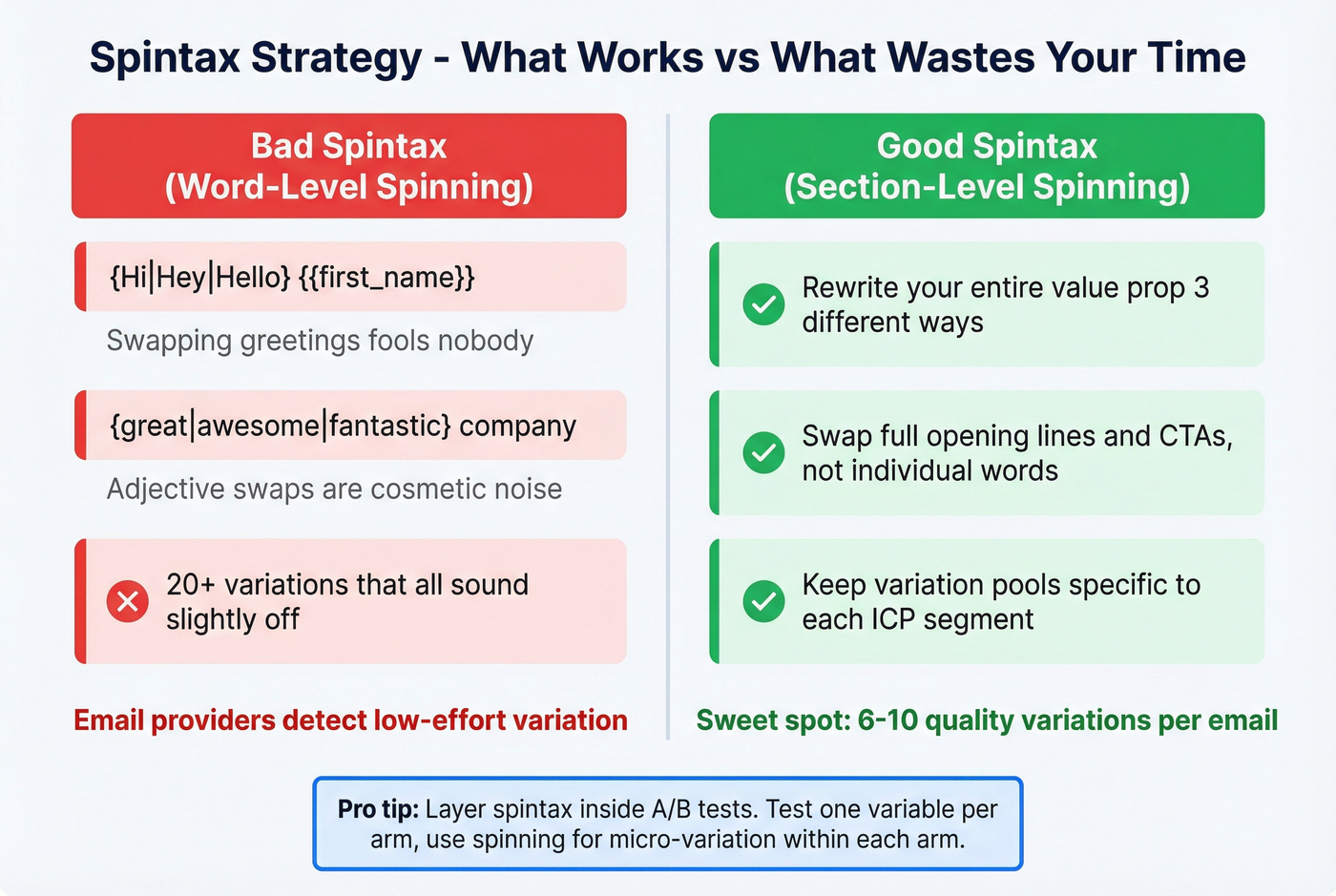
Spin sections, not words. Rewrite your value prop three different ways. Swap entire opening lines. Vary your CTA phrasing. This creates genuinely distinct emails rather than cosmetic differences.
Build ICP-specific variation pools. Your email to a VP of Sales at a Series B company shouldn't share spintax blocks with your email to a CTO at an enterprise. Keep variation pools contextually relevant to each segment. (If you need a segmentation framework, use behavioral segmentation.)
Layer spintax inside A/B tests carefully. Test one variable per arm - subject line, CTA, or opening hook - and use spinning for micro-variation within each arm. You're testing a real hypothesis while still getting the deliverability benefits of unique content. (For the math and setup, see how to A/B test reply rates.)
We've seen teams spend hours crafting 20+ variations that all sound slightly off. Aim for 6-10 variations per email. That's the sweet spot where you get enough uniqueness without sacrificing quality. If you can't write six good versions of a sentence, the sentence itself probably needs work.
Best Spintax Tools Compared
| Tool | Type | Spintax Approach | Starting Price |
|---|---|---|---|
| Instantly | Sending platform | Built-in + AI writer variations | ~$30/mo |
| GMass | Gmail add-on | Manual + SpinMax AI | ~$25/mo |
| Woodpecker | Sending platform | Built-in manual | ~$29/mo |
| Mailshake | Sending platform | SHAKEspeare AI variations | ~$45/mo |
| Salesforge | Free generator | Web-based | Free (platform ~$40/mo) |
| Folderly | Free generator | Web-based | Free (monitoring ~$120/mo) |
| Postly | Free generator | Web-based + validator/formatter | Free (scheduling ~$15/mo) |
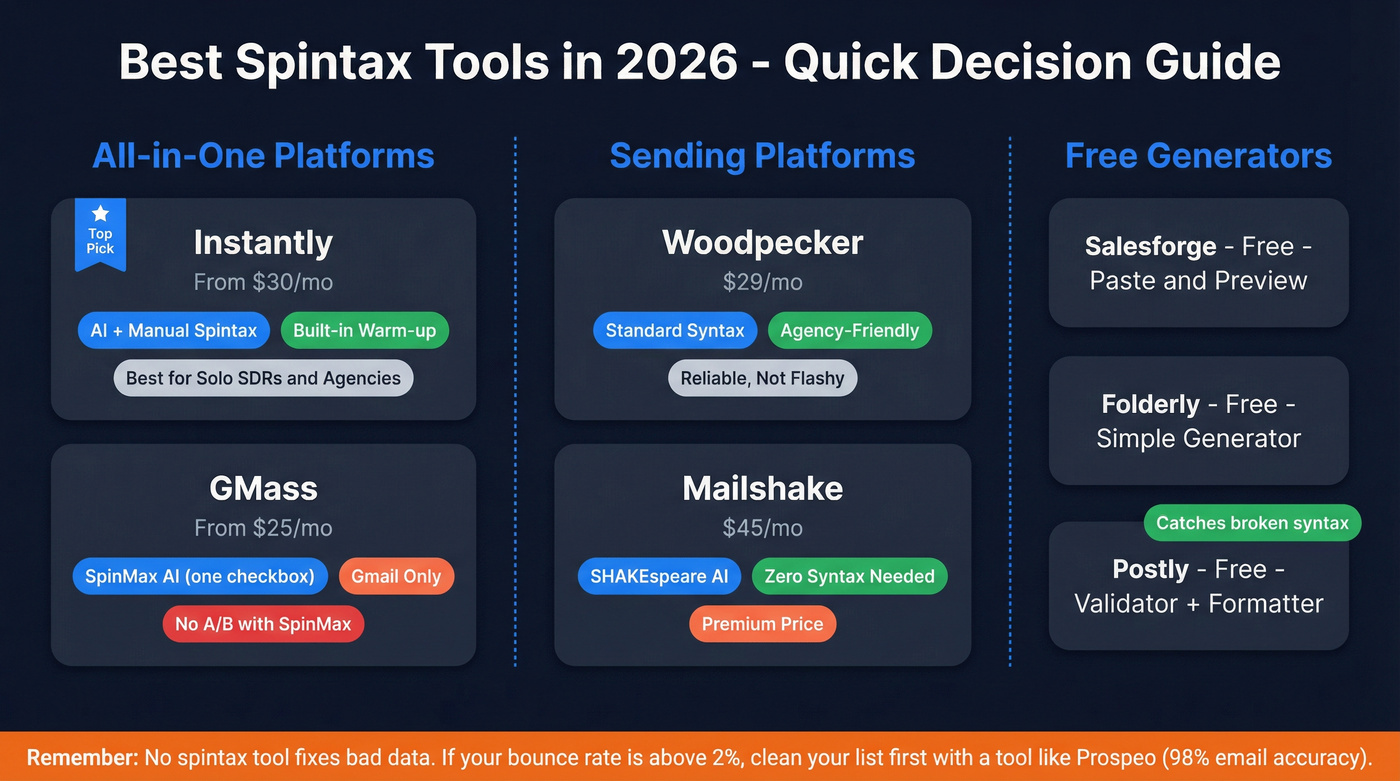
Instantly - Best All-in-One
Instantly is the obvious pick if you want spintax, warm-up, and sending in one platform. Its email writer includes a free automation feature that generates variations, so you don't need to manually write spinning syntax unless you want to. The built-in guidance pushes you toward section-level spinning, which is the right approach.
Starting at ~$30/mo, it's affordable enough for solo SDRs and scales well for agencies running multiple client accounts. The warm-up network is a genuine differentiator - most standalone generators don't touch deliverability infrastructure. If you're only going to use one tool for cold email, Instantly is the default recommendation.

GMass - Best for Gmail Power Users
Use this if you live in Gmail and refuse to leave. GMass's SpinMax feature is a single checkbox that automatically generates wording variations on every email - no manual notation required. It works on subject lines, body copy, and auto follow-ups.
Skip this if you need A/B testing alongside variation. SpinMax and A/B testing can't run simultaneously, which is a real limitation for teams optimizing sequences. There's also a 5-10 second per-email delay while SpinMax generates each variation, which adds up on large sends. Pricing runs ~$25-55/mo per user depending on the tier.
Woodpecker and Mailshake
Woodpecker (~$29/mo) handles standard curly-brace spintax well and is solid for agencies managing multiple client inboxes. Nothing flashy, but reliable.
Mailshake (~$45-85/mo) takes the opposite approach with SHAKEspeare, their AI that generates variations so you never write spintax manually. Higher price, less manual work. For teams that don't want to think about syntax at all, it's a clean solution - though you're paying a premium for that convenience.
Free Generators
Salesforge and Folderly are straightforward generators. Paste your template, get rendered variations, copy them out.
Postly goes further with a generator plus validator/formatter features that catch issues like unbalanced braces, illegal nesting, and empty choices like {Book now||Schedule}. If you're writing spintax manually, run it through Postly before pasting it into your sending platform. It'll save you from the silent failures that break campaigns without any error message.
AI vs. Manual Spinning
Manual spintax is a dying practice. I don't say that lightly - we've used it for years - but the evidence is clear. AI variation generators like GMass SpinMax produce unique emails with a single checkbox, no syntax knowledge required. They handle subject lines, body copy, and follow-ups simultaneously.
The concrete tradeoff is speed. SpinMax adds 5-10 seconds per email while it generates each variation. On a 1,000-email campaign, that's an extra 80-160 minutes of send time. For most teams, that's fine. For high-volume agencies sending tens of thousands daily, it matters.
The bigger issue is testing. You can't combine SpinMax with A/B testing in GMass, which means you're choosing between AI variation and structured experimentation. A practical approach: use AI for the heavy lifting, then layer in light manual spintax for micro-variation inside templates you've already tested.
Let's be honest - if your average deal size is under five figures, you probably don't need to write spintax at all. Let AI handle variation and spend your time on offer testing and list quality. Those levers move results 5x more than any spinning block ever will. (If you want a tighter system, use these cold email tactics.)
The Step Most People Skip
Spintax gets you past the content filter. Clean data gets you past the bounce filter. And the bounce filter is the one that actually kills your domain.
Industry best practice is keeping bounces under 2%. Stack Optimize, an outbound agency using Prospeo's verified data, maintains 94%+ deliverability and under 3% bounce rates across all their clients - and they credit data quality as the foundation, not copy tricks. Even the best email spinning software can't compensate for a list full of dead addresses. (If you’re troubleshooting, start with hard bounces and invalid emails.)
Prospeo's 5-step verification process catches the problems no spintax tool can touch: invalid addresses, catch-all domains, spam traps, and honeypots. With 98% email accuracy and data refreshed every 7 days - compared to the 6-week industry average - your sequences reach real inboxes instead of bouncing off stale addresses. The free tier gives you 75 verified emails per month plus 100 Chrome extension credits to test, and paid plans work out to roughly $0.01 per email. Before you spend another hour on variations, verify your list. (Here’s a deeper dive on B2B contact data decay.)
You just built 9 spintax variations per line. Now imagine 40 of those 500 emails bouncing because your data provider refreshes every 6 weeks. Prospeo refreshes every 7 days, verifies emails in 5 steps, and costs roughly $0.01 per lead.
Your spintax is only as good as the list underneath it.
FAQ
Is spintax mandatory for cold email?
Not mandatory, but strongly recommended once you're sending 100+ emails per day. At that volume, providers start flagging repetitive content. AI-generated variations work as an alternative to manual syntax. The bigger deliverability levers are list hygiene, proper warm-up, and sending infrastructure - fix those first.
Does spintax work in Gmail or Outlook?
Not natively. Standard email clients don't parse the syntax and will send raw curly braces to your prospect. You need a tool like GMass for Gmail or a dedicated sending platform like Instantly or Woodpecker to process variations before delivery.
How many variations do I need?
Six to ten variations per email is the practical sweet spot. Section-level rewrites - entire sentences or paragraphs - matter far more than word-level swaps like "Hi" vs. "Hey." If you can't write six genuinely distinct versions of a section, simplify the section first.
What's the best free spintax tool?
Postly is the strongest free option for manual writers - its validator catches unbalanced braces and empty choices before they break your campaign. Salesforge and Folderly are faster if you just need to generate and preview variations. All three are free to use.
Can I use spintax and A/B testing together?
Yes, on most platforms - but not with GMass SpinMax, where the two features conflict. Test one variable per A/B arm and use spinning for micro-variation within each arm. Make sure your list is clean before running tests so bounce noise doesn't corrupt your results - a 5% bounce rate can make a winning variant look like a loser.