

10 Phone Sales Skills That Separate Top Reps from Everyone Else
You made 50 dials today. Forty went to voicemail. Six were wrong numbers. Three people picked up and immediately said "not interested." And the one real conversation you had? You fumbled the opener and lost them in 12 seconds.
That's not a motivation problem - it's a preparation problem. 82% of decision-makers say salespeople are unprepared for calls. The phone sales skills that fix this aren't mysterious. They're specific, learnable, and backed by data. If you've been wondering how to get better at selling over the phone, the answer starts with preparation and ends with deliberate practice.
What You Need (Quick Version)
Three things separate reps who book meetings from reps who don't:
- Verified data. Your skills don't matter if you're calling dead lines. Verified mobile numbers can lift a ~5% connect-rate baseline into the 15%+ range. (If you want to go deeper on list quality, see data enrichment.)
- A structured opener. The email-anchor technique (covered below) avoids the awkward "Is now a good time?" and gets prospects asking you what the call's about.
- A named objection framework. When someone says "I'm not interested," you need a practiced 4-step response - not a freeze followed by "okay, sorry to bother you." (More on frameworks in sales communication.)
Phone Sales by the Numbers
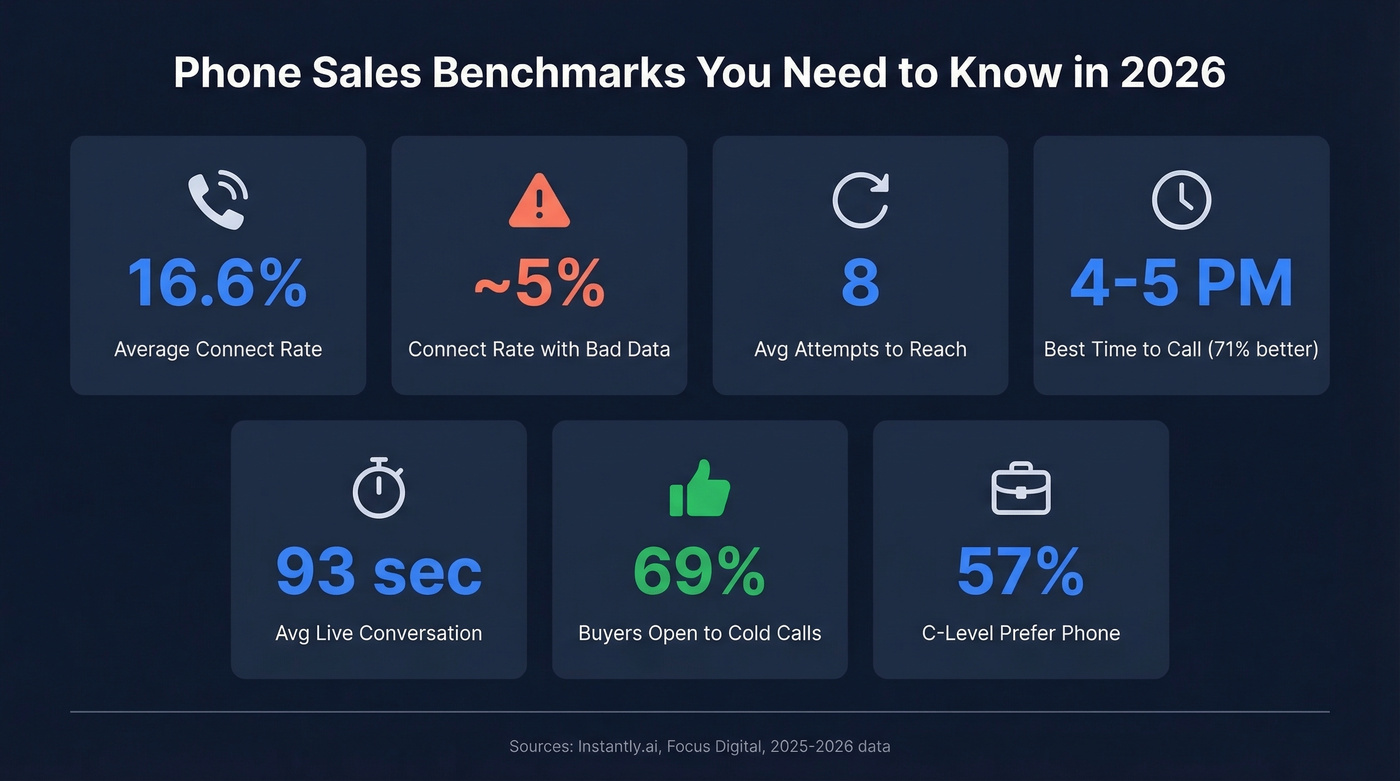
Here's what the data says about cold calling in 2026:
| Metric | Benchmark |
|---|---|
| Connect rate (avg) | 16.6% |
| Connect rate (bad data) | ~5% |
| Attempts to reach | 8 avg |
| Best time to call | 4-5 PM (71% better) |
| Avg live conversation | 93 seconds |
| Buyers open to cold calls | 69% |
| C-level prefer phone | 57% |
Conversion rates vary wildly by industry. Sales call conversion (SQL to closed) in Technology/SaaS sits around 9.39%, while janitorial services hit 27.15%. Referrals convert at 25.56% versus cold calling's 9.38%. That gap isn't because cold calling doesn't work - it's because most reps execute it poorly.
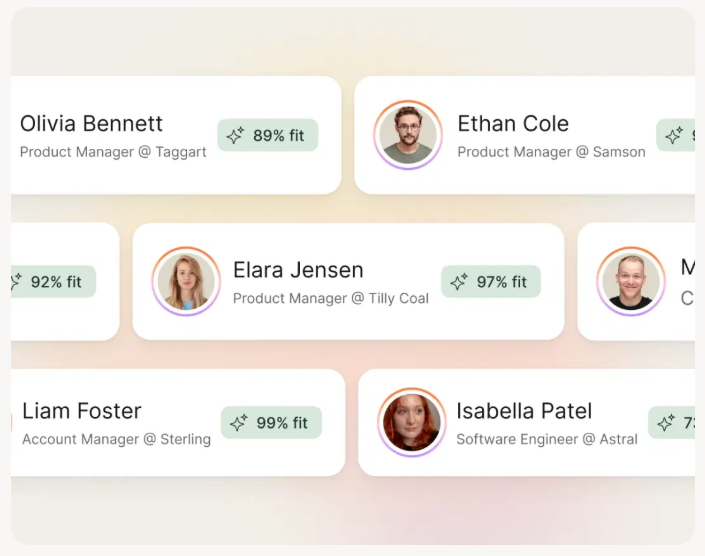
The funnel math is simple. Two hundred dials at a 5% connect rate gives you 10 live conversations. At a 16.6% connect rate with better data and targeting, those same 200 dials yield 33 conversations. Data quality is the biggest lever you can pull before you even open your mouth. (If you're building a repeatable process, use a cold calling system.)

The article above shows it clearly: connect rate is the biggest lever in your cold calling funnel. Prospeo gives you 125M+ verified mobile numbers with a 30% pickup rate - turning 200 dials from 10 live conversations into 33. At $0.10 per verified mobile, bad data stops being your bottleneck.
Triple your connect rate before you even pick up the phone.
The 10 Skills That Move the Needle
1. Pre-Call Research and Data Quality
Your technique doesn't matter if you're calling dead lines. Teams running unverified lists often live around ~5% connect rates. When your list quality and targeting are dialed in, 15%+ is realistic.
We've seen teams triple their connect rate by switching to verified data and tightening their targeting. Meritt pushed connect rates into the 20-25% range after upgrading data quality - that's the difference between booking one meeting a day and booking three. Beyond phone numbers, check your CRM's web activity data before you dial. Someone who hit your pricing page yesterday is a fundamentally different conversation than someone who read a blog post three weeks ago. (If you're tightening targeting, start with a clear ideal customer profile.)
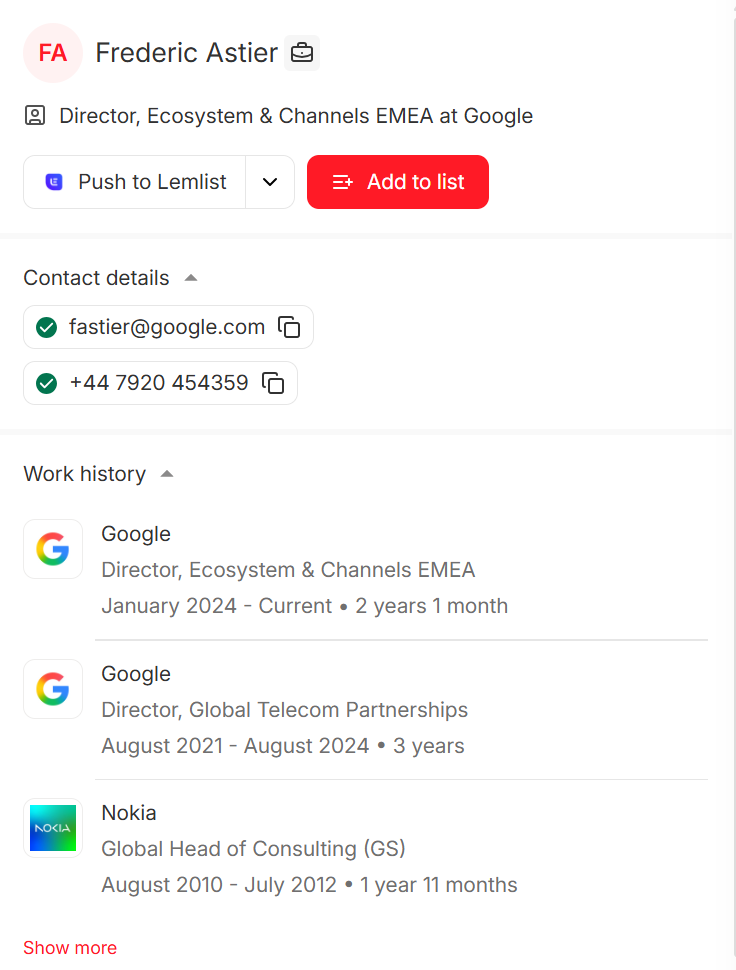
Use this if you're making 100+ dials a day and your connect rate is below 10%. Data quality is the first thing to fix.
Skip this if you're already connecting on 20%+ of dials - your time is better spent on the skills below.
2. The Opening - Kill Permission-Based Openers
"Is now a good time?" is dead. Every rep asks it, every prospect says no, and you've handed them the exit before you've said anything of value.
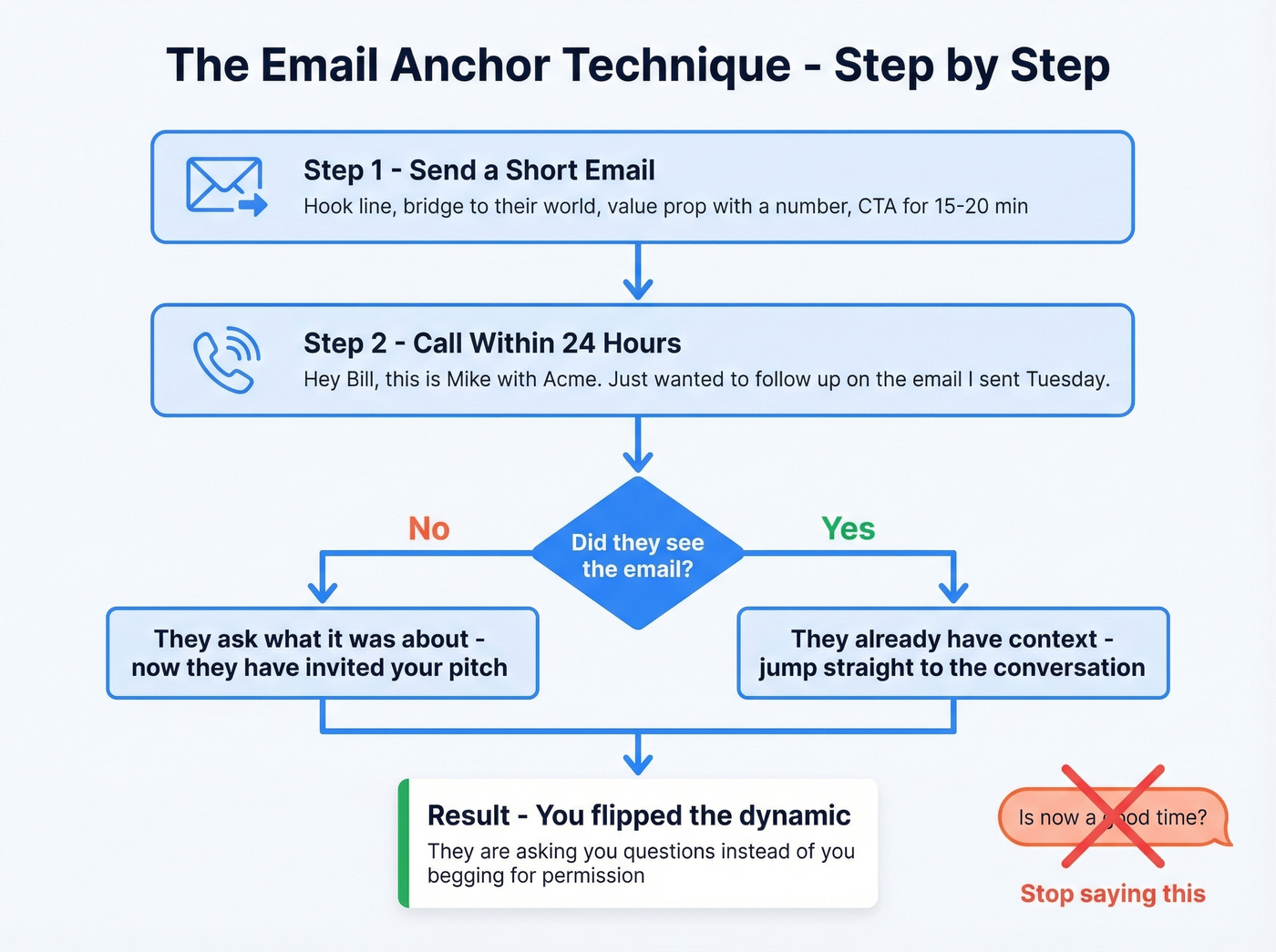
The email-anchor technique works better. Here's the exact script, popularized on r/sales:
You: "Hey Bill, this is Mike with Acme. Just wanted to quickly follow up on the email I sent you Tuesday."
If they didn't see the email, they'll ask what it was about. Now they've invited your pitch instead of you begging for permission to deliver it. You've flipped the dynamic entirely.
For this to work, you actually need to send the email first. Keep it tight - a hook line, a bridge to their world, a value prop with a specific number, and a CTA asking for 15-20 minutes. The call follows within 24 hours. The email doesn't need to be brilliant; it just needs to exist so your opener isn't a lie. (If you need ideas, borrow from these email subject lines.)
3. Tone, Pace, and Vocal Presence
Confidence on the phone sounds like something specific: a slightly slower pace than your natural speaking speed, downward inflection on statements instead of upward like you're asking a question, and strategic pauses after key points.
Most reps rush because they're nervous. Rushing signals uncertainty, and prospects mirror that energy.
The average live conversation on a cold call lasts 93 seconds. You have under two minutes to earn more time. Stand up while you dial - it changes your breathing and energy. Record yourself and listen back. Most reps are horrified the first time, then improve fast. Vocal presence is one of the easiest cold calling skills to improve with simple recording and review.
4. Active Listening With Actual Numbers
Poor performers talk 68% of the time on calls. Top performers stay in the 54-58% range - enough to guide the conversation without steamrolling it. Calls that stretch past 30 minutes show 580% higher success rates than calls under five minutes. Your job on a cold call isn't to close. It's to earn enough time to have a real conversation. (To improve discovery, use a set of proven discovery questions.)
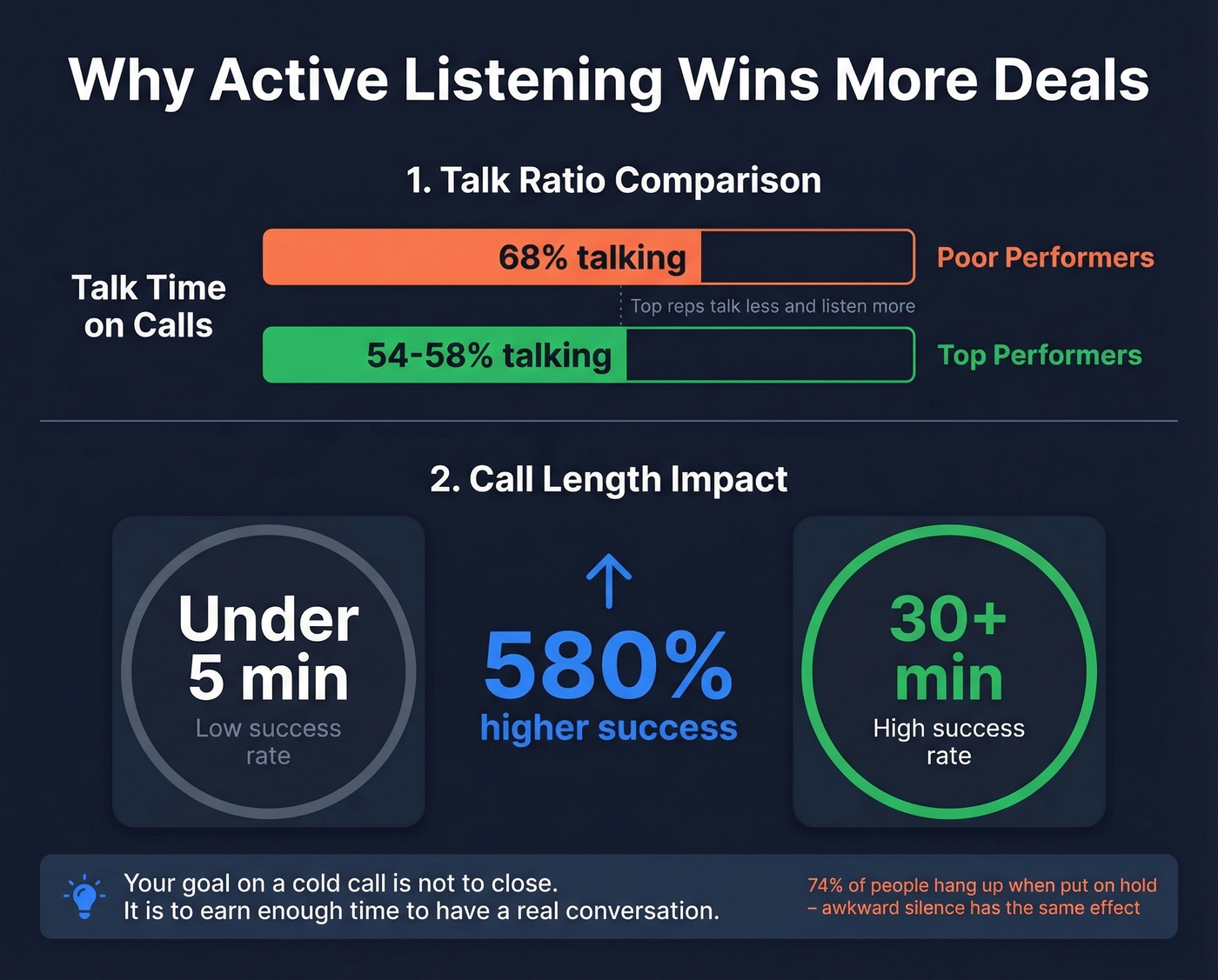
Here's the thing: active listening isn't just "being quiet." It's confirming what you heard, asking follow-up questions that prove you understood, and resisting the urge to jump to your pitch the moment you hear a keyword. The difference between an intentional two-to-three-second pause and dead air where you've frozen for five-plus seconds is whether the prospect feels heard or abandoned. 74% of people hang up when placed on hold, and awkward silence has a similar effect.
5. Asking Questions That Open Doors
Open-ended questions keep conversations moving. Closed questions shut them down. This sounds obvious until you listen to your own call recordings and realize half your questions start with "Do you currently..."
A simple discovery framework: start broad ("What's your team's biggest challenge with outbound right now?"), narrow to pain ("How is that affecting pipeline this quarter?"), then quantify impact ("What does that cost you in missed revenue?"). 62% of buyers expect reps to answer complex questions in the moment - but you can't answer well if you haven't asked well first. (If you're building a repeatable approach, see these sales prospecting techniques.)
6. Objection Handling - The 4-Step Framework
Objections are buying signals, not rejections. A prospect who says "we already have a vendor" is telling you they have budget, they've identified the problem, and they've bought a solution before.
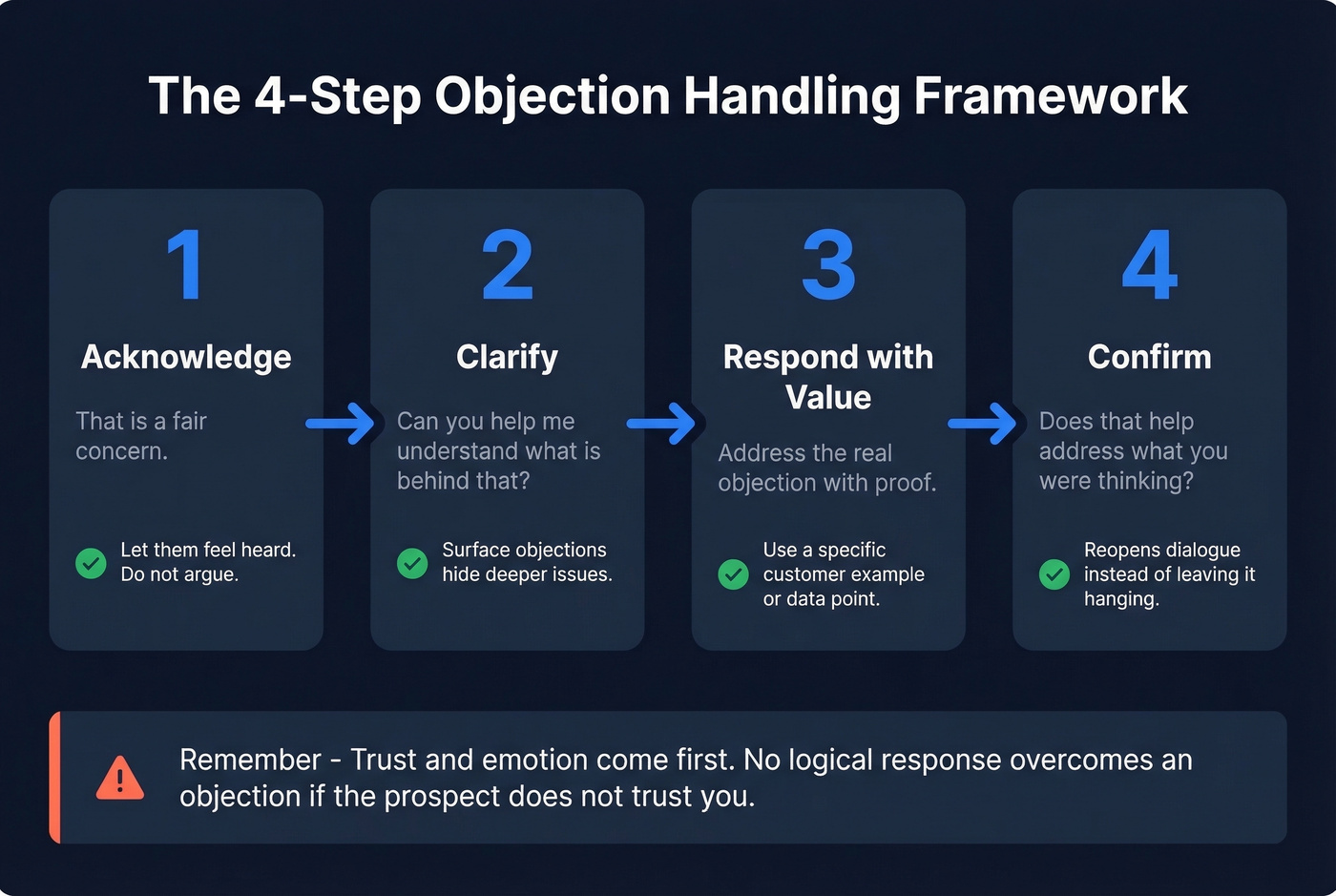
The framework:
- Acknowledge. "That's a fair concern." Don't argue. Let them feel heard.
- Clarify. "Can you help me understand what's behind that?" Most surface objections hide a deeper issue - a price objection might really be a timing issue.
- Respond with value. Address the real objection with a specific proof point or customer example.
- Confirm. "Does that help address what you were thinking?" This reopens dialogue instead of leaving the objection hanging.
The Objection Handling Pyramid from Klue adds an important layer: trust and emotion come first. If the prospect doesn't trust you, no logical response will overcome their objection. (If this is a recurring issue, work through cold call rejection.)
7. Gatekeeper Navigation
Gatekeepers aren't obstacles - they're people doing their job. The adversarial approach fails because it treats them like a barrier instead of an ally. Learn their name. Ask for help:
You: "Hi Sarah, I'm hoping you can help me out. I'm trying to reach [prospect name] about [specific topic]. What's the best way to make that happen?"
One tactical tip: call outside standard business hours. Executives often pick up their own phones before 8:30 AM and after 5:30 PM when the gatekeeper has gone home.
8. Voicemail That Gets Callbacks
Seven out of 10 calls go to voicemail. If you don't have a voicemail strategy, you're wasting 70% of your dials.
Keep it under 30 seconds. State your name, company, a clear reason for calling, and your callback number - then repeat the callback number. Pair every voicemail with an immediate email follow-up. The voicemail creates awareness; the email gives them something to respond to on their own time. (For follow-up copy, use these sales follow-up templates.)
9. Closing and Securing Next Steps
Never end a call with "I'll send you some info." That's not a next step - it's a polite way for the prospect to disappear.
Use the "choose your own adventure" close: give two specific options. "Would Thursday at 2 PM or Friday morning work better for a 20-minute deep dive?" This creates a micro-yes - they're choosing when, not whether. Always send the calendar invite before you hang up. A strong close means never leaving a conversation without a concrete commitment on the calendar. (If you want a full framework, see the steps to close a sale.)
10. Follow-Up Persistence
Most reps quit after 2-3 attempts. It takes 8-12 attempts to reach a decision-maker.
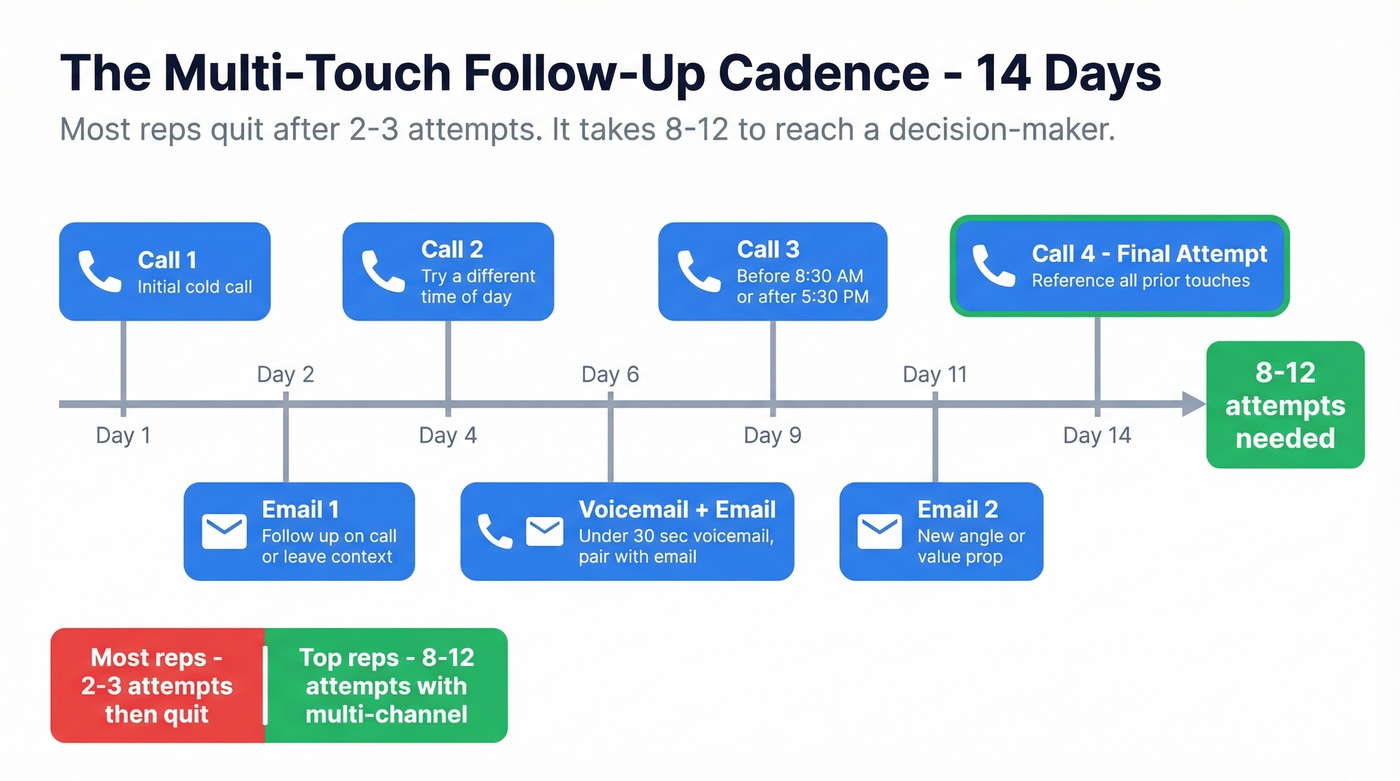
That gap is where meetings die.
Build a multi-touch cadence: call, email, call, voicemail plus email, call. Spread it across 10-14 days. Persistence plus good data is the combination that actually fills pipeline. In our experience, 100 calls with verified numbers outperform 300 calls with garbage data every single time.
Scripts You Can Steal
Cold Call Opener (Email Anchor):
You: "Hey [Name], this is [Your Name] with [Company]. Just wanted to quickly follow up on the email I sent you [Tuesday/yesterday]."
[If they ask what it was about]: "We help [their role/industry] [specific outcome - e.g., 'cut prospect research time by 60%']. I was curious whether [specific pain point] is something your team's dealing with right now."
Gatekeeper Transfer:
You: "Hi [Gatekeeper Name], I'm hoping you can help me. I'm trying to connect with [Prospect Name] regarding [specific topic]. What's the best way to make that happen?"
Time Objection Response:
Prospect: "I don't have time right now."
You: "Totally understand - I'll be brief. In three minutes, I can share how [Company] helped [similar company] [specific result]. If it's not relevant, I'll let you go. Fair enough?"
[If still no]: "No problem. When's better - Thursday afternoon or Friday morning?"
Your Phone Sales Tech Stack in 2026
Skills matter, but so does tooling. Here's what a modern stack looks like for reps serious about selling over the phone.
Verified contact data: Prospeo covers 125M+ verified mobiles with a 30% pickup rate, refreshed every seven days. The free tier gives you 75 emails plus 100 Chrome extension credits per month, and paid plans run about $0.01 per email. (If you're comparing options, start with B2B company data providers.)
Power dialer: Orum (~$100-200/user/mo) is the go-to for teams doing serious volume - parallel dialing, AI-powered voicemail detection, and CRM logging. PhoneBurner (~$124-179/user/mo) is a solid alternative with simpler setup and strong reporting.
Conversation intelligence: Gong (~$100-150/user/mo) transcribes calls, analyzes talk-time ratios, flags objection patterns, and surfaces coaching moments automatically. For teams managing reps, this is how you scale coaching without listening to every call.
AI coaching: Second Nature (~$20-50/user/mo) runs AI-powered roleplay simulations so reps can practice objection handling without burning real prospects. Teams report 37% faster onboarding, 24% higher win rates, and 83% reduction in manual coaching time.
Let's be honest about one thing: if your deal sizes are consistently under five figures, you don't need a $150/seat conversation intelligence platform. Invest in verified data and a decent dialer first. Gong is incredible, but it's a luxury for teams that already have their fundamentals locked in.
Meritt tripled pipeline from $100K to $300K/week and pushed connect rates to 20-25% after switching to Prospeo's verified data. Every phone sales skill on this list compounds when you're actually reaching real buyers on real numbers - refreshed every 7 days, not 6 weeks.
Stop perfecting your opener on voicemails and wrong numbers.
FAQ
What are the most important phone sales skills in 2026?
Data quality, a structured opener, and a practiced objection framework matter most. Those three account for the majority of the gap between reps who book meetings and reps who don't. Vocal presence and active listening amplify them, but without the foundation, technique alone won't save you.
What's the best time to call prospects?
Late afternoon - specifically 4-5 PM - performs 71% better than the late-morning slot most reps default to. Decision-makers clear meetings by mid-afternoon and catch up on calls as the day winds down. Early morning (before 8:30 AM) also works well for bypassing gatekeepers.
How do I handle "I'm not interested" on a cold call?
Use the 4-step framework: acknowledge, clarify, respond with value, confirm. Most "not interested" really means "you haven't earned my attention yet." The clarify step - "Can you help me understand what's behind that?" - is where you uncover the real objection and find an opening.
How do I improve my connect rate?
Start with data quality. Verified mobile numbers can lift connect rates from ~5% into the 15%+ range. Then optimize timing to 4-5 PM, increase your cadence to 8-12 touches per prospect, and pair calls with emails so your name isn't completely cold when they pick up.
Is cold calling still effective in 2026?
69% of B2B buyers are open to cold calls, 57% of C-level buyers prefer phone over email, and 82% have accepted meetings from strategic cold outreach. The channel works. The consensus on r/sales is blunt: cold calling isn't dead, you're just bad at it.