

Sales Call Metrics: The 2026 Benchmarks Nobody Else Will Give You
Your team made 2,000 calls last month. Connect rate: 4%. Meetings booked: 3. The VP of Sales wants to know what went wrong, and someone suggests "more dials."
That's the wrong answer. Cold call success rates dropped from 4.82% to 2.3% between 2024 and 2025, and 47% of sales leaders now say CRM activity counts are the most dangerous metric to obsess over. Reps already spend just [28% of their time](https://www.askdonna.com/blog/only-28-of-sales-time-is-spent-selling - heres-how-to-fix-that) actually selling - the rest disappears into admin, logging, and chasing bad numbers. More activity isn't the fix. Better sales call metrics are.
The Only Metrics That Predict Pipeline
Stop tracking calls per day. The performance indicators that actually move pipeline are connect rate, talk-to-listen ratio, and call-to-meeting conversion.
- Connect rate - the single best indicator of data quality and timing
- Talk-to-listen ratio - tells you whether reps are discovering or pitching
- Call-to-meeting conversion - the only output metric that matters
- Call duration - short calls mean bad openers; long calls mean real conversations
- Questions per discovery call - the most undertracked metric in sales
One thing to stop tracking: raw dial volume. It's the most overrated number on your dashboard.
2026 Benchmarks Worth Bookmarking
Print this table. Tape it to your monitor. The "red flag" column is where most teams actually live.
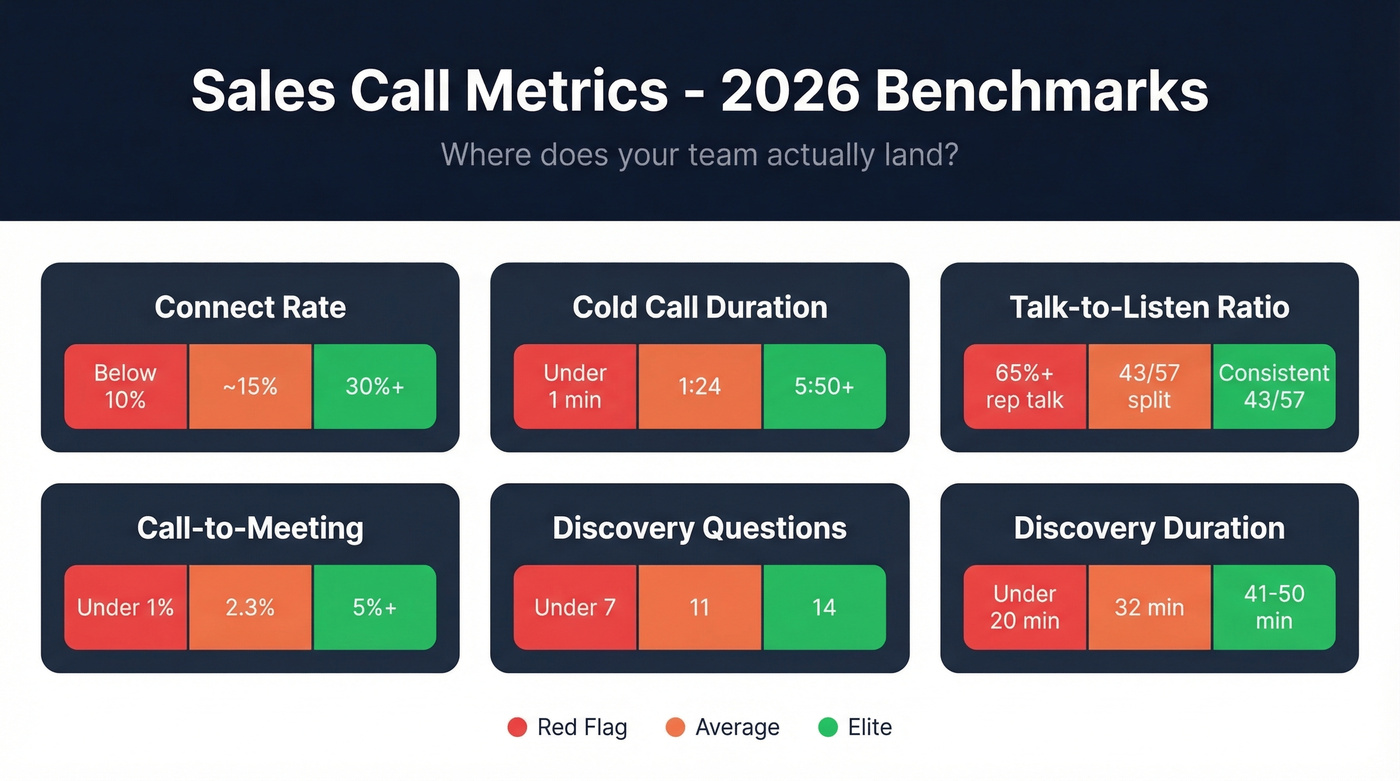
| Metric | Red Flag | Average | Elite |
|---|---|---|---|
| Connect rate | Below 10% | ~15% | 30%+ |
| Cold call duration | Under 1 min | 1:24 | 5:50+ |
| Talk-to-listen | 65%+ rep talk | ~43/57 | Consistent 43/57 |
| Call-to-meeting | Under 1% | 2.3% | 5%+ |
| Questions (discovery) | Under 7 | 11 | 14 |
| Discovery duration | Under 20 min | 32 min | 41-50 min |
If your connect rate is below 10%, that's not a rep problem - it's a data problem. And if discovery calls are under 20 minutes, they're 42% less likely to advance.
The Metrics That Move Pipeline
Connect Rate
Answer rates vary wildly by lead temperature: 5.5% for cold calls, 15-20% for warm leads, and 30-50% for inbound leads called [within five minutes](https://www.insidesales.com/response-time-matters/). A healthy cold call connect rate sits between 10-20%. Below 10% means your phone numbers are stale or wrong. Above 30% means you've cracked something - usually local presence dialing combined with verified mobile numbers. The average rep needs 18+ dials to reach a single prospect.
Here's the thing: if your connect rate is stuck below 10%, check your data before you blame your reps. We've seen teams triple their connect rate just by switching to a provider with fresher mobile numbers - Meritt went from single digits to 20-25% after cleaning up their data source.
One stat that deserves more attention: leaving a voicemail on a cold call lifts subsequent email reply rates from 2.73% to 5.87%. That's a 115% increase from a 30-second message most reps skip entirely. If your team isn't leaving voicemails, they're leaving pipeline on the table.
Talk-to-Listen Ratio
The gold standard is 43% talk / 57% listen for discovery calls. But the real insight from Gong's data isn't the ratio itself - it's consistency. Low performers' talk time swings 10 points: 54% in won deals, 64% in lost deals. High performers maintain nearly identical ratios regardless of outcome. They don't panic-pitch when a deal feels shaky.
If you're building a coaching cadence around this, pair it with a simple sales call rejection review process so reps know what to fix when calls go sideways.
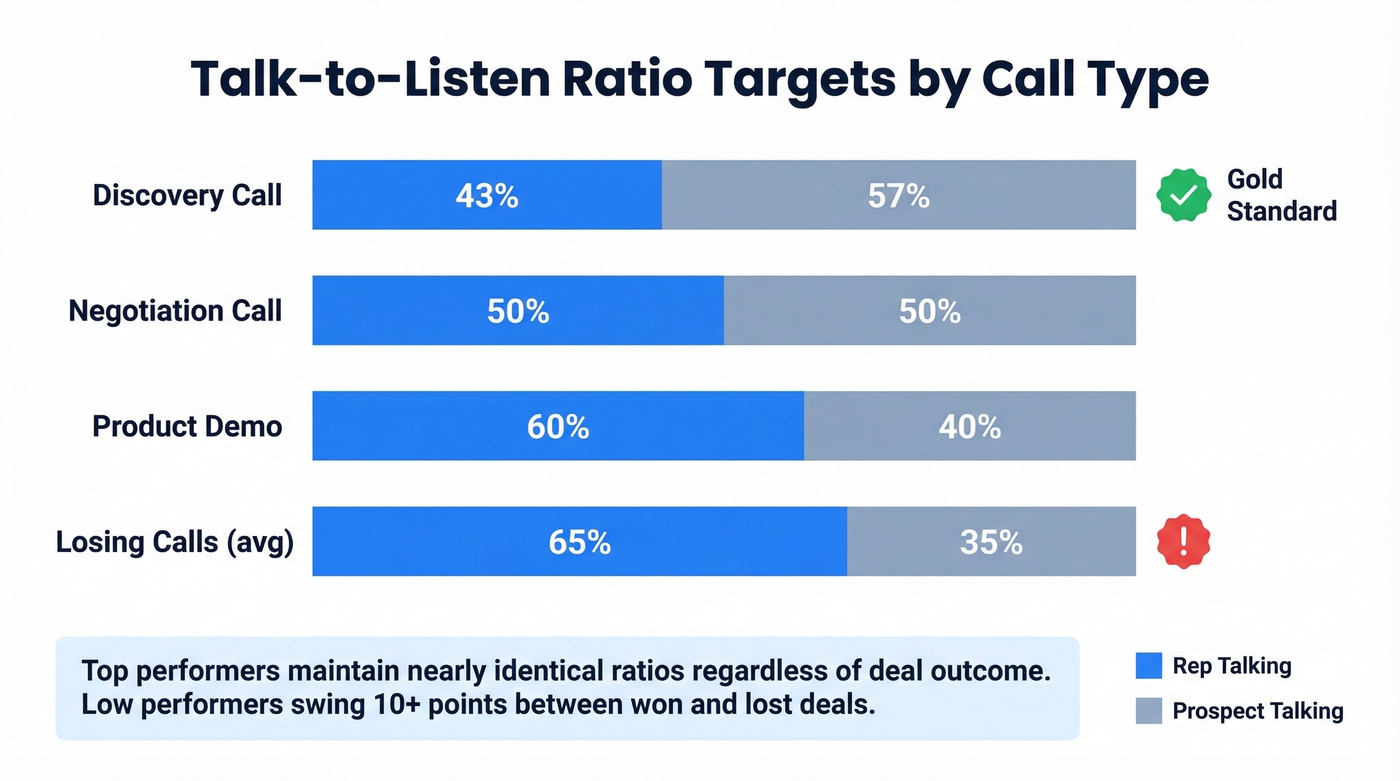
Targets shift by call type. Product demos run closer to 60/40 since you're presenting. Negotiations should land at 50/50. Discovery stays at 43/57. When reps let prospects do most of the talking, close rates improve up to 20%.
Call-to-Meeting Conversion
The average is 2.3%. Top performers clear 5%. Teams using intent signals to prioritize dials push to 5.3%. Harte Hanks sets a 10% call-to-lead benchmark for inside sales - roughly one new lead for every 15 outbound calls. If you're consistently below 2%, audit your list quality and call openers before adding more dials. Those are different problems that need different fixes.
If you want a broader baseline, compare this against the average B2B lead conversion rate to see where calls are underperforming.
Let's be honest: 49% of buyers actually prefer cold calls to any other first-touch channel, and 57% of C-level and VP buyers prefer the phone. Cold calling isn't dead. Bad cold calling is dead. If your conversion rate is low, the channel isn't the problem.
Call Duration
Average cold call: 1:24. Successful cold call: 5:50. In our experience, reps who can't hold a cold call past 90 seconds almost always have an opener problem, not a closing problem - they're pitching before they've earned attention. The sweet spot for cold calls is 5-10 minutes. For discovery, top performers run 41-50 minutes versus the 32-minute average, and longer discovery calls correlate directly with deal advancement.
If your team struggles here, tighten your sales prospecting techniques so reps call the right accounts at the right time.
Questions Per Discovery Call
This is the most undertracked metric in sales, and most teams don't even measure it. Reps who ask 11-14 questions per discovery call close at the highest rates. Below 7 questions and you're not discovering - you're presenting. Most conversation intelligence tools track this automatically. Start measuring it this week.
To standardize what “good” looks like, build a shared bank of discovery questions and score calls against it.
Multi-Threading: The Advanced Metric
Here's the metric almost nobody has on their dashboard: how many contacts per deal your reps engage. Data shows 77% of closed-won deals involve multiple stakeholders, and multi-threading deals over $50K boosts win rates by 130%. If your reps are single-threading enterprise deals, they're building on sand.
This is where account-based selling becomes measurable instead of theoretical.
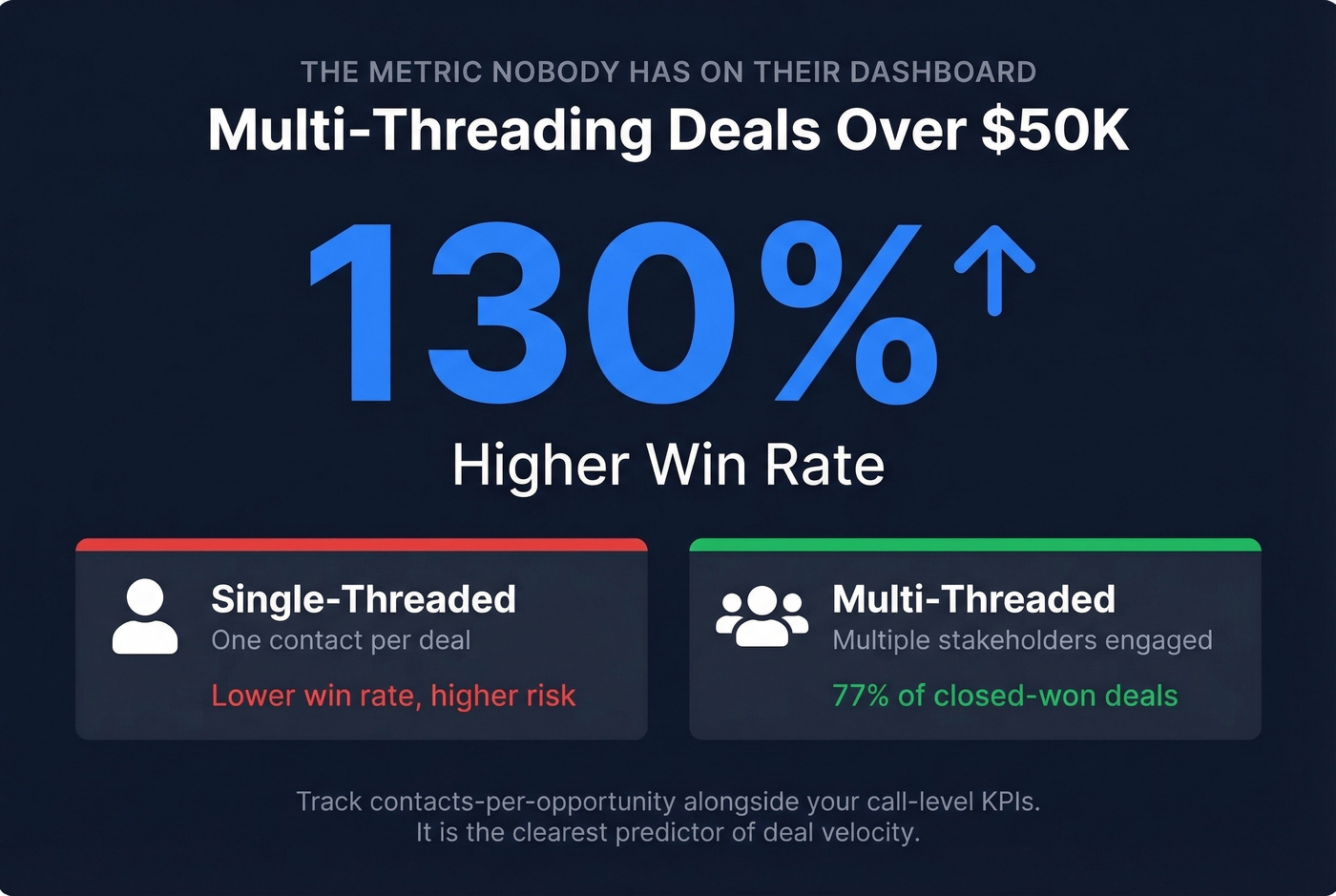
Track contacts-per-opportunity alongside your other call-level KPIs. It's the clearest predictor of deal velocity we've found.

A connect rate below 10% isn't a rep problem - it's stale data. Prospeo delivers 125M+ verified mobile numbers refreshed every 7 days, not every 6 weeks. Teams like Meritt tripled their connect rate to 20-25% after switching.
Stop coaching reps on numbers your data broke.
Building a Call Quality Scorecard
Tracking metrics is half the job. Scoring individual calls is the other half. This simplified QA framework uses a 20/30/30 weighting model that takes five minutes per call review and catches problems that aggregate metrics miss entirely. Score each item yes/no, multiply by section weight, and anything below 70% triggers a coaching session.
If you want to operationalize this across the funnel, align it with your broader sales operations metrics so coaching ties to revenue outcomes.
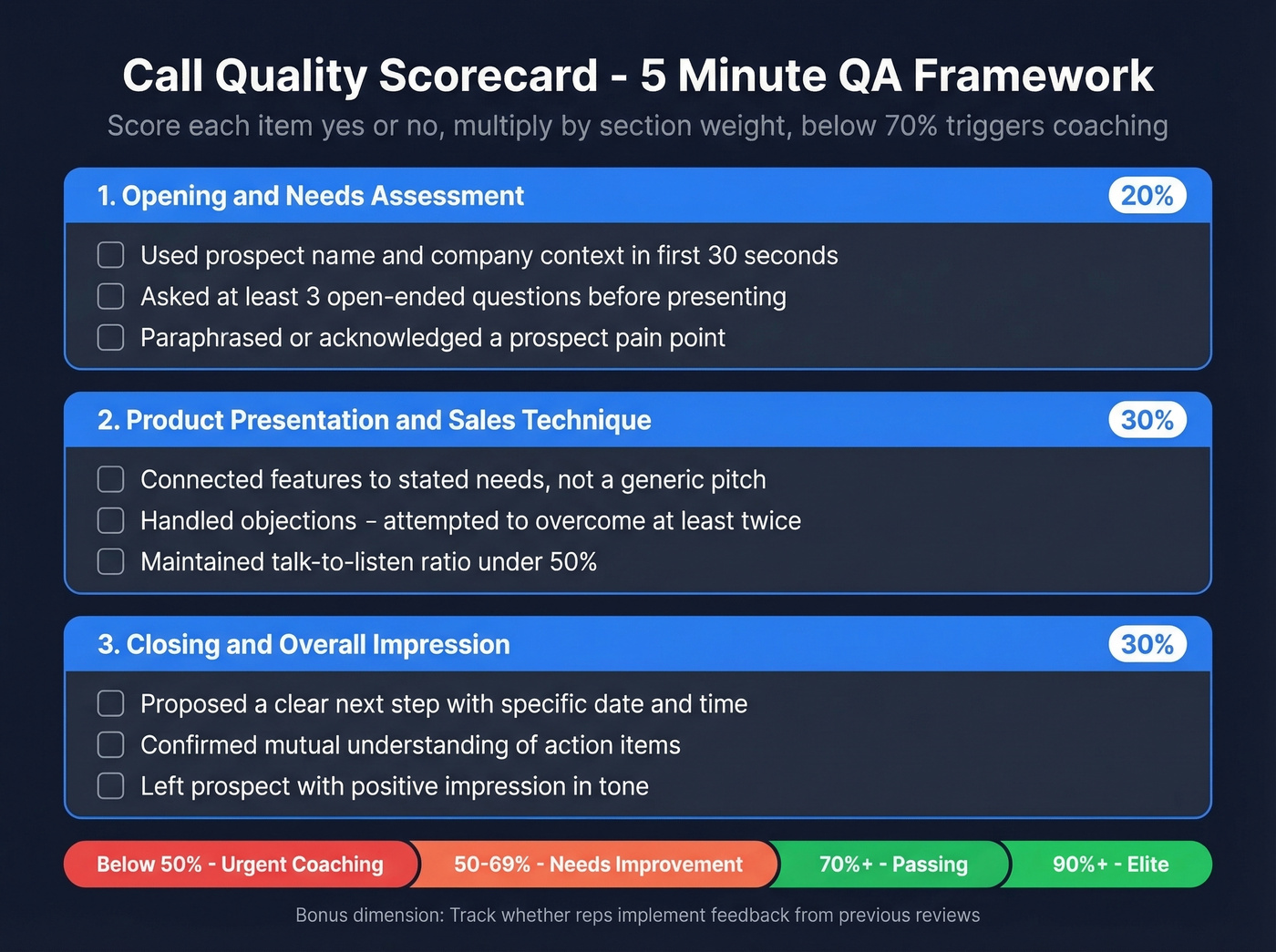
Opening & Needs Assessment (20%)
- Used prospect's name and company context within the first 30 seconds
- Asked at least 3 open-ended questions before presenting
- Paraphrased or acknowledged a prospect pain point
Product Presentation & Sales Technique (30%)
- Connected features to stated needs, not a generic pitch
- Handled objections - attempted to overcome at least twice before accepting a no
- Maintained talk-to-listen ratio under 50%
Closing & Overall Impression (30%)
- Proposed a clear next step with a specific date and time
- Confirmed mutual understanding of action items
- Left the prospect with a positive impression in tone and professionalism
One dimension worth adding: coachability. Track whether reps implement feedback from previous reviews. The best QA programs don't just score calls - they measure improvement velocity.
What Not to Track
47% of sales leaders say CRM activity counts are the most dangerous metric, and another 37% say pipeline size. That's 84% of leaders admitting the two most common dashboard metrics are misleading. One consultant puts it bluntly - 75% of your pipeline is rubbish.
If you need a cleaner way to report “real” progress, use a pipeline health view instead of raw activity totals.
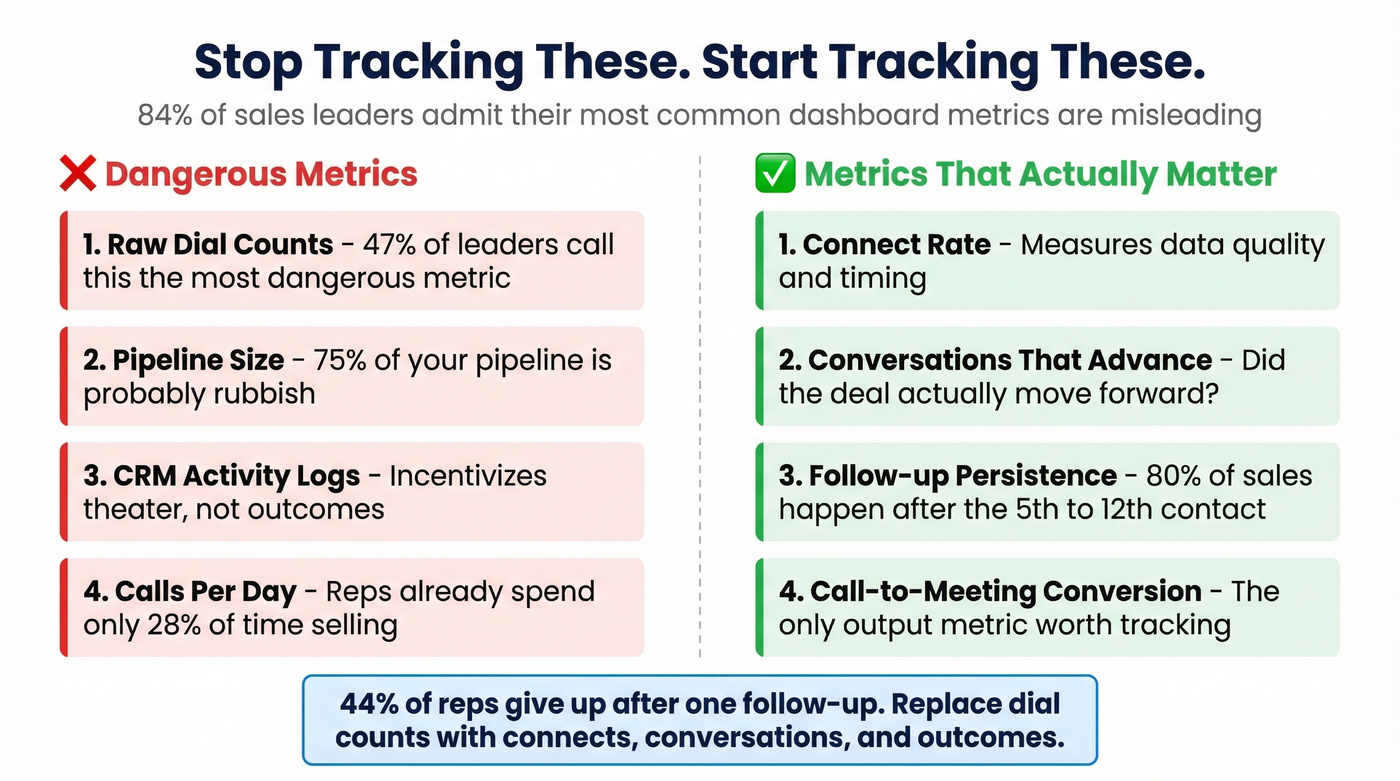
The real damage comes from dial counts. 44% of reps give up after one follow-up, while 80% of sales happen after the 5th-12th contact. Follow-up persistence is a real metric. Logged dials are not. If your CRM rewards reps for logging 80 calls but doesn't track whether those calls connected or advanced a deal, you're incentivizing theater. Skip raw dial counts entirely and replace them with connects, conversations, and outcomes - that gives managers a far more honest picture of team performance.
If you want to systematize persistence, keep a set of sales follow-up templates so reps don’t improvise under pressure.
Tools for Tracking Call Performance
| Tool | Best For | Price |
|---|---|---|
| Prospeo | Data quality pre-call - verified emails and mobiles | Free tier, ~$0.01/email |
| Gong | Revenue intelligence, full-stack analytics | ~$160-250/user/mo |
| Fathom | Small teams needing transcription + basic analytics | $19/user/mo |
| Fireflies.ai | Budget-friendly recording and search | $10-18/user/mo |
| Dialpad | AI-powered calling with built-in coaching | $15-150/user/mo |
| Aircall | Call center teams needing CRM integration | ~$30/user/mo |
Prospeo solves the problem that sits upstream of every other tool on this list. It verifies emails and mobile numbers on a 7-day refresh cycle - the industry average is 6 weeks - so your connect rate reflects your reps' skill, not stale data. With 98% email accuracy and 125M+ verified mobiles, it ensures the numbers your team dials actually ring.
Gong is the gold standard for conversation intelligence: talk-to-listen ratios, question counts, deal intelligence. It's expensive, but for teams with 10+ reps, it pays for itself in coaching efficiency. Fathom is the best value for teams under 10 who just need transcription and basic analytics. Dialpad and Aircall sit in the middle, combining dialer functionality with AI-powered call scoring. If your budget is tight, start with Fathom and upgrade to Gong when your team grows past the point where you can review calls manually.
If you're evaluating your stack, start with a shortlist of SDR tools so you don’t miss key call-tracking features.
Multi-threading requires accurate contact data across entire buying committees. Prospeo gives you 300M+ profiles with 98% email accuracy and 30% mobile pickup rate - so reps reach every stakeholder, not just one gatekeeper.
Book 26% more meetings with data that actually connects.
FAQ
What's a good connect rate for cold calls?
A healthy cold call connect rate is 10-20%. Below 10% signals a data quality problem - wrong numbers or stale lists - not a rep skill issue. Elite teams hit 30%+, often using local presence dialing and verified mobile numbers.
How do you calculate talk-to-listen ratio?
Divide total rep speaking time by total call duration. The benchmark is 43% talk / 57% listen for discovery calls. Conversation intelligence tools like Gong and Fathom calculate this automatically from call recordings - no manual tracking required.
What's a good call-to-meeting conversion rate?
The industry average is 2.3%. Top-performing SDR teams hit 5%+, and teams layering intent data into their call lists push past 5.3%. If you're consistently below 2%, audit your list quality and call openers before adding more dials.
How long should a discovery call be?
The average discovery call runs 32 minutes, but top performers consistently land in the 41-50 minute range. Calls under 20 minutes are 42% less likely to advance. Aim for 11-14 questions per call to keep conversations substantive and moving forward.
How many questions should reps ask on discovery calls?
Reps who ask 11-14 questions per discovery call close at the highest rates. Below 7 questions typically means the rep is presenting, not discovering. Most conversation intelligence platforms track question count automatically - enable it and set a floor of 10.