

The Practitioner's Guide to Sales Training in 2026
Your VP just approved $25k for training. Twelve SDRs, eight AEs, no shared methodology, and a 15% win rate that's making the board nervous. Where do you start?
The global sales training market hit $10.32 billion in 2024 and is projected to reach nearly $19 billion by 2032. The money is flowing, but most of it still funds one-time events that evaporate within weeks. U.S. companies alone spent $102.8 billion on training in 2025, averaging $874 per learner. The difference between training that sticks and training that wastes budget comes down to four things: methodology fit, program quality, AI-powered practice, and the data infrastructure underneath it all.
What You Actually Need (Quick Version)
If you don't read another word, here's the decision tree:
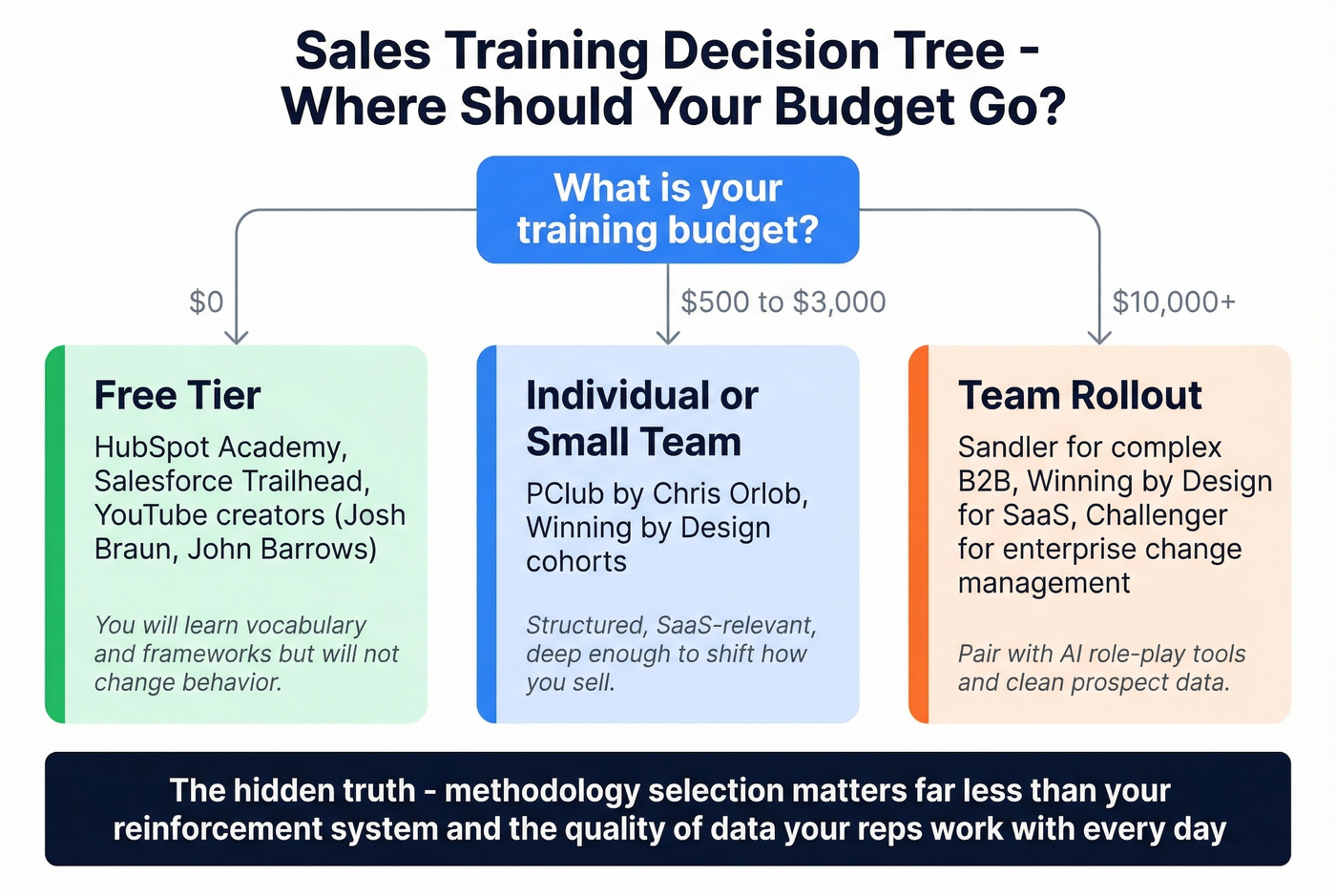
- $0 budget / individual rep: HubSpot Academy + Salesforce Trailhead + YouTube creators like Josh Braun and John Barrows. You'll learn vocabulary and frameworks. You won't change behavior.
- $500-$3,000 / individual or small team: Chris Orlob's PClub or Winning by Design. Structured, SaaS-relevant, with enough depth to actually shift how you sell.
- $10k+ / team rollout: Sandler for complex B2B cycles, Winning by Design for SaaS motions, Challenger for enterprise change-management deals. Pair any of these with AI role-play tools and clean prospect data so reps can actually execute what they learn.
Here's the thing most training vendors won't tell you: methodology selection matters far less than your reinforcement system and the quality of data your reps work with every day. A perfectly trained rep whose emails bounce 35% of the time is still dead in the water.
Does Training Actually Deliver ROI?
Yes - when it's done right. An Accenture analysis pegs training ROI at 353%, roughly $4.53 back for every dollar invested. Xerox reported a 17% increase in sales and $65 million in contract value after implementing the Challenger methodology across their org. Reps trained on virtual selling techniques close at 41% higher rates with 29% higher buyer satisfaction - numbers that matter in a world where hybrid selling is the default.
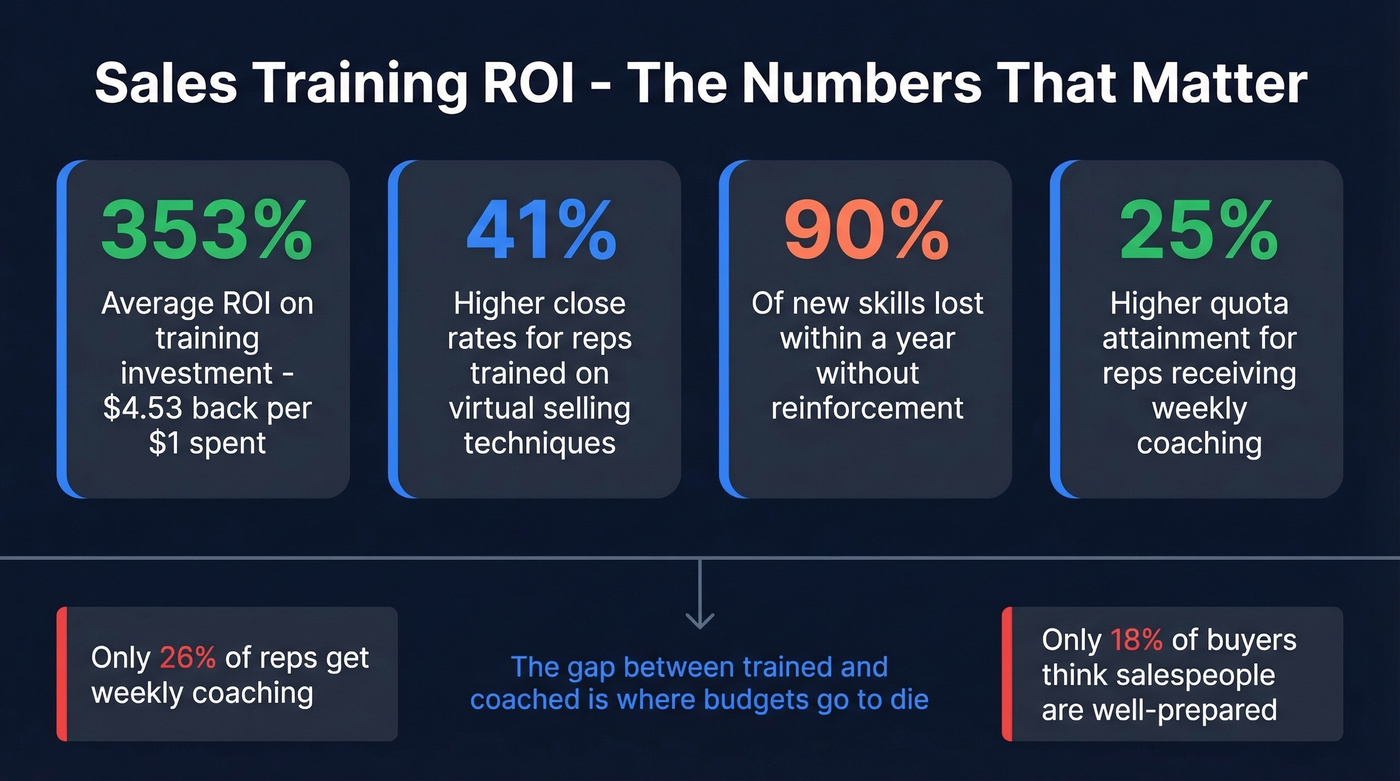
Coaching frequency is the hidden multiplier. Only 26% of reps receive weekly coaching, but those who do hit 25% higher quota attainment and close 30% more deals. That gap between "trained" and "coached" is where most budgets go to die.
The buyer side tells an equally damning story. Only 18% of buyers believe salespeople are well-prepared for meetings. That's not a training problem - it's a reinforcement and practice problem. Reps learn a framework in a two-day workshop, never practice it under realistic conditions, and show up to discovery calls defaulting to old habits. The training "worked" in the classroom. It failed in the field.
Why Most Programs Fail
The Wall Street Journal reported that 90% of new skills are lost within a year without follow-up and reinforcement. The forgetting curve is even more brutal in the short term - reps forget an average of [70% within 24 hours] of passive training. If your plan is a two-day offsite followed by "go sell," you've already lost.
Benjamin Bloom's famous 1984 study showed that one-on-one tutoring produces outcomes two standard deviations higher than traditional classroom instruction. That's the 2-sigma problem: we know what works - personalized feedback and practice - but it doesn't scale with human coaches alone. AI is starting to close that gap. Structured onboarding alone retains 50% more new hires and [cuts ramp time by 34%], which tells you how much low-hanging fruit most orgs are leaving on the table.
Here are the failure modes we see in post-mortem after post-mortem:
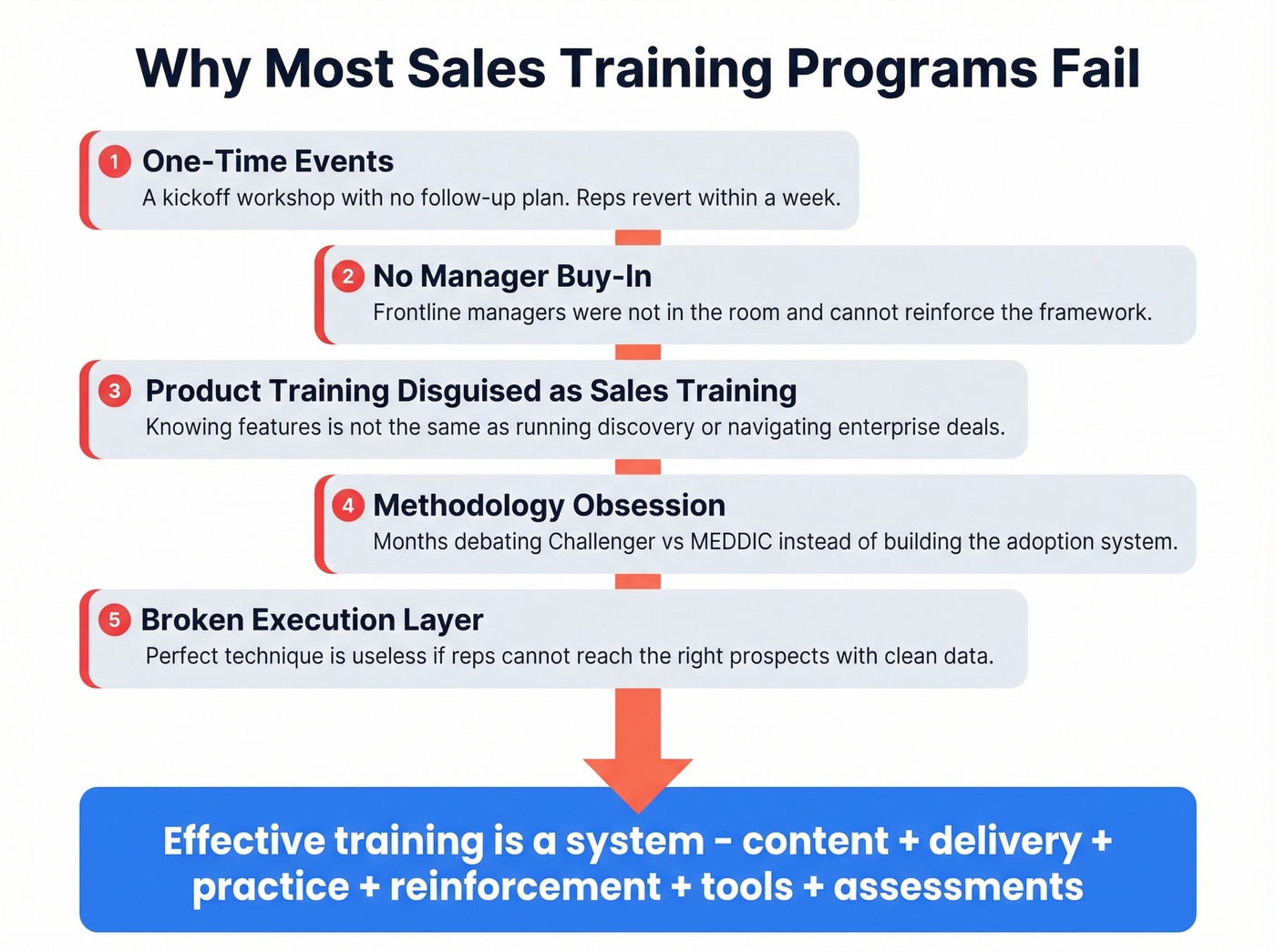
- One-time events. A kickoff workshop with no follow-up plan. Reps are energized for a week, then revert.
- No manager buy-in. Frontline managers weren't in the room, don't know the framework, and can't reinforce it in deal reviews.
- Product training masquerading as sales training. Knowing your product's features isn't the same as knowing how to run a discovery call or navigate a multi-threaded enterprise deal.
- Methodology obsession. Leaders spend months debating Challenger vs. MEDDIC instead of building the adoption system - the coaching cadence, the practice reps, the deal review templates.
- Broken execution layer. You can teach the perfect Challenger reframe. If reps can't reach the right prospects because their contact data is garbage, that reframe never gets delivered.
Effective training is a system: content + delivery method + practice activities + reinforcement plan + tools + assessments. Cut any piece and the whole thing degrades.
Sales Methodologies Compared
"They're All Basically the Same"
There's a popular take on r/sales that all methodologies boil down to the same thing: need, budget, stakeholders, timeline. Half-right. Every methodology is a structured way to uncover those four things. The packaging differs, but the core motion is similar.
Where that crowd gets it wrong is team alignment. A shared methodology gives your org a common language for deal reviews, coaching sessions, and forecasting. "What's the champion's access to the economic buyer?" means something specific when everyone speaks MEDDIC. Without that shared vocabulary, coaching devolves into ad hoc advice that varies by manager.
The sequencing advice from practitioners is sound: teach fundamentals first - discovery, objection handling, pipeline management - then layer a methodology on top. Jamming MEDDIC down a new SDR's throat before they can run a decent cold call is a waste of everyone's time.
Head-to-Head
| Methodology | Research Base | Best For | Core Mechanic |
|---|---|---|---|
| Challenger | CEB, 6,000+ reps | Enterprise, status-quo deals | Teach, Tailor, Take Control |
| SPIN | 35,000+ calls, 20+ countries, 12 yrs | Mid-market, consultative | Situation - Problem - Implication - Need-payoff |
| Sandler | Practitioner-developed | Complex B2B, long cycles | Upfront contracts, pain funnels |
| MEDDIC | PTC/Parametric origin | Enterprise, multi-stakeholder | Metrics, Econ Buyer, Decision, Paper, Identify Pain, Champion |
| Consultative | Broad, Hanan (1970s) | Relationship-driven, services | Needs diagnosis before prescription |
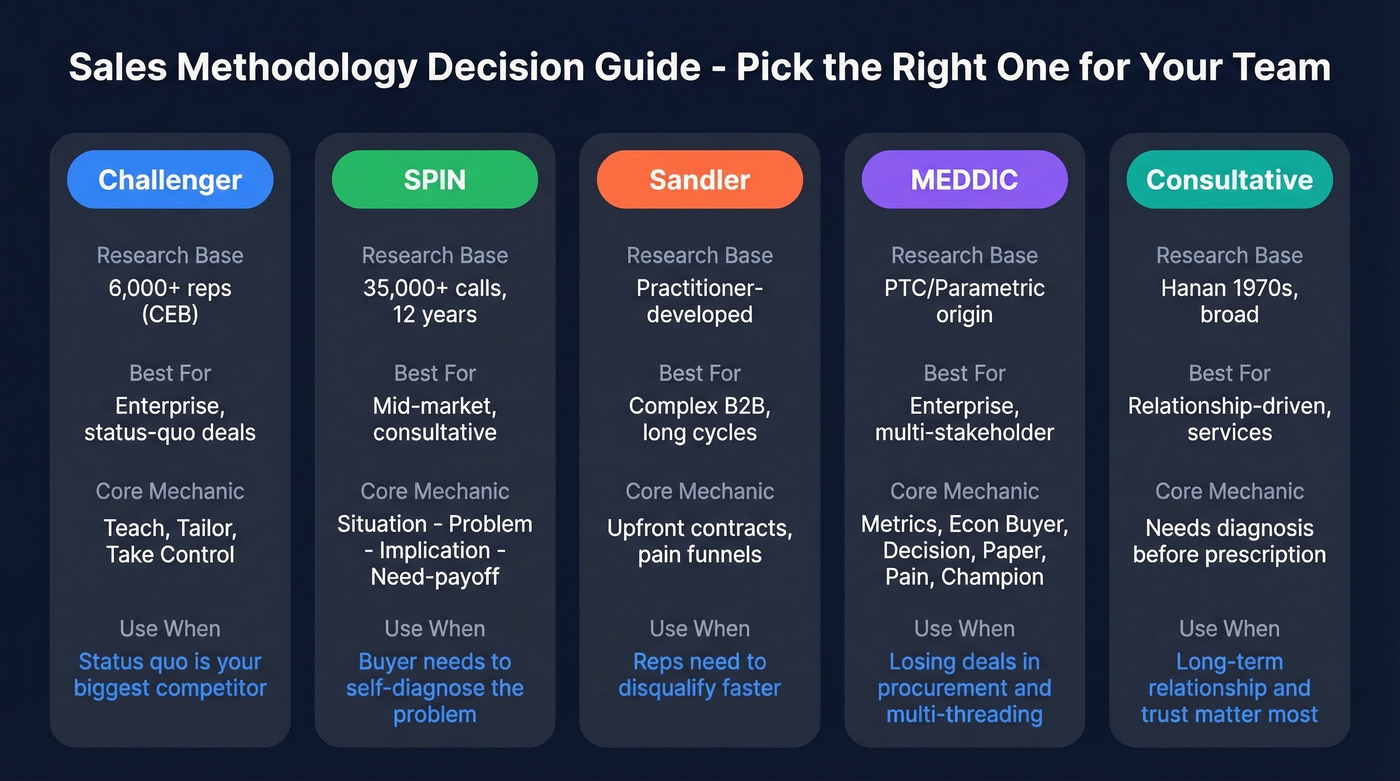
The decision heuristic is simpler than vendors make it sound. If the status quo is your biggest competitor - meaning prospects are more likely to do nothing than buy a competitor - Challenger is your framework. If you're losing deals because reps can't navigate procurement and multi-threading, MEDDIC gives you the scaffolding. If your sales cycle involves heavy discovery and the buyer needs to self-diagnose the problem, SPIN's questioning framework is hard to beat. Sandler works best when reps need to disqualify faster and stop wasting time on deals that were never real.
Real Deals, Real Methodologies
MEDDIC on a $72k ARR deal. The deal had been slipping for two quarters. A MEDDIC review exposed the root cause: no identified economic buyer, unquantified success metrics, and zero visibility into the decision process. The deal didn't close - but the MEDDIC framework saved the forecast by killing a zombie opportunity before it inflated the quarter.
Challenger on a $350k ARR deal. The prospect was comfortable with their current vendor. The AE used a Challenger reframe to make staying put riskier than switching - quantifying the cost of their current approach's inefficiencies. The deal closed because the rep changed how the buyer thought about the problem, not just the solution.
Sandler on $8-10k ARR deals. A team selling lower-ticket SaaS shifted to upfront agendas, early budget and authority checks, and explicit exit criteria. Fewer demos, faster decisions, higher close rates. Sandler's strength at this deal size is speed - it kills bad deals early so reps focus on real ones.
SPIN on a $20k ARR deal. Structured implication questioning helped the prospect calculate the downstream cost of their current manual process. The rep didn't pitch features - they helped the buyer build their own business case. Deal signed.

You just read it: a perfectly trained rep whose emails bounce 35% of the time is dead in the water. Prospeo delivers 98% email accuracy with a 7-day refresh cycle, so every Challenger reframe and MEDDIC qualification actually reaches a real inbox. At $0.01 per email, clean data costs less than one hour of wasted training.
Stop training reps to sell into a void. Give them data that connects.
Best Sales Training Programs in 2026
Free Programs ($0)
HubSpot Inbound Sales Certification is the best free starting point. It's structured, takes about 1 hour 46 minutes, and covers the inbound methodology end to end. You'll get a certificate for your profile. It won't make you a closer, but it'll give you a shared vocabulary with marketing.
Salesforce Trailhead offers free learning paths for sales fundamentals. The certification exam costs $200 plus applicable taxes if you want the credential, but the coursework itself is free. Good for CRM-centric selling skills. Anthropic Academy's AI Fluency course at just over an hour is a smart add-on - understanding AI tools is becoming table stakes for modern reps.
Skip these if you already have 2+ years of selling experience. They're onboarding material, not skill sharpeners. Free programs teach vocabulary and frameworks but won't change behavior because there's no personalized feedback, no role-play, no call-level diagnostics.
Individual / Small Budget ($100-$3,000)
If you're an individual AE looking to level up discovery or negotiation, Chris Orlob's PClub is where your money goes furthest. It runs $500-$2,000 depending on the course, and Orlob built his reputation on Gong data analysis - the programs are SaaS-specific, tactical, and dense.
Winning by Design offers cohort-based programs at $1,500-$3,000 per person. Their revenue architecture framework is the closest thing to a SaaS-native methodology. Strong for individual contributors who want structured learning, and it scales naturally into team rollouts if the org decides to standardize.
RAIN Group Online typically runs $100-$300/month for access to an online training library - solid for ongoing skill development if you're disciplined enough to use it consistently. Dale Carnegie starts at $899 per person, more traditional and less SaaS-specific, but the presentation and communication skills transfer well.
On the budget end, Udemy courses start at $5-$20, GoSkills offers plans from $6.36/learner/month with a free tier, ProProfs runs just $1.99/learner/month for basic content, and edX offers professional certificate programs at $349/learner/year. VirtualSpeech has a $250 one-time program focused on pitch delivery using VR - niche but interesting for teams where presentation skills are the bottleneck.
Team Programs ($5,000-$50,000)
Sandler Training is the workhorse of complex B2B selling. Individual programs run $1,000-$3,000; team engagements range from $15,000-$50,000 depending on customization and duration. The ongoing reinforcement model - weekly sessions over months - is Sandler's real differentiator. It's built to fight the forgetting curve, and that alone makes it worth serious consideration for any team selling deals with 3+ month cycles.
Winning by Design scales well for team rollouts at $1,500-$3,000 per person in cohort format. For a 10-person team, you're looking at $15,000-$30,000. Their frameworks map directly to SaaS metrics like NRR, expansion revenue, and time-to-value, which makes adoption easier because reps see the connection to their comp plan.
John Barrows' JB Sales / SellBetter runs $7,500-$25,000 for team programs - he's built a strong reputation in the SDR/AE development space, and the content is practical and modern. Challenger workshops cost $20,000-$75,000, worth it for enterprise orgs where the status quo is the primary competitor but overkill for transactional sales motions. Richardson runs $15,000-$50,000 for virtual series and is strong on consultative selling frameworks.
For teams prioritizing diverse pipeline development, programs like Women Sales Pros and the National Association of Women Sales Professionals offer training specifically designed for underrepresented sellers.
Enterprise Rollouts ($50,000+)
Korn Ferry runs $50,000-$250,000+ for full enablement transformations. You're paying for organizational change management as much as sales skills. Wilson Learning falls in the $20,000-$50,000+ range with a focus on consultative and relationship selling. Corporate Visions does custom engagements, typically $30,000-$100,000+ depending on scope.
Let's be honest: enterprise rollouts are only worth the investment if you also fund manager coaching certification and build reinforcement infrastructure. We've seen $200k programs produce zero measurable lift because the enablement team treated the workshop as the finish line instead of the starting gun.
SaaS-Specific Picks
These are the names that come up repeatedly when SaaS reps on r/SaaSSales recommend training to each other: Brian LaManna's Closed Won, Mor Assouline's From Demo to Close, Josh Braun for cold outreach frameworks, Thibaut Souyris' SalesLabs, Tom Alaimo, and Will Aitken. These aren't enterprise methodology vendors - they're practitioners who teach what's working right now in SaaS sales cycles. Most run $200-$2,000 for courses or cohorts.
Our hot take: If your average deal is under $15k ARR, skip the $50k enterprise methodology rollout. Buy Chris Orlob's PClub for your AEs, Sandler's self-paced program for your managers, and spend the remaining $40k on AI role-play tools and clean data infrastructure. You'll get 3x the lift.
Pricing at a Glance
| Program | Best For | Format | Price Range |
|---|---|---|---|
| HubSpot Academy | Beginners | Online, self-paced | Free |
| Salesforce Trailhead | CRM skills | Online, self-paced | Free (exam $200 + taxes) |
| Udemy | Budget learners | On-demand video | $5-$20/course |
| ProProfs | Basic skills | Online library | $1.99/learner/month |
| GoSkills | Small teams | Online library | From $6.36/mo/learner |
| edX | Structured certs | Online, self-paced | $349/learner/year |
| VirtualSpeech | Pitch skills | VR simulation | $250 one-time |
| PClub (Orlob) | SaaS AEs | Online cohort | $500-$2,000 |
| Dale Carnegie | Communication | Workshop + online | From $899/person |
| RAIN Group | Ongoing dev | Online library | $100-$300/month |
| Winning by Design | SaaS teams | Cohort | $1,500-$3,000/person |
| JB Sales | SDR/AE teams | Workshop + online | $7,500-$25,000 |
| Sandler | Complex B2B | Ongoing coaching | $1k-$50k (ind to team) |
| Challenger | Enterprise | Workshop | $20,000-$75,000 |
| Richardson | Consultative | Virtual series | $15,000-$50,000 |
| Corporate Visions | Enterprise | Custom engagement | $30,000-$100,000+ |
| Wilson Learning | Relationship sales | Custom | $20,000-$50,000+ |
| Korn Ferry | Enterprise orgs | Full transformation | $50,000-$250,000+ |
The industry average is $874 per learner. If you're spending significantly less, you're getting content without coaching. If you're spending significantly more, make sure you're getting reinforcement infrastructure - not just a fancier binder.
The fact that training vendors hide pricing behind sales calls - for a sales training company - is peak irony.
AI-Powered Coaching Tools
Gartner projects that 60% of large enterprises will incorporate AI-based simulation tools by the end of 2026, up from less than 10% in 2022. That's not a gradual shift - it's a phase change. The sales training technology market alone grew from $2.68 billion in 2024 to a projected $7.82 billion by 2032, and AI tools are eating most of that growth.
PwC reported that simulation learners were 275% more confident and completed training 4x faster than classroom learners. McKinsey ties generative AI in customer-facing roles to 15-20% productivity improvements. The core constraint AI solves is manager capacity - high-performing sales managers already spend up to 40% of their time coaching and can't scale further. AI role-play tools let reps practice discovery calls, objection handling, and negotiation scenarios at 10pm on a Tuesday without burning a manager's calendar.
The tools worth evaluating right now:
Hyperbound builds AI buyers modeled on your actual ICP for realistic cold call and discovery practice. Second Nature focuses on pitch certification and onboarding simulations with conversational AI. Rehearsal records video role-plays and uses AI to score delivery, messaging, and adherence to methodology. All three integrate with major LMS platforms and can be layered on top of whatever methodology you're running.
A practical implementation framework:
- Assess your current coaching effectiveness and identify the highest-leverage skill gaps.
- Define scenarios that mirror real deal situations - not generic "sell me this pen" exercises.
- Deploy AI coaching alongside your existing methodology - Challenger reframes, MEDDIC qualification, Sandler pain funnels.
- Schedule weekly practice - 15-minute AI sessions beat monthly 2-hour workshops every time.
- Measure impact on leading indicators like connect rate and discovery-to-demo conversion within 30-60 days.
AI won't replace human managers. It scales the practice reps that managers can't provide at volume. The best results come from combining both - AI for repetition and pattern recognition, humans for context, accountability, and the judgment calls that algorithms still get wrong.
The Data Quality Multiplier
You can train your team on the perfect Challenger reframe. If 35% of their emails bounce, that training never gets applied. This is the gap nobody talks about at sales kickoffs.
Consider this scenario: your best AE says there's no development path. Your worst rep blames bad leads. Both problems trace to the same root - an execution layer that's broken before the selling even starts.
The proof is in the numbers. Snyk had 50 AEs each spending 4-6 hours per week prospecting, and their bounce rate was running 35-40%. After fixing the data layer with Prospeo, bounce rates dropped to under 5%, AE-sourced pipeline jumped 180%, and the team generated 200+ new opportunities per month. That's not a training win - it's an infrastructure win that made training investments actually pay off.
Before you invest $25k in training, audit your data. If bounce rates are above 5%, fix that first. The ROI on clean data is immediate and compounds with every other investment you make.
Coaching and practice drive ROI - but reps need live prospects to practice on. Prospeo's 300M+ profiles with 30+ filters (intent data, job changes, headcount growth) let trained reps immediately apply new skills on the right buyers. Teams using Prospeo book 35% more meetings than Apollo users.
Turn your training investment into pipeline the same week.
How to Measure Training ROI
Most sales orgs track completions and satisfaction scores. That's like measuring a gym membership by how many times you swiped your badge. Only 25% of sales organizations directly measure leading-indicator sales behaviors after training.
The KPIs that matter fall into two buckets.
Lagging indicators take 2-3 quarters to shift: revenue/ARR growth, win rate, average deal size, sales cycle length, quota attainment, rep retention.
Leading indicators shift within 30-60 days: email bounce rate, phone connect rate, discovery-to-demo conversion, coaching session frequency, pipeline creation velocity.
Leading indicators are where you catch problems early. If your connect rate doesn't improve within 60 days of training, either the program didn't stick or the data underneath is broken. If bounce rates exceed 5%, fix the data before blaming the curriculum.
The measurement framework is straightforward: baseline your leading indicators before training starts, track weekly for 90 days post-training, then watch lagging indicators over two to three quarters. If leading indicators move but lagging ones don't, your problem is deal execution or market fit - not training quality.
FAQ
What is sales training?
Sales training is the structured process of teaching reps the skills, frameworks, and behaviors needed to move buyers through a pipeline and close deals. It spans cold calling, discovery, negotiation, and account management. The best programs combine methodology instruction with ongoing coaching, AI-driven practice, and clean execution data so reps can apply what they learn.
How much does it cost per person?
The range spans from free (HubSpot Academy, Salesforce Trailhead) to $50,000+ for enterprise rollouts. The industry average is $874 per learner. Most SaaS teams get the best value in the $500-$3,000 range with programs like PClub or Winning by Design, paired with verified prospect data for execution.
What's the best methodology for SaaS?
Winning by Design or Challenger for team rollouts; PClub for individual reps sharpening specific skills. Methodology selection matters less than your reinforcement system - weekly coaching, AI role-play, and verified prospect data drive more lift than any framework alone.
How long until you see ROI?
Leading indicators like connect rate, discovery quality, and pipeline creation shift within 30-60 days if reinforced properly. Lagging indicators - win rate, deal size, quota attainment - take two to three quarters. If nothing moves after 90 days, your reinforcement plan or data layer needs attention.
Can AI replace live coaching?
Not yet. AI role-play tools like Hyperbound and Second Nature scale practice and give reps unlimited repetitions on specific scenarios. Human managers provide context, accountability, and nuanced judgment. The best results combine both - AI handles volume, managers handle depth. Reps using regular AI role-play improve win rates by up to 30%.