SQO Meaning: What a Sales Qualified Opportunity Is (2026)
It's Monday morning. The pipeline review starts, and within five minutes three people are using "SQL," "opportunity," and "qualified opportunity" interchangeably. The VP of Sales is counting deals that haven't had a discovery call. The SDR lead is claiming credit for "opportunities" that are really just demo requests. Nobody agrees on what's actually in the pipeline, and the forecast is fiction.
That confusion has a fix. Understanding SQO meaning is where it starts.
SQO: Quick Definition
SQO stands for Sales Qualified Opportunity - an SQL that's been vetted against defined criteria and officially converted into an active opportunity in the pipeline. It's the gate between "this lead looks promising" and "we're actively working this deal with a real next step scheduled." Without it, your pipeline is a wish list.
Why SQO Matters (And Why Teams Get It Wrong)
68% of B2B organizations haven't clearly defined their funnel stages. If your team hasn't agreed on what separates an SQL from a sales qualified opportunity, you're running pipeline reviews in different languages.
The confusion is real. Reddit's r/salesdevelopment has threads specifically asking "SAOs vs SQLs?" - SDR teams genuinely don't know where acceptance ends and qualification begins. Stage naming varies wildly across orgs, which means reps who change companies bring their old definitions with them and suddenly your CRM has three conflicting taxonomies.
Here's the thing: the specific labels matter less than having a defined gate. Call it SQO, call it "Stage 2 Qualified" - just make sure there's a checkpoint between "sales accepted this lead" and "we're forecasting revenue." We've watched teams add this single gate and immediately cut their forecast variance in half. It's the highest-ROI process change a revenue org can make.
Lead Qualification Taxonomy
| Stage | Full Name | Who Owns It | Key Signal | Example |
|---|---|---|---|---|
| MQL | Marketing Qualified Lead | Marketing | Engagement threshold | 3+ content downloads |
| SAL | Sales Accepted Lead | Sales (SDR) | Accepted for outreach | SDR confirms ICP fit |
| SQL | Sales Qualified Lead | Sales (AE/SDR) | Sales conversation started | Pain identified |
| SQO | Sales Qualified Opportunity | Sales (AE) | Official opportunity + next step agreed | Demo/proposal/POC scheduled |
| PQL | Product Qualified Lead | Product/Sales | Usage signals | Trial user hits activation |
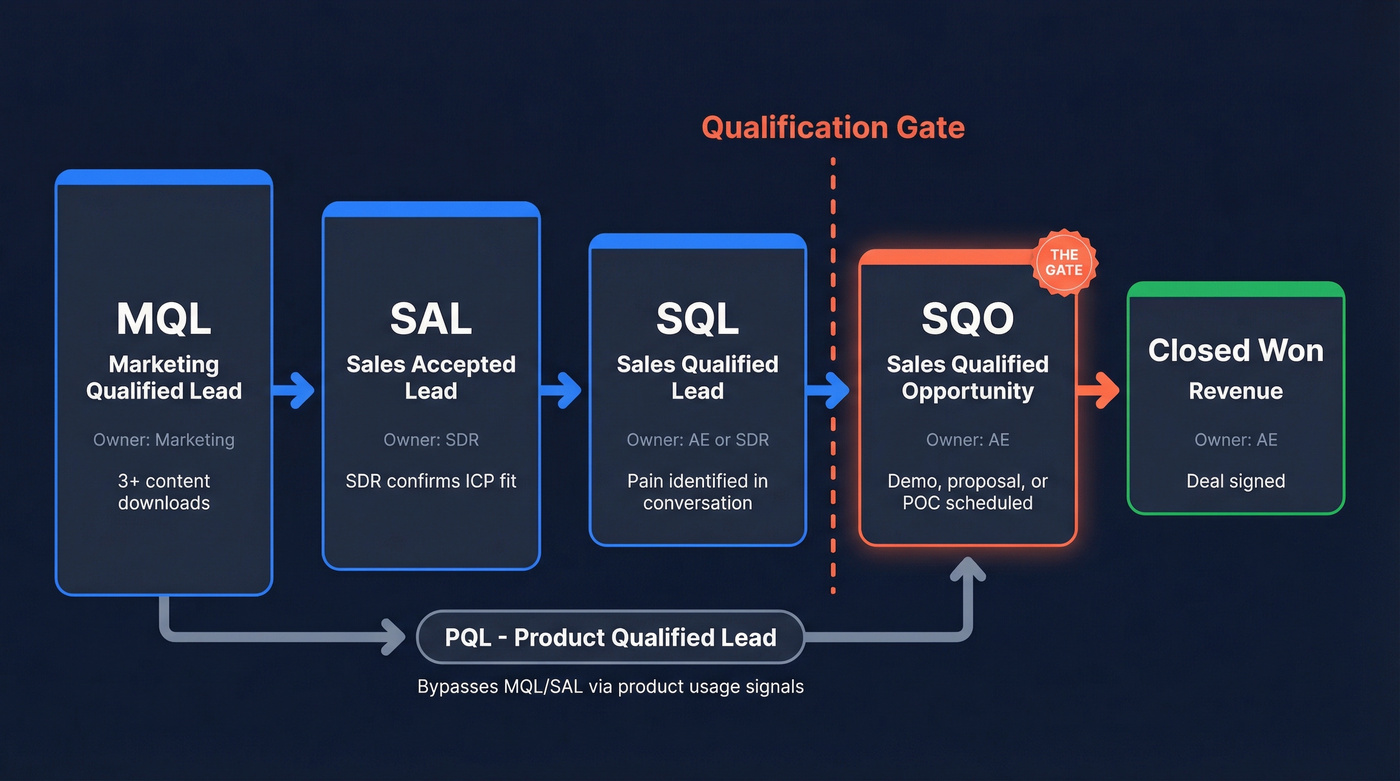
The SAL-to-SQO distinction trips people up the most. An SAL is a lead that sales has accepted - they've agreed it's worth pursuing. An SQO is a lead that's been qualified through direct engagement and has earned a pipeline slot. Acceptance isn't qualification. One is a handshake; the other is due diligence.
For product-led growth teams, PQLs often bypass MQL/SAL entirely and enter the funnel based on product usage signals.
What Makes a Lead an SQO?
A lead qualifies as a sales qualified opportunity when all of these are true:
- ICP fit confirmed - company size, industry, and tech stack match your target profile (see account qualification)
- Pain identified - the prospect has articulated a specific problem your product solves
- Budget verified - they have budget allocated or a clear path to securing it
- Decision-maker engaged - you're talking to someone who can sign or directly influence the deal (use multithreading when needed)
- Next step scheduled - a concrete meeting, demo, or proposal review is on the calendar
What does NOT make an SQO: a demo request with no discovery call, an SQL that got auto-promoted in your CRM because nobody built a gate, or a lead where the only contact is a junior champion with no budget access. Traditional intent signals like form fills and pageviews are often less than 20% accurate on their own, which is exactly why the SQO gate needs human verification, not just lead scoring.

Every SQO criterion you just read - ICP fit, decision-maker engaged, next step scheduled - falls apart if your contact data is wrong. Prospeo's 98% email accuracy and 125M+ verified mobile numbers mean your reps actually reach the buyers they qualified.
Stop qualifying deals you can't even contact.
Why an SQO Gate Doubles Win Rate
Let's break this down with real numbers. A company had 80% of their SQLs automatically created as opportunities - no gate, no required fields. Their win rate sat at 15%. After implementing an SQO gate with verified BANT criteria, scheduled next steps, and budget confirmation, opportunity volume dropped 40% but win rate jumped to 30%.
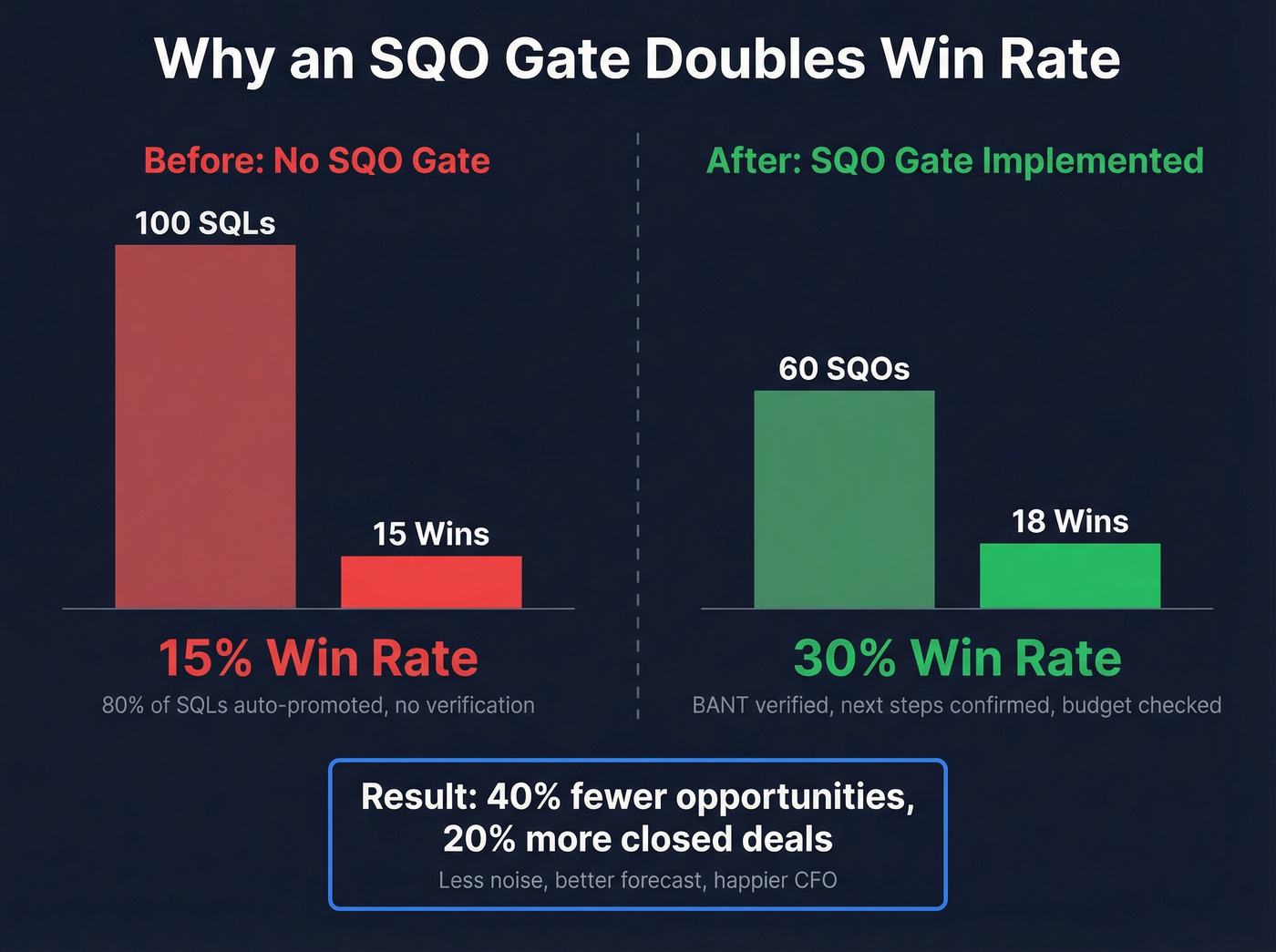
100 SQLs x 15% = 15 deals. Gate to 60 SQOs x 30% = 18 deals. More wins, less noise.
That tracks with broader benchmarks. B2B tech teams report roughly 6% lead-to-opportunity conversion on average, and aligned sales-marketing teams see 38% higher win rates than misaligned ones. The SQO gate doesn't reduce your revenue - it reduces the noise that makes your forecast unreliable. Your CFO will thank you. (If forecasting is still messy, fix deal forecast accuracy next.)
Which Qualification Framework to Use
| Framework | Best For | Complexity | When to Use |
|---|---|---|---|
| BANT | High-volume, transactional | Low | Smaller deals with fast cycles |
| CHAMP | Mid-market, consultative | Medium | Multi-stakeholder, solution selling |
| MEDDIC | Enterprise, complex | High | High-ACV deals with a formal buying process |
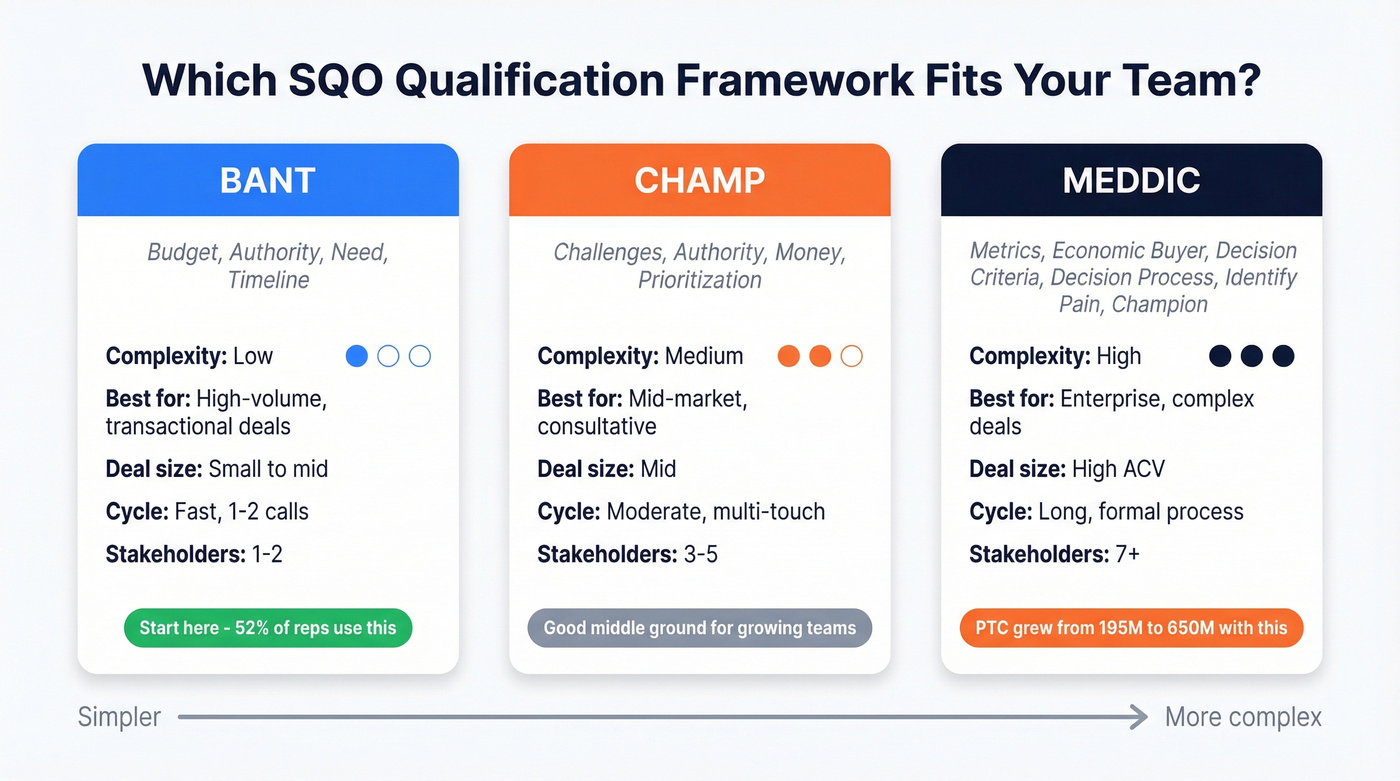
52% of sales reps trust BANT as their go-to framework, and for good reason - it's simple and fast. But modern B2B deals average around seven stakeholders, which means BANT's single-buyer assumption breaks down quickly for enterprise motions.
PTC's revenue grew from £195M to £650M in four years after implementing MEDDIC - a compelling case for the added complexity when deal sizes warrant it.
Our recommendation: start with BANT. It works for most teams and most deal sizes. Graduate to MEDDIC when you're consistently dealing with multiple stakeholders and a formal decision process. Don't over-engineer qualification for deals that close in two calls.
Common SQO Mistakes
Stage inflation. Auto-promoting every SQL to an opportunity without a gate. If your CRM lets reps create opportunities with zero required fields, your pipeline number is a fantasy (common sales pipeline challenges).
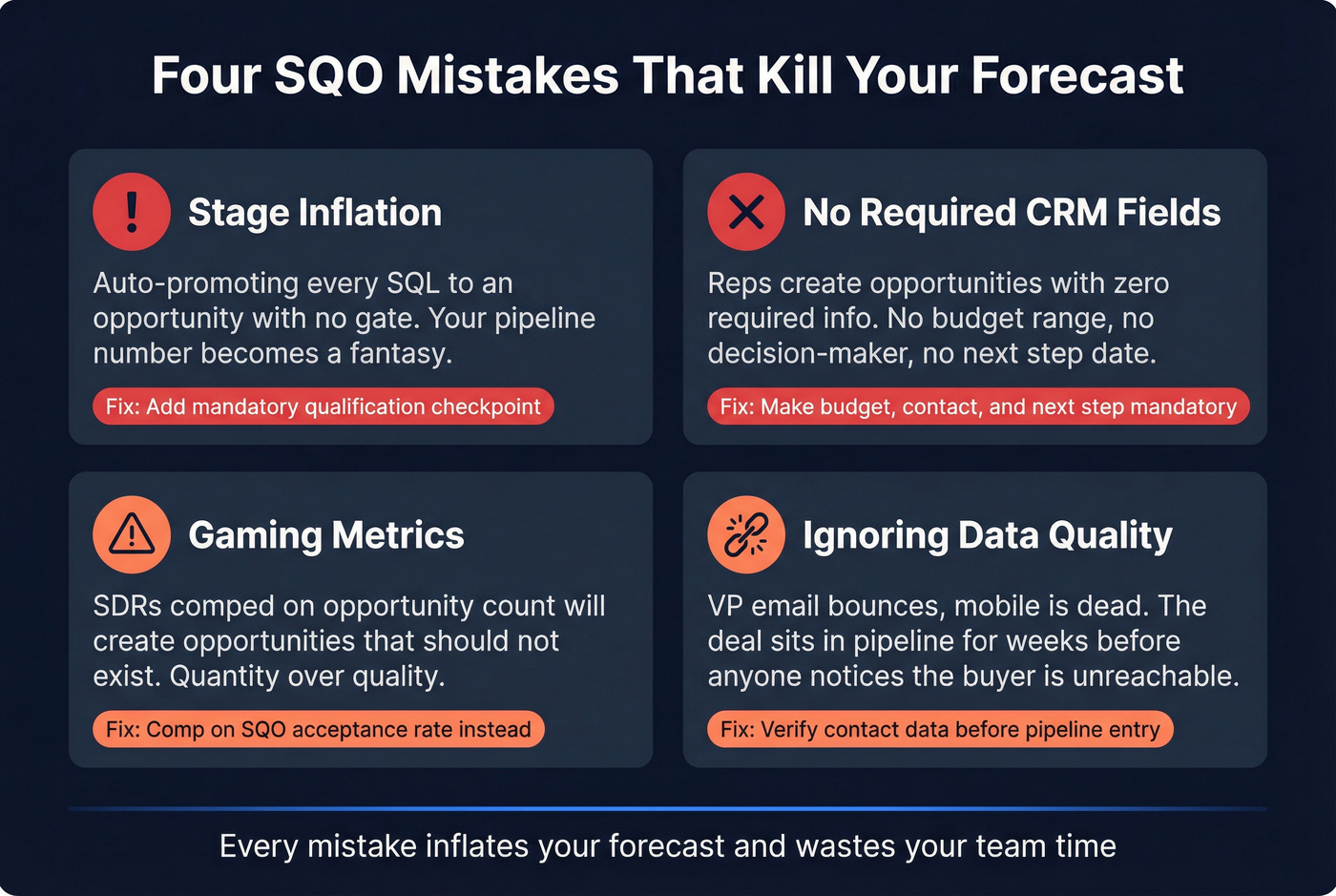
No required CRM fields. The SQO gate needs teeth. Budget range, decision-maker name, next step date, and timeline should all be mandatory before a deal enters pipeline.
Gaming metrics. We've seen teams where "opportunities created" became a comp hack - SDRs comped on raw opportunity count will create opportunities that shouldn't exist. Comp on SQO acceptance rate instead.
Ignoring data quality. A lead can pass every qualification criterion and still be a phantom opportunity if the contact data is wrong. Bounced emails, disconnected numbers, stalled outreach that never reaches the decision-maker. Skip this step and you'll spend weeks forecasting deals where nobody can actually reach the buyer. (This is why CRM hygiene matters.)
Clean Data In, Clean Pipeline Out
Bad contact data creates phantom SQOs. A rep marks a deal as qualified, but the VP's email bounces and the mobile number is dead. The opportunity sits in pipeline for weeks, inflating the forecast, before someone realizes there's no way to actually reach the buyer.
Before a lead becomes a sales qualified opportunity, verify the contact data. Prospeo runs 98% email accuracy with a 7-day refresh cycle across 143M+ verified emails and 125M+ verified mobile numbers - so the contacts entering your pipeline are actually reachable, not stale records from a database that refreshes every six weeks. (If you want the mechanics, start with email verification for outreach.)

Bad data turns SQOs back into dead leads. Prospeo refreshes 300M+ profiles every 7 days - not every 6 weeks - so the decision-maker email your AE qualified last Tuesday is still valid when they send the proposal.
Clean pipeline starts at $0.01 per verified email.
FAQ
What does SQO mean in sales?
SQO stands for Sales Qualified Opportunity - a lead that's passed a defined qualification gate with confirmed budget, an engaged decision-maker, and a scheduled next step. It's the line between "interested lead" and "forecasted deal." Most B2B teams use it as the formal entry point into their active pipeline.
How is an SQO different from an SQL?
An SQL is a lead where a sales conversation has started and initial interest is confirmed. An SQO goes further - it requires verified budget, decision-maker access, and a concrete next step on the calendar. Think of SQL as "worth talking to" and SQO as "worth forecasting."
Who creates the SQO?
Sales creates it. Marketing generates MQLs, but the SQO designation happens after a sales rep has personally verified qualification criteria through direct engagement. It's a sales-owned gate, full stop.
What's a good SQO-to-closed-won rate?
Well-gated SQOs convert at 25-35% in B2B - roughly 2x the rate of ungated opportunities. Below 20% means your qualification criteria are too loose. Verifying contact data before pipeline entry keeps that rate from being dragged down by unreachable contacts.