How to Divide Sales Territories in 2026 (With Formulas)
It's January. Leadership handed you a 25% higher target and said "rebalance territories." You open last year's spreadsheet - half the accounts changed industries, three reps left, and the boundaries haven't been touched since 2024. Sound familiar?
If you're figuring out how to divide sales territories without guesswork, here's the math that actually makes it work.
Quick version: Pick a segmentation axis (geography, vertical, or company size). Balance territories using the potential formula and ±10% variance rule below. Verify your account data before assigning anything.
Why Territory Design Is a Revenue Lever
HBR research puts the impact at a 2-7% revenue lift from realignment alone - no new headcount, no strategy change. Alexander Group data shows optimized territories drive a 10-20% increase in sales productivity. On a $20M quota, 5% is a million dollars you're leaving on the table because someone drew lines on a map three years ago.
That's not marginal. That's a headcount you didn't have to hire.
Six Approaches to Sales Territory Segmentation
The right model depends on your product, team size, and how buyers cluster. Each segmentation axis has trade-offs.
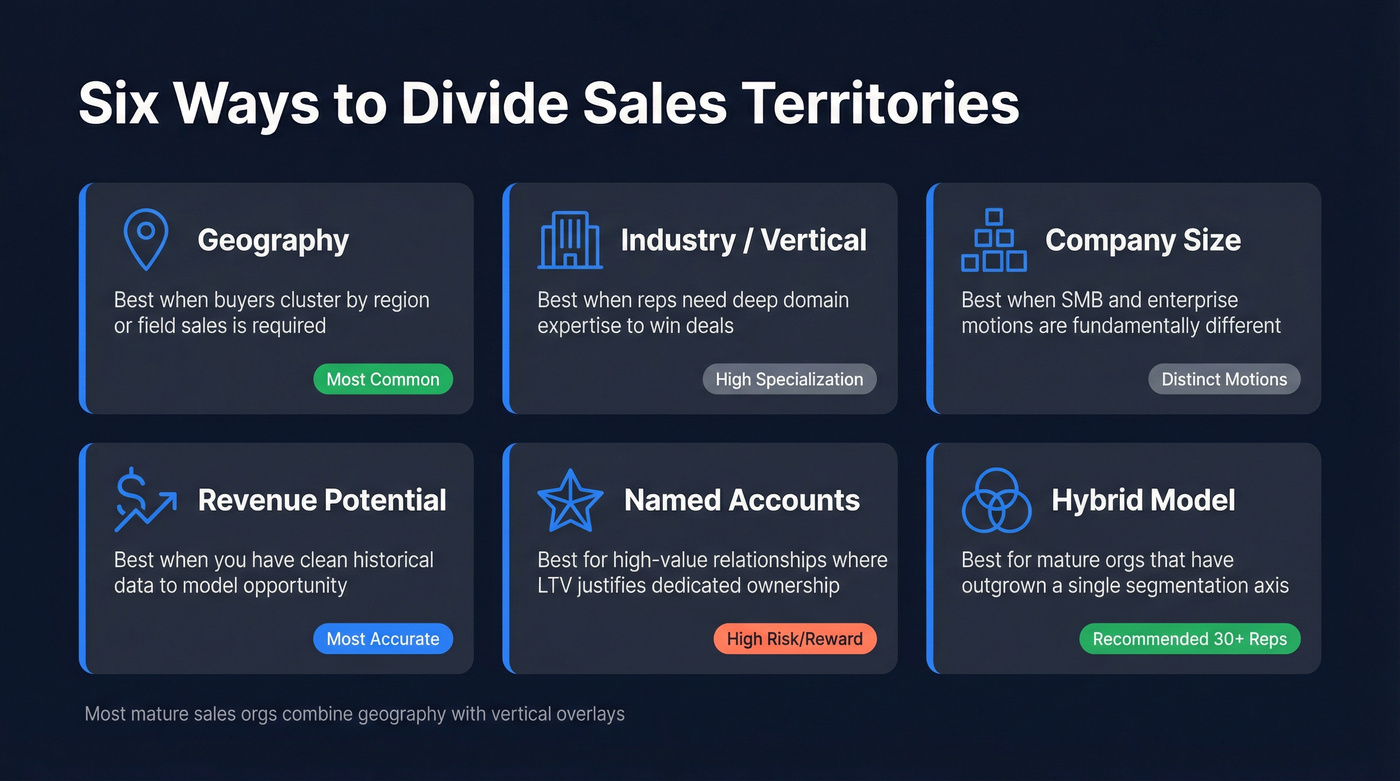
Division by Geography
Forget ZIP codes - they change over time and don't reflect real travel patterns. Use 15/20/30-minute drive-time isochrones instead. This method wins when your product requires in-person meetings or buyers cluster by region. We've found that switching from ZIP-based to drive-time-based boundaries alone can cut windshield time by 20% for field reps, which translates directly into more selling hours.
Industry-Based Territories
Early-stage startups only win in 2-4 verticals, so don't spread reps across 15 industries. A "healthcare territory" in the Midwest looks nothing like one on the East Coast. This approach is best for products that solve vertical-specific problems where reps need deep domain expertise to earn buyer trust.
Company Size
Selling to a 50-person startup and a 5,000-person enterprise are fundamentally different motions - different cycles, stakeholders, and deal sizes. If your product has distinct use cases by segment, this is your axis.
Revenue Potential
The most sophisticated approach: balance by modeled revenue opportunity, not account count. It requires clean historical data, but it's the most accurate way to ensure fairness across the team.
Named Accounts
Assign specific reps to own high-value relationships end-to-end. Just verify that LTV outweighs support costs. A single churned whale can blow up a rep's entire year.
Hybrid Models
Most mature orgs combine axes. HubSpot's NA small business team runs roughly 120 reps in micro-territories using geographic boundaries with vertical overlays. If you've outgrown a single axis, this is where you land - pairing geographic territories with industry-based ones is the most common hybrid we see in practice. The consensus on r/sales tends to agree: pure geographic models break down fast once you pass about 30 reps.

Your territory potential formula is worthless if half your prospect records are outdated. Prospeo enriches your CRM and CSV lists with 50+ data points per contact at a 92% match rate - refreshed every 7 days, not every 6 weeks. Balance territories on data that reflects reality, not last quarter's CRM dump.
Fix the inputs first. Clean data costs ~$0.01 per email.
The Math: How to Balance Territories
Here's the thing - most territory plans fail not because the segmentation is wrong, but because the balance is off. One rep gets $50M in potential; another gets $8M. Equal counts, wildly unequal opportunity.
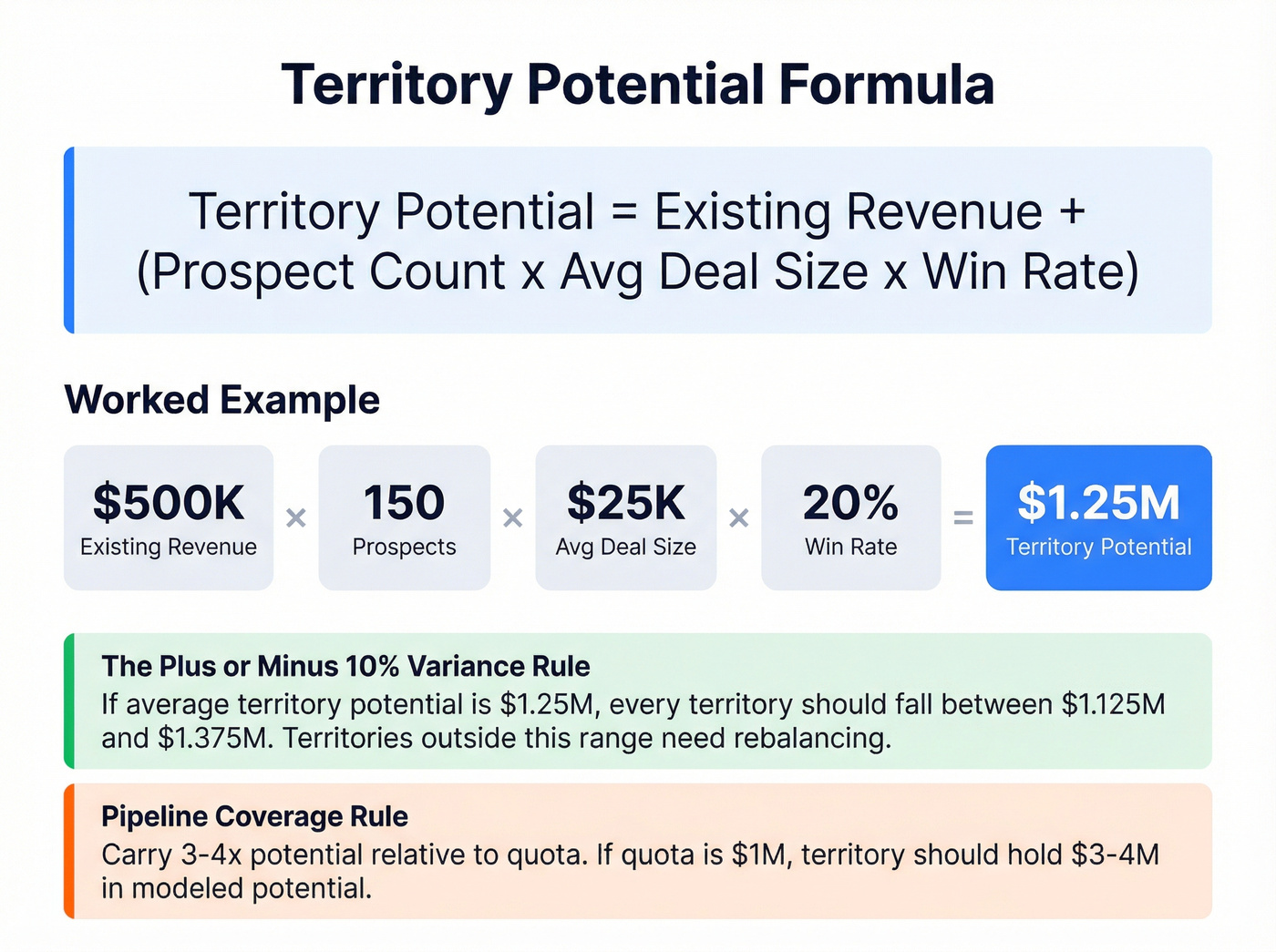
Territory Potential Formula:
Territory Potential = Existing Revenue + (Prospect Count x Avg Deal Size x Win Rate)
Example: $500K existing revenue, 150 prospects, $25K average deal, 20% win rate = $500K + (150 x $25K x 0.20) = $1.25M. Aim for ±10% variance across all territories. For planning purposes, carry 3-4x potential relative to quota - if a rep's quota is $1M, their territory should hold $3-4M in modeled potential.
Visit Capacity Formula (field sales):
Capacity = Available Selling Days x Visits Per Day
A typical rep has ~250 selling days at 4-5 visits per day, giving 1,000-1,250 visits per year. Over 95% utilization means the rep is stretched thin. Under 70% means the territory is too sparse.
| Benchmark | Default Range |
|---|---|
| SMB sales cycle | 30-45 days |
| Enterprise sales cycle | 120+ days |
| Quota attainment (high-performing) | 70-90% |
| Enterprise AE ramp time | 6-9 months |
Let's be honest: these formulas aren't complicated. The hard part is having accurate inputs. Garbage data in, garbage territories out - every time.
Five Mistakes That Kill Territory Plans
1. Static models never revisited. A plan balanced in January can be 30% off by June. Review quarterly; lock structural changes semi-annually.
If you need a repeatable cadence, run an Internal QBR so territory changes are tied to the same metrics every time.
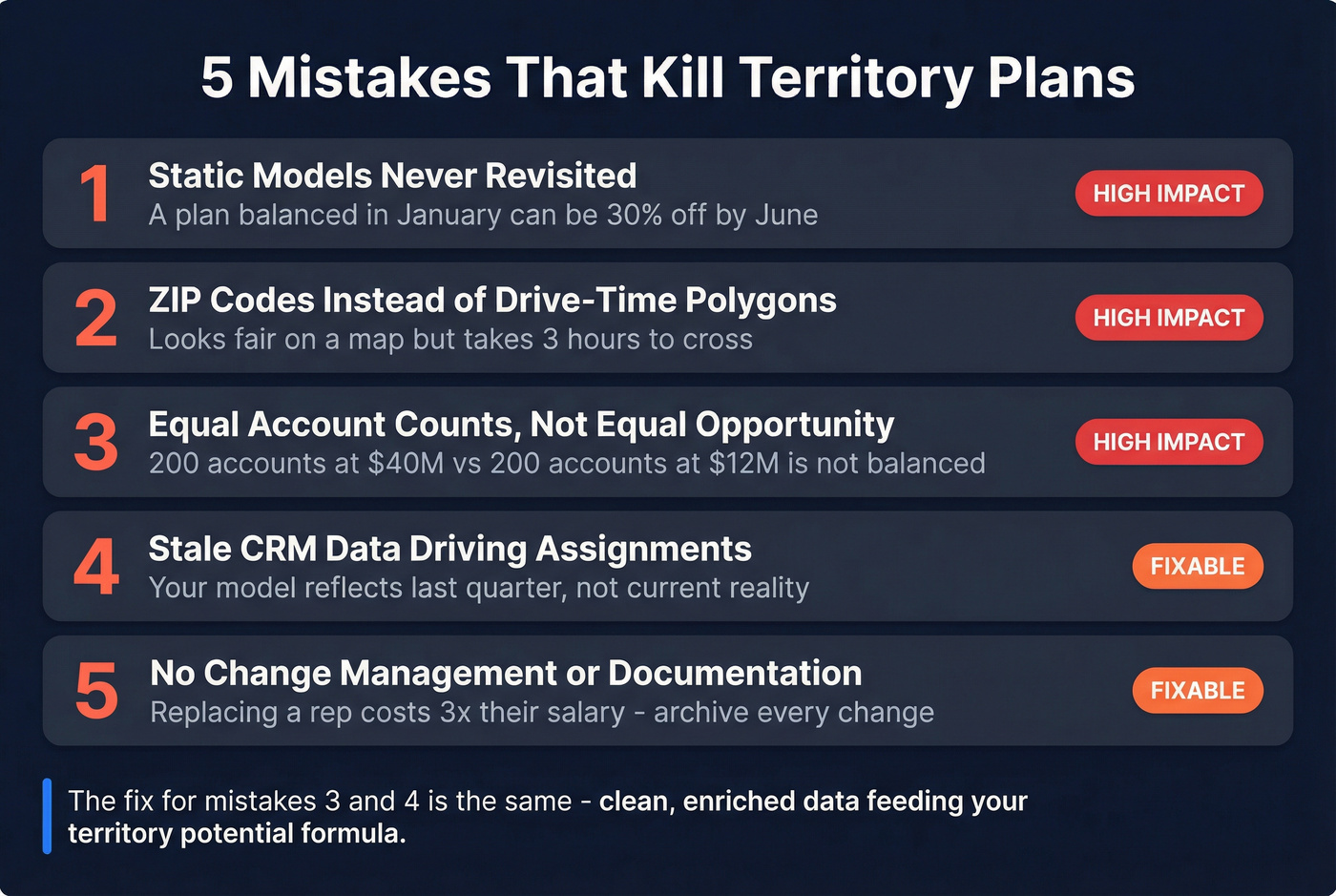
2. ZIP-code mapping instead of drive-time polygons. We've seen this kill field productivity more than once. A territory looks "fair" on a map but takes three hours to cross. One team we worked with discovered their "balanced" Northeast territory required a rep to drive through two mountain passes to reach half their accounts - something no spreadsheet would catch.
3. Equal account counts don't equal opportunity. This is the most common mistake. Overlap, unclear ownership, and unbalanced workload are the top territory planning failure modes. Balance by revenue potential, not headcount.
If you're struggling to define "opportunity" consistently, start with Account Qualification so your model isn't mixing junk accounts with real buyers.
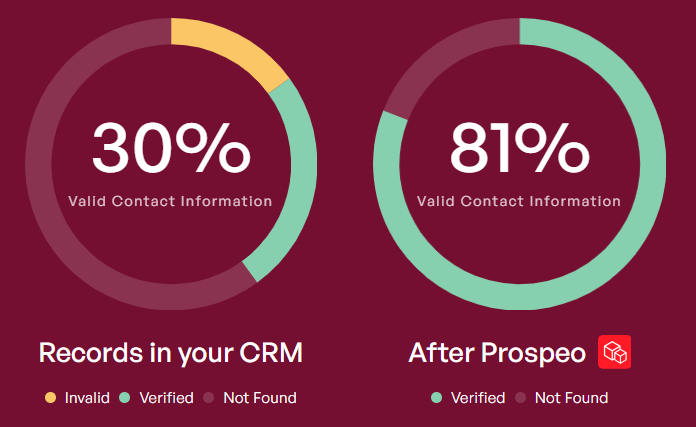
4. Stale CRM data driving assignments. Your territory plan is only as good as your account data. Before assigning territories, run your list through an enrichment tool like Prospeo, which returns 50+ data points per contact and refreshes every 7 days - so your model reflects current reality, not last quarter's CRM dump.
This is also where CRM Hygiene and B2B Contact Data Decay matter more than any mapping tool.
5. No change management. Xactly Insights' aggregated data shows reps hit peak performance at year three and often decline by year five - and replacing one can cost 3x their salary. Archive every territory change with dated maps and documented parameters. Future you will be grateful.
To keep disputes down, align on Revenue Operations Alignment so Sales, RevOps, and Marketing use the same rules of ownership.
Territory Mapping Tools
You don't need expensive software. In our experience, most teams under 50 reps get 80% of the way there with a spreadsheet and a lightweight mapping tool.
If you're evaluating your stack at the same time, use a Sales Tools Checklist to avoid buying overlapping tools.
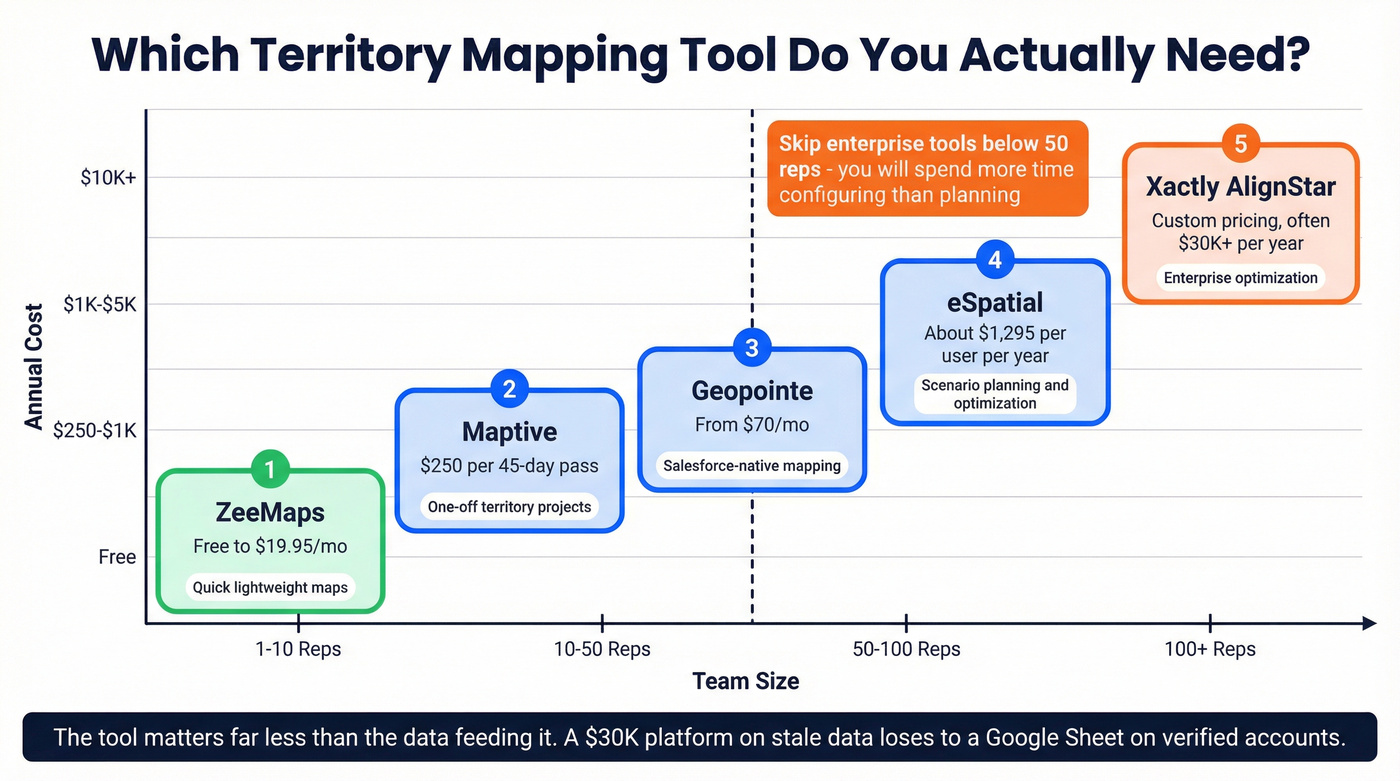
| Tool | Best For | Starting Price |
|---|---|---|
| ZeeMaps | Quick, lightweight maps | Free - $19.95/mo |
| Geopointe | Salesforce-native mapping | From $70/mo |
| eSpatial | Scenario planning + optimization | ~$1,295/user/yr |
| Maptive | One-off territory projects | ~$250/45-day pass |
| Xactly AlignStar | Enterprise optimization | Custom (often $30K+/yr) |
Enterprise tools like Xactly AlignStar make sense when you're managing hundreds of reps across complex overlays. For everyone else, start simple. Skip the enterprise tool if you have fewer than 50 reps - you'll spend more time configuring it than actually planning.
The tool matters far less than the data feeding it. A $30K mapping platform built on stale CRM records will produce worse territories than a Google Sheet built on verified accounts. Fix the inputs first.
If you want a more rigorous way to quantify the upside, run the numbers with a Sales ROI Calculator before you commit budget.
You just spent hours modeling territory potential and balancing ±10% variance across reps. Don't blow it by assigning accounts with stale emails and dead phone numbers. Prospeo delivers 98% email accuracy and 125M+ verified mobiles so every account in every territory is actually reachable.
Start free - 75 verified emails, no credit card, no contracts.
FAQ
How often should you realign sales territories?
Review quarterly using pipeline-to-quota ratio and win rate by territory. Lock structural changes semi-annually to avoid mid-cycle disruption. Full overhauls every 2-3 years or after major headcount shifts.
What's the biggest cause of territory disputes between reps?
Unbalanced workload disguised as "fair" distribution. When one rep's 200 accounts hold $40M in potential and another's hold $12M, the friction is about math, not attitude. Proper segmentation up front prevents most disputes.
How do you fix stale CRM data before territory planning?
Run your account list through a CRM enrichment tool that flags invalid emails and fills missing fields. Reps shouldn't be chasing contacts who left six months ago. Clean data is the foundation of every balanced territory model.