How to Build an Outreach Plan That Actually Works
You built a 12-touch sequence, loaded 2,000 contacts, and hit send. Open rate: 8%. Reply rate: 1.2%. Three bounces triggered a domain warning. The problem wasn't your copy - it was everything that came before it. Cold email reply rates dropped 15% year over year, and most teams are still running an outreach plan that hasn't been updated since deliverability rules changed.
Here's the thing: most outreach planning advice online is built for nonprofits and community engagement. That's not what you need. You need a framework for booking meetings with B2B buyers who don't know you exist.
Let's build one.
The Quick Checklist
Before we get into the full framework, here's what separates plans that book meetings from plans that burn domains:
- Define your ICP before touching a single tool. Industry, company size, titles, pain points. Everything downstream depends on this.
- Verify your contact data. About 28% of B2B emails go invalid every year from job changes alone. Sending to stale lists tanks deliverability.
- Go multichannel. Coordinated email + phone + social outreach delivers up to 287% higher response rates vs. single-channel.
- Set up deliverability infrastructure first. SPF, DKIM, DMARC - configured and passing before you send a single cold email.
- Track positive reply rate, not just total replies. "Not interested" is a reply. It isn't pipeline.
What Is an Outreach Plan?
An outreach plan is a structured document that defines who you're targeting, what you're saying, which channels you're using, and how you're measuring results. It turns random acts of prospecting into a repeatable system with tracking, follow-up cadences, and clear ownership.
We're focused on B2B sales outreach here - the kind where you're trying to get a VP of Engineering at a Series B company to take a 15-minute call. The mechanics differ from nonprofit or PR outreach, the stakes are higher, and the margin for error on data quality is razor-thin. A solid sales outreach plan bridges the gap between "we have a list" and "we have pipeline."
How to Build a Sales Outreach Plan
Eight steps, in order. Skip one and the whole thing underperforms.
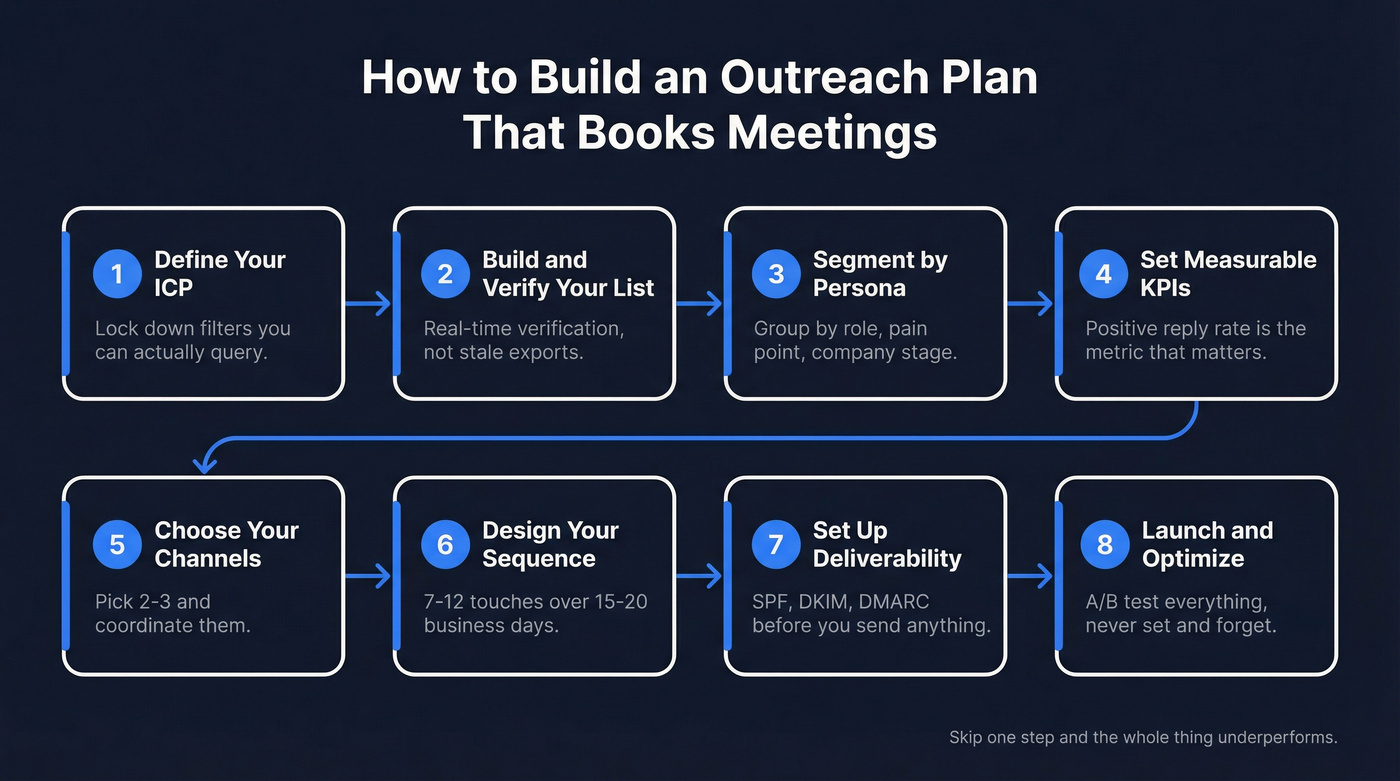
Step 1 - Define Your ICP
Your Ideal Customer Profile isn't a persona doc that lives in a shared folder nobody opens. It's a set of filters you can actually apply to a database. Lock down these components:
- Industry and sub-vertical - "B2B SaaS, 50-200 employees, selling to finance teams" is a filter. "SaaS" alone isn't.
- Company size by headcount and revenue range
- Job titles and seniority levels you're targeting
- Pain points your product solves for this specific segment
- Technographic signals - what tools they already use that indicate fit
Layer in buyer intent signals too. Companies actively researching topics related to your solution are 2-3x more likely to engage. Modern data platforms let you search across 30+ filters including intent, funding events, headcount growth, and tech stack. The tighter your ICP, the higher every downstream metric gets.
Step 2 - Build and Verify Your List
This is where most outreach plans quietly die. You pull a list from a database, dump it into your sequencer, and start sending. Two weeks later, your bounce rate is 12% and Gmail is throttling your domain.
The math is brutal: about 28% of B2B emails become invalid every year from job changes and role shifts. On the phone side, relying on switchboard numbers instead of direct dials can reduce connect rates by up to 75%. Your list is decaying right now.
Real-time verification before any outreach isn't optional - it's the foundation. We've seen this firsthand with teams using Prospeo's 7-day refresh cycle: Meritt cut their bounce rate from 35% to under 4% and tripled pipeline from $100K to $300K/week. That kind of swing doesn't come from better subject lines. It comes from sending to real, verified contacts.

Step 3 - Segment by Persona
A list of 2,000 contacts isn't one audience - it's probably four or five. Group contacts by persona (VP Sales vs. Director of RevOps), by pain point (scaling outbound vs. fixing deliverability), and by company stage (Series A vs. enterprise).
Personalization beyond first name is what separates 3% reply rates from 10%. Reference company achievements, recent funding rounds, shared connections, or segment-specific challenges. The segmentation you do here determines whether your messaging feels relevant or generic.
Step 4 - Set Measurable KPIs
Track these, at minimum:
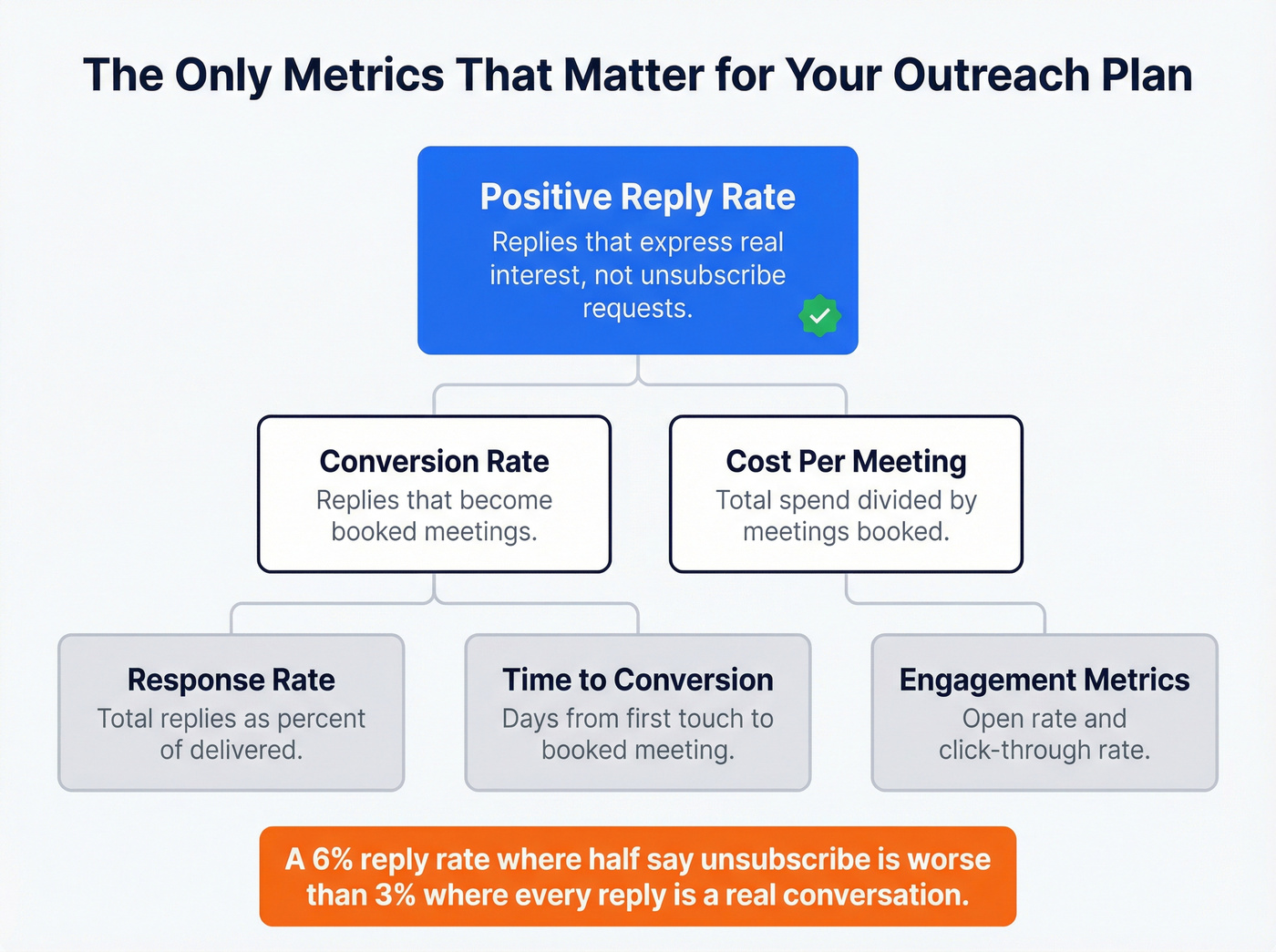
- Positive reply rate - replies that express interest, not "remove me"
- Response rate - total replies as a percentage of delivered emails
- Conversion rate - replies that become booked meetings
- Engagement metrics - open rate, click-through rate
- Time to conversion - days from first touch to booked meeting
- Cost per meeting - total spend divided by meetings booked
Positive reply rate is the only metric that truly matters. A 6% reply rate where half the replies are "unsubscribe" is worse than a 3% reply rate where every response is a genuine conversation. Optimize for quality of response, not volume.
Step 5 - Choose Your Channels
Not every channel makes sense for every ICP:
| Channel | CPL Range | Meeting Conversion | Best For |
|---|---|---|---|
| Cold email | $25-$50 | 1-3% | Scale, top-of-funnel |
| Cold calling | $75-$150 | 2-2.3% dial-to-meeting | Mid-market, urgency |
| LinkedIn/social | $50-$100 | Varies | Warm intros, ABM |
| Paid ads | $100-$300+ | Varies | Awareness, retargeting |
The real advantage is combining them. Multichannel campaigns show 20% higher close rates, 20% lower CAC, and 25% shorter sales cycles compared to single-channel. Email opens the door, a phone call builds urgency, and a social touch adds familiarity.
Pick two or three channels and coordinate them. For deals under $15k, email plus one social channel is plenty. Save the full multichannel orchestra for higher-value accounts worth the effort. Your sales engagement plan should specify exactly which channels each persona receives and in what order.
Step 6 - Design Your Sequence
Effective cadences run 15-20 business days with 7-12 touches across your chosen channels. Start with the problem, move to proof, and end with a clear next step. Each follow-up should reference the prior touch - not restart the conversation. If you need copy, start with a proven outreach email template set and adapt by persona.
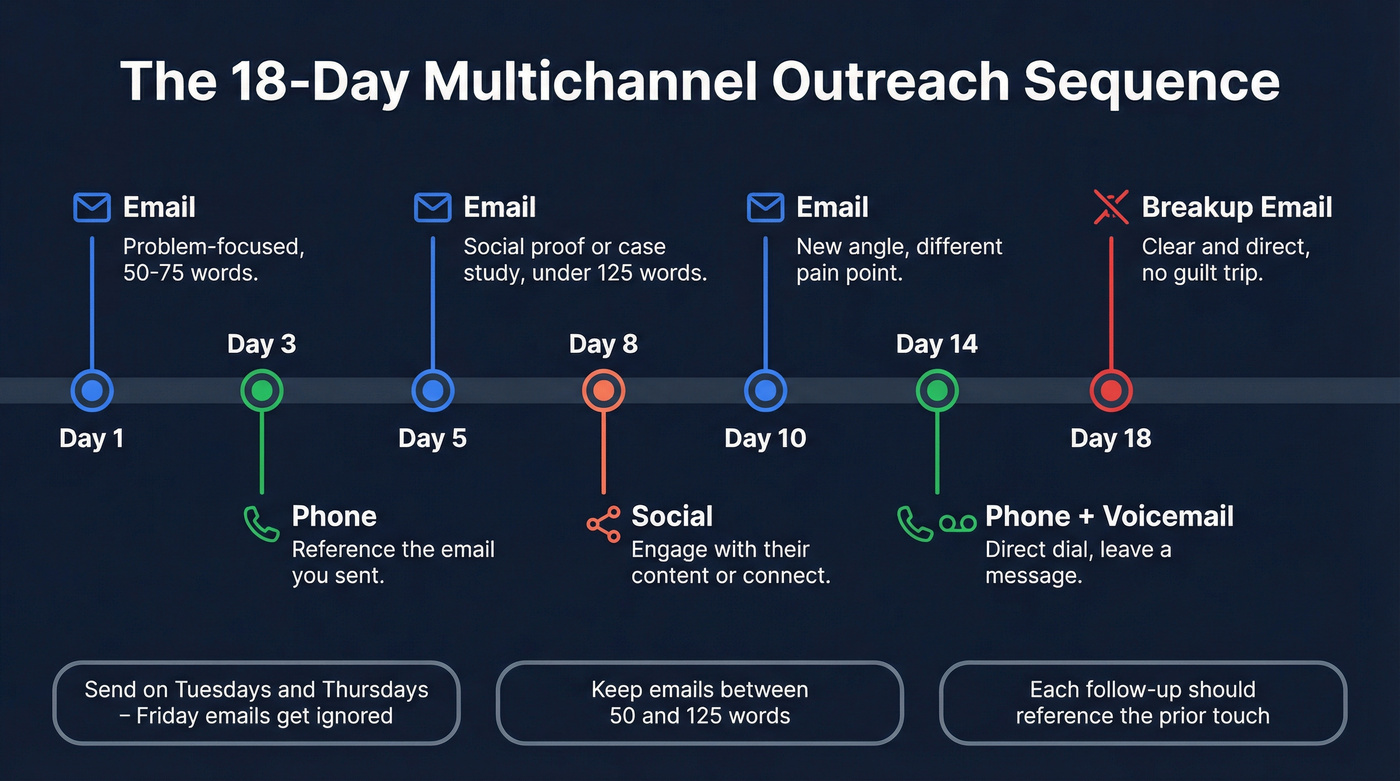
- Day 1: Email - problem-focused, 50-75 words
- Day 3: Phone call - reference the email
- Day 5: Email - social proof or case study, under 125 words
- Day 8: Social touch - engage with their content or send a connection note
- Day 10: Email - new angle, different pain point
- Day 14: Phone + voicemail
- Day 18: Breakup email - clear, no guilt trip
Send on Tuesdays and Thursdays. Friday emails get ignored. Keep every email between 50 and 125 words - shorter consistently outperforms longer.
Step 7 - Set Up Deliverability
You built the perfect sequence and your open rate is 8%. The problem isn't your subject line - it's your infrastructure. Since February 2024, Google and Yahoo require bulk senders to have SPF, DKIM, and DMARC configured and passing on every sending domain, spam complaint rates below 0.3% (0.1% is the target), and one-click unsubscribe honored within 2 days.
You also need domain warmup completed before scaling volume - start with 20-30 emails per day and ramp over 2-3 weeks. Use separate sending domains from your primary corporate domain. Skip any of these and your emails land in spam regardless of how good your copy is.
Step 8 - Launch and Optimize
Once you're live, track everything: emails sent, opens, replies, positive replies, opportunities created, and turnaround time from first touch to meeting. The winning model in 2026 is human-in-the-loop - use AI for research, enrichment, and sequencing, but keep humans in charge of relevance and personalization. We've seen teams automate 80% of the workflow and still write every opening line by hand. Those teams consistently outperform fully automated sequences.
A/B test subject lines, opening lines, CTAs, and send times. The #1 outreach mistake we see? Teams that launch a sequence and never look at the data again.

Your outreach plan dies at Step 2 if your data is stale. Prospeo's 7-day refresh cycle and 98% email accuracy keep your lists clean - Meritt cut bounce rates from 35% to under 4% and tripled pipeline to $300K/week.
Stop burning domains. Start with data that actually connects.
2026 Outreach Benchmarks
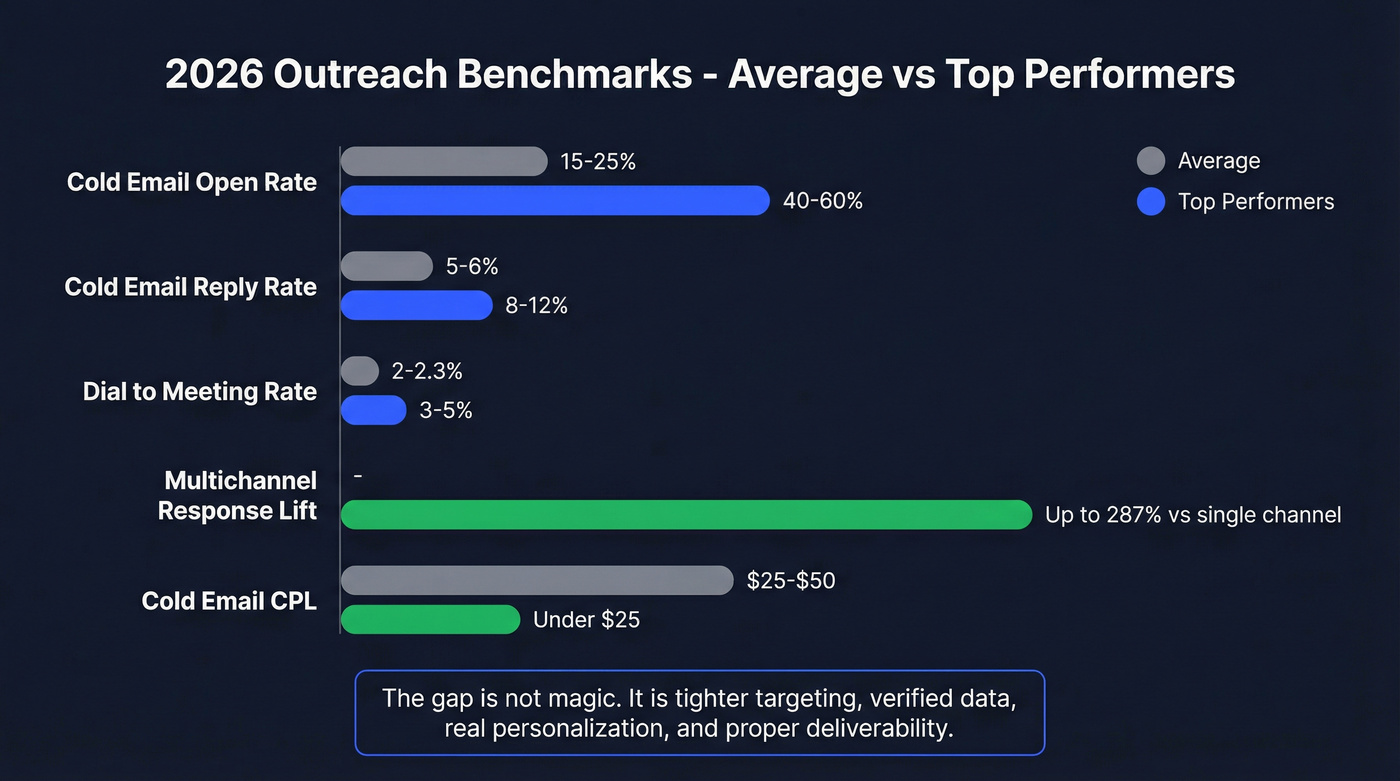
Before you judge your own numbers, you need context. Here's where the industry sits right now:
| Metric | Average | Top Performers |
|---|---|---|
| Cold email open rate | 15-25% | 40-60% |
| Cold email reply rate | 5-6% | 8-12% |
| Dial-to-meeting | 2-2.3% | 3-5% |
| Multichannel response lift | - | Up to 287% vs. single |
| Cold email CPL | $25-$50 | Under $25 |
The gap between average and top performers is enormous. And the difference isn't magic - it's tighter targeting, verified data, real personalization, and proper deliverability setup. Ask any SDR team lead and they'll tell you the same thing: bad data is the silent killer of outreach campaigns. The consensus on r/sales echoes this constantly - threads about "my reply rate tanked" almost always trace back to list quality, not messaging.
Outreach Plan Template for B2B Sales
Most templates online are built for nonprofits and community engagement. The framework below is specifically designed for B2B sales teams booking meetings with cold prospects. It works as a static doc in Google Docs or Notion, or inside a project management tool like ClickUp where you can assign owners and track deadlines.
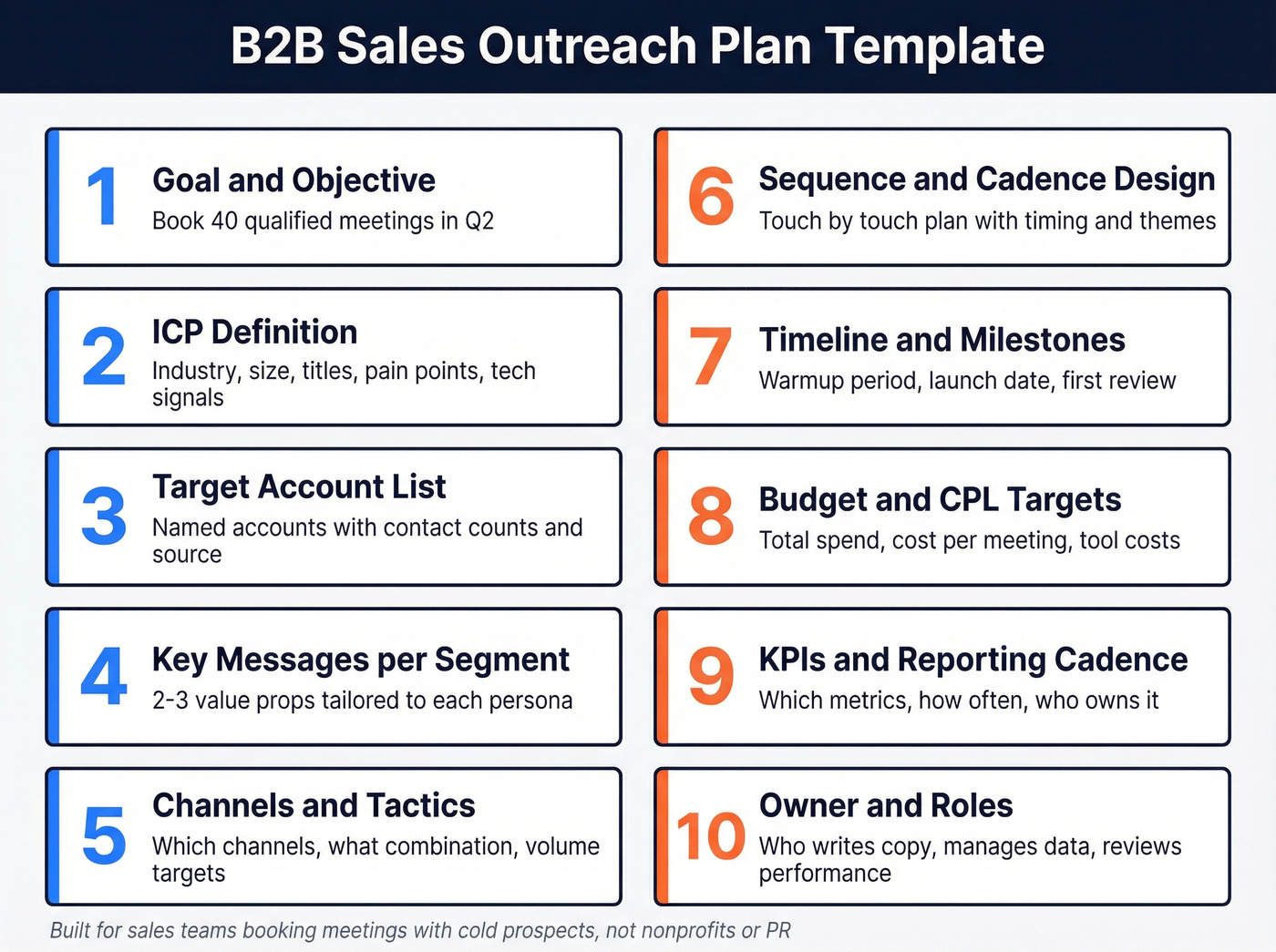
- Goal / Objective - Specific outcome with a number ("Book 40 qualified meetings in Q2")
- ICP Definition - Industry, company size, titles, pain points, tech stack signals
- Target Account List - Named accounts with contact counts and data source
- Key Messages per Segment - 2-3 value props tailored to each persona
- Channels & Tactics - Which channels, in what combination, with volume targets
- Sequence / Cadence Design - Touch-by-touch plan with timing and content themes
- Timeline & Milestones - Warmup period, launch date, first review checkpoint
- Budget & CPL Targets - Total spend, target cost per meeting, tool costs
- KPIs & Reporting Cadence - Which metrics, how often reviewed, who owns the dashboard
- Owner / Roles - Who writes copy, who manages data, who reviews performance
Five Mistakes That Kill Results
1. Skipping data verification. With 28% annual email decay, sending to an unverified list means 1 in 4 contacts is a bounce waiting to happen. Verify every contact before it enters a sequence.
2. Running single-channel only. Email-only outreach leaves massive response rates on the table. Add at least one secondary channel - even a single phone touchpoint measurably lifts conversion.
3. No deliverability setup. Without SPF, DKIM, and DMARC, your emails hit spam. Configure authentication and warm your domain before sending a single cold email.
4. Measuring total replies instead of positive replies. A 6% reply rate means nothing if half are "not interested." Track positive reply rate as your primary metric.
5. Generic templates without segmentation. "Hi {first_name}, I noticed your company..." isn't personalization. Segment by persona and pain point, then reference something specific to each segment. If your opening line works for every prospect on your list, it's not personalized enough.
Best Tools for Your Outreach Plan
Your outreach stack has three layers: data foundation (where contacts come from), sequences (how you orchestrate touches), and sending infrastructure (how emails get delivered). Don't conflate them.
| Tool | Category | Best For | Starting Price | Key Limitation |
|---|---|---|---|---|
| Prospeo | Data foundation | Verified emails + mobiles | Free (75 emails/mo) | Pair with a sequencer |
| Apollo | Prospecting + sequences | All-in-one free start | Free (100 credits/mo) | UI can overwhelm |
| Instantly | Volume sending | Multi-inbox scaling | ~$30/mo | No built-in database |
| GMass | Gmail sending | Solo operators | $25/mo | No warmup feature |
| Smartlead | Multi-inbox sending | Inbox rotation | ~$39/mo | Learning curve |
| Lemlist | Sequences | Image/video personalization | ~$59/mo per user | Pricey per seat |
| HubSpot Sequences | CRM sequences | HubSpot users | $90/mo per seat | Locked to HubSpot |
| Outreach.io / Salesloft | Enterprise engagement | Large sales teams | ~$100-150/user/mo | Overkill for SMBs |
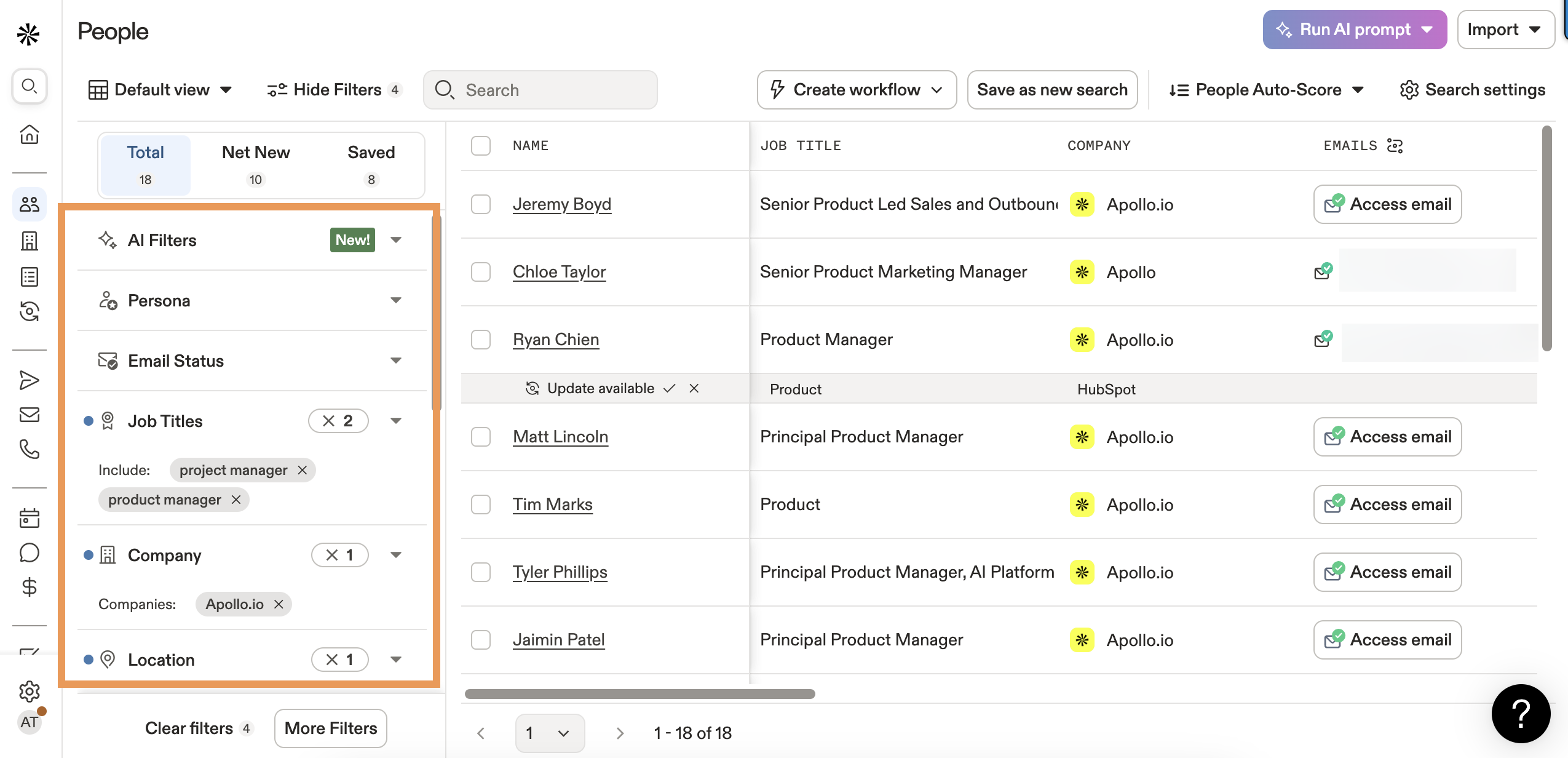
Apollo is the obvious starting point if you want prospecting and sequences in one platform. The free plan is genuinely useful - 100 credits per month, basic sequences, and a solid search interface. Paid plans start at $59/mo per user. The tradeoff: the interface tries to do everything, which means it takes time to learn what you actually need.
Instantly is purpose-built for teams scaling cold email volume across multiple sending accounts. Plans start around $30/mo and include inbox warmup, which is critical if you're running new domains. You'll need a separate data source - skip this if you don't already have a reliable contact list provider.
GMass works inside Gmail for mail merge, sequences, and basic reporting at $25-55/mo - solid for solopreneurs but pair it with a warmup tool. Smartlead competes with Instantly on multi-inbox sending at ~$39/mo. Lemlist is the pick if image and video personalization matter, at ~$59-99/mo per user. HubSpot Sequences makes sense only if you're already paying for Sales Hub Professional - don't buy HubSpot just for sequences. Outreach.io and Salesloft are enterprise-grade at ~$100-150/user/mo with annual contracts. Unless you have 20+ reps and need manager-level reporting, they're overkill.
If you're comparing platforms, start with a shortlist of cold email marketing tools and pick based on your volume, data needs, and reporting requirements.
Multichannel outreach only works when you have real emails and direct dials. Prospeo gives you 143M+ verified emails and 125M+ mobile numbers with 30+ filters to match your exact ICP - intent signals, tech stack, funding, headcount growth.
Build your entire outreach list in minutes, not days.
FAQ
What should an outreach plan include?
A complete plan needs a defined goal, ICP criteria, verified contact list, channel strategy, sequence design, deliverability setup, KPIs, budget with CPL targets, reporting cadence, and clear ownership. Skip any section and you're guessing. Use the 10-point template above and customize each field for your market.
How long should an outreach sequence be?
Plan for 15-20 business days with 7-12 touches across email, phone, and social. Progress from problem-focused messaging to proof to a clear next step. Sequences shorter than 7 touches leave 60%+ of potential replies on the table - don't bail early just because the first few emails didn't land.
What's a good cold email reply rate in 2026?
Average sits at 5-6%, while top-performing campaigns hit 8-12%. Below 3% signals a list quality or deliverability problem - fix your data before rewriting copy.
What's the best free tool for building a contact list?
Prospeo's free tier gives you 75 verified emails plus 100 Chrome extension credits per month with 98% email accuracy and a 7-day data refresh. Apollo's free plan (100 credits/mo) is a solid alternative when you also need built-in sequences.
Do I need multichannel outreach?
Yes. Coordinated email, phone, and social outreach delivers up to 287% higher response rates and 25% shorter sales cycles compared to email alone. Even adding one phone touchpoint to an email sequence measurably lifts conversion.