

3CX vs Zoom in 2026: Which Business Phone System Actually Wins?
Every comparison page for 3CX vs Zoom is either a biased 3CX forum thread where the founder calls Zoom users unintelligent, or a Capterra page with zero editorial analysis. Neither helps you make a decision.
Here's what actually changed with January 2026 pricing, what V20 Update 8 stabilized, and what real users are saying on Reddit and review sites - not what the vendors want you to hear.
30-Second Verdict
Choose 3CX if you have IT resources, need on-premise control, and want to save 80-90% on phone costs at 50+ users. The pricing math is still unbeatable at scale, even after the January 2026 hike.
Choose Zoom Phone if you want zero-hassle cloud deployment, your team already lives in Zoom Meetings, and you don't have dedicated IT staff. The mobile app alone is worth the premium for distributed teams.
Hot take: If your average deal size is under $15k and your team is under 50 people, you probably don't need either of these. Get Microsoft Teams Phone and spend the savings on better data.
3CX vs Zoom Phone at a Glance
The real question isn't "which platform?" It's whether you need a full PBX at all. If you just need people to make and receive calls from their laptops, both are overkill. But if you're here, you probably need more than that.
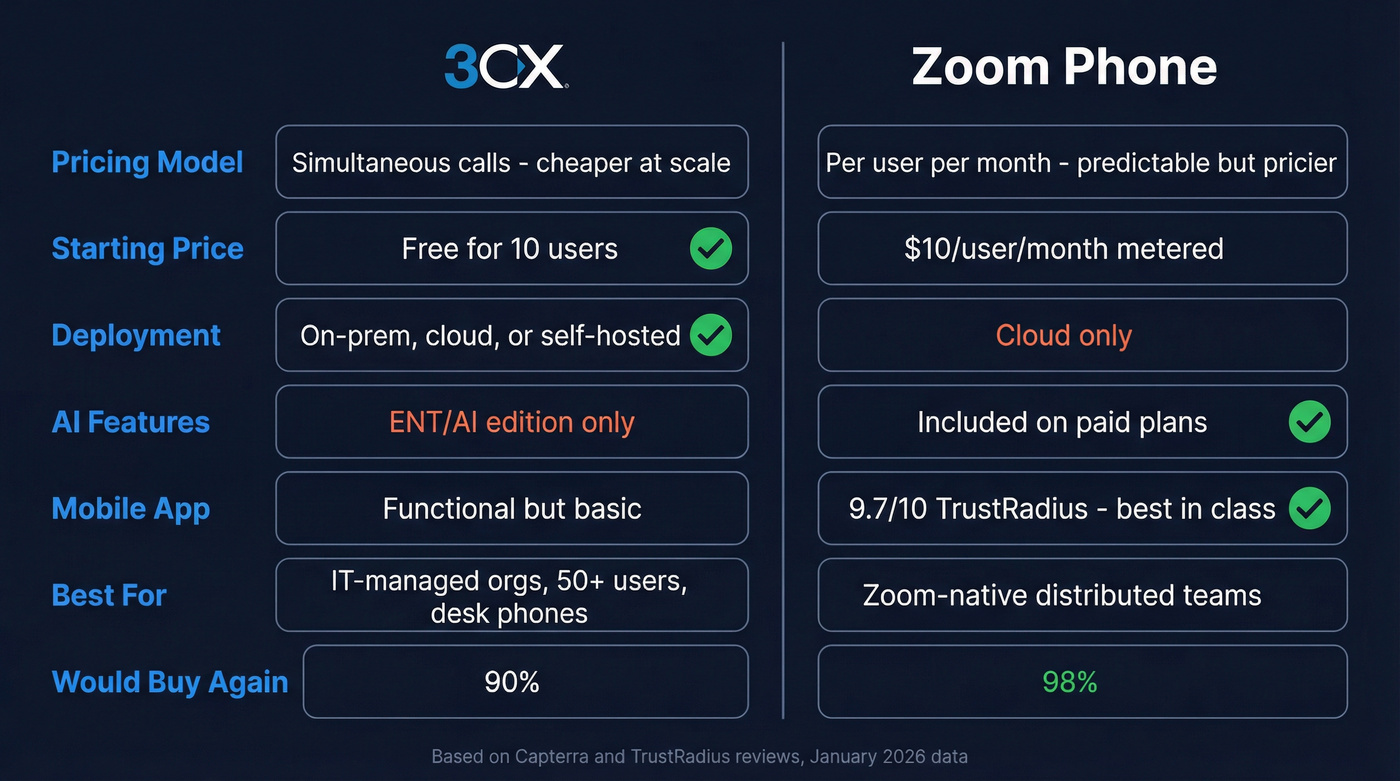
| Category | 3CX | Zoom Phone | Edge |
|---|---|---|---|
| Pricing model | Simultaneous calls | Per user/month | 3CX (cheaper at scale) |
| Starting price | Free (10 users or fewer) | $10/user/mo (metered) | 3CX |
| Deployment | On-prem, cloud, self-hosted | Cloud only | 3CX (more options) |
| AI features | ENT/AI edition only | Included (paid plans) | Zoom (broader access) |
| Mobile app | Functional | 9.7/10 TrustRadius | Zoom |
| Best for | IT-managed orgs, 50+ users | Zoom-native teams | - |
| Capterra rating | 4.4/5 (463 reviews) | 4.5/5 (240 reviews) | Zoom (marginally) |
| TrustRadius "buy again" | 90% | 98% | Zoom |
The ratings gap is small, but that "would buy again" gap is telling. 98% vs 90% says something about day-to-day satisfaction that aggregate scores don't capture.
Pricing - The Real Math at Every Team Size
3CX's pricing model is genuinely different from anything else in the market. You don't pay per user or per extension - you pay by simultaneous call capacity. A 150-person office where maybe 30 people are on the phone at once? You're paying for 30 simultaneous calls, not 150 seats.
Post-January 2026, 3CX PRO runs roughly $1.20-1.40/user/month equivalent (up from $1.08), with the ENT/AI edition higher. The 3CX Sales Director confirmed the hike in their community forums, and the founder said annual increases are "predictable now." Partners weren't even told in advance whether prices were going up or down - just told to close deals fast.
Zoom Phone is straightforward: $10/user/month metered, $15 unlimited domestic, $20 for Global Select with 40+ countries. The Pro Plus bundle (Phone + Workplace) runs $18.33/user/month billed annually, and Business Plus hits $22.49/user/month.
What Zoom doesn't advertise: The $10/month Metered plan charges $0.0242/min for outbound calls - fine for inbound-heavy teams, expensive for outbound. Additional phone numbers cost $5/month each. Toll-free SMS runs $0.0070/message. These add-ons stack up fast.
Here's where it gets real:
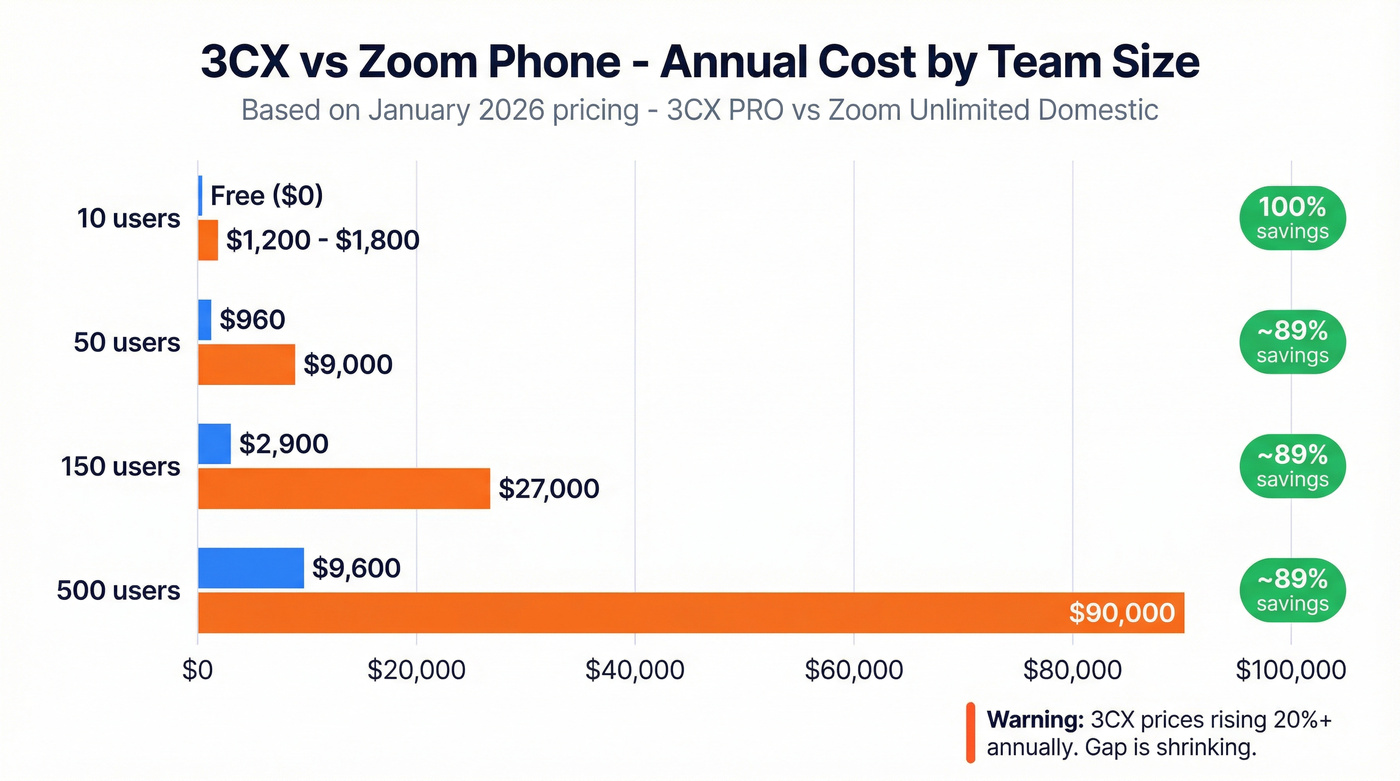
| Team size | 3CX (annual) | Zoom Unlimited (annual) | Savings with 3CX |
|---|---|---|---|
| 10 users | Free (StartUp) | $1,200-$1,800 | 100% |
| 50 users | ~$960 | $9,000 | ~89% |
| 150 users | ~$2,900 | $27,000 | ~89% |
| 500 users | ~$9,600 | $90,000 | ~89% |
That education case study from the 3CX forums is real: a school running 150 extensions pays roughly $2,900/year total on 3CX. Zoom quoted them $27,000.
But - and this is the part 3CX fans don't want to talk about - that pricing advantage is eroding. 3CX has been hiking prices 20%+ annually. Starting April 2026, they're enforcing maximum user limits per license tier, which partners are calling "per-user licensing in disguise." The simultaneous-call model that made 3CX special is slowly becoming a traditional licensing scheme with extra steps.
3CX is still dramatically cheaper. The gap is shrinking, though, and the licensing complexity is growing.

You're optimizing your phone system - but are your reps actually reaching decision-makers? 3CX and Zoom Phone don't matter if you're dialing wrong numbers. Prospeo gives you 125M+ verified mobiles with a 30% pickup rate and 98% email accuracy.
Fix the data before you fix the dialer.
Core Features Head-to-Head
Your CEO says "just use Zoom" - but you need call queues, IVR, 15 extensions for support, and TFTP provisioning for 150 desk phones. That's where the conversation gets interesting.
Calling and Call Routing
3CX's call routing scores 4.4 on Capterra vs Zoom's 4.2. The difference shows up in complex scenarios: multi-level IVR trees, ring groups with overflow rules, call queue management with real-time wallboards. 3CX was built as a PBX first. It shows.
Zoom Phone's cloud PBX features score 9.4/10 on TrustRadius - 16% above the category average. For straightforward call management, it's excellent. But when an MSP on Reddit needed shared number functionality across multiple users with SMS/MMS, Zoom Phone couldn't deliver. They started shopping for alternatives.

Video Conferencing
No contest. Zoom rates 4.7 on Capterra for video; 3CX sits at 4.4. 3CX added video conferencing, but it's a bolt-on to a phone system. Zoom is a video platform that added phone. If video matters, Zoom wins by default.
Mobile Experience
Zoom Phone's mobile app scores 9.7/10 on TrustRadius - 19% above the category average. For distributed teams where reps are taking calls from their cars, airports, and coffee shops, this matters more than any PBX feature.
3CX's mobile app works, but Capterra reviewers note you can't see direct-dial numbers on handsets, and the experience isn't as polished.
Messaging and Chat
3CX includes built-in live chat and messaging - useful for teams that want website chat and internal messaging in one system. Zoom has Team Chat, which integrates tightly with Meetings and Phone. Neither is replacing Slack, but Zoom's chat feels more modern and gets more daily use from teams already in the ecosystem.
The PBX Gap
3CX supports TFTP provisioning and multicast paging that Zoom simply doesn't offer. When that school with 150 desk phones evaluated Zoom, the response was essentially "code the provisioning yourself or hand-configure 150 phones." For organizations with physical phone infrastructure, this isn't a minor gap.
It's a dealbreaker.
Integrations and Ecosystem
This is where Zoom pulls ahead for most modern sales and support teams. Zoom Phone integrates natively with Salesforce, Microsoft Teams, Slack, and Zendesk. It also supports hybrid deployments with Avaya and Mitel systems - a genuine differentiator for enterprises migrating gradually from legacy PBX to cloud.
3CX offers CRM integrations too (Salesforce, HubSpot, Microsoft Dynamics), plus a Teams integration that lets you make 3CX calls within the Teams interface. But Zoom's ecosystem is broader and the integrations are more polished.
AI Features - Zoom AI Companion vs 3CX Agentic AI
Both platforms shipped AI features in 2025-2026. Neither is going to replace your team. But one is more practical today.
Zoom AI Companion
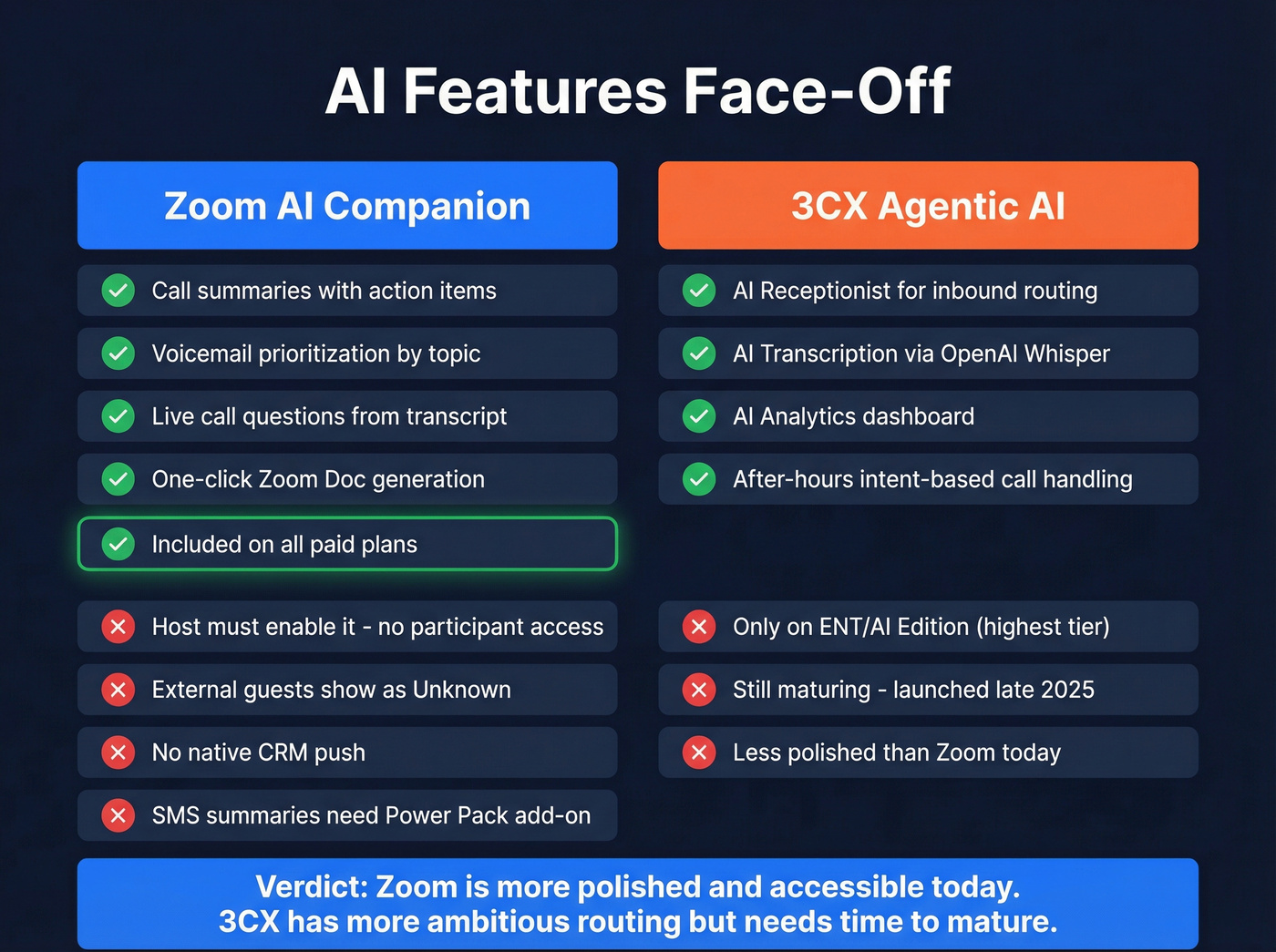
Zoom's AI Companion comes included with paid plans at no extra cost:
- Call summaries with dates, names, discussion points, and action items
- Voicemail prioritization based on user-defined topics
- Voicemail task suggestions that analyze content and recommend next steps
- Call questions - ask "when did they say the event is?" during a live call and AI references the transcript
- One-click Zoom Doc generation from call summaries
The limitations are frustrating. It only works when the host enables it - participants can't independently access summaries. External guests show as "Unknown" in speaker identification. There's no native CRM push, so you're copy-pasting summaries manually. And Team SMS summaries require the Power Pack add-on, which feels nickel-and-dime for a feature marketed as "included."
3CX Agentic AI
V20 Update 8 introduced 3CX's AI suite: AI Analytics, AI Transcription, AI Receptionist, and OpenAI Whisper integration. The AI Receptionist handles inbound calls and routes based on intent - genuinely useful for after-hours coverage.
The catch: it's only available on the ENT/AI Edition. And it's new. We haven't tested 3CX's AI deeply enough to recommend it over Zoom's more mature implementation, but the AI Receptionist concept is compelling for businesses that get high call volumes outside business hours.
Bottom line: Zoom's AI is more polished and broadly available today. 3CX's AI has more ambitious routing capabilities but is locked behind the highest-tier license and still maturing.
Deployment and Security
Deployment - On-Premise vs Cloud-Only
This is 3CX's structural advantage and Zoom's structural limitation.
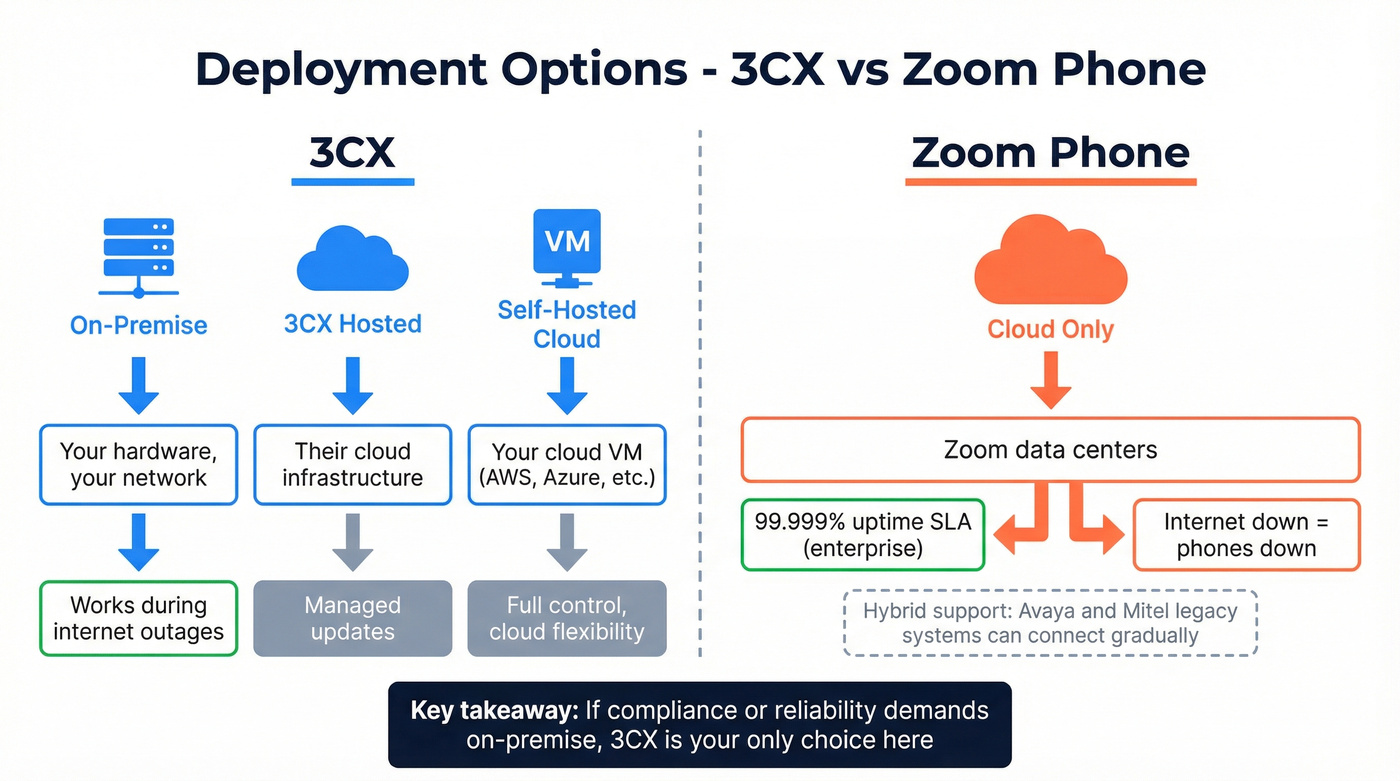
3CX offers three deployment models: on-premise (your hardware, your network), 3CX hosted (their cloud), or self-hosted (your cloud VM). On-premise means your phones keep working during internet outages via local backup routes. You get direct gateway connectivity. Complete control.
Zoom Phone is cloud-only. Period. Lower capital investment, less IT overhead, automatic updates. But if your internet goes down, your phones go down. Zoom does support hybrid deployments with Avaya and Mitel systems, which helps enterprises migrating from legacy PBX infrastructure gradually rather than ripping and replacing.
If you need on-premise control - for compliance, for reliability, for sheer stubbornness - 3CX is your only option between these two.
Security - The Elephant in the Room
We have to talk about this.
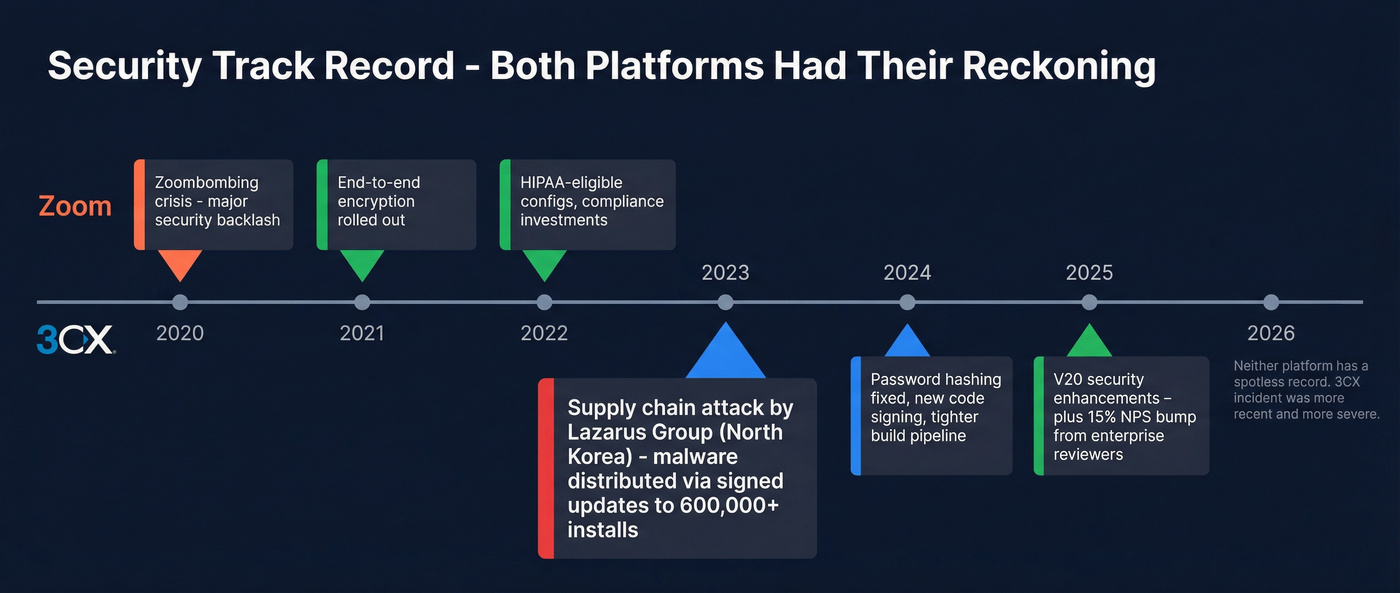
In March 2023, 3CX suffered one of the most sophisticated supply chain attacks in recent memory. North Korean state actors (Lazarus Group) compromised 3CX's build systems after an employee installed compromised software on a personal computer. The attackers stole corporate VPN credentials, infected both Windows and macOS build pipelines, and distributed malware through signed desktop app updates across 3CX's 600,000+ installation base.
The malware was signed with valid 3CX certificates. Google had to invalidate 3CX's code signing certificate entirely. Mandiant was brought in to investigate. And it came out that 3CX wasn't properly hashing passwords before the incident.
3CX has implemented significant security improvements since - proper password hashing, new code signing infrastructure, and tighter build pipeline controls. V20's security enhancements earned a +15% NPS bump from enterprise reviewers. But the breach happened, and security-conscious organizations should evaluate 3CX's current audit posture before committing.
Zoom offers a 99.999% uptime SLA for enterprise plans, HIPAA-eligible configurations, and compliance with Kari's Law and Ray Baum Act requirements. Zoom had its own security reckoning during the "Zoombombing" era of 2020, but they've invested heavily in end-to-end encryption and compliance infrastructure since.
Neither platform has a spotless record. 3CX's incident was more recent and more severe.
What Real Users Say
Zoom Phone Users: Easy Setup, Shaky Support
The sentiment is mostly positive with a support asterisk. A 10-month review from an office manager who switched from Nextiva captures it well: "Even my least-competent employee had no problems whatsoever." Call quality is consistently praised. The implementation specialist walked them through everything.
The negatives are real though. That same reviewer had three different account executives in roughly one year. Customer Care initially denied that extensions, IVR, and voicemail were part of their subscription - then reversed after the contract was shown. That's not a bug; that's a support culture problem.
Another user couldn't make or receive calls on go-live day. Zoom classified it as a "4 - low priority ticket" with a 1-3 business day response. The AI phone support was broken - it asked for a 6-digit PIN but only recognized 5 digits. They set up a competitor system while waiting for Zoom to fix it.
3CX Users: Cheaper, but V20 Burned Trust

The V20 migration was rough for many. A Capterra reviewer called it "an alpha release - unstable and missing basic features we relied on in V18." SMB satisfaction dropped 22% year-over-year on Capterra due to V20's steep learning curve and missing features.
Partners are even angrier. One wrote on r/VOIP: "Between 3CX banning partners for speaking up on issues and the push to fund his new 3CX AI hosted infrastructure, this is just extortion." 3CX published a strategic direction blog post, then deleted all critical comments.
That's not a good look.
V20 Update 8 has stabilized things considerably - eight major updates suggest 3CX heard the feedback. But trust takes longer to rebuild than software.
The Numbers
| Metric | 3CX | Zoom Phone |
|---|---|---|
| Capterra | 4.4/5 (463 reviews) | 4.5/5 (240 reviews) |
| TrustRadius | 8.4/10 | 8.5/10 |
| Exafol | 4.7/5 | 4.2/5 |
| G2 | 4.4/5 (529 reviews) | 4.3/5 (57 reviews) |
| Would buy again | 90% | 98% |
| Recommend score | 7.5/10 | 9.2/10 |
| Support rating | 5.4/10 | 6.6/10 |
G2 lists Zoom Contact Center separately, so Zoom Phone doesn't have comparable review volume there. Exafol skews toward technical users, which explains 3CX's higher score on that platform.
That 7.5 vs 9.2 likelihood-to-recommend gap is the biggest red flag for 3CX. And support at 5.4/10 is genuinely poor.
When Neither 3CX nor Zoom Phone Is Right
Yeastar - the most commonly recommended 3CX alternative among MSPs migrating away. On-premise capable, cleaner licensing, and none of the partner drama. Pricing runs ~$2,000-5,000/year for mid-size deployments depending on features.
VitalPBX - the go-to for multi-tenant MSP deployments. If you're managing phone systems for multiple clients and 3CX's licensing changes have you looking for the exit, VitalPBX is where most partners land. Free tier available; commercial licenses start around $500-1,500/year.
Microsoft Teams Phone - if you're already paying for Microsoft 365 E5, Teams Phone is included. Don't buy a separate phone system. It won't match 3CX's PBX depth or Zoom's mobile polish, but the marginal cost is zero and the integration with Outlook, SharePoint, and Teams chat is native and tight. Standalone plans run ~$8-15/user/month.
Skip both 3CX and Zoom if: you need multi-tenant MSP support (VitalPBX), you're already on M365 E5 (Teams Phone), or you want on-premise without 3CX's licensing drama (Yeastar).
Final Verdict
Choose 3CX if:
- You have 50+ users and dedicated IT resources
- On-premise deployment is a requirement (compliance, reliability, control)
- You need deep PBX features: multi-level IVR, call queues, TFTP provisioning, multicast paging
- Maximum cost savings matters more than polish - you'll save 80-89% vs Zoom at scale
- You can stomach the licensing uncertainty and V20 growing pains
Choose Zoom Phone if:
- You want fast cloud deployment with minimal IT involvement
- Your team already uses Zoom Meetings (the integration just works)
- Mobile experience is a priority - that 9.7/10 app rating is earned
- You don't have dedicated IT staff and don't want to manage a PBX
- You value stability and support over raw cost savings
Choose neither if:
- You're under 50 employees and don't need PBX features - just get Teams Phone
- You're an MSP tired of 3CX's annual licensing surprises - look at Yeastar or VitalPBX
- Your real problem is data quality, not the phone system - no platform verifies the numbers your reps dial, and bad data kills connect rates faster than any phone system can fix them
Whichever side of the 3CX vs Zoom debate you land on, the phone system is just plumbing. What flows through it - the accuracy of your contact data, the quality of your dial lists - determines whether reps actually connect.
That school saved $24K/year picking 3CX over Zoom. Smart move. Now imagine your sales team reaching 3x more prospects with verified direct dials instead of gatekept main lines. Prospeo delivers at $0.01/email - 90% cheaper than ZoomInfo.
Stop saving on phones and losing on bad contact data.
FAQ
Is 3CX really free?
Yes, for up to 10 users on StartUp/Basic. Beyond that, you pay by simultaneous call capacity - roughly $1.20-1.40/user/month on PRO after the January 2026 increase. The free tier is genuinely useful for tiny offices but lacks AI features and advanced call routing.
Can Zoom Phone replace a traditional PBX?
For most teams under 100 people without physical desk phones, yes. It handles call routing, IVR, voicemail, and auto-attendants well. But it lacks TFTP provisioning and multicast paging - if you have 150+ desk phones, Zoom can't provision them at scale.
Is 3CX safe to use after the 2023 supply chain attack?
3CX has implemented proper password hashing, new code signing infrastructure, and tighter build controls since the Lazarus Group breach. V20 security improvements earned a +15% NPS bump from enterprise reviewers. Request current SOC 2 or audit documentation before committing.
Which is better for outbound sales teams?
Both handle outbound calling fine - that's table stakes. The bigger factor is data quality. Neither platform verifies the numbers you're dialing. Pair either with a verification layer like Prospeo to stop burning dials on dead numbers.
Does 3CX work with Microsoft Teams?
Yes, 3CX offers Teams integration for making and receiving calls within the Teams interface. But if you're on M365 E5 where Teams Phone is included, running 3CX alongside adds complexity for marginal benefit. Pick one ecosystem.