How to Build a Sales Sequence That Books Meetings in 2026
A RevOps lead we know ran a 3-tool bake-off last quarter. The winning sequence platform wasn't the one with the fanciest AI features - it was the one connected to a clean contact list. The "best" tool bounced a painful chunk of emails on Day 1 and torched the domain before Step 2 ever fired. Expensive lesson, simple takeaway: your sales sequence is only as good as the data underneath it.
What Is a Sales Sequence?
It's a planned series of touchpoints - emails, calls, social messages - designed to move a specific prospect toward a meeting or reply. One-to-one, response-driven, and it stops when the prospect engages.
Don't confuse it with a marketing drip, which is one-to-many, HTML-heavy, and built to nurture over weeks or months. A well-built sequence is plain-text, multi-channel, and stops immediately on reply to avoid those cringe-worthy automated follow-ups after someone already said yes.
Then there's the sales cadence, which HubSpot frames as the broader timing philosophy behind your sequences - the org-level rhythm that dictates how frequently reps touch prospects across all their active outreach. The cadence is the policy; the sequence is the execution. Most teams use the terms interchangeably, and that's fine in conversation, but the distinction matters when you're building process.
What You Need Before Writing a Single Email
Three things:
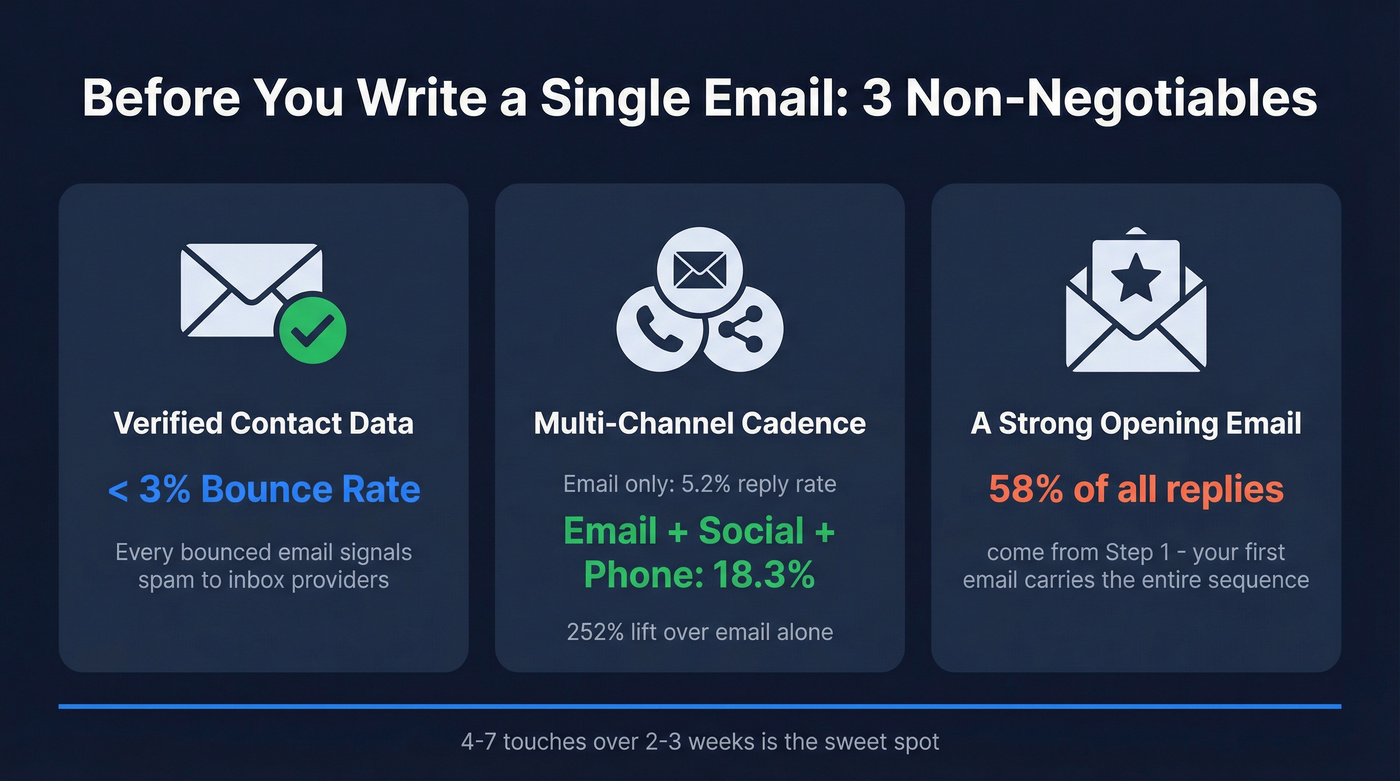
- Verified contact data. If your emails bounce, nothing else matters. Target under 3% bounce rate.
- A multi-channel cadence of 4-7 touches. Email alone gets you 5.2% reply rates. Add social and phone, and that jumps to 18.3%.
- A strong opening email. 58% of all replies come from Step 1. Your first email carries the entire sequence.
2026 Outbound Benchmarks
Most teams don't know what "good" looks like. They run sequences for months without a baseline. Here's what the data says.
| Metric | Average | Top Quartile | Elite (Top 10%) |
|---|---|---|---|
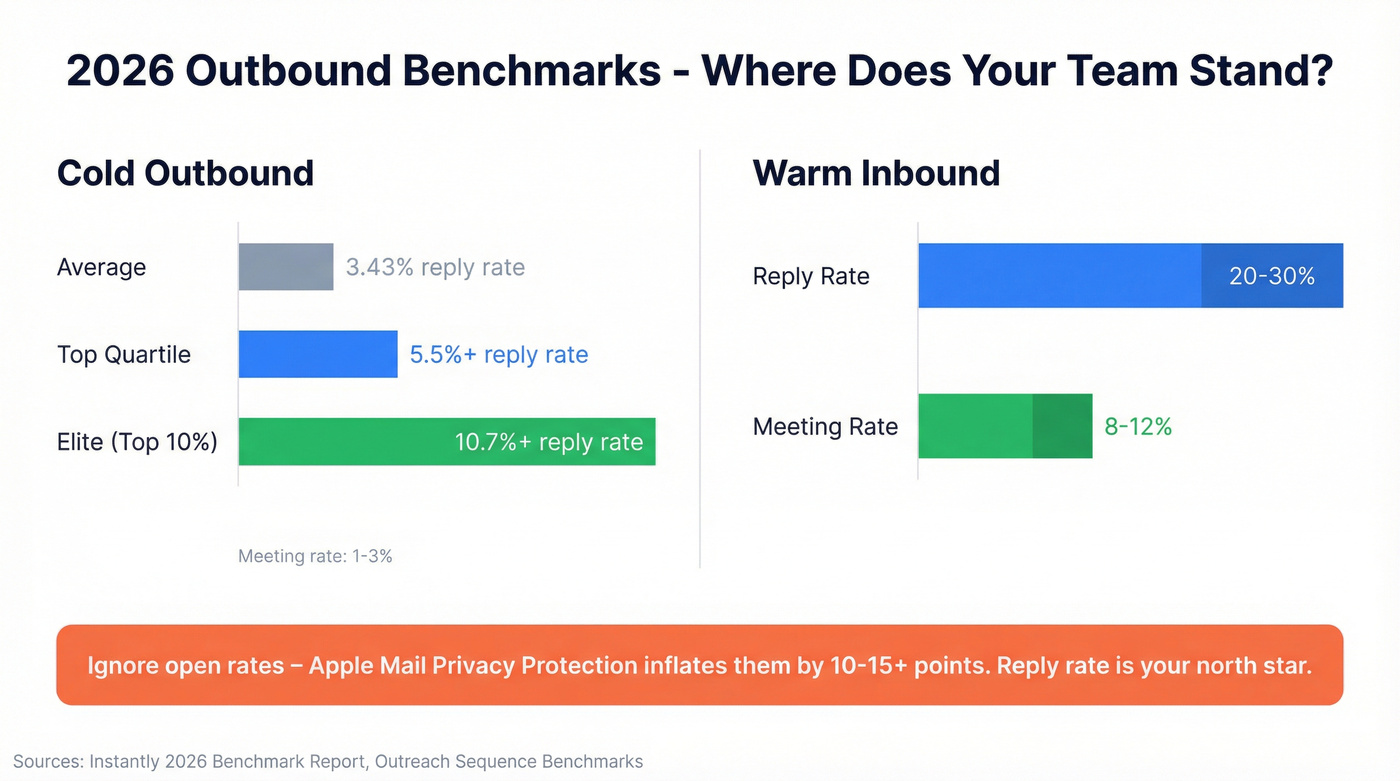
| Cold email reply rate | 3.43% | 5.5%+ | 10.7%+ |
| Cold outbound meeting rate | 1-3% | - | - |
| Warm inbound reply rate | 20-30% | - | - |
| Warm inbound meeting rate | 8-12% | - | - |
The cold email reply rate tiers come from Instantly's 2026 report, which analyzed billions of interactions across thousands of workspaces. Meeting rate and warm inbound ranges come from Outreach's sequence benchmarks. Outreach also reports a broader "prospect reply rate" of 8-15% for cold outbound - that figure includes replies via phone and email, which explains the gap with Instantly's email-only number.

One more thing: ignore open rates. Apple Mail Privacy Protection inflates them by 10-15+ percentage points. Reply rate is your real north star.
Here's the thing - if your average deal size is under $10K and your total addressable list is under 5,000 accounts, you probably don't need a $150/seat sequencer. A verified list, a basic tool like Instantly, and disciplined follow-up will outperform a bloated tech stack every time.
How to Build a Sales Sequence
Start With Clean Data
60% of prospects are lost due to poor targeting. That's not a sequence problem - it's a data problem. Before you write a single email, make sure your list is accurate and your emails won't bounce.
The target is a bounce rate under 3%. Anything above that starts burning your domain reputation, and once deliverability tanks, even perfect copy won't save you. We've seen this firsthand: Meritt was running at 35% bounce rates before switching their data source to Prospeo, which dropped them under 4% and tripled their pipeline from $100K to $300K per week.
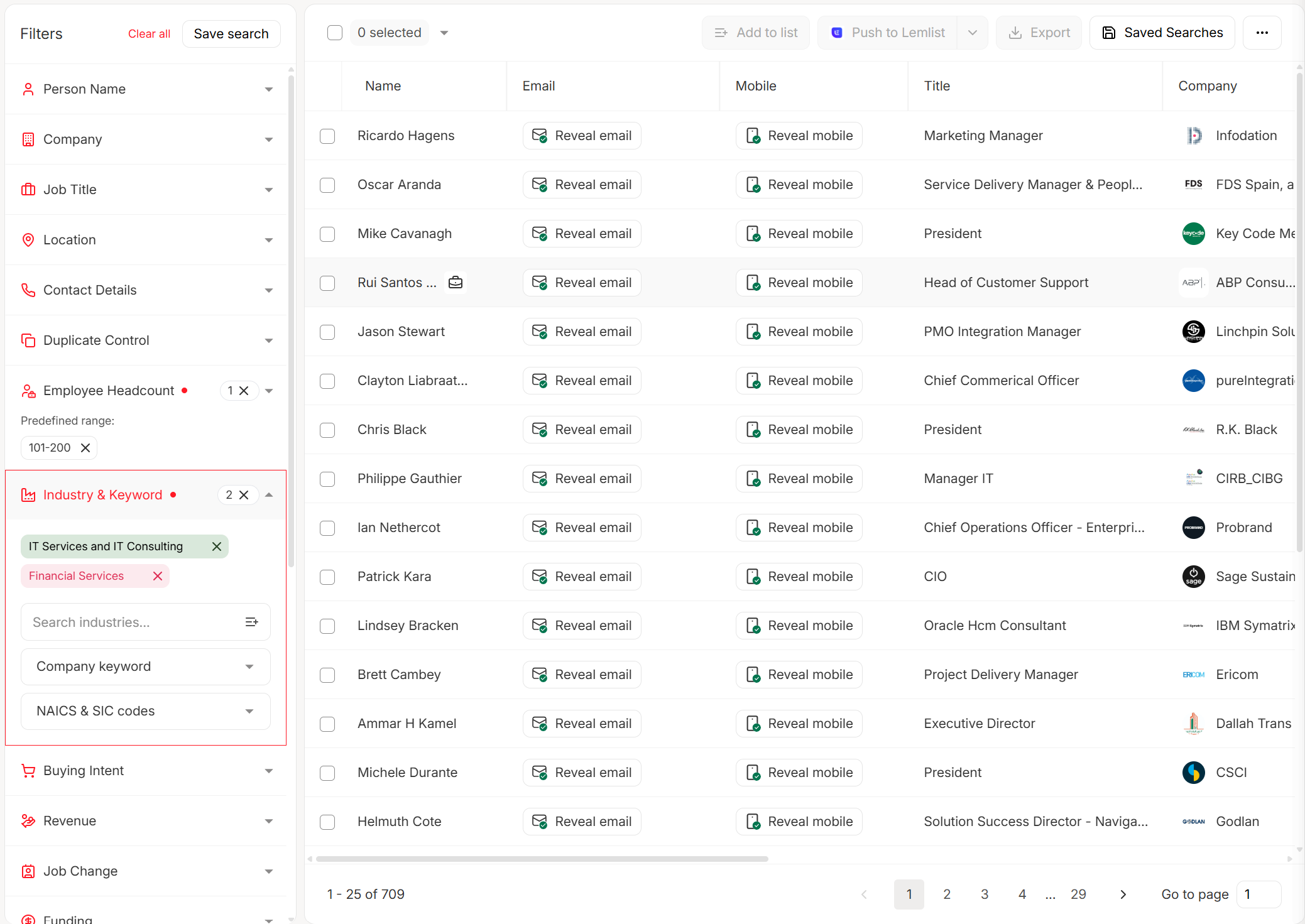
The math is straightforward. Verified emails cost about $0.01 each. A bounced email that kills your domain reputation costs infinitely more.
Choose Your Step Types
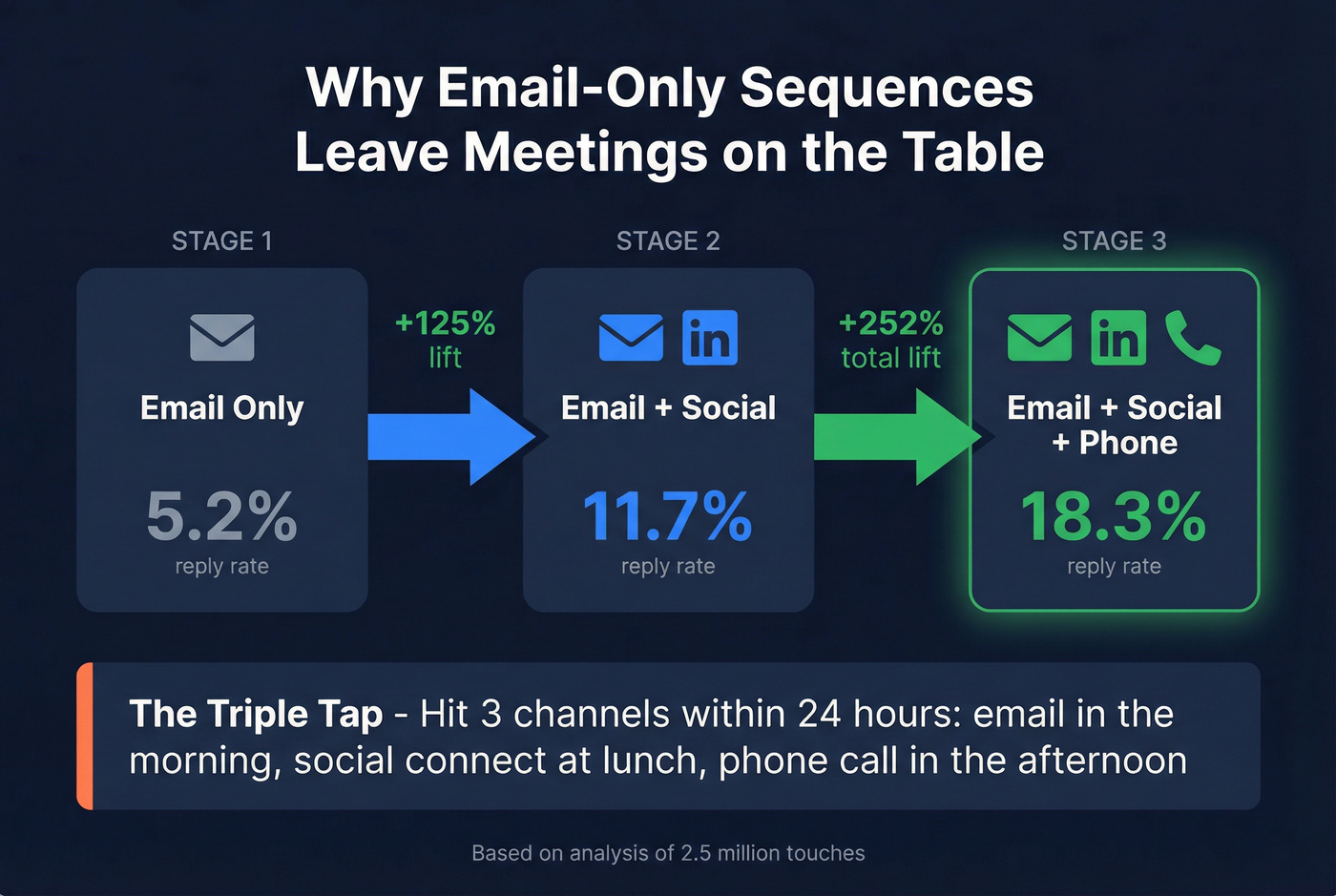
Email-only sequences are leaving meetings on the table. Data from 2.5 million touches shows the progression clearly: email-only gets 5.2% reply rates, add social touches and that jumps to 11.7% - a 125% increase - and layer in phone calls to hit 18.3%, a 252% lift over email alone. That tracks with what 88% of sales professionals already report: email and social networking are their primary outreach channels. The gap is execution. Most teams default to email-only because it's easier to automate.
Don't be most teams.
One tactic worth stealing: the "triple tap." Hit three channels within 24 hours - email in the morning, a social connect at lunch, a phone call in the afternoon. It creates the impression of omnipresence without being pushy, and it's especially effective in the first 48 hours when urgency is highest.
Set Your Cadence
The sweet spot is 4-7 touchpoints over about 2-3 weeks. Under four and you're giving up too early - 42% of replies come from follow-ups. Beyond seven, diminishing returns kick in unless each touch genuinely adds new value.
For spacing, 3 days between touches works well. A Fibonacci-like pattern - Days 1, 2, 4, 8, 12, 15, 20 - starts aggressive and gradually eases off, front-loading urgency while respecting the prospect's inbox over time.
One framework most guides skip: organize your sequences by persona x touch intensity. A VP of Engineering at a 500-person company warrants a high-touch, research-heavy sequence. A marketing manager at a 20-person startup gets a lighter, faster cadence. Mapping this matrix before you write a single email prevents the "one sequence fits all" trap that kills reply rates.
Write Your Emails
Keep emails under 80 words. One clear CTA per email. Each email should use a different angle - social proof in one, pain point in the next, objection handling in the third. Repeating the same pitch across five emails isn't a sequence; it's spam.
Only 21% of sales teams fully personalize their outbound emails. That means 79% are sending some version of generic templates. Even basic personalization - referencing a prospect's tech stack, a recent funding round, or a job change - puts you ahead of four out of five competitors in the inbox. Industry matters too: a SaaS buyer expects different language and proof points than a manufacturing VP.
Best send times: Tuesday and Wednesday perform best, with Wednesday highest across large datasets. Send between 9-11am in the prospect's local time zone. Thursday is solid but drops off. Skip Friday - it has the highest auto-reply volume.

The article says it clearly: 60% of prospects are lost to poor targeting, and anything above 3% bounce rate torches your domain. Prospeo's 5-step email verification delivers 98% accuracy with a 7-day data refresh cycle - so every step in your sales sequence reaches a real inbox.
Stop burning domains. Start booking meetings with verified data.
Two Copy-Ready Templates
Cold Outbound (7 Touches, 21 Days)
| Day | Channel | Purpose |
|---|---|---|
| 1 | Opening - strongest pitch | |
| 3 | Social | Connect + brief note |
| 5 | Call + VM | Voice touch, reference email |
| 8 | New angle (social proof) | |
| 12 | Call | Follow-up, reference VM |
| 15 | Pain point angle | |
| 21 | Breakup |
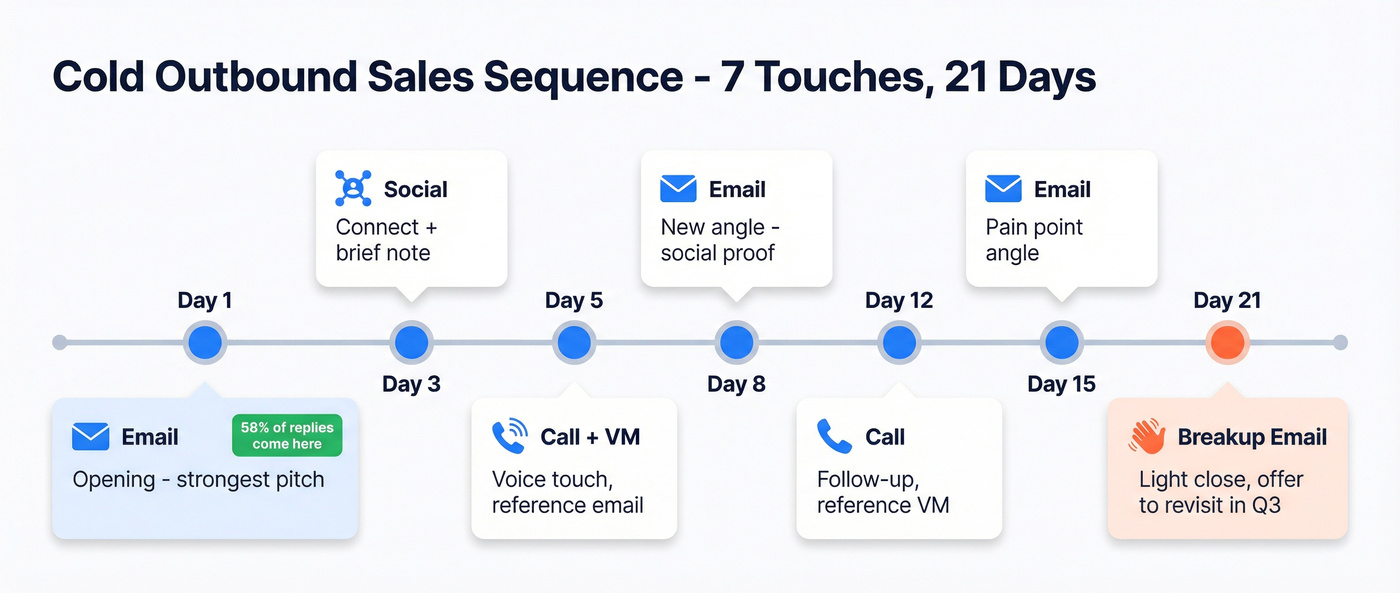
Step 1 email (your best shot - 58% of replies come here):
Subject: {{Company}} + [your value prop in 3 words]
Hi {{First Name}},
Noticed {{Company}} just [trigger event - hiring, funding, tech adoption]. When that happens, teams usually hit [specific pain point].
We helped [similar company] solve that - [one-line result with a number].
Worth a 15-minute call this week?
Keep it under 80 words. Send Tuesday or Wednesday, 9-11am local time. The breakup email on Day 21 should be light - "Seems like timing isn't right. I'll check back in Q3. Meanwhile, here's [useful resource]."
Warm Inbound Follow-Up (5 Touches, 14 Days)
| Day | Channel | Purpose |
|---|---|---|
| 0 | Immediate follow-up (within 1 hr) | |
| 2 | Call | Voice touch |
| 5 | Value-add (case study) | |
| 9 | Social | Engage with their content |
| 14 | Soft close / breakup |
Step 1 email:
Subject: Re: Your {{resource/demo}} request
Hi {{First Name}},
Thanks for [downloading / requesting / signing up]. Based on what I see at {{Company}}, the biggest win we typically deliver is [specific outcome].
I have a few ideas specific to your setup. Free Thursday at 2pm?
Warm inbound sequences should hit 20-30% reply rates and 8-12% meeting rates. If you're below that, your speed-to-lead is probably the issue - respond within the hour, not the day.
Common Mistakes That Kill Sequences
Look, most of these come down to bad data or bad discipline.
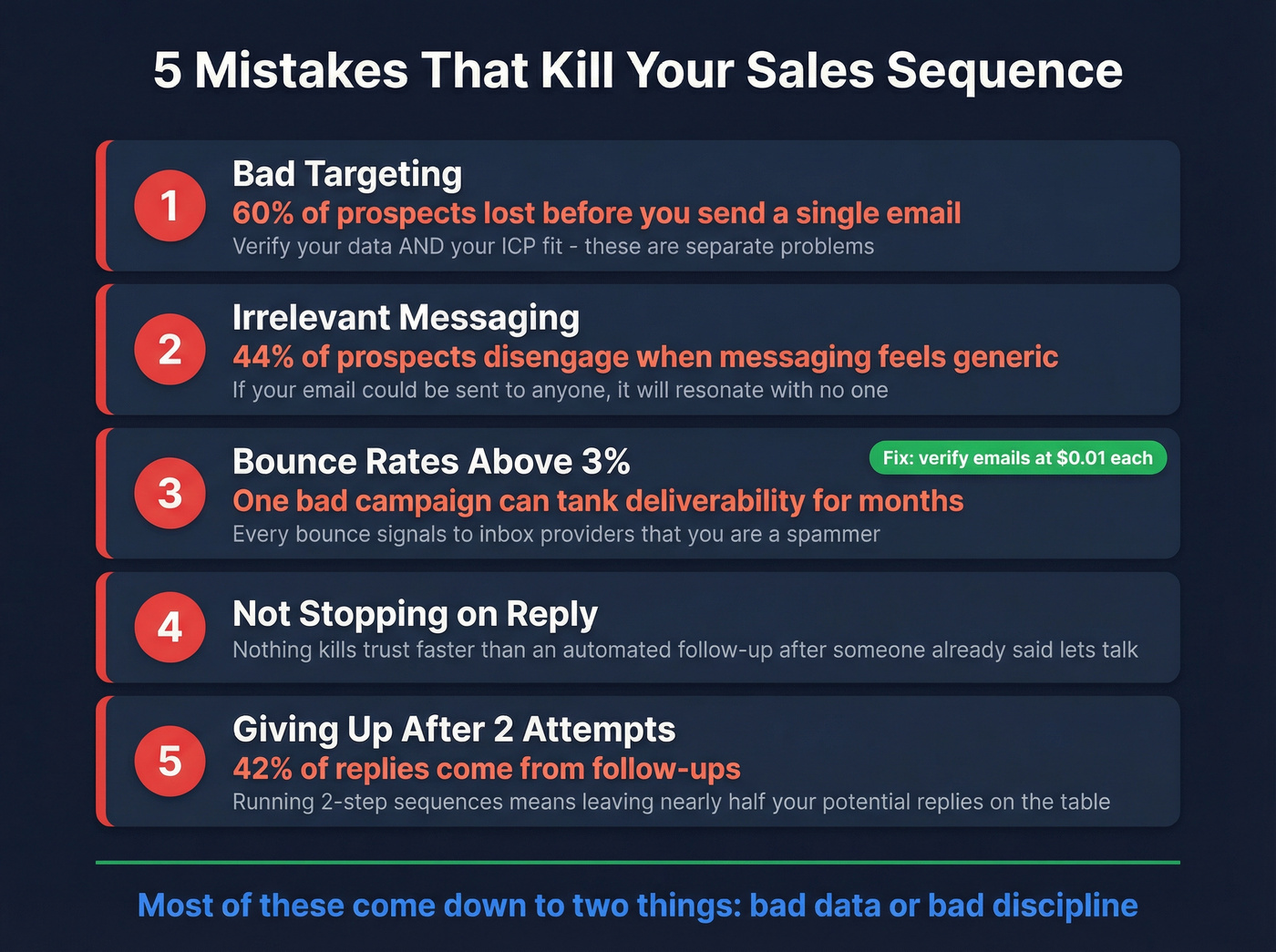
- Bad targeting. 60% of prospects are lost before you send a single email because the list is wrong. Verify your data and your ICP fit - these are separate problems.
- Irrelevant messaging. 44% of prospects disengage when messaging feels generic. If your email could be sent to anyone, it'll resonate with no one.
- Bounce rates above 3%. Every bounced email signals to inbox providers that you're a spammer. This compounds - one bad campaign can tank deliverability for months.
- Not stopping on reply. Your sequence must pause the moment a prospect responds. Nothing kills trust faster than an automated follow-up after someone already said "let's talk."
- Giving up after 2 attempts. The average rep quits after two touches. But 42% of replies come from follow-ups. Running 2-step sequences means you're leaving nearly half your potential replies on the table.
Measure and Optimize
Reply rate is your primary KPI. Not open rate, not click rate, not "engagement score." How many people responded, and how many of those responses turned into meetings?
A useful heuristic from Outreach: if your last-step reply rate is still above 3%, your sequence is probably too short - add another step. If early steps are pulling all the weight and later steps are dead, tighten the sequence or rewrite the back half.
A/B test one variable per week - subject line, CTA, send time, email length. The teams hitting 10.7%+ reply rates aren't running one sequence forever. They're iterating constantly. In our experience, the single highest-leverage change is establishing a formal monthly review where your sales and marketing leads audit active sequences, kill underperformers, and promote winning patterns across the team. Apollo's sequence analytics and HubSpot's enrollment reports both make this easy to visualize.
If you want a tighter testing cadence, use a simple A/B test plan and stick to one variable at a time.
After the Sequence Ends
The breakup email isn't the end - it's a handoff. Cobalt runs a 5-phase model that illustrates this well: BDRs identify leads, import to CRM, run them through a standardized sequence, and when a prospect doesn't respond after the breakup, they disqualify the lead and route it to marketing for a nurture campaign. They attribute 106% revenue growth over two years to this process. Build the handoff into your sequence design from Day 1 - your marketing team should know exactly what happens to every non-responder.
Best Sales Sequence Tools
Your stack needs two layers: a data layer (where contacts come from) and a sequencing layer (where touches get executed). Most teams conflate these and end up with mediocre data inside a great sequencer.
| Tool | Best For | Starting Price | Key Strength |
|---|---|---|---|
| Prospeo | Data + verification | Free; ~$0.01/email | 98% email accuracy, 7-day refresh |
| Apollo | SMB sequencing + data | Free; paid from ~$49/user/mo | All-in-one for small teams |
| Outreach | Enterprise sequencing | Custom (typically $30-100K+/year) | Workflow depth |
| HubSpot Sales Hub | CRM-native sequences | ~$90/user/mo (Pro) | No extra tool to manage |
| Instantly | High-volume cold email | From ~$30/mo | Inbox rotation |
| Salesloft | Mid-market sequencing | ~$100-200/user/mo (annual) | Deal-stage automation |
| Reply.io | Multi-channel automation | From ~$49/user/mo | AI email assistant |
| Smartlead | Agency cold email | From ~$39/mo | Unlimited mailboxes |
Apollo is the best starting point for teams under 10 reps who want prospecting and sequencing in one tool. Its built-in database is decent, though email accuracy doesn't match dedicated verification tools - pair it with a verified list for best results.
Outreach is the enterprise standard. Users consistently praise its workflow depth and integrations, though teams flag a steep learning curve and enterprise-level pricing. If you have the budget and the ops resources to configure it properly, nothing else matches its sequencing power. Skip it if you're a team of three running lean - you'll spend more time configuring than selling.
For the data layer, Prospeo's 143M+ verified emails and 125M+ verified mobile numbers feed directly into Instantly, Smartlead, HubSpot, Salesforce, and more via native integrations. You build the list, push it to your sequencer, and know the contacts are verified within the last 7 days. That's the foundation most guides skip - and it's the one that determines whether your outbound sequence actually reaches inboxes.
If you're evaluating platforms, start with a shortlist of sales prospecting platforms and then compare cold email marketing tools based on deliverability features.
If deliverability is the bottleneck, run through an email deliverability checklist and confirm your SPF, DKIM, DMARC setup before scaling volume.
Multi-channel sequences need more than emails - you need direct dials. Prospeo gives you 125M+ verified mobile numbers with a 30% pickup rate, plus 30+ filters like buyer intent, job changes, and tech stack to build sequences by persona from Day 1.
Layer phone, email, and social with contacts you can actually reach.
FAQ
How many steps should a sales sequence have?
Four to seven touchpoints over 2-3 weeks. Under four, you're quitting before follow-ups work - 42% of replies come after Step 1. Beyond seven, diminishing returns set in unless each touch adds genuinely new value.
What's a good reply rate for cold outbound?
Average cold email reply rate is 3.43%. Top quartile hits 5.5%+, and elite performers reach 10.7%+. Below 2%, fix your data quality and targeting before rewriting copy.
Should I use email only or multiple channels?
Multi-channel, always. Adding social and phone lifts reply rates from 5.2% to 18.3% - a 252% increase. The effort is higher, but the math is unambiguous.
What's the best day to send cold emails?
Tuesday and Wednesday, with Wednesday performing best across large datasets. Send between 9-11am in the prospect's local time zone. Avoid Friday due to high auto-reply volume.
How do I keep my bounce rate low?
Verify every email before adding it to a sequence. Target under 3% bounce rate. One bad campaign can damage domain deliverability for months, and recovery isn't quick.