The Inbound Sales Process Nobody Actually Follows (And How to Build One That Works)
Last quarter, your marketing team delivered 200 inbound leads. Your reps booked 8 meetings and closed 2 deals. The CMO blames lead quality. The VP of Sales blames volume. It's neither - it's an inbound sales process problem. 81% of sales teams never review their sales process at all, which is exactly why this hits home for so many orgs.
Here's the quick version: a lead scoring model with a defined MQL threshold, a 5-minute response SLA for demo requests, and four BANT discovery questions before any lead advances to opportunity. Everything else is iteration.
What Is Inbound Sales?
Inbound sales is the methodology of converting buyers who've already raised their hand - form fills, demo requests, content downloads, chatbot conversations - into closed revenue. Inbound demo requests close at 70-80% vs. 5-10% for outbound, and 96% of buyers do their own research before ever talking to a rep.
The problem isn't generating interest. It's what happens after someone fills out the form.
The 4-Step Inbound Sales Process
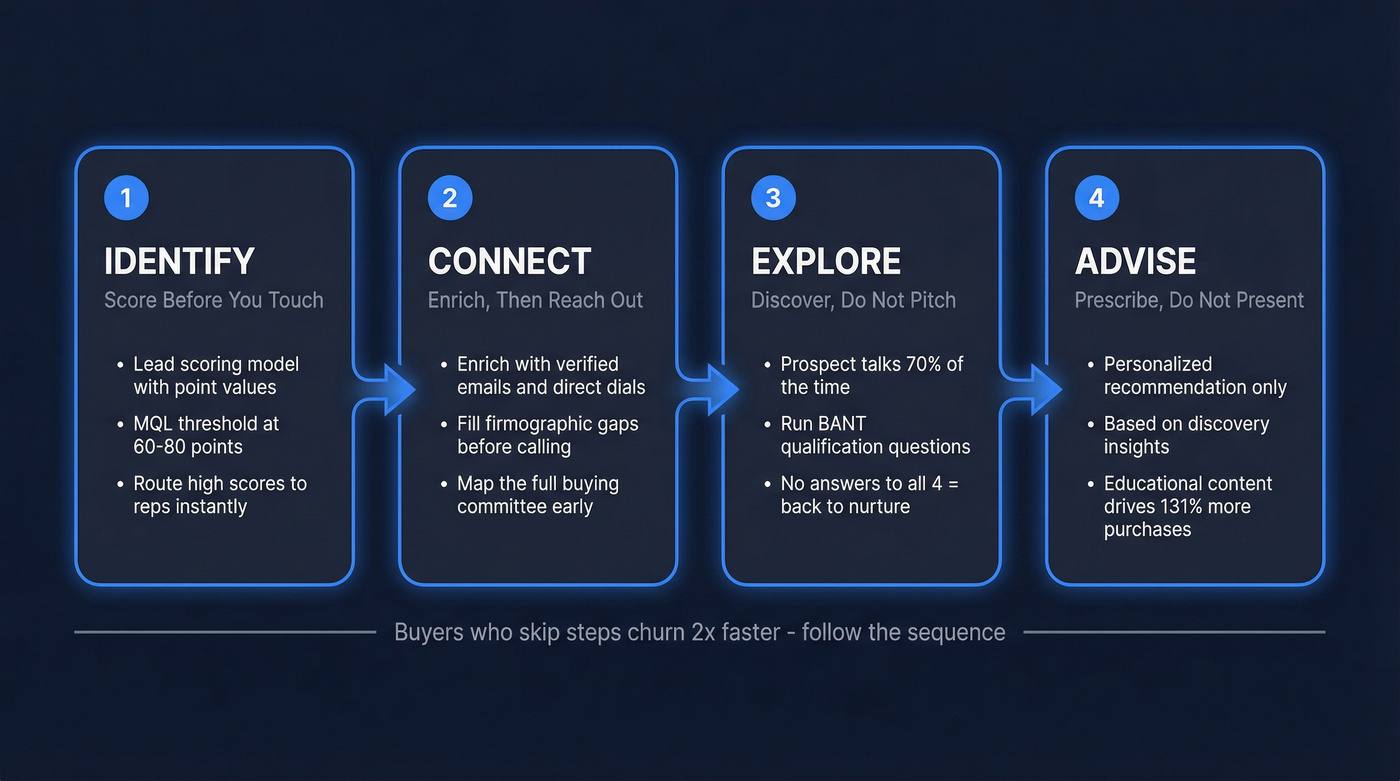
1. Identify - Score Before You Touch
Most teams treat every inbound lead the same. A pricing page visitor who booked a demo gets the same response as someone who downloaded a whitepaper six weeks ago. That's broken. Build a scoring model with actual point values and load it into your CRM today:
- +25 Director+ title
- +20 Demo booking
- +10 Pricing page visit
- -10 No engagement for 30+ days
Set your MQL threshold at 60-80 points. Below that stays in marketing nurture. Above gets routed to a rep immediately. This isn't complicated - it just requires someone to actually configure it.
2. Connect - Enrich, Then Reach Out
Inbound leads arrive with garbage data. Wrong email, no phone number, missing company size. Before your rep picks up the phone, enrich the lead. Tools like Prospeo return a verified email, direct dial, and 50+ data points per contact at 98% email accuracy on a 7-day refresh cycle. Bad data is one of the biggest reasons inbound leads die before the first conversation even starts.
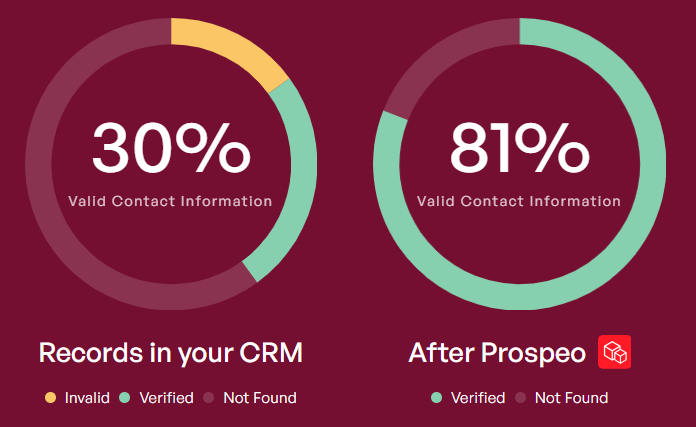
Here's the thing: the average B2B deal involves 13 decision-makers. If your rep only has contact info for the person who filled out the form, they're selling to one-thirteenth of the buying committee. Multi-thread from the first conversation or lose the deal three months later.
3. Explore - Discover, Don't Pitch
Discovery isn't a product demo with questions sprinkled in. It's a structured conversation where the prospect talks 70% of the time. Target 15-30 minutes, and use these four BANT discovery questions before any lead advances:
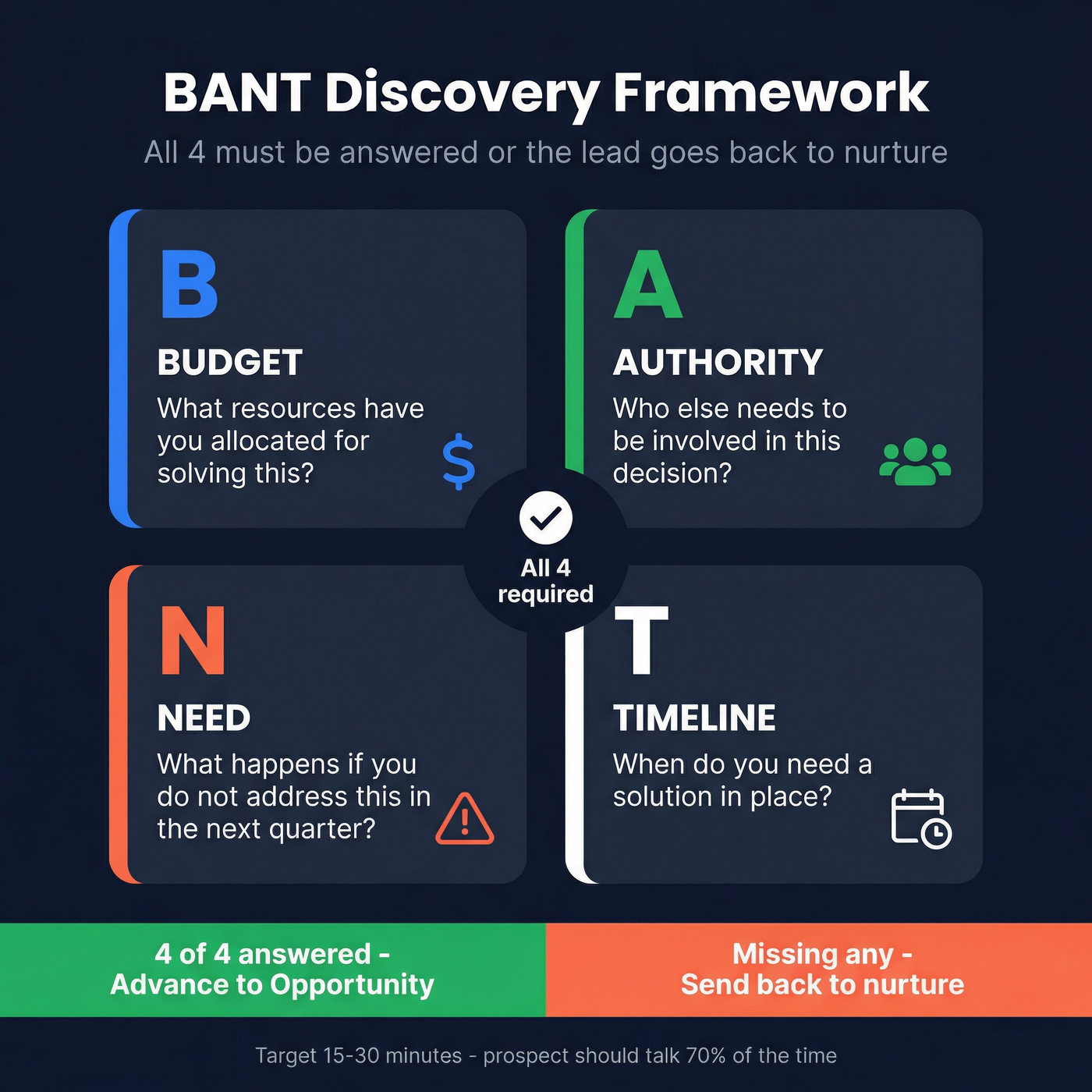
- Budget: "What resources have you allocated for solving this?"
- Authority: "Who else needs to be involved in this decision?"
- Need: "What happens if you don't address this in the next quarter?"
- Timeline: "When do you need a solution in place?"
If a rep can't answer all four after the call, the lead isn't qualified. Full stop. Send it back to nurture.
4. Advise - Prescribe, Don't Present
Only after Explore is complete does your rep earn the right to recommend anything. This isn't a generic deck walk-through - it's a personalized prescription based on what the prospect told you in discovery. Buyers are 131% more likely to purchase after engaging with educational content tailored to their situation. Your reps aren't presenters. They're advisors who happen to sell software.

You just read it: the average deal has 13 decision-makers, but your form only captures one. Prospeo enriches every inbound lead with verified emails, direct dials, and 50+ data points at 98% accuracy - so your reps can multi-thread the buying committee from day one instead of selling to one-thirteenth of the room.
Stop losing deals because you only had one contact.
Speed-to-Lead Decides Everything
The average B2B team takes 47 hours to respond to an inbound lead. That's not a typo. The breakdown by channel is even worse: form fills average 28 hours, live chat 8 hours, content downloads 52 hours, and event leads 72 hours. When Workato tested 114 B2B companies, zero called back within 5 minutes. Responding within 5 minutes increases contact rates by 900%, and buyers often go with the first company that responds.
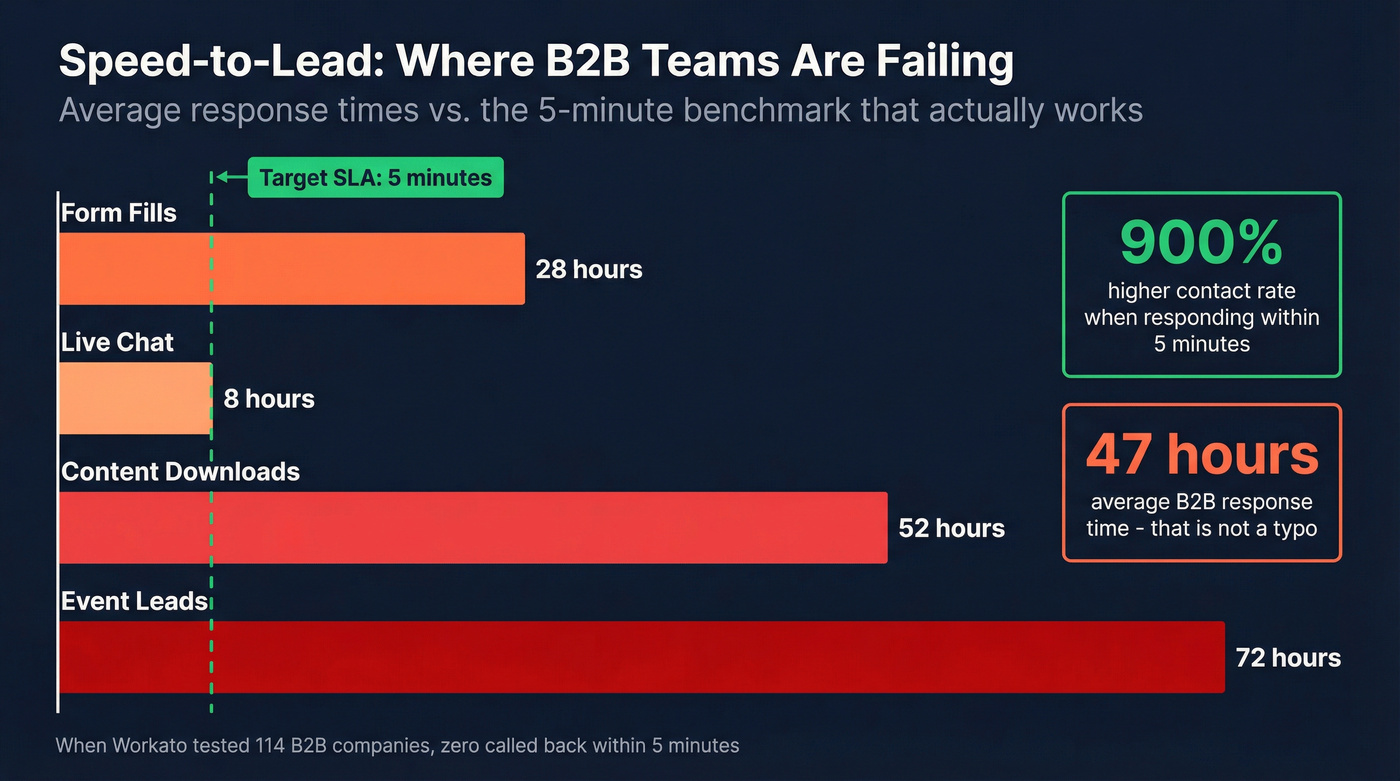
We've seen this firsthand across dozens of teams we work with: the ones that fix speed-to-lead first see the fastest pipeline improvement - faster than fixing messaging, hiring, or even lead volume. If your SLA isn't under 5 minutes for demo requests and under 1 hour for content downloads, you're leaving revenue on the table every single day.
Let's be honest: most teams don't need more leads. They need to stop ignoring the ones they already have. A team responding in 4 minutes with mediocre messaging will outsell a team responding in 4 hours with a perfect pitch deck. Speed is the strategy.
Inbound Funnel Benchmarks for 2026
Here's where your funnel is leaking. These are 2026 B2B benchmarks - use them to diagnose which stage needs work:
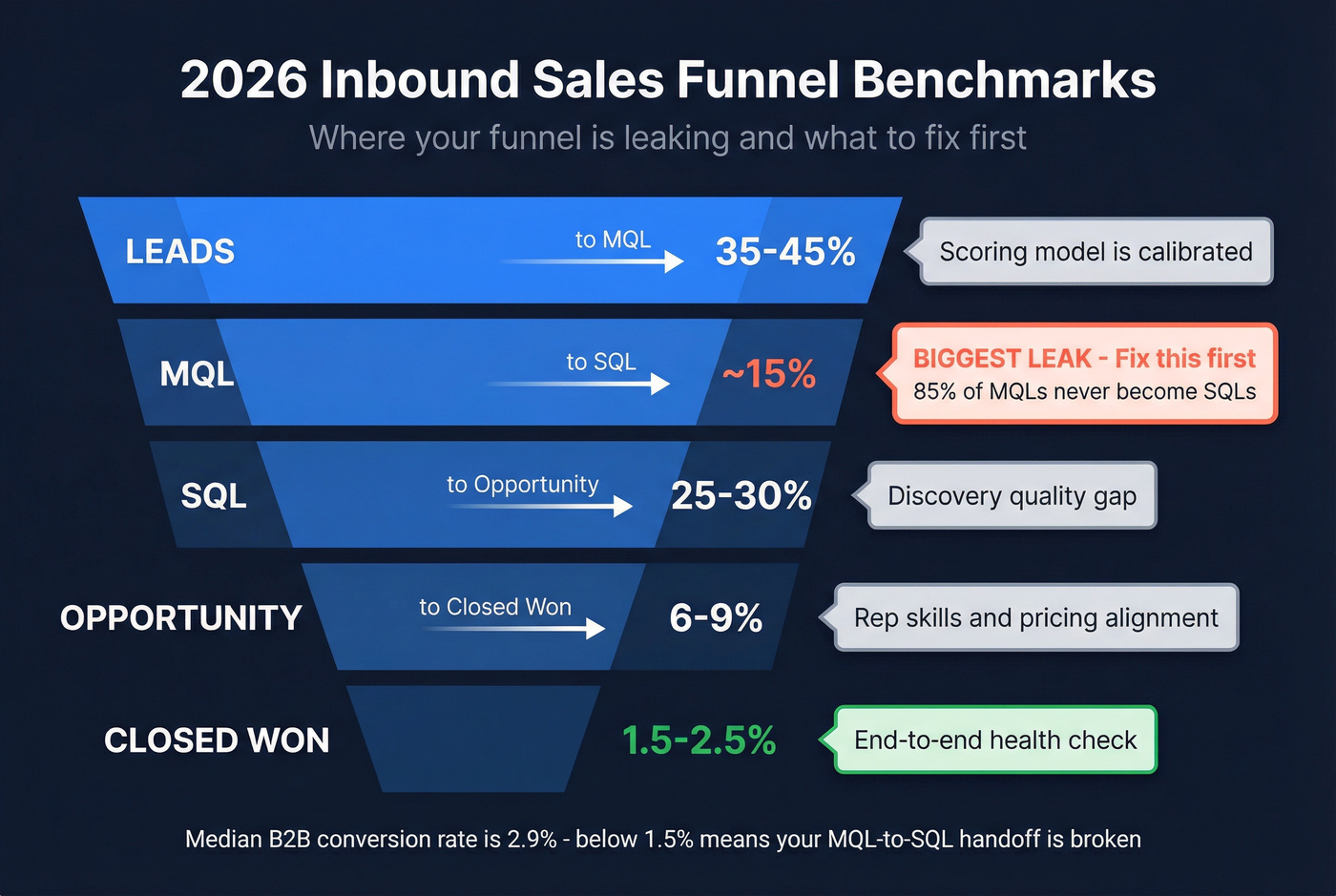
| Stage | Conversion Rate | Diagnosis |
|---|---|---|
| Lead → MQL | 35-45% | Scoring model is calibrated |
| MQL → SQL | ~15% | Biggest leak - fix this first |
| SQL → Opportunity | 25-30% | Discovery quality gap |
| Opp → Closed-Won | 6-9% | Rep skills + pricing alignment |
| Overall Lead → Customer | 1.5-2.5% | End-to-end health check |
The median B2B conversion rate sits at 2.9%. If you're below 1.5%, your MQL-to-SQL handoff is almost certainly broken - roughly 85% of MQLs don't become SQLs in the median benchmark. In practice, reps cherry-pick the leads that look easy and ignore the rest. That's where we've seen the most wasted pipeline, and it's maddening to watch good leads rot because nobody built a routing rule.
Advanced Tactics Most Teams Skip
Friction-signal scoring. Most scoring models only reward positive behavior. Start penalizing friction signals: repeated pricing page visits without booking, no-shows after scheduling, 7+ days of silence. These aren't engagement - they're hesitation. Score them negatively and trigger a different playbook. (If you want examples, see Negative Lead Scoring.)
Intent drift alerts. When engagement drops - no site visits for a week, emails unopened - fire an automated Slack alert to the assigned rep with a suggested re-engagement message. Catch the drift before the lead goes cold. For teams that want to layer in buyer intent data at scale, platforms tracking thousands of intent topics through providers like Bombora can flag when accounts are actively researching your category, so reps know which "cold" leads are actually warming up elsewhere. (More on this in Intent signals.)
One organizational shift worth noting: nearly half of inbound sales teams now report to marketing, not sales. If your inbound process keeps breaking at the MQL-to-SQL handoff, the reporting structure itself might be the problem. Skip this tactic if your team is under 10 reps - at that size, a shared Slack channel and a weekly pipeline review will do more than a reorg.
Your MQL-to-SQL handoff is leaking because reps don't have enough data to qualify fast. Prospeo returns verified emails, mobile numbers, company size, tech stack, and intent signals on a 7-day refresh cycle - giving reps everything they need to run BANT discovery in the first call, not the third.
Give your reps complete lead data before they ever pick up the phone.
FAQ
What's the difference between inbound and outbound sales?
Inbound sales responds to buyers who've already shown interest, while outbound initiates contact cold. Inbound leads close at 70-80% vs. 5-10% for outbound - but only when you've got a documented process with scoring, SLAs, and structured discovery to convert them. Without that process, inbound leads perform barely better than cold outreach, which is a painful realization for teams that spent six figures on content marketing.
How fast should you respond to an inbound lead?
Under 5 minutes for demo requests, under 1 hour for content downloads. Teams responding within 5 minutes see 900% higher contact rates than those waiting an hour. The average B2B team takes 47 hours, so speed alone is a massive competitive advantage.
How do you keep inbound lead data clean?
Enrich every lead before first outreach. That means running contacts through a verification tool that catches bad emails, appends missing phone numbers, and fills in firmographic gaps. Clean data is the difference between a 5-minute callback and a 47-hour one - because reps won't call a lead they can't find a number for.