

Unqualified Leads Are Killing Your Pipeline - Here's the Playbook to Fix It
Your reps worked 200 leads last month. If 160 go absolutely nowhere - wrong budget, wrong title, wrong timing - that's not a pipeline. That's a time shredder.
79% of marketing-generated leads never convert to sales. Not because marketing is bad at their job, but because most organizations haven't agreed on what "qualified" actually means. The result is a system that rewards volume and punishes everyone downstream.
The Short Version
- Build a lead scoring model (template below) - takes 2 hours to set up, saves 20+ hours a month.
- Give every rep the same BANT question bank so "qualified" means one thing across the entire org.
- Fix your data upstream - stale and bad contact data is one of the biggest reasons poor-quality leads enter your pipeline. Prospeo verifies emails and phones in real time before leads hit the CRM, with 98% email accuracy on a 7-day refresh cycle.
What Is an Unqualified Lead?
Picture this: a marketing director at a 12-person startup downloads your enterprise whitepaper. They're curious, maybe even impressed. But they have no budget, no buying authority, and no timeline. That's an unqualified lead - someone who's entered your funnel but doesn't meet the criteria for active sales engagement.
Only about 25% of marketing leads actually qualify for direct sales engagement. The average MQL-to-SQL conversion rate sits at just 13%. The vast majority of what enters your pipeline isn't pipeline at all.
| Trait | Qualified Lead | Unqualified Lead |
|---|---|---|
| Budget | Confirmed or realistic | Unknown or absent |
| Authority | Decision-maker identified | No access to buyer |
| Need | Clear pain, active search | Vague interest at best |
| Timeline | Within 1-2 quarters | "Maybe next year" |
| Data quality | Verified email/phone | Bounced or outdated |
The Real Cost of Chasing Bad Leads
Leads that don't belong in your pipeline don't just waste time. They waste money in ways that never show up on a dashboard.
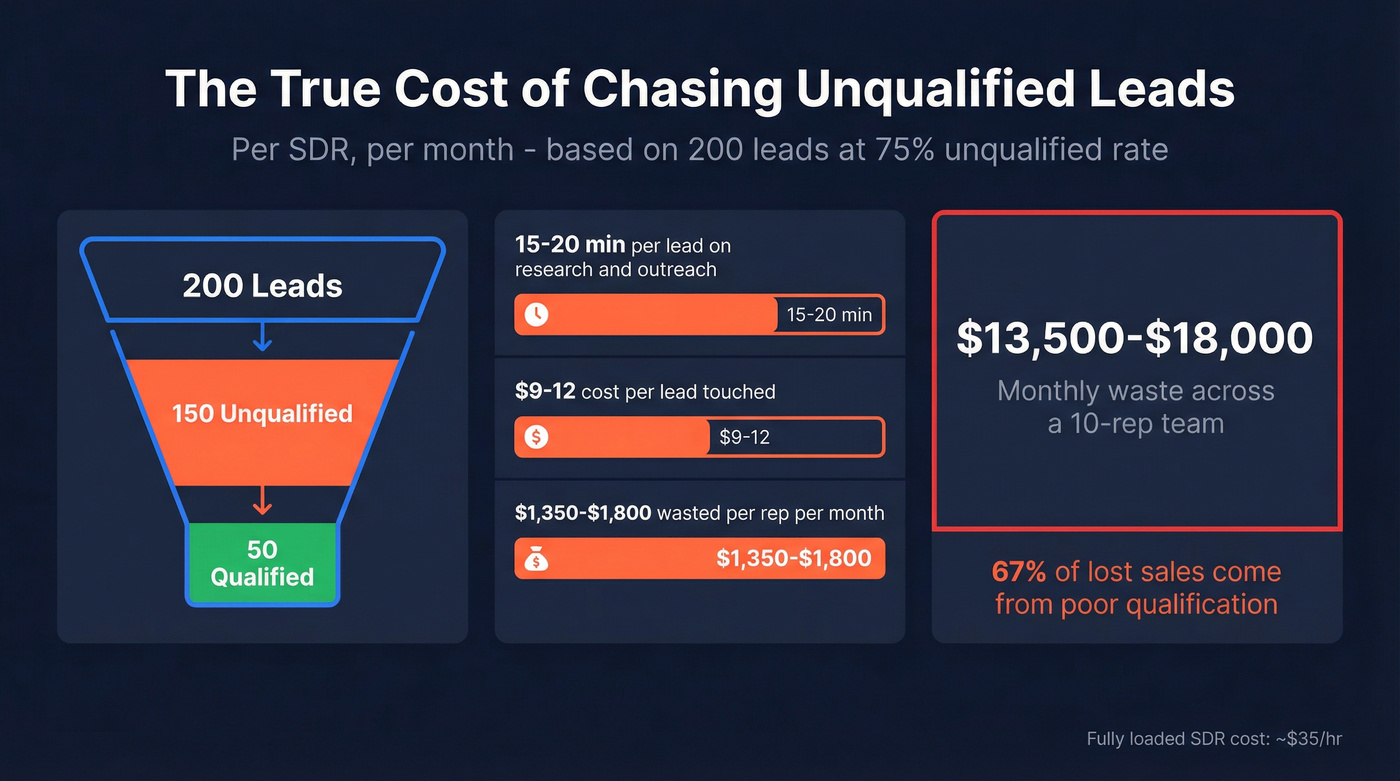
67% of lost sales stem from inadequate lead qualification. That's not a lead gen failure - it's a qualification failure. And the cost compounds fast.
An SDR spends roughly 15-20 minutes per lead on research, outreach, and follow-up. At a fully loaded cost of ~$35/hour, that's about $9-12 per lead touched. If ~75% of 200 monthly leads are unqualified, you're burning $1,350-$1,800/month per rep on contacts who were never going to buy. Scale that across a 10-rep team and you're looking at $13,500-$18,000/month in wasted payroll.
The downstream cost is worse. When reps force-close unfit prospects to hit quota, those customers churn faster, file more support tickets, and drag down NPS. As Entrepreneur's analysis puts it, if a quarter of your leads are clearly unqualified, that's the same fraction of your sales payroll spent on dead ends. Your customer success team knows exactly which customer profiles churn fastest - loop them into your ICP definition so you stop qualifying leads that become problems six months later.
Why Your Pipeline Is Full of Them
Five root causes show up in almost every org we've audited. Most teams have at least three running simultaneously.
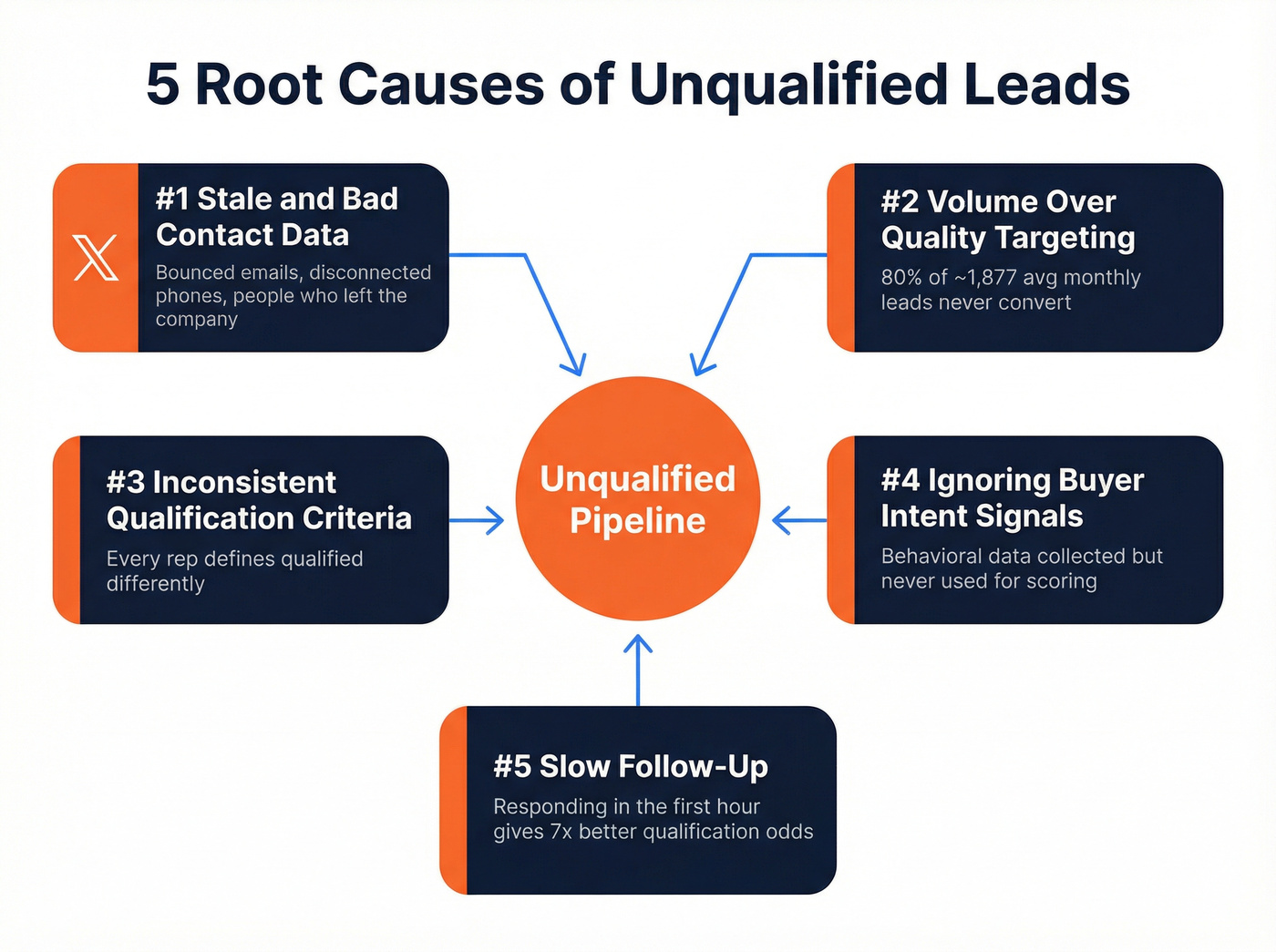
1. Stale and bad contact data. This is the silent killer. A big chunk of your pipeline can be people who already left the company. Your reps are calling disconnected numbers, emailing dead inboxes, and reaching contacts that bounce. Every bad contact that enters your CRM is unqualified by default - you can't qualify someone you can't reach.
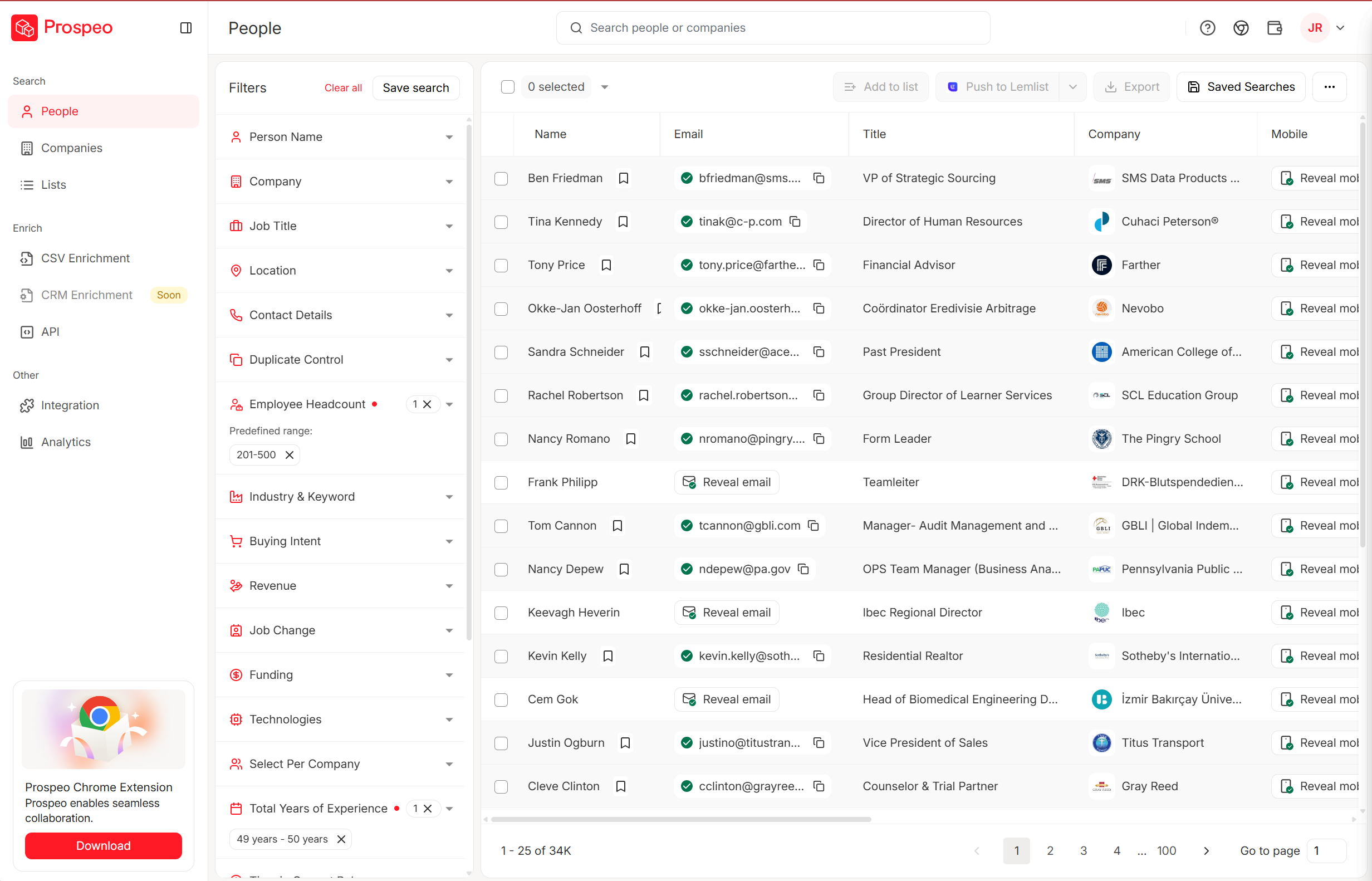
The fastest fix is verifying contacts before they enter the pipeline. Prospeo checks emails and phone numbers across 300M+ professional profiles, including 143M+ verified emails and 125M+ verified mobile numbers, on a 7-day refresh cycle - 98% email accuracy and a 30% mobile pickup rate. Snyk cut bounce rates from 35-40% to under 5% after switching, and AE-sourced pipeline jumped 180%.
2. Volume-over-quality targeting. Organizations generate ~1,877 leads per month on average, and roughly 80% never convert. If marketing is measured on MQL volume and sales is measured on closed revenue, you've built a system that incentivizes junk leads. Full stop.
3. Inconsistent qualification criteria across reps. One rep's "hot lead" is another rep's "not even close." Without a shared framework, every handoff is a coin flip.
4. Ignoring buyer intent signals. Website visits, content downloads, pricing page views, event attendance - these behavioral signals separate curious browsers from active buyers. Most teams collect this data and never use it for qualification. (If you want a tighter system, start with intent signals.)
5. Slow follow-up. Responding within the first hour is associated with 7x higher odds of qualifying a lead. Wait 24 hours and a competitor has already booked the meeting. Speed isn't just a nice-to-have - it's a qualification multiplier.
How to Qualify Leads With BANT
Here's the thing: BANT isn't dead. It's under-used. The "BANT is outdated" narrative comes from people who've never actually watched reps skip budget and authority questions because they're uncomfortable asking. Most teams don't have a framework problem - they have a "nobody actually asks these questions" problem.
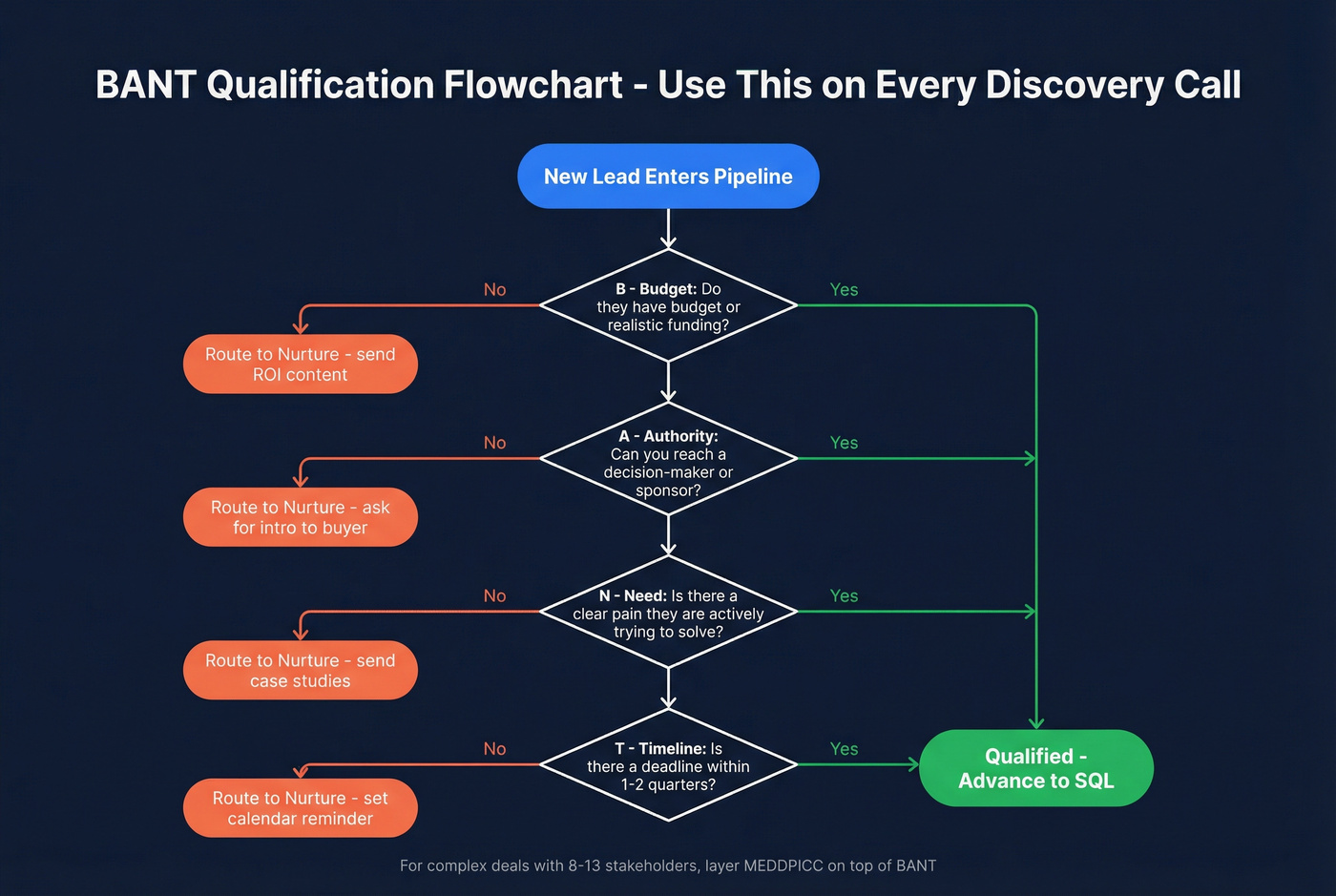
Buying committees now range from 8-13 stakeholders, with some studies putting it at 5 to 16 people across four functions. That makes BANT harder to execute, not less important. You just need to map authority across the committee instead of looking for a single decision-maker.
Here's a question bank your reps can use tomorrow, adapted from Otter.ai's BANT framework guide.
Budget
- "What's the budget range allocated for solving this problem?"
- "Have you invested in a similar solution before? What did that cost?"
- "Who controls the budget for this initiative?"
- "If we can demonstrate ROI, is there flexibility in the budget?"
Authority
- "Who else needs to sign off on this decision?"
- "Walk me through your typical purchasing process for tools like this."
- "Is there an executive sponsor for this initiative?"
- "Who would block this if they disagreed?"
Need
- "What's the biggest challenge you're trying to solve right now?"
- "How are you handling this today without a dedicated solution?"
- "What happens if you don't solve this in the next 6 months?"
- "What would success look like 90 days after implementation?"
Timeline
- "When do you need this in place?"
- "Is there an event or deadline driving the timeline?"
- "Have you started evaluating other solutions?"
- "What would delay this project?"
When to disqualify: If budget access, authority, need, or timeline remains undefined after discovery, the lead isn't ready for sales. Route them to nurture. Don't waste a second meeting hoping clarity materializes. For larger, more complex deals, layer MEDDPICC on top of BANT - the complexity warrants it.

Bad data is the #1 reason unqualified leads enter your pipeline. Prospeo verifies 300M+ contacts on a 7-day refresh cycle with 98% email accuracy - so your reps only work leads they can actually reach.
Kill unqualified leads at the source - start with verified data.
Build Your Lead Scoring Model
Before we started using a scoring model, our team watched reps argue over lead quality in every pipeline review. A scoring model turns those arguments into a system. Start with 5-7 core criteria that predict most of your conversions, then expand as you learn.
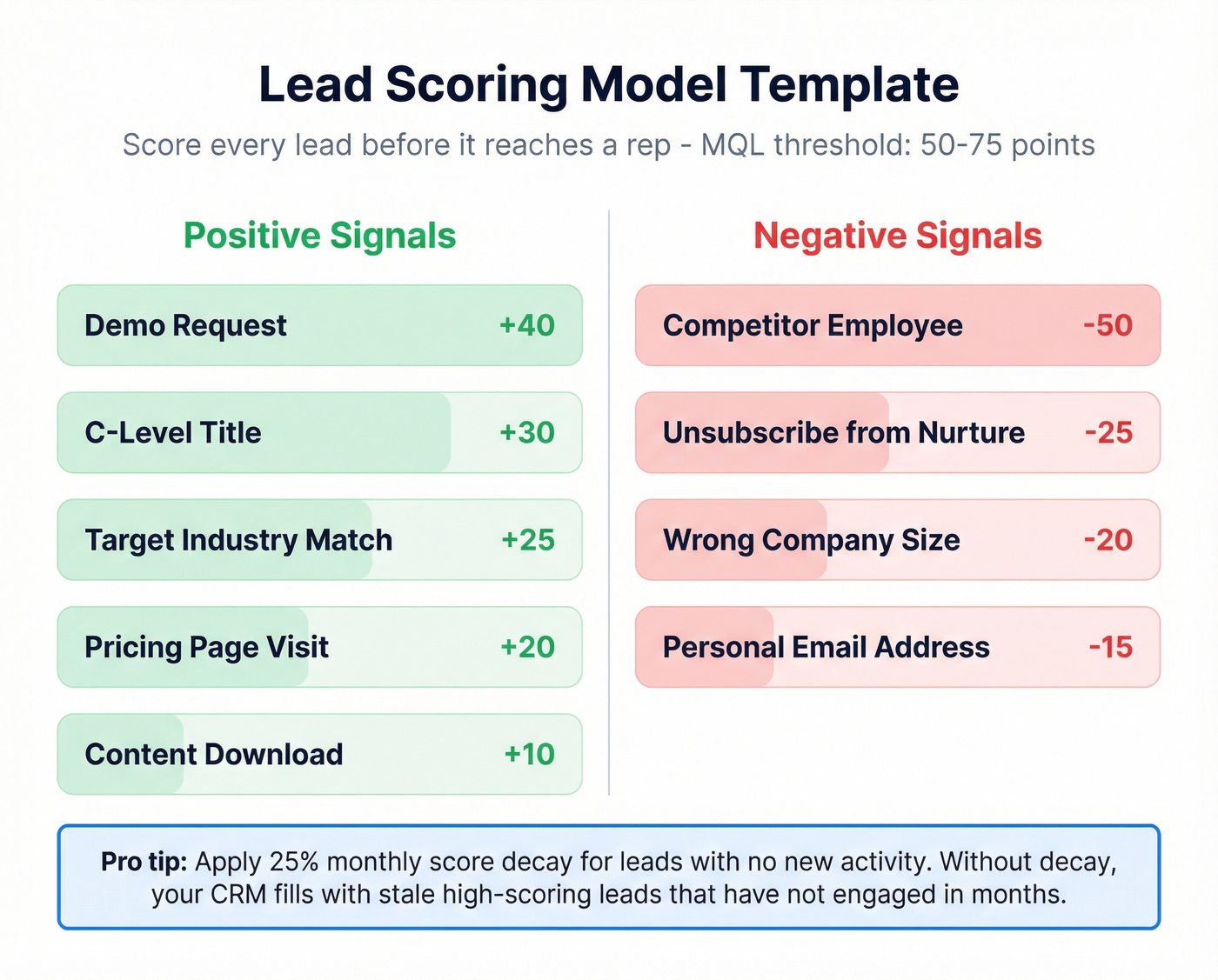
Here's a template based on monday.com's scoring framework:
| Signal | Points |
|---|---|
| C-level title | +30 |
| Target industry match | +25 |
| Pricing page visit | +20 |
| Demo request | +40 |
| Content download | +10 |
| Personal email address | -15 |
| Competitor employee | -50 |
| Unsubscribe from nurture | -25 |
| Wrong company size | -20 |
Set your MQL threshold to capture the top ~20% of leads by score - typically 50-75 points on a 100-point scale. Apply a 25% monthly score decay for leads with no new activity. Without decay, your CRM fills up with stale "high-scoring" leads that haven't engaged in months.
A personal email earns a -15 for good reason. Prospeo's enrichment API can identify personal emails and return verified business emails before leads reach a rep, so you're scoring against real professional data instead of Gmail addresses.
Fix the Handoff - Sales/Marketing SLA
Only 22% of organizations say sales and marketing are tightly aligned. Meanwhile, 58% rate their alignment as poor. That gap is where poorly qualified leads breed.
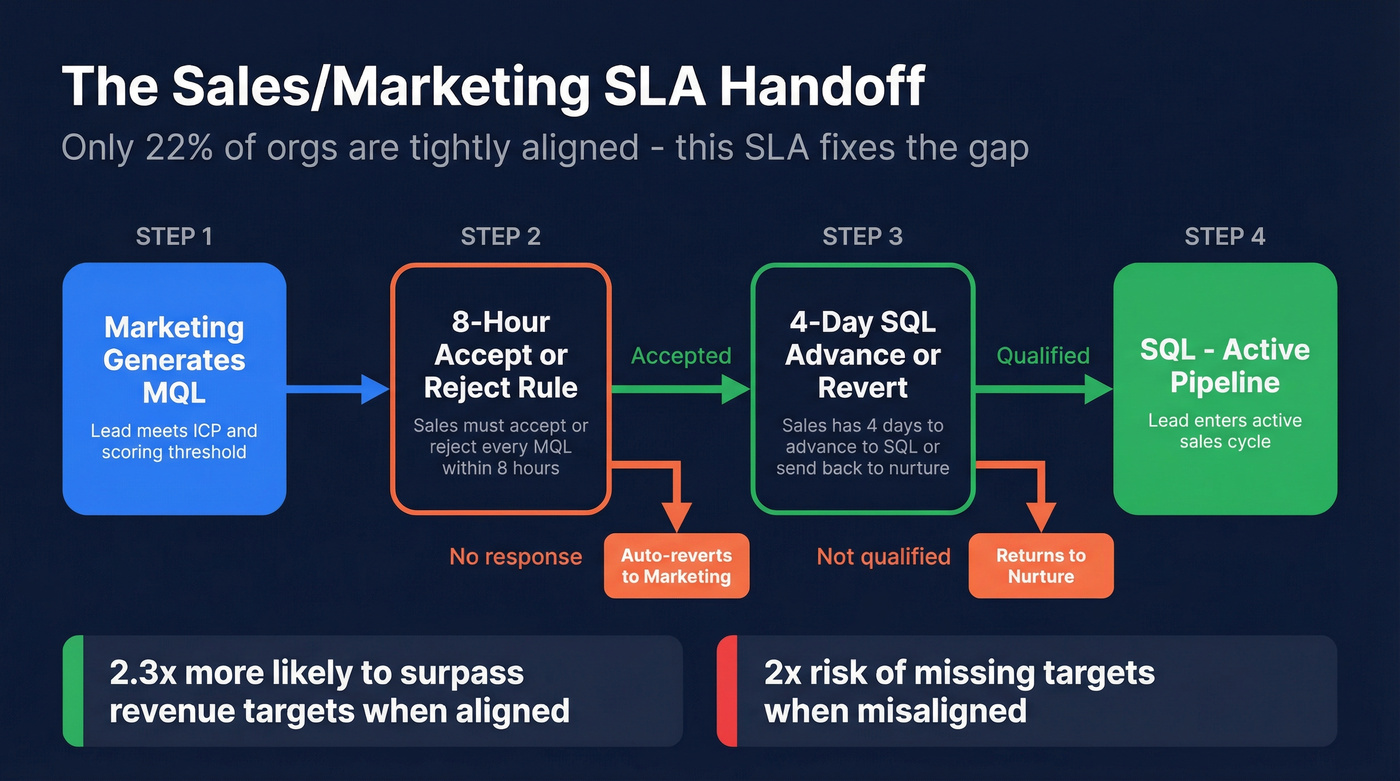
An SLA makes the handoff mechanical instead of political. We've watched teams blow past quota simply by enforcing these rules:
- 8-hour accept/reject rule. Sales must accept or reject every MQL within 8 hours. If they don't, the lead reverts to marketing automatically.
- 4-day SQL advance or revert. Once accepted, sales has 4 days to advance the lead to SQL status or send it back to nurture. No lead sits in limbo.
- Shared ICP definition. Both teams sign off on the same ideal customer profile. No ambiguity about who counts.
- Shared dashboards. Marketing sees pipeline velocity. Sales sees campaign performance. Weekly feedback loops keep both sides honest.
If you don't know your lead-to-revenue conversion rate, start with 1.5% and adjust quarterly. Aligned teams are 2.3x more likely to surpass revenue targets. Misaligned teams carry 2x the risk of missing them. (If you need a clean operating model, use a Revenue Operations alignment plan.)
How to Recycle Unqualified Leads
Not every lead that fails qualification is a dead lead. Many are just early. The trick is building systems that keep them warm without burning rep time.
New lead sequences. Send 3-5 emails that deliver what the lead originally asked for - the ebook, the report, the webinar recording. Don't pitch until you've provided value. Then introduce yourself and your solution. SolidGrowth's playbook nails this cadence.
Nurture to booking. For leads that engaged but didn't qualify on timing or budget, drip case studies and objection-handling content over 4-8 weeks. Time the booking link for the third or fourth touch, not the first. Fast-track anyone who revisits your pricing page. (More templates in our lead nurturing emails guide.)
Re-engagement. For leads that went cold, run a wake-up sequence - three to four touches max. If there's no response, remove them from active nurture. Strong nurturing generates 50% more sales-ready leads at 33% lower cost, but only if you're disciplined about removing the truly dead. If you need subject lines, start with re-engagement email subject lines.
Disqualification as intelligence. This is the angle most teams miss entirely. Track why leads disqualify. If 40% fail on budget, your targeting is off. If 30% fail on authority, you're reaching the wrong titles. Feed this data back to marketing monthly - it's the fastest feedback loop you'll ever build, and it turns your disqualification pile into a strategic asset for refining messaging, adjusting ad targeting, and even informing product positioning.
When to Add AI Scoring
Manual qualification works until it doesn't. The breaking point is around 800-1,000 leads per month at 15-20 minutes per lead - that's roughly 200-330 hours of rep time monthly. Past that threshold, you need automation.
AI-powered scoring can handle 15,000+ leads per month at 75-90% accuracy, compared to 60-70% for manual processes. Per McKinsey research, 67% of organizations using AI in marketing and sales saw revenue growth over the prior 12 months.
But AI is a scale layer, not a replacement for frameworks. If your BANT criteria are vague and your scoring model doesn't exist, AI will just automate bad decisions faster. Build the system first. Automate it second. (If you're evaluating tools, see AI lead qualification.)
Let's be honest: if your average deal size is under $10K and you're processing fewer than 500 leads a month, you don't need AI scoring. You need a tighter ICP and a rep who actually asks the budget question on the first call. The tooling obsession is a distraction from the fundamentals.
Conversion Benchmarks by Industry
The most surprising number in this table isn't the highest - it's how low the SaaS baseline actually is.
| Industry | Conversion Rate |
|---|---|
| B2B SaaS | 1.1% |
| IT / Managed Services | 1.5% |
| Construction | 1.9% |
| Manufacturing | 2.2% |
| Legal Services | 7.4% |
Data from FirstPageSage's industry report. The overall average across 14 industries is 2.9% based on 100M+ data points from Ruler Analytics.
If your SaaS website conversion rate is ~2%, you're above the 1.1% benchmark. The problem isn't traffic - it's downstream qualification. Every percentage point you recover through better scoring and faster follow-up compounds across the entire funnel.
Snyk cut bounce rates from 35-40% to under 5% and grew AE-sourced pipeline 180% by switching to Prospeo. When every contact is verified before it enters the CRM, your reps stop wasting 75% of their time on dead ends.
Every unqualified lead costs you $9-12. Verified data costs $0.01.
FAQ
What's the difference between qualified and unqualified leads?
A qualified lead matches your ICP and has confirmed budget, authority, need, and timeline. An unqualified lead fails one or more of those criteria. They can become qualified later through nurturing, but they shouldn't consume active sales time now.
What makes a good lead for a B2B sales team?
A good lead has a verified way to reach them, matches your ideal customer profile, and shows signals across all four BANT dimensions - a decision-maker at a target-size company with an active need, realistic budget, and timeline within one to two quarters.
How many leads are typically unqualified?
Roughly 75-80%. Industry data shows only about 25% of marketing leads qualify for direct sales engagement, and the average MQL-to-SQL conversion rate is just 13%. This is normal - the goal is to filter efficiently, not to eliminate every misfit lead entirely.
Can bad contact data cause leads to be unqualified?
Absolutely - it's one of the biggest upstream causes. Stale emails, disconnected numbers, and outdated job titles mean reps can't reach real buyers. Verifying contacts on a weekly refresh cycle prevents this before leads ever enter the pipeline.