

How to Book Meetings With Cold Email: The Data-Backed System
The average rep sends 344 cold emails to book one meeting. That's the median across 28M+ cold emails analyzed by Gong and Outbound Squad. Top reps book 8.1x more meetings from the same channel, and the difference isn't talent or a magic subject line - it's system.
Here's the uncomfortable part: across 2M+ cold emails tracked by Sales.co, only 0.64% of contacts emailed result in a positive reply. Most reps obsess over copy when the real gains sit upstream - in data quality, deliverability, and targeting. If you want to book meetings with cold email consistently, you've got to fix the foundation first.
Stack Your Priorities
If you take nothing else from this piece:
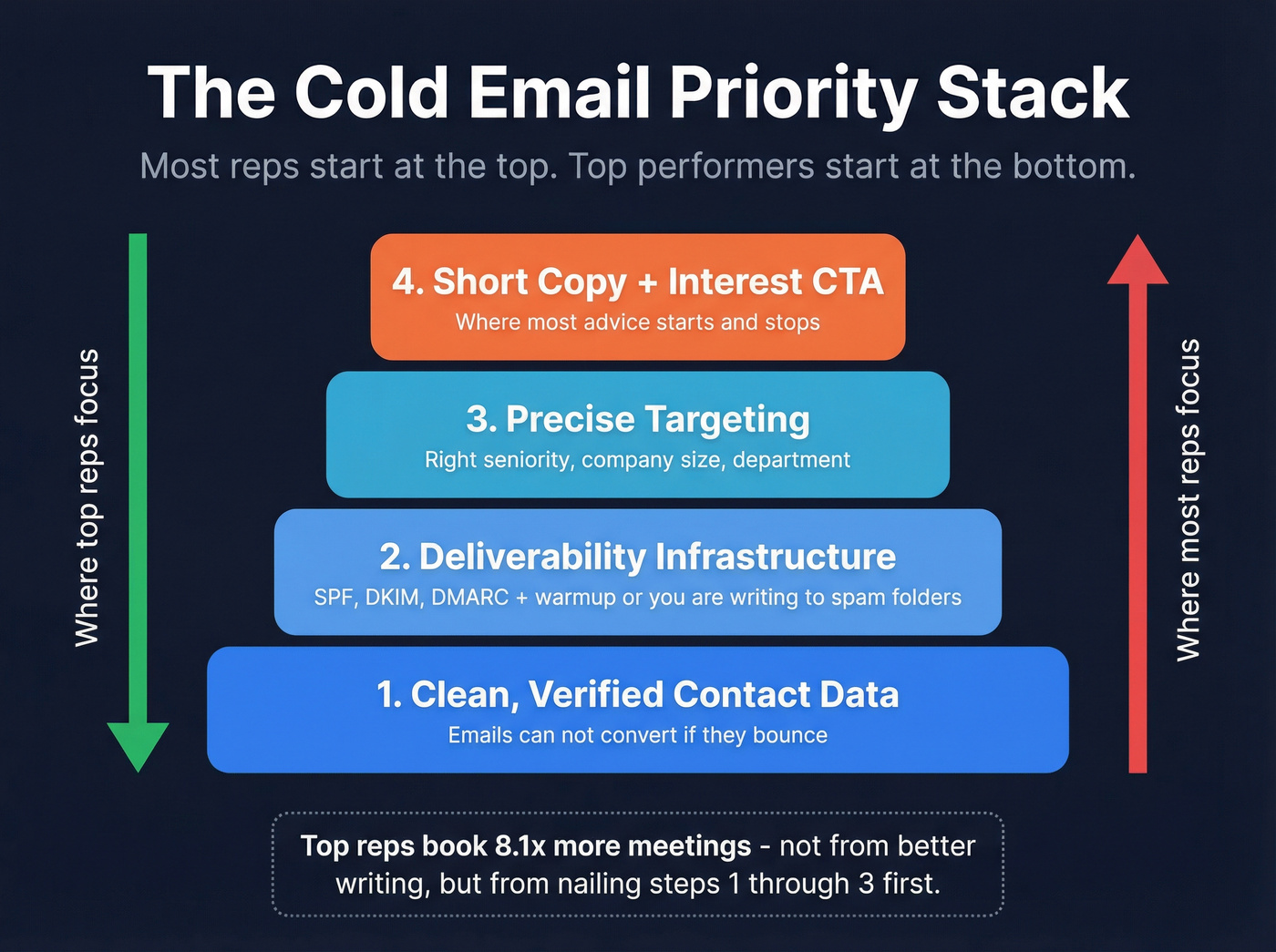
- Clean, verified contact data - emails can't convert if they bounce (see email verification)
- Deliverability infrastructure - SPF/DKIM/DMARC + warmup, or you're writing to spam folders
- Precise targeting - right seniority, company size, department (use account qualification to tighten this)
- Short, informal copy with an interest-based CTA
Most cold email advice jumps straight to step 4. That's why most cold email advice fails. The reps booking 8.1x more meetings aren't better writers. They've nailed steps 1-3 first.
Fix Your Data First
Bad data doesn't just waste sends - it actively destroys your ability to send at all. Every bounce chips away at your domain reputation, and once you cross the 2% bounce-rate threshold that matters in today's bulk-sender environment, deliverability craters for everyone on that domain. Not just the bad addresses. Everyone.

We've seen this play out across dozens of teams. Snyk's 50-person AE team was running bounce rates of 35-40%. After switching to verified data through Prospeo, they dropped under 5% - and AE-sourced pipeline jumped 180%. Meritt tripled pipeline from $100K to $300K per week after making the same switch, with bounce rates falling from 35% to under 4% and connect rates tripling. Stack Optimize built to $1M ARR while maintaining 94%+ deliverability across all clients - zero domain flags - by refusing to send to unverified addresses.
The math is straightforward: at roughly $0.01/lead with verified data versus $1/lead with legacy providers, you're not just saving money - you're protecting the domain that makes everything else possible. (If you're auditing list decay, start with B2B contact data decay.)
Deliverability Infrastructure
Verified data gets you past the bounce problem. Deliverability infrastructure gets you past the spam folder. Without both, no amount of clever copy will reach inboxes.
Authenticate everything. SPF, DKIM, and DMARC on every sending domain. Start with DMARC p=none and tighten later. Gmail expects From-domain alignment with SPF or DKIM - skip this and you're flagged immediately.
Add one-click unsubscribe. RFC 8058 headers with List-Unsubscribe and List-Unsubscribe-Post. Yahoo requires you honor requests within 2 days.
Keep spam complaints under 0.3%. Monitor weekly in Google Postmaster Tools. If you're trending toward 0.3%, pause and diagnose before you hit the threshold.
Bounce rate under 2%. This is where verified data pays for itself. Prospeo's 98% email accuracy and 5-step verification process - including catch-all handling, spam-trap removal, and honeypot filtering - keeps you well under that line without manual list scrubbing. (If you're troubleshooting bounces, see hard bounce.)
Use a custom tracking domain via CNAME. Shared tracking domains pool your reputation with everyone else using that tool. Isolate yours.
Warm up new domains gradually. Start at 5-10 emails per day, ramp over 4-6 weeks. Don't launch campaigns until inbox placement tests hit 80%+. (More detail: automated email warmup.)
None of this is glamorous. All of it is mandatory.
Target the Right Prospects
The biggest lever for booking sales meetings through outreach isn't your copy - it's who you're sending to.
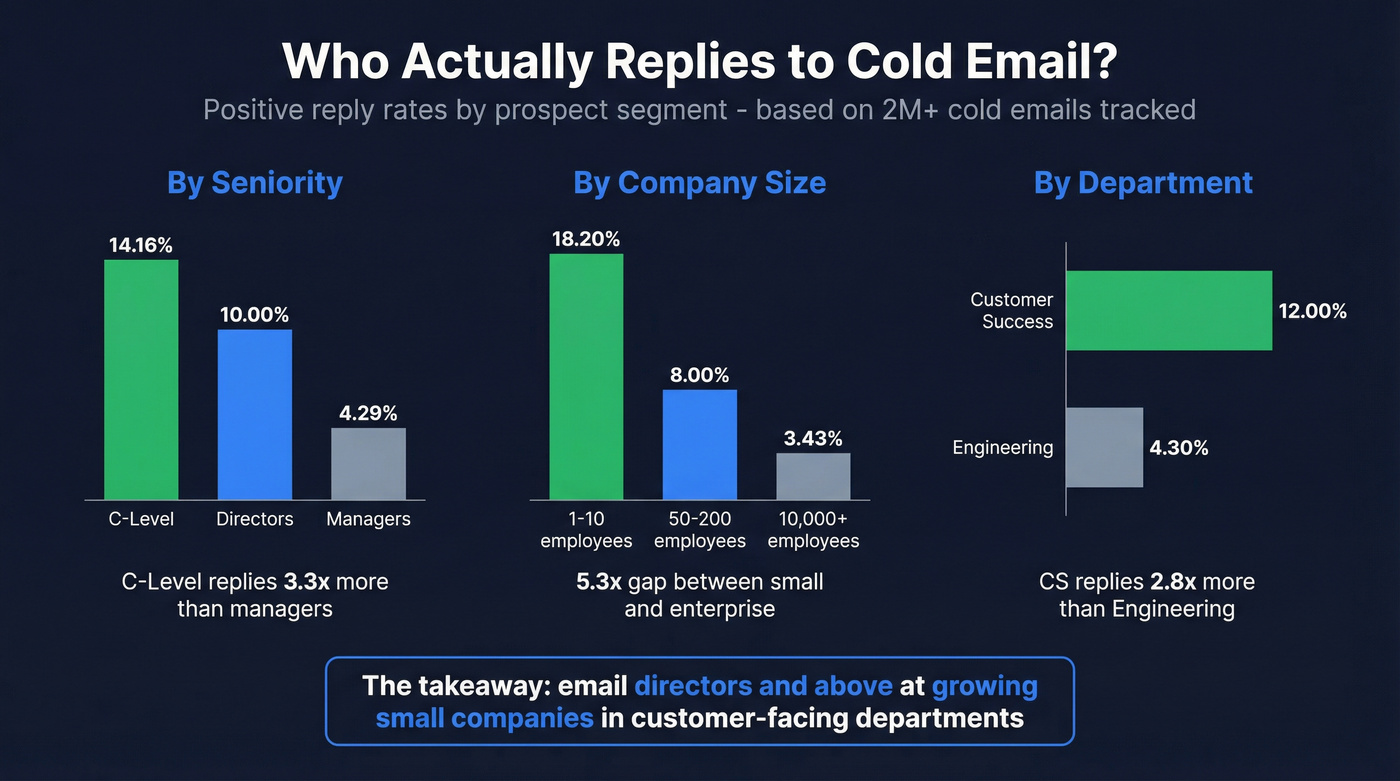
Directors reply 66% more than junior contacts. C-level prospects hit a 14.16% positive reply rate - 3.3x higher than managers. If you're emailing individual contributors because they're easier to find, you're leaving meetings on the table. Full stop.
Company size matters even more. Small companies with 1-10 employees reply at an 18.20% positive rate. Companies with 10,000+ employees manage just 3.43% - a 5.3x gap. Customer Success departments reply 2.8x more than Engineering. European prospects reply 2-3x more than US contacts.
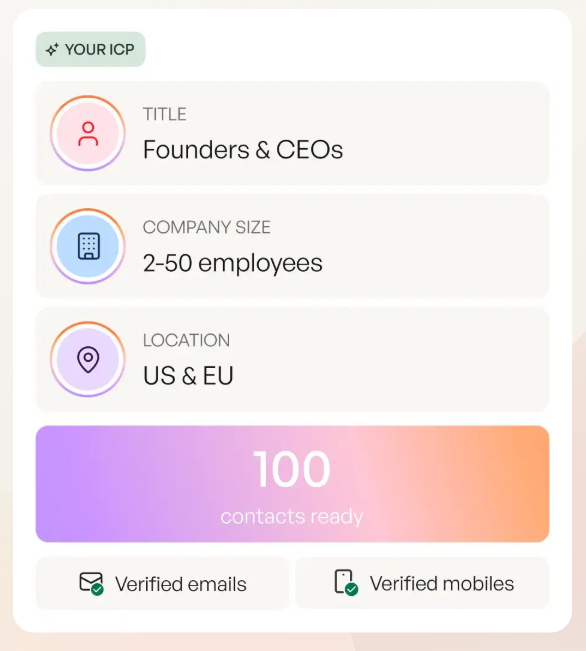
This is where list building becomes critical. You need granular filters - buyer intent signals, technographics, job changes, headcount growth - to build exactly the list this data says works: directors and above, at growing companies, in departments that actually respond. We've found that layering intent data on top of firmographic filters is what separates a 2% reply rate from a 10% one. (If you want a tighter process, use choosing targets for cold outreach.)

You just read the data: bounce rates above 2% crater deliverability for your entire domain. Prospeo's 5-step verification - catch-all handling, spam-trap removal, honeypot filtering - delivers 98% email accuracy at $0.01/lead. Snyk dropped from 40% bounces to under 5% and added 200+ opportunities per month. Meritt tripled pipeline to $300K/week. Same teams, better data.
Stop writing to spam folders. Send to verified inboxes instead.
Subject Lines That Get Opened
A Belkins study of 5.5M emails found personalized subject lines hit 46% open rates versus 35% without - a 31% lift. Reply rates doubled from 3% to 7%.
What works: 2-4 words hit a 46% open rate sweet spot. Question format performs best. Personalize with company name or role. Keep it short, lowercase, and informal - think "{{company}}'s demo form" not "Exclusive Opportunity for {{first_name}}." (More examples: words to avoid in email subject lines.)
What kills opens: buzzwords and numbers reduce open rates by up to 17.9%. Anything over 7 words drops to 39% and keeps falling. Corporate phrasing gets treated like a newsletter.
The Chili Piper SDR team that booked 260 meetings in a month used subject lines like "{{company}}'s demo form" - short, lowercase, specific. No cleverness. No emojis.
The Reply-Rate Formula
Informal tone drives a 10.36% positive reply rate versus 5.83% for formal - 78% higher. Under 100 words. Three to four sentences. No pitching. Pitching in cold emails drops reply rates by up to 57%. (For more structures, see sales email structure.)
The highest-performing structure is "VP -> Trust -> CTA" at a 9.47% positive rate. Reference the prospect's value proposition or pain, establish credibility with a relevant proof point, then close with a single question. One question per email, not two or three.
Chili Piper's team also found that emails written in the prospect's native language got 7x the open rate of English-only versions. Reducing "I/we/our" language in favor of "you/your" consistently lifts engagement - the email isn't about you, it's about them.
| Element | What Works | What Kills Replies |
|---|---|---|
| Tone | Informal (+78%) | Corporate/formal |
| Length | Under 100 words | 150+ words |
| Structure | VP -> Trust -> CTA (9.47%) | Feature dump |
| Focus | Prospect's problem | Your product |
| Questions | One per email | Multiple asks |
The CTA That Books 3.5x More
"Want to see it in action?" generates a 30.05% positive reply rate. "Mind if I send more info?" hits 8.59%. That's a 3.5x difference - and the single easiest change you can make. In our experience, the CTA swap alone moves the needle more than any other single tweak. (If you need more options, pull from these outreach email templates.)
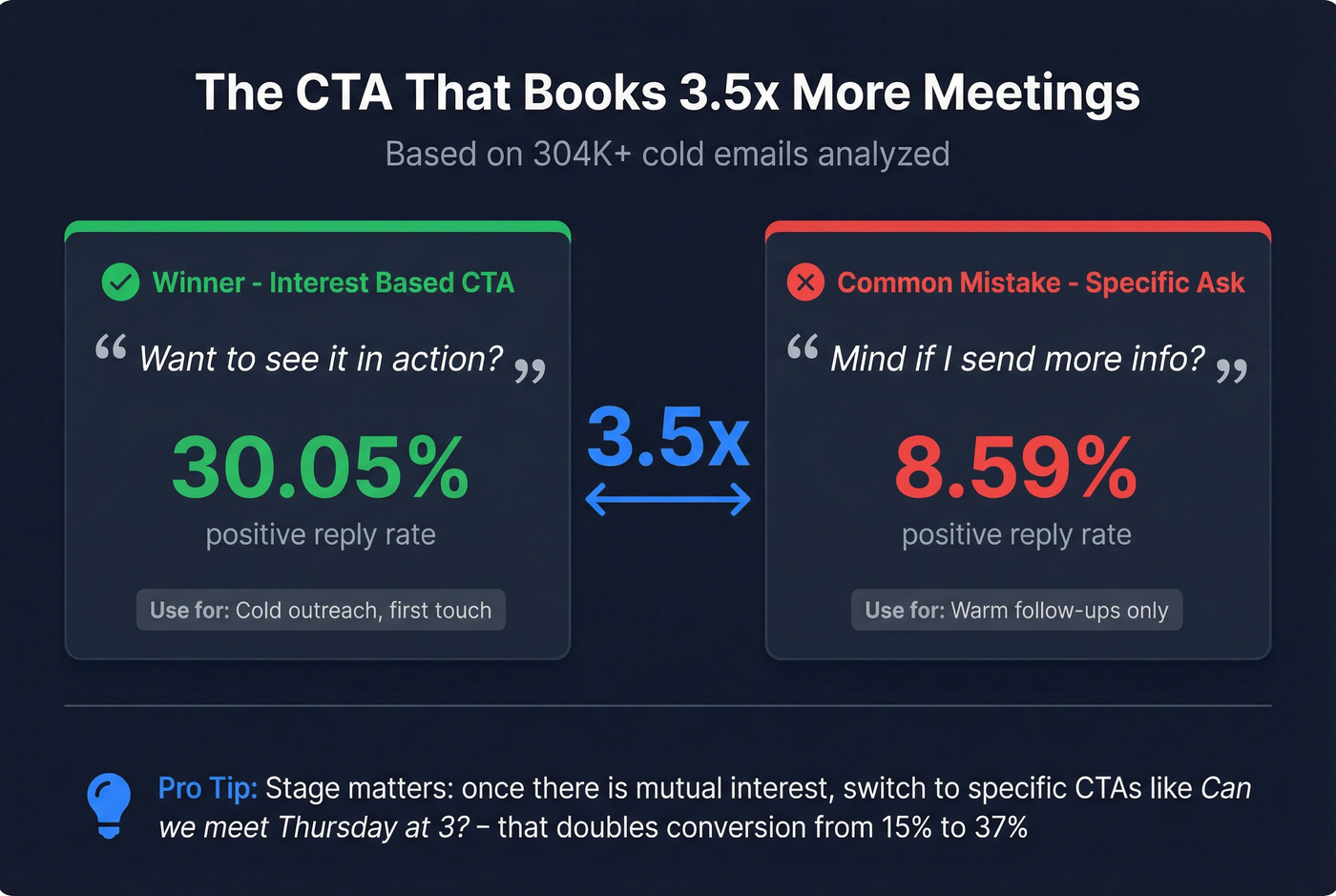
An analysis of 304K+ emails confirms the pattern: interest-based CTAs outperform specific time asks for cold outreach.
Let's be honest - if your average deal size is under $10K, you probably don't need a 12-step sequence or enterprise tooling. Nail the interest-based CTA on a tight 3-email cadence with verified data and you'll outperform most teams running bloated tech stacks.
The stage-based nuance matters though. Once there's mutual interest, specific CTAs like "Can we meet Thursday at 3?" more than double meeting conversion from 15% to 37%. Cold outreach gets the interest CTA. Warm follow-ups get the specific ask.
Automate Your Follow-Up Sequence
The initial email drives 79.4% of all replies. But in real outbound workflows, 40-60% of meetings booked still come from follow-ups - because follow-ups convert interested-but-busy prospects into scheduled calls. Sequencing tools ensure no warm reply falls through the cracks. (If you're building a cadence, start with a sales cadence example.)
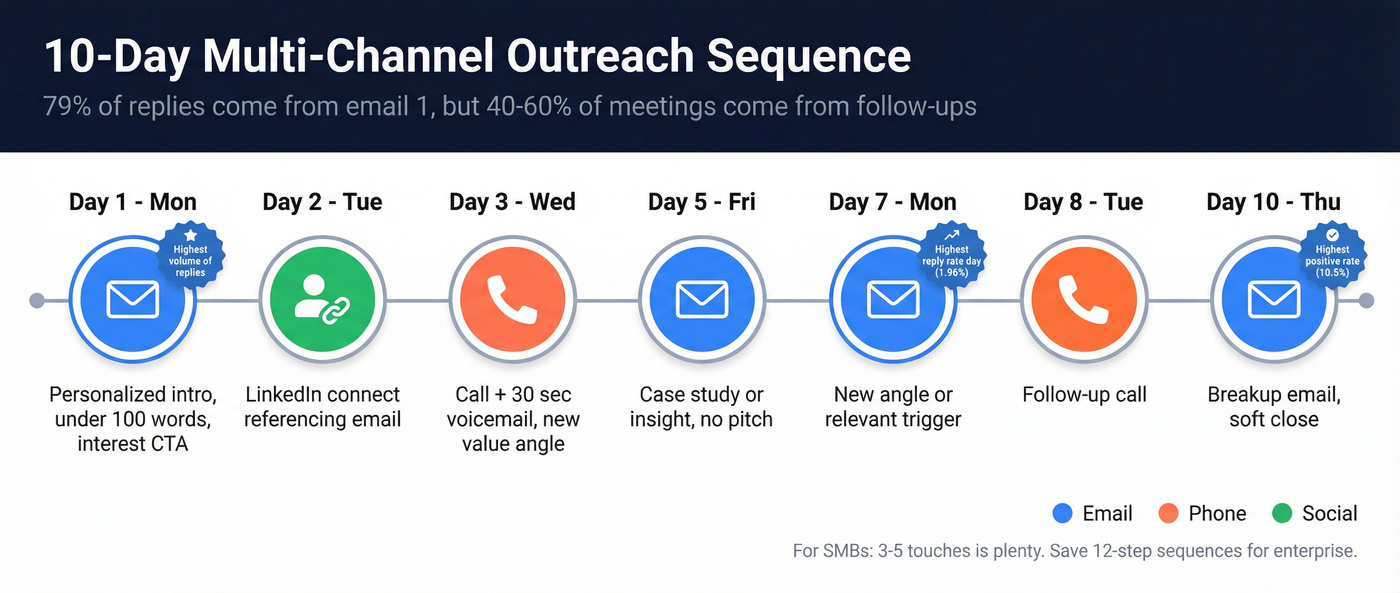
| Day | Channel | Action |
|---|---|---|
| 1 (Mon) | Personalized intro, under 100 words, interest CTA | |
| 2 (Tue) | Social | Connection request referencing email |
| 3 (Wed) | Phone | Call + 30-second voicemail with new value |
| 5 (Fri) | Case study or insight - no pitch | |
| 7 (Mon) | New angle or relevant trigger | |
| 8 (Tue) | Phone | Follow-up call |
| 10 (Thu) | Breakup email - soft close |
Monday has the highest reply rate at 1.96%. Thursday has the highest positive rate at 10.5%. Weekends drop 27%. Plan your sequence around these windows.
Skip the 12-touch sequences if you're selling to SMBs. Three to five touches is plenty when your targeting is tight and your data is clean. Long sequences are for enterprise deals where buying committees move slowly - not for booking a 15-minute intro call with a VP at a 50-person company.
Templates You Can Adapt
Each template follows the rules: informal tone, under 100 words, VP -> Trust -> CTA, interest-based close.
Template 1: Pain Point
Subject: {{company}}'s {{pain area}}?
Hi {{first_name}},
Noticed {{company}} is scaling the {{department}} team - usually means {{specific pain}} becomes a bottleneck around this stage.
We helped {{similar company}} cut {{metric}} by {{result}} in {{timeframe}}.
Worth a quick look?
Template 2: Social Proof
Subject: quick question
{{first_name}},
{{Similar company}} was dealing with {{problem}} last quarter. They switched to {{approach}} and saw {{specific result}}.
Running into the same thing? Want to see how they did it?
Template 3: Breakup
Subject: closing the loop
Hi {{first_name}},
Sent a couple notes about {{pain area}} - totally understand if the timing's off. If it becomes a priority, happy to pick this back up.
Cheers, {{your name}}
These aren't magic scripts. They're starting points. The consensus on r/sales is that templates work best when you rewrite them in your own voice and swap in real data from your prospect's world - not when you copy-paste them verbatim.
The data says directors reply 66% more and small companies convert at 5.3x the rate. Prospeo gives you 30+ filters - buyer intent, technographics, job changes, headcount growth, department size - so you build the exact list that turns a 0.64% positive reply rate into something worth measuring. Layer Bombora intent data across 15,000 topics to reach buyers already in-market.
Build the list that books meetings, not the one that bounces.
FAQ
How many cold emails does it take to book one meeting?
The average is 344 emails per meeting based on Gong's analysis of 28M+ sends. That number drops dramatically with verified data, director-level targeting, and interest-based CTAs. Top reps achieve 8.1x the average rate by fixing the system upstream - data, deliverability, and ICP - not the subject line.
What's a good cold email reply rate?
The average positive reply rate is 0.64%. A well-targeted campaign should aim for 5-12% total replies and 2-4% positive. Above 10% positive means your targeting and copy are both working. Below 1%, revisit your list criteria and deliverability setup before rewriting copy.
How do I stop cold emails from landing in spam?
Set up SPF, DKIM, and DMARC on every sending domain. Warm up new domains over 4-6 weeks starting at 5-10 emails per day. Keep bounce rates under 2% by verifying every address before sending. Monitor Google Postmaster Tools weekly and pause if spam complaints trend toward 0.3%.
What's the fastest way to start booking meetings from cold email?
Focus on three upstream levers before touching copy: verified data (under 2% bounce rate), deliverability infrastructure (SPF/DKIM/DMARC + warmup), and precise ICP targeting (directors+, growing companies). Teams that nail all three routinely see 2-3x the industry average within the first two weeks of launching.