Friendly Email Opening Lines That Actually Get Replies
You're staring at a blank email. The cursor blinks. You type "I hope this email finds you well," delete it, type it again, and hate yourself a little.
The average professional receives 121 emails a day, and most open with something forgettable. Your opening line isn't just a greeting - it's the preview text in your recipient's inbox, and 34% of people weigh that snippet almost as heavily as the subject line. That gap between "archived instantly" and "actually replied to" often comes down to a single sentence.
Why Your Opening Line Carries All the Weight
58% of replies come from the first email - not the follow-up, not the third touch. Your opener is doing the heaviest lifting of any sentence you'll write all week.
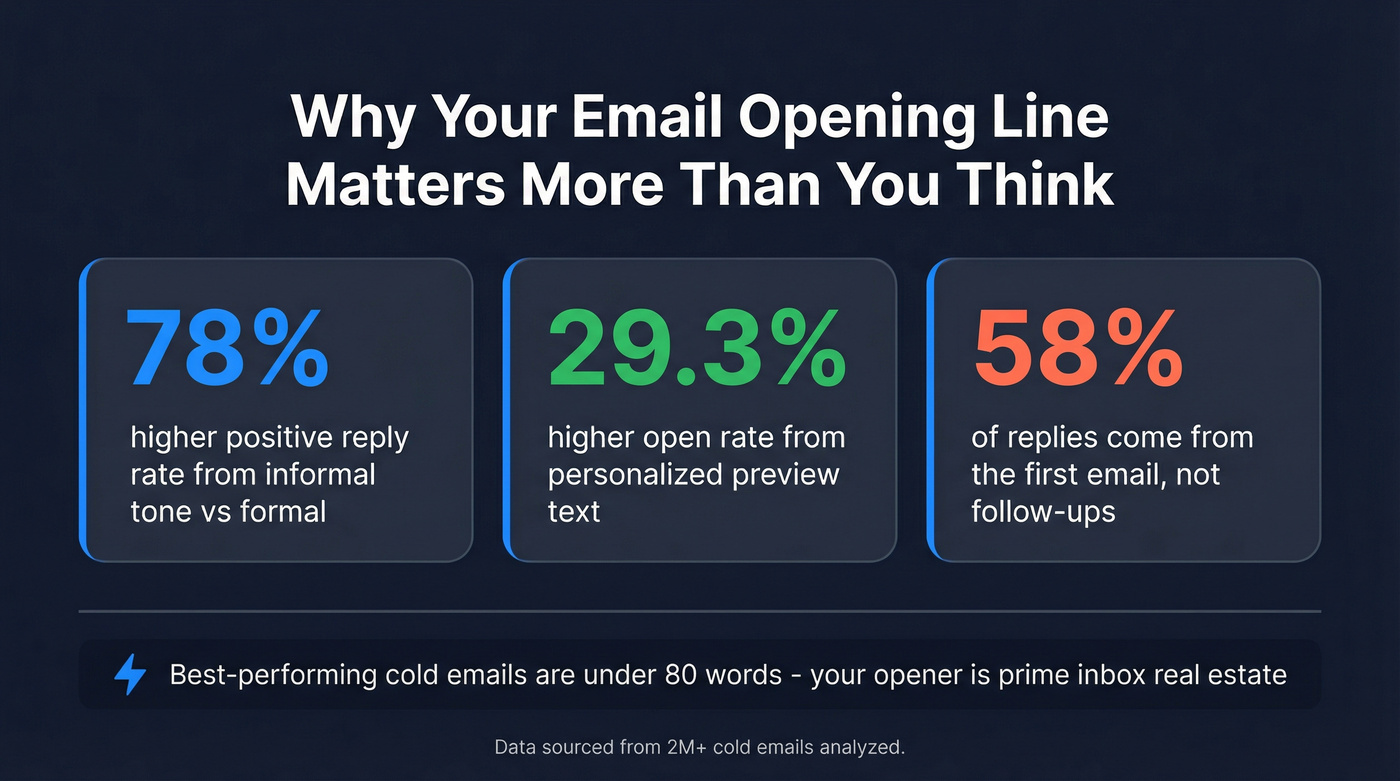
Tone matters more than most people realize. Across 2M+ cold emails analyzed by Sales.co, informal tone produced a 78% higher positive reply rate than formal. Personalized preview text drives a 29.3% higher open rate compared to generic filler. And keep it tight: Instantly's 2026 benchmark data shows the best-performing cold email campaigns keep messages under 80 words. Your opening line is inbox real estate. Treat it that way.
Openers to Stop Using Today
"I hope this email finds you well" is the email equivalent of a limp handshake. Kill these off:
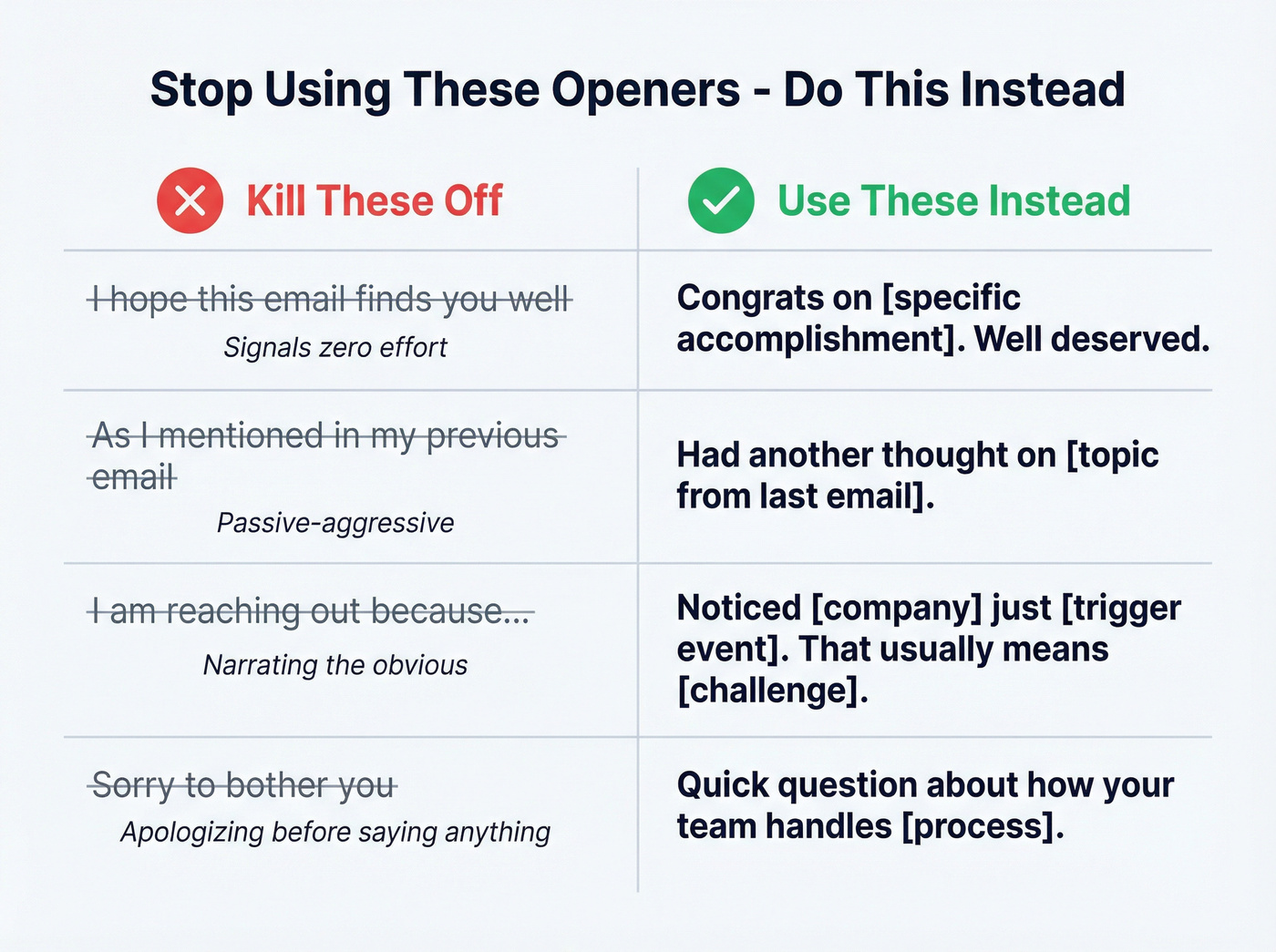
- "I hope this email finds you well" - A holdover from letter-writing formality. It signals you didn't think about the recipient for one second before writing. (If you need better options, start with these "I hope this email finds you well" alternatives.)
- "As I mentioned in my previous email" - Passive-aggressive. They know they didn't reply.
- "I'm reaching out because..." - Every email is someone reaching out. Skip the narration.
- "Sorry to bother you" - You're apologizing before you've said anything, which guarantees your message gets treated like an interruption.
They all share the same flaw: formal, impersonal, and burning the most valuable sentence in your email on nothing.

Your opening line only matters if it actually lands. 35% bounce rates kill reply rates faster than any bad opener. Prospeo's 5-step email verification delivers 98% accuracy - so every carefully crafted first sentence reaches a real inbox.
Stop wasting great copy on dead email addresses.
Opening Lines by Scenario
Stop collecting opening lines in a swipe file you'll never reopen. Start reading your recipient. Every opener below works because it's specific to a situation, not because it's clever. One rule applies everywhere: match your opener's tone to your sign-off. A casual "Hey Sarah" followed by "Respectfully yours" creates tonal whiplash that makes the whole email feel off.
Someone You Already Know
The key with existing contacts is proof of memory - referencing something specific from a past interaction signals this isn't a template. A warm opener for someone you've met before should feel like picking up a conversation, not starting one from scratch.
- "Great catching up at [event] - your point about [topic] stuck with me."
- "Congrats on [specific accomplishment]. Well deserved."
- "Saw your team just [launched/shipped/announced something]. How's it going?"
- "It's been a while - last time we talked you were working on [X]. How'd that turn out?"
Cold Outreach to a Stranger
We've tested hundreds of cold openers across client campaigns, and the pattern is clear: lead with an observation about them, not a statement about you. The best-performing structure follows a Value Prop → Trust → CTA flow. (If you want more plug-and-play options, grab these outreach email templates.)
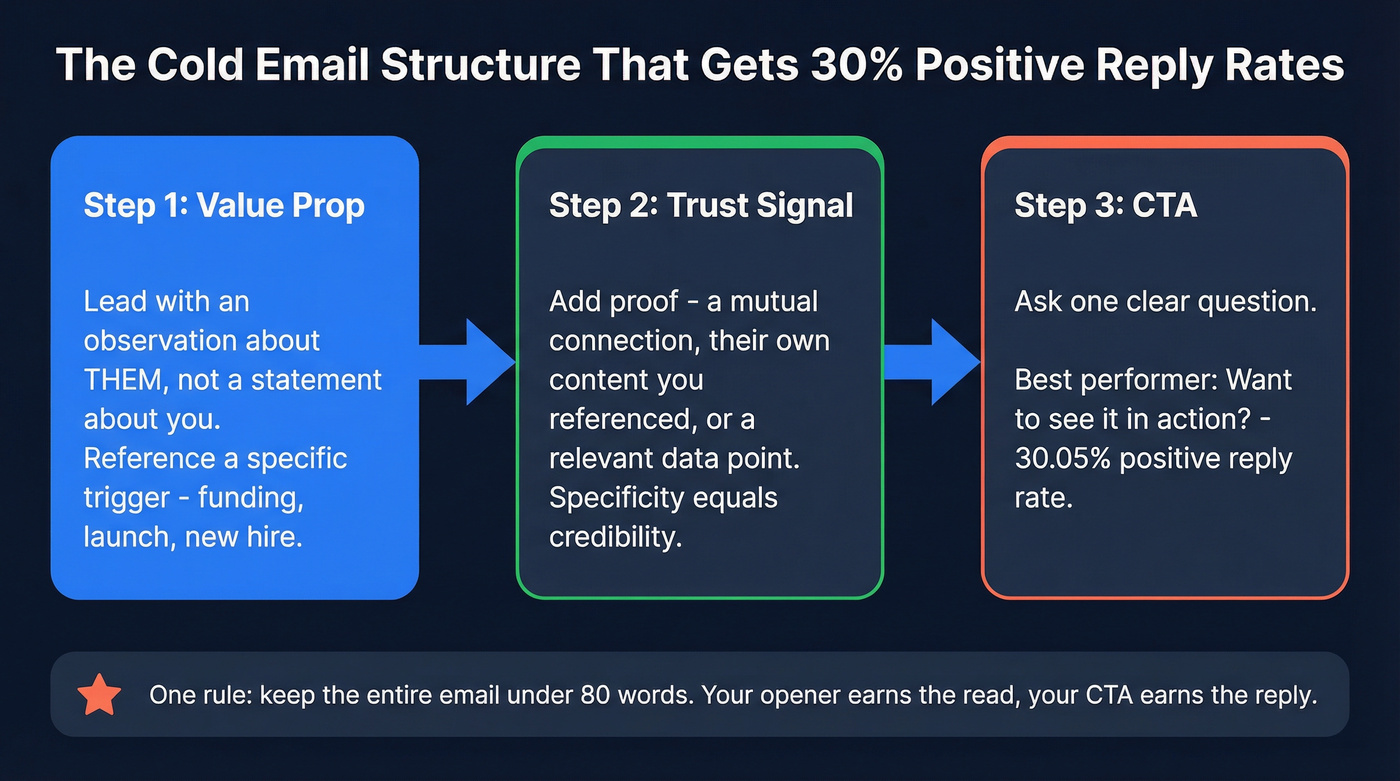
- "Noticed [company] just [specific trigger - funding, launch, new hire]. That usually means [relevant challenge]."
- "Quick question about how your team handles [specific process relevant to their role]."
- "Your [blog post/talk/podcast] on [topic] was sharp - especially the bit about [detail]."
- "[Mutual connection] mentioned you're the person to talk to about [challenge]."
One stat worth stealing: the CTA "Want to see it in action?" hit a 30.05% positive reply rate across that same 2M-email dataset. Your closer matters almost as much as your opener. If you're building a full cadence, use these cold email tactics to keep reply rates climbing.
Follow-Up Emails
Here's the thing: "just checking in" is the follow-up equivalent of "I hope this email finds you well." Follow-ups that add new information rather than restate the ask outperform standard follow-ups by roughly 30%. In our experience, the best follow-ups feel like a reply to a conversation, not a nudge. For more options, these follow-up email greetings work without sounding needy.
- "Wanted to share something that adds context to my last note."
- "Had another thought on [topic from original email]."
- "Since I last wrote, [new relevant development at their company]."
Warm Intros and Replies
For warm intros, the formula is simple: get permission first, introduce both parties in one sentence each, and step out.
- "[Name] and I were talking about [topic], and your name came up immediately."
- "I asked [mutual contact] who I should talk to about [challenge], and they pointed me straight to you."
When replying to someone's email, lead with gratitude and move to substance immediately. "Thanks for the quick reply - really helpful context" beats "Thank you so much for taking the time to get back to me regarding my previous inquiry" every time. That second version is four lines of nothing.
How to Start a Casual Email by Culture
What reads as warm in Dallas can read as unprofessional in Tokyo. Knowing how to start a business email friendly depends heavily on where your recipient sits - and one data point that surprised us: European countries reply to cold emails at 2-3x the rate of the US.
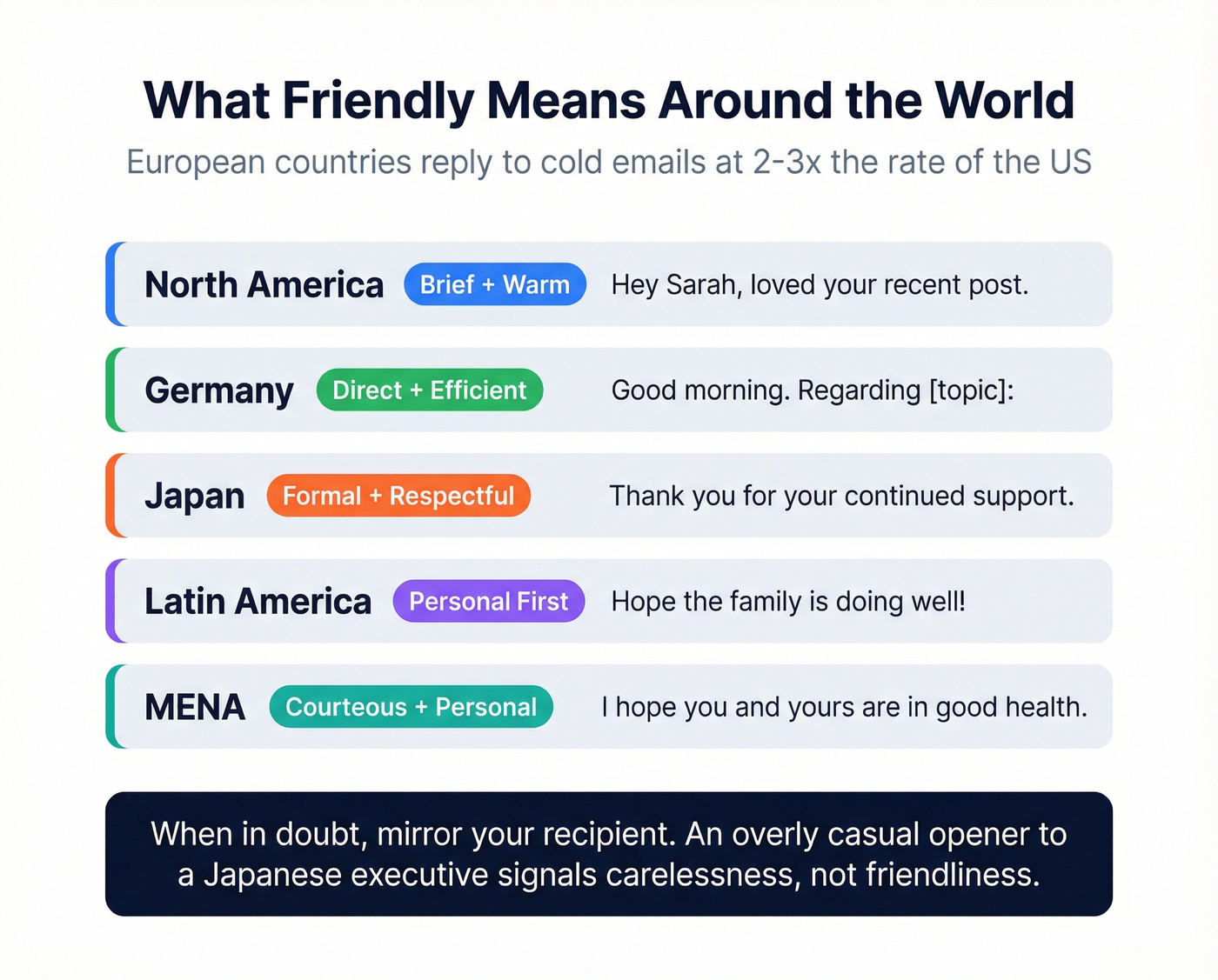
| Region | What "Friendly" Means | Example Opener |
|---|---|---|
| North America | Brief + warm | "Hey Sarah, loved your recent post." |
| Germany | Direct + efficient | "Good morning. Regarding [topic]:" |
| Japan | Formal + respectful | "Thank you for your continued support." |
| Latin America | Personal first | "Hope the family is doing well!" |
| MENA | Courteous + personal | "I hope you and yours are in good health." |
Mirroring your recipient's cultural norms isn't just polite - it's strategic. An overly casual opener to a Japanese executive signals carelessness, not friendliness.
Quick-Reference Decision Matrix
Not sure how to calibrate? Use this:
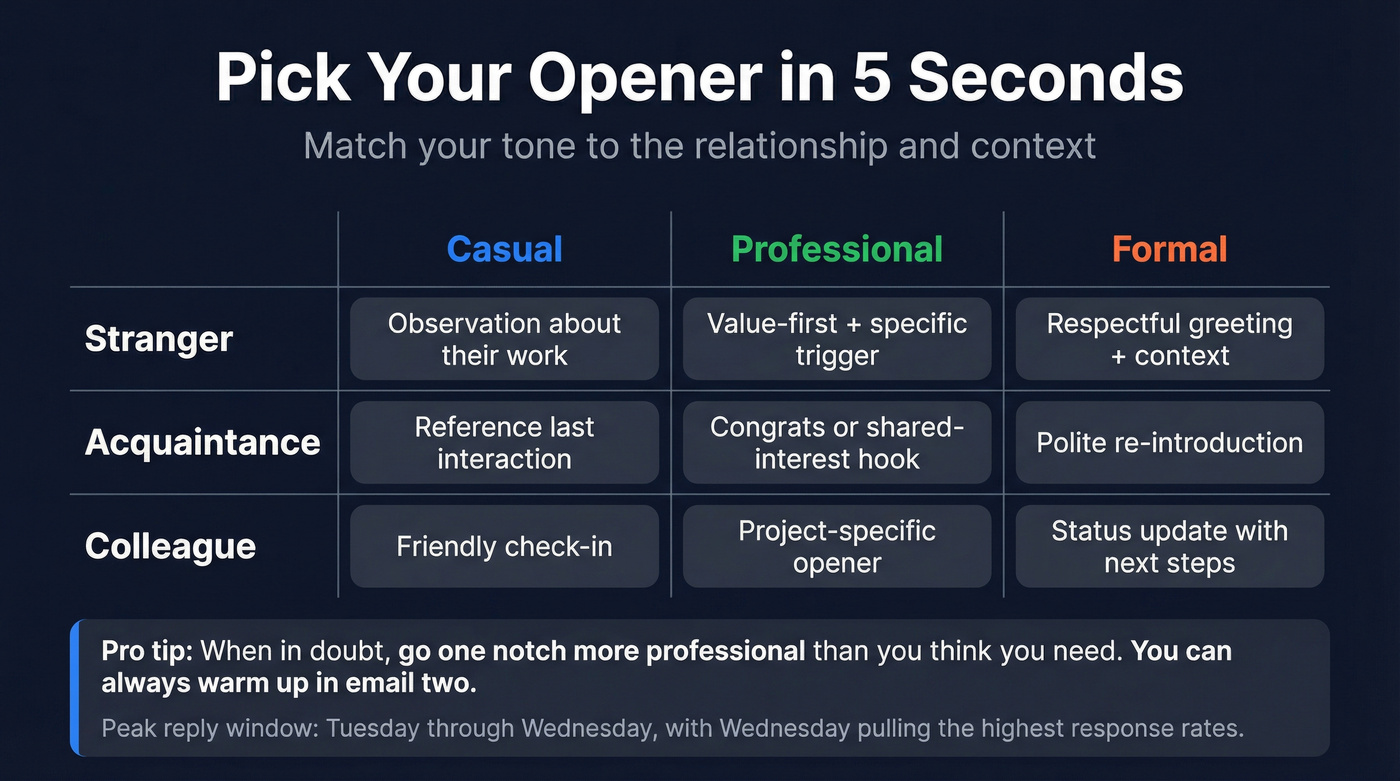
| Casual | Professional | Formal | |
|---|---|---|---|
| Stranger | Observation about their work | Value-first + specific trigger | Respectful greeting + context |
| Acquaintance | Reference last interaction | Congrats or shared-interest hook | Polite re-introduction |
| Colleague | Friendly check-in | Project-specific opener | Status update with next steps |
When in doubt, go one notch more professional than you think you need. You can always warm up in the second email.
Let's be honest: if you're spending more than 90 seconds on your opening line, you don't know your recipient well enough. Close the email, do five minutes of research, and the opener will write itself. (Need a repeatable system? Use this prospecting workflow to make research faster.)
One more thing worth noting from Instantly's 2026 benchmark data: Tuesday through Wednesday is the peak window for cold email replies, with Wednesday pulling the highest response rates. Pair the right opener with the right send time and you're stacking advantages - then validate it with the best time to send prospecting emails data.
You just spent five minutes researching a prospect and writing the perfect opener. Don't send it to an outdated email. Prospeo refreshes 300M+ contacts every 7 days - not every 6 weeks like competitors - so your outreach hits the right person at the right address.
Pair your best opening lines with data that's never more than a week old.
FAQ
What's the best replacement for "I hope this email finds you well"?
Reference something specific - a recent event, shared connection, or their work. Even "Congrats on [recent accomplishment]" outperforms any generic well-wish because it proves you did thirty seconds of homework. Specificity is what makes an opener feel friendly rather than formulaic.
Should cold emails start with a friendly opener?
Yes, but friendly means relevant, not chatty. Across 2M+ emails, informal tone produced 78% more positive replies than formal. Lead with an observation about their company or role and get to value within the first two sentences.
How do I sound warm without being unprofessional?
Anchor your opener in something specific - their recent work, a shared connection, or a relevant trigger event. Specificity signals effort, which reads as professional warmth rather than empty casualness. The scenario examples above all follow this principle.
How do I find the right email address for cold outreach?
Use a verified data platform like Prospeo - 98% email accuracy with a 7-day refresh cycle means your opener actually reaches the inbox. The free tier includes 75 email credits per month, enough to test your new opening lines on real prospects.