

The Best Bulk Email Software for 2026: 12 Platforms Compared
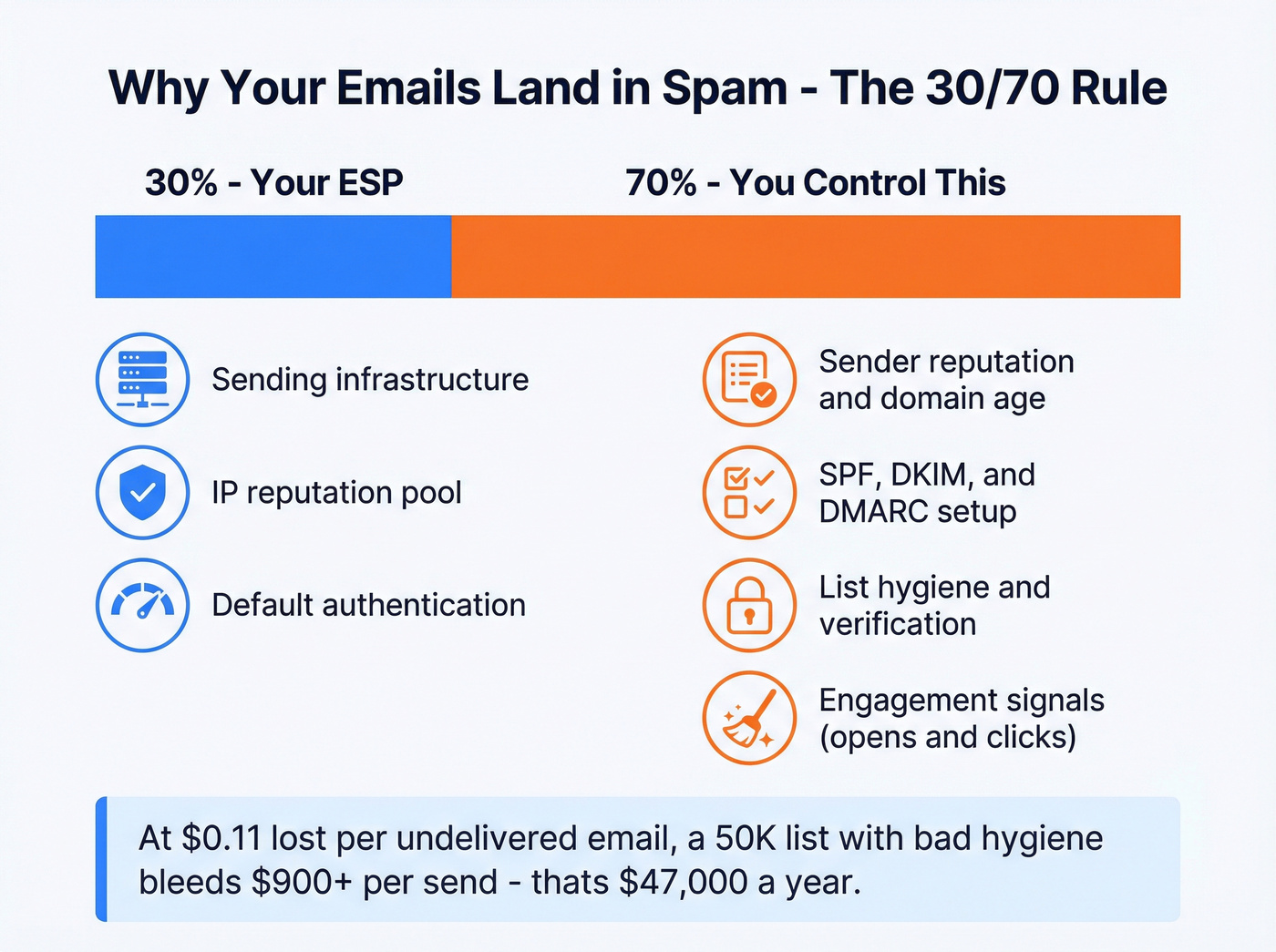
16.9% of marketing emails never reach their destination. That's not a rounding error - it's revenue evaporating before anyone opens a subject line. At an average of $0.11 lost per undelivered email, a 50,000-contact campaign with mediocre deliverability bleeds over $900 in a single send. Multiply that across a year of weekly sends and you're staring at $47,000+ in wasted spend.
The tool you pick matters. But maybe not in the way most comparison articles suggest. Your ESP accounts for roughly 30% of deliverability. The other 70%? Sender reputation, list hygiene, and authentication - things you control. The best bulk email software nails that 30% while making the 70% easier to manage. The worst ones charge you a premium and still land in spam.
Email marketing still returns $36 for every $1 spent on average - $68 for top performers. But only if your emails actually arrive.
Our Picks (TL;DR)
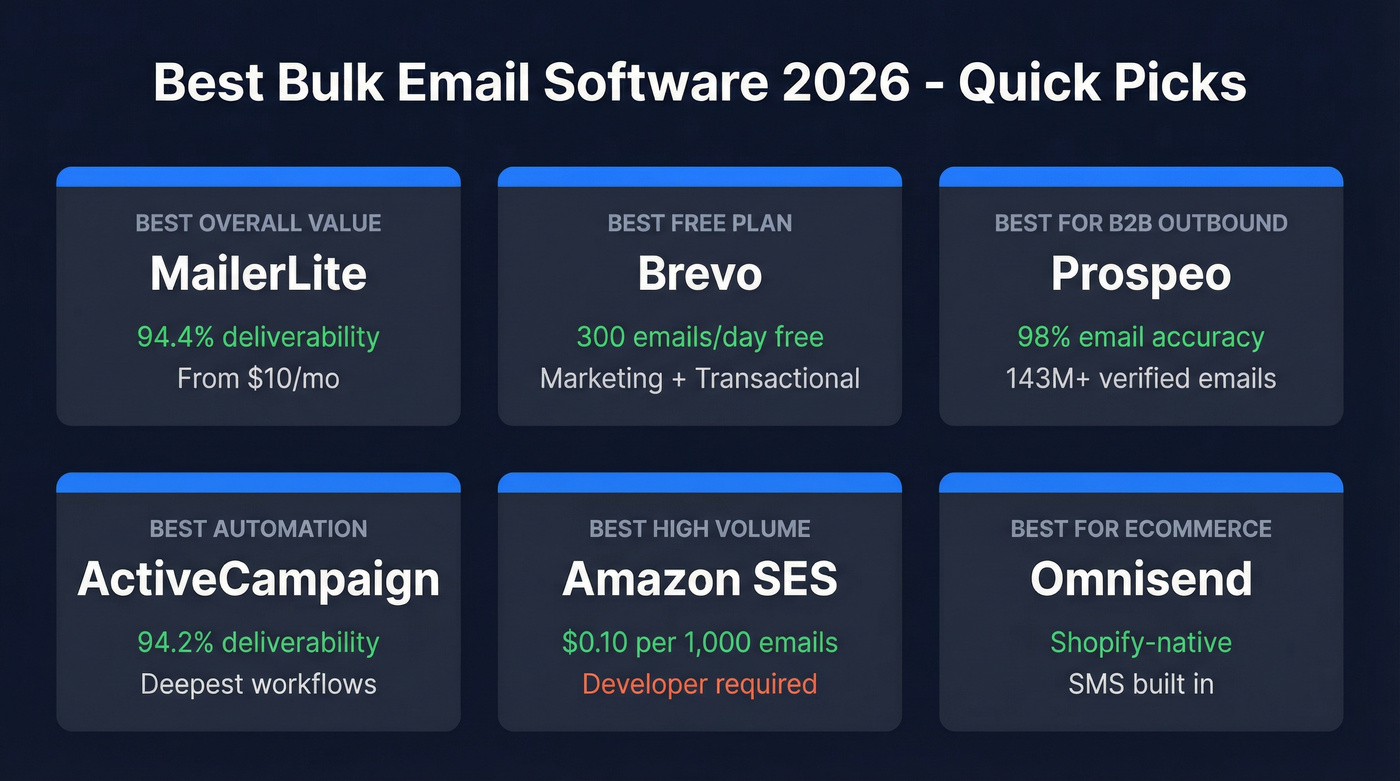
| Use Case | Pick | Why |
|---|---|---|
| Best overall value | MailerLite | 94.4% deliverability, from $10/mo |
| Best free plan | Brevo | 300 emails/day free, marketing + transactional |
| Best for B2B outbound | Prospeo | 98% email accuracy, fewer bounces |
| Best automation | ActiveCampaign | 94.2% deliverability, deepest workflows |
| Best high volume on budget | Amazon SES | $0.10/1,000 emails, unbeatable at scale |
| Best for ecommerce | Omnisend | Shopify-native, SMS built in |
"Best" depends entirely on what you're sending, who you're sending to, and how technical your team is. A Shopify store and a B2B outbound agency have completely different needs.
How We Evaluated These Bulk Email Programs
Every tool was scored across six criteria:
- Deliverability test scores - GlockApps seed-list testing from independent reviewers, plus transactional provider comparisons. Real inbox placement data, not vendor claims.
- Pricing at scale - what you actually pay at 1K, 10K, 50K, and 100K contacts. Free plan generosity is weighted separately.
- Compliance features - SPF/DKIM/DMARC support, one-click unsubscribe, dedicated IP options. In 2026, these aren't optional.
- Automation depth - from basic autoresponders to multi-branch workflows with conditional logic.
- Ease of use - G2 ratings, setup complexity, learning curve.
- List hygiene support - verification tools, bounce handling, catch-all detection. Because your mass email platform accounts for ~30% of deliverability. Sender reputation handles the other ~70%.

Your ESP handles 30% of deliverability. The other 70% is list quality. Prospeo's 143M+ verified emails refresh every 7 days with 98% accuracy - so your bulk sends don't bounce, and your sender reputation stays intact.
Stop bleeding $47K/year on emails that never arrive.
The 12 Best Bulk Email Platforms in 2026
MailerLite - Best Overall for Most Senders
MailerLite is the tool we recommend most often to teams that don't have a specific reason to pick something else. That sounds like faint praise - it's not. Being the best default option in a crowded market is genuinely hard.

The deliverability numbers tell the story: 94.41% average across five independent test rounds, earning a "best of 5" award. That's not a single lucky test - it's consistency. The most recent single-round score came in at 89.8%, so expect some natural variance. The interface is clean enough that a marketing coordinator can build campaigns without training, and support quality scores 9.3/10 on G2 (4.6/5 overall).
What you get:
- Free plan: 1,000 subscribers, 12,000 emails/month
- Paid from $10/mo (500 contacts), $73-88/mo at 10K contacts
- No send limits on paid plans
- Drag-and-drop editor, landing pages, pop-ups, automation
The tradeoff: Automation is good but not ActiveCampaign-level. If you need complex multi-branch workflows with CRM-style lead scoring, you'll outgrow it. For everyone else - newsletters, product updates, promotional campaigns - it's the sweet spot of price, deliverability, and usability.
Brevo - Best Free Plan for Marketing + Transactional
Use this if: You need marketing emails and transactional emails (order confirmations, password resets) from one platform without paying for two tools. The free plan gives you 300 emails/day. Brevo Starter begins at $9/mo for 5,000 emails/month, scaling to $15/mo for 10,000.
Skip this if: Consistent deliverability is your top priority. Brevo's average sits at 88.3%, which is acceptable - but individual test rounds ranged from 67.7% to 96.3%. That inconsistency is concerning. You might have a great month followed by a terrible one.
G2 sits at 4.5/5 across 2,507 reviews, with ease of use as the top-mentioned pro. Paid plans at 10K contacts run $39/mo - significantly cheaper than Mailchimp's $135. Removing Brevo branding costs an extra $12/mo, which is annoying but not a dealbreaker.
Brevo's real strength is being a Swiss Army knife. Marketing automation, transactional API, SMS, WhatsApp - all in one dashboard. If you're a small team that doesn't want to manage four different tools, that consolidation has real value.
Prospeo - Best Bulk Email Outreach Tool for B2B
Most bulk email programs focus on what happens after you hit send. Prospeo focuses on what happens before - and that's where most deliverability problems start.
If 5% of your list bounces, mailbox providers notice. If 10% bounces, you're flagged. The #1 cause of poor sender reputation isn't your ESP - it's bad email addresses. Prospeo's database covers 143M+ verified emails across 300M+ professional profiles, all run through a 5-step verification process with catch-all handling, spam-trap removal, and honeypot filtering. Accuracy rate: 98%. Every record refreshes on a 7-day cycle - the industry average is six weeks.

Stack Optimize, an outbound agency, built from $0 to $1M ARR using Prospeo as their data layer - client deliverability stayed above 94%, bounce rates under 3%, zero domain flags. It integrates natively with Smartlead, Instantly, and Lemlist. Free tier: 75 emails and 100 Chrome extension credits per month.
ActiveCampaign - Best Deliverability + Automation
ActiveCampaign holds the highest tested deliverability among marketing platforms: 94.2% in the most recent independent test round. Combine that with the most sophisticated automation builder in this price range and you've got a serious tool.

Pros:
- 94.2% deliverability - best tested in a single round
- Customer benchmarks: 39.26% average open rate, 6.21% click rate
- Automation builder handles multi-branch workflows, lead scoring, CRM pipeline management
- Starts at $15/mo for 1,000 contacts
Cons:
- $174/mo at 10K contacts - that's 2x MailerLite and 4x Brevo at the same tier
- The interface has a learning curve. This isn't a "set up in 20 minutes" tool.
- Overkill if you're sending newsletters and nothing else
Here's the thing: ActiveCampaign is the right choice when automation complexity justifies the price. If you're running behavior-triggered sequences, scoring leads based on engagement, and routing contacts through different paths based on actions - this is the tool. If you're sending a weekly newsletter to 5,000 people, you're overpaying.
Moosend - Best Value With Unlimited Sends
Moosend offers unlimited sends on every paid plan - a rarity in the email campaign software market. Starting at $9/mo for 500 contacts and $79-88/mo at 10K, it's priced competitively with MailerLite while removing the mental overhead of counting sends.
G2 rating: 4.7/5, the highest among budget-tier tools. The automation builder is surprisingly capable for the price, with pre-built workflows for cart abandonment, onboarding sequences, and re-engagement.
Who should skip it: Anyone who needs a free plan. Moosend only offers a 30-day trial. And at 90.1% deliverability, it's good but not best-in-class - ActiveCampaign and MailerLite both score higher. For teams that prioritize volume and value over bleeding-edge features, Moosend is the quiet winner most people overlook.
Mailchimp - The Familiar Name That Gets Expensive Fast
Here's my hot take: Mailchimp is the most overpaid email blast tool in the market. Not the worst - just the one where the gap between price and value is widest.

The free plan has been gutted to 250 contacts and 1,000 emails - barely enough to test the platform. Standard plan pricing tells the real story: $135/mo at 10K contacts, $450 at 50K, $800 at 100K. That's nearly double MailerLite at every tier.
Deliverability is middle-of-the-pack at 89.5%. G2 rating: 4.3/5 - the lowest among the marketing platforms on this list. Send limits cap at 12x your contact count on Standard, which means 10K contacts gets you 120K emails/month. Not terrible, but Moosend gives you unlimited for $47-56 less.
I've seen teams stick with Mailchimp purely out of inertia. If that's you, run the numbers on MailerLite or Brevo. The migration takes a weekend. The savings compound every month.
Sender - Most Generous Free Plan
| Best for | Small businesses and newsletters starting at $0 |
| Free plan | 2,500 contacts + 15,000 emails/month - the most generous in the market |
| Paid plans | From $7/mo |
| G2 / Capterra | 4.8/5 / 4.7/5 |
| Deliverability | Not independently tested by major benchmarking services |
| Standout feature | A/B testing with up to 8 combinations |
Automation is basic - fine for welcome sequences, not for complex workflows. Limited integrations compared to ActiveCampaign or Brevo. You'll outgrow it if your needs get sophisticated. But for small businesses and anyone who wants to start sending without spending a dollar, Sender handles what most startups need for their first year.
Amazon SES - Cheapest at Scale for Developers
At $0.10/1,000 emails, Amazon SES is unbeatable on raw cost. A million emails runs about $100/month. No other bulk email sending tool comes close at that volume.

The catch: there's no drag-and-drop editor, no templates, no campaign management. It's an API and SMTP relay - you build everything yourself. Deliverability on shared IPs tested at 77.1% in transactional API comparisons, but that improves significantly with dedicated IPs and proper SPF/DKIM/DMARC configuration. On dedicated IPs with authentication locked down, teams routinely see 90%+ inbox rates.
Best for teams with developers who can build their own sending layer and want to keep costs minimal. If you don't have engineering resources, look elsewhere.
SMTP2GO - Best SMTP Relay Deliverability
Use this if: You already have email creation handled (custom HTML, another tool generating emails) and need the most reliable sending infrastructure. SMTP2GO tested at 96% average deliverability - the highest among all SMTP relays in independent seed-list testing.
Skip this if: You need marketing features. No drag-and-drop editor, no automation, no landing pages. Pure sending infrastructure.
Pricing is remarkably fair: free for 1,000 emails/month, $15 for 10K, $30 for 50K, $75 for 100K. For teams that separate email creation from email delivery, SMTP2GO is the infrastructure layer that just works.
Omnisend - Best for Ecommerce Bulk Email
Omnisend does one thing - ecommerce email - and does it well. Shopify-native integration, product recommender blocks, dynamic discount codes, gamified forms (spin-to-win popups), SMS to 200+ countries, and push notifications - all from one platform. G2 rating: 4.6/5.
The weakness is deliverability: 75.1% in testing, well below average.
That's a real concern for high-volume senders. Free plan covers 250 contacts and 500 emails; paid starts at $16/mo. If you're running a Shopify store and want one tool for email, SMS, and push, Omnisend is the specialist pick. Just pay extra attention to list hygiene - that deliverability score means you can't afford dirty data.
Mailgun - Developer API Sending
Mailgun starts at $15/mo for 10K emails, with the Scale plan at $90/mo for 100K. Inbox rate tested at 71.4% in independent comparisons - mediocre. Best for developers who need API-first sending with detailed logs and don't mind building their own templates. The Scale plan includes dedicated IP pools and send-time optimization. If deliverability matters more than API flexibility, SMTP2GO is the better infrastructure pick.
SendGrid - Legacy Option With Caveats
SendGrid retired its free plan in May 2025 and has seen significant deliverability declines. Independent SMTP testing shows an 82% average inbox rate, while transactional API testing on shared IPs recorded just 61% - with Outlook and Hotmail showing 0% inbox placement in that test. Paid plans start at $19.95/mo for 50K emails, but the reputation trajectory makes it hard to recommend over SMTP2GO or even Amazon SES at this point.
Honorable mentions: GetResponse, Postmark, and AWeber are solid tools that didn't make our primary list. Postmark in particular excels at transactional email (94% deliverability in testing) and deserves a look if that's your primary use case.
Stack Optimize built a $1M outbound agency with under 3% bounce rates and zero domain flags - all powered by Prospeo's 5-step verified data. At $0.01 per email, it costs less than a single undelivered message.
Fix deliverability at the source - start with better data.
Pricing Compared: What You'll Actually Pay
Pricing is where the real differences show up. Here's what each tier costs:
| Tool | 1K Contacts | 10K Contacts | 50K Contacts | 100K Contacts |
|---|---|---|---|---|
| MailerLite | $16/mo | $73-88/mo | $315/mo | ~$400+/mo |
| Brevo | $17/mo | $39/mo | $239/mo | $399/mo |
| ActiveCampaign | $39/mo | $174/mo | $486/mo | ~$700+/mo |
| Moosend | $19/mo | $79-88/mo | ~$199/mo | ~$350+/mo |
| Mailchimp Std | $20/mo | $135/mo | $450/mo | $800/mo |
| Sender | $7/mo | ~$40/mo | ~$150/mo | ~$300/mo |
| Omnisend | $16/mo | ~$60/mo | ~$250/mo | Not public |
For infrastructure/API tools, pricing works differently (per email, not per contact):
| Tool | 10K Emails | 50K Emails | 100K Emails |
|---|---|---|---|
| Amazon SES | $1 | $5 | $10 |
| SMTP2GO | $15 | $30 | $75 |
| Mailgun | $15 | $35 | $90 |
| SendGrid | ~$15 | ~$20 | ~$35 |
The Mailchimp premium is striking. At 10K contacts, you're paying $135/mo for a tool that delivers 89.5% inbox rate. MailerLite charges $73-88 for 94.4% deliverability. That's paying more for worse results.
Deliverability Scores: What the Tests Actually Show
Deliverability data is the most important comparison point in this article, and the hardest to find. Most roundups skip it entirely.
I'm using a four-tier scale: Excellent (95%+), Good (85-94%), Below Average (70-84%), Poor (below 70%).
Marketing Platform Deliverability:
| Platform | Avg Inbox Rate | Rating |
|---|---|---|
| MailerLite | 94.4% (5-round avg) | Good |
| ActiveCampaign | 94.2% | Good |
| Constant Contact | 91.7% | Good |
| Moosend | 90.1% | Good |
| Mailchimp | 89.5% | Good |
| Brevo | 88.3% | Good |
| Omnisend | 75.1% | Below Average |
SMTP/Transactional Deliverability:
| Provider | Avg Inbox Rate | Rating |
|---|---|---|
| SMTP2GO | 96% | Excellent |
| Postmark | 94% | Good |
| SendGrid | 82% | Below Average |
| Brevo (SMTP) | 80% | Below Average |
| Mailtrap | 78.8% | Below Average |
| Amazon SES | 77.1% | Below Average |
| Mailgun | 71.4% | Below Average |
Note: SMTP/transactional tests were conducted on shared IPs. Tools like Amazon SES perform significantly better with dedicated IPs and proper authentication - the 77.1% figure represents a baseline, not a ceiling.
A few things jump out. The gap between the best and worst is enormous - 96% vs. SendGrid's declining scores. And no marketing platform cracks the "Excellent" threshold, which tells you something important: your ESP alone will never guarantee great deliverability.
Deliverability Varies by Industry
This is data most comparison articles never mention. Independent testing shows massive inbox rate variance by sector:
- Mining & Minerals: ~98% average inbox rate
- Government: ~96%
- Software/SaaS: ~80-82%
- Agriculture: ~60%
If you're in a high-risk industry (SaaS, finance, anything with aggressive sending patterns), deliverability is harder to earn. You need a better ESP and cleaner data to compensate.
Provider-level differences matter too: Gmail inboxes average ~87.2% placement across all ESPs, while Outlook averages ~75.6%. If your audience skews Outlook-heavy (common in B2B), authentication and sender reputation become even more critical. That 70% you control - sender reputation, authentication, and list hygiene - is where clean, verified data makes the biggest difference.
Compliance Checklist for Bulk Senders in 2026
Google, Yahoo, and Microsoft are all actively enforcing bulk sender requirements. Microsoft now rejects non-compliant messages entirely - not spam-folders them, rejects them. If you see SMTP error codes 550-5.7.26 (permanent rejection) or 421-4.7.26 (temporary deferral), your authentication is failing.
Authentication (non-negotiable):
- SPF record configured and passing
- DKIM signature on every email
- DMARC record published (minimum p=none, ideally p=quarantine or p=reject)
- SPF or DKIM aligned with your From domain
- TLS encryption enabled
- Forward-confirmed reverse DNS (FCrDNS) configured
Unsubscribe compliance:
- One-click unsubscribe via List-Unsubscribe header
- Unsubscribe requests processed within 2 days
- Visible unsubscribe link in every email
Reputation thresholds:
- Spam complaint rate below 0.1% - never above 0.3%
- Bounce rate under 2%
- 5,000+ emails/day = you're a bulk sender in Google/Yahoo/Microsoft's eyes
The penalties are real. CAN-SPAM violations run up to $53,088 per email. CASL (Canada) can hit $10M for businesses. GDPR fines reach EUR10M depending on severity.
IP/domain warming: If you're starting fresh or switching providers, plan for 4-6 weeks of warming. Scale volume no more than 25% per day. Start with your most engaged subscribers - openers from the last 30 days - then gradually mix in older segments. Skip a day and you can undo weeks of progress.
How to Choose the Right Bulk Email Sending Tool
Instead of reading every review above, use this decision framework:
Beginner with under 2,500 contacts? Start with Sender (free, 15,000 emails/month) or MailerLite (free, 12,000 emails/month). Both are easy to set up and won't cost you anything while you're building your list.
Need marketing + transactional in one platform? Brevo. It's the only tool on this list that handles both well at a reasonable price.
Automation is your priority? ActiveCampaign. Nothing else in this price range matches its workflow builder. Just budget for the premium - $174/mo at 10K contacts.
Developer team building custom infrastructure? Amazon SES for cost ($0.10/1K emails), SMTP2GO for deliverability (96% inbox rate). If you can write code, you don't need a drag-and-drop editor.
Running an ecommerce store? Omnisend for Shopify-native features. Pair it with aggressive list hygiene to offset the lower deliverability scores.
B2B outbound at scale? This is a different stack entirely. You need a data verification layer (like Prospeo - 98% accuracy, native integrations with Smartlead, Instantly, and Lemlist) paired with a cold email platform for sequences and warmup. Trying to do B2B outbound with a marketing ESP is a recipe for domain damage.
Budget is everything? Moosend. Unlimited sends from $9/mo. No per-email caps, no surprise overages.
Look, the biggest mistake I see teams make isn't picking the wrong ESP. It's picking the right ESP and then feeding it garbage data. Verify your list before you send. Authenticate your domain. Warm up properly. The tool matters - but it's only 30% of the equation.
FAQ
What's the cheapest way to send bulk emails?
Amazon SES at $0.10 per 1,000 emails is the cheapest option for developers - about $100/month for a million emails. For non-technical users, Sender's free plan covers 15,000 emails/month at zero cost. Moosend offers unlimited sends from $9/mo if you need paid features without per-email pricing.
How many emails can I send per day without getting flagged?
Google, Yahoo, and Microsoft classify you as a bulk sender at 5,000+ emails per day, triggering strict authentication requirements. Keep spam complaint rates below 0.1% - never let them reach 0.3%. New domains need 4-6 weeks of warming, increasing volume no more than 25% daily, starting with your most engaged subscribers.
Does the email platform I choose affect deliverability?
Yes, but only about 30%. Your sender reputation, list hygiene, and authentication (SPF/DKIM/DMARC) account for the other 70%. ActiveCampaign tests at 94.2% while SendGrid tests as low as 61% on shared IPs - that gap matters. But even a 95% deliverability tool won't save a list full of invalid addresses.
How do I keep bounce rates low when sending mass email campaigns?
Verify every email address before sending. Remove hard bounces immediately, re-verify lists older than 30 days, and never purchase email lists from third-party brokers. Catch-all handling and spam-trap removal are essential - without them, you're flying blind on a significant chunk of your list.
Is Mailchimp still the best bulk email software in 2026?
No. At 10K+ contacts, Mailchimp costs $135/mo on Standard with mid-pack 89.5% deliverability. MailerLite delivers 94.4% inbox rates at $73-88/mo - better results at roughly half the price. Unless you're deeply invested in Mailchimp's ecosystem, MailerLite or Brevo offer stronger value at every list size.