Best Lead Generation Software for 2026: An Honest Buyer's Guide
Dozens of tools call themselves lead generation software. You need maybe three of them - a data provider, a CRM, and something to run sequences. The real problem isn't finding options. It's that 80% of leads never convert, which means most teams are generating volume, not quality. And yet, lead generation as their top priority - a disconnect that explains why the B2B lead generation market is projected to hit $32.85B by 2035 at 11.33% CAGR. More money chasing the same broken playbook.
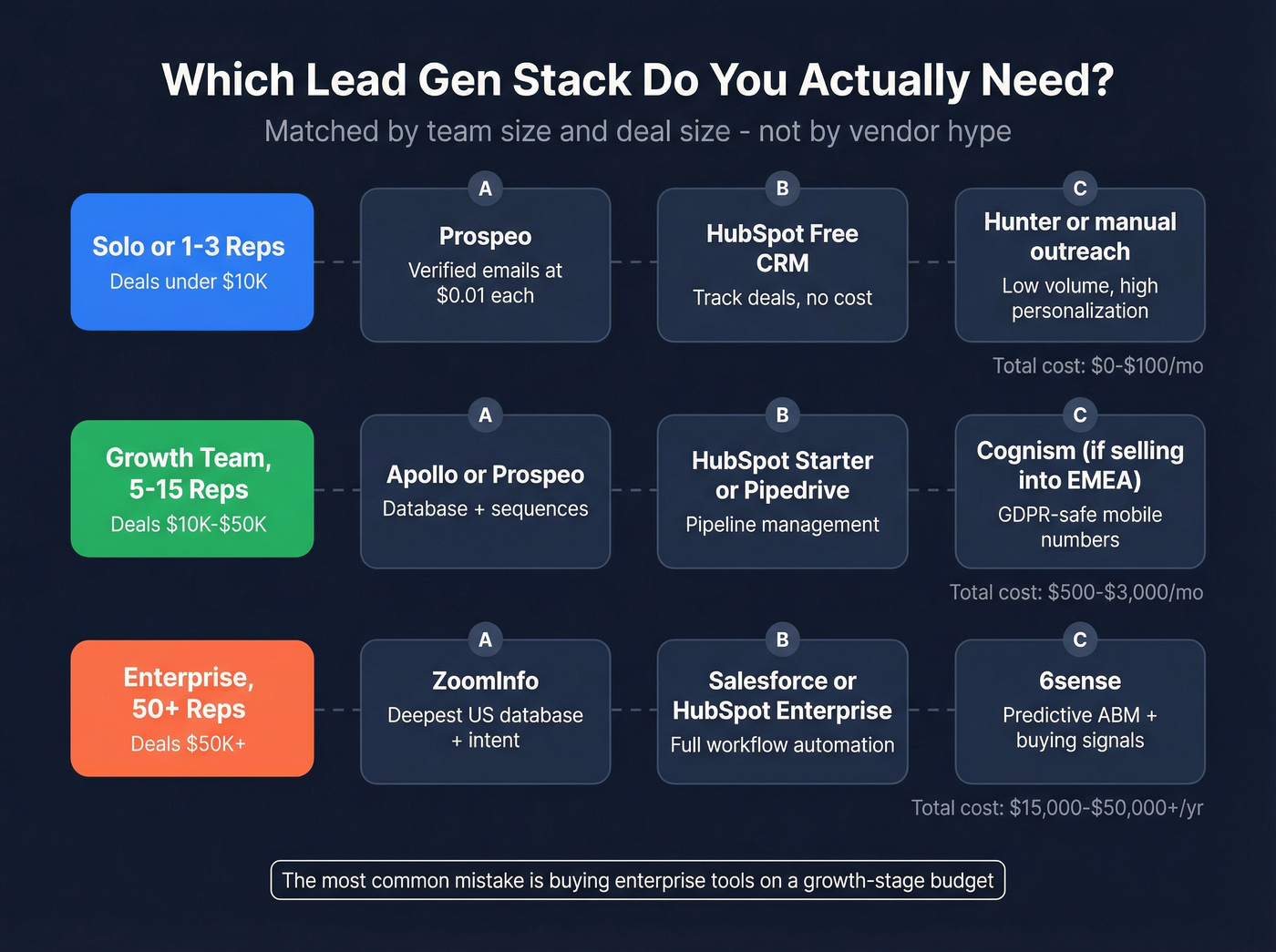
Here's the hot take most vendors won't give you: if your average deal size sits below $10K, you probably don't need a $15,000/year database. You need clean data, a simple CRM, and disciplined follow-up. We've tested and tracked these tools across dozens of outbound campaigns, and this guide covers 12 worth your time - organized by what they actually do, with real pricing and honest tradeoffs so you don't overspend.
Our Picks (TL;DR)
If you're short on time, here's where to start. These five lead generation solutions cover the core use cases, and each earns its spot for a different reason.
| Tool | Best For | Starting Price | Verdict |
|---|---|---|---|
| Prospeo | Email accuracy + self-serve | Free (75 emails/mo); ~$0.01/email | Best verified data, no contract |
| Apollo | All-in-one outbound | Free; $49/user/mo (Basic) | Best value if you manage credits |
| ZoomInfo | Enterprise database + intent | ~$15,000/yr | Deepest database, steep pricing |
| Cognism | EMEA + GDPR compliance | ~$1,000-$3,000/mo | Best for European markets |
| HubSpot | Inbound lead capture + CRM | Free CRM; $20/user/mo | Best free starting point |
What Does Lead Generation Software Actually Do?
This isn't one category - it's at least four, and most buyers conflate them.
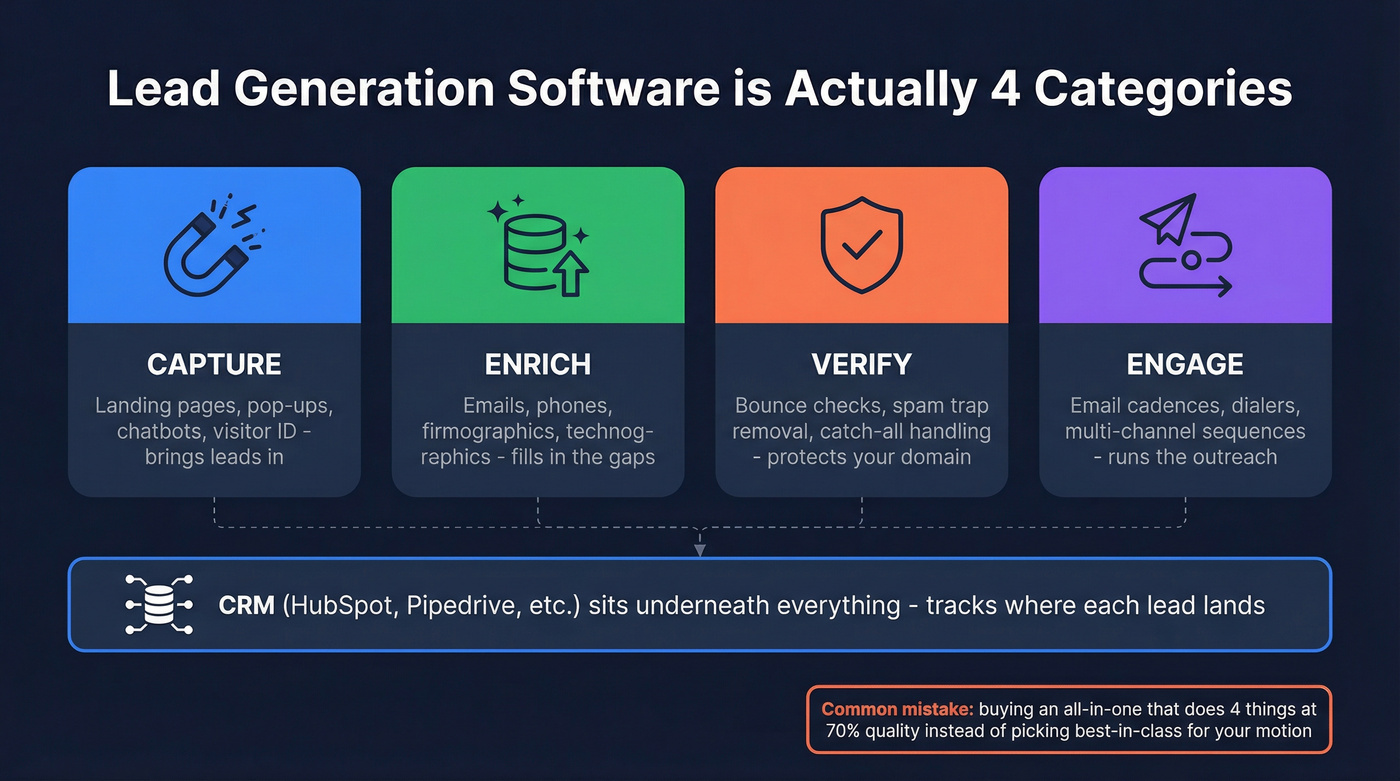
Capture tools bring leads in through landing pages, pop-ups, chatbots, and website visitor identification. Enrich tools fill in the gaps with email addresses, phone numbers, firmographics, and technographics (see firmographics and technographics). Verify tools make sure the data's real before you burn your domain reputation on bounced emails. Engage tools run the sequences - email cadences, dialers, and multi-channel touches (more on AI sales outreach automation).
A CRM like HubSpot or Pipedrive sits underneath all of this, tracking where each lead lands. The mistake most teams make is buying an all-in-one that does four things at 70% quality instead of picking best-in-class tools for the one or two stages that matter most to their motion. If you're running outbound, data accuracy is everything (use a prospecting workflow). If you're running inbound, capture and CRM matter more.
The Real Cost of Lead Gen Tools
Let's be honest about something most comparison articles skip entirely: advertised pricing and actual cost are wildly different in this category.
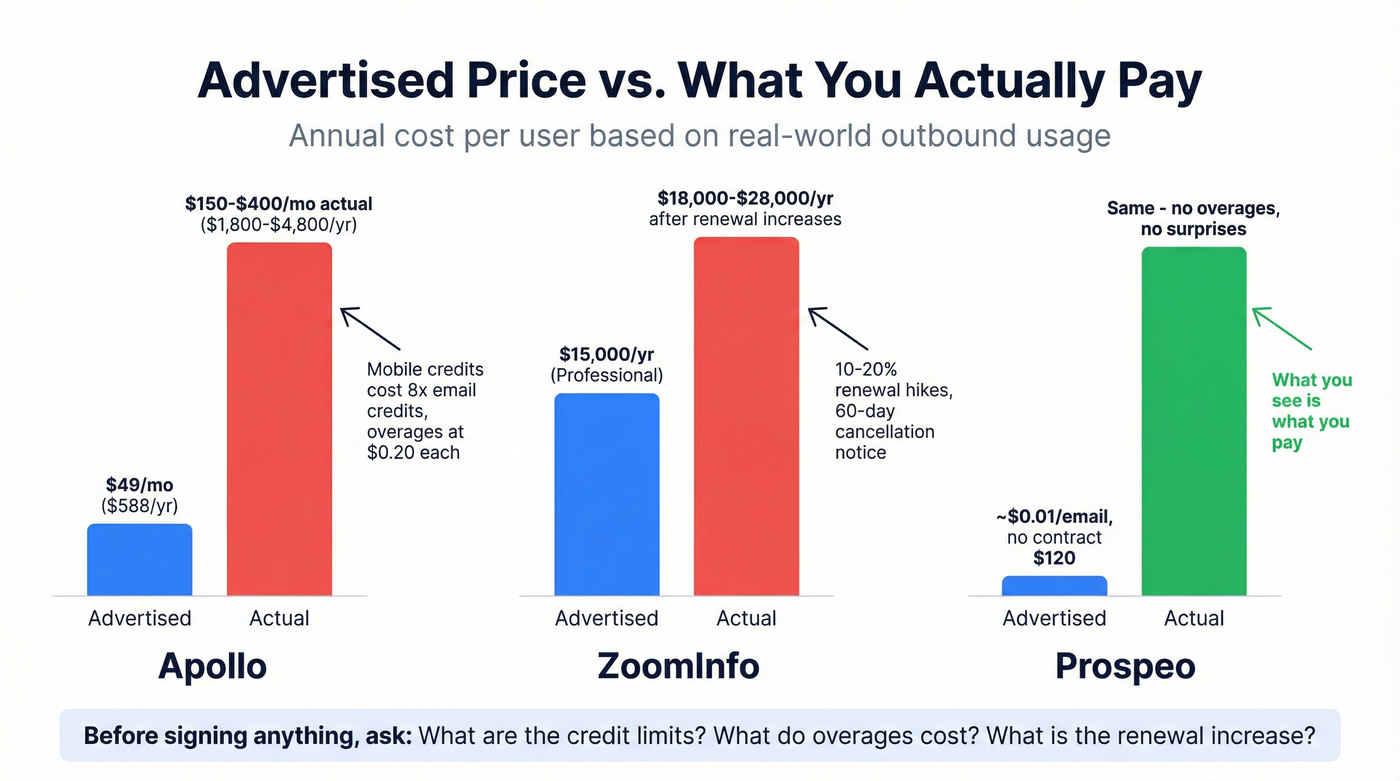
Apollo lists Basic at $49/user/month. But mobile credits cost 8x what email credits cost, you only get 75 mobile credits per month on Basic, and overages run $0.20/credit with a 250-credit minimum. Heavy outbound teams realistically spend $150-$400/user/month once you factor in credit overages and add-ons. That's 3-4x the sticker price.
ZoomInfo's even worse. A Professional contract runs $15,000-$18,000/year for 1-3 seats. Advanced pushes $22,000-$28,000. Elite? $35,000-$45,000+. Renewals often come with 10-20% increases, and many contracts require 60 days' cancellation notice to avoid auto-renewal.
Advertised price ≠ real cost. Before you sign anything, ask three questions: What are the credit limits? What do overages cost? What's the renewal increase?
Cost-per-lead benchmarks by channel add context. SEO leads cost ~$31 each. Email leads run ~$53. PPC jumps to $181, and trade shows hit $811. If email is your primary channel, investing in data quality - not database size - gives you the best CPL improvement (see data quality).

You just read that advertised pricing rarely matches real cost. Prospeo charges ~$0.01 per verified email with no contracts, no overages, and no sales calls. 98% email accuracy means fewer bounces, better deliverability, and lower actual cost-per-lead than tools charging 90x more.
Stop overpaying for leads that bounce. Start with 75 free emails.
12 Best Lead Generation Software Tools for 2026
Here's the full reference table before we get into each tool. Pricing reflects annual billing where applicable.
| Tool | Starting Price | Free Tier | Access | Best For |
|---|---|---|---|---|
| ZoomInfo | ~$15,000/yr | ❌ | Annual | Enterprise database |
| Apollo | $49/user/mo | ✅ | Monthly/Annual | All-in-one outbound |
| Cognism | ~$1K-$3K/mo | ❌ | Annual | EMEA + GDPR |
| Lusha | ~$49/user/mo | ✅ Limited | Monthly | Quick lookups |
| Seamless.AI | ~$125-$200/user/mo | ✅ 50 credits | Annual | Real-time search |
| Dealfront | $99/mo | ❌ (trial) | Annual | Website visitor tracking |
| HubSpot | $20/user/mo | ✅ Full CRM | Free CRM | Inbound lead capture |
| Pipedrive | $14/seat/mo | ❌ (trial) | Monthly/Annual | Simple pipeline |
| 6sense | $25/user/mo | ✅ 50/mo | Annual (enterprise) | Predictive ABM |
| OptinMonster | ~$7/mo | ❌ (trial) | Annual | Blog conversion |
| Hunter | ~$49/mo | ✅ | Monthly | Manual outreach |
Now let's break these down, organized by what each tool actually does.
B2B Data & Prospecting
These are the tools that find you contacts, verify the data, and get it into your outreach stack. For most outbound teams, this is where the budget should go (compare options in our sales prospecting platforms guide).
Prospeo
Use this if you care more about data accuracy than database size, want self-serve pricing without a sales call, or have been burned by bounced emails from another provider.
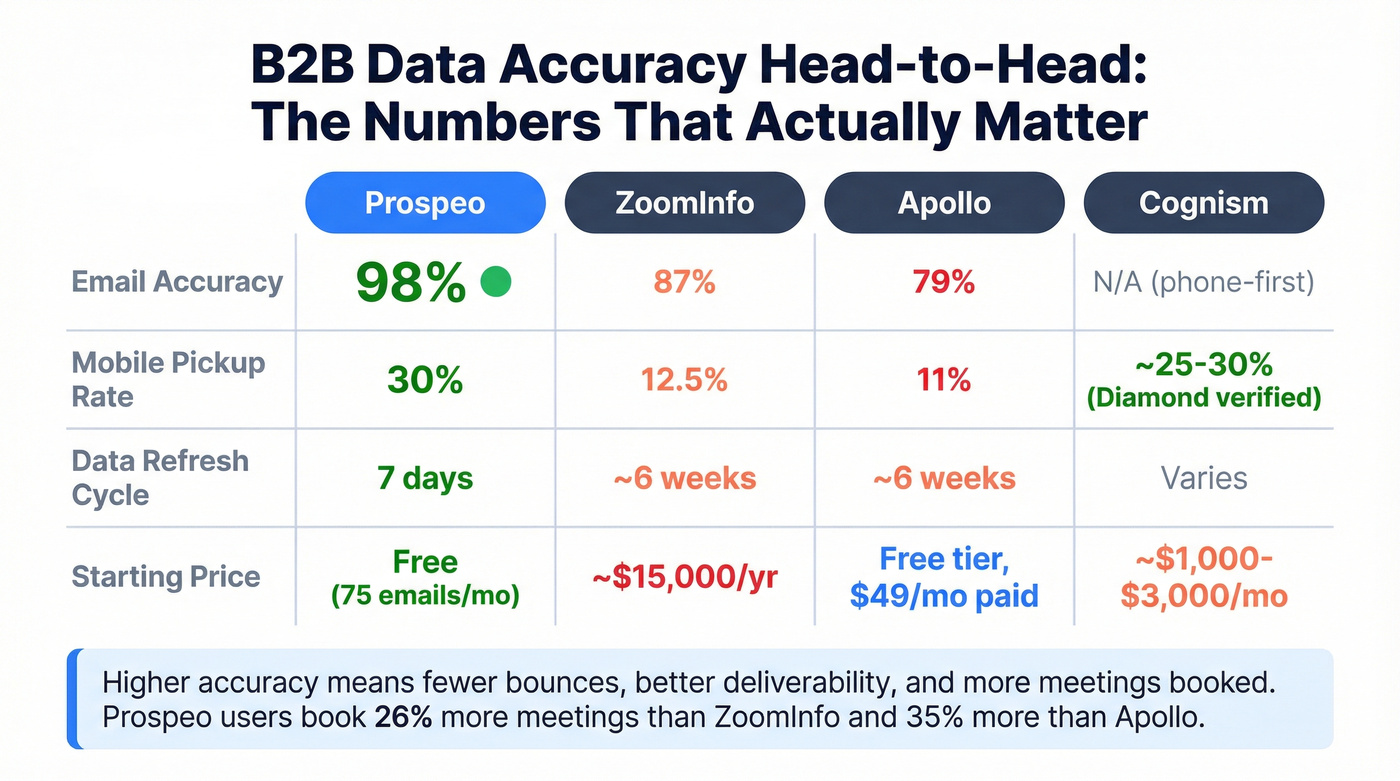
Prospeo's database covers 300M+ professional profiles, 143M+ verified emails, and 125M+ verified mobile numbers. The standout number is 98% email accuracy - compared to 87% at ZoomInfo and 79% at Apollo - achieved through a proprietary 5-step verification process (see AI email verification) that includes catch-all handling, spam-trap removal, and honeypot filtering. Mobile numbers hit a 30% pickup rate across all regions, versus 12.5% at ZoomInfo and 11% at Apollo.
Those aren't marginal differences. Teams using Prospeo book 26% more meetings than ZoomInfo users and 35% more than Apollo users, because reps spend less time chasing dead numbers and bounced emails. Snyk's 50-person AE team dropped their bounce rate from 35-40% to under 5% after switching, generating 200+ new opportunities per month.

The 30+ search filters go beyond basic firmographics - you can layer buyer intent signals across 15,000 Bombora topics, technographics, job changes, headcount growth, funding rounds, and department-level headcount (see intent signals). The Chrome extension has 40,000+ users and works across company websites and professional profiles. CRM enrichment returns 50+ data points per contact at a 92% API match rate, with native integrations into Salesforce, HubSpot, Smartlead, Instantly, Lemlist, Clay, Zapier, and Make.
Data refreshes every 7 days. The industry average is 6 weeks. That gap matters when you're prospecting into fast-moving markets where people change roles constantly (see B2B contact data decay).
Pricing starts free with 75 emails and 100 Chrome credits per month. Paid plans run roughly $0.01 per email with no contracts and no annual commitment.
ZoomInfo
Use this if you're an enterprise org with 50+ reps that needs the deepest US database, intent data, and workflow automation under one roof. Skip this if you're a Series A company with 5 reps and a $20K annual tools budget.
ZoomInfo's database runs 500M+ contacts and 100M+ company profiles, processing 1B monthly buying signals. It's the incumbent for a reason - nobody else matches the breadth of US contact data, org charts, and technographic coverage at that scale. SOC 2 Type II certified, GDPR and CCPA compliant, with 35,000+ customers.
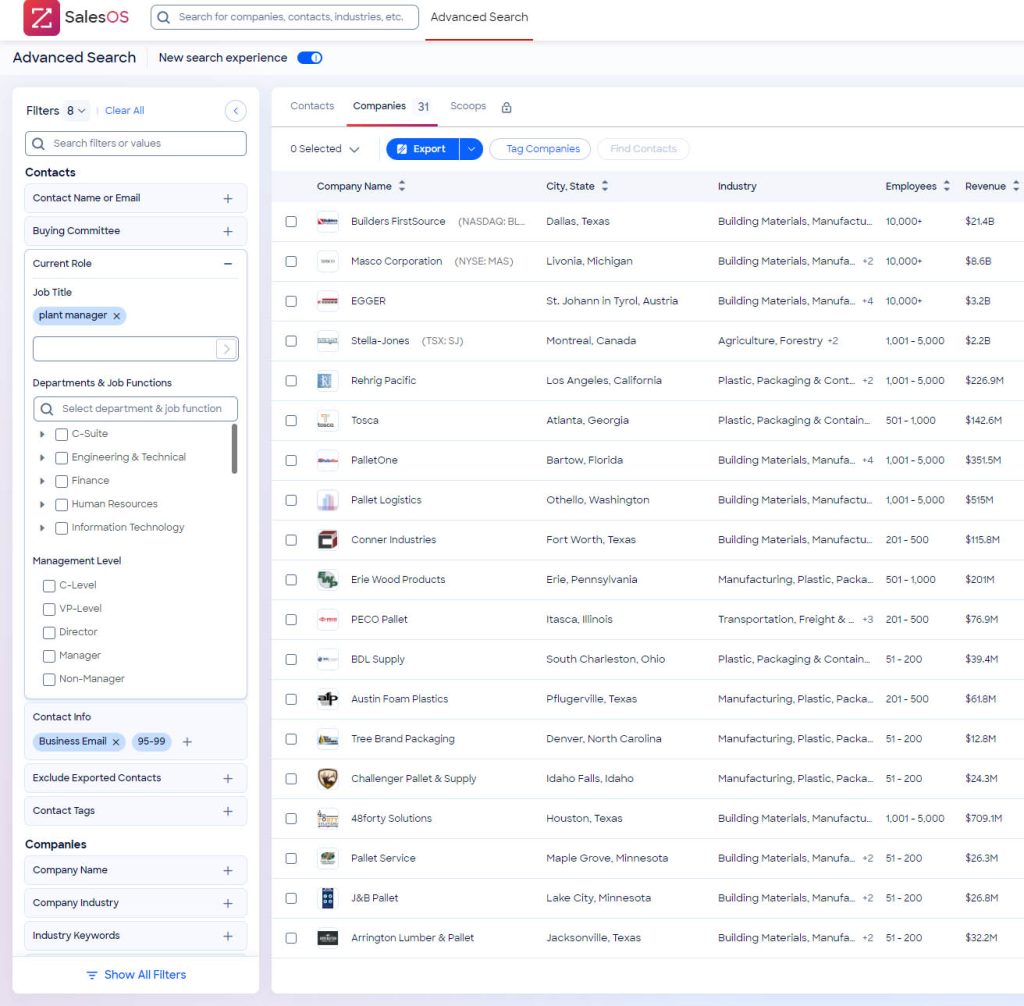
The pricing reality is what separates ZoomInfo from everything else on this list. Professional starts at $15,000-$18,000/year for 1-3 seats. Advanced runs $22,000-$28,000. Elite hits $35,000-$45,000+. Renewals often come with 10-20% increases, and many contracts require 60 days' cancellation notice to avoid auto-renewal. A common frustration on r/sales and r/salestools is paying for modules you don't use - bundling can push teams into features they never touch.
Where ZoomInfo wins: US database depth, workflow breadth, and intent signal volume. Where it loses: cost-per-lead economics and flexibility for smaller teams.
Apollo
Apollo is the obvious starting point for most SMB outbound teams. It combines a 210M+ contact database with built-in email sequencing, a US dialer starting at the Professional tier, and basic CRM functionality - all starting at a free tier.
Use this if you want one platform for prospecting, sequencing, and calling without stitching together three tools. Skip this if you need high-accuracy data outside North America or your team burns through mobile credits fast.
Plans run Free, Basic at $49/user/month, Professional at $79, and Organization at $119 with a minimum of 3 users on annual billing. But watch the credit mechanics. Mobile credits cost 8x email credits. Basic gives you just 75 mobile credits per month. Overages hit $0.20/credit with a 250-credit minimum purchase. We've seen teams budget $49/user and end up at $200-$300/user once they're actually running outbound at volume.
Common switching triggers: support responsiveness, data accuracy in EMEA markets, and credit costs that scale faster than headcount.
Cognism
Best for: Teams selling into the UK, DACH, or Nordics. Watch out for: Limited US depth compared to ZoomInfo or Apollo.
Cognism is the tool you pick when your ICP lives in Europe. Its GDPR-first positioning isn't marketing fluff - it's the core architecture. "Diamond Data" contacts are phone-verified by humans, which means the mobile numbers you pull for EMEA prospects actually connect (see GDPR for sales and marketing).
Where Cognism wins over ZoomInfo: European coverage, mobile verification quality, and compliance confidence. Where ZoomInfo still wins: US database depth and breadth of workflow features. Pricing typically lands between $1,000-$3,000/month for small teams on annual contracts.
Lusha
Best for: Individual sellers or 2-3 person teams needing occasional direct dials without a full database subscription.
Lusha is the lightweight option for reps who need a quick contact lookup without committing to a platform. The free tier gives you a handful of credits to test, and paid plans start around $49/user/month. Think of it as the vending machine of B2B data - convenient for a quick grab, expensive if you're feeding a team of 10.
Seamless.AI
Seamless.AI offers real-time contact search, pulling and verifying data on the fly rather than serving from a static database. The pitch sounds compelling. The execution is polarizing.
Contracts are annual, typically $125-$200/user/month for teams. The free tier gives you 50 non-replenishing credits - barely enough to evaluate the product. The most common complaint across Reddit threads is that cancellation is difficult and the sales process is aggressive. Commit only if you're confident in a full-year contract and want real-time search as a core workflow.
Website Visitor Identification
Dealfront (Leadfeeder)
Dealfront identifies anonymous companies visiting your website via reverse IP lookup and matches them to firmographic data. It won't give you individual contacts - it tells you which companies are browsing your pricing page at 2 AM. Pair it with a B2B data provider to turn those company signals into actual outreach targets with verified emails and direct dials (see B2B lead capture).
Free 14-day trial available. Paid starts at $99/month on an annual contract. Best for inbound-heavy teams that want to see buying intent from website traffic they're already generating.
CRM & Pipeline
HubSpot
HubSpot's free CRM is genuinely free - not a 14-day trial, not a feature-stripped demo. You get contact management, forms, landing pages, and a free form builder at $0. For inbound lead capture, it's the best starting point that exists.
The catch is what happens when you grow. HubSpot gets expensive fast once you move into higher-tier marketing automation, reporting, and additional hubs. Paid Sales Hub starts at $20/user/month on annual billing, which is reasonable. But it doesn't provide contact databases - you'll need a separate data provider for outbound.
Pipedrive
Pipedrive starts at $14/seat/mo on annual billing and does one thing well: visual pipeline management for small sales teams. It's a 14-day trial, not a free tier. Best for teams under 10 reps who want simplicity over feature depth.
Conversion, Capture & Outreach
OptinMonster
Pop-ups, slide-ins, and exit-intent forms starting around $7/month on annual billing. If you're a content marketer trying to convert blog traffic into email subscribers and leads, OptinMonster is a go-to. It integrates with major email platforms and CRMs, and the exit-intent technology alone can justify the price for high-traffic blogs. Not a prospecting tool - purely inbound capture.
Hunter
Hunter finds and verifies email addresses via domain search, starting free with paid plans from around $49/month. Best for freelancers and small teams doing manual, one-at-a-time outreach where you know the company but need the right contact. For anything at scale, you'll outgrow it quickly.
6sense
Enterprise-grade predictive intent and ABM orchestration. Free tier gives you 50 credits/month, Team plans start at $25/user/month, and enterprise contracts typically run $30,000-$100,000+/year. For enterprise ABM programs with real budget, it's a category leader alongside Demandbase. For teams under 100 reps, the ROI math rarely works - you're paying for predictive models that need massive data volume to be accurate (see account based marketing software).
How to Choose by Team Size
Most teams overcomplicate this. Here's the framework we use.
SMB with 5-20 reps ($50-$200/user/month): Apollo Basic if you want sequencing built in, paired with HubSpot or Pipedrive for CRM. Watch Apollo's credit overages - budget 2x the sticker price to be safe. One agency, Stack Optimize, built from $0 to $1M ARR using Prospeo, maintaining 94%+ deliverability, sub-3% bounce rates, and zero domain flags across all clients. That's the kind of data quality that compounds.
Mid-market with 20-100 reps ($200-$500/user/month): Apollo Professional or Cognism for European markets. Add Dealfront if inbound traffic is a meaningful lead source. This is the tier where ZoomInfo starts making sense, but only if you'll actually use the intent data and workflow features.
Enterprise with 100+ reps ($500+/user/month): ZoomInfo or 6sense for database depth and ABM orchestration. At this scale, layer a dedicated verification tool on top of whatever database you pick - bad emails will tank your sequences regardless of provider.
Look, most teams under 50 reps are overpaying for ZoomInfo. The database is deep, but if your reps only use the search bar and export contacts, you're paying for intent data, org charts, and workflow automation that nobody's touching. In our experience, data accuracy matters more than database size at this stage.
Benchmarks Worth Knowing
Your lead gen stack should optimize for the channels where your CPL is lowest.
Cost per lead by channel: SEO delivers leads at ~$31 each. Email marketing runs ~$53. Webinars come in at ~$72. Content marketing hits ~$92. PPC jumps to $181. Trade shows? $811 per lead. If email is your best-performing channel, investing in data quality - verified emails, accurate direct dials - gives you the highest-impact CPL improvement.
LinkedIn converts website visitors to leads at 2.74%, roughly 3.5x Facebook's 0.77%. LinkedIn Lead Gen Forms convert at ~13%, compared to a ~2.35% landing page benchmark.
For cold email specifically, expect 15-25% open rates and 1-5% reply rates - which means your list quality is the single biggest lever. A 98% accurate list at 3% reply beats a 70% accurate list at 5% reply, because the bounces from the second list destroy your sender reputation before you hit volume.
Lead generation software only works when the data is real. Prospeo's 5-step verification, 7-day refresh cycle, and 30+ search filters - including buyer intent across 15,000 topics - give outbound teams the accuracy that drove Snyk to 200+ new opportunities per month.
Generate leads that actually convert. Build your first list in minutes.
FAQ
What is lead generation software?
Software that finds, captures, qualifies, and engages potential customers. The category spans B2B contact databases, inbound capture tools, CRMs, and outreach platforms. Most teams need two or three solutions working together rather than one monolithic platform.
How much does lead gen software typically cost?
Free tiers exist at HubSpot, Apollo, and Prospeo. Paid tools range from ~$7/month (OptinMonster) to $45,000+/year (ZoomInfo Elite). Most SMB teams spend $50-$200/user/month across their stack. Budget 2-3x advertised rates to account for credit overages and add-ons.
What's the best free option for outbound prospecting?
Prospeo's free tier includes 75 verified emails and 100 Chrome extension credits monthly with 98% accuracy - enough to test real campaigns. Apollo's free plan adds sequencing but caps mobile credits heavily. For inbound, HubSpot's free CRM with forms and landing pages has no time limit.
Why does data accuracy matter more than database size?
A 30% bounce rate can tank your sender score and cost months of deliverability recovery. Verified contacts at 98% accuracy outperform a larger database at 79% accuracy because you avoid domain reputation damage, wasted rep time, and sequence disruptions. Starting clean is exponentially cheaper than cleaning up after a bad campaign.
Can a 5-person team compete with enterprise sales orgs?
Yes. Self-serve platforms give small teams access to the same contact data that used to require a $50K/year contract. The gap between enterprise and SMB tooling has collapsed - what separates winners is clean data, fast iteration, and disciplined follow-up, not budget size.