

The ABM Playbook: A Step-by-Step Operational Guide for 2026
Your CMO just came back from a conference buzzing about account-based marketing. She wants a playbook by Friday. The problem? Most ABM playbook guides read like vendor brochures - heavy on frameworks, light on the operational details that determine whether a program actually produces pipeline.
71% of B2B practitioners now run some form of ABM, but the top three challenges haven't budged in years: proving ROI (47%), aligning sales and marketing (43%), and scaling beyond a pilot (40%). This guide addresses all three with real numbers, real timelines, and the mistakes that quietly kill programs before they ever get a chance.
The Quick Version
Before you read the full guide, here's the distilled version:
- If your average deal is under $50K, skip ABM. Run demand gen instead. The per-account investment doesn't pencil out below that threshold.
- Start with 5-10 accounts, a spreadsheet, and a weekly standup with your best AE. That's your pilot. No platform required.
- Tier your accounts (1:1, 1:few, 1:many) and match personalization depth to each tier. Don't blast the same content to everyone.
- Fix your contact data before you fix your messaging. Bounced emails kill campaigns silently - and nobody talks about it until the post-mortem.
- Measure account progression and pipeline, not leads or MQLs. If your dashboard still shows MQLs, you're measuring the wrong thing.
Should You Even Do ABM?
ABM is a strategy, not software. Buying an ABM platform doesn't mean you're doing account-based marketing any more than buying a gym membership means you're fit.
Mason Cosby's viability heuristic is the simplest decision rule we've found: if your average contract value is under $50K, ABM isn't worth the investment. The math is straightforward - a proper 1:1 campaign for a single account costs $2,000-$5,000 in time and resources, and if your deal size can't absorb that, you're better off with scalable demand gen. Most teams that "fail at ABM" never had the deal economics to justify it in the first place. This is a high-margin strategy for high-ACV products. Trying to run it on $15K deals is like hiring a personal chef to make ramen.
If you clear the ACV bar, start with a pilot. Pick 5-10 accounts where you already have some relationship or signal - they've visited your pricing page, downloaded a whitepaper, or a champion just changed jobs. Run a manual, scrappy campaign for one quarter. If you can't make it work manually for 10 accounts, no platform will save you.
Building a Playbook Your Team Can Execute
Define Your ICP
Your ideal customer profile isn't a persona doc gathering dust in a shared drive. It's a living set of filters your team uses every week to decide which accounts deserve attention and which don't.
Start with four filter categories:
- Firmographics - industry, headcount, revenue, geography, funding stage
- Technographics - what tools they run (CRM, marketing automation, competitive products)
- Behavioral signals - website visits, content engagement, intent data spikes on relevant topics
- Deal history - look at your best closed-won accounts from the last 12 months and reverse-engineer the common traits
The best ICP definitions use dozens of filters to narrow from millions of companies to hundreds. Intent data from providers like Bombora, tracking 15,000+ topics, is the accelerant - if an account is actively researching your category, that's a signal worth acting on immediately. Score each account against these filters using a simple 1-5 scale per category, then stack-rank your list before tiering. Don't build a static list. Build a dynamic filter that surfaces new accounts as they enter your buying window.
Build and Tier Your Account List
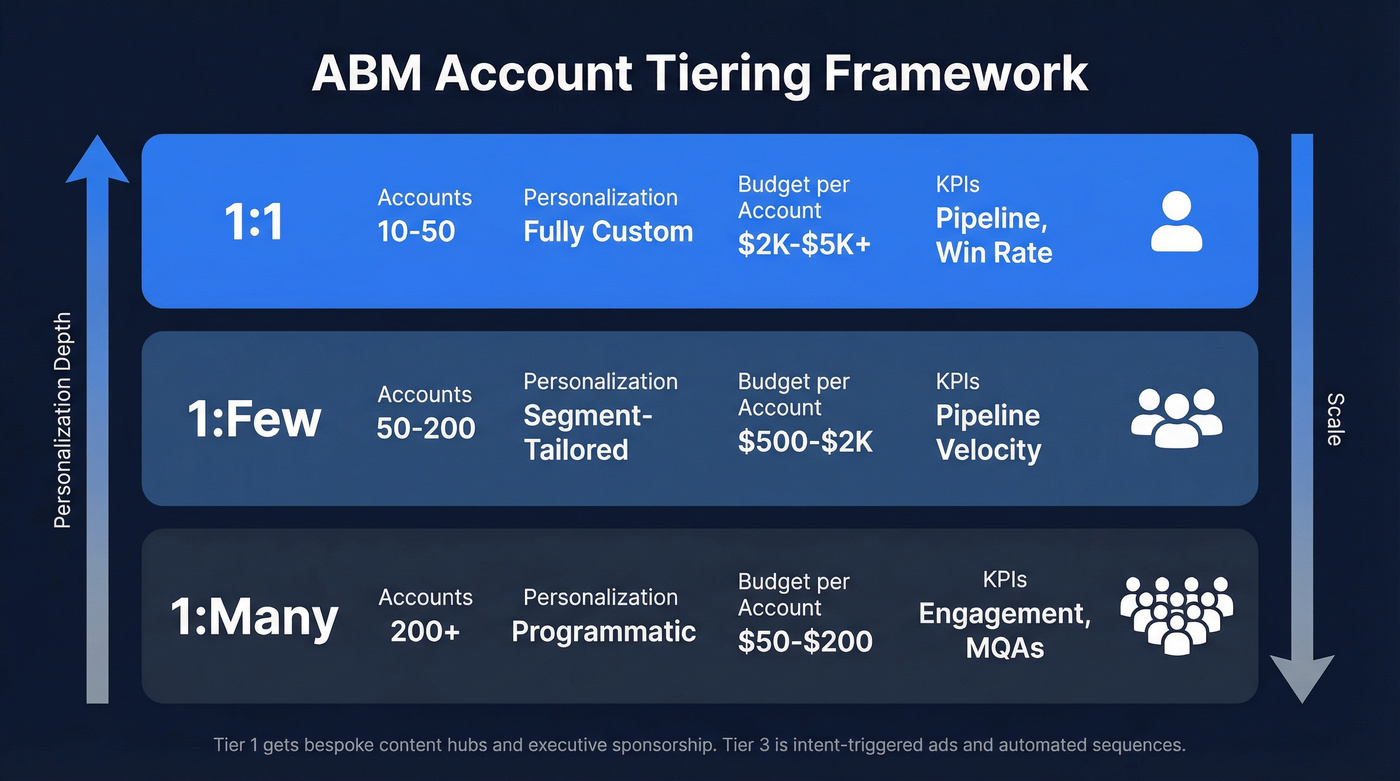
Not every account gets the same treatment. Tiering is how you decide who gets the white-glove treatment and who gets the automated sequence. Copy the framework below into a spreadsheet and fill in your accounts:
| Tier | Accounts | Personalization | Budget/Account | Primary KPIs |
|---|---|---|---|---|
| 1:1 | 10-50 | Fully custom | $2K-$5K+ | Pipeline, win rate |
| 1:Few | 50-200 | Segment-tailored | $500-$2K | Pipeline velocity |
| 1:Many | 200+ | Programmatic | $50-$200 | Engagement, MQAs |
Tier 1 accounts get bespoke content hubs, executive sponsorship, and custom event invitations. Tier 2 gets campaigns tailored by industry vertical or shared challenge. Tier 3 is programmatic - intent-triggered ads, automated sequences, and scalable thought leadership.
The personalization stats back this up: 76% of buyers expect personalized interactions, and 72% only engage with tailored messages. But only 43% of marketers feel confident delivering personalization at scale. That gap is exactly why tiering matters - you can't personalize everything for everyone, so you prioritize ruthlessly.
Map the Buying Committee
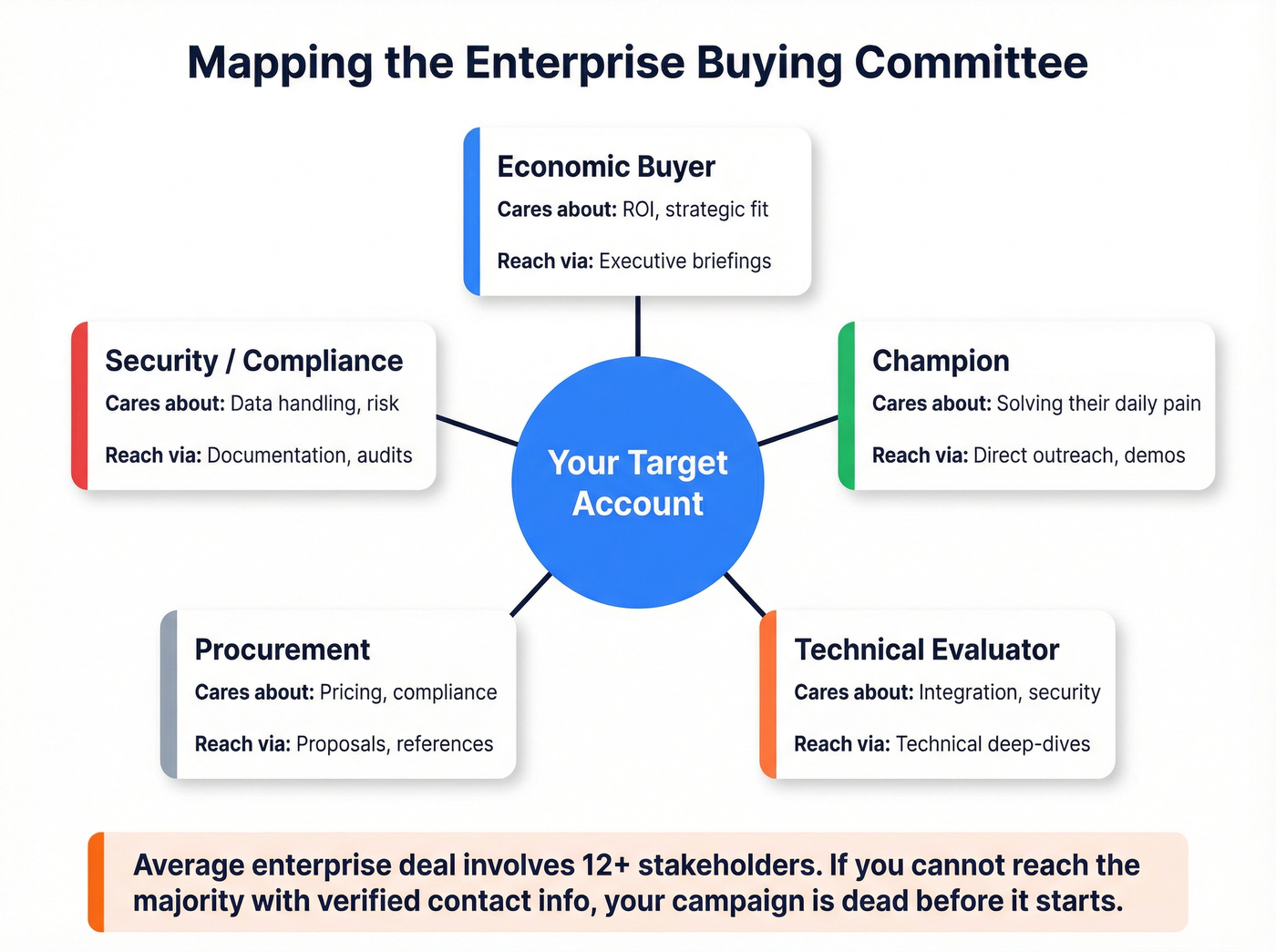
Enterprise buying committees run 12+ people deep. You're not selling to a single VP - you're navigating a web of economic buyers, champions, technical evaluators, procurement gatekeepers, and security reviewers.
| Role | What They Care About | How to Reach Them |
|---|---|---|
| Economic Buyer | ROI, strategic fit | Executive briefings |
| Champion | Solving their problem | Direct outreach, demos |
| Technical Evaluator | Integration, security | Technical content |
| Procurement | Pricing, compliance | Proposals, references |
| Security/Compliance | Data handling, risk | Documentation |
Here's the thing: we see this pattern constantly. A team launches a 1:1 campaign targeting 25 accounts. Three weeks in, they're staring at a 40% email bounce rate and zero C-suite replies. The messaging wasn't the problem. The data was. They had outdated emails for half the buying committee and no direct dials for the other half.
Bad contact data is the silent killer of account-based programs. Use an enrichment tool with verified emails and direct dials - refreshed weekly, not every 4-6 weeks - to build coverage you can actually act on. If you can't reach the majority of the buying committee with verified contact info, your campaign is dead before it starts.

Align Sales and Marketing
The Revenue Team model treats sales and marketing as a single operating unit with shared metrics, shared accounts, and shared accountability. Organizations with strong alignment see 36% higher customer retention and 38% higher win rates. Those aren't small numbers.
Alignment isn't a workshop. It's a cadence:
- Weekly standup - 30 minutes, non-negotiable. Review account progression, surface blockers, adjust plays based on live signals. ZoomInfo's account-based marketing playbook calls this the "reset point," and they're right.
- Monthly account strategy sessions - deep dives on Tier 1 accounts, competitive intelligence updates, process improvements.
- Quarterly business reviews - program performance, resourcing decisions, tech stack evaluation.
Phase the work: foundation first (shared ICP, shared metrics, shared CRM hygiene), then process integration (joint account plans, coordinated outreach), then technology. Most teams try to start with technology. That's backwards.
Execute Multi-Channel Campaigns
Email drives results for 92% of ABM programs. In-person events come in at 72%. But 95% of buyers engage across 3+ channels, so single-channel outreach is just cold email with a fancier name.
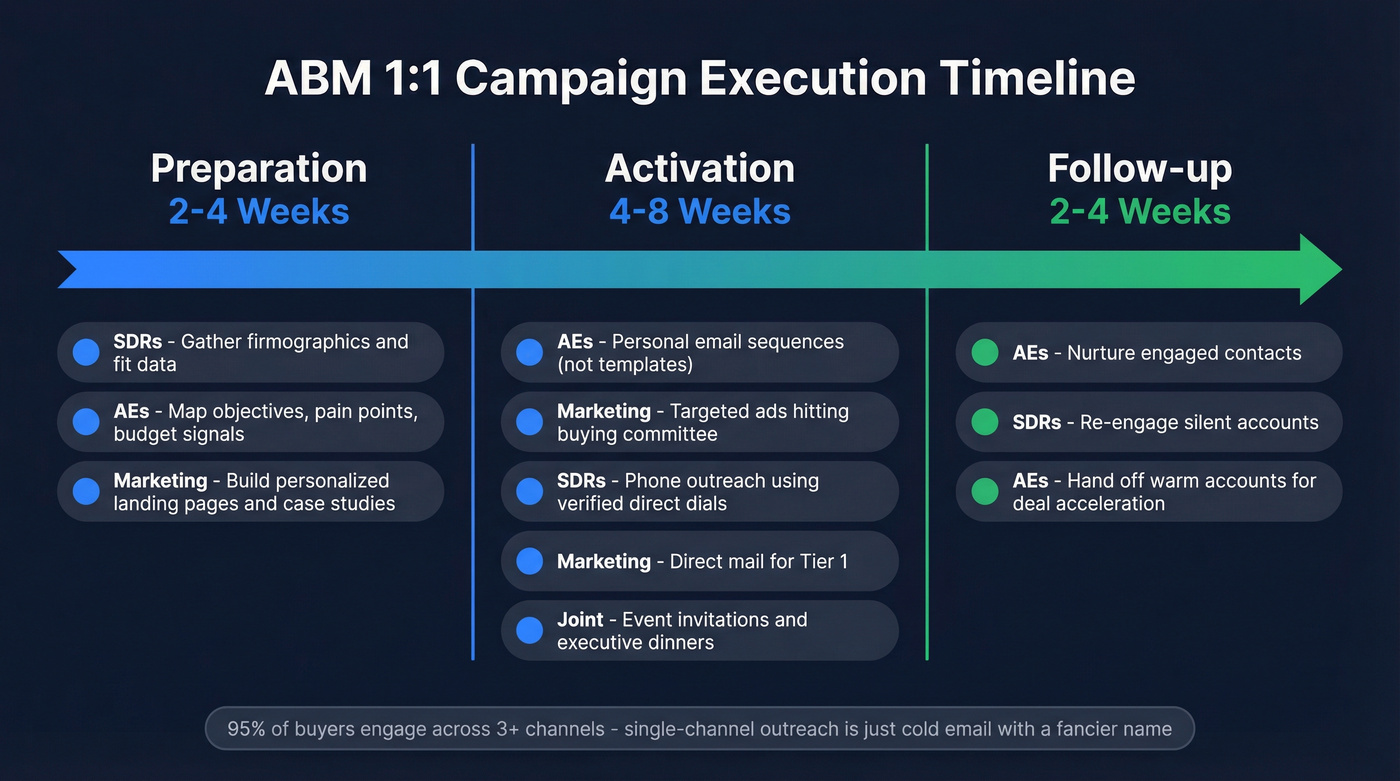
For a 1:1 campaign, the timeline and role split look like this:
Preparation (2-4 weeks): SDRs gather firmographics and initial fit data. AEs map objectives, pain points, decision process, and budget signals. Marketing builds the content - personalized landing pages, custom one-pagers, tailored case studies.
Activation (4-8 weeks): Coordinated multi-channel execution. Email sequences from AEs - personal, not templated. Targeted ads hitting the buying committee. Direct mail for Tier 1 accounts. Event invitations. SDR phone outreach using verified direct dials.
Follow-up (2-4 weeks): Nurture engaged contacts, re-engage silent ones, hand off warm accounts to AEs for deal acceleration.
Measure Account Progression
Stop measuring leads. Account-based marketing doesn't produce leads - it progresses accounts through buying stages.
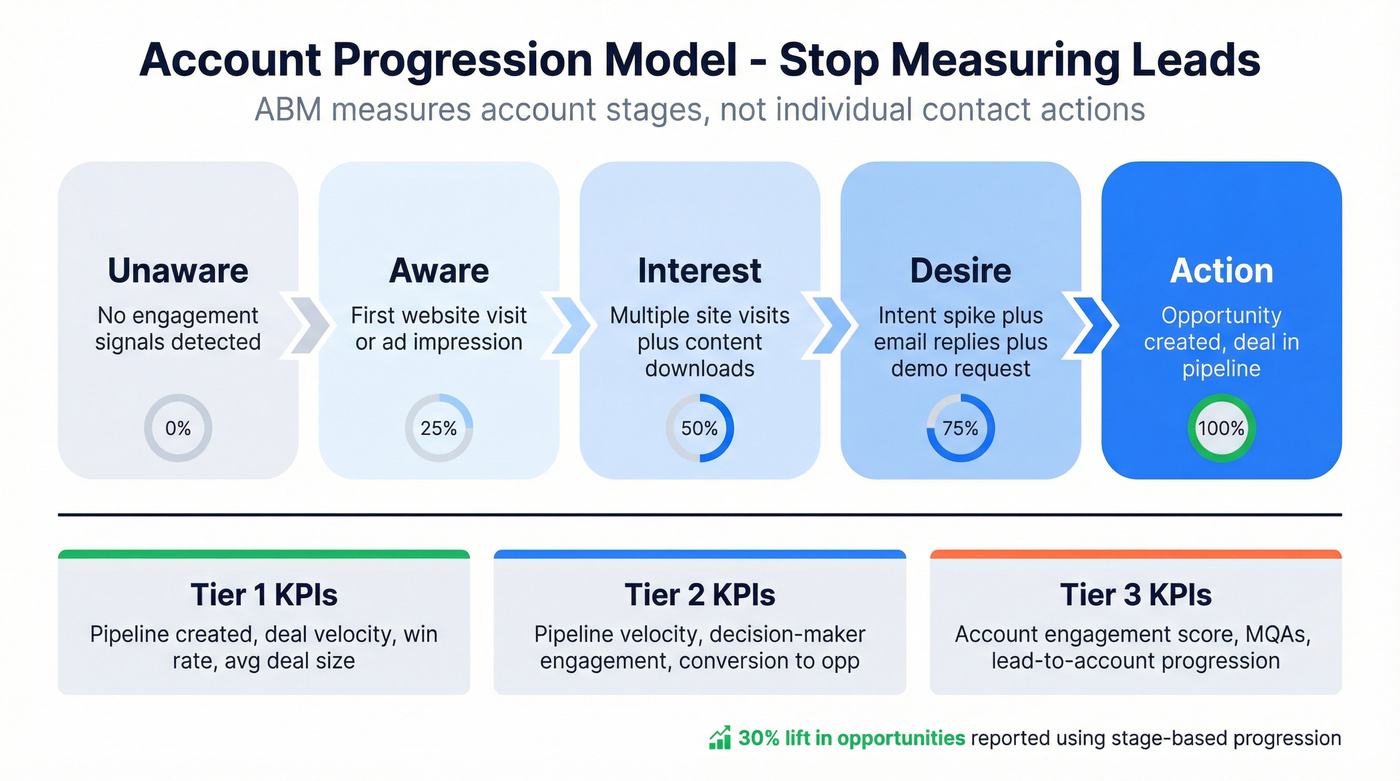
A stage-based progression model defines five stages: Unaware, Aware, Interest, Desire, Action. Stage advancement is based on patterns of signals - not a single webinar registration, but a cluster of website visits plus ad engagement plus email replies plus intent spikes. Calculate the stage centrally in your data warehouse and sync only the stage to your CRM. This keeps orchestration consistent and avoids burying reps in noise.
The KPIs that matter, by tier:
- Tier 1 (1:1): Pipeline created, deal velocity, win rate, average deal size
- Tier 2 (1:few): Pipeline velocity, engagement depth from decision-makers, conversion to opportunity
- Tier 3 (1:many): Account engagement score, marketing-qualified accounts, lead-to-account progression
One team using this stage-based approach reported a 30% lift in opportunities generated and a 20% increase in closed-won accounts. The ITSMA 3R framework offers another useful measurement lens for board-level reporting, tracking Reputation (are target accounts aware of you?), Relationships (are you engaging the right people?), and Revenue (is pipeline growing?). Whether you use stage-based progression or the 3R model, the principle is the same: measure what the account is doing, not what individual contacts are doing.

Bad contact data is the silent killer of ABM programs - you just read why. Prospeo gives you 98% verified emails, 125M+ direct dials, and a 7-day refresh cycle so your buying committee coverage never goes stale. Map entire accounts with 30+ filters including intent data, technographics, and department headcount.
Stop losing Tier 1 deals to bounced emails and outdated org charts.
Mistakes That Kill ABM Programs
Poor account selection. 60% of teams struggle here. The fix: reverse-engineer your best 20 closed-won deals and build your ICP from actual data, not wishful thinking.
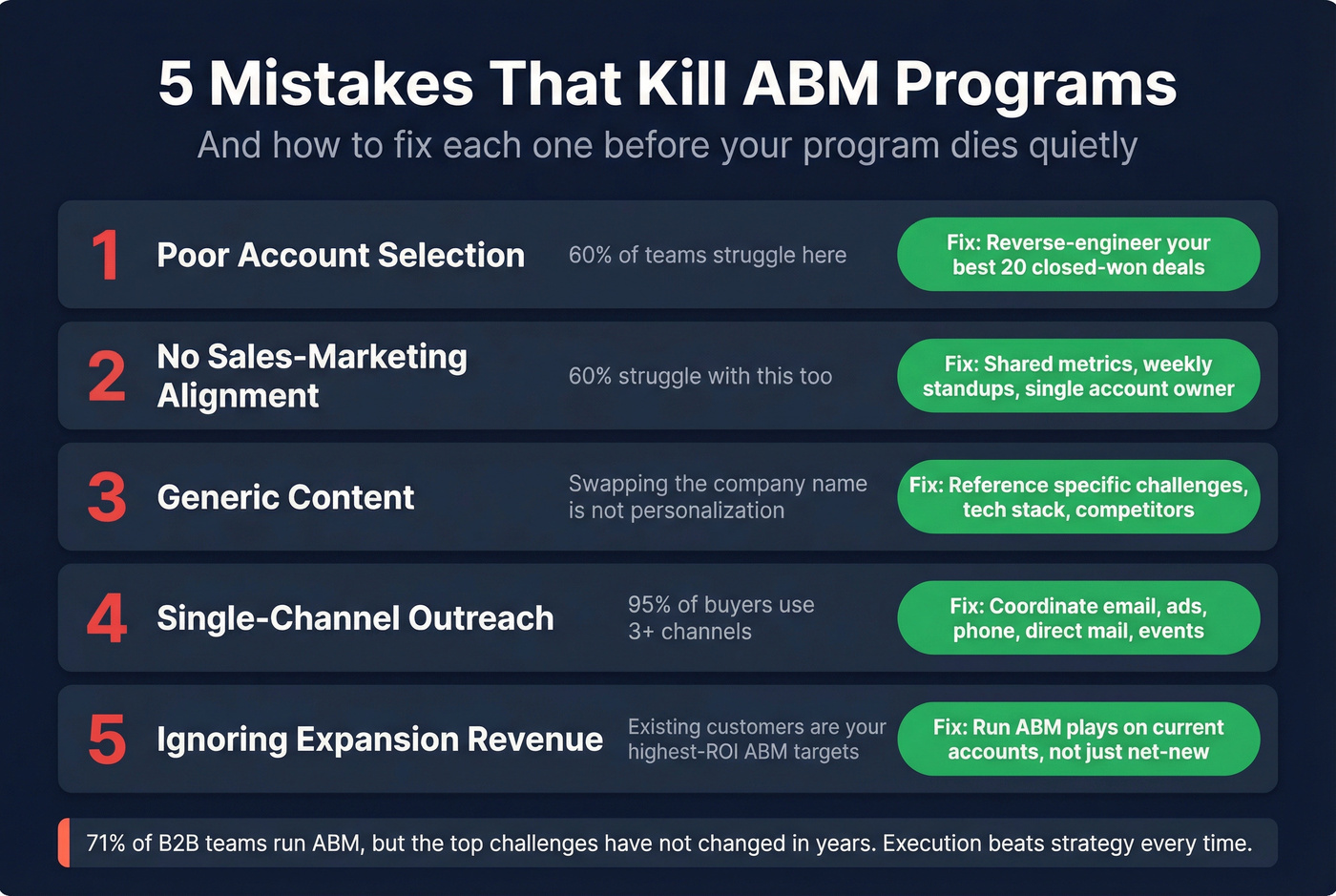
Lack of sales-marketing alignment. Another 60% struggle with this. Shared metrics, weekly standups, and a single account owner per Tier 1 account solve most of it.
Generic content. If your "personalized" email just swaps the company name, it's not personalized. Create content that references the account's specific challenges, tech stack, or competitive situation.
Single-channel outreach. Email alone isn't account-based marketing. Coordinate across email, ads, phone, direct mail, and events - even if the "event" is a 1:1 executive dinner.
Ignoring expansion. Existing customers are 60-70% more likely to buy again versus 5-20% for new logos. Dedicate at least 20% of your resources to expansion plays.
Measuring the wrong metrics. MQLs don't tell you anything about account progression. Track pipeline created, deal velocity, and engagement from the buying committee - not form fills.
Bad contact data. You can have the perfect ICP, the perfect content, and the perfect alignment - and still fail because half your emails bounce. Verify your contact data before every campaign launch. A 35% bounce rate doesn't just waste sequences; it torches your sender reputation.
AI in ABM - Hype vs. Reality
Let's be honest about where AI stands in account-based marketing right now. 45% of practitioners see AI's promise for personalization, but nearly 70% find its current effectiveness limited.
The realistic use cases in 2026: creative velocity (generating first drafts of personalized emails and landing pages), account research (summarizing 10-K filings, earnings calls, and news into account briefs), and personalized copy at scale (turning a Tier 2 template into something that reads like Tier 1). Don't use AI to replace strategy. AI can't tell you which accounts to target, how to structure your tiers, or when to escalate an account from 1:few to 1:1. Those are human judgment calls that require context no model has yet.
ABM Tool Stack With Pricing
If you're a 10-person startup, you don't need a $50K platform. You need a CRM, an enrichment tool, intent data, and a sequencer. That's the minimum viable stack, and it'll run you $500-$1,500/month total. We've tested dozens of combinations, and the stack below works without enterprise budgets.
| Category | Tool | Starting Price | Notes |
|---|---|---|---|
| CRM | HubSpot CRM | Free; paid from ~$20/mo | Free tier is solid |
| CRM | Salesforce | From ~$25/user/mo | Enterprise standard |
| ABM Platform | Demandbase | ~$20K-$100K+/yr | Enterprise; modules + ads |
| ABM Platform | 6sense | ~$30K-$100K+/yr | Intent + orchestration |
| ABM Platform | HubSpot ABM | From $800/mo | Mid-market |
| ABM Platform | RollWorks | ~$10K-$25K/yr | Smaller teams |
| Intent Data | Bombora | ~$25K-$50K+/yr | Often bundled |
| Enrichment | Prospeo | Free; ~$0.01/email | 98% accuracy, 7-day refresh |
| Enrichment | ZoomInfo | ~$15K-$40K+/yr | Enterprise pricing |
| Enrichment | Apollo.io | Free; from $49/mo | Good for SMBs |
| Enrichment | Clay | Free; from ~$149/mo | Workflow enrichment |
| Social Selling | LinkedIn Sales Nav | From $99/mo | Account research |
| Sequencing | Outreach / Salesloft | ~$100-$150/user/mo | Enterprise |
| Sequencing | Smartlead / Instantly | From ~$39-$99/mo | Cold outreach at scale |
The enrichment layer is where most programs either succeed or fail. You can run a $100K Demandbase instance, but if your contact data bounces at 30%, none of those orchestration features matter. Prioritize verified, frequently refreshed data over flashy platform features every time. The consensus on r/sales is the same - data quality beats platform sophistication, and it's not close.
Real ABM Results
$1.3M pipeline from 50 accounts. A cloud services provider ran a 1:1 campaign targeting 50 accounts with personalized content hubs. Results: [70% engagement rate, 190% increase in successful contacts](https://www.inverta.com/resources/the-power-of-precision - building-effective-abm-campaigns-a-case-study), and 35 out of 50 target accounts engaged. The 12% bounce rate on their content hubs was a fraction of industry norms - proof that personalization drives consumption.
30% more opportunities, 20% more closed-won. A stage-based progression model produced a 30% lift in opportunities generated and a 20% increase in closed-won accounts. The key insight: syncing only the account stage to downstream tools kept CRM noise to a minimum while giving reps exactly the signal they needed.
Snyk: 200+ new opportunities per month. Snyk had 50 AEs each spending 4-6 hours per week on prospecting - with a 35-40% email bounce rate. After fixing their data layer with Prospeo, bounce rates dropped to under 5%, AE-sourced pipeline jumped 180%, and the team started generating 200+ new opportunities monthly. That's what happens when you fix the foundation before scaling the strategy.
Running ABM at $0.01 per verified email changes the math on every tier. Prospeo's 300M+ profiles, Bombora intent data across 15,000 topics, and CRM enrichment returning 50+ data points per contact let you scale from pilot to program without blowing your per-account budget.
Enterprise-grade ABM data without the enterprise contract. Start free today.
FAQ
What is an ABM playbook?
An ABM playbook is an operational document defining your target accounts, tiering model, buying committee coverage, channel strategy, team cadences, and measurement framework. It turns "we're doing ABM" into a repeatable process with clear ownership, weekly rhythms, and pipeline-focused KPIs - not a slide deck that lives in a shared drive.
How many accounts should a program target?
Start with 5-10 accounts for a pilot. Mature programs typically run 10-50 for 1:1, 50-200 for 1:few, and 200+ for 1:many. The common mistake is going too wide too fast - deeply engaging 10 accounts beats superficially touching 500.
What's the minimum deal size for ABM?
$50K+ average contract value. Below that threshold, the per-account investment in research, personalized content, and multi-channel orchestration doesn't justify the return. Run scalable demand gen instead and revisit when deal sizes grow.
How do you fix high bounce rates in ABM campaigns?
Use an enrichment tool with a weekly data refresh cycle - not the 4-6 week industry average. Verify every contact list before launch, and re-verify before each new sequence. Snyk cut their bounce rate from 35-40% to under 5% by switching to a weekly refresh, and their AE-sourced pipeline jumped 180% as a result.
How long does it take to see results?
Expect 2-4 weeks of preparation, 4-8 weeks of activation, and 2-4 weeks of follow-up. Pipeline impact typically shows within one quarter. Closed-won impact takes two. Anyone promising faster results is either running very warm accounts or stretching the truth.